What is Kabuki Oshiroi Whiteface?
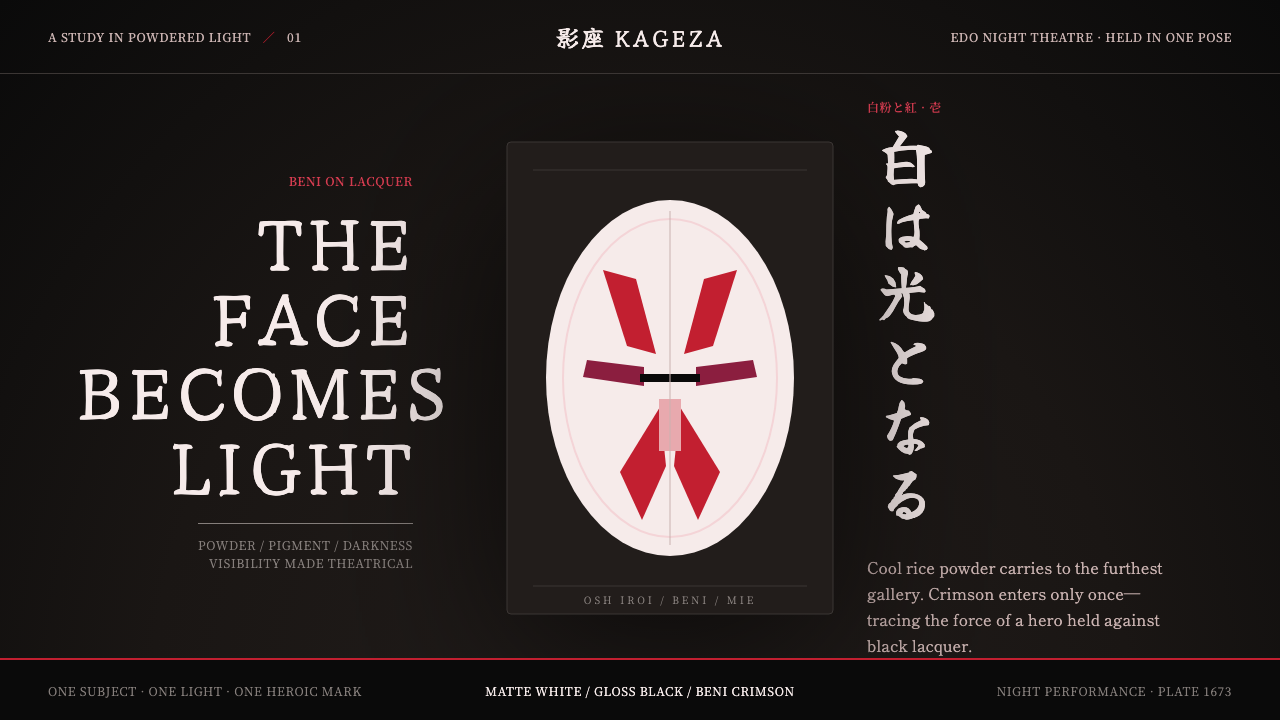
Powder becomes stage light: cool white cuts through lacquered black, while one heroic crimson stroke gives rage a visible shape.
Kabuki Oshiroi Whiteface in brief
Kabuki Oshiroi Whiteface is a theatrical visual language built from a cool blue-white face, a black-lacquered stage world, and sharply controlled crimson linework. Its whiteness is not a soft cosmetic neutral. Oshiroi is a thick rice-powder base that covers the actor's whole face and turns the face into a lit surface, designed to remain legible across the deepest galleries under pre-electric footlights.
The style depends on opposition. Matte powdered white stands against glossy black; the face appears almost lantern-like while the stage recedes into darkness. Over that field, safflower-beni crimson is drawn into kumadori strokes that suggest muscle, veins, strain, and fury. The result is not a palette of equal partners. White establishes visibility, black establishes depth, and red arrives only where the action needs to land.
Its emotional force comes from restraint as much as contrast. The face is fully transformed, yet the crimson is not spread across every available surface. The line is sweeping, directional, and purposeful. This makes Kabuki Oshiroi Whiteface feel ceremonial and heroic rather than decorative: a system in which surface, contrast, and gesture turn performance into an image readable from far away.

Where does Kabuki Oshiroi Whiteface come from?
Oshiroi belongs to the material language of kabuki theatre in Japan, particularly the Edo, Kyoto, and Osaka theatre worlds named in the source tradition. Its defining problem was practical and theatrical at once: how to make a human face carry across a large interior before electric lighting. The thick rice-powder base answered that problem by replacing ordinary facial variation with a single, cool, highly legible field.
The historical setting is the Edo-period stage, before 1900 and associated with the aragoto mode from about 1673 onward. In that environment, the black-lacquered stage created a deep visual ground against which the powdered face could operate almost like a lantern. The contrast was not an incidental aftereffect. It made the actor's presence readable as an enlarged sign, separating the face from the darkness and giving the performer a presence suited to heroic theatrical action.
The source identifies Ichikawa Danjūrō I and the Ichikawa Danjūrō lineage as key figures in this history. Their importance here is not a claim that one individual invented every element, but that the lineage provides a named anchor for the aragoto visual imagination: forceful acting, enlarged emotion, and facial linework that turns internal rage into an external emblem.
Kumadori line-painting completes the system. Crimson strokes are dragged across the white base in patterns that evoke muscle and veins, especially on the aragoto hero. The movement is therefore not simply cosmetic decoration. It is a translation device between body and image, making strength, anger, and heroic intensity visible through sweeping marks. Oshiroi supplies the luminous field; kumadori supplies the action within it.
What defines the Kabuki Oshiroi Whiteface look?
Oshiroi Whiteface
The face is covered as a continuous cool blue-white field rather than treated as a natural complexion. Its thickness matters because the material must read under footlights and from distant seating. The whiteface is therefore both cosmetic surface and stage technology: it suppresses ordinary facial nuance so that the actor can appear as a clearly defined heroic presence.
Cool Luminous White
The white is not warm, creamy, or softly domestic. It carries a blue cast that makes the face feel optically lit against the surrounding darkness. This coolness separates Oshiroi from generic pale backgrounds. It behaves less like paper and more like a concentrated stage beam held in the shape of a human face.
Lacquered Black Ground
Black functions as the depth behind the face. The reference to lacquer is important: this is not a flat, dull void but a dark surface with a polished, stage-like presence. Against it, the matte white becomes more forceful. The relationship is material as well as chromatic, pairing powder with lacquer and absorption with sheen.
Kumadori Strokes
Crimson is applied as sweeping linework rather than as a broad fill. The strokes move like drawn anatomy, suggesting muscle and veins while also directing the eye across the face. Their force comes from decisive placement and visible gesture. A line can imply tension, anger, or heroic exertion without rendering those emotions naturalistically.
Distance Legibility
Every major decision serves visibility across the theatre. The white face establishes a single readable mass, black removes competing atmosphere, and crimson marks the expressive structure. The style is therefore not merely high contrast for its own sake. Its contrast is communicative, designed to preserve the actor's identity and emotional charge when fine facial detail would disappear.
Aragoto Force
The visual system is especially tied to the aragoto hero, whose rage is made legible through exaggerated line and contrast. The face does not aim for psychological subtlety or everyday realism. It enlarges the body into a sign of force. That enlargement gives the style its heroic register: the actor appears not simply as a person in makeup but as a concentrated image of action.
Crimson Restraint
Red is powerful precisely because it is spent selectively. It should feel like a stroke that lands, not a field that decorates. When every surface becomes crimson, the relationship between white visibility, black depth, and red action collapses. The discipline of the style lies in reserving the warmest and most aggressive note for the places where the image needs a blow.

Who shaped Kabuki Oshiroi Whiteface?
Ichikawa Danjūrō I is named in the source as a key figure in the history of this visual language. He functions as a historical anchor for the aragoto imagination: forceful action, enlarged emotion, and a face transformed into a visible emblem. The connection matters because Oshiroi Whiteface is not an abstract color exercise; it belongs to a lineage of theatrical performance in which makeup carries character and intensity across the stage.
The Ichikawa Danjūrō lineage represents continuity rather than a single isolated image. Its place in the source material links kumadori, aragoto, and the heroic face to an inherited theatrical vocabulary. For design interpretation, the lineage suggests that repetition can be meaningful: a visual system gains authority when its contrasts and gestures are carried forward with discipline instead of reinvented as surface fashion.
The aragoto hero is the central character type expressed by the crimson strokes. He is not described through subtle naturalism but through visible force: the white face provides the iconic field, while the linework makes rage and muscular energy readable. As a figure, he explains why the style feels heroic rather than merely theatrical. Every mark is asked to enlarge presence.
How do you use Kabuki Oshiroi Whiteface today?
For presentation slides, use the style as a staged sequence. A cover can place a luminous cool-white field against a lacquered black ground, with the title treated as a decisive gesture rather than a decorative label. Content slides should preserve the same hierarchy: white carries the main information, black creates the surrounding depth, and crimson marks the key transition or argument. Data slides can turn charts into kumadori-like directional structures, using red only for the value or movement that deserves attention.
For web interfaces, Kabuki Oshiroi Whiteface suits dashboards and pricing pages that need immediate hierarchy and a strong dark-stage atmosphere. A near-black interface can act as the lacquered ground, while pale surfaces become the readable panels and states. Use the cool white consistently for primary information and reserve crimson for active choices, urgent changes, or the single tier that must command attention. The interface should feel staged and legible, not covered in equal accents.
For editorial and marketing work, the style supports a dramatic alternation between concealment and revelation. Long-form pages can begin in darkness, introduce a broad white reading field, and use crimson rules or directional marks to punctuate major sections. Marketing compositions benefit from the face-like quality of a single luminous surface: one dominant image or statement should emerge from black, while the red accent behaves like a drawn sign of action rather than a general brand color.
For campaign covers, posters, and title cards, think in terms of distance and gesture. A large pale plane should remain calm enough to read immediately, while a black surrounding field gives it theatrical depth. The crimson element should have a visible direction, as though it were dragged across the surface by a performer. Cropping, scale, and placement should make the composition feel like a staged entrance: presence first, explanation second.
The common mistake is to treat the style as a license for black backgrounds, white text, and red decoration everywhere. That produces a generic dark interface rather than Kabuki Oshiroi Whiteface. The essential relationship is more specific: cool powdered light against lacquered darkness, with crimson concentrated in expressive strokes. If red becomes a full surface, if white loses its luminous role, or if every element receives equal theatrical emphasis, the hierarchy and the heroic restraint disappear.

Kabuki Oshiroi Whiteface — FAQ
What is oshiroi in this visual style?
Oshiroi is the thick rice-powder base that sheets the actor's whole face in cool blue-white. In this style, it should be understood as both makeup and stage illumination. It creates a continuous, legible field that can carry across distant seating under pre-electric footlights. Its purpose is not to imitate ordinary skin but to transform the face into a luminous theatrical surface.
What does kumadori contribute beyond decoration?
Kumadori turns emotion and bodily force into directional marks. The crimson strokes suggest muscle and veins, especially for the aragoto hero, so anger becomes something the audience can read rather than merely infer. Because the lines sweep across the white field, they also guide the eye and give the face a sense of movement. They are expressive structure, not ornament added after the fact.
Can the style work without a black background?
It can be adapted, but black is doing essential structural work in the source language. The lacquered darkness gives the cool white its lantern-like force and prevents the crimson from becoming an ordinary warm accent. If black is replaced, the substitute should still provide strong depth and contrast. Without that opposing ground, the face may remain pale, but the theatrical logic of Oshiroi becomes much weaker.
How much crimson should be used?
Use it selectively, as a stroke that lands rather than a field that fills. The source language gives white the role of visibility and black the role of depth; crimson marks the expressive blow. In a layout, one concentrated red gesture will usually communicate more force than many scattered accents. The test is whether removing most of the red would make the remaining mark feel more important, not less.
Does this style represent ordinary realism?
No. Kabuki Oshiroi Whiteface enlarges performance into a readable sign. The whiteface suppresses everyday complexion, the black ground removes ordinary atmosphere, and kumadori makes rage and strength visible through deliberate linework. The result is theatrical rather than naturalistic. Its aim is not to show a person exactly as seen in life, but to make heroic presence carry across a stage.
Related design styles
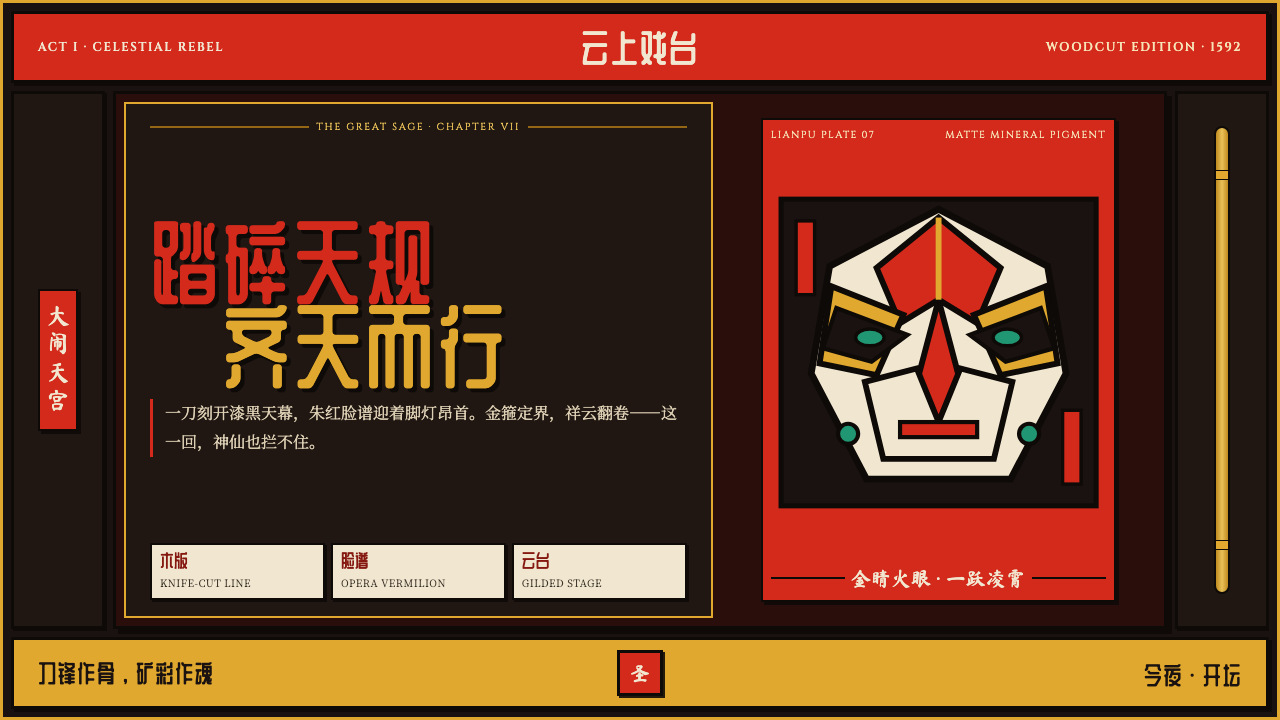 Journey to the West (Monkey King)A god roars off the block. Vermilion opera paint and gilt rules ignite a lacq…
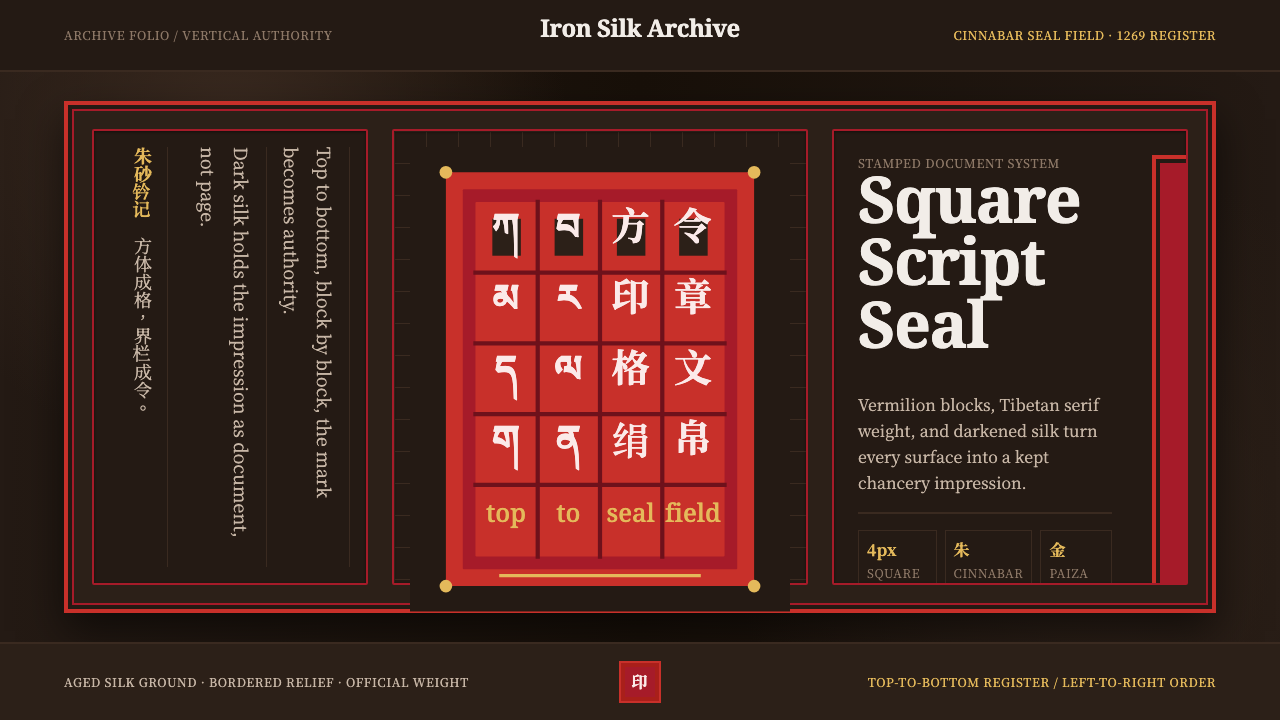 Phags-pa Seal ScriptAuthority, stamped vertical. Cinnabar borders press Tibetan serif blocks into…
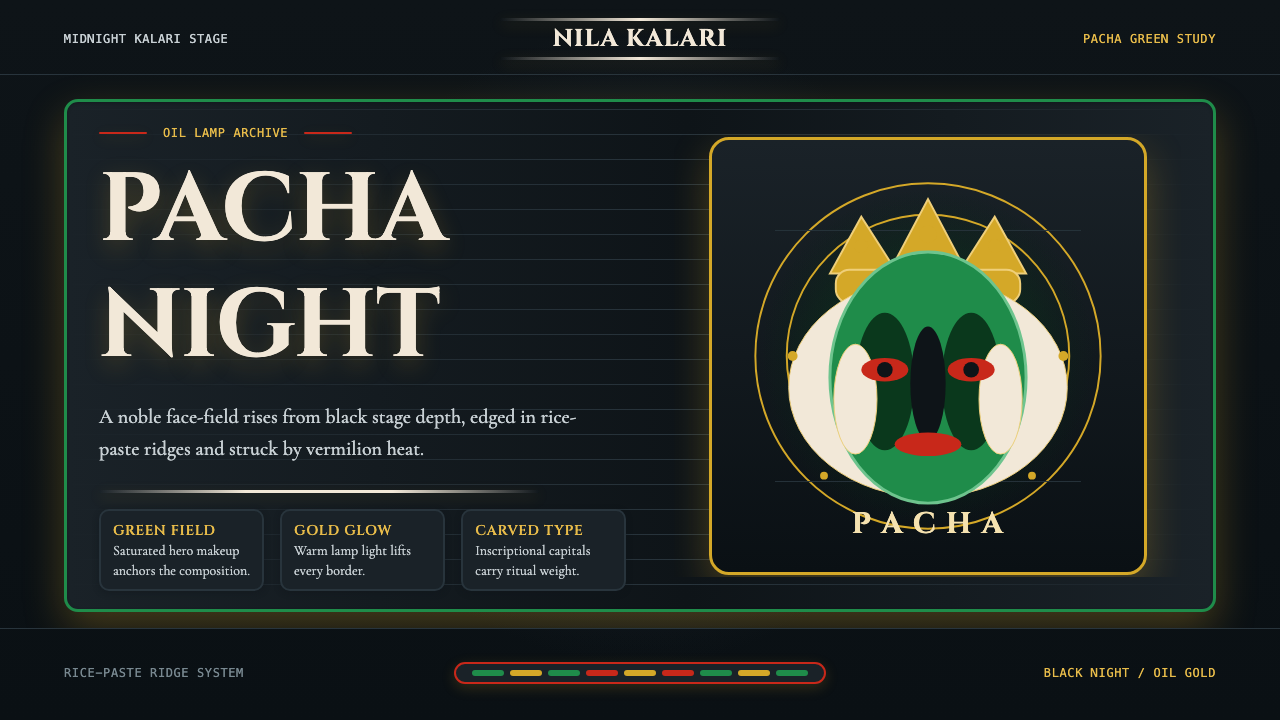 Kerala Kathakali (Pacha Green Makeup)Fierce ceremonial night. Pacha green, vermilion, and oil-gold frame monumenta…
 Mon Hongsa EmblemRepetition outranks the hero. Gold paired emblems tile down a lacquer-red ban…
 Shang-Zhou Ritual BronzeAncient terror fills every surface. Patina green, bronze relief, mirrored tao…
 Sri Lankan Kandyan Mask & DanceRitual carries weight. Gold serif type and ruby-emerald filigree burn on blac…