What is Journey to the West (Monkey King)?
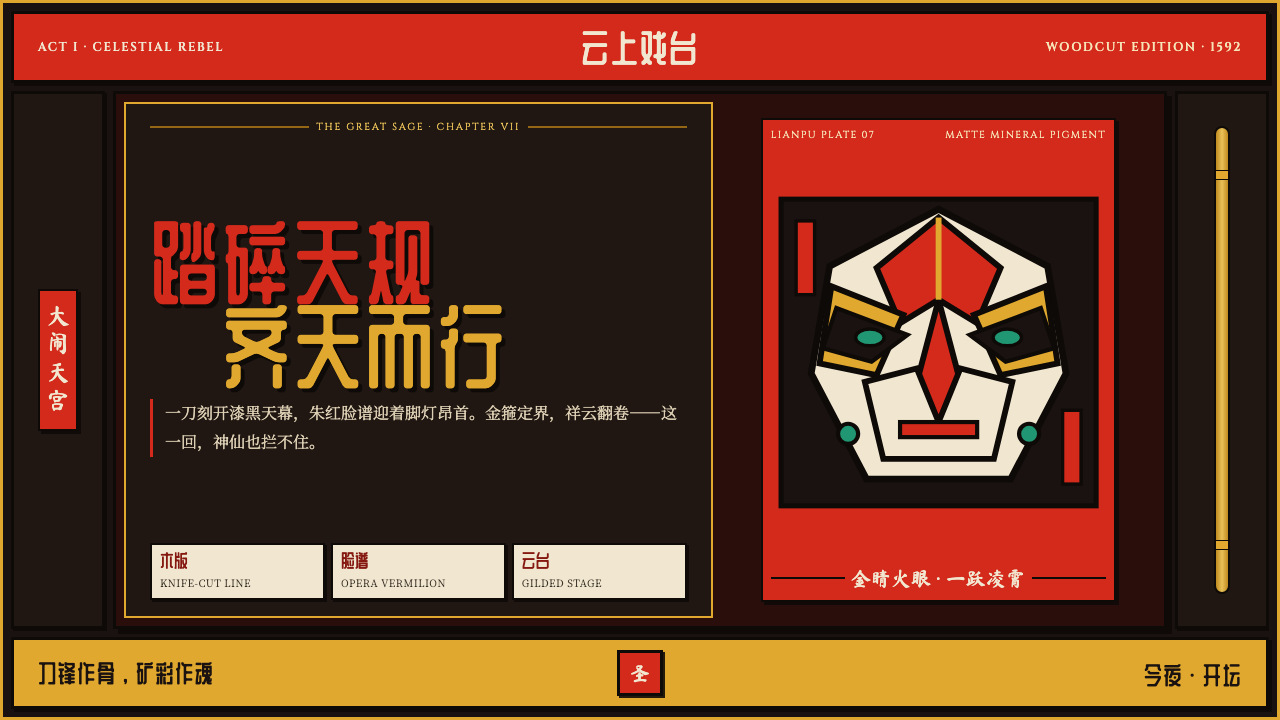
A god roars off the block: vermilion opera paint and gilt rules ignite a lacquer-black stage.
Journey to the West (Monkey King) in brief
Journey to the West, or Monkey King, is a dark theatrical visual language built around Sun Wukong as he appears to have been cut from wood and illuminated for the opera. Its foundation is a confident black knife-cut outline pressed against a lacquer-dark ground. Mineral vermilion, matte gilt, bone white, cloud-scrolls, and the gold-banded staff create a page that behaves less like an illustration than a stage flat caught at the loudest instant of a performance.
The style fuses two source traditions named by the theme: the 1592 Shide Tang woodblock Xiyouji and painted jingju lianpu face-painting. The woodblock contribution is graphic decisiveness: carved contours, dense framing, and imagery that reads immediately at a distance. The lianpu contribution is facial force: the red monkey brow, gold-rimmed eyes, and bone-white muzzle turn the hero’s face into an emblem with theatrical authority.
Nothing in this system is meant to settle into the background. A page is framed, ruled, and activated from edge to edge; somersault cloud-scrolls ribbon through the margins while the staff descends like a vertical rule. The overall impression is poster-loud but materially restrained. Pigment remains matte, black remains deep, gold remains sober, and the image refuses both pastel softness and glossy spectacle.
Where does Journey to the West (Monkey King) come from?
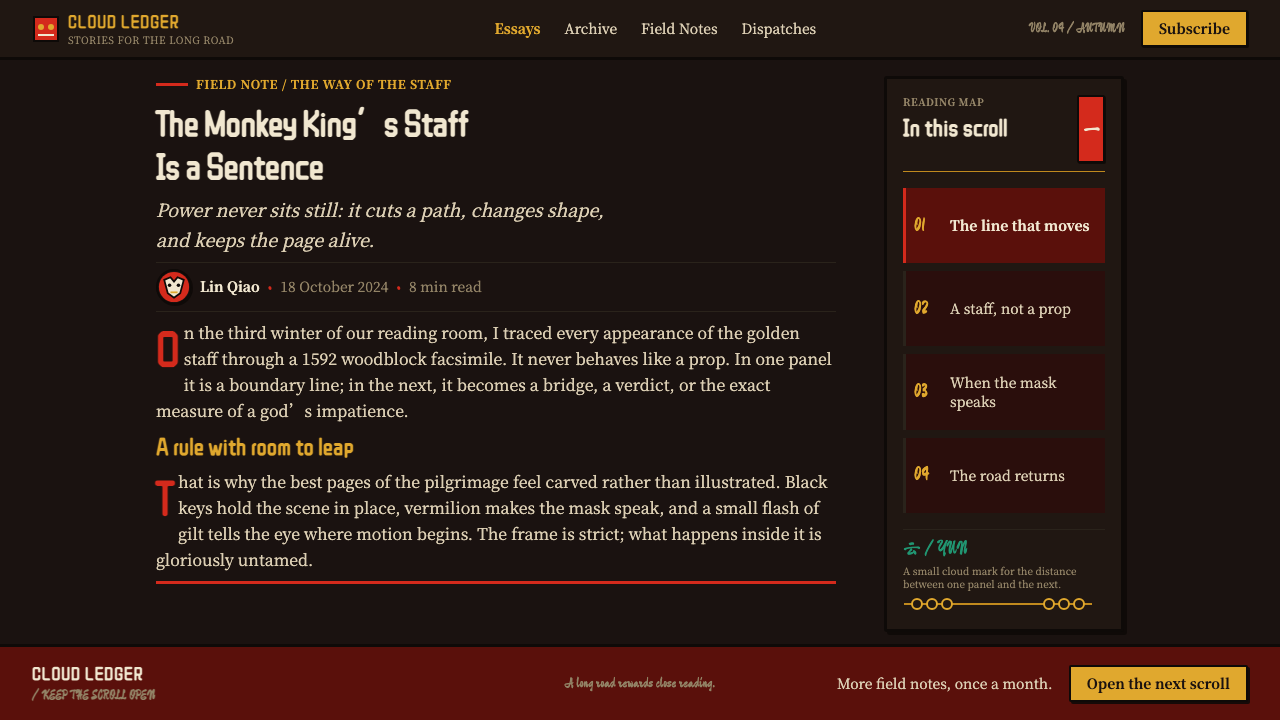
Its first visual root lies in the Ming woodblock peak from 1550 to 1644, with the Shide Tang Xiyouji of 1592 named as a central reference. Woodblock illustration makes contour inseparable from decision: a line is not a casual sketch but a cut that must carry silhouette, motion, expression, and hierarchy at once. That pressure gives the style its forceful black outline and its refusal of vague or atmospheric edges.
Its second root is jingju lianpu, codified from 1790 to 1900. Face-painting supplies a different kind of compression. Rather than asking a viewer to study naturalistic expression, the painted face presents brow, eye, muzzle, and contrast as instantly legible theatrical signs. In this theme, the Monkey King’s red brow, gilt-rimmed eyes, and pale muzzle preserve that stage-born immediacy.
The geography is equally important to the image. The source locates its materials across China: Nanjing print houses, the folk-print towns of Yangliuqing and Taohuawu, and Beijing opera stages. These are not treated as separate decorative references. They form a continuous visual field in which book illustration, New Year print energy, and operatic paint can all intensify the same heroic figure.
The named movements clarify the synthesis: Ming banhua book illustration supplies the carved graphic structure, jingju lianpu face-painting supplies theatrical identity, and nianhua New Year prints supply festive density and public-facing impact. The result is not a quiet historical reconstruction. It is a deliberate collision of print, mask, cloud, staff, and stage darkness, organized so Sun Wukong appears perpetually mid-leap.
What defines the Journey to the West (Monkey King) look?
Lacquer Darkness
The ground is lacquer-dark rather than merely dark. It functions as a pulled-back curtain, making vermilion, bone white, and muted gold feel lit from below. The darkness is dense and deliberate, never smoky, faded, or casually neutral.
Knife-Cut Outline
Black contours should feel carved, not drawn with a soft hand. They establish the figure’s authority, divide color fields, and preserve legibility inside a crowded composition. A contour is a commitment: firm, graphic, and unafraid of contrast.
Vermilion and Matte Gilt
Vermilion provides the emotional roar, while matte gilt supplies rank, ritual, and structural emphasis. Their relationship is not decorative abundance. Red advances with heat; gold frames, directs, and dignifies. Both remain opaque and pigment-like rather than luminous or glossy.
Opera Face
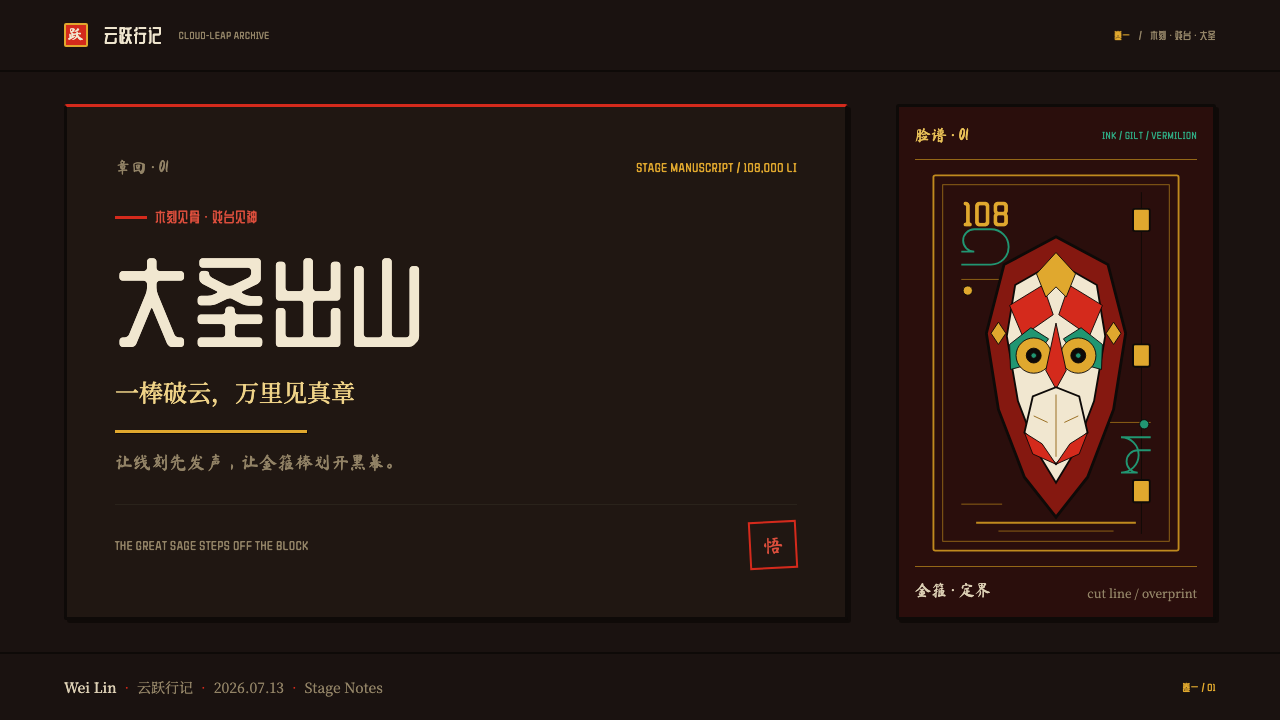
The face is organized as a theatrical emblem: monkey brow in red, eyes ringed in gold, muzzle held in bone white. Features are simplified and amplified so expression survives distance. The goal is not portrait realism but an unmistakable stage identity.
Cloud-Scroll Motion
Somersault cloud-scrolls are active ribbons, not passive ornament. They fold through margins, connect separate zones, and make the figure seem airborne. Their curves should carry centrifugal movement, pushing the eye around the frame before returning it to the hero.
Rule and Frame
The gold-banded staff can operate as a rule down the page, while borders make the composition feel pressed into a printed and theatrical frame. Density is intentional: the image should feel contained under pressure, not spacious in a contemporary editorial sense.

Who shaped Journey to the West (Monkey King)?
Wu Cheng'en is named among the theme’s key figures. His presence anchors the visual world in Journey to the West, the narrative field from which the Monkey King enters this design language as a charged, heroic protagonist.
Chen Hongshou is listed as a key figure within the source material. In an article about this theme, the name marks the importance of figure-making and graphic character within the wider visual lineage.
Hu Zhengyan appears among the supplied key figures. The name belongs to the print-centered side of the theme, whose visual vocabulary depends on decisive marks, framed surfaces, and the material authority of reproduced imagery.
Ding Yunpeng is named as a key figure. His inclusion reinforces that the style is not only about a palette or a costume, but about a broader inherited language of figure, line, and dramatic arrangement.
Li Wanchun is included among the theme’s key figures. Within the supplied framework, the name helps hold the design close to its opera-facing identity, where a character must read with force across the imagined stage.
How do you use Journey to the West (Monkey King) today?
For presentation covers, use the style as an entrance rather than a background treatment. Set a single monumental Monkey King silhouette or face against the lacquer-dark field, then let vermilion and matte gilt establish the first visual impact. A staff-like vertical rule or a cloud-scroll at the edge can direct attention toward the title. Keep the cover theatrical, framed, and immediately legible.
Content slides should preserve the same stage logic while allowing information to speak. Treat black as the enclosing field, use gilt rules to divide sections, and reserve vermilion for decisive emphasis. For data slides, charts should read as carved and painted objects: solid fields, direct labels, strong outlines, and a hierarchy that makes the important comparison visible before decorative movement enters.
For web interfaces, this language suits cultural archives, event pages, collector editions, and dashboards where a ceremonial, high-contrast atmosphere supports the product. Navigation can behave like a framed inscription, with gold rules providing order and vermilion signaling the active path. Panels should feel like lacquered stage surfaces rather than airy cards, while cloud motifs should guide transitions or section entrances rather than compete with controls.
For editorial and marketing work, the style is strongest when an article, campaign, or product story needs mythic momentum. Use the page edge as an active boundary, let a staff or border carry vertical structure, and bring in face details as recurring anchors. Marketing compositions can alternate between crowded heroic moments and quieter reading passages, but the visual voice should remain matte, black-grounded, and materially firm.
The common mistake is reducing the style to black, red, and gold alone. Without knife-cut contours, framed density, opera-face logic, cloud movement, and the staff’s ordering role, the palette becomes generic luxury decoration. Another mistake is making every surface shiny or every flourish ornate. This is a woodblock-and-stage language: forceful, disciplined, opaque, and purposeful.
Journey to the West (Monkey King) — FAQ
Is this style simply a black, red, and gold palette?
No. The palette matters, but it works only inside a larger system of carved black contours, lianpu facial signs, cloud-scroll motion, dense framing, and staff-like rules. Remove those structural devices and the colors lose their specific Journey to the West character.
Why must the gold remain matte?
The theme describes matte gilt and matte pigment throughout. A subdued gold holds its place as a rule, rim, or emblematic accent beside vermilion and black. Gloss would shift attention toward surface shine instead of carved outline, painted face, and theatrical contrast.
Can photography be used with the style?
It can, provided photography submits to the same graphic logic. It should read as a sharply bounded, high-contrast theatrical element, not as a soft realistic window. Cropping, black contour treatment, and opaque color fields can help a photograph join the woodblock-and-stage world.
How dense should a layout be?
It should feel deliberately framed and charged, rather than empty or casually spacious. Density does not mean placing unrelated motifs everywhere. Each cloud-scroll, border, face detail, and staff line should tighten the composition, sustain motion, or clarify the hero’s dominance.
Where does this style work best?
It is especially effective where theatrical myth, cultural memory, celebration, or heroic momentum is central: exhibition pages, cultural programming, illustrated editorial work, event campaigns, collector objects, and dramatic presentations. It is less suitable when an interface needs an anonymous, quiet, or highly neutral voice.
Related design styles
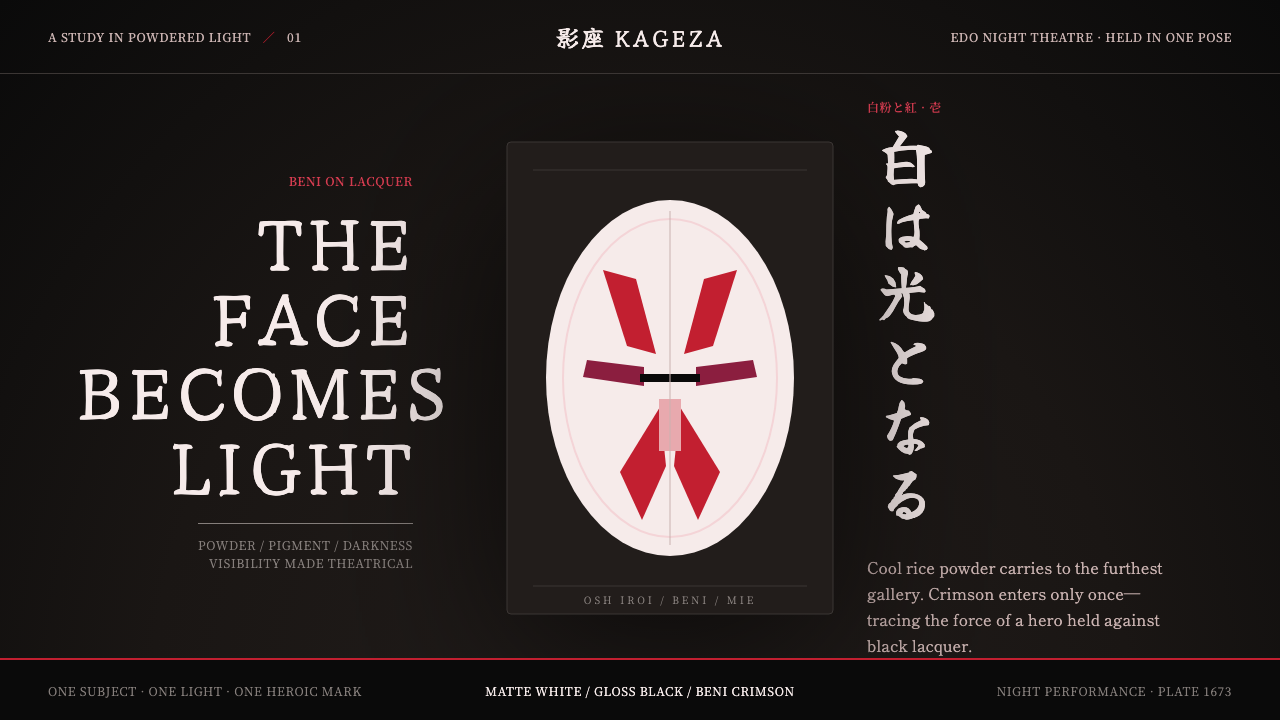 Kabuki Oshiroi WhitefacePowder becomes stage light. Cool white cuts through black lacquer with one he…
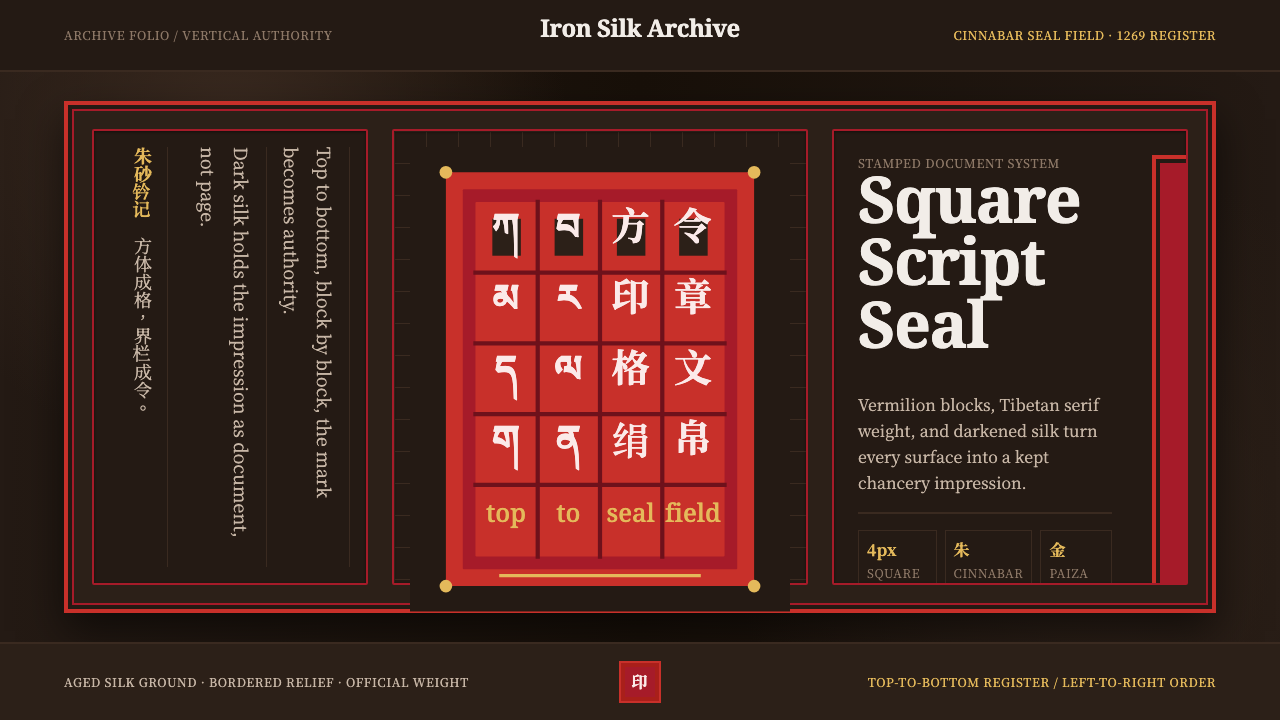 Phags-pa Seal ScriptAuthority, stamped vertical. Cinnabar borders press Tibetan serif blocks into…
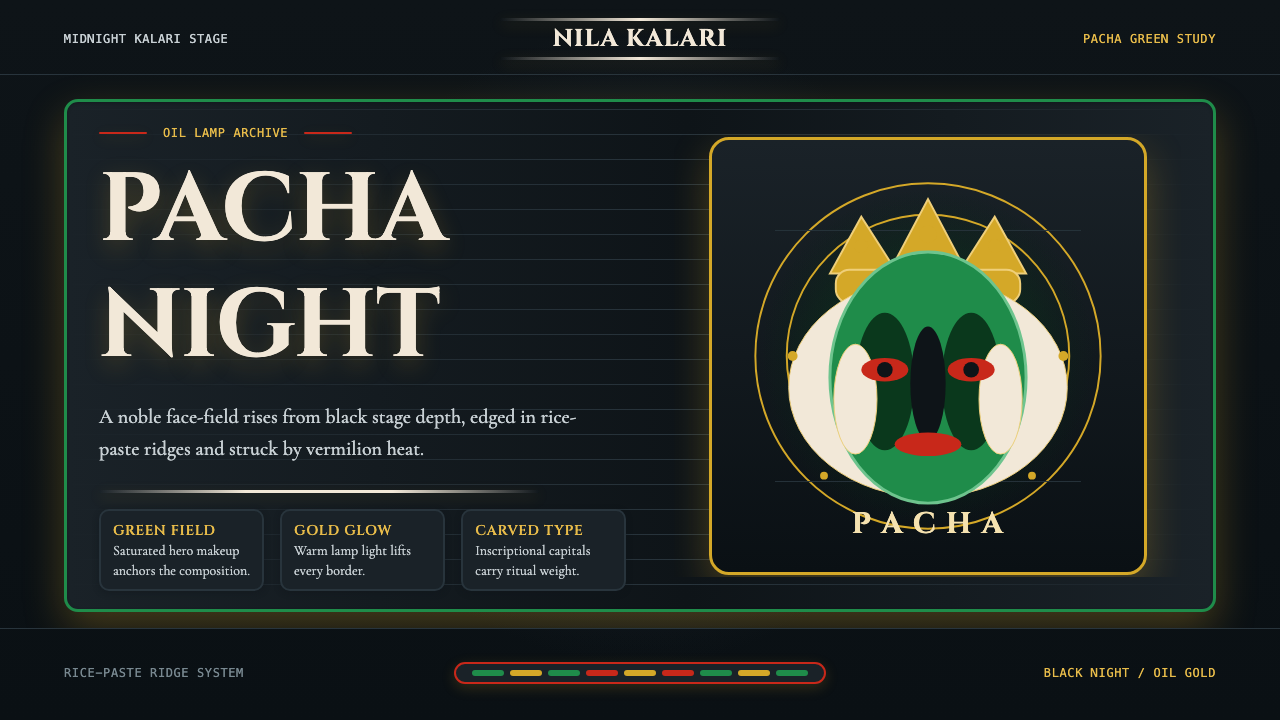 Kerala Kathakali (Pacha Green Makeup)Fierce ceremonial night. Pacha green, vermilion, and oil-gold frame monumenta…
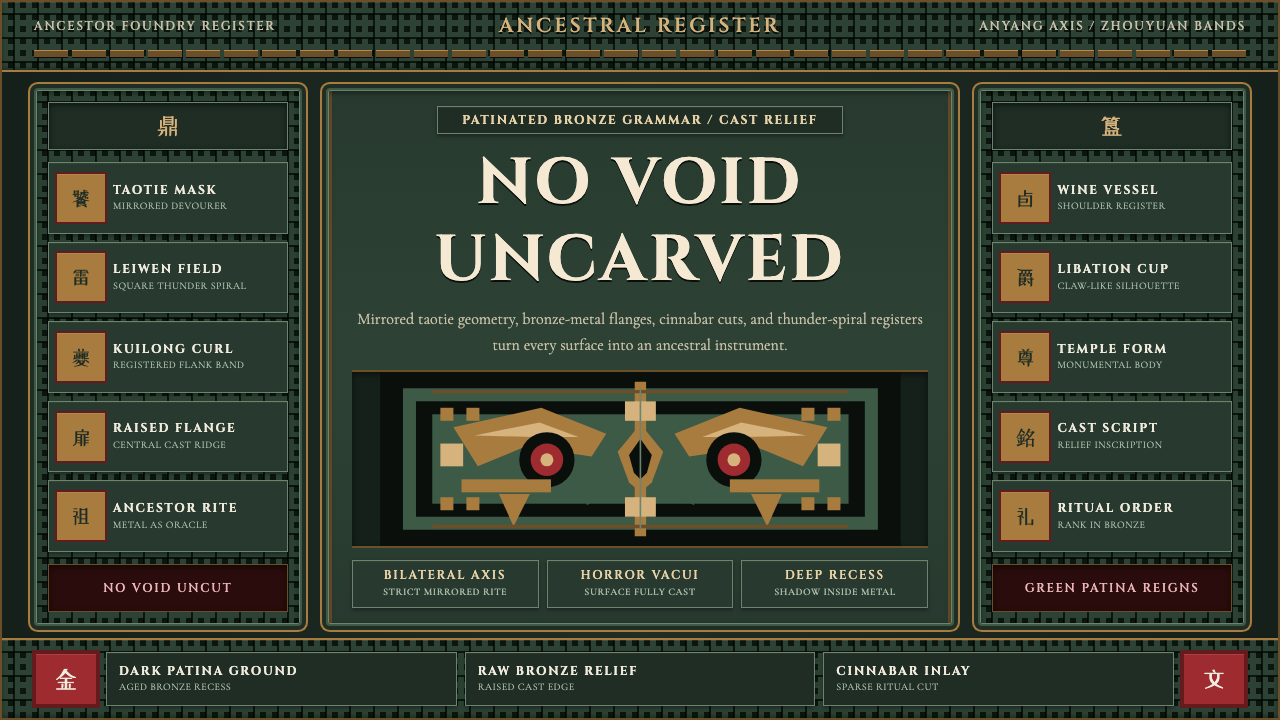 Shang-Zhou Ritual BronzeAncient terror fills every surface. Patina green, bronze relief, mirrored tao…
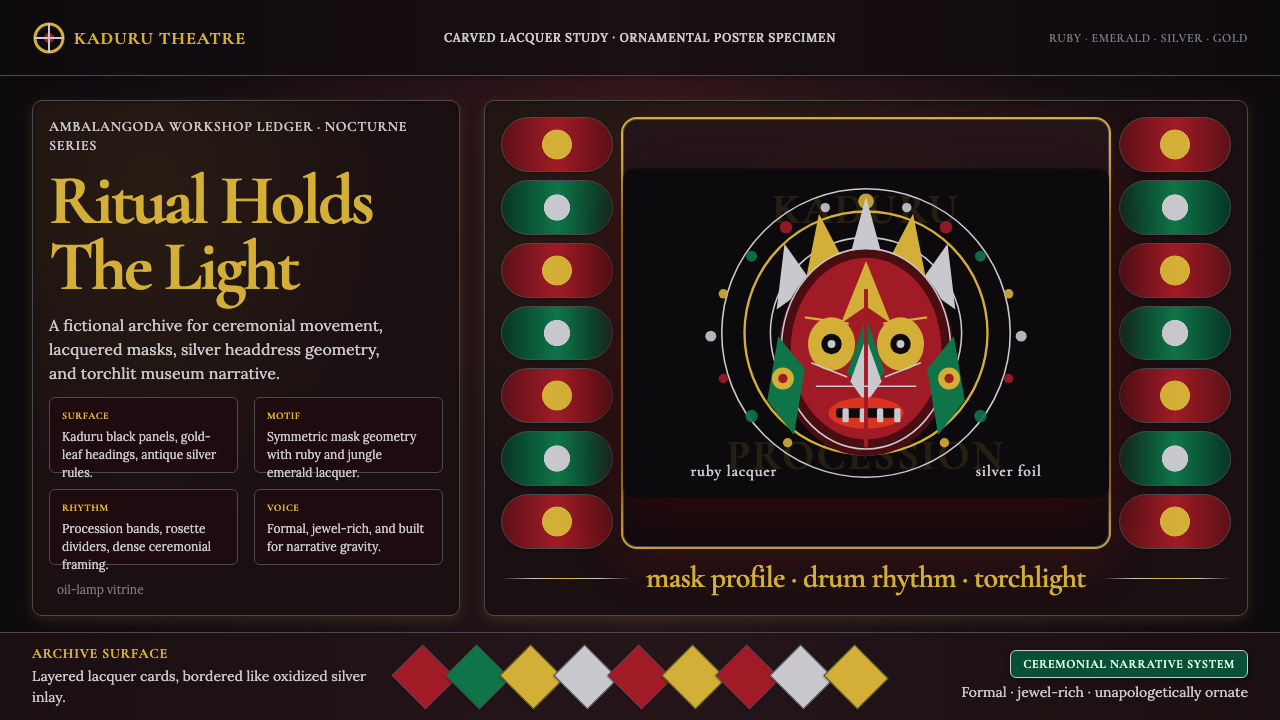 Sri Lankan Kandyan Mask & DanceRitual carries weight. Gold serif type and ruby-emerald filigree burn on blac…
 Victorian Circus Poster (1880)Spectacle leaves no inch quiet. Forest green, antique gold borders, mixed ser…