What is iMac G3 Bondi Blue (1998)?
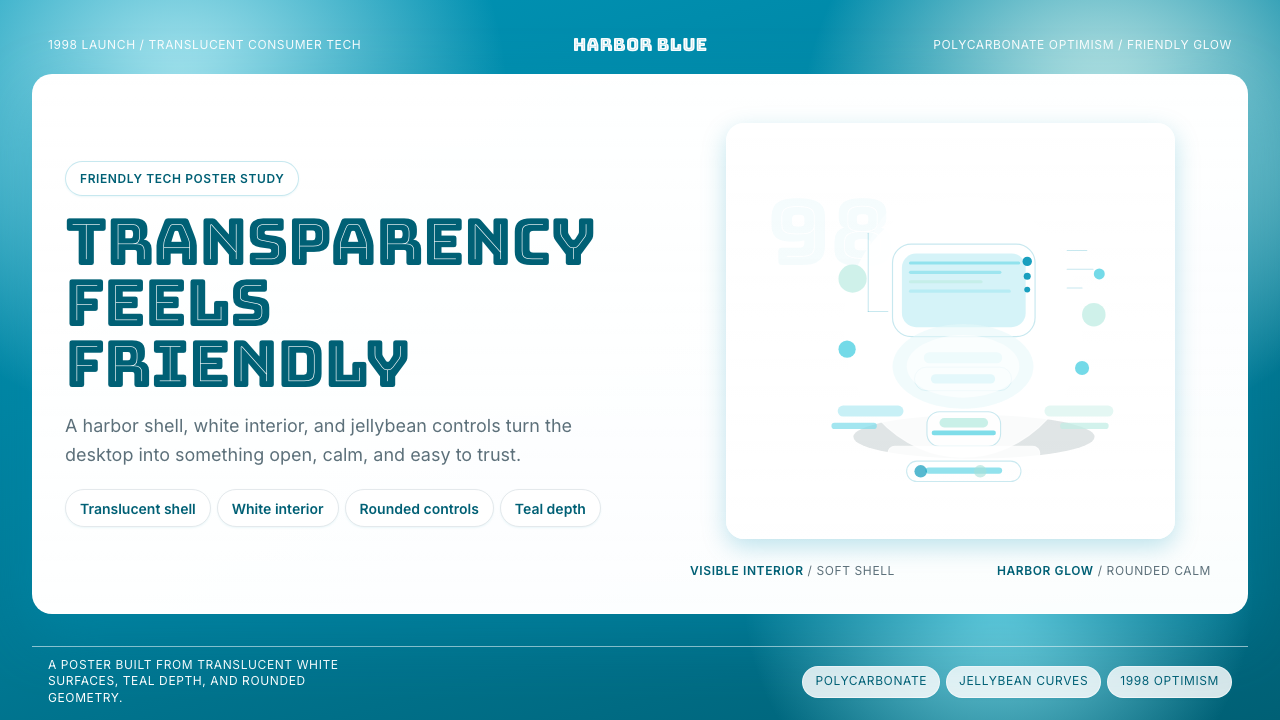
A translucent teal egg on a desk in 1998 proved that a computer could look like something you actually wanted.
iMac G3 Bondi Blue (1998) in brief
The iMac G3 Bondi Blue aesthetic is a design language built around translucency, curvature, and saturated color — a direct repudiation of the beige, angular, anonymous personal computer that had dominated offices and homes since the late 1970s. Where the prevailing PC aesthetic communicated utility through blankness, the Bondi Blue iMac communicated friendliness through visibility: the machine's internal components were legible through its polycarbonate shell, and the teal-cyan color shifted in intensity depending on the angle of light.
As a visual system, Bondi Blue centers on a specific tension between richness and approachability. The background color — that distinctive blue-green drawn from the waters of Sydney's Bondi Beach — is deeply saturated but not aggressive. White surfaces act as counterweights, keeping the palette from tipping into heaviness. Interface elements are rounded to near-circular extremes, a formal choice that made the machine feel safe and playful rather than clinical. The visual language says: technology is not hostile territory; come closer and look inside.
This aesthetic belongs to a brief, specific window in consumer-technology history — the late 1990s moment when the internet was being sold to ordinary households as a place of optimism and possibility. Every visual decision in the iMac G3's design reinforces that narrative: the curves soften authority, the transparency builds trust, the saturated color signals that this is not a tool for specialists but a companion for everyone.

Where does iMac G3 Bondi Blue (1998) come from?
In the summer of 1997, Apple was weeks from insolvency. The company that had invented the graphical user interface for a mass market was being outsold by commodity PC makers running Windows. Steve Jobs, returning as interim CEO after a twelve-year absence, identified the problem with characteristic bluntness: Apple had lost its identity, and its products had become as anonymous as any other beige box. His prescription was equally blunt — make something undeniably, visibly different.
Jonathan Ive, the British industrial designer who had joined Apple in 1992 and led its industrial design group since 1996, had already been developing concepts for a radically new form factor. Working under the code name 'C1', the design team explored polycarbonate as a primary casing material — a choice that enabled the translucency that became the machine's defining characteristic. The form that emerged was bulbous and egg-like, a complete break from the rectilinear logic that had governed computer enclosure design since the beginning of the personal computer era. The integrated handle on top communicated that this was a consumer object, meant to be moved and owned personally, not bolted to a corporate workstation.
The name 'Bondi Blue' was chosen by Jobs himself, reportedly after he saw a swatch of the color during the development process and declared it perfect. The reference to Bondi Beach in Sydney — known internationally for its vivid blue-green water — carried associations of leisure, beauty, and the natural world rather than technology or industry. This was deliberate: the iMac was being positioned as a gateway to the internet, and its color was meant to evoke the openness and optimism of that promise rather than the mechanical seriousness of computing.
The iMac G3 launched on August 15, 1998, at a retail price that was aggressive by Apple's standards, and it sold 800,000 units in its first 139 days — at the time, the fastest-selling Macintosh in company history. In 1999, Apple extended the line with five additional colors under the 'Five Flavors' campaign: Blueberry, Strawberry, Tangerine, Grape, and Lime. Each variant extended the design language while retaining the translucent polycarbonate shell and the rounded, integrated form. The Bondi Blue original remained the design's purest expression — the one that established the visual grammar that all subsequent variants inherited. The line was discontinued in 2003, replaced by the flat-panel iMac that pointed toward a different aesthetic future, but the Bondi Blue iMac's influence on consumer electronics, industrial design, and interface design had already been profound and lasting.
What defines the iMac G3 Bondi Blue (1998) look?
Translucent Color
The defining material quality of the Bondi Blue aesthetic is translucency rather than opacity. The teal-cyan color is not a surface coating but a property of the material itself, allowing light to pass through and interior structures to remain partially visible. This quality makes the color feel alive and variable — it shifts from deeper blue-green in shadow to a brighter, more aqueous tone in direct light. When applied to digital surfaces, this translucency is evoked through layered semi-transparent overlays and materials that suggest depth without creating literal see-through windows.
Generous Curves
Every form in this aesthetic curves — corners are rounded to a degree that would have seemed extreme in earlier consumer electronics, buttons approach pill or jellybean shapes, and container edges follow sweeping arcs rather than right angles. This pervasive curvature is not merely decorative; it communicates that the object or interface is safe, approachable, and designed for human hands and eyes rather than industrial efficiency. The curves also give the aesthetic a slightly organic quality, as though the forms have been inflated from within or shaped by gentle pressure.
Saturated Teal-Cyan Palette
The primary color of this aesthetic sits in the precise zone between blue and green — not quite teal, not quite cyan, not quite turquoise, but something that partakes of all three. It is deeply saturated, meaning it reads as vivid and confident rather than muted or pastel. White is the essential counterpart, used generously for content surfaces to let the saturated background breathe. Black appears rarely, primarily for high-contrast text. Secondary accent colors, when present, tend toward complementary warm tones rather than additional saturated cool hues, maintaining the palette's internal coherence.
Soft Glow and Inner Light
Unlike design systems that use shadow to create the impression of elevation, the Bondi Blue aesthetic relies on luminosity — a sense that surfaces glow from within. Highlights are placed at the edges and upper faces of rounded elements as though light is passing through the material. Gradients, when they appear, are extremely gentle and suggest illumination rather than dramatic dimension. This gives the aesthetic a slightly ethereal quality that distinguishes it from both the flat, shadowless look of later minimal design and the hard-edged realism of skeuomorphism.
Friendly, Rounded Typography
Text in this aesthetic favors rounded letterforms — typefaces that echo the overall formal vocabulary of curves and softness rather than the geometric precision of modernist sans-serifs or the authority of traditional serifs. Headlines can be bold and expressive, communicating warmth rather than corporate weight. Body text is set generously with comfortable line spacing, reinforcing the approachable character of the system. The overall typographic tone is conversational rather than instructional.
White Space as Invitation
The Bondi Blue aesthetic uses white space not as austere reduction but as generous invitation. Padding inside containers is spacious, giving content room to breathe in a way that feels welcoming rather than sparse. Content areas are typically set against bright white or near-white backgrounds, creating a sharp contrast with the saturated interface chrome and drawing the eye naturally to the primary content. This allocation of white space signals that the design is not trying to cram in information but to make it comfortable to receive.
Tactile Material Suggestion
Even in purely digital applications, the Bondi Blue aesthetic carries a sense of material presence derived from the original polycarbonate casing. Surfaces are not perfectly flat; they have subtle curvature and highlights that suggest a three-dimensional shell. Interactive elements feel pressable and tangible rather than purely diagrammatic. This is a careful calibration — the aesthetic avoids full skeuomorphism while retaining enough material suggestion to make the interface feel physically engaging rather than abstract.

Who shaped iMac G3 Bondi Blue (1998)?
Jonathan Ive joined Apple in 1992 and became head of the industrial design group in 1996. The iMac G3 was his first major project executed in close collaboration with the returning Steve Jobs, and it established the design philosophy that would define Apple for the next two decades: material expressiveness, manufacturing precision, and the conviction that industrial design is not ornamental but fundamental to a product's meaning. Ive went on to oversee the iPod, iPhone, and iPad, each of which carried forward the principle demonstrated in the Bondi Blue iMac — that the physical and visual qualities of a product determine how users feel about themselves when they use it.
Jobs returned to Apple in September 1997 and within months had approved the iMac G3 project, personally selecting the Bondi Blue color and the consumer-facing name. His insistence that the machine look unlike anything else on the market — combined with his decision to remove the floppy disk drive, add a USB port, and price the machine accessibly — transformed it from a design experiment into a commercial phenomenon. Jobs's role in the iMac was less that of a designer and more that of a demanding editor: he set the parameters within which Ive's team could find the optimal form, and he used his authority to protect decisions that would have been reversed under conventional product management.
As Apple's head of worldwide product marketing at the time of the iMac G3 launch, Phil Schiller was responsible for the commercial framing that made the machine's design legible to a mainstream audience. The 'Five Flavors' campaign, which extended the iMac line into additional colors in 1999, was a marketing invention that transformed a design decision into a cultural event — each color variant becoming a form of personal expression. Schiller's approach demonstrated that a product's visual identity is not fixed at manufacturing but is continuously shaped by how it is presented, talked about, and associated with particular lifestyles.
Avie Tevanian served as Apple's chief software technology officer and oversaw the operating system software that ran on the iMac G3. The visual design of Mac OS 8 and the early Mac OS 9 interface — with its Platinum appearance and the later Aqua interface previewed in 2000 — was developed in parallel with the hardware aesthetic that Ive's team was creating. Tevanian's contribution to the iMac's legacy lies in demonstrating that hardware and software design needed to speak the same visual language: the rounded, translucent, material-aware qualities of the physical machine required a software interface that could honor rather than contradict them.
Though not directly involved in the iMac G3, Hartmut Esslinger's earlier work at Apple — particularly the Snow White design language he developed for Apple in the early 1980s through his firm frogdesign — established the principle that Apple computers should have a distinctive, unified visual language that set them apart from competitors. The beige, rectilinear Snow White aesthetic that characterized Apple through the 1980s and much of the 1990s was precisely what the iMac G3 was designed to replace, but Esslinger's foundational insight — that design is a competitive advantage and a form of communication, not merely an aesthetic preference — was one the iMac inherited and amplified.
How do you use iMac G3 Bondi Blue (1998) today?
The Bondi Blue iMac aesthetic is most effective in design contexts where the product needs to feel simultaneously premium and approachable — not the cold authority of a professional tool, not the casual disposability of a budget product, but something that feels considered, welcoming, and slightly joyful. It works well for consumer software products, creative tools aimed at non-specialists, educational platforms, and any interface where the goal is to reduce the anxiety that technology can provoke and replace it with a sense of invitation.
For presentation slides, the Bondi Blue palette operates most naturally as a full-saturated-background treatment for cover and section-break slides, with white content slides providing the working surface for information. A cover slide benefits from the teal-cyan ground occupying the full field, with white type and simple geometric shapes — perhaps a soft circular or oval form — creating a focal point. Content slides should be treated as white-surface layouts with teal used sparingly for accent, highlighting key figures or calls to action. Data slides can use the teal as a primary bar or chart color against a white ground, letting the saturation provide hierarchy without additional color complexity.
For web interfaces, Bondi Blue suits consumer-facing dashboards, onboarding flows, pricing pages, and marketing landing pages more naturally than it suits dense productivity tools or data-heavy enterprise applications. The approach is to set the overall page field in either the saturated teal or in white, use rounded card containers with generous internal padding, and apply soft translucent overlay effects for modal layers and hover states rather than hard shadows or color inversion. Navigation elements should be rounded rather than rectangular, and interactive buttons should carry the pill or jellybean form that makes the system legible as a coherent visual language.
For editorial and marketing work, the aesthetic supports strong feature moments — a full-width hero section in deep teal-cyan with white headline type creates immediate visual impact, while white-background body sections allow content to breathe without the palette becoming fatiguing. Pull quotes and highlighted facts work well inside teal containers with white text, giving editorial emphasis without resorting to heavy typographic treatment. In print or social card contexts, the aesthetic's natural friendliness makes it effective for announcements, invitations, and communications that need to feel both considered and warm rather than purely formal.
A common mistake when applying this aesthetic is confusing translucency with transparency and either making surfaces fully opaque — which loses the material quality entirely — or fully transparent — which creates visual noise rather than depth. The correct calibration is a middle state: surfaces that have presence and weight but allow some sense of what lies beneath. A second common mistake is over-applying the saturated teal to body text, borders, and secondary UI elements simultaneously, which quickly becomes visually dense and loses the contrast that gives the palette its energy. The teal is most powerful when it has room — used for large surfaces, primary interactive states, and moments of emphasis, with white carrying the informational weight.

iMac G3 Bondi Blue (1998) — FAQ
Is Bondi Blue iMac aesthetic the same as general 1990s nostalgia design?
No. General 1990s nostalgia design tends to evoke the era through specific typographic choices, color palettes associated with early web design (browser-safe colors, garish gradients), and cultural reference points (grunge, neon, early rave aesthetics). The Bondi Blue iMac aesthetic is specifically about the consumer optimism of the late 1990s internet moment and the material language of translucent polycarbonate. It is cleaner, more premium, and more specifically tied to a single product family than broad 1990s pastiche. Where 1990s nostalgia often embraces the era's visual excess and confusion, the Bondi Blue aesthetic is actually quite disciplined — it is 1990s consumer hope, not 1990s visual chaos.
Can this aesthetic work in a dark-mode context?
With significant modification, yes — but dark mode inverts the aesthetic's fundamental logic in ways that require care. The original Bondi Blue palette works because the saturated teal-cyan contrasts against white, not against black; against a dark background, the teal becomes less legible as a background color and more useful as a glowing accent. A dark variant of this aesthetic works best when the background is a very deep, slightly warm neutral (not pure black, which reads as too hard-edged for this system), the teal is used selectively for interactive elements and highlights, and white or near-white is used generously for text and content containers. The translucent overlay effects require extra attention in dark mode — the inner-glow quality that defines the aesthetic tends to wash out against dark fields rather than reading as luminous.
How is this aesthetic different from Apple's later Aqua interface style?
Aqua, introduced with Mac OS X in 2000, was the direct software descendant of the Bondi Blue hardware aesthetic, but it evolved in a more explicitly liquid and reflective direction. Aqua used more aggressive wet-surface highlights, more complex multilayer translucencies, and a fuller range of colors including the famous lozenge-shaped traffic-light window controls. The Bondi Blue aesthetic is its simpler, more restrained predecessor — rooted in the physical properties of a specific material (polycarbonate) rather than in the possibility space of a software rendering engine. Bondi Blue is material memory; Aqua is material imagination. In practice, Bondi Blue references tend to feel warmer and more grounded, while Aqua references tend toward a slightly more hyperreal glossiness.
What kinds of products and brands should avoid this aesthetic?
The Bondi Blue iMac aesthetic carries specific associations that make it unsuitable for certain brand positions. Products that want to communicate serious professional authority — financial services, legal platforms, medical devices, enterprise security tools — will find the aesthetic's friendliness and playfulness working against their credibility. Luxury brands will find the consumer-accessible, design-for-everyone quality of the aesthetic at odds with the exclusivity they are trying to project. Products aimed at older demographics who did not experience the late 1990s internet moment may find the aesthetic's references opaque rather than evocative. And products that need to feel timeless or culturally neutral will find the aesthetic's specific historical moment too legible — it is unmistakably of its era, which can be a strength or a liability depending on the product's relationship to nostalgia.
How does translucency work in a flat digital design context where there is no physical material?
In digital design, translucency is an effect rather than a material property, and achieving the Bondi Blue quality of it requires a specific approach distinct from both full opacity and full transparency. The technique is to layer elements such that a background surface is partially visible through a foreground element — but with the foreground element carrying enough color and luminosity of its own to read as a distinct layer rather than a window. Practically, this means applying a saturated teal-cyan at reduced opacity over a white or near-white content area, or using a frosted-glass-style blur effect that softens rather than transmits the background. The inner-glow quality is achieved through subtle highlights — lighter values at the upper edge and corners of rounded elements — that suggest internal luminosity. The key calibration is that the translucent elements should feel like they are made of something, not like holes in the layout.
Related design styles
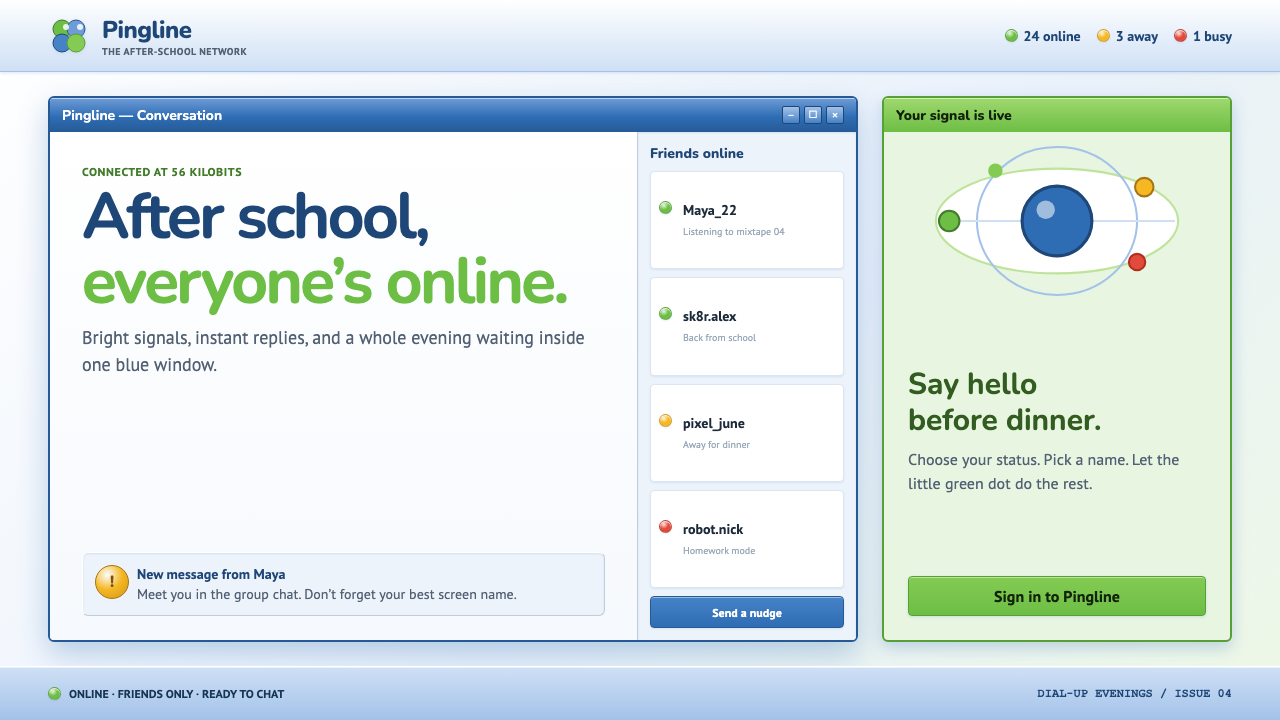 MSN Messenger (2001)Dial-up optimism, online. Luna-blue chrome and bright status dots keep every…
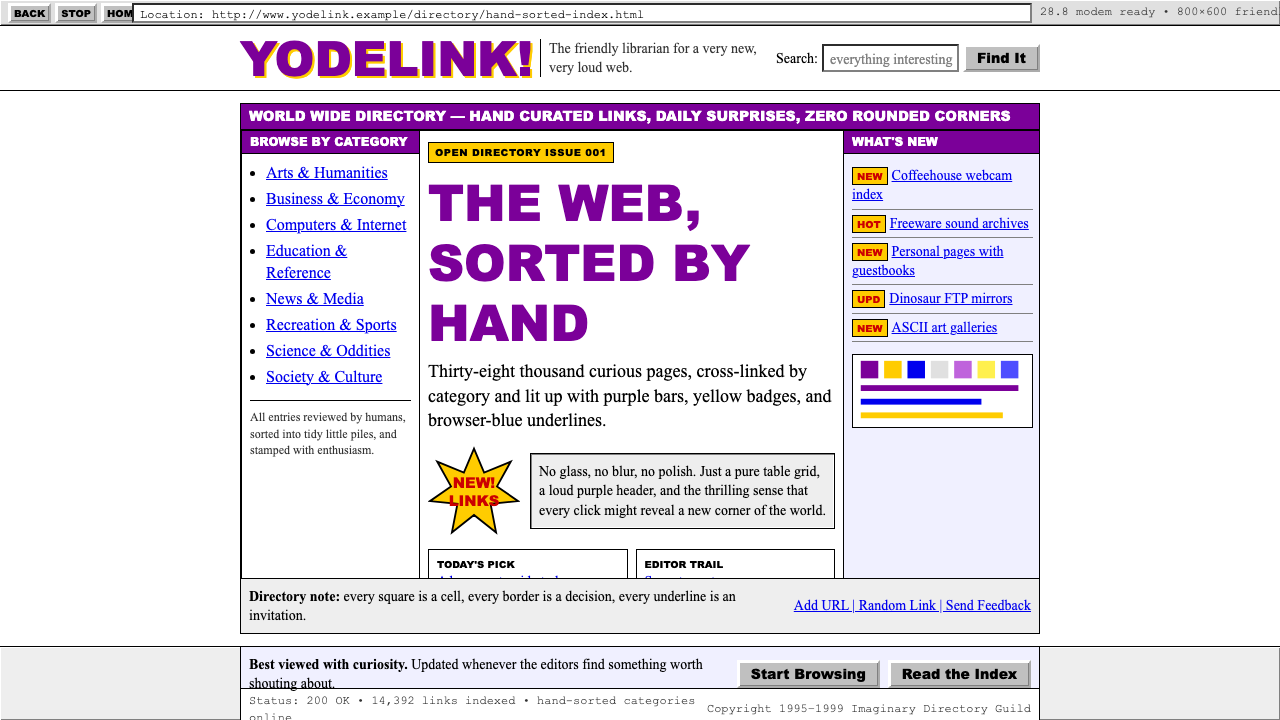 Yahoo! 1995Directory-era optimism. Purple table bars, yellow NEW badges, blue underlined…
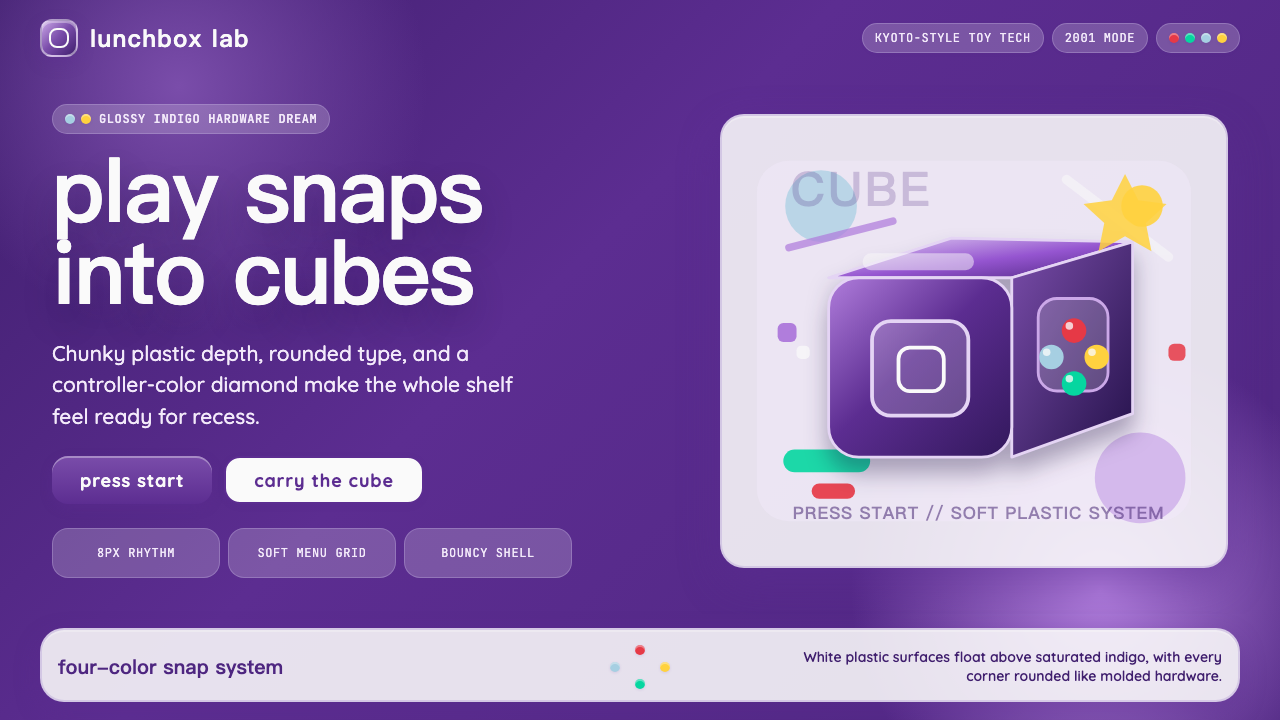 Nintendo GameCube (2001)Toy-tech refuses restraint. Indigo plastic, glossy cubes, and four-color butt…
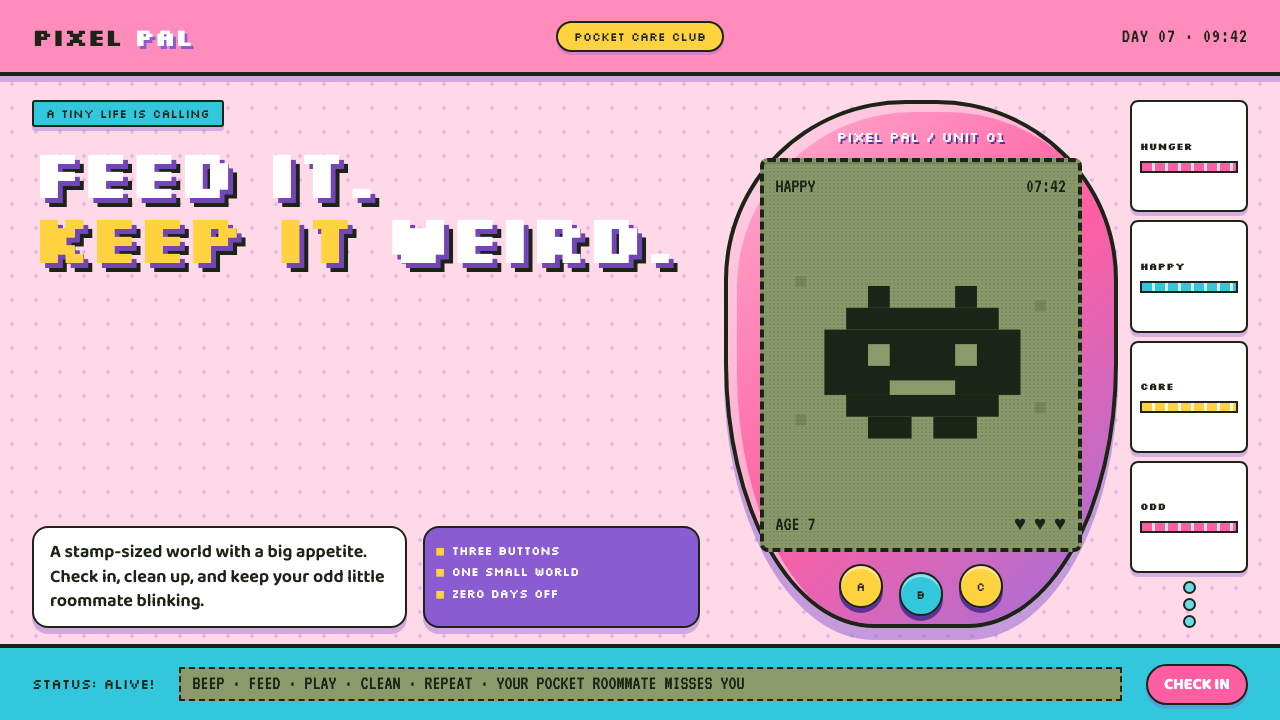 Tamagotchi (1996)Care gets candy-coated. Bubblegum plastic frames a crunchy pea-green pixel wo…
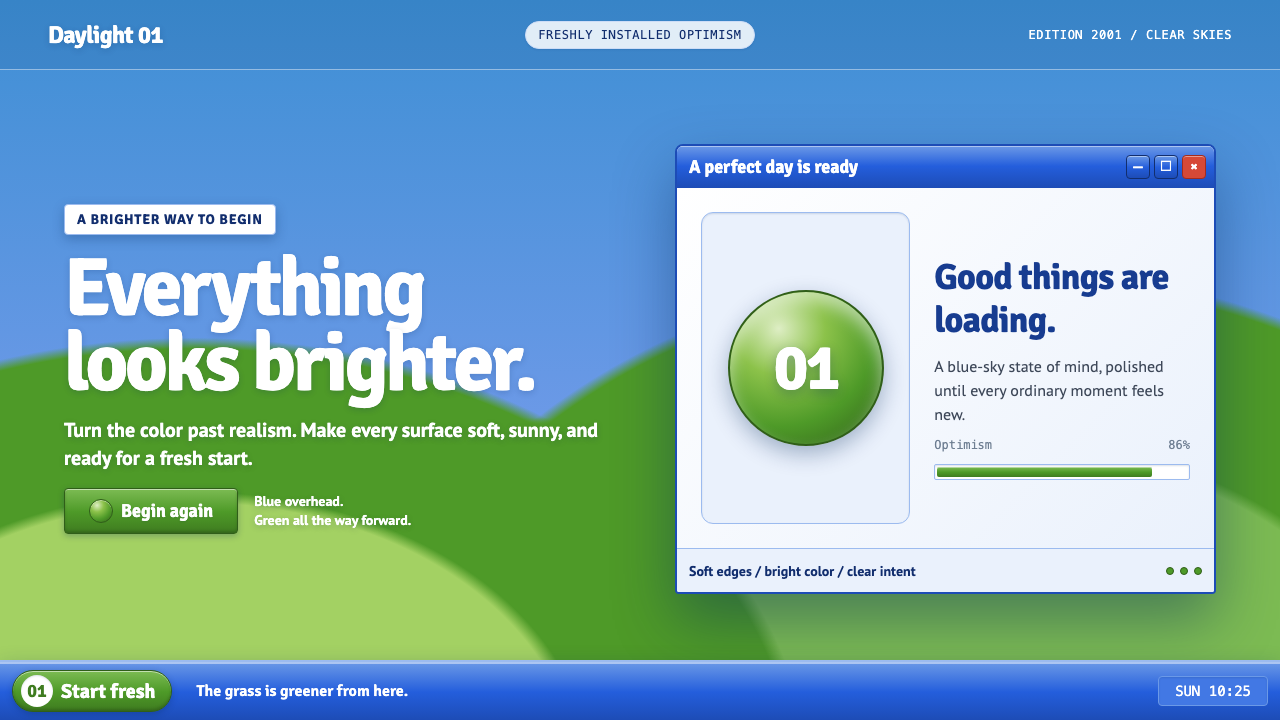 Windows XP Bliss (2001)Fresh-install optimism. Sky blue, hill green, and glossy gel chrome turn real…
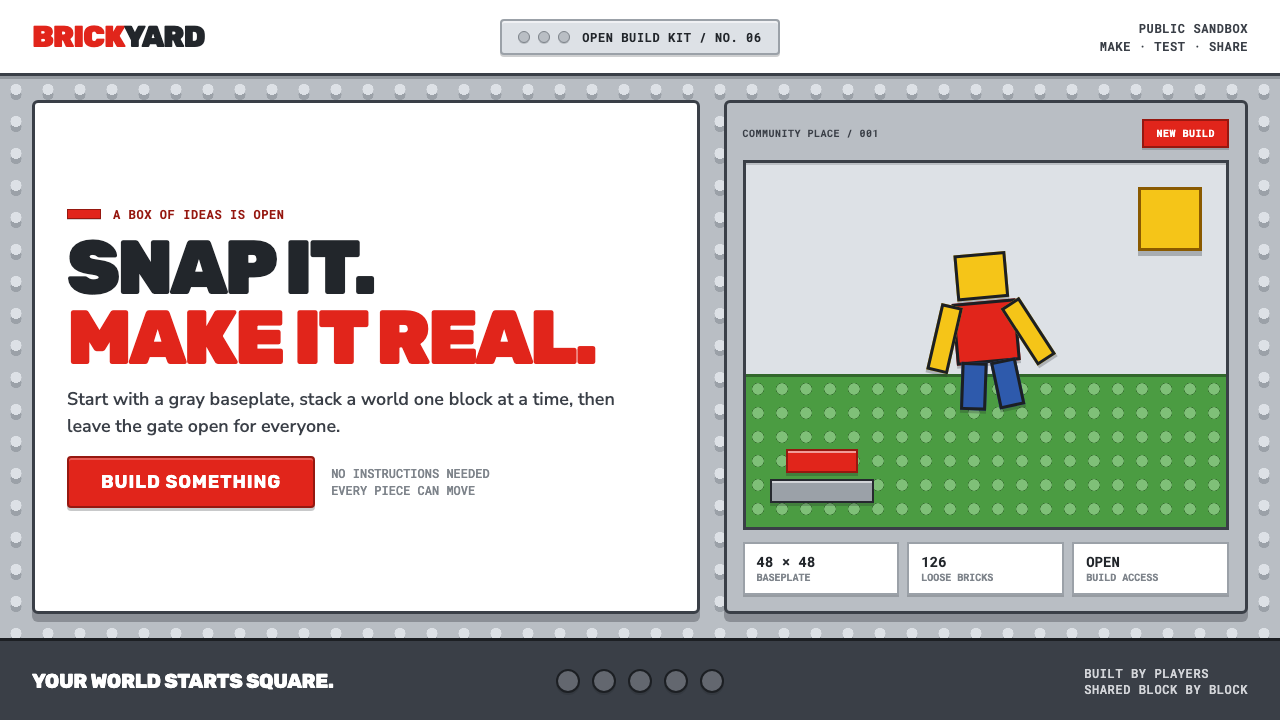 Roblox (2006)Play begins with a click. Fire-engine red cuts through a hard-edged gray stud…