What is Bluesky AT Protocol 2024?
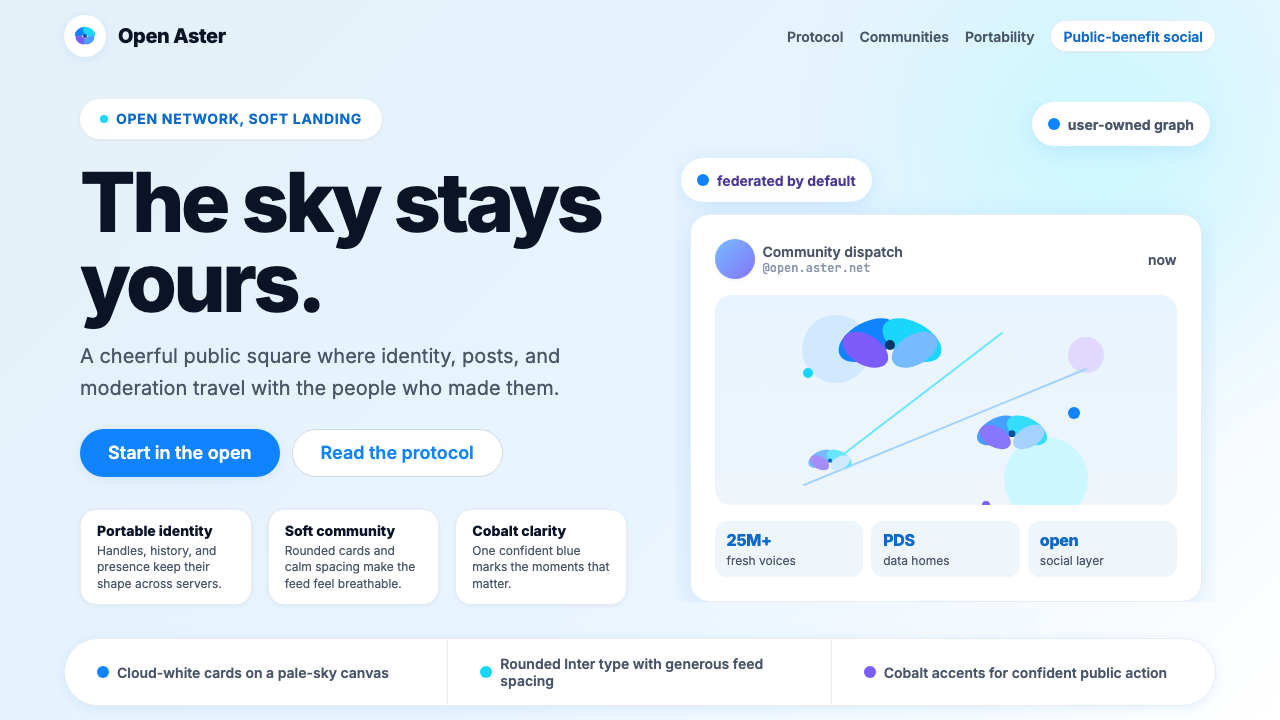
Bluesky proved that open infrastructure and warm, inviting design are not opposites — its pale sky canvas and soft cloud cards made decentralization feel like home.
Bluesky AT Protocol 2024 in brief
Bluesky AT Protocol 2024 is the visual design language of the Bluesky social network, built on the AT Protocol — a federated, open-source framework for social media. It emerged as an alternative to closed corporate platforms, and its aesthetic makes that mission visible: the interface feels welcoming and human rather than imposing or industrial, projecting openness not as a technical specification but as a sensory promise.
The design system centers on a light, airy palette anchored by a pale sky blue and soft cloud white, with a single cobalt accent that carries authority without aggression. Cards have generous rounding that softens each container into something approachable. The brand mark — a stylized flock of butterflies — reinforces the social and distributed nature of the platform; it is motion, plurality, and lightness simultaneously.
What distinguishes this style from other tech-platform aesthetics is its refusal of the cold precision often associated with infrastructure products. The Bluesky visual language does not perform power or scale; it performs community and trust. Rounded forms, airy spacing, and a warm near-white ground all communicate that the technology serves the people on it, not the other way around.
Where does Bluesky AT Protocol 2024 come from?
Bluesky's origins trace back to 2019, when Twitter co-founder and then-CEO Jack Dorsey announced a small research initiative aimed at developing open, decentralized standards for social media. The project operated under the name Bluesky — framing the work as aspirational and directional rather than product-oriented. Jay Graber, a developer with a background in decentralized technologies, was hired to lead the team in 2021.
In 2022, Bluesky Social PBC was incorporated as a public benefit company, deliberately separating the organization from Twitter's corporate structure and affirming its nonprofit-adjacent mission. The AT Protocol — the underlying technical standard — was designed with portability as a core value: users could carry their identity and social graph across different servers and applications, a direct repudiation of the silo model that defines most commercial social platforms.
The public launch came in February 2024, when Bluesky opened registration to all users after a period of invite-only access. The timing coincided with widespread anxiety about centralized social media following ownership changes at major platforms. Journalists, scientists, academics, and community organizers arrived in significant numbers, bringing the user count past twenty-five million. These communities valued transparency, portability, and moderation tools they could control — and the visual design was shaped to serve them.
The design identity was developed alongside the product rather than handed down from brand guidelines alone. Paul Frazee, Daniel Holmgren, and Aaron Goldman were among the technical architects of the AT Protocol, and the engineering culture of building for openness filtered into the design sensibility. The butterfly-flock mark, the sky-blue palette, and the rounded card system all emerged from the desire to make a platform that felt genuinely different from the corporate platforms it positioned itself against — friendlier, lighter, more willing to admit the humans inside.
What defines the Bluesky AT Protocol 2024 look?
Palette
The palette is built on three layers: a pale sky blue that serves as the primary brand color and can wash the entire background, soft cloud white used for card surfaces and content containers, and a single cobalt blue accent reserved for interactive elements, calls to action, and emphasis moments. This hierarchy — background wash, surface, accent — keeps compositions legible without needing secondary colors or decorative hues. The overall effect is cool but not clinical, open rather than austere.
Shape and Rounding
Generous corner rounding appears on every container — cards, buttons, input fields, modal sheets, and avatar frames. This is not merely a style preference but a communicative choice: rounded forms are psychologically associated with approachability, safety, and social warmth, in direct contrast to the sharp rectangles that signal corporate efficiency. The rounding is consistently applied across all element sizes, creating a visual system that feels coherent at any scale.
Surface Depth
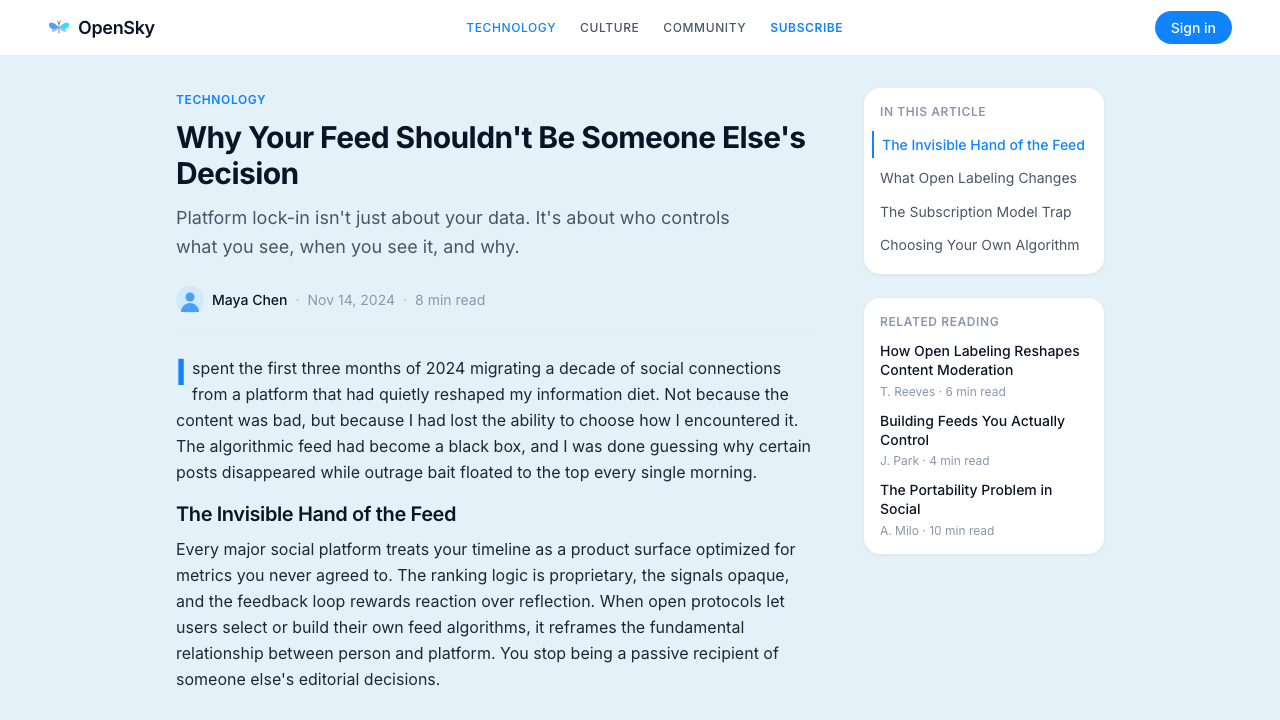
Rather than using hard-edged contrasts or heavy borders, the Bluesky visual language creates depth through soft layering. Card surfaces sit above the background wash without a harsh dividing line; shadows are diffuse and elevation-suggesting rather than graphic and structural. This softness extends to the treatment of media — images and embedded content are contained within rounded frames that feel native to the interface rather than dropped in from outside.
Typography
The type system draws on humanist sans-serif letterforms — particularly the proportions and openness associated with Inter — that prioritize reading comfort over graphic assertion. Headlines are set with restraint rather than dramatic scale contrast; the type voice is conversational and clear, not commanding. Text hierarchy is achieved through weight and spacing rather than size extremes, which keeps the interface readable in the dense, high-frequency reading context of a social feed.
Icon and Mark System
The butterfly-flock logomark operates as both brand identity and semantic key: the distributed formation of individual marks coming together into a recognizable whole mirrors the AT Protocol's architecture of federated servers and portable identities. Interface icons are simple, friendly, and slightly rounded at their stroke ends, maintaining tonal consistency with the rounded card system. Nothing in the icon vocabulary is aggressive or angular; every mark softens at its extremities.
Whitespace and Breathing Room
Generous internal padding within cards, comfortable line height in feed text, and deliberate vertical rhythm between posts all contribute to a sense of spaciousness unusual in social media design, where density is often treated as a proxy for activity and engagement. Bluesky's spacing choices communicate the opposite: that each piece of content deserves attention, and that the platform is not trying to overwhelm or addict but simply to host.
Warmth as Principle
The cumulative effect of the palette, rounding, spacing, and typographic restraint is a quality that can be named precisely: warmth. This is not accidental ornamentation but a principled stance. Bluesky's design communicates that its technology exists in service of human connection, not in spite of it. The visual system is an argument against the cold, surveillance-adjacent aesthetic that characterizes many attention-economy platforms — and that argument is made through form, not through copy.
Who shaped Bluesky AT Protocol 2024?
Graber was appointed to lead the Bluesky project in 2021 and guided the transition from research initiative to operational public benefit company. Under her leadership, the AT Protocol was developed and stabilized, and the network moved from invite-only access to public launch in February 2024. Her background in decentralized technology and her commitment to building infrastructure that resists corporate capture shaped both the technical architecture and the design philosophy — the user-controlled, portable identity system is as much a product of her direction as the visual identity that reflects it.
Frazee was a core technical architect of the AT Protocol and a key figure in defining the concepts of decentralized identity, personal data servers (PDS), and the lexicon system that allows different AT Protocol applications to share data structures. His earlier work on peer-to-peer systems informed the protocol's design, and his presence in the team's public technical writing helped communicate to developers why the architecture was structured as it was — a kind of transparency that mirrors the platform's visual openness.
Holmgren contributed significantly to the AT Protocol's implementation, working on the repository model and cryptographic identity system that allows users to own and port their data across the network. His engineering work on the underlying infrastructure is part of what makes the platform's promise of openness technically credible — without the cryptographic foundations, the warm visual design would be marketing language rather than a structural commitment.
Goldman worked on the AT Protocol's technical foundations during its development phase, contributing to the infrastructure that enables the federation model. The collective engineering team behind Bluesky represents a unusual concentration of developers with ideological commitments to open systems — an orientation that filtered into product and design decisions, ensuring that the visual warmth of the interface was backed by genuinely open technical architecture.
How do you use Bluesky AT Protocol 2024 today?
The Bluesky AT Protocol 2024 style is most effective when the product it represents genuinely shares the values the aesthetic communicates: openness, accessibility, community, and trust. Applied to the right context — collaborative tools, community platforms, civic technology, open-source product marketing — the design language reads as authentic. Applied cynically to a closed or surveillance-adjacent product, it reads as contradictory. Understanding this limits the style's appropriateness, but also clarifies where it works exceptionally well.
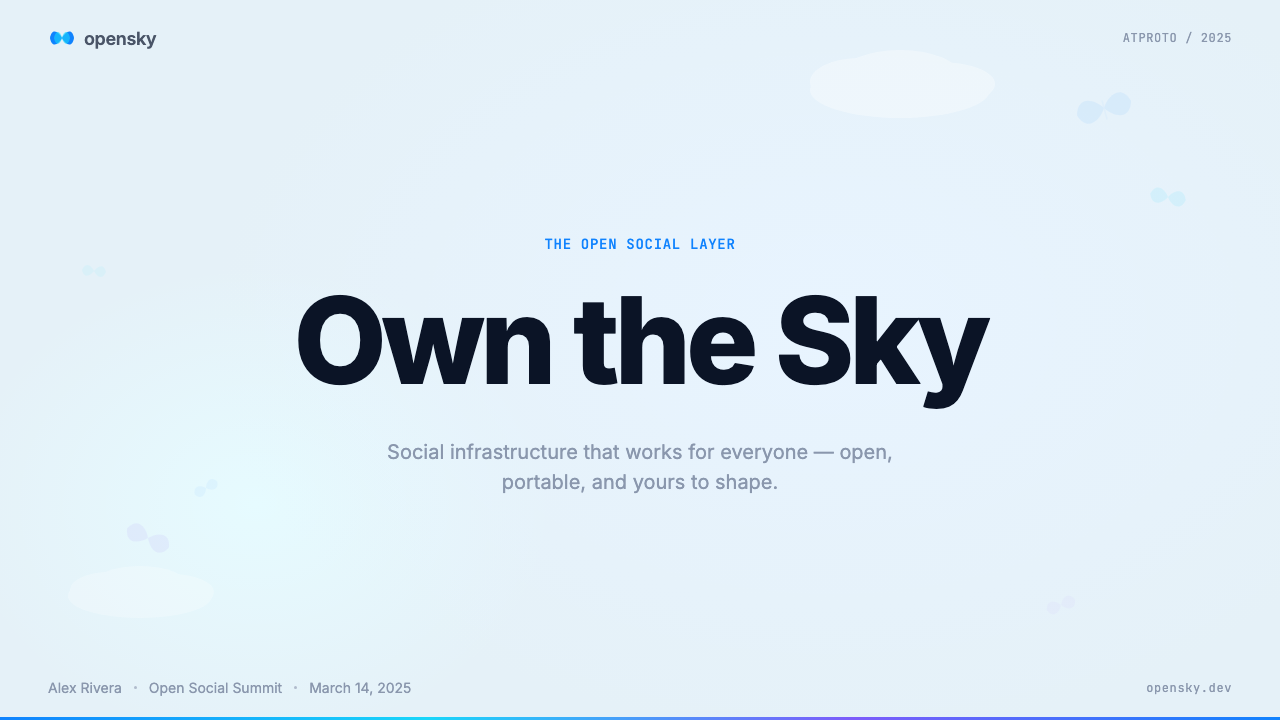
For presentation slides, this style suits covers and section dividers more than dense data pages. A cover in this language: pale blue field, cloud-white card inset with generous rounding, humanist type set at a moderate scale contrast, and the cobalt accent used on a single word or element. Content slides should feel spacious — one key idea per slide, ample padding, line-height that invites rather than rushes reading. Data visualizations can carry the palette by assigning the cobalt accent to the primary data series and using the sky blue as background fill for chart areas, keeping everything legible without harshness.
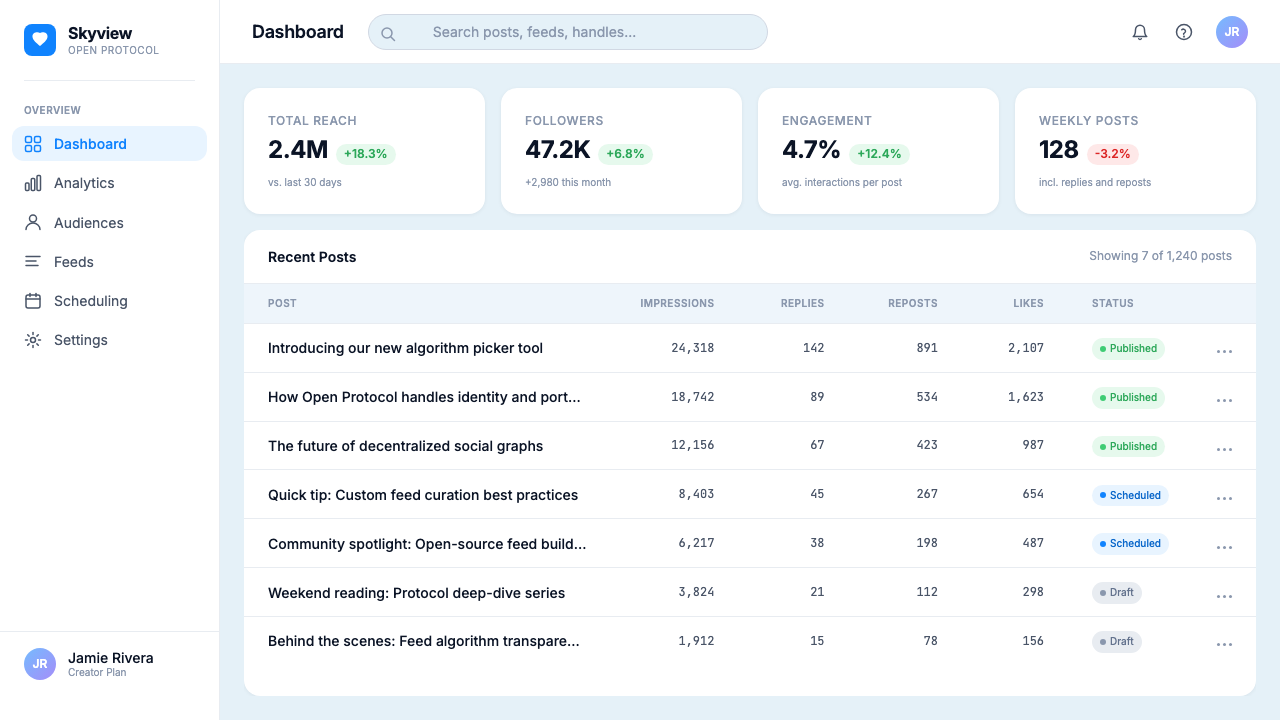
For web interfaces, the style is well-matched to community dashboards, open-source project landing pages, and platforms positioning themselves as alternatives to existing corporate products. The approach: use the pale blue as the page background rather than pure white, which immediately signals that this is not a standard corporate interface. Cards on top of the blue ground carry the cloud white surface, with the cobalt accent used for primary buttons and link states only. Navigation should be typographically light and the overall density should stay lower than a traditional SaaS dashboard — breathing room is part of the message.
For editorial and marketing work, the style supports thought leadership, open-source announcements, and community updates where the relationship between platform and user is presented as collaborative rather than transactional. Hero sections can use the full sky-blue wash with a centered cloud-white card containing the headline and summary. Body sections return to near-white for extended reading. The butterfly-flock motif, or abstracted distributed network patterns built from individual small marks, can serve as background texture without breaking the palette or adding noise.
A common mistake when applying this style is using too many blues simultaneously — sky blue and cobalt are distinct roles, and conflating them produces a monotone palette that loses the warmth the design depends on. A second frequent error is defaulting to sharp corners on any element to save time; even a modest rounding on buttons and inputs is essential to maintaining the system's psychological tone. The third mistake is overdensing the layout out of habit — the spaciousness of this style is structural, not decorative, and compressing it strips away the core message.
Bluesky AT Protocol 2024 — FAQ
How does the Bluesky style differ from other tech-platform design systems?
Most large tech platforms use their visual design to project scale and authority — sharp edges, high contrast, dense information, and a palette that signals efficiency over warmth. Bluesky deliberately inverts this: the rounded forms, airy spacing, and sky-blue palette position the platform as human-scale and community-oriented rather than corporate and surveilling. The closest visual relatives are newer consumer social products that also prioritize approachability, but Bluesky's design is further distinguished by its explicit connection to open infrastructure values — the warmth is not just aesthetic positioning, it is an argument about what the technology is for.
Can this style work for dark-mode interfaces?
The style's natural mode is light — the pale sky blue and cloud white are foundational, and the warmth depends substantially on the light ground. A dark mode adaptation is possible but requires care. A deep navy or near-black background can substitute for the sky blue, with a slightly lighter surface for cards, and the cobalt accent intensified slightly to maintain contrast. The key is preserving the spatial hierarchy: background, surface, accent — without that layering, the interface loses the sense of depth that the original system uses to feel warm and inhabitable rather than flat and cold.
Is this style appropriate for productivity or data-heavy tools?
The style can work in productivity contexts, but its spaciousness creates a practical tension. Dense data environments — analytics dashboards, financial tables, developer tooling — typically rely on tight grid layouts and high information density, which conflicts with the generous padding and breathing room this aesthetic depends on. The most successful application would be in a tool that handles complexity without trying to display all of it simultaneously: a focused writing environment, a lightweight project tracker, or a community data tool where the warmth signals approachability rather than cutting-edge analytical power. For tools where density is a feature, a more neutral system design language would be more honest.
What makes this style feel different from general rounded or friendly design?
Many contemporary interfaces use rounding and light palettes without producing the specific character of the Bluesky design language. What makes the style coherent rather than generic is the combination of three specific properties: the pale sky blue ground (not just light gray or white), the butterfly-flock mark that carries ideological weight about distributed systems, and the deliberate choice to restrict the accent to a single cobalt. Remove any one of these — replace the sky blue with neutral gray, add a second accent, or genericize the mark — and the design becomes a pleasant but undifferentiated rounded-friendly interface. The specificity is the style.
How should the cobalt accent be used to avoid overuse?
The cobalt accent is effective precisely because it is rare. On any given screen, it should appear in only one or two locations: typically the primary action button, a link in active or hover state, or a single highlighted data point. When cobalt appears on every interactive element, every status indicator, and every heading, it loses its ability to direct attention and becomes background noise. The discipline required is treating cobalt as a pointer — it says 'this is what you do next' or 'this is what matters' — not as decoration or brand application. The rest of the interface should be doing its work in sky blue, cloud white, and near-black type, with cobalt arriving only when there is something worth pointing at.
Related design styles
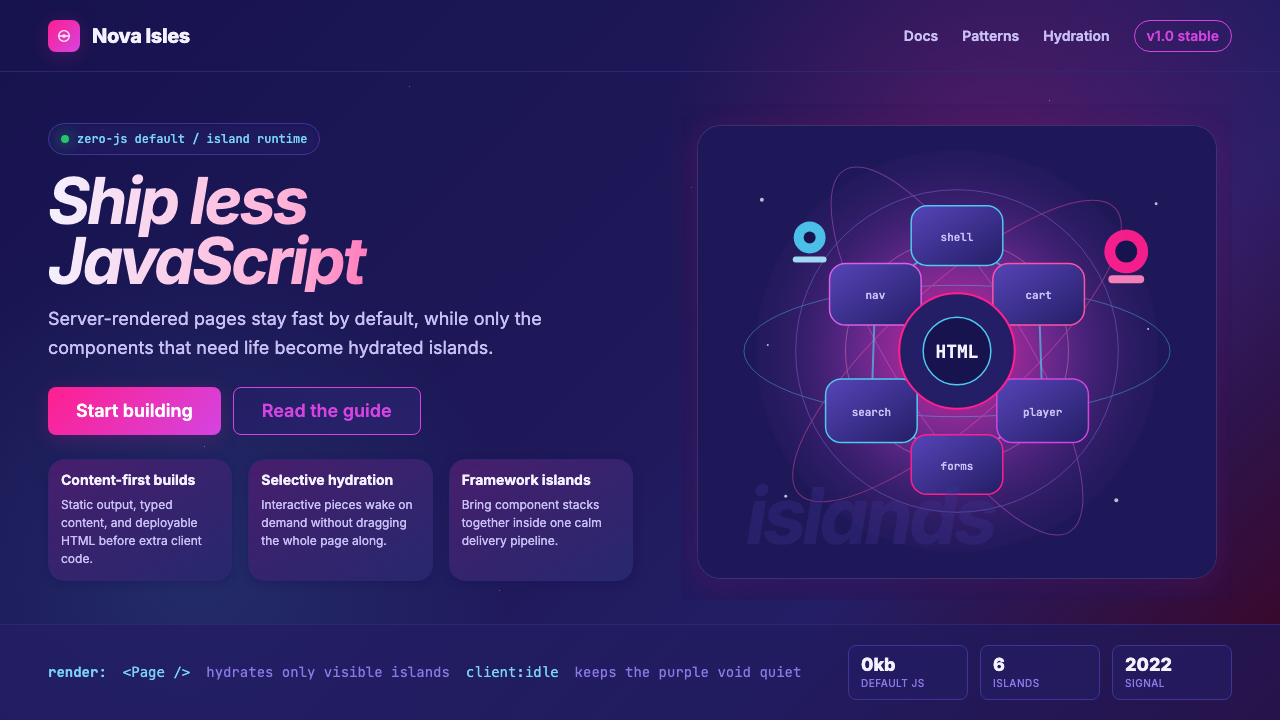 Astro Islands Architecture 2022Warm cosmic devtools. Deep violet, magenta glow, Inter clarity, and island ge…
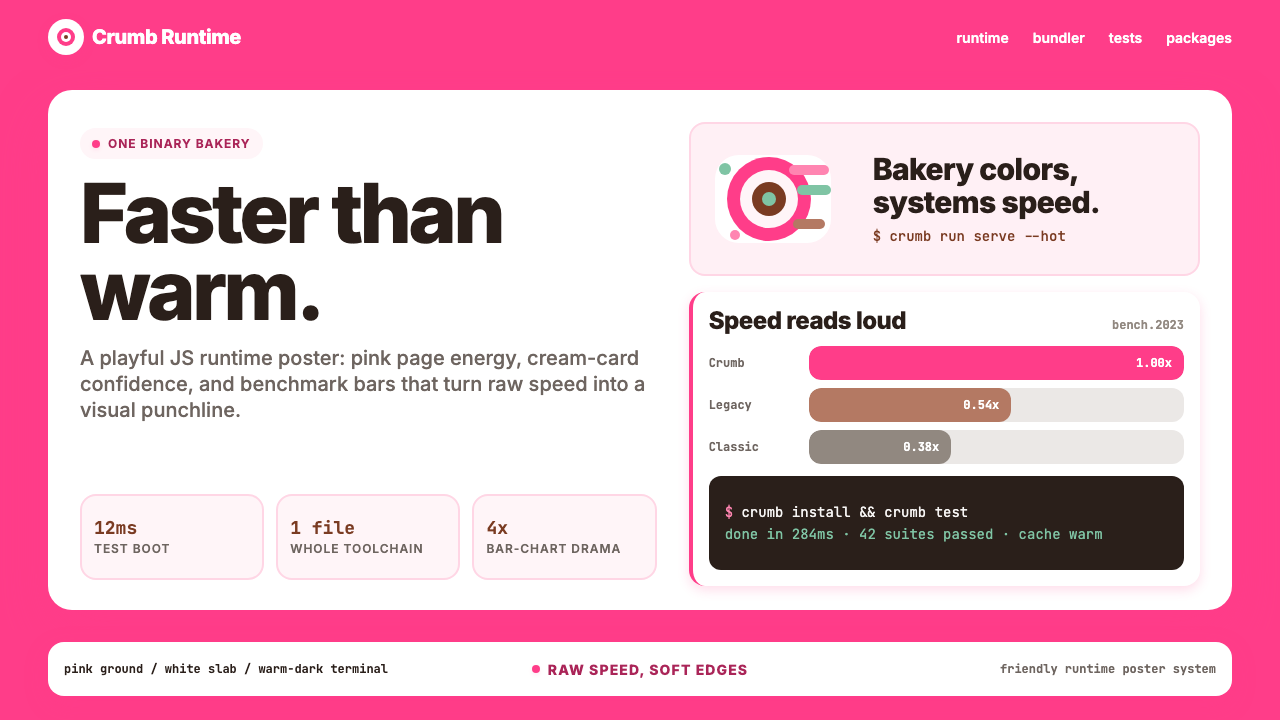 Bun JS Runtime Pink 2023Dev speed gets bakery-bright. Hot pink grounds white slabs, mono bars, and wa…
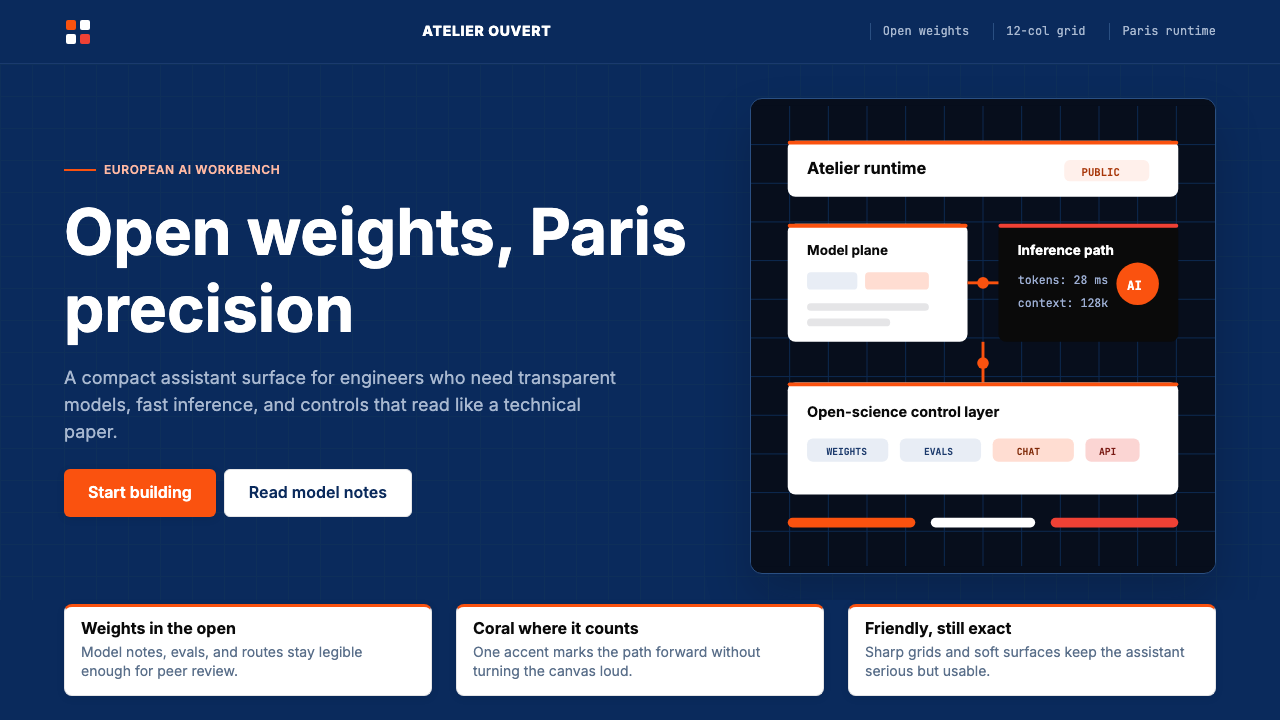 Mistral Le Chat French AIOpen science feels engineered. Navy panels, Inter grids, and coral stripes ke…
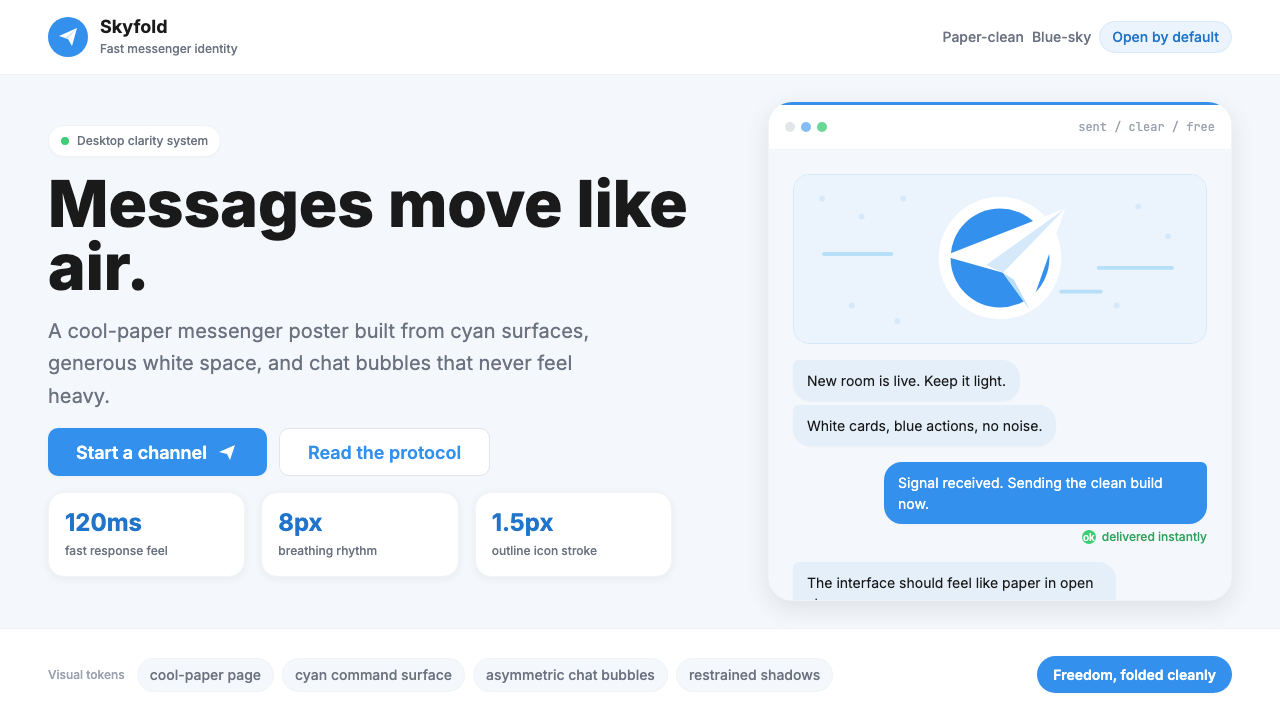 Telegram Blue Paper PlanePaper-clean speed. Cyan planes, white cards, and chat bubbles carry the ident…
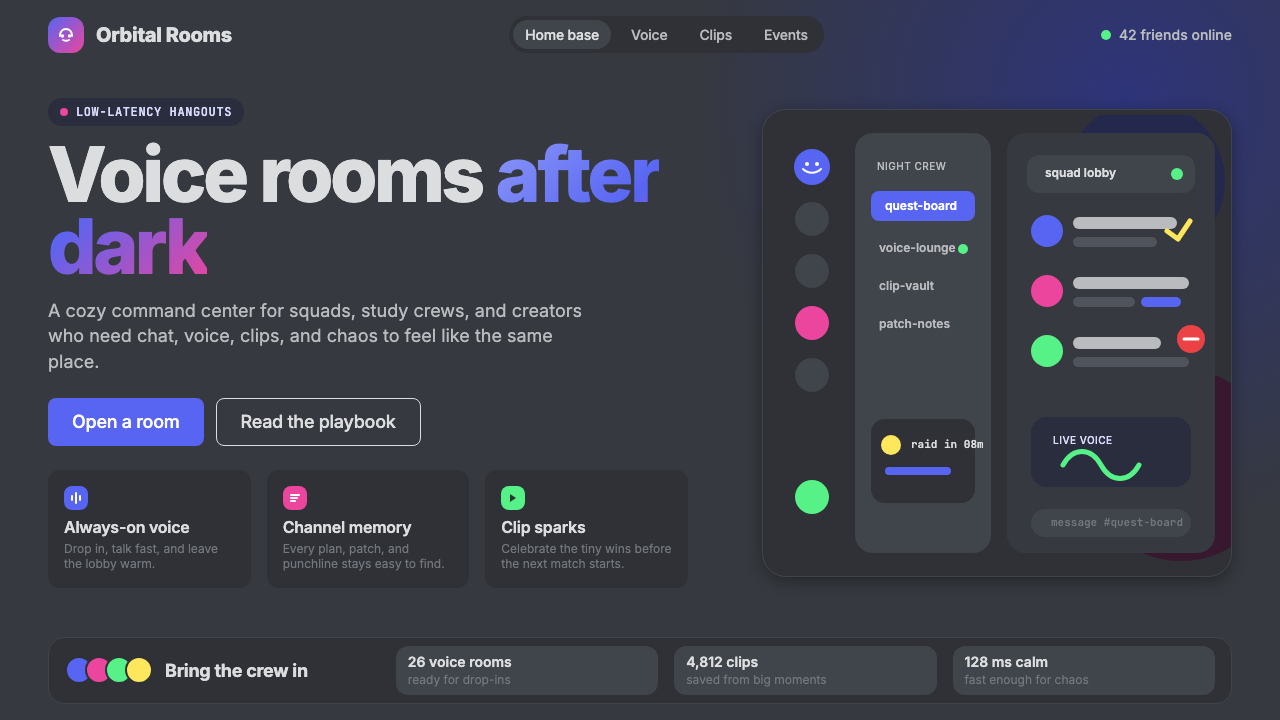 Discord 2024Blurple cozy. Charcoal grounds, illustrated characters — every surface says '…
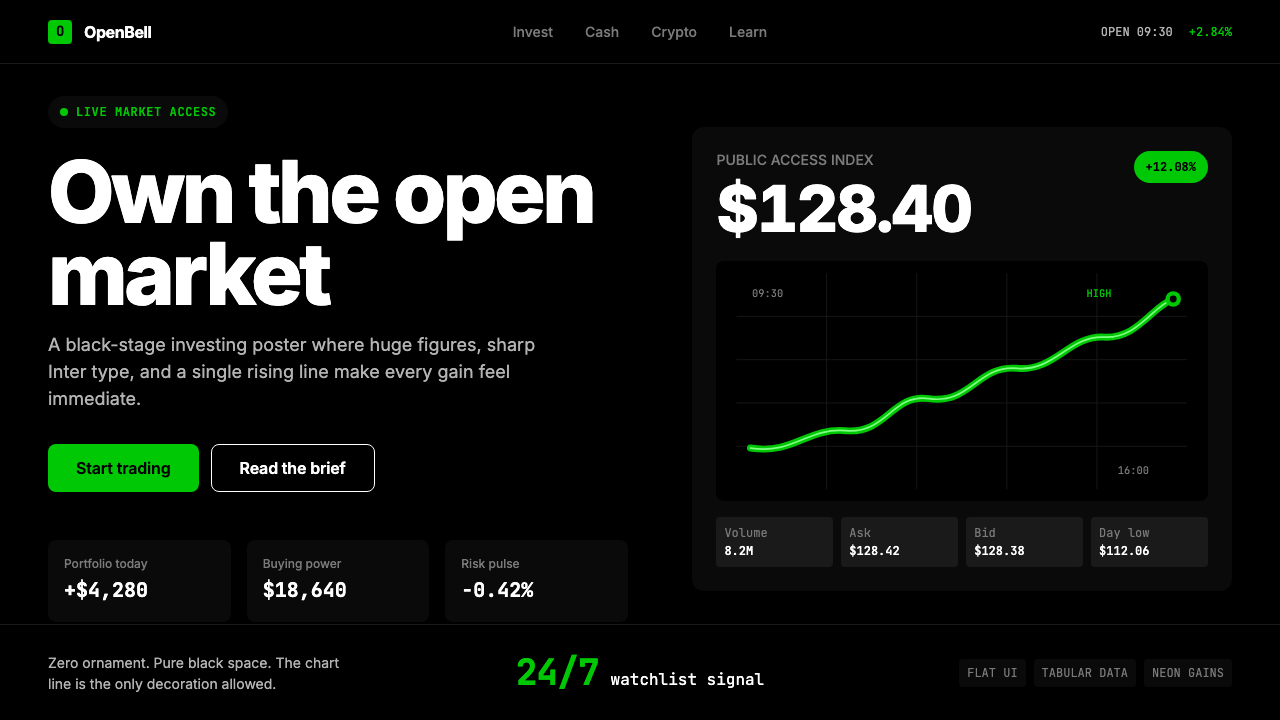 Robinhood 2023Markets feel immediate. Pure black, Inter numbers, and one neon-green line do…