What is Astro Islands Architecture 2022?
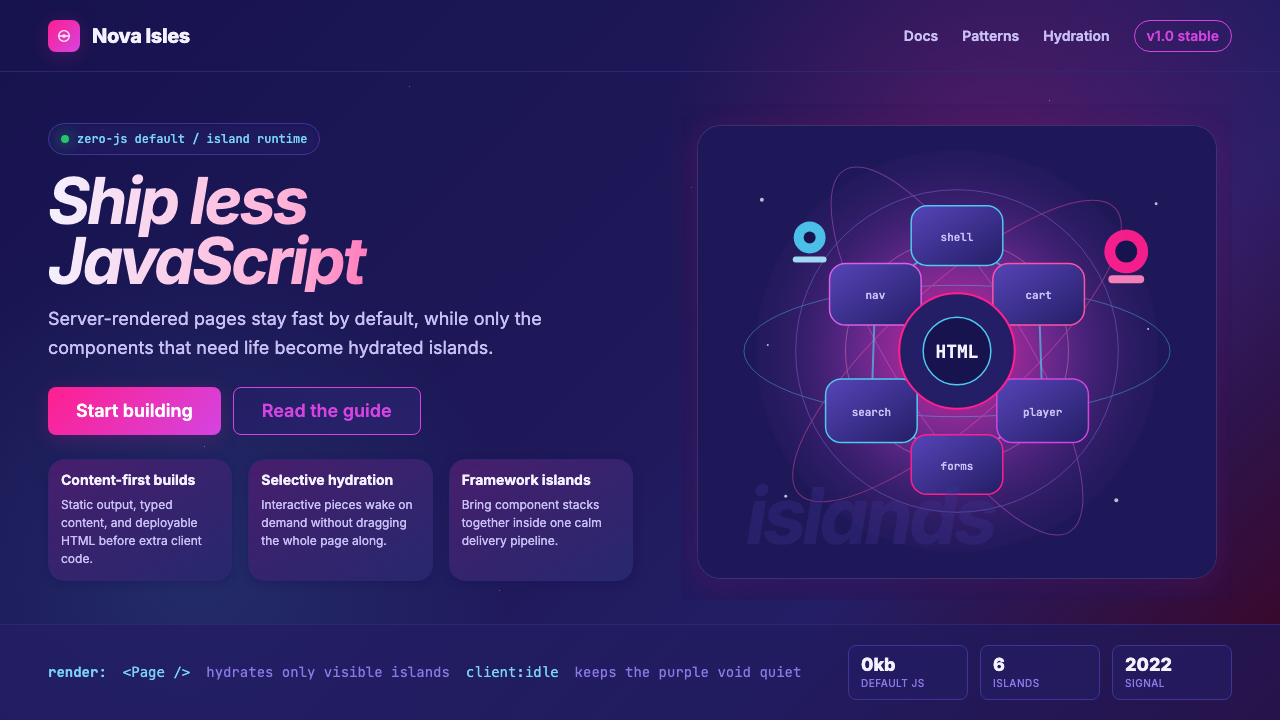
Astro Islands Architecture 2022 fuses deep-violet cosmic gradients with developer-first clarity, proving that a technical framework can carry genuine warmth and personality.
Astro Islands Architecture 2022 in brief
Astro Islands Architecture 2022 is the visual identity that accompanied the release of Astro 1.0 in August 2022 — a design language born inside a developer tool that ended up influencing how an entire generation of documentation sites, framework landing pages, and open-source brand identities look. At its center is a bold tension: cosmic depth rendered in saturated indigo and violet gradients, held in check by the crisp, utilitarian clarity that developer audiences expect and demand.
The style takes its name from the Islands Architecture pattern itself — a philosophy of shipping zero JavaScript by default and hydrating only the interactive components a page actually needs. That philosophy of restraint and purposefulness is embedded in the visual language: every glowing accent has a reason to be there, every soft nebula of color serves as a stage for sharp, readable information. The result is an aesthetic that feels simultaneously futuristic and trustworthy.
What makes this style distinctive among developer brand identities is its emotional register. Most technical documentation defaults to cold neutrality — white backgrounds, system-default type, muted accent colors. Astro's 2022 identity chose the opposite: warm magenta glows against deep violet fields, playful astronaut illustrations that give the framework a mascot-like personality, and a visual richness usually reserved for consumer products. It demonstrated that technical credibility and visual warmth are not mutually exclusive.
Where does Astro Islands Architecture 2022 come from?
Astro was created by Fred K. Schott and launched publicly in 2021, emerging from a community of developers frustrated with the JavaScript weight that had accumulated in modern web frameworks. The core insight — that most website content is static and should not require client-side JavaScript to render — predated Astro, but Astro was the project that gave Islands Architecture a name, a coherent implementation, and a brand capable of communicating the idea to a broad audience.
The visual identity took shape alongside the 1.0 release campaign in 2022. The design decisions were made within a distributed remote team spanning the United States and Europe, and they reflected the sensibilities of a community that had grown up on dark-mode code editors, terminal emulators with neon syntax highlighting, and the science-fiction aesthetics of space exploration imagery. Deep violet and indigo recalled the interface palettes of popular development environments; the magenta glow referenced the hot-pink accent colors popularized by vaporwave and the lo-fi aesthetic movements that had been circulating through developer culture for several years.
The astronaut mascot was a deliberate departure from the abstract logo marks that dominate the developer tooling space. Where most frameworks communicate through wordmarks and geometric symbols, Astro gave itself a character — a spacefarer in a helmet, surrounded by stars, connoting adventure and exploration rather than mere technical utility. This mascot decision aligned the brand with the spirit of the Islands Architecture pattern itself: something new and different from the incumbent JavaScript-heavy mainstream.
By 2022, Astro had attracted contributors including Matthew Phillips, Nate Moore, and Ben Holmes, each of whom helped shape both the technical direction and the community culture that the visual identity expressed. The 2022 brand became a template that influenced dozens of subsequent open-source framework identities, demonstrating that the developer tooling space had developed its own coherent aesthetic vocabulary — one that borrowed from space exploration, retro-futurism, and the expressive possibilities of modern CSS, rather than defaulting to the corporate minimalism that had dominated the preceding decade.
What defines the Astro Islands Architecture 2022 look?
Color — Cosmic Violet Depth
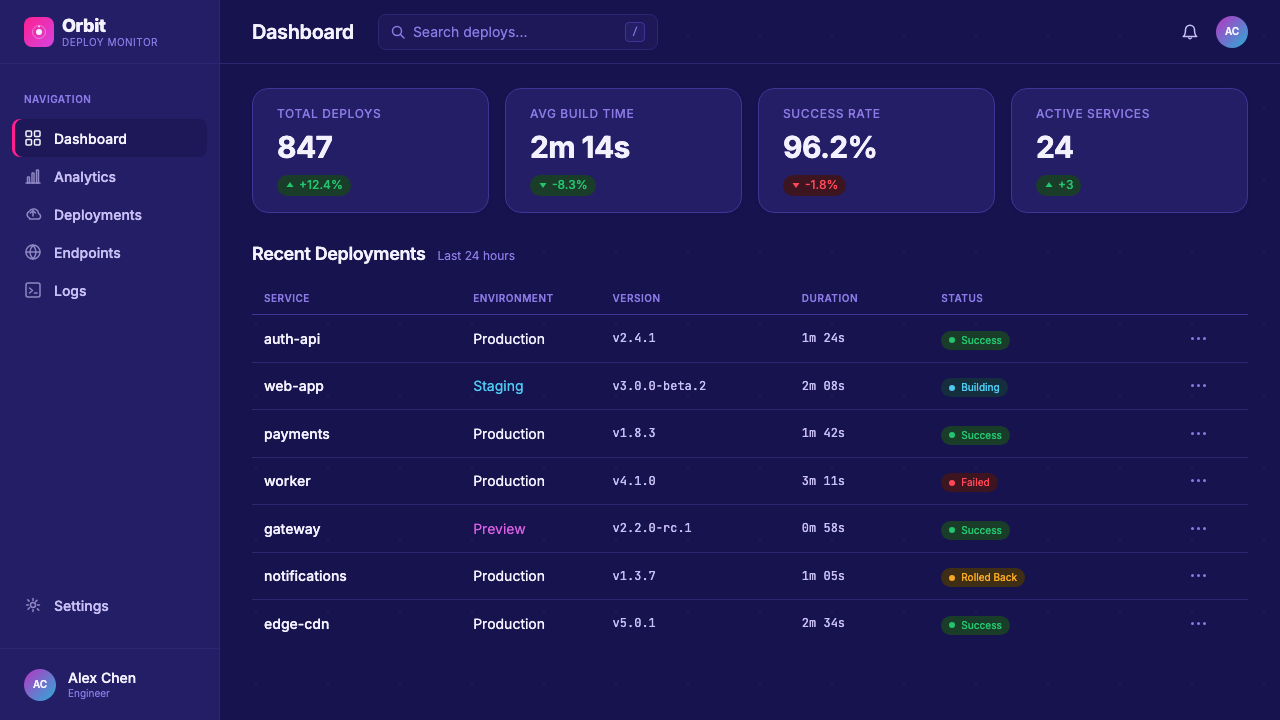
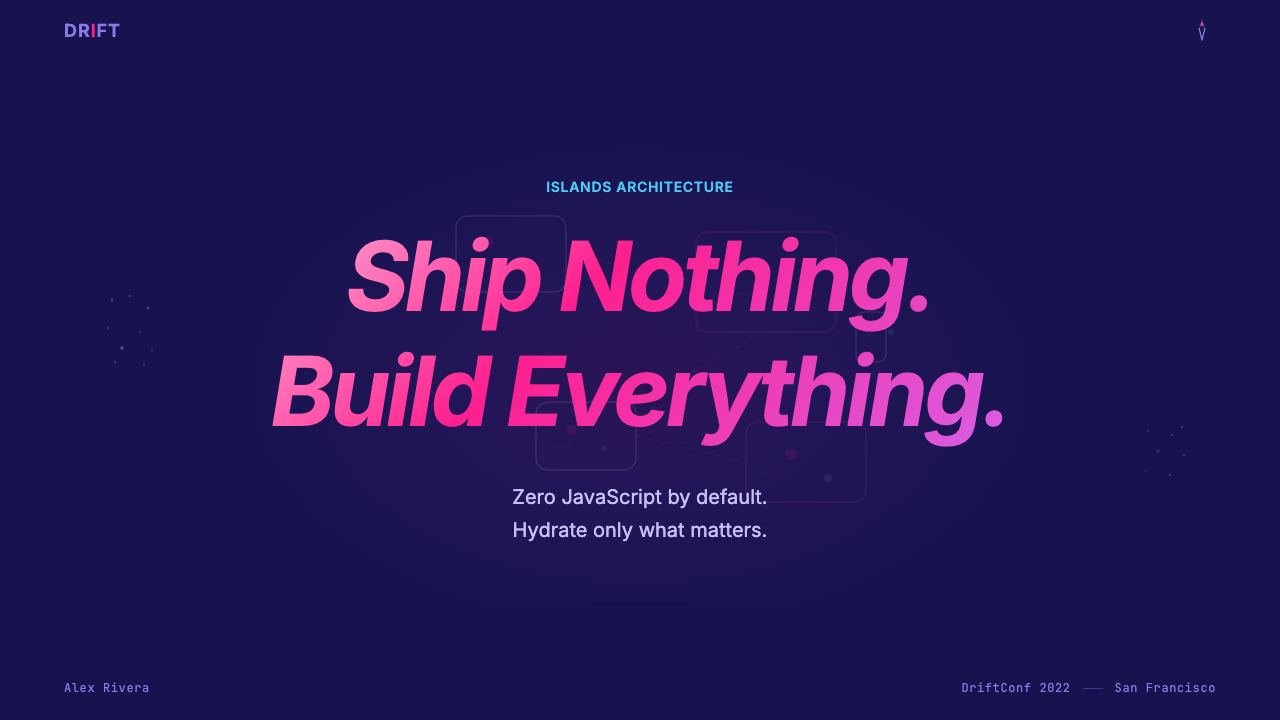
The palette anchors on a rich, saturated indigo-violet that occupies the full background, evoking the depth of outer space without tipping into generic darkness. Against this field, hot-magenta accents glow with a luminous quality — less like painted shapes and more like light sources embedded in the composition. This glow effect creates a sense of warmth that is unusual for deep-dark backgrounds. Secondary neutrals are cool-toned and desaturated, reserving the full saturation budget for the magenta accent and the violet field itself.
Typography — Developer Clarity
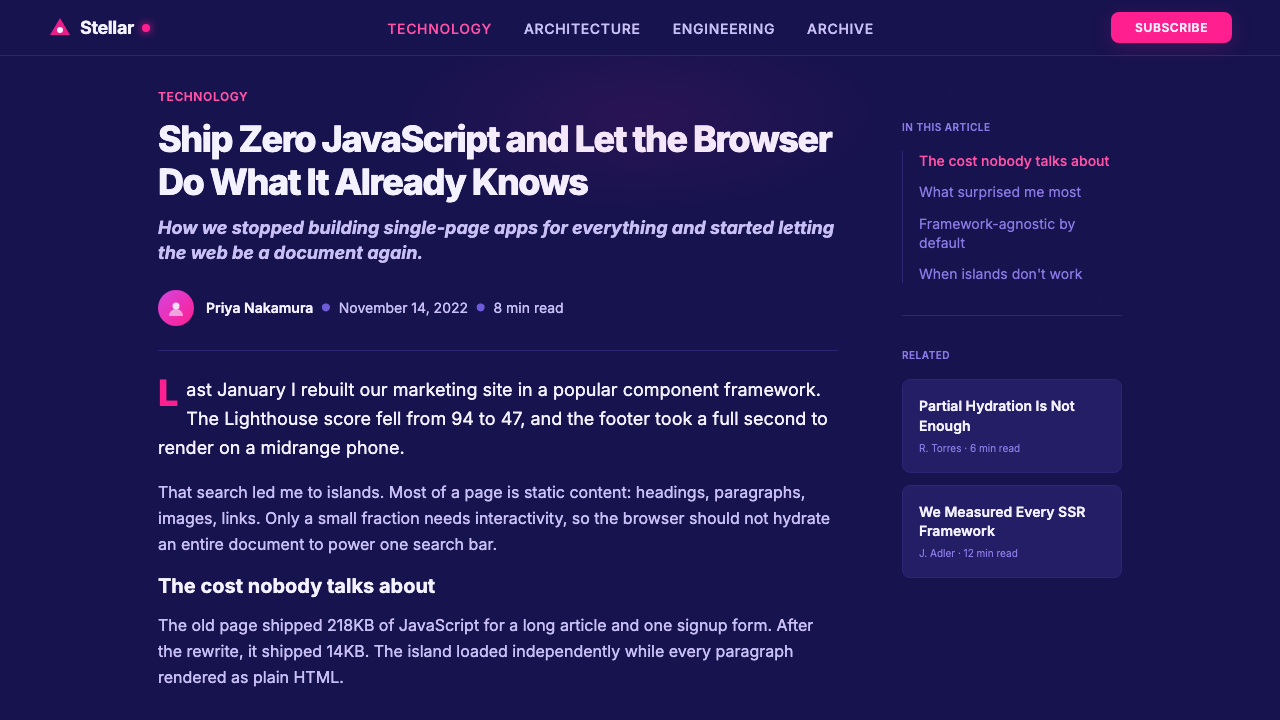
Type is set in a geometric sans-serif that prioritizes legibility at the large sizes required by hero headings and at the small sizes required by code snippets and metadata. The contrast between headline weight and body weight is deliberately amplified — headings are bold and expansive, while body copy sits at a modest weight that does not compete. Monospace type for code samples is treated with the same visual respect as the display type, appearing in distinctly styled code blocks rather than inline interruptions.
Gradients — Purposeful Nebulae
Unlike the hard-edged flatness of modernist styles, this aesthetic embraces gradients as a primary expressive tool — but with restraint. Gradients serve as backgrounds for compositional zones rather than decorative fills for individual elements. The transitions typically move from a deep violet anchor through an indigo mid-range into suggestions of teal or pink at the edges, creating a sense of atmospheric depth. Radial gradients — centered on key focal points — reinforce the glow effect of accent colors and create soft vignettes that guide the eye toward interactive elements.
Illustration — Warmth Through Character
The astronaut mascot is the most distinctive element of the identity and the one that sets it apart from every competing developer brand. The illustration style is clean vector work — smooth curves, a limited palette drawn from the brand colors, and enough detail to convey personality without photographic realism. The character appears in multiple contexts: floating in space, interacting with interface elements, exploring abstract geometric landscapes. This illustrative presence communicates approachability and adventure, lowering the perceived barrier to entry for developers who might find a purely technical brand cold.
Layout — Islands of Content
Layout reflects the Islands Architecture principle at a visual level. Blocks of content are treated as distinct, self-contained units — each with its own background treatment, padding, and visual boundary — rather than as continuous flowing columns. This island-like quality means that sections of a page can be visually distinct from their neighbors while still reading as part of a coherent whole. Feature grids use generous whitespace between cards; hero sections are full-viewport-width compositions with centered focal points; documentation areas switch to a clean, high-contrast light mode to prioritize readability over atmosphere.
Motion — Purposeful Orbital Energy
Animated elements in this style tend toward slow, orbital movements — particles drifting through a star field, gradient orbs that shift position subtly over time, constellation-like connection lines that expand and contract. The motion vocabulary reinforces the cosmic theme without becoming distracting. Transitions between states favor smooth easing curves rather than snappy spring animations; the overall tempo is measured and calm, suggesting the quiet vastness of space rather than the reactive urgency of an action-oriented interface.
Dark-Mode Primacy
This style is fundamentally dark-mode first — the deep violet background is not a variant of a light theme but the canonical, primary experience. Switching to a light mode (where it exists at all, typically in documentation subsections) feels like leaving the brand's emotional core and entering a functional utility zone. This inversion of the usual light-first convention is a deliberate signal that the style belongs to developer culture, where dark interfaces have been standard for decades, and to a generation that associated darkness not with gloom but with focus and craft.
Who shaped Astro Islands Architecture 2022?
Schott is the creator of Astro and the primary architect of the Islands Architecture pattern as Astro implements it. He authored the founding vision of zero-JavaScript-by-default and led the project through its public beta and 1.0 release in 2022. His background in web standards and his work on earlier projects informed the technical philosophy that the 2022 visual identity was designed to communicate — a framework that respected the web's fundamentals while offering a modern developer experience.
Phillips joined the core team and became one of Astro's most prolific contributors during the critical period leading to 1.0. His work on Astro's build pipeline and integration system helped define the framework's scope and capability, which in turn informed what the brand needed to communicate. The visual identity's emphasis on being an orchestration layer — rather than a competing runtime — reflects the architectural decisions that Phillips and the broader core team made.
Moore contributed extensively to Astro's component model and its integrations with popular UI frameworks, helping make the Islands Architecture approach practical for real-world projects. His work on enabling developers to mix components from different frameworks within a single Astro project was central to the framework's appeal — and to the brand narrative of Astro as a meta-framework that transcended the framework wars rather than joining them.
Holmes joined the team during the pre-1.0 period and became closely associated with developer education and community outreach. His contributions to Astro's documentation, tutorial content, and developer-facing communications helped translate the framework's technical philosophy into language that a broad audience could engage with. The warmth and approachability of the 2022 brand identity — particularly its illustrative character and its community-first messaging — owes much to the culture that Holmes and others built around the project.
How do you use Astro Islands Architecture 2022 today?
Astro Islands Architecture 2022 is one of the most transferable developer-brand aesthetics of its era, but it carries strong contextual associations. Used in the right context — technical frameworks, developer tools, documentation sites, open-source project landing pages — it immediately signals credibility within developer culture while providing a visual warmth that distinguishes the product from cold corporate technical brands. Used outside this context, the cosmic depth and magenta glow can read as theatrical or genre-specific in ways that undermine rather than support the message.
For presentation slides, this style works especially well for conference talks aimed at developer audiences, framework comparison presentations, and architectural overview decks. A cover slide benefits from the full cosmic treatment: deep violet background, a centered composition with a large glowing accent element, and the title set in a generous, high-contrast display size. Content slides should switch to a cleaner treatment — lighter backgrounds for body text sections, with the cosmic palette reserved for accent elements, code block backgrounds, and slide-end callout panels. Data slides work best when charts are built from the brand's limited accent palette against a neutral dark background, giving data a gemstone-like vividness.
For web UI, the style is most effective on landing pages, documentation homepages, and feature announcement pages. A landing page built on this aesthetic should open with a full-viewport hero — deep violet gradient background, a heading with significant visual weight, and a subheading that sets up the value proposition. Below the fold, feature sections can use a card-island layout: each card as a self-contained content unit with a slightly lighter or more saturated background than its surroundings. Pricing pages benefit from the style's capacity for visual hierarchy; tier cards should use brightness and saturation rather than borders to signal emphasis.
For editorial and marketing materials — blog post headers, social media graphics, email header treatments, and event banners — the most useful application of this style is the glow-on-dark formula: a deep violet or near-black background with one or two luminous accent shapes that frame the central typographic message. The astronaut mascot, if licensed, can anchor an entire editorial identity. Without it, a strong geometric shape rendered in the magenta accent — a circle, a ring, a burst — functions as a stand-in focal point.
The most common mistake when applying this style is treating the glow effect as decoration rather than structure. Authentic applications of this aesthetic use glowing accents to direct attention — they mark the entry point, the interactive element, the primary call to action. When every element glows, nothing stands out, and the cosmic depth becomes visual noise. A second common error is importing the violet-magenta palette into contexts that call for different emotional registers: medical, legal, or financial interfaces where the science-fiction associations of this palette may undermine rather than support trust.
Astro Islands Architecture 2022 — FAQ
Is this style limited to developer products, or can it work elsewhere?
The style works beyond developer products, but it requires intentional recontextualization. The cosmic violet and magenta glow palette reads naturally as futuristic and exploratory — qualities that suit gaming interfaces, science communication, space and astronomy products, creative tools aimed at digital artists, and forward-looking financial or fintech brands that want to signal innovation. It struggles in contexts that call for organic warmth (food, wellness, home), classical authority (legal, institutional), or conventional consumer trust (insurance, healthcare). The astronaut mascot is specific to Astro and should not be borrowed; the palette and glow aesthetic, however, are public visual territory.
How does this style relate to vaporwave and synthwave aesthetics?
The family resemblance is real but the lineage is distinct. Vaporwave and synthwave both use neon accents on dark backgrounds, gradient skies, and a retro-futurist register. Astro's 2022 identity draws on the same cultural substrate — developer culture absorbed these aesthetics through terminal color schemes, code editor themes, and lo-fi playlists — but applies them with a more contemporary, functional restraint. Where vaporwave embraces excess and nostalgia (grid floors, glitching imagery, Roman busts), Astro's palette is edited and purposeful. The magenta glow is a single accent, not a field of competing neons. The result is closer to the considered darkness of modern design systems than to the maximalism of the retro aesthetic movements that influenced it.
Can this style work in print or physical materials?
Print application is possible but demanding. The style's core effects — glow, gradient depth, luminous accent colors — depend on additive light and are produced by screens; printing relies on subtractive color, which cannot reproduce the glowing quality of backlit violet and magenta. A print adaptation needs to commit to either a very dark, ink-heavy background that approximates the screen feel, or a simplified light-mode interpretation that preserves the geometric structure and typographic clarity while abandoning the glow. Conference materials, branded merchandise, and event signage have been produced in this style, but they typically work best when they simplify to the mascot illustration, the logotype, and the most saturated flat version of the palette rather than attempting to faithfully reproduce the screen-native gradient and glow effects.
What makes the astronaut illustration so effective for a technical brand?
The astronaut works because it resolves a tension that technical brands typically fail to address: the need to signal competence and warmth simultaneously. A purely abstract logo or a geometric wordmark signals seriousness but offers no emotional entry point. A cartoon mascot offers warmth but risks undercutting technical credibility. The spacesuit-clad astronaut occupies a middle ground: the helmet and suit carry the connotations of precision engineering, systematic training, and high-stakes performance; the posture and context (floating freely, exploring) carry the connotations of wonder and adventure. Together they communicate that the product is rigorous AND fun — a combination that is genuinely rare in developer tooling.
How should the glow effect be used to maintain visual hierarchy?
The glow effect is the style's most powerful — and most easily misused — tool. The rule is simple: glow marks importance, so it must be rationed. A single glowing call-to-action button on a page reads as unmissable; five glowing elements compete with one another and cancel each other out. In practice, the hierarchy should run: one primary glow (the most important interactive element or focal point), one secondary glow at reduced intensity (a supporting element or section anchor), and no glow at all on tertiary elements. Background gradient glows — the radial bloom in the hero, the nebula behind a feature section — operate at a scale and diffusion that does not compete with element-level glows; they are environmental rather than directional. Keeping these two categories of glow distinct is what separates polished applications of this style from cluttered imitations.
Related design styles
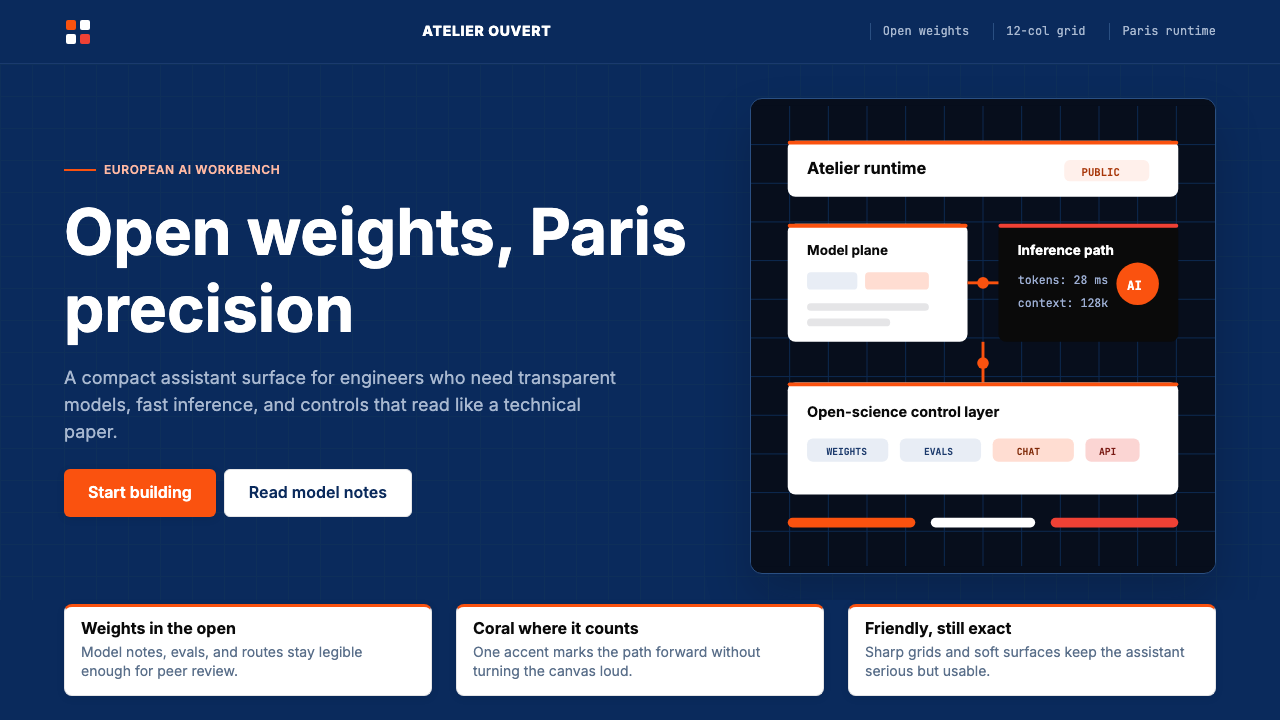 Mistral Le Chat French AIOpen science feels engineered. Navy panels, Inter grids, and coral stripes ke…
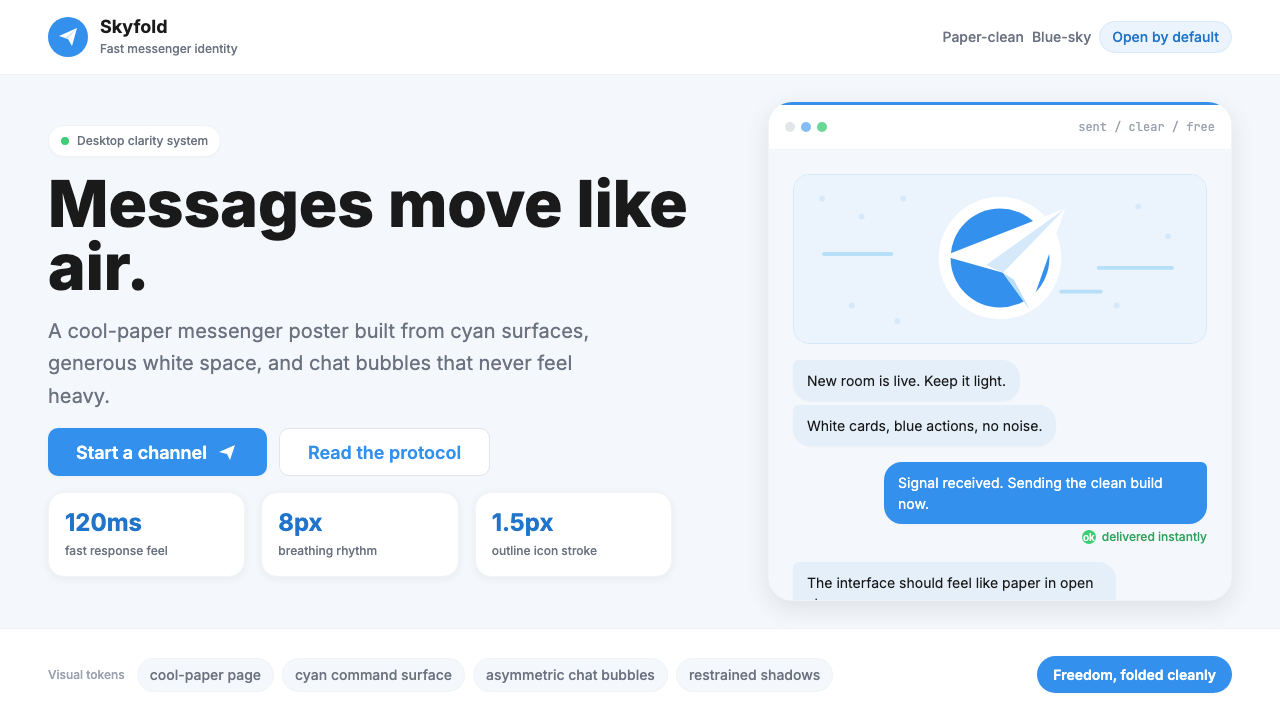 Telegram Blue Paper PlanePaper-clean speed. Cyan planes, white cards, and chat bubbles carry the ident…
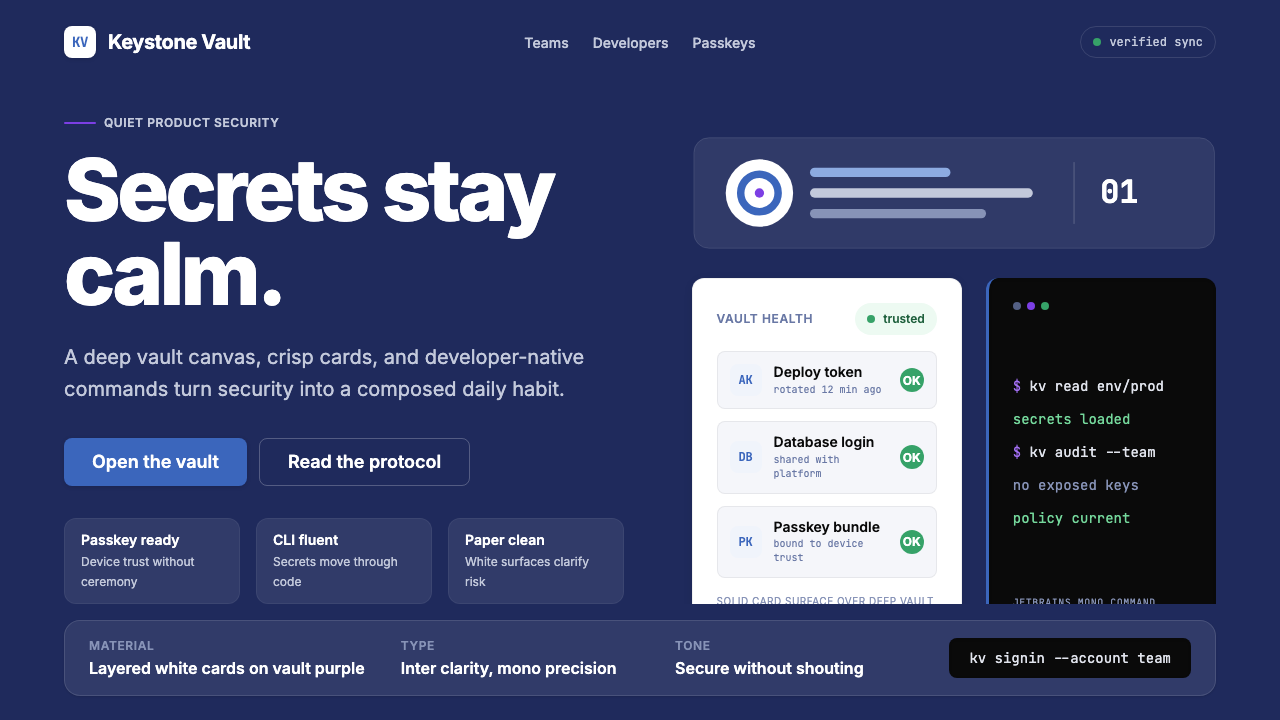 1Password Purple VaultSecurity stays quiet. Vault purple, Inter type, and crisp white cards do the…
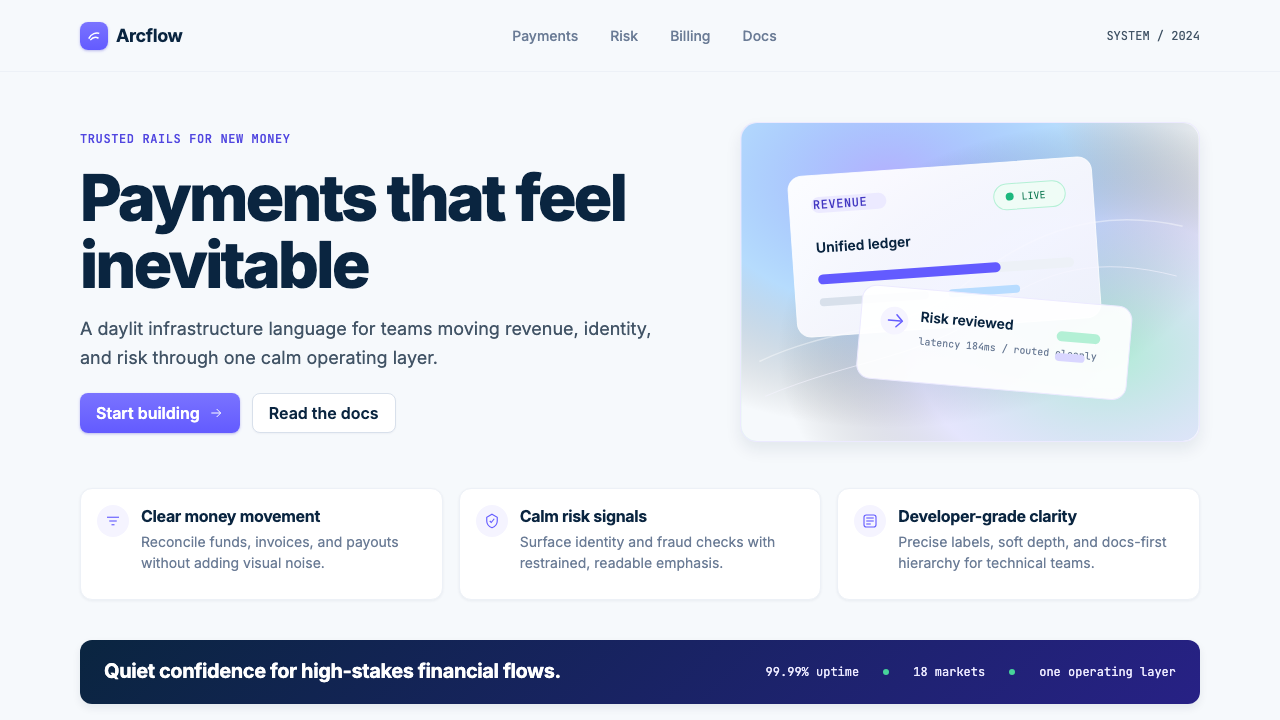 Stripe 2024Trust earns its glow. Indigo mesh, neutral type, and whisper cards float on n…
 Tailscale Mesh VPN 2024Friendly infrastructure. Cool grey cards, magenta mesh nodes, and mono CLI bl…
 Android Bugdroid GreenFriendly tech, reduced to geometry. Vivid green pops from Grey 900 and rounde…