What is Igbo Mbari House?
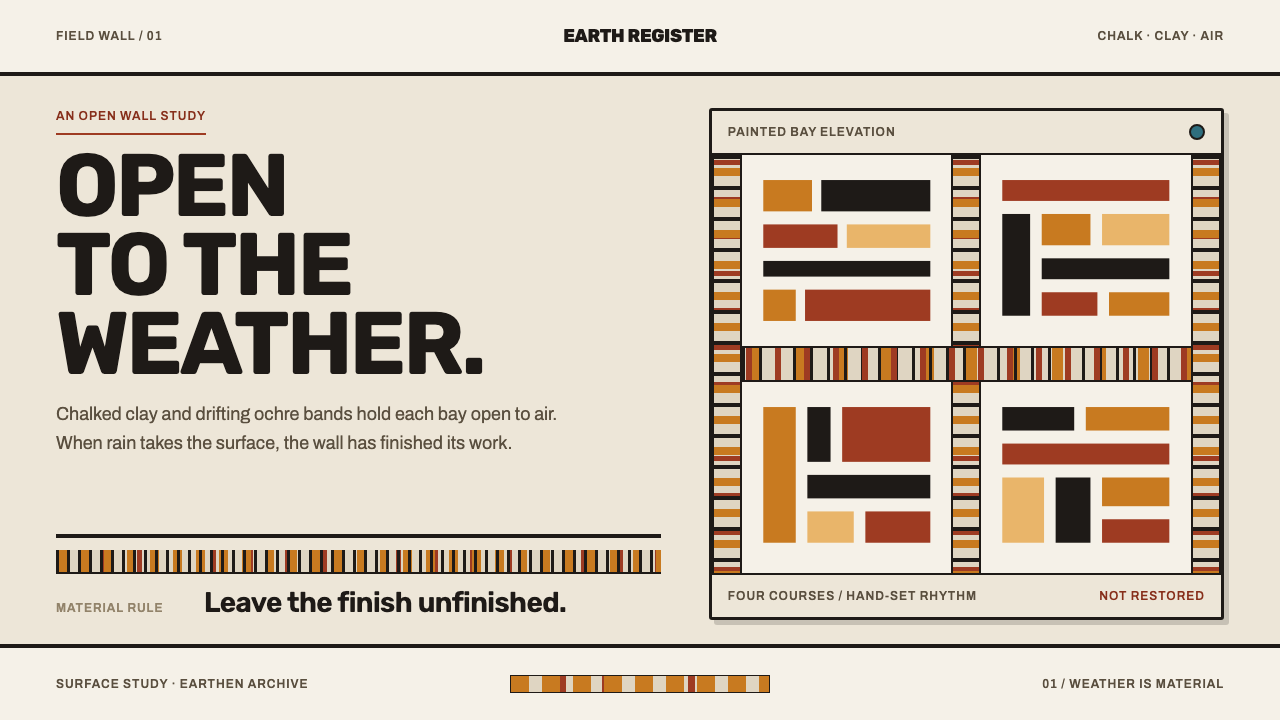
An mbari house is raised from clay, washed in chalk and then left to melt back into the earth, so its finish is time itself.
Igbo Mbari House in brief
Mbari is an Igbo art form of south-eastern Nigeria: an open-sided shelter of anthill clay built as an offering to Ala, the earth goddess, and filled with life-sized figures modelled in mud. Its pillars are washed with nzu, a white kaolin chalk, and banded freehand in ochre, camwood red and charcoal. Along the gallery stand deities, ancestors and the people and machines of the makers' own day, all facing the viewer. As a visual system it is defined by three things: a rough earth ground, a bright chalk surface laid over it, and bold hand-painted bands that are allowed to be imperfect.
What sets mbari apart from almost every other architectural tradition is its attitude to time. Once the house has been consecrated it is not repaired. Rain, sun and insects take it apart over the following seasons, and the clay returns to the ground it was dug from. Weathering here is not damage but part of the design: the house is an offering whose last act is to disappear. A design system that borrows this logic has to treat age as a finish, a surface expected to soften, streak and fade rather than stay pristine.
Visually, the result is both austere and generous. The clay is dull and warm; the chalk is bright and slightly uneven; the painted bands are strong, geometric and visibly made by a hand. Nothing is polished, nothing is symmetrical by machine, and nothing tries to look permanent. The structure is open, a bay framed by two pillars with space through the middle, so that the figures inside feel displayed rather than boxed in.

Where does Igbo Mbari House come from?
The mbari tradition belongs to Owerri and the Igbo communities around it in south-eastern Nigeria. The theme's record places it from before 1900 into the twentieth century, which means it was a living practice, not a relic, for generations. It sits within a larger world of West African earth architecture, in which clay is the primary material for shrines, compounds and palaces, and it overlaps with uli, the Igbo tradition of painted designs on walls and bodies. The same hands and the same sensibility, the idea that a painted surface is an event rather than a monument, run through both.
The fullest outside documentation comes from the American art historian Herbert M. Cole, whose fieldwork in the 1960s recorded how mbari houses were conceived, built and consecrated. As Cole and other observers describe it, the project was a communal vow to the deity: a large group of makers worked together for a long period on a single house, and the building was completed with a ceremony that closed it to further work. After that the house was left alone. The record emphasises that this abandonment was intended and sacred. A visitor who saw an mbari collapsing was not looking at neglect, but at a house doing what it was built to do.
The sculptures inside are the other half of the tradition's identity. They are modelled in clay in frontal poses, with deliberately enlarged heads and necks and long slender limbs that carry no anatomical muscle. The cast of figures reflects the whole of the makers' world: deities and ancestors share the gallery with a colonial District Officer and, famously, with a motorcycle. Nothing is considered too ordinary or too modern to be offered to the goddess. This inclusiveness gives mbari its documentary energy, and it is a useful model for any system that wants to hold the sacred and the everyday in one frame.
Because mbari were designed to vanish, the surviving record is made of photographs, field notes and memory, rather than preserved buildings. That is part of why the style is so well suited to translation. It is not a catalogue of fixed forms but a set of attitudes: rough ground, bright wash, drifting hand-painted bands, open bays, and a surface that is permitted to age. Those attitudes can be carried into other materials, provided they are carried with respect for what the original houses were: sacred offerings, made by a community, for a purpose.
What defines the Igbo Mbari House look?
Chalk over clay
The surface is a bright mineral wash laid over a dull, rough earth ground. The chalk is never a perfectly even coat: clay shows through at the edges, in thin patches and along cracks. In a design, that means a pale, slightly grainy field with a warm earth tone peeking from underneath, not a clean white card. The contrast between the two layers is the entire palette in miniature.
Bands drawn by hand
Ochre, camwood red and charcoal run across the pillars in bold geometric bands. Because a hand drew them, they drift off true, vary in thickness, and taper where the brush ran dry. The bands are the system's ornament and its rhythm, and their slight wandering is essential. A band ruled by machine into perfect uniformity would lose the evidence of the maker.
The open bay
The structural unit is a bay framed by two painted pillars and open through the middle. Content is displayed in the gap rather than enclosed in a solid box. For layout, this suggests cards that are defined by flanking vertical elements and a threshold at the top, with the interior left transparent to the ground behind, so every item feels placed on view.
Frontal figures
The sculptures stand square to the viewer with enlarged heads and necks and long, slender limbs. They are modelled for presence, not anatomical accuracy. In visual terms, the system favours direct, frontal composition, strong vertical rhythm, and emphasis on the head and face over the body. Images and portraits should look straight out of the surface, not turn away in candid angles.
Weathering as finish
The house is designed to age in public. Streaks where rain has run, chalk worn thin at the edges, bands faded by sun are not flaws to be corrected but the final layer of the work. This is an aesthetic of honest wear, and it is different from a decorative grunge filter: the wear follows physical logic, concentrated at edges, corners and exposed upper areas, never sprinkled evenly.
An earth palette
The colours are materials: pale kaolin, yellow ochre, a warm red from camwood, charcoal black, and the muted brown of clay. They are used flat, in large simple areas, with little blending. High-chroma synthetic colours would break the logic that every colour comes from the ground, a tree or a fire.
Sacred and everyday together
A deity, an ancestor, a District Officer and a motorcycle can stand in one row. The tradition does not rank its content by how old or how holy it is; it records the world as the makers found it. In an interface, that is permission for a plural, inclusive, documentary tone, but one that needs rhythm and care, because a plain inventory without order is only noise.

Who shaped Igbo Mbari House?
The art historian whose 1960s fieldwork among the Owerri Igbo is the main outside documentation of mbari. His record of how the houses were conceived, built, consecrated and left to decay is the reason the tradition can be discussed in detail at all. For designers, his work is a reminder that the style comes from a documented, living community practice and should be credited accordingly.
The Igbo earth goddess for whom mbari houses are raised. She is the reason the material is clay: the house is built from her body and returned to it. Understanding Ala's role explains why the style treats ground, weathering and return as meaningful, rather than as limitations to hide.
The community of builders, modellers and painters who made each house, most of them anonymous in the record. The tradition is collective by design: a house is the work of many hands under a shared vow. A system inspired by mbari should carry that sense of group authorship, where the individual hand is visible in a band or a gesture but never claims to be a signature.
Uli is the Igbo tradition of painted designs on walls and bodies, long associated with women artists and with surfaces made to be temporary. It shares mbari's world: pigments from the land, drawing done by eye, and an acceptance that the image will fade. It is the wider tradition within which mbari's painted bands can be understood.
How do you use Igbo Mbari House today?
The mbari system suits work that wants to feel human, communal and honest about material: cultural institutions and museums, craft and food brands, community projects, architecture and landscape studios, and any story told through hands and places. It is less suited to contexts that require surgical precision or glossy tech polish. Its value is that it makes roughness look intentional.
For presentation slides, build the cover like a gallery wall: a chalk-white field with a warm clay edge showing at one side, two bold hand-banded vertical posts framing the title like an open bay. Content slides can reuse the bay as a repeated unit, placing each key point between a pair of thin banded verticals and leaving the middle open. Data slides work best with flat blocks of ochre, red and charcoal on the pale ground, with bar edges left slightly irregular and no gradient fills or glossy highlights.
For web interfaces, use the chalk-washed ground with visible grain, make cards open bays defined by vertical banded edges rather than solid boxes, and give buttons the feel of a chalk-washed slab with a strong ochre or red band. Separators are painted bands that taper at one end. Keep shadows soft and minimal; the depth should come from layered earth tones, not from glow. This style fits portfolios, storytelling sites, cultural archives and campaign pages. It is a poor match for dense financial dashboards where uniform alignment is part of the user's trust.
For editorial and marketing work, use frontal photography, strong vertical rhythm and wide margins that let the chalk field breathe. Section dividers can be hand-drawn bands, headline type can be solid and plain, and captions can acknowledge the source of every image and pattern. A short note crediting the Igbo tradition behind the style, and the community that sustains it, is part of using it well.
The most common mistake is treating it as a distressed texture pack. Overlaying generic scratches, grime and torn edges on a clean template produces fake wear that contradicts the system's logic, because real weathering collects in particular places for physical reasons. The second mistake is exoticism: pasting stereotyped African patterns as decoration. The bands here are specific, sparing and made by hand, and the sacred figures at the centre of the tradition are not ornaments. Keep the bands few, the wear honest and the context respectful.

Igbo Mbari House — FAQ
What is an mbari house?
It is an open-sided shelter of anthill clay built by Igbo communities around Owerri in south-eastern Nigeria as an offering to Ala, the earth goddess. It is filled with life-sized clay figures of deities, ancestors and people, its pillars are washed in white chalk and banded with ochre, camwood red and charcoal, and once consecrated it is left to weather away.
Why is the house left to decay?
Because decay is part of the offering. The record states that the house is not repaired after consecration, and that the clay is meant to return to the earth. Weathering is therefore not damage but completion. This is why the design system treats age, streaking and fading as legitimate finishes instead of problems to be cleaned up.
What are nzu and uli?
Nzu is the white kaolin chalk used to wash the pillars and walls. Uli is the Igbo tradition of painted designs on walls and bodies, and it is the wider context for mbari's hand-painted bands. In the design system, nzu translates into the pale mineral ground and uli into the freehand, slightly drifting bands.
How do I get a weathered look without it feeling like a grunge filter?
Follow the physics. Let wear collect at edges, corners and the upper parts of a surface, let chalk thin out where it would be rubbed, and let the underlying clay show through in patches. Keep the underlying structure clean and the typography legible. Wear that is concentrated and plausible reads as age; wear sprinkled uniformly reads as a texture overlay.
Where does the mbari style work, and where does it struggle?
It works for storytelling, cultural, craft, community and place-based products, where warmth, handmade character and honesty about material are assets. It struggles in settings that rely on glossy precision, such as high-density financial or analytical tools, or where the surrounding brand cannot credit the tradition respectfully. Because the figures at its centre are sacred, the style should be adapted with care rather than used as casual decoration.
Related design styles
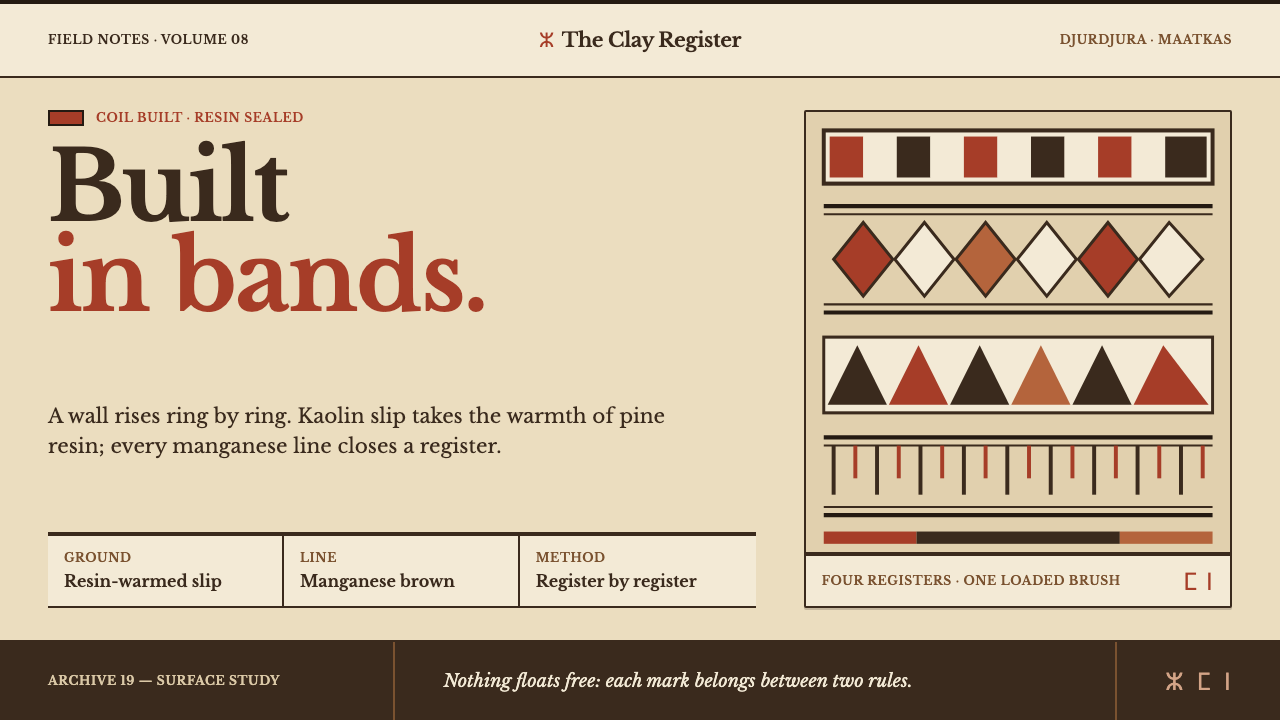 Kabyle PotteryBuilt band by band. Resin-warm kaolin carries manganese rules and iron-red ge…
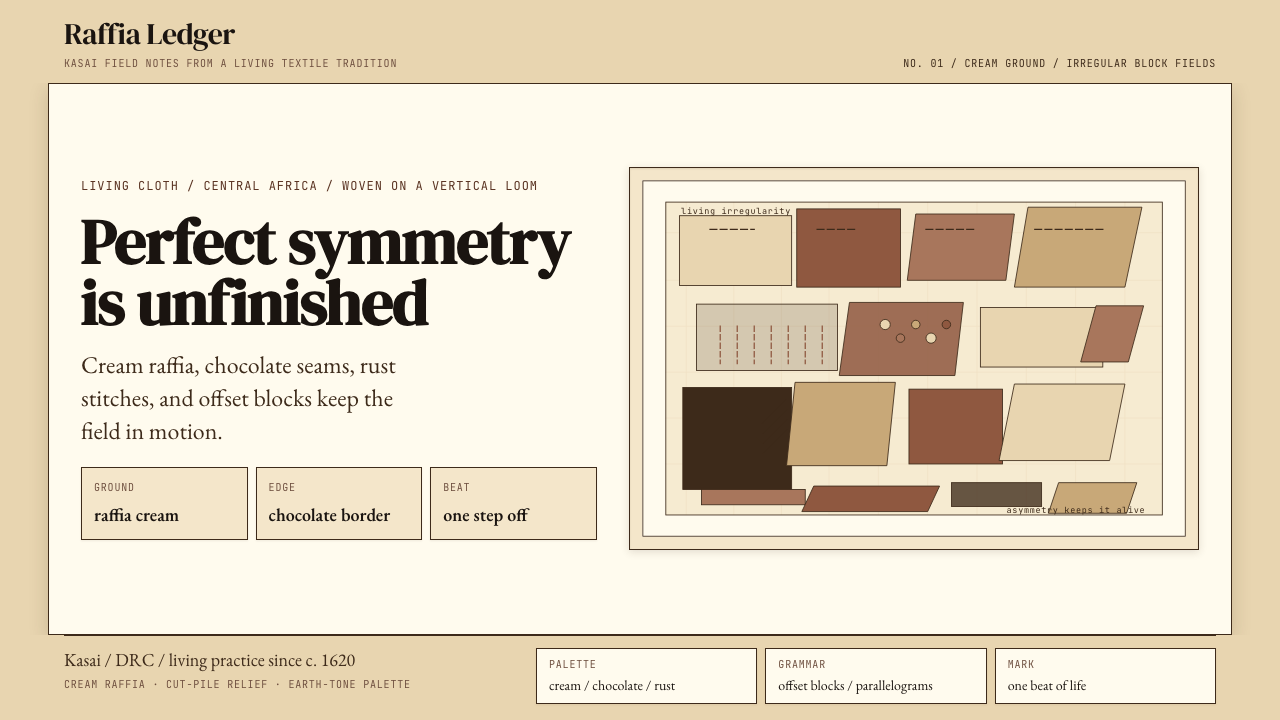 Kuba Raffia Cloth (Congo)Deliberate asymmetry lives. Cream raffia, chocolate seams, and rust blocks.
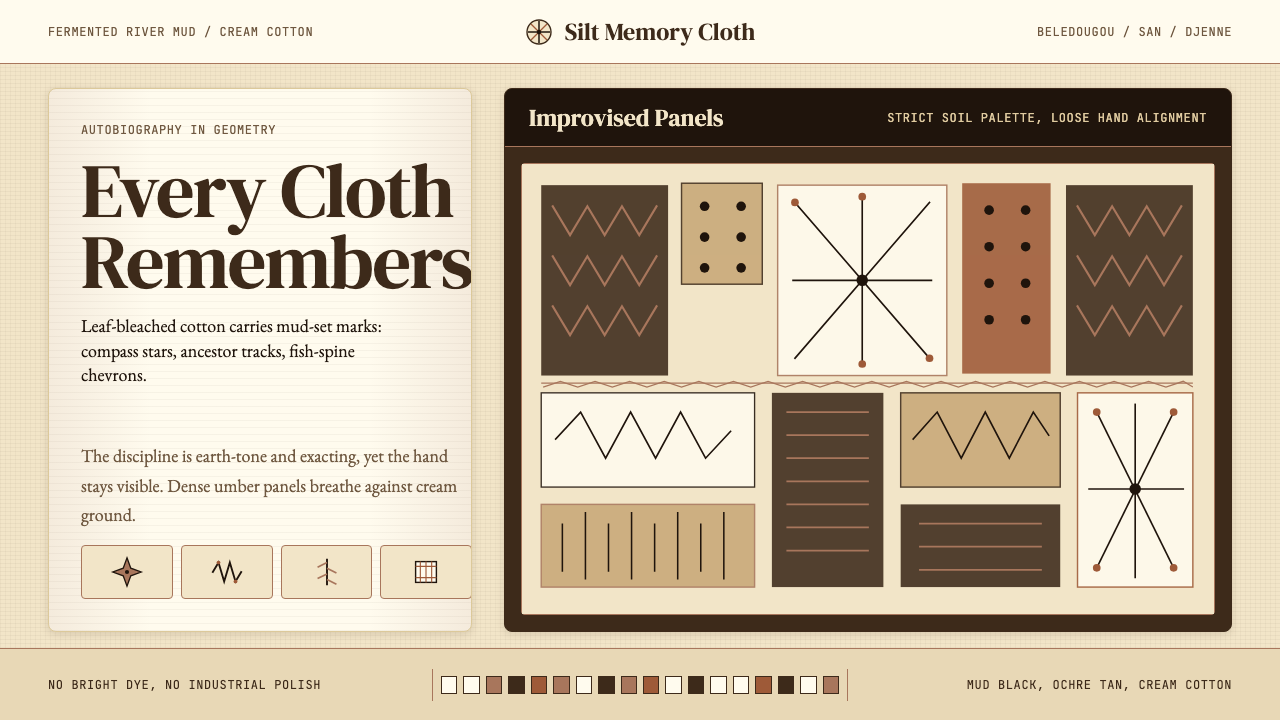 Mali Bògòlanfini (Bambara Mud-Cloth)Autobiography in geometry. Deep umber motifs breathe across cream cotton.
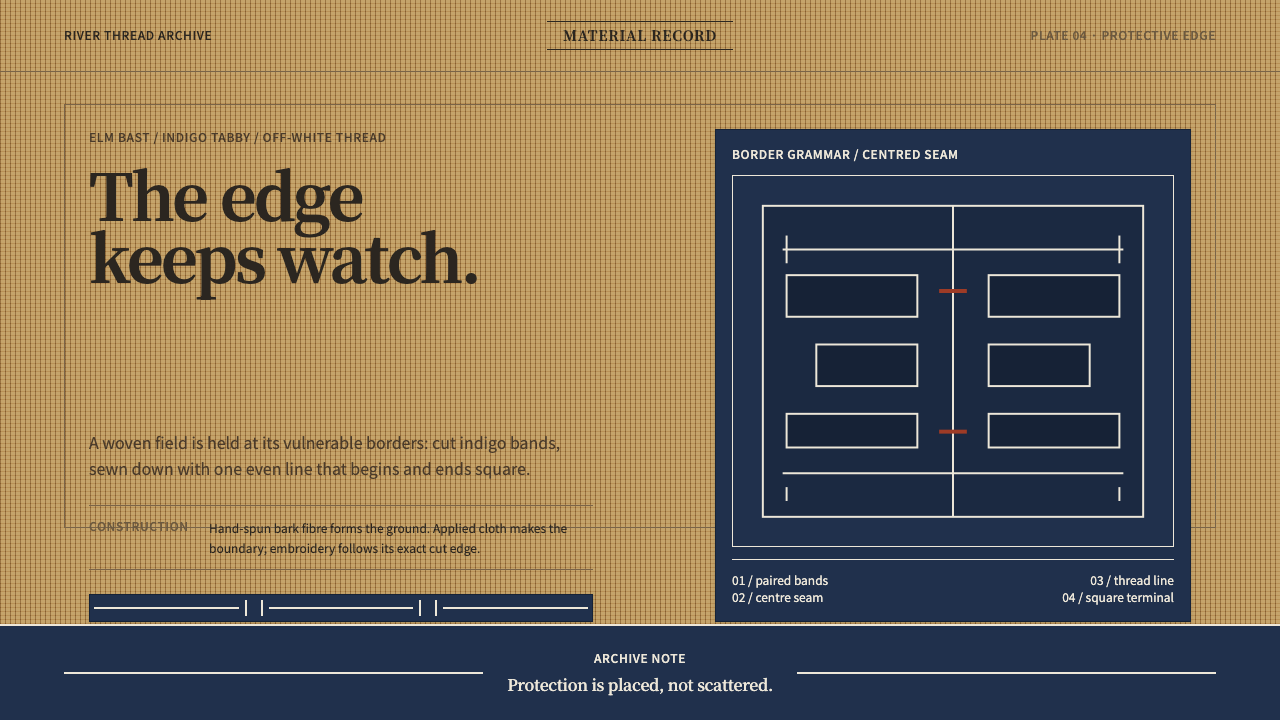 Ainu Attus RobeProtection is cut, not painted. Indigo bands and square-ended thread hold elm…
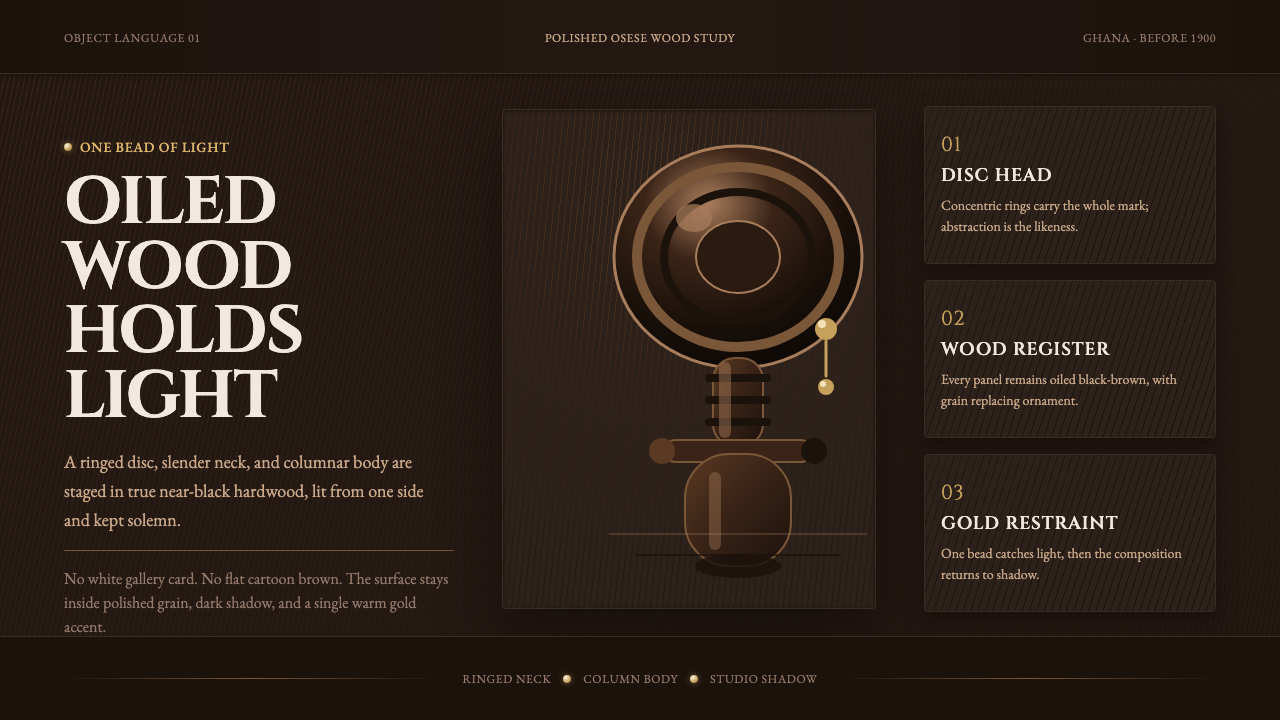 Akuaba Akan Fertility DollDarkness becomes sculpture. Near-black wood, ringed geometry, and one gold be…
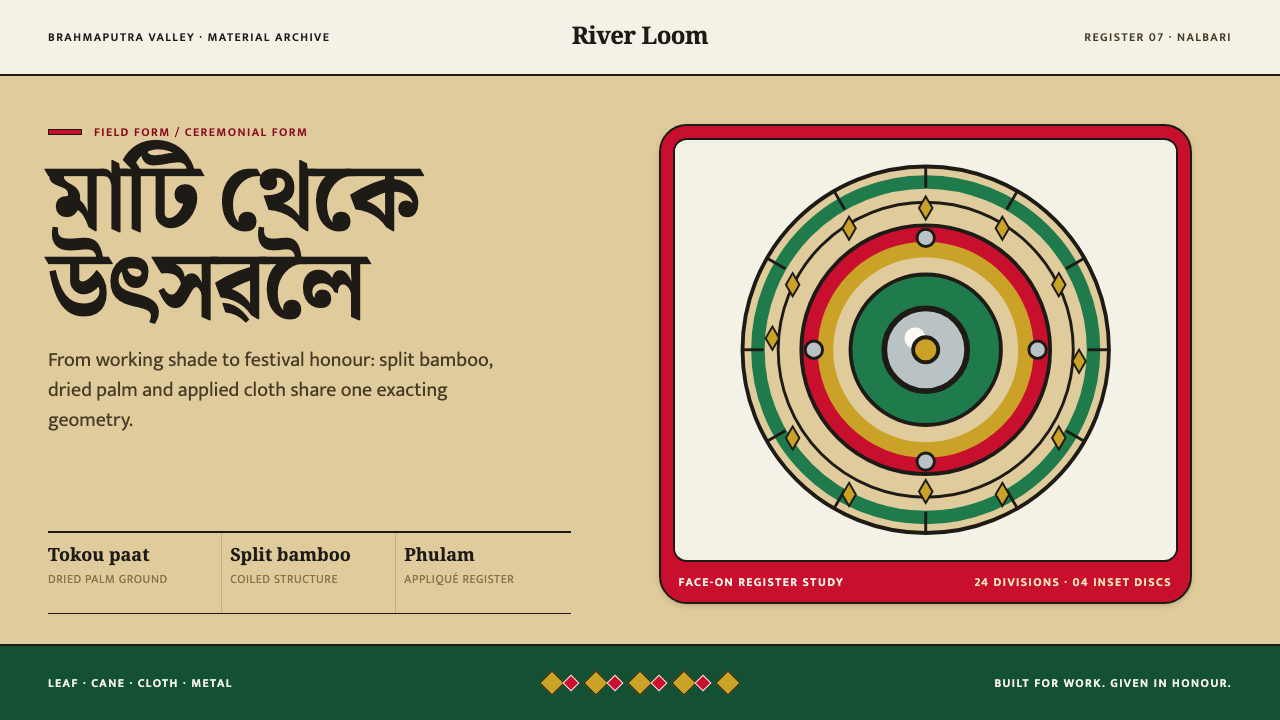 Assamese JapiWork becomes ceremony. Straw-gold rings carry green appliqué, festival red an…