What is Kalocsa Embroidery?
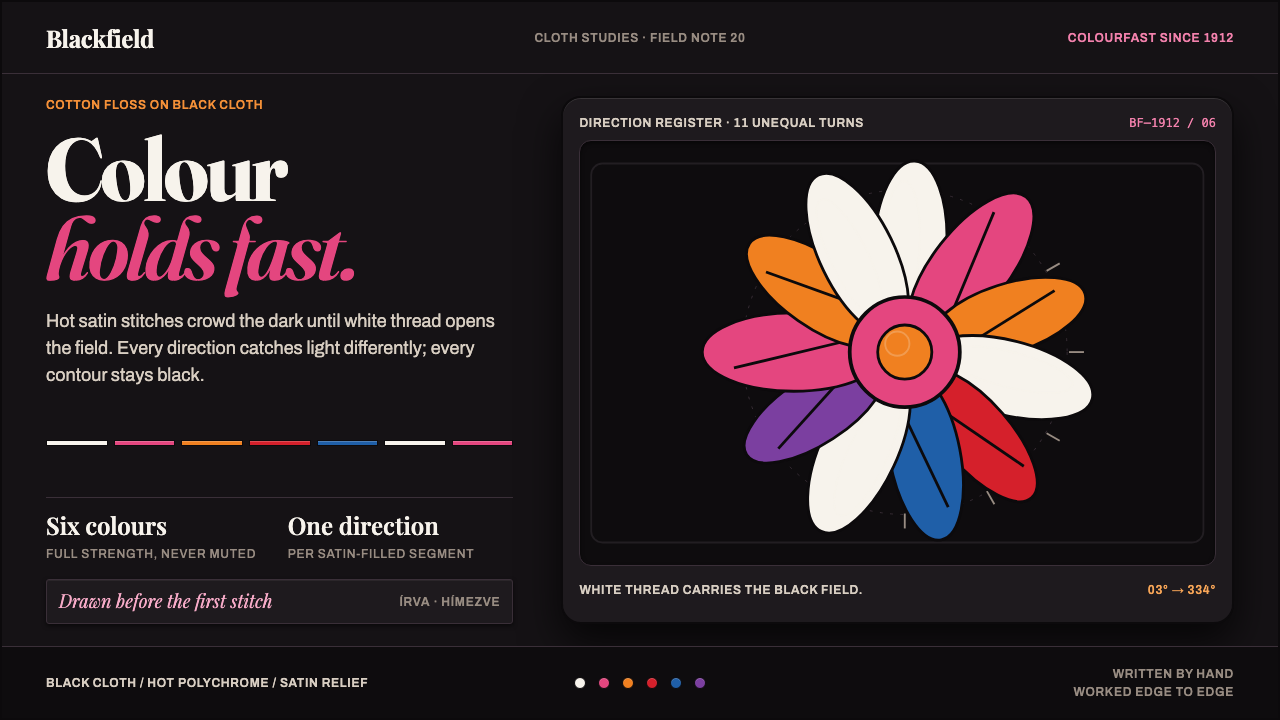
Color burns against black. Hot satin-stitch flowers and white thread pack the field edge to edge, drawn freehand before a single stitch goes in.
Kalocsa Embroidery in brief
Kalocsa embroidery on a black ground is dense cotton floss worked in satin stitch, its pattern drawn freehand directly onto the cloth by a village pattern-drawer, the íróasszony, before a single thread is sewn. The design this system reproduces takes the black-ground branch of the tradition specifically — the cloth worn by older women and used for wall pictures called falikép — rather than the white-on-white or lighter-ground variants the craft also produced at other points in its history.
The palette on black is not casual brightness; it is a solved problem. Burgundy and dark green, colors that read clearly on a pale ground, disappear visually against black cloth, so the black-ground tradition shifted its emphasis to white daisy and lily-of-the-valley motifs that carry real contrast, with every petal edge and the scalloped border trim known as riseling worked in black thread to keep the shapes legible against their own ground.
Every stitch runs in one consistent direction across a given shape, which means light catches the satin floss and each petal picks up its own individual sheen rather than reading as a flat, uniformly colored fill — the surface has real, physical dimension even though the motifs themselves are two-dimensional in layout.
Where does Kalocsa Embroidery come from?
Kalocsa embroidery developed in and around the town of Kalocsa and the neighboring Sárköz villages of Bács-Kiskun County in southern Hungary, a region whose folk art traditions are formally recognized on Hungary's Hungarikum list, a designation covering the combined practice of írás (freehand pattern-drawing), hímzés (embroidery), and pingálás (wall painting). These three crafts developed together rather than separately, and it is common for the same women's community, or even the same practitioners, to move between drawing patterns, stitching them, and painting related motifs directly onto interior walls.
The tradition's color story moved in distinct stages rather than arriving fully formed. Early Kalocsa work was worked in white thread on a white ground, later shifting to a black or blue-black ground as a separate, more somber register used by older women and for wall pictures. The dense, saturated polychrome most associated with Kalocsa today only became possible after 1912, when a mill in Nagyatád began supplying colorfast thread — dye that would not run or fade the way earlier available yarns did, which had limited how boldly color could be used until that point.
Full polychrome embroidery, layering many hot, saturated hues in a single piece, developed through the 1920s and 1930s, building on the colorfast thread that had become available only a decade or so earlier. The black-ground register that this design system specifically reproduces sits alongside that fuller polychrome tradition as its own distinct branch, retaining white and black as its structural colors even as other Kalocsa work moved toward maximal color density.
The craft's transmission has always run through named roles within the village rather than through formal institutions: the íróasszony who draws the pattern freehand, the embroiderers of the Sárköz villages who stitch it, and the pingáló women who apply related motifs to walls. This structure — drawing, stitching, and painting as three linked but distinct crafts practiced by named community roles — is part of what the Hungarikum listing formally protects.
What defines the Kalocsa Embroidery look?
Black Ground
The base is a solid, deep black cloth, historically the register worn by older women and used for falikép wall pictures rather than the brighter cloth used elsewhere in the tradition. Black is treated as an active, structural color choice rather than a neutral backdrop — it determines which other colors will read clearly and which will not.
White as Primary Motif Color
White daisy and lily-of-the-valley motifs carry the visual weight of the composition, chosen specifically because white contrasts clearly against black where colors like burgundy or dark green would simply vanish. White here functions the way a bold accent color would function on a light ground — it is the color the eye is meant to follow first.
Black Keyline and Border Work
Every petal edge and the scalloped border trim known as riseling is worked in black thread, a deliberate choice that keeps pale motifs legible and crisply bounded against their own dark ground rather than letting edges soften or blur into the black cloth beneath them.
Satin Stitch Directionality
Stitches within a given shape all run in a single, consistent direction, producing a subtle directional sheen as light catches the floss. This gives each motif a genuine surface texture and a sense of individual dimension, distinguishing it from a flat, uniformly printed color fill.
Edge-to-Edge Density
Motifs pack the available field densely, edge to edge, rather than floating with generous open space around them. This produces a saturated, maximalist reading even though the color count itself, on the black-ground register, is deliberately restrained to white and black.
Freehand Pattern Origin
Every pattern begins as a freehand drawing applied directly to the cloth by the íróasszony, not a repeated stencil or a mechanically reproduced template. This origin gives the finished motifs a slightly irregular, hand-drawn quality even within an overall symmetrical or repeating composition.

Who shaped Kalocsa Embroidery?
The íróasszonyok are the named community role responsible for drawing every pattern freehand directly onto the cloth before any stitching begins. Their freehand draftsmanship, rather than a stencil or printed template, is the origin point for every motif in the tradition, which is why finished embroidery carries a hand-drawn irregularity even in symmetrical compositions.
The embroiderers of the Sárköz villages carried out the dense satin-stitch work that turns a freehand pattern into a finished piece, developing the directional stitching and edge-binding techniques — including the black-thread outlining and riseling border trim — that define the tradition's finished surface.
The pingáló women applied related motifs directly to interior walls as painted decoration, a parallel craft to embroidery that shares the same visual vocabulary of dense floral motifs. Their work, alongside the íróasszonyok and the embroiderers, forms the three-part Hungarikum-listed craft complex that this tradition is formally recognized under.
How do you use Kalocsa Embroidery today?
This system's core lesson is that a restrained, high-contrast color pair — here, white against black — can carry a maximalist, edge-to-edge density without becoming visually chaotic, provided the contrast is strong enough and the linework is consistent enough to keep every motif legible. Applying it well means resisting the urge to add more colors than the black ground can actually support.
For presentation slides, the black-ground, white-motif logic works well for a cover slide that wants to feel rich and crafted rather than corporate-minimal: a dense, edge-to-edge decorative border or motif frame in white-on-black, with a black keyline detail carried through, can frame a title without competing with it for attention. Content slides should use the density sparingly — as a border treatment or section divider rather than a background applied to every slide, since the system's visual weight is meant to be encountered occasionally, not constantly.
For web interfaces, the black-ground-plus-white-accent pairing suits dark-mode designs that want warmth and craft rather than a cold, purely digital dark theme — a dense decorative motif can anchor a header or footer region, while the interior content areas stay simpler, echoing how the historical craft reserved its densest work for borders and focal panels rather than covering every surface equally. The directional-stitch sheen has no literal digital equivalent, but a subtle, consistent highlight or texture on decorative elements can gesture toward the same handmade quality.
In editorial and brand contexts, the pairing of freehand-drawn irregularity with dense, confident execution supports a handmade, heritage-craft brand voice — a single motif rendered in white-on-black with black keyline detailing makes a strong, recognizable mark or divider, and works especially well for brands built around textile, folk-craft, or regional-heritage positioning.
The most common mistake is introducing the fuller Kalocsa polychrome palette — burgundy, dark green, and other saturated hues — onto the same black ground this system uses, which recreates exactly the legibility problem the black-ground tradition solved by shifting to white. A second common mistake is flattening the motifs into a single uniform color fill without directional linework, which discards the subtle dimensional sheen that satin-stitch directionality is responsible for.
Kalocsa Embroidery — FAQ
Why does this system use only white and black instead of Kalocsa's famous bright polychrome?
Because it reproduces a specific, earlier branch of the tradition — the black ground worn by older women and used for wall pictures — where the color logic is a solved contrast problem rather than an invitation to maximal color. On black cloth, colors like burgundy and dark green disappear visually, so the tradition shifted its emphasis to high-contrast white motifs. The fuller, saturated polychrome most people associate with Kalocsa belongs to a separate branch of the same craft, developed after colorfast thread became available in 1912.
Why is so much of the linework done in black thread even where the motif itself is white?
Because a white motif with soft, undefined edges would blur into the surrounding black cloth and lose its shape. Outlining petal edges and border trim in black thread gives every white shape a crisp, deliberate boundary, keeping the motif legible as a distinct form rather than a vague pale mass against the dark ground.
Does the pattern need to look hand-drawn, or can it be perfectly symmetrical and machine-precise?
The tradition's authenticity comes specifically from the freehand drawing stage carried out by the íróasszony before any stitching begins, so a small degree of hand-drawn irregularity is part of the system's genuine character rather than a flaw to be corrected. A version that is engineered to be perfectly, mechanically symmetrical throughout tends to read as a printed imitation rather than as a piece connected to the drawing-then-stitching craft process the tradition is built on.
Can this black-ground style be combined with the brighter Kalocsa polychrome in the same piece?
It is possible but requires care, because the two registers solve different problems and were historically worn or displayed in different contexts — the black ground for older women and wall pictures, the bright polychrome for other garments and occasions. Mixing them in a single composition risks diluting the specific contrast logic that makes the black-ground version work; if combining registers, it is more effective to keep them as clearly separated sections rather than blending their palettes together.
Related design styles
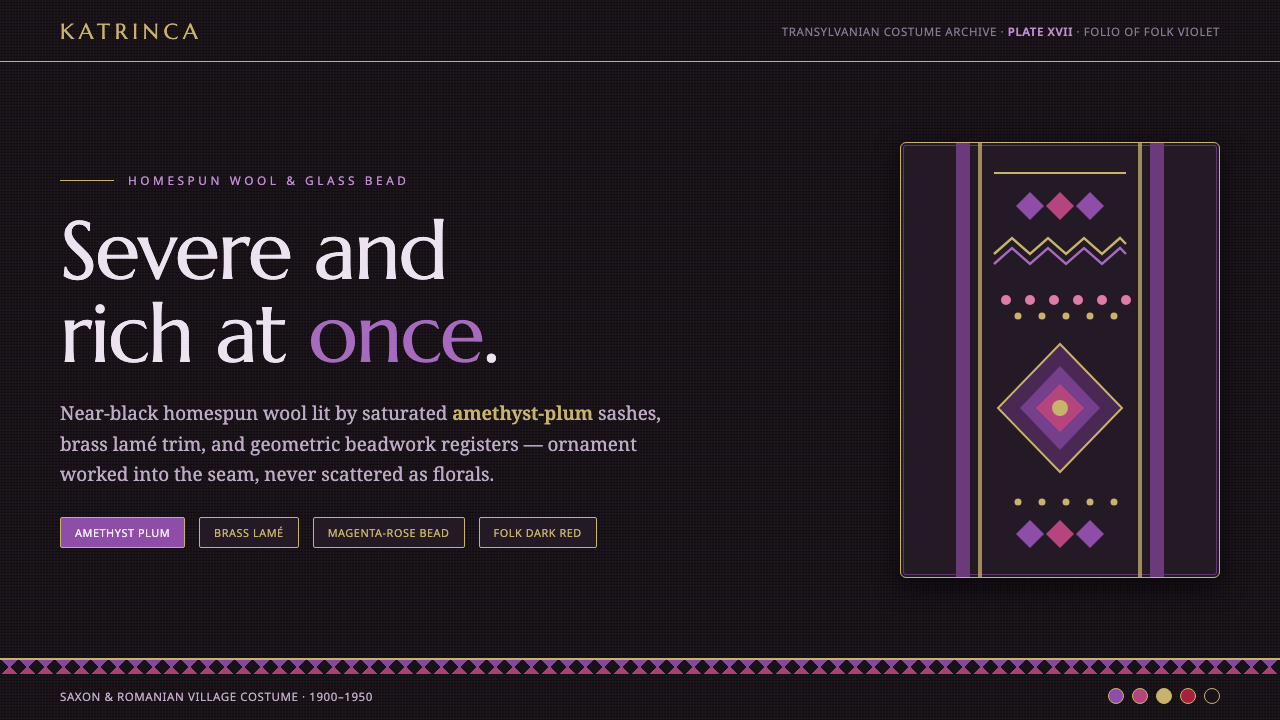 Romanian Folk VioletSevere and rich at once. Near-black homespun wool lit by amethyst-plum and br…
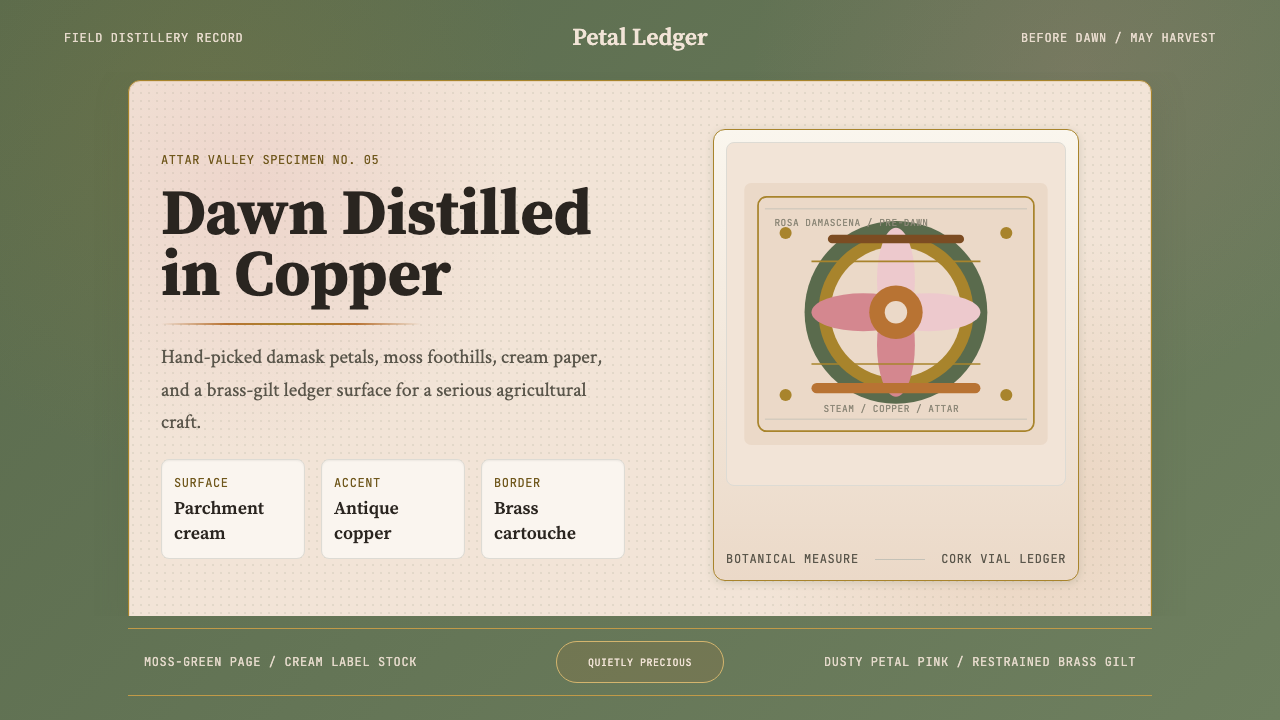 Bulgarian Rose Attar (Valley of Roses)Quietly precious craft. Moss green, dusty rose and brass borders frame a dawn…
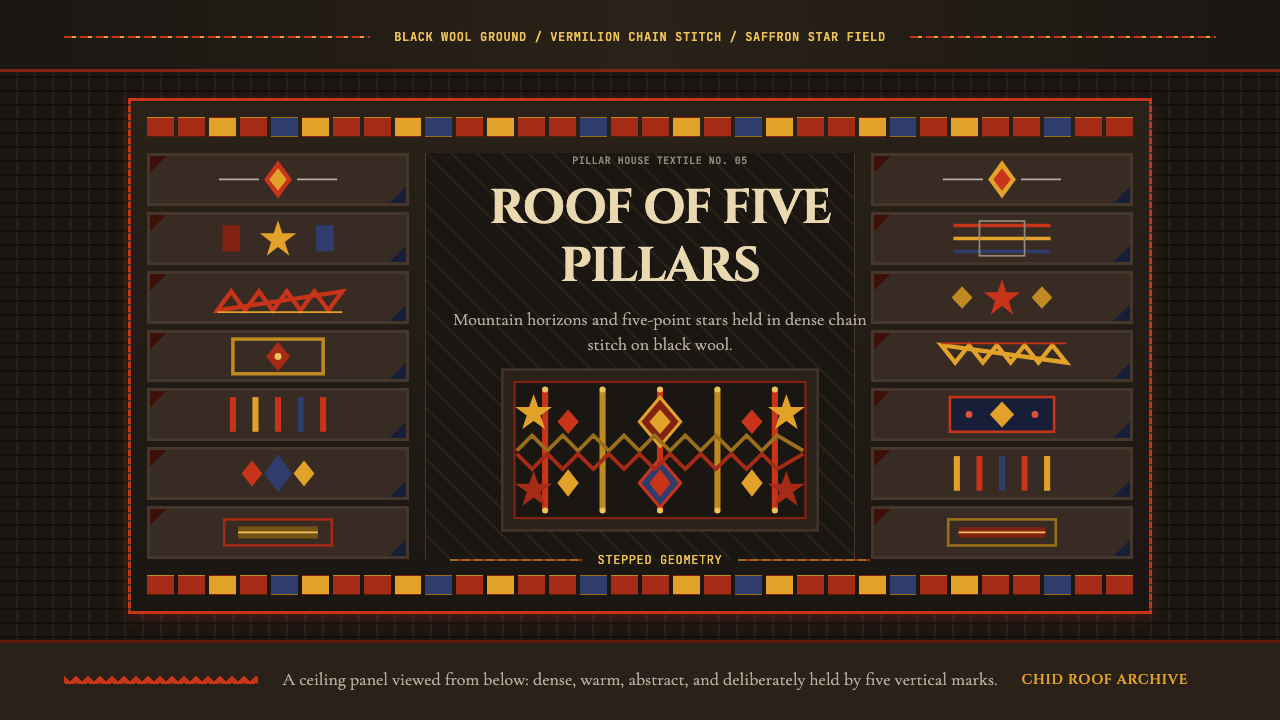 Tajik Pamir Needlework (Chid Roof)Cosmos stitched into wool. Vermilion diamonds and saffron stars hold a five-p…
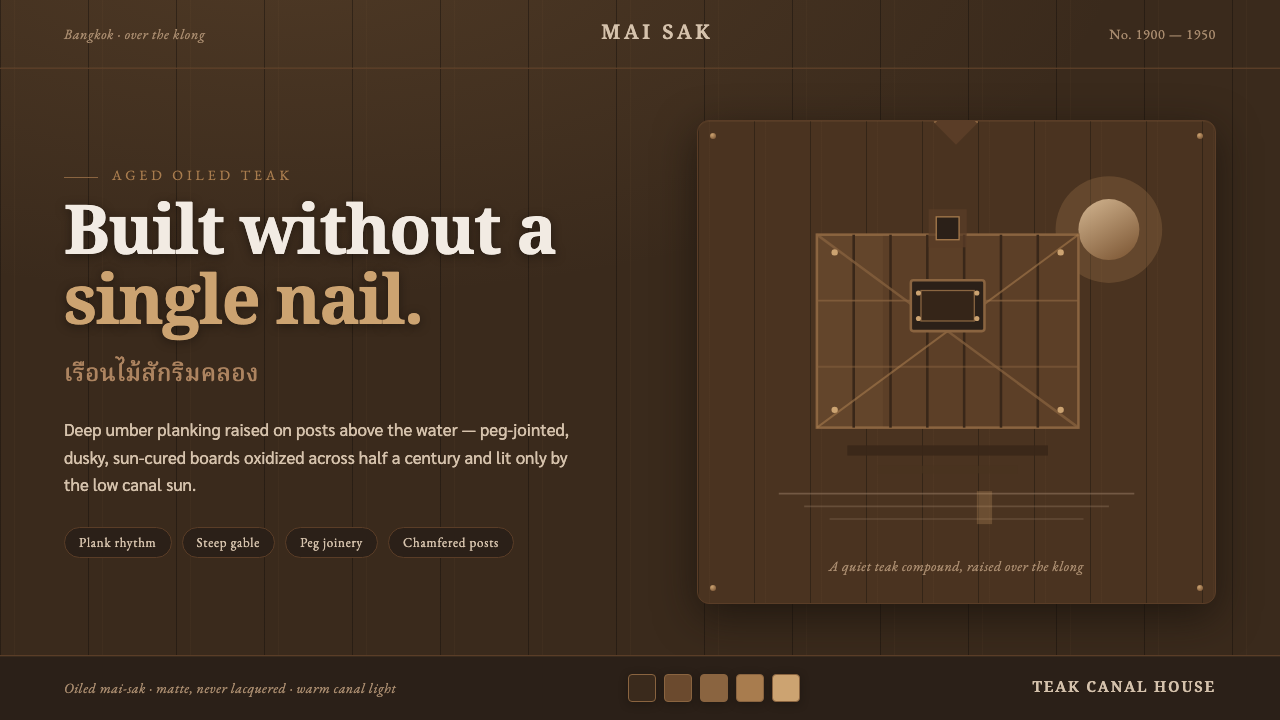 Thai Teak Canal HouseAged oiled teak, never fresh-sawn. Deep umber planks raised over the klong, l…
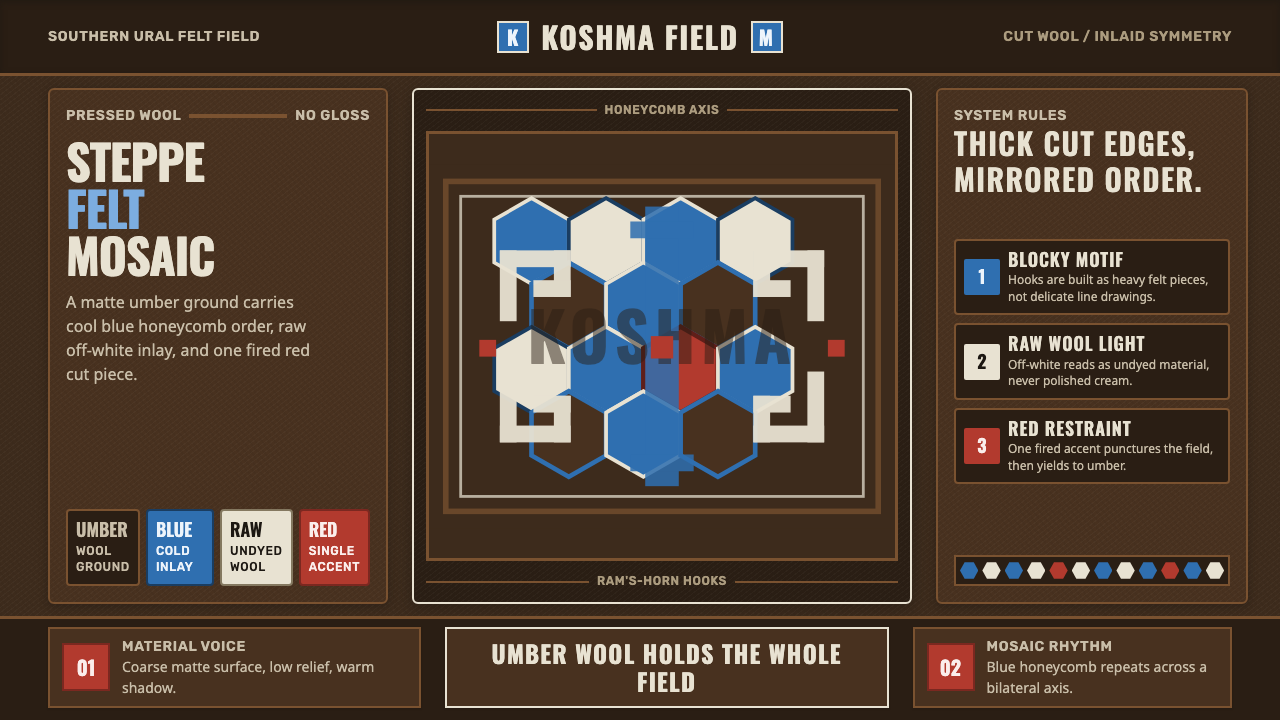 Bashkir Honeycomb Felt OrnamentSteppe craft feels weighty. Umber felt holds blue honeycomb and raw-wool hook…
 Basotho Seanamarena BlanketRank made visible. Cobalt wool, gold maize diamonds, and chestnut borders rea…