What is Honeybee Anatomy Plate?
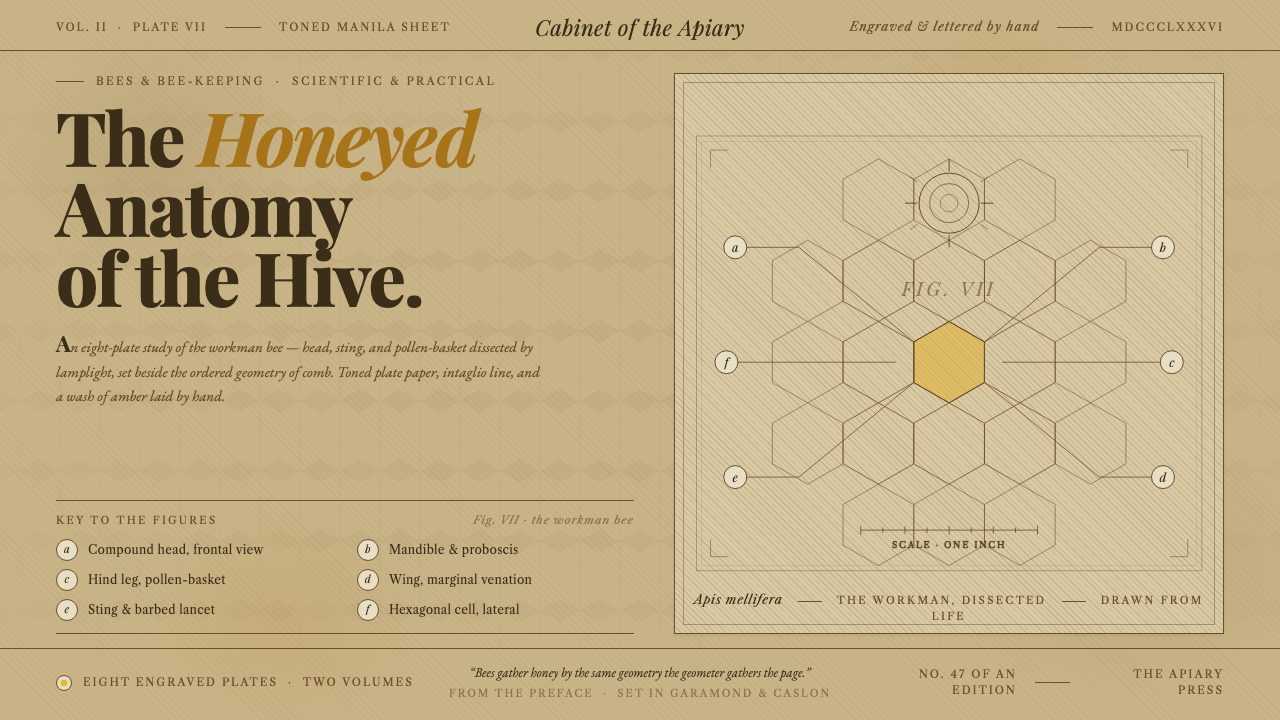
Honeybee Anatomy Plate turns the amber-stained page of an 1886 beekeeping manual into a visual system where engraved bodies, ordered comb, and patient annotation make scientific scrutiny feel warm and narrative.
Honeybee Anatomy Plate in brief
Honeybee Anatomy Plate is a historically grounded editorial style derived from Frank R. Cheshire’s 1886 two-volume work Bees and Bee-keeping. Its immediate source is the Victorian scientific plate: a toned sheet carrying finely engraved specimens, numbered figures, leader lines, anatomical labels, and hexagonal comb. Rather than imitating a general antique mood, the style concentrates on the specific visual machinery by which a beekeeping manual made the hidden structures of the honeybee legible.
The system is defined by a meeting of precision and warmth. Fine dark engraving describes the bee’s head, sting, pollen-basket, and articulated body, while an amber-yellow wash gives the surrounding wax and paper a mellow glow. Foxing, manila-like paper, and the measured rhythm of lettering suggest an object that has passed through time, yet the organization remains disciplined. Every line either identifies, connects, separates, or explains.
Its central image is not the bee alone but the relationship between specimen and knowledge. A bee may be enlarged, isolated, or dissected visually; a key sits nearby; a ruled leader crosses the page; comb geometry supplies a stable field against which organic anatomy can be studied. The result is scholarly without becoming sterile and decorative without abandoning evidence. It treats observation itself as a form of visual storytelling.
Where does Honeybee Anatomy Plate come from?
The style begins with Frank R. Cheshire’s Bees and Bee-keeping, published in two volumes in 1886 in Britain. The work belongs to Victorian scientific apiculture, a culture in which practical knowledge of bees was organized through close observation, written explanation, and engraved illustration. Its eight plates labelled structures including the head, sting, and pollen-basket, placing anatomical details beside the repeating geometry of comb. The page therefore joined the practical concerns of beekeeping with the classificatory habits of nineteenth-century scientific publishing.
Engraved anatomical plates were suited to this task because their lines could distinguish minute structures while preserving an orderly hierarchy. The image did not stand alone as a picturesque animal portrait. Numbered figures directed the reader toward a key, leader lines connected names with parts, and separated studies allowed a single organ or body region to be examined apart from the whole. Lettering and illustration operated as one explanatory instrument. The plate’s authority came from this coordination: looking, naming, and comparing occurred on the same sheet.
Color changed the emotional register without replacing the engraved evidence. An amber-yellow wash spread across the fine linework and gave the comb the appearance of warm wax. Against the toned, foxed character of manila-like plate paper, the wash linked the living material of the hive with the physical material of the book. Dark marks remained precise, but the page no longer felt clinical. It suggested handling, storage, repeated consultation, and the slow accumulation of practical knowledge.
Honeybee Anatomy Plate revives this visual logic as a contemporary design language. It retains the contrast between organic anatomy and ordered hexagonal structure, between explanatory typography and observational image, and between aged paper warmth and disciplined dark linework. Its historicism is therefore procedural rather than theatrical. The style does not depend on ornamental Victorian display; it depends on arranging evidence as Cheshire’s plates did, so that a reader feels guided through a specimen rather than merely shown an antique illustration.
What defines the Honeybee Anatomy Plate look?
Amber Plate Color
The palette grows from toned plate paper, amber-yellow wash, dark engraved marks, and the muted gold of comb wax. Warmth belongs mainly to the ground and selected anatomical or hive details; it should not flood every element equally. Dark ink supplies intellectual authority and crisp separation, while restrained variations in ochre, honey, and aged paper suggest material depth without turning the page into a brightly colored natural-history illustration.
Engraved Linework
Form is built through fine contour lines, short hatching, and concentrated dark passages rather than smooth photographic shading. The bee’s segmented body can carry dense detail, but the surrounding paper remains comparatively open so that the specimen retains definition. Variations in line direction explain curvature and articulation. The drawing should feel patiently cut and printed, with small irregularities that preserve the human pressure of the engraved mark.
Anatomical Annotation
Numbers, abbreviated keys, labels, and slender leader lines form a second visual layer over the specimen. Their placement follows explanation rather than decoration: each marker must resolve clearly to a part, and crossings should remain rare enough that the route can be followed without hesitation. The most convincing layouts allow annotation to approach the image closely while preserving a calm margin where the key can be read as an ordered list.
Comb Geometry
Hexagonal comb supplies the system’s organizing geometry. It may appear as a complete field, a cropped fragment, or a faint structural echo behind text, but its repetition should remain regular and purposeful. The comb contrasts with the irregular anatomy of the bee: one is modular and collective, the other articulated and individual. Used well, this opposition creates order without requiring a conventional decorative border.
Scholarly Typography
Typography should read as cataloguing, captioning, and patient explanation. Headings are composed rather than advertised; captions sit near the evidence they describe; figure numbers are prominent enough to navigate but never louder than the specimen. A measured, bookish voice suits the historical source, while careful alignment with rules, keys, and image edges makes type feel integrated into the plate rather than placed on top of it.
Foxed Material Surface
The ground carries age through uneven tone, restrained spotting, and the dry character of printed paper. These traces should remain subordinate to legibility. Foxing is not a blanket texture or a shortcut to nostalgia; it is evidence of a physical sheet. Areas of relative cleanliness are essential because they let engraved detail and small labels remain distinct, while occasional marks keep the surface from feeling digitally uniform.
Plate-Like Composition
Composition proceeds as a sequence of evidence: principal specimen, enlarged detail, numbered key, comb study, and explanatory note. Scale changes signal what deserves closer inspection, while open paper separates one inquiry from another. The arrangement can be asymmetric, but it should feel inventoried rather than casual. Every object appears to have been placed for comparison, reference, or instruction, producing narrative through the reader’s movement across the plate.
Who shaped Honeybee Anatomy Plate?
Cheshire is the named figure behind the source material: the 1886 two-volume Bees and Bee-keeping. Through its eight engraved plates, his work brought practical apiculture and anatomical explanation onto the same page. For this style, his importance lies not in a personal decorative signature but in the structure of communication associated with the book — labelled bee anatomy, numbered figures, comb studies, and a close relationship between image and instructional text.
The 1886 publication is the principal historical artifact behind Honeybee Anatomy Plate. Its two volumes and eight engraved plates provide the style’s concrete vocabulary: head, sting, and pollen-basket studies; hexagonal comb; lettered keys; and explanatory sequencing. Treating the book itself as a central figure keeps contemporary applications anchored to a specific documentary source rather than drifting into a generic mixture of sepia paper, insects, and Victorian ornament.
Victorian scientific apiculture supplies the intellectual setting in which the plate makes sense. Beekeeping knowledge is presented as something observed, classified, illustrated, and taught, not merely celebrated through pastoral imagery. This context explains the style’s distinctive balance: honeyed warmth belongs to the subject, but labels and anatomical separation impose scholarly discipline. Contemporary work that preserves both sides feels informed; work that keeps only the amber color loses the source’s explanatory purpose.
How do you use Honeybee Anatomy Plate today?
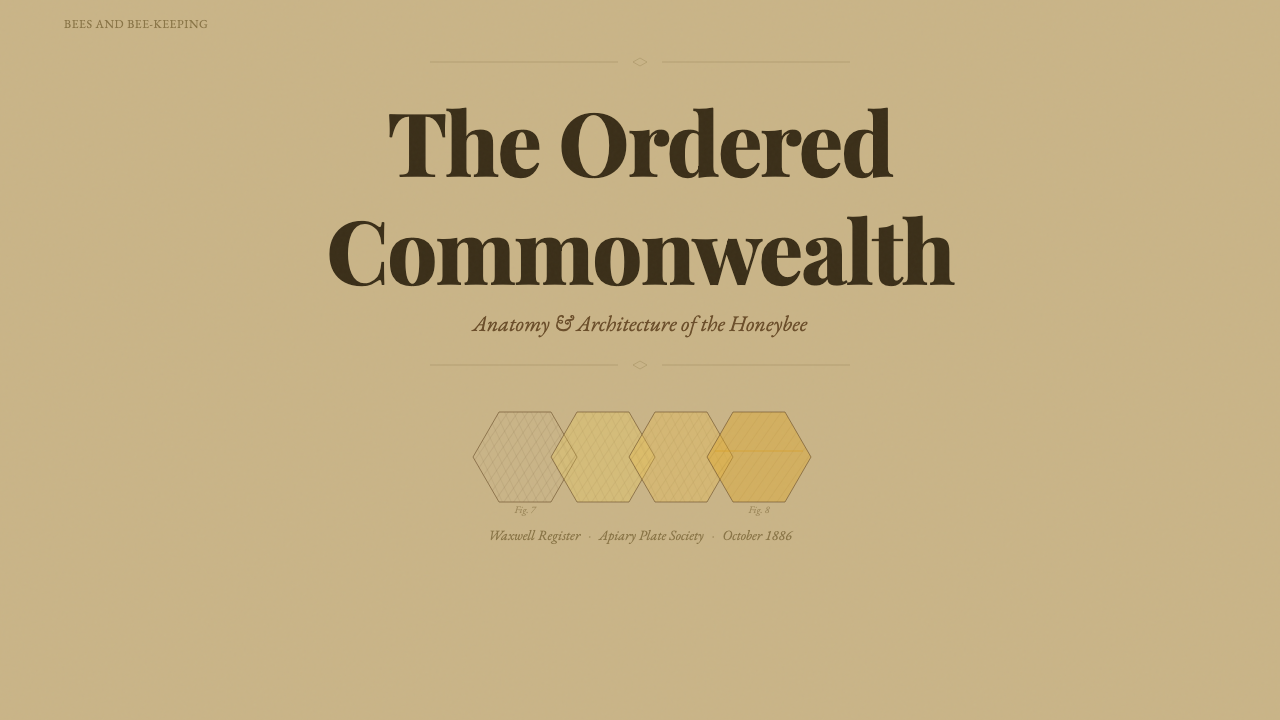
For presentation slides, begin with the logic of a plate rather than that of a decorative theme. A cover can isolate one engraved bee against toned paper, with a fragment of comb establishing context and a restrained title behaving like a specimen heading. Content slides work best as ordered studies: a principal statement, a labelled image or diagram, and a compact key aligned along one edge. The visual hierarchy should suggest that the audience is opening a manual and proceeding from observation to explanation.
Data slides can translate values into the vocabulary of catalogue and comb. Repeating hexagonal cells can organize categories, while numbered markers connect findings to concise notes. Conventional charts should retain clear comparison before receiving any historical treatment; amber emphasis can identify the significant series, and dark engraved-style lines can define the rest. Fine rules and captions may make the slide feel archival, but the result must remain readable at presentation distance rather than reproducing the density of a book plate literally.
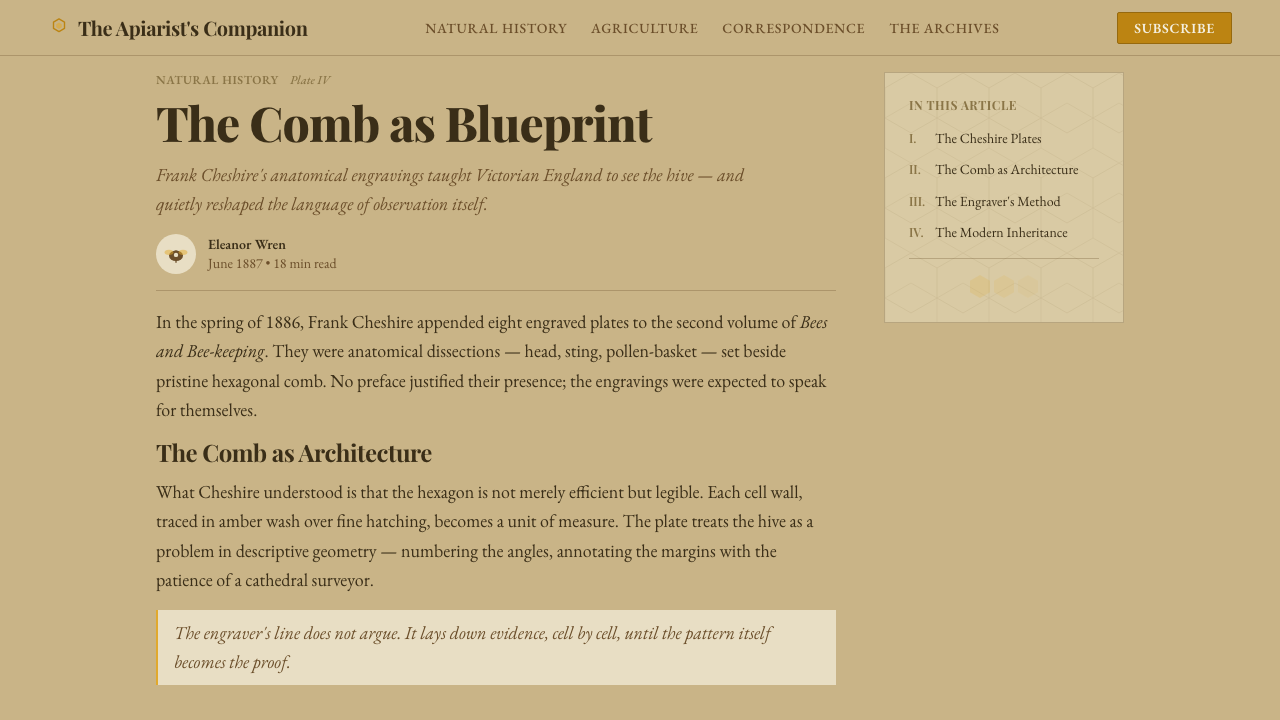
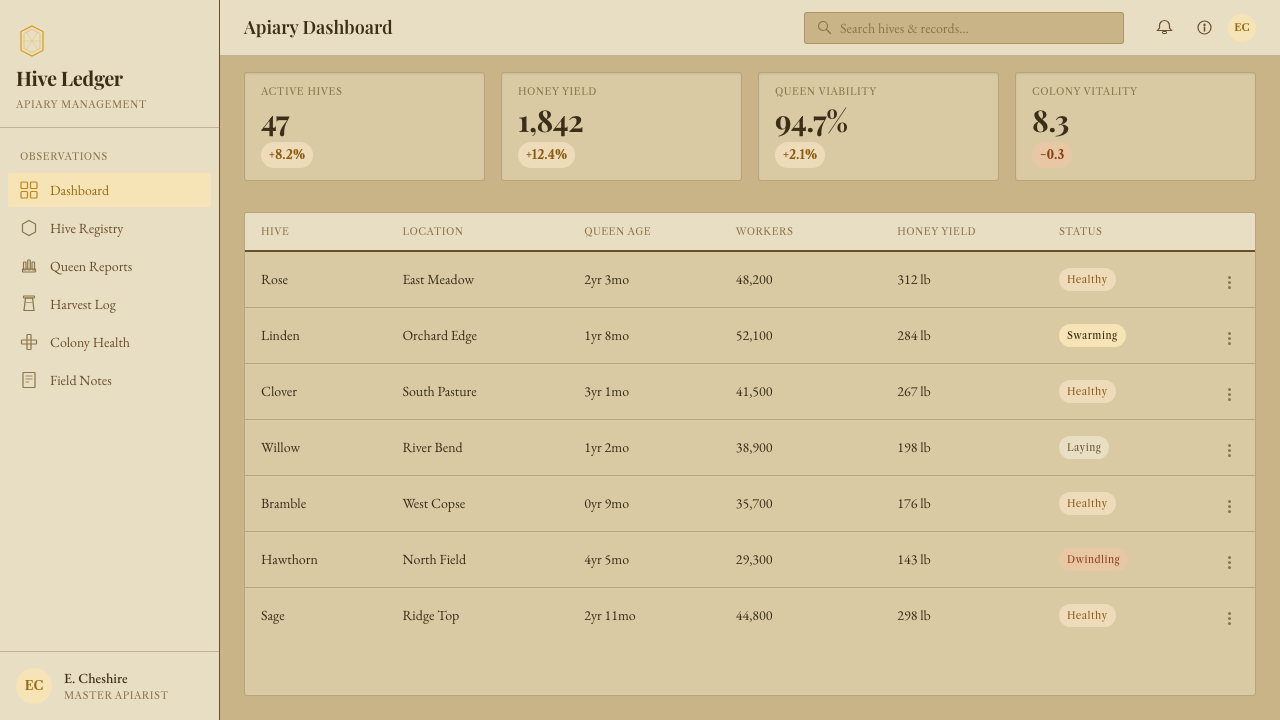
For web interfaces, the style suits dashboards, research collections, educational products, and pricing pages that benefit from a sense of patient expertise. Dashboard modules can resemble individual studies on one larger sheet, using small labels, ruled connections, comb-derived grouping, and warm paper-like surfaces. Pricing tiers can be presented as catalogued specimens, each with a clear heading, ordered feature key, and one deliberate amber distinction. Interactive states should clarify selection through contrast and annotation, not through layers of unrelated antique decoration.
Editorial and marketing layouts should use the bee as evidence, not as a repeating mascot. Long-form articles can place engraved details in the margins, connect terms to anatomy with leader lines, and use plate captions to interrupt the text with moments of close looking. Marketing pages can unfold as a narrative examination: whole bee, enlarged structure, comb system, then practical conclusion. The scholarly voice lends authority to honey, natural-history, craft, museum, or educational subjects, provided claims remain more prominent than atmosphere.
The most common mistake is reducing the style to sepia paper with scattered bees. Excessive stains obscure fine labels; ornamental frames compete with the plate’s explanatory rules; indiscriminate honey color turns careful emphasis into a uniform haze. Another failure is using leader lines that point nowhere or figure numbers without a corresponding key. Authenticity comes from functional annotation and ordered comparison. If an antique-looking element cannot help the reader identify, connect, sequence, or understand something, it weakens the system.
Honeybee Anatomy Plate — FAQ
Is Honeybee Anatomy Plate simply a Victorian decorative style?
No. Its source is Victorian, but its defining qualities come from scientific communication rather than ornamental display. The essential elements are engraved anatomical studies, numbered figures, leader lines, keys, comb geometry, and toned plate paper. A layout can contain no elaborate border or flourish and still feel authentic if it guides the reader through evidence. Conversely, a richly ornamented antique page may miss the style entirely if its insects function only as decoration.
How should the amber wash be used without overwhelming the engraving?
Treat amber as illumination and material association, not as a universal filter. It can gather around comb, selected anatomical areas, headings, or navigational emphasis while substantial regions of toned paper remain quiet. The dark engraved line must continue to define edges and internal structure. If the wash begins to reduce contrast between specimen, annotation, and ground, it has stopped supporting the plate and started obscuring it.
Can photography be used in this style?
Photography is possible, but it should enter the system as documented evidence. A photograph may be tightly cropped, isolated, paired with a numbered key, or placed beside an engraved study for comparison. Naturalistic depth and glossy commercial lighting can disrupt the dry material unity of the plate, so photographic imagery works best when its contrast, tone, and framing allow it to participate in the same catalogue structure as the drawings.
Does every layout need a honeybee and a complete comb pattern?
No. The style can remain recognizable through its method: fine observational linework, warm plate color, disciplined annotation, numbered sequencing, and evidence arranged for comparison. A small comb fragment may be enough to establish geometry, and some pages may focus entirely on a labelled anatomical detail. Repeating complete bees and full comb fields everywhere quickly turns a scholarly system into a motif collection.
Where does Honeybee Anatomy Plate work poorly?
It struggles when an interface requires extreme visual neutrality, rapid high-volume scanning, or a sleek technological mood with no room for narrative texture. Fine engraving, aged surfaces, and annotation can become noise if applied to every control or dense operational table. The style is strongest where readers can pause, inspect, and connect image with explanation. In highly transactional contexts, reserve it for framing, editorial moments, or selected educational details rather than the entire working surface.
Related design styles
 Hangul 訓民正音Ink obeys the grid. Carbon rules, vertical Myeongjo columns, and rare vermili…
 Caslon English Text SerifWarm authority, pressed into paper. Caslon capitals and engraved rules comman…
 ClockpunkInventive antiquity. Walnut vellum, Cinzel capitals, brass orrery rings, and…
 Garamond Old-Style French SerifInk ages with grace. Warm-grey rag paper, Garamond columns, and red rubric ma…
 Golgi Neuron Silver StainA century-darkened specimen. Near-black dendrites branch across an aged amber…
 Amsterdam Canal HouseQuiet luxury in brick and cream. Playfair serif, narrow columns, amber window…