What is Gutai (Yoshihara, 1954)?
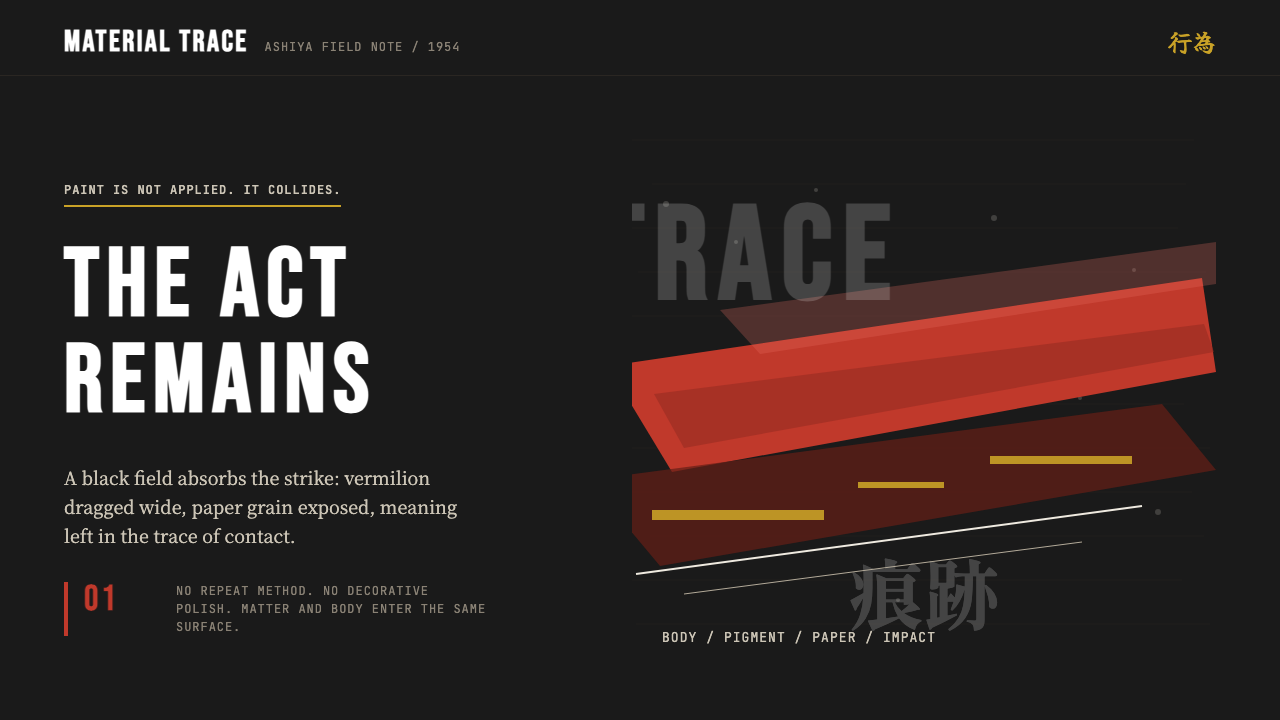
Gutai turned painting into a collision — bodies through paper, feet through pigment, paint fired from cannons — and left only the raw trace of the act behind.
Gutai (Yoshihara, 1954) in brief
Gutai — the word means 'concrete' or 'embodied' in Japanese — was a radical postwar collective founded in 1954 in Ashiya, Japan, by the painter and critic Jirō Yoshihara. Where most postwar art movements still treated the canvas as a window or a field of symbolic meaning, Gutai insisted on something far more physical: the artwork is the record of a real encounter between a human body and real material. No mediation, no illusion, no second-guessing — only the mark that survived the act.
The visual language that emerged from this conviction is unmistakable. Gutai work features deep, absorptive black grounds — the dense black of sumi ink, of darkness that seems to have weight — against which single gestural marks appear in fierce contrast. A single sweep of vermilion, a violent horizontal drag, a burst of raw pigment: each stroke is left exactly as it landed, neither corrected nor refined. Asymmetry is absolute; the empty half of a composition is as deliberate as the marked half. And every surface carries evidence of process: the grain of hand-made paper, the cracking of thick dried pigment, the irregularity of a gesture made at speed.
Unlike Abstract Expressionism, with which it is sometimes superficially compared, Gutai was not primarily interested in psychological interiority or romantic self-expression. The group's manifesto, written by Yoshihara in 1956, demanded that material and gesture become inseparable from meaning — that the thing itself, not what it represented or symbolized, was the work. This distinction matters when applying the style: Gutai aesthetics are about material truth, not emotional confession.
Where does Gutai (Yoshihara, 1954) come from?
Japan in 1954 was a country still absorbing the shock of defeat, occupation, and the atomic bombings of Hiroshima and Nagasaki. The cultural landscape was turbulent: traditional aesthetic values felt compromised by their association with wartime nationalism, while Western modernism arrived simultaneously as liberating and as another form of cultural imposition. It was in this charged atmosphere — in the small port city of Ashiya, between Osaka and Kobe in the Kansai region — that Jirō Yoshihara gathered around him a group of mostly young painters and declared that they would make art unlike anything that had come before.
Yoshihara was an unusual figure for a avant-garde leader: a successful businessman from a wealthy family, already in his forties, with a refined knowledge of both Western modernism and Japanese ink traditions. His patronage gave the group financial stability, but his vision gave it intellectual coherence. The Gutai manifesto of 1956 announced a direct challenge to what he called the 'corpse' of traditional painting — the deadness of conventions inherited without examination. The group's demand was for a living art, one in which the material itself was allowed to assert its own nature rather than being bent to the artist's preconceived image.
The early performances and works of the Gutai Art Association were sensational in the most literal sense. Saburo Murakami ran through panels of paper stretched on wooden frames, breaking through them with his body. Kazuo Shiraga wrestled with mud in a pit, his body leaving its traces in the material. Atsuko Tanaka wore a dress made of electric light bulbs that lit and flashed around her body. Shozo Shimamoto fired paint-filled bottles at canvas from above. These were not stunts — they were rigorous investigations of what happened when a material was pushed to its limits by a human body operating at the edge of control.
Gutai achieved international visibility through its contact with the French critic Michel Tapié, who visited Japan in 1957 and recognized in the group's work a kinship with the Informel movement in Europe. Tapié's advocacy brought Gutai into dialogue with international contemporary art, and the group exhibited in Paris, New York, and across Europe through the late 1950s and 1960s. The collective continued until Yoshihara's death in 1972, after which it dissolved — honoring his centrality to the whole enterprise. Yoshihara had insisted from the beginning: 'Do not imitate others. Do something no one has done before.'
What defines the Gutai (Yoshihara, 1954) look?
Sumi-Black Ground
The defining ground of Gutai aesthetics is a deep, absorptive black that recalls the density of sumi ink — not the decorative darkness of a night sky, but a blackness that seems to pull light into itself. This ground is never flat in the decorative sense; it carries weight, grain, and occasional surface variation. Against it, any mark reads with maximum intensity. The effect is confrontational: the viewer is given no neutral zone in which to rest.
Single-Gesture Marks
Where most design traditions build up imagery through multiple layers and refinements, Gutai aesthetics are built on the principle of the irreversible single act. A mark is made — a sweep, a drag, a burst — and it stands as made. There is no correction layer, no second pass. This irreversibility is not a limitation but a discipline: every element must justify its existence in the moment of its making. The visual result is a quality of directness and inevitability that cannot be faked through revision.
Vermilion as Violent Accent
Against the deep black ground, a single fierce accent — most characteristically vermilion, the traditional red of Japanese seals and lacquer — carries enormous visual energy. This color is not decorative; it is the trace of a specific act, a specific moment of impact. Used sparingly, it reads as both formal event and physical record. The contrast between the weight of the black and the violence of the red defines the emotional register of the entire composition.
Radical Asymmetry and Empty Space
Gutai compositions refuse centered balance and decorative distribution of elements. A mark lands where the act placed it — often to one extreme of the field — and the remainder of the composition is left deliberately, conspicuously empty. This empty space is not passive background; it is the silence against which the gesture registers as an event. The asymmetry is so absolute that it reads not as imbalance but as evidence of a real, unrepeatable occurrence.
Material Surface as Evidence
Gutai aesthetics never smooth over the evidence of process. The grain of hand-made paper, the cracking of thick pigment as it dries, the variation in ink density where a brush or body pressed harder — all of this is preserved, not erased. In digital or print applications, this translates to textures that read as authentic and time-marked rather than digitally generated: rough paper grain, cracking paint effects, ink blooms. The surface must tell the truth of how it was made.
Dark Drama Over Decoration
The overall visual register of Gutai-derived design is deliberately dramatic, even confrontational. This is not achieved through ornamentation or decorative complexity — there are no flourishes, no patterns, no gradients, no layered effects for their own sake. The drama comes entirely from contrast: deep black against fierce red, vast emptiness against a single charged mark, quiet surface grain against violent gesture. Every element earns its place by contributing to that essential tension.
Process Visibility
In conventional design, the process that produced the artifact is hidden; the artifact presents itself as a finished, timeless object. Gutai aesthetics invert this: the process is the point, and the artifact exists only to make the process visible. A Gutai-derived composition announces how it was made — the direction of the gesture, the speed at which it was applied, the pressure that varied along its length. Nothing is post-processed into anonymity.
Who shaped Gutai (Yoshihara, 1954)?
Yoshihara founded the Gutai Art Association in 1954 and served as its central organizing intelligence until his death in 1972, after which the group dissolved. A successful businessman and deeply read critic, he provided both financial support and intellectual vision: his 1956 manifesto set the terms for everything that followed, insisting that authentic material encounter — not inherited convention — was the only legitimate basis for art. He was unusual among avant-garde leaders in that he did not impose a style but rather a set of demands: make something no one has done before, let the material assert its own nature.
Shiraga is among the most internationally recognized of the Gutai members, known for paintings made by suspending himself from a rope above the canvas and applying paint exclusively with his feet. The resulting works are swirling, violent accumulations of pigment that bear the unmistakable trace of a body operating at its physical limits. His process was not a performance trick but a rigorous method for removing the hand's habitual control and forcing a different kind of encounter between body and material. His paintings, now in major museum collections worldwide, defined the visual intensity most closely associated with the Gutai aesthetic.
Murakami's most famous works involved running at full speed through panels of paper stretched on wooden frames, breaking through them with his body. The shredded paper surrounding the hole was the work — not a representation of an act but the literal record of it. His piece at the First Gutai Art Exhibition in 1955 established the group's radical proposition with maximum economy: the artwork required a body, a material, and a single irreversible act. Nothing else.
Tanaka occupied a singular position within Gutai, working not with paint and canvas but with electric light and textile. Her most celebrated work — a dress made entirely of painted electric light bulbs connected by colored cables — was worn in performance, turning her own body into a blinking, glowing circuit. She later made large paintings in which sinuous colored lines traced the paths of electric wiring, translating the live energy of the performance works into a sustained painted record. Her work extended the Gutai principle of material encounter into new territories: the material was electricity, warmth, and the body as conduit.
Shimamoto was among the most experimental of the Gutai members, developing techniques that removed the artist's hand from direct contact with the canvas entirely. He fired paint-filled bottles at canvas from overhead, shot paint through cannons, and poured pigment through perforated sheets. Each method was a deliberate investigation into what happened when the act of application was made violent, imprecise, and unrepeatable. His work pushed the group's central question — what is left when you remove all artistic convention from the encounter between material and maker — to its most extreme formulation.
How do you use Gutai (Yoshihara, 1954) today?
Gutai aesthetics translate into designed artifacts with surprising directness, but they require an honest commitment to what the style is actually doing. The visual power of Gutai-derived work comes from genuine tension: a deep, absorptive dark ground; a single mark of fierce chromatic energy; and the vast empty space that makes both register as events. Attempting to use this vocabulary decoratively — as a stylistic skin over conventional composition — will produce work that reads as imitation rather than resonance.
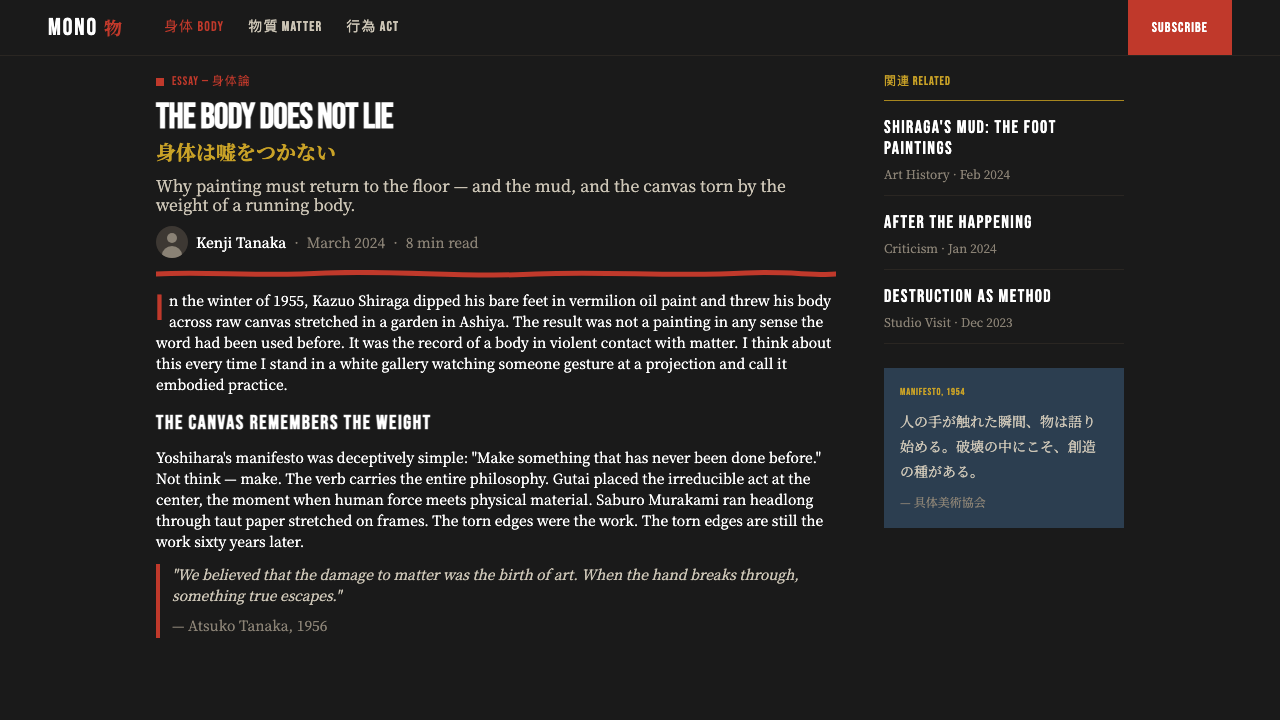
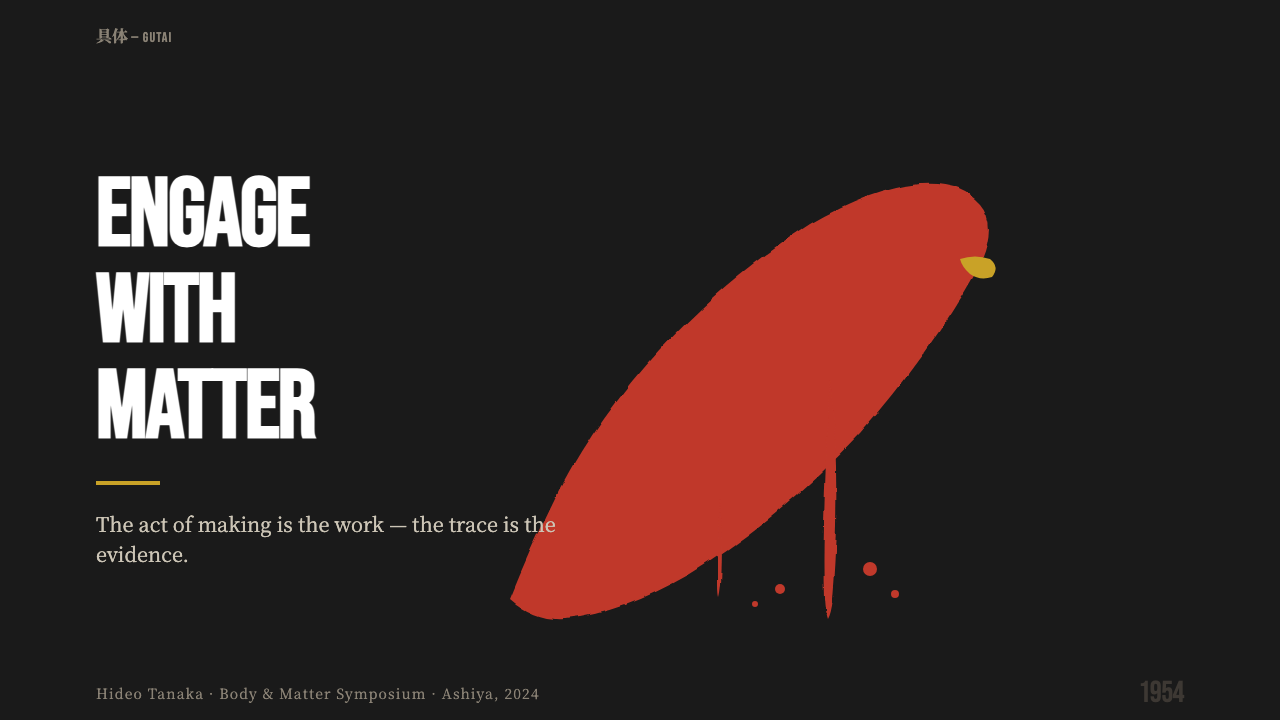
For presentation slides, Gutai is most effective on cover pages and chapter dividers where confrontational visual impact is appropriate. A cover built on a near-black ground with a single asymmetric gestural mark in a fierce warm tone — positioned to one side, leaving the majority of the field empty — creates an immediate sense of seriousness and controlled intensity. Body content slides should not attempt to extend the full aesthetic; instead, they can borrow the palette's dark discipline: deep backgrounds, restrained text, perhaps a single warm-tone line or rule to mark hierarchy. Data slides are more challenging — the style's asymmetry and unpredictability sit uneasily with the regularity that data visualization requires. Use Gutai framing on section-break slides and return to a cleaner, more neutral ground for charts and tables.
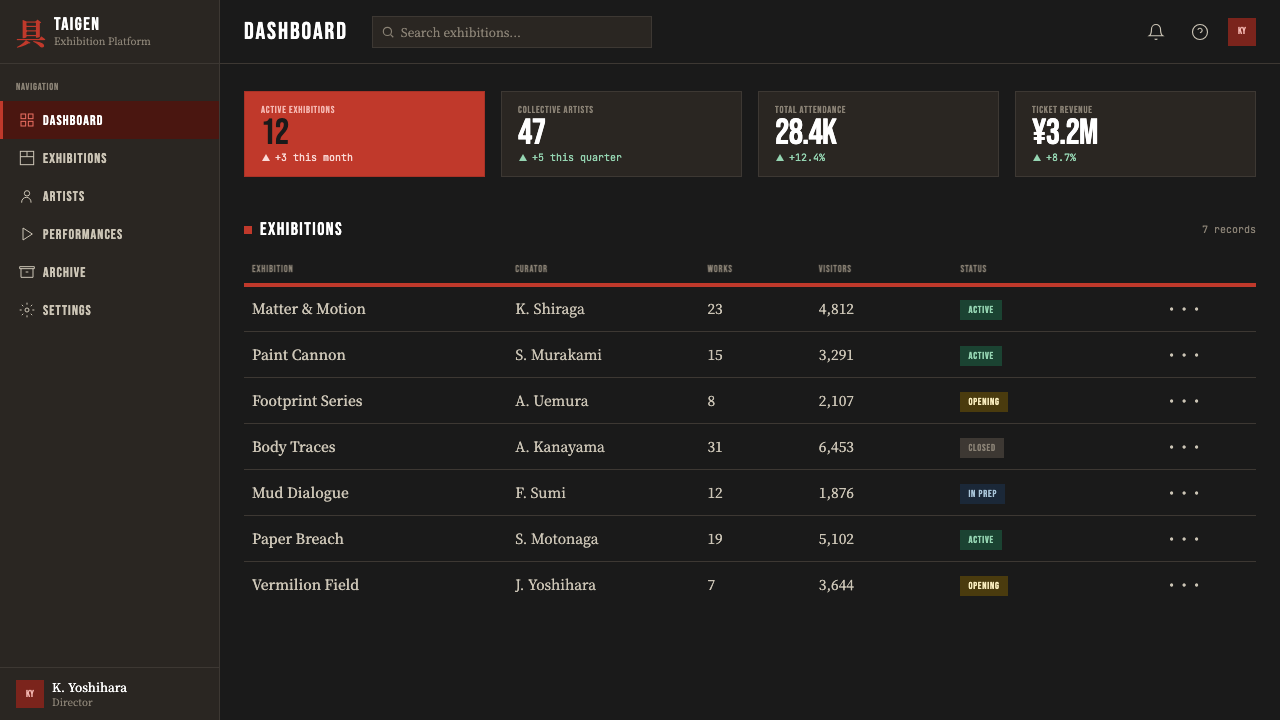
For web interfaces, Gutai is best suited to contexts where dramatic first impression outweighs navigational clarity: portfolio landing pages, creative agency homepages, cultural institution sites, or any surface where the brand's positioning is boldness and visual authority. A Gutai-informed dashboard would be an unusual choice — the style's deliberate spatial tension resists the density of information that dashboards typically require. Where it does appear in UI, it should be reserved for hero sections, full-bleed feature statements, or modal moments where the interface steps briefly outside its operational register.
For editorial and marketing work, the style supports striking campaigns for cultural brands, arts organizations, luxury goods, or any context where aesthetic seriousness is a brand value. A Gutai-derived editorial spread works by severe editorial discipline: one large gestural image occupying most of the spread, with text confined to a narrow column and set in a quiet, restrained typeface. The image does the work; the text explains. Marketing pages built in this aesthetic communicate authority and distinctiveness but should be tested carefully — the confrontational quality can read as excluding rather than inviting in mass-market contexts.
A common mistake when working with Gutai aesthetics is over-complicating the mark. The visual logic depends on singularity: one ground, one mark, one act. Introducing multiple gestural elements, or varying the color accent across several points in the composition, immediately collapses the tension the style depends on. Similarly, softening the contrast — lightening the ground, reducing the intensity of the accent color, adding intermediate tones — dismantles the all-or-nothing confrontation that gives the style its power. Work in Gutai's register should feel as if it could not have been composed any other way, as if the arrangement was determined by the act rather than by the designer.
Gutai (Yoshihara, 1954) — FAQ
Is Gutai the same as Abstract Expressionism?
They share a historical moment — both emerged in the early postwar years — and both placed great emphasis on gesture and physical engagement with material. But their intentions were fundamentally different. Abstract Expressionism, especially in its American form, was largely concerned with psychological depth and the romantic self: the painting as a record of the artist's inner state. Gutai was not interested in the inner state at all. Yoshihara's manifesto explicitly rejected the idea that a painting should express the artist's personality. What mattered was the encounter between the body and the material — not what the artist felt, but what the material did when a human body acted upon it. The distinction matters visually: Abstract Expressionist work often has a quality of sustained emotional development, building across the canvas in layers. Gutai work is typically singular and abrupt — the mark happened, and that is all.
Can Gutai aesthetics work in light-background contexts?
The historical Gutai palette was predominantly dark — sumi black, deep earth tones, the dense darkness of pigment-saturated surfaces. A light-ground inversion is possible, but it fundamentally changes the emotional register. On a pale or white ground, a gestural mark reads as expressive mark-making rather than as rupture or eruption; the confrontational quality diminishes considerably. If a light ground is required by the project, the accent color should be pushed toward its maximum intensity to compensate — a color so saturated and directional that it still reads as an event rather than a decoration. Be aware that the result will feel closer to gestural expressionism than to authentic Gutai: powerful, but different in kind.
How should texture be handled in digital applications of this style?
Texture is not optional in Gutai-derived work — it is load-bearing. The grain of the ground, the irregularity of the gestural mark, the evidence of process in the surface: these are what distinguish authentic Gutai-derived aesthetics from merely dark-background design. In digital contexts, this means working with actual photographic or scanned textures rather than procedurally generated ones. A scan of hand-made paper, ink applied to rough card and photographed, or actual paint marks captured at high resolution will carry a quality of material authenticity that synthetic filters cannot reproduce. The textures should be subtle enough not to compete with the gestural mark, but present enough to read as genuinely material.
What kinds of brands or projects should avoid this style?
Gutai's visual register is confrontational, severe, and deliberately unpredictable. This makes it poorly suited to any context where warmth, accessibility, or reassurance are primary values. Consumer goods brands that depend on everyday approachability — food, family products, health and wellness services — will find the style alienating rather than inviting. Corporate contexts that require communicating stability and institutional reliability are similarly mismatched: the style's deliberate asymmetry and its embrace of the irreversible and unpredictable undermine exactly the qualities those brands need to project. Children's products and educational platforms for broad audiences should also avoid the aesthetic — the dramatic darkness and confrontational intensity are calibrated for an audience that brings existing visual sophistication to the encounter.
How does Gutai relate to contemporary Japanese design aesthetics like wabi-sabi?
Both Gutai and wabi-sabi are grounded in an appreciation of material process and imperfection, and both reject decorative idealization. But their emotional registers are nearly opposite. Wabi-sabi tends toward quietness, restraint, and a meditative acceptance of impermanence — the worn surface, the asymmetric vessel, the faded patina. Gutai is confrontational, energetic, and rooted in violence as much as in acceptance: materials are not allowed to age quietly, they are forced into encounter with a body at speed. Wabi-sabi aesthetics recede and invite contemplation; Gutai aesthetics advance and demand a response. In practice, the two are rarely mixed successfully — their underlying emotional logic points in opposite directions, and blending them typically produces work that commits fully to neither.
Related design styles
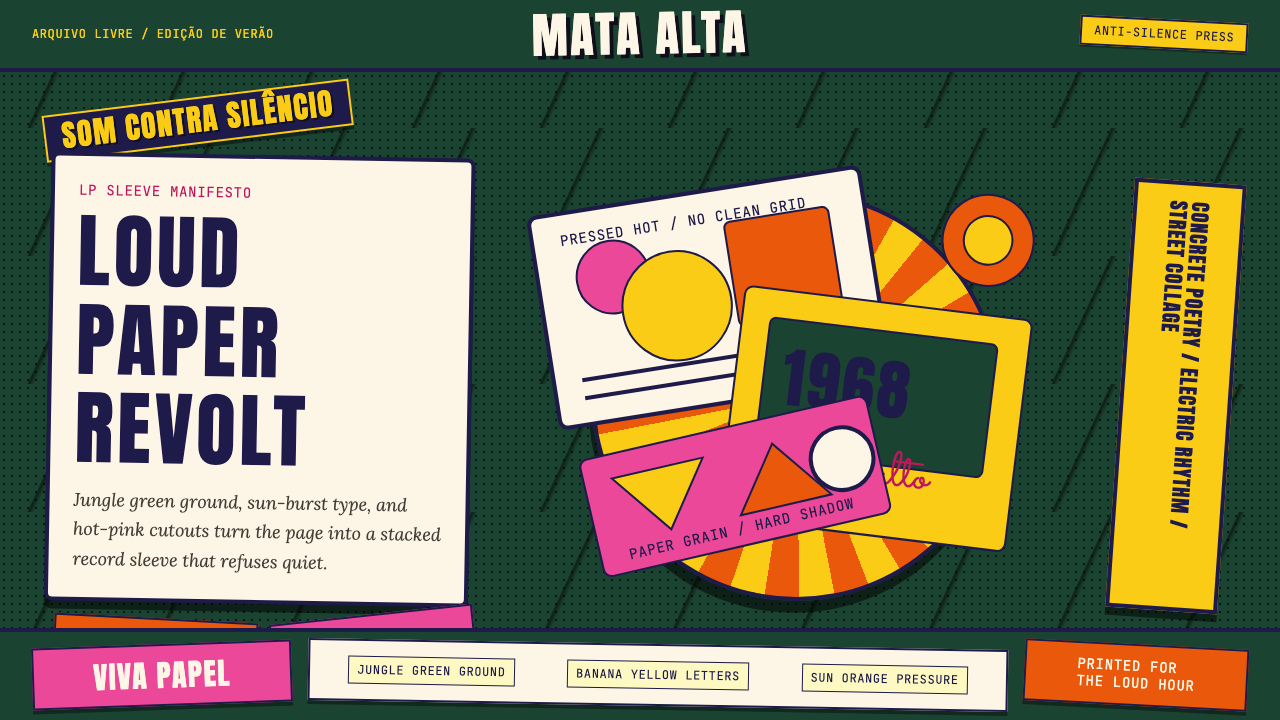 Brazilian Tropicália (1968)Art must be loud. Jungle green, banana yellow Anton type, and hard-shadow col…
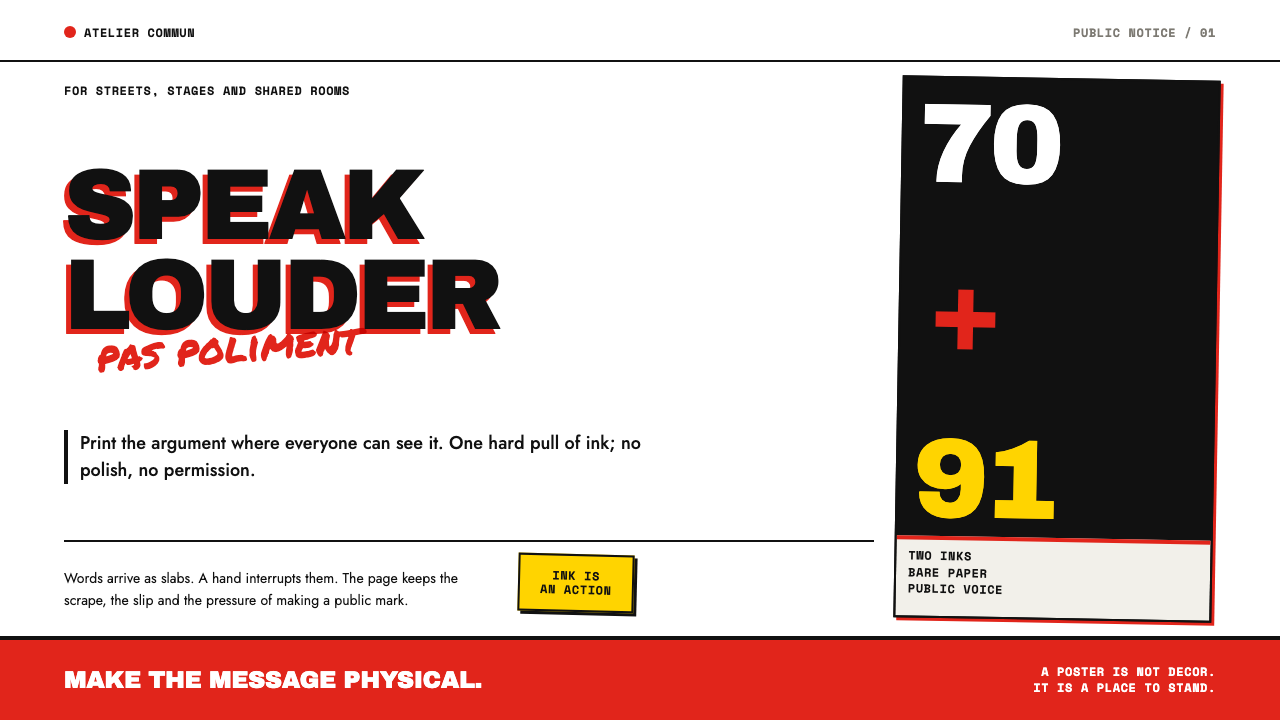 Grapus CollectivePrints dissent without polish. Red-black type slabs are disrupted by blunt ma…
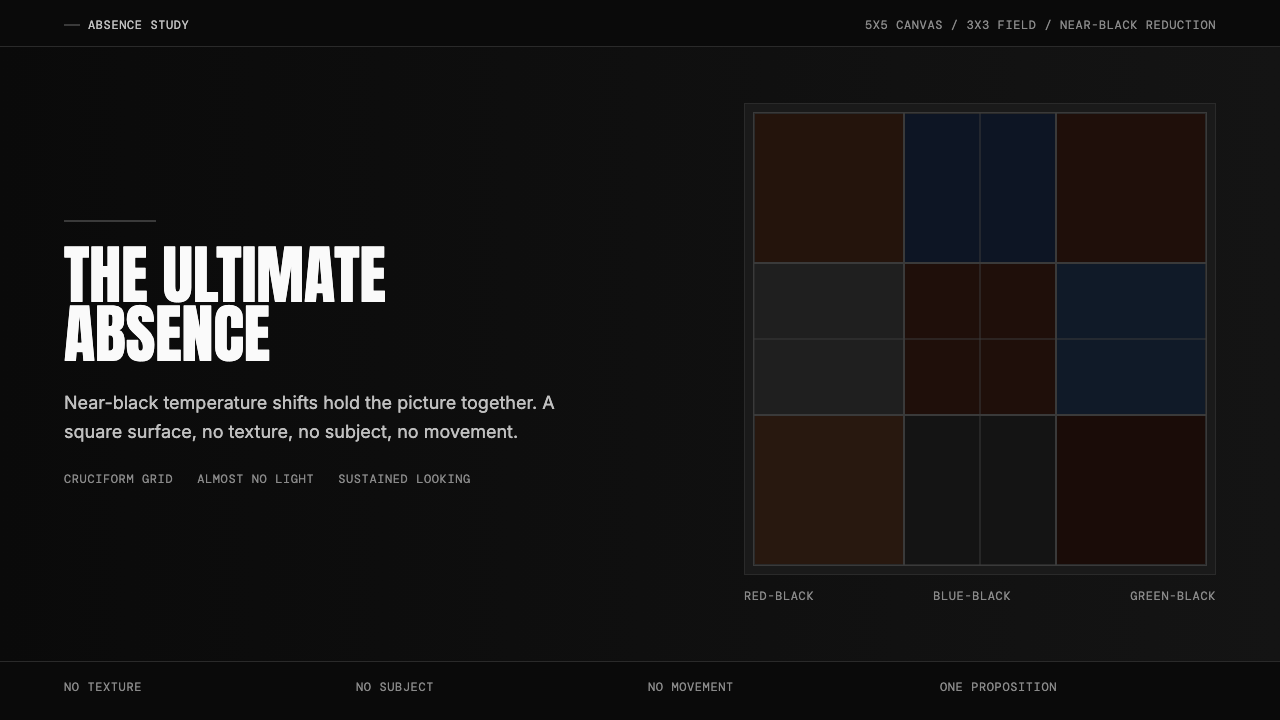 Ad Reinhardt Black Painting (1953)Austere absence. Near-black grid shifts reveal structure on sustained looking.
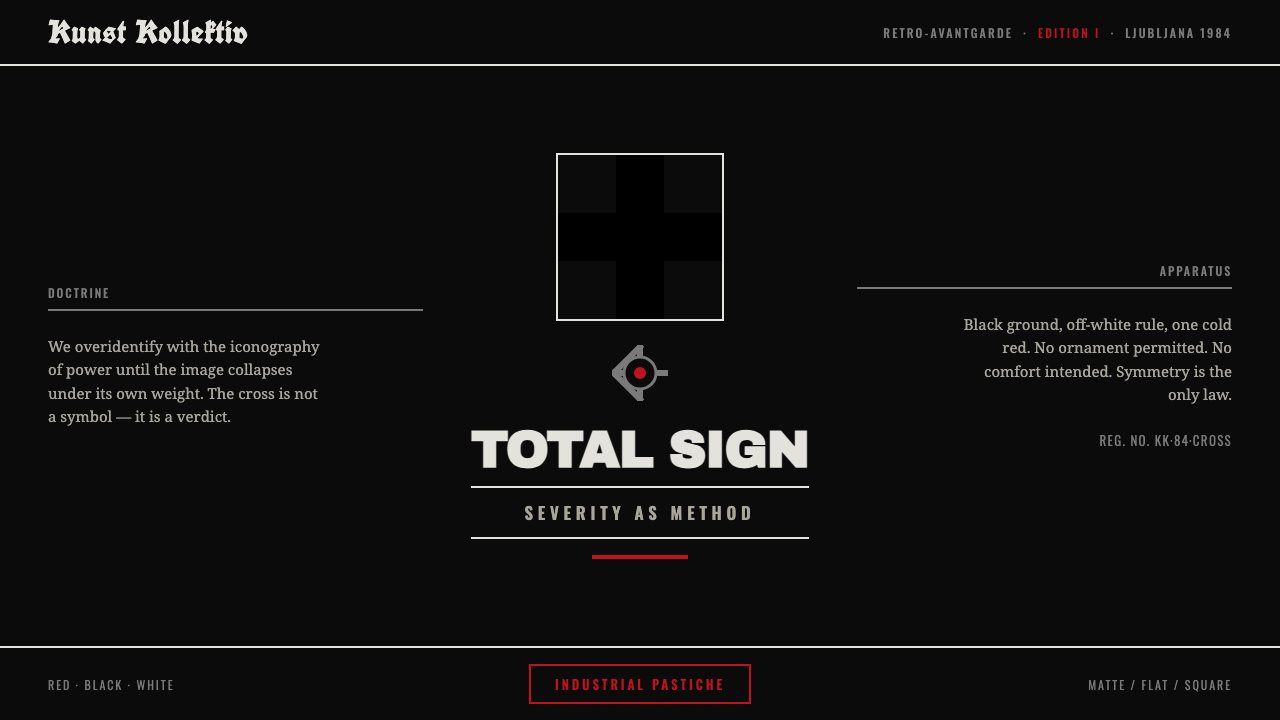 NSK / Laibach Retro-AvantgardePower's iconography turned into critique. Malevich black cross on matte black…
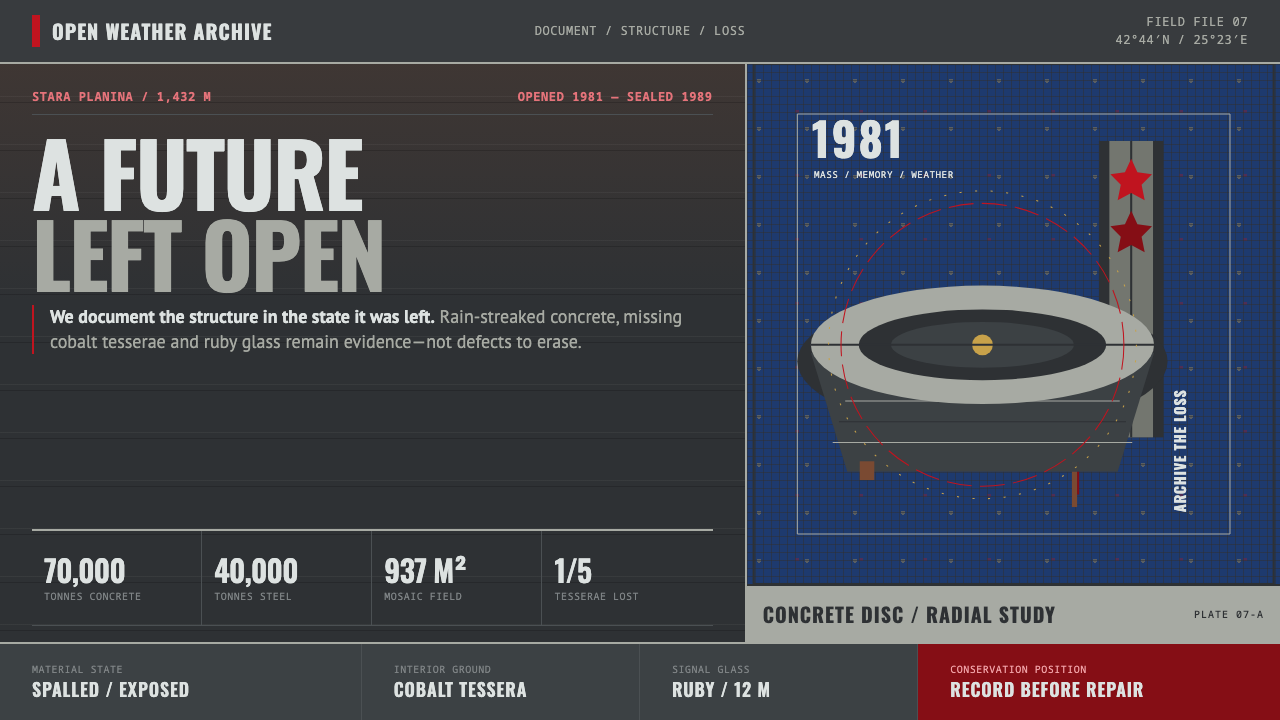 Buzludzha MonumentMonumentality without repair. Stained concrete frames cobalt tesserae, ruby g…
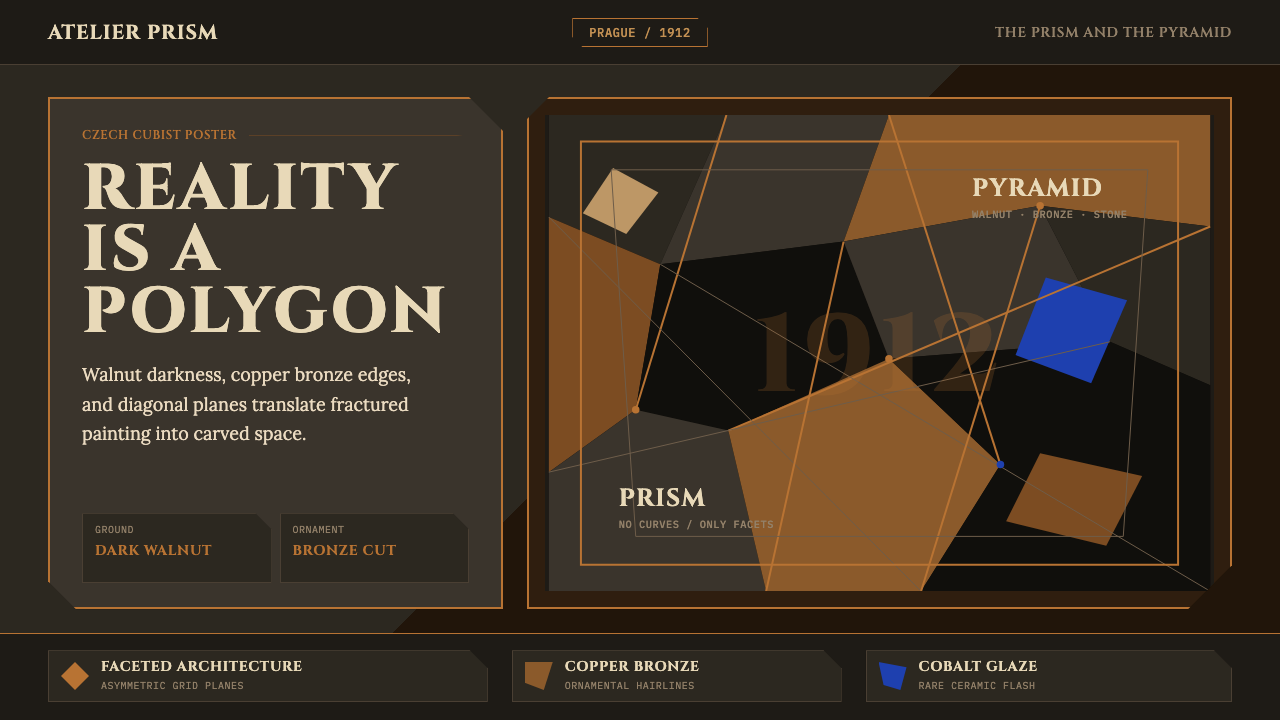 Czech Cubism (Prague 1912)Reality is faceted. Walnut ground, Cinzel capitals, and bronze diagonals cut…