What is Guatemalan Huipil Maya Weave?
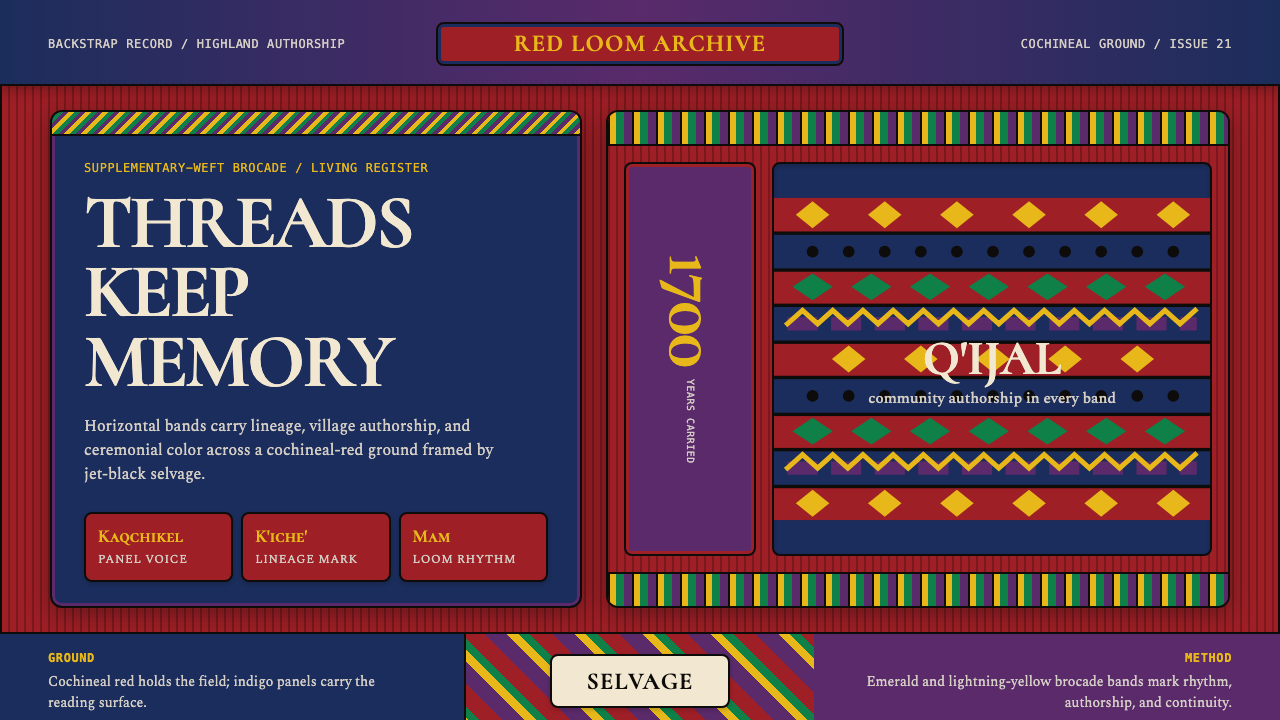
In Guatemala's highland villages, cloth is biography — every huipil encodes its weaver's community, cosmology, and signature in a visual language older than the Spanish conquest.
Guatemalan Huipil Maya Weave in brief
The huipil is a hand-woven blouse worn by Maya women across Guatemala and southern Mexico, and it is among the most sophisticated community-identity systems in the material world. Each of Guatemala's 21 Mayan-language communities produces its own distinct huipil, differentiated by the specific arrangement of brocade bands, the colors drawn from local dyeing traditions, and the symbolic motifs woven into supplementary-weft sections. A trained eye can read the garment's origin, the weaver's lineage, and even the occasion for which it was made.
As a design system, Guatemalan Huipil Maya Weave translates this dense, layered textile logic into a digital visual language. The cochineal-red ground — the deep, warm crimson produced by the dried bodies of the cochineal insect on cotton or silk — becomes the dominant surface. Horizontal brocade bands function as section dividers, echoing the register-based composition used across pre-Columbian textile and mural traditions. Quetzal-emerald greens and lightning-yellow accents animate interactive elements, while jet-black selvage edges provide structural containment around every component.
The aesthetic discipline of this system is unusual in contemporary digital design: it is dense rather than sparse, richly layered rather than reductive, and deeply relational — every element references the community of forms around it. Yet the underlying organizational logic is rigorous. Like the backstrap-loom construction from which it draws, the system operates on a strict horizontal register structure, and every decision about color or motif carries communicative intent rather than decorative impulse.
Where does Guatemalan Huipil Maya Weave come from?
The technical and symbolic foundations of Maya weaving reach back to the Classical Maya period, roughly 250 to 900 CE, when evidence from ceramic figurines and murals at sites such as Bonampak documents women wearing elaborately brocaded garments on backstrap looms. The backstrap loom — in which one end attaches to a fixed point and the other wraps around the weaver's back, maintaining tension through the weaver's own body — is itself a pre-Columbian technology still used today across the Guatemalan highlands. The physical relationship between the weaver and the cloth means that each piece carries an embodied signature; the weaver's posture, tension habits, and hand become part of the textile's identity.
Spanish colonization in 1524 brought catastrophic disruption but did not sever the weaving tradition. Colonial administrators initially mandated changes to regional dress as a tool of social control and tribute categorization, effectively institutionalizing the very community-specific textile differentiation that continues today. Cochineal — the red dyestuff produced from insects cultivated on nopal cactus in Oaxaca and Guatemala — became one of the most valuable export commodities of the colonial world, second only to silver. The intense, light-fast crimson of cochineal-dyed cloth gave Highland Maya textiles their characteristic warm-red ground that persists across centuries of stylistic evolution.
The late nineteenth and early twentieth centuries brought further transformations. Commercial aniline dyes from Germany and the United States entered highland markets after the 1870s, expanding the available palette and eventually competing with traditional natural dyes. The introduction of commercial cotton thread and, later, synthetic thread altered the texture and reflective quality of woven surfaces. Yet even through these material disruptions, community-specific pattern vocabularies persisted with remarkable fidelity — a consequence of the social role weaving plays as a marker of identity, continuity, and collective memory.
The Guatemalan civil war (1960–1996) caused severe disruption to weaving communities, with many highland villages targeted in the military campaigns of the early 1980s. The peace accords of 1996 were followed by a period of cultural recovery and economic organization. Textile cooperatives, several founded or led by figures such as Doña Rosalina Tuyuc and promoted through international indigenous-rights networks, gave weavers collective marketing power and helped establish provenance-based pricing that credited community authorship. The contemporary period since 1996 has seen the huipil become both a vehicle for cultural assertion and an object of serious scholarly and design attention worldwide.
What defines the Guatemalan Huipil Maya Weave look?
Cochineal Red Ground
The dominant ground color is a deep, warm crimson drawn from the cochineal dyeing tradition — a saturated, slightly organic red that reads as simultaneously ancient and commanding. Unlike the cooler reds of digital primary palettes, cochineal red has a brownish, earthy undertone that prevents it from feeling aggressive or purely commercial. In this design system, it functions as the equivalent of a canvas: every element is placed against it and receives its meaning partly from contrast with this particular hue.
Brocade Band Register Structure
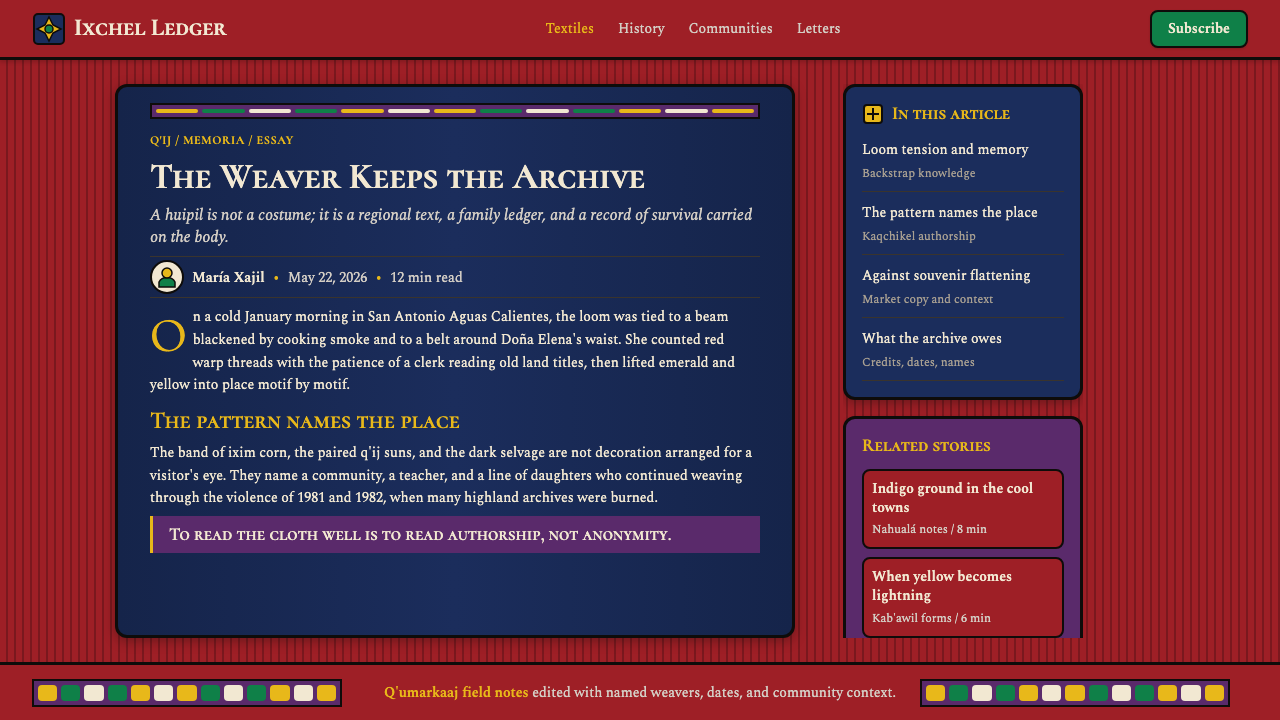
Content is organized into distinct horizontal bands, each carrying its own symbolic or functional register — a compositional logic inherited directly from the supplementary-weft brocade structure of the huipil. These bands are not merely decorative dividers; they signal transitions between types of information, just as brocade registers in textile practice distinguish sections of cosmological narrative, community insignia, and personal authorship. The bands create a powerful sense of vertical rhythm and make even complex content feel architecturally organized.
Accent Color Symbolism
Two secondary colors carry specific symbolic weight alongside the red ground. Quetzal-emerald — the rich, blue-green associated with the resplendent quetzal bird, the emblem of both divine authority and Guatemalan national identity — marks elements of high significance or interactive invitation. Lightning-yellow, derived from the Maya lightning deity Huracán and the agricultural importance of maize, signals energy, urgency, or points of transformation. These are not arbitrary color choices; both carry deep cultural resonance within the tradition from which the system draws.
Selvage Edge Containment
Jet-black selvage edges — the finished, non-fraying edges that form naturally at the sides of a backstrap-loom textile — provide structural containment for every component in the system. Where Bauhaus might use a geometric frame, this system uses the selvage: a boundary that signals completion, craftsmanship, and intentional closure. The black edge is not decorative in the contemporary sense; it is the direct translation of a structural textile convention into a two-dimensional surface grammar.
Density as Signal
Unlike design systems that use whitespace as the primary organizational tool, this system embraces deliberate density. High information packing is not a failure of restraint — it is fidelity to the source aesthetic, in which every square inch of a huipil's surface carries intentional meaning. The practical implication is that visual hierarchy must be achieved through contrast of color, scale, and register rather than through breathing room and isolation. Elements that need to stand out must earn their prominence within a rich context, not by standing alone on an empty field.
Community Authorship Motifs
Individual brocade motifs — birds, geometric diamonds, serpents, flowering plants, celestial markers — function as community-specific signatures within the textile tradition. In the design system, these translate into micro-pattern elements: small repeating geometric units that fill brocade band areas and distinguish sections from one another. These patterns are not purely decorative fill; they carry the logic of provenance and authorship, signaling that the work belongs to a specific tradition and has been made with specific intent.
Textile Materiality Translated
The surface quality of hand-woven cloth — slight irregularity, the subtle directional texture of weft over warp, the way light catches the raised brocade against the ground cloth — informs the system's treatment of surface. Simulated weave texture, used sparingly, adds tactile resonance without becoming decorative noise. The goal is to evoke materiality without mimicking it literally: the visual memory of cloth rather than a photograph of it.
Who shaped Guatemalan Huipil Maya Weave?
A Kaqchikel Maya leader from Chimaltenango, Tuyuc founded the National Coordination of Guatemalan Widows (CONAVIGUA) in 1988 following the murder of her husband in the civil war, and later served in the Guatemalan Congress. Her work in organizing highland indigenous women foregrounded the inseparable connection between cultural practice — including textile production as a community economic and identity activity — and political rights. Cooperatives organized under networks she supported helped establish frameworks for attributing provenance and community authorship to highland Maya textiles in domestic and international markets.
A master weaver from San Antonio Aguas Calientes, one of the villages most celebrated for the intricacy of its brocade technique, Hernández represents a lineage of weavers who maintained the community's specific pattern vocabulary across the civil war period. San Antonio Aguas Calientes weavers are known for a particularly dense supplementary-weft brocade that renders figurative birds and geometric diamonds with exceptional precision. The continuity of this tradition, preserved in part through the teaching relationships between master weavers like Hernández and younger community members, has made San Antonio a reference point for huipil scholarship and textile revival projects.
Associated with the weaving cooperatives of the Sololá region and recognized for her role in transmitting technical knowledge across generational disruptions caused by the civil conflict, Ramírez exemplifies the category of master weavers whose primary contribution is pedagogical. In Highland Maya textile culture, the transmission of weaving knowledge — the memorized sequences of pattern counts, the intuitive reading of motif registers — occurs through sustained hands-on practice rather than written documentation. Figures like Ramírez function as living archives: their continued practice and teaching make the tradition accessible to communities still rebuilding after conflict.
A K'iche' Maya human rights activist from Chichicastenango who was awarded the Nobel Peace Prize in 1992, Menchú brought the cultural and political situation of Guatemala's indigenous highland communities to international attention. Her autobiography, dictated to Elisabeth Burgos-Debray and published in 1983, describes the textile practices of her K'iche' community as inseparable from family identity, ceremonial life, and economic survival. While Menchú's primary work is in political advocacy rather than textile production, her international prominence created a context in which Highland Maya material culture — including huipil weaving — became visible to global audiences and scholarly networks.
Nahualá, a K'iche' Maya municipality in Sololá department, is recognized for a weaving tradition distinguished by particularly bold geometric patterning and a palette that emphasizes deep indigo against the cochineal ground. The weavers of Nahualá represent a collective rather than a single individual — an acknowledgment that in Highland Maya textile culture, the most important authorship is communal. Pattern innovations in Nahualá's huipil tradition are adopted or rejected through community consensus over generations, making the tradition simultaneously conservative and adaptive. The municipality's sustained practice through the civil war period, often under severe threat, is itself a form of cultural resistance.
How do you use Guatemalan Huipil Maya Weave today?
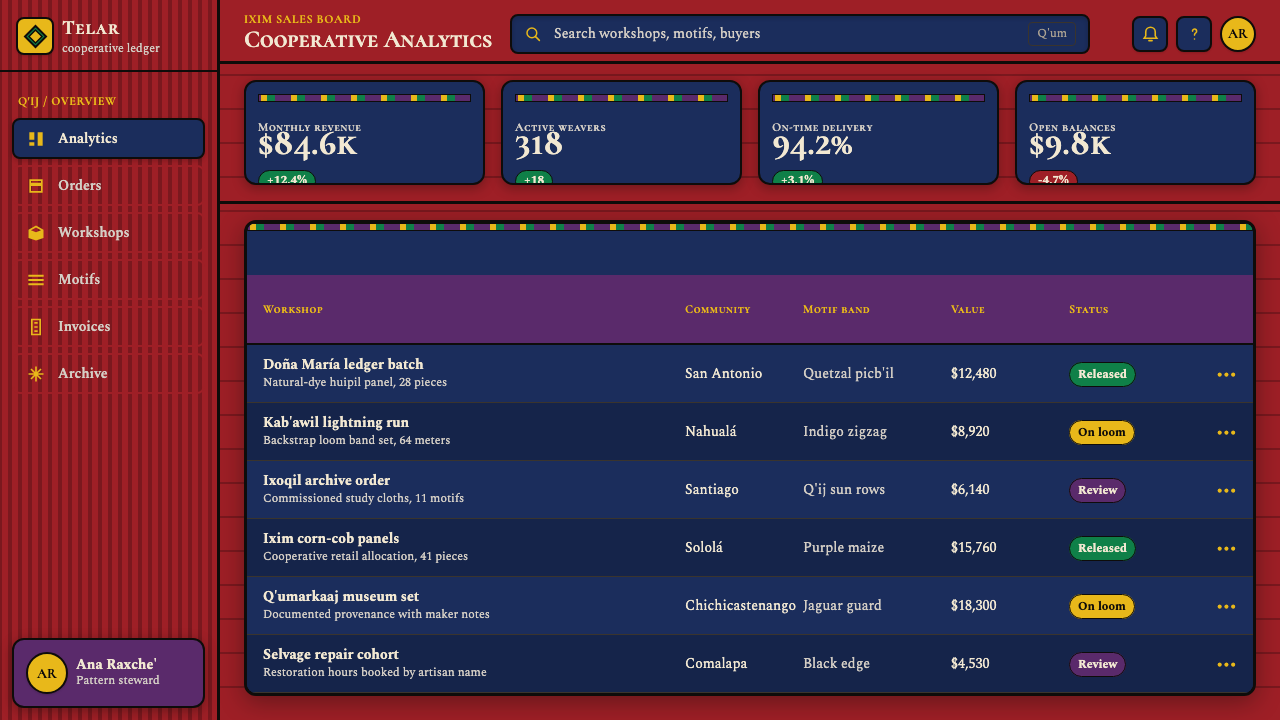
Guatemalan Huipil Maya Weave is a design system for contexts where cultural depth, visual richness, and a strong sense of heritage are primary values. It is not a minimal system, and applying it correctly requires embracing density rather than fighting it. The key is understanding how the brocade-band register structure organizes content: information should be grouped into clearly delineated horizontal zones, each with its own color character and motif logic, separated by the bold selvage-black edge treatment.
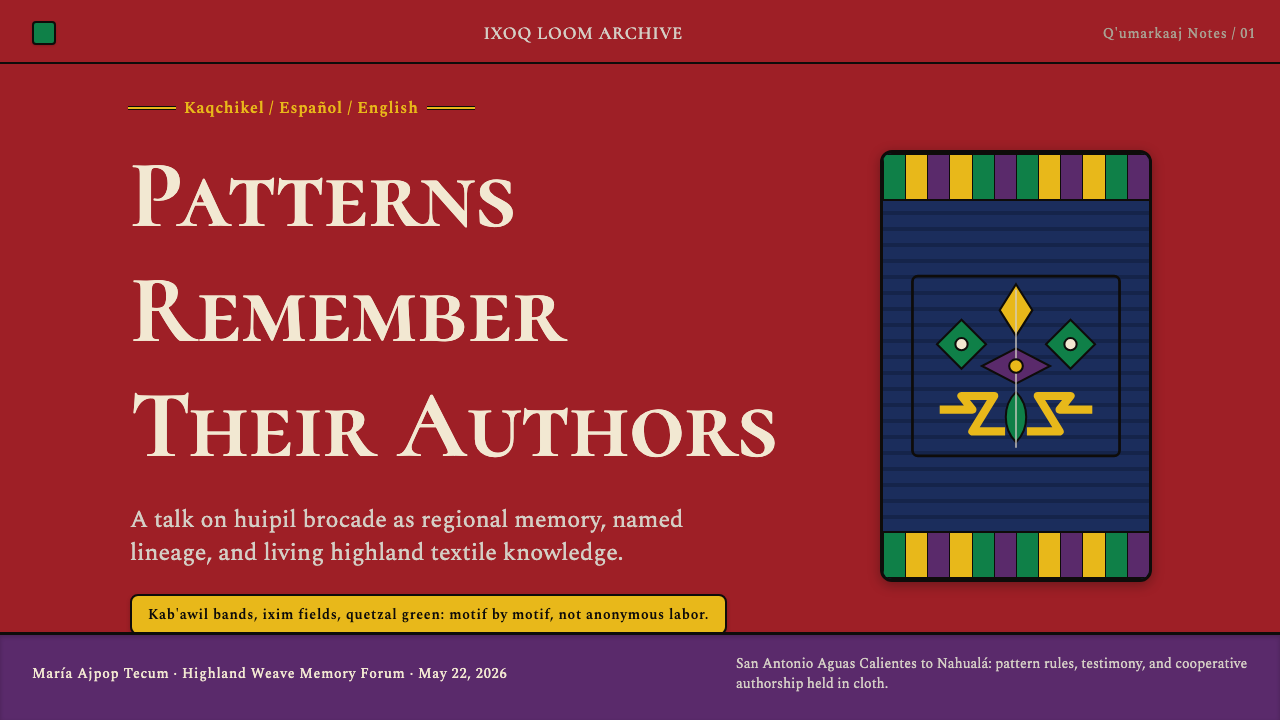
For presentation slides, the system works powerfully on both cover and section-break pages. A cover built on cochineal red with a large central brocade-band block carrying the title — in a bold, upright type that contrasts cleanly with the warm ground — establishes the system's authority immediately. Section-break slides use the emerald-green or lightning-yellow accent to signal transitions. Content slides require discipline: the brocade-band logic means that each slide should have no more than two or three horizontal registers, each containing a distinct type of information. Data visualizations benefit from the warm palette — bar charts and area graphs rendered in the accent colors against the red ground acquire an earthy visual warmth that distinguishes them from cooler analytical aesthetics.
For web interfaces, this system is best suited to editorial sites, cultural organizations, fair-trade marketplaces, and heritage-focused brand platforms where the richness of the aesthetic actively communicates the content's values. Dashboard or productivity applications will find the density challenging; the system is more at home with content-heavy pages where the user is expected to dwell and explore rather than scan and act quickly. Navigation should be structured as a clear horizontal or vertical register using the selvage-black containment treatment; the accent colors mark current state and primary calls to action. Card components benefit from the brocade-band approach: a band of accent color at the card's top or bottom signals category, while the main card body uses the cochineal-red ground.
For editorial and marketing work, the system's brocade-band register structure maps directly onto editorial hierarchy. Long-form articles benefit from section headers treated as brocade bands — a horizontal band of deep red or emerald with white or yellow title text — that break the page into clearly navigable regions. Marketing landing pages work well using a full-width banded structure: alternating bands of cochineal red, jet black, and emerald green, each carrying a different message register, create the visual momentum of a textile unrolling. The system communicates heritage, care, and material intelligence — ideal for artisan brands, cultural institutions, and products that want to foreground craft and community.
A common mistake is treating the cochineal-red ground as a mere background color that can be swapped out for other reds or neutralized with extensive white space. The warmth and cultural specificity of the red is essential to the system's coherence; replacing it with a cooler or more neutral color immediately dissolves the aesthetic logic. A second common error is applying the brocade-band structure decoratively — using it only on hero sections or cover pages while reverting to a generic grid elsewhere. The system's power comes from consistency: the register-based organization must extend through every page template, every component, every state.
Guatemalan Huipil Maya Weave — FAQ
Is it appropriate to use this design system outside of Guatemalan or Maya cultural contexts?
This is a genuine ethical consideration. The huipil tradition is a living cultural practice with specific community ownership, not a static historical artifact available for free appropriation. Using this design system respectfully means, at minimum, understanding the tradition's origins and significance, crediting it explicitly where the context allows, and avoiding applications that would trivialize or misrepresent the culture. Using it for products that actively exploit or mock indigenous communities is clearly inappropriate. In general, the system is well-suited for organizations working in solidarity with indigenous craft communities, for cultural education contexts, and for designers who have done the work of understanding what they are drawing on. The more distant the application context from the source culture, the more important explicit acknowledgment becomes.
How does this system handle light-background or dark-background variants?
The canonical form of the system uses cochineal red as the primary ground, which is a mid-dark value — neither pure light nor pure dark. A dark variant using jet black as the ground color with cochineal red and emerald green as accent layers is historically grounded: night ceremony textiles and certain prestige huipiles use deep-indigo or near-black grounds. A light variant is less historically authentic but workable: cream or off-white grounds with brocade-band elements rendered in red, emerald, and yellow. In either variant, the selvage-black edge treatment remains constant, and the brocade-band register structure must be maintained — without it, the system loses its organizing logic entirely.
What distinguishes this system from other pre-Columbian or Latin American textile-inspired aesthetics?
The key distinctions are specificity and continuity. This system draws from a living, community-specific tradition — the highland Maya huipil — not from a generalized notion of 'indigenous' or 'pre-Columbian' design. Its color relationships (cochineal red against emerald and yellow), its compositional structure (horizontal brocade registers), and its edge treatment (selvage black) are all grounded in the specific material and technical practices of Highland Guatemalan weaving communities. It is distinct from, for example, Andean textile aesthetics (which tend toward stepped diagonal geometry and a different palette), or Mexican huipil traditions (which vary significantly by region and community). Using it as a generic 'Latin American indigenous' style misreads both its specificity and its cultural stakes.
How should typographic choices work within this system?
The huipil tradition is non-alphabetic — its visual vocabulary consists entirely of geometric and figurative woven motifs rather than letterforms. This means the system does not prescribe a specific typeface in the way that some print-tradition-derived systems do. What it does prescribe is typographic behavior: type should be set at relatively high weight and contrast against the warm ground colors, using the brocade-band register logic to determine scale hierarchy. Tall, upright letterforms tend to harmonize better with the textile's vertical-rhythm sensibility than condensed or highly oblique forms. Avoiding type that appears delicate or hairline-thin is important — the system's energy is substantial and craft-weighted, not refined or precious.
Can this system work for digital products targeting users in Guatemala or the broader Maya diaspora?
It can, and in those contexts it carries particular resonance and communicative power. However, this is precisely where the most careful thinking about community specificity and attribution matters. Different highland communities have different textile traditions; using motifs or color combinations specifically associated with one community in a product intended for another could be read as homogenizing or misappropriating. Products targeting specific highland communities would benefit most from collaboration with members of those communities in the design process — ensuring that the specific vocabulary used reflects the intended community's tradition rather than a generalized approximation. The system is a starting framework, not a complete answer to the complexity of designing within and for living cultural traditions.
Related design styles
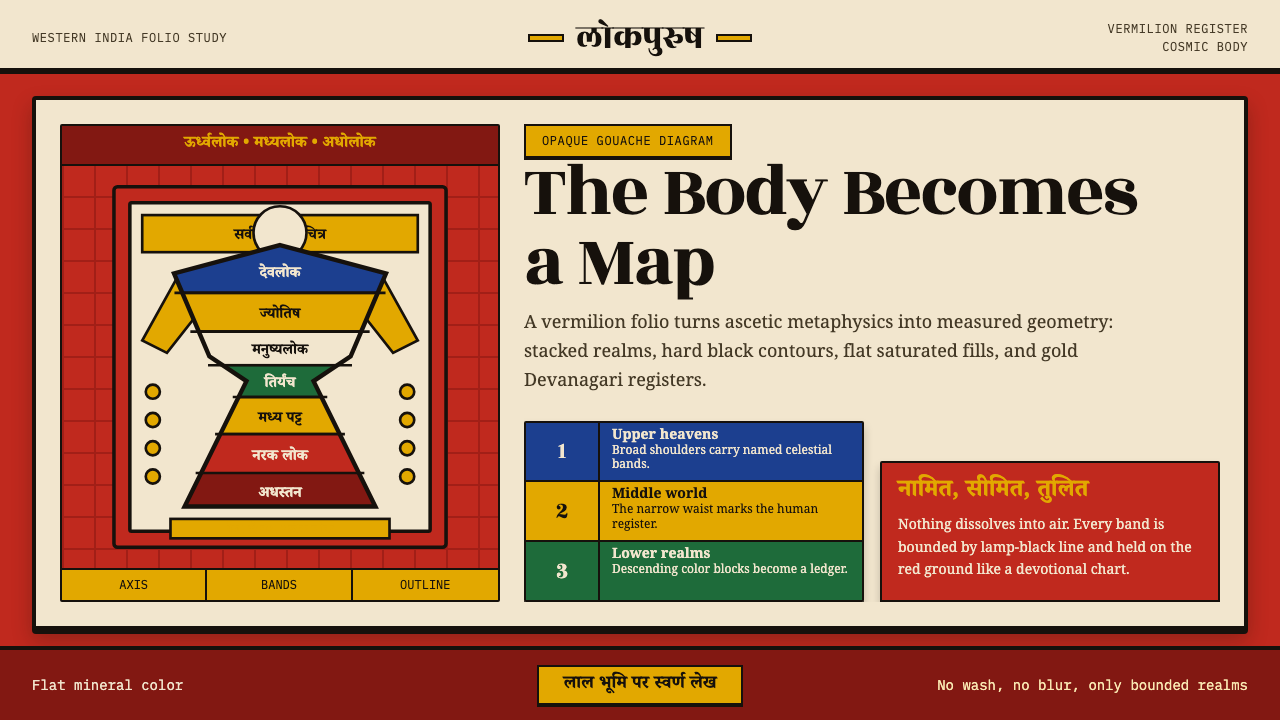 Jain CosmologyAscetic geometry, made visible. Vermilion ground, black contours, gold Devana…
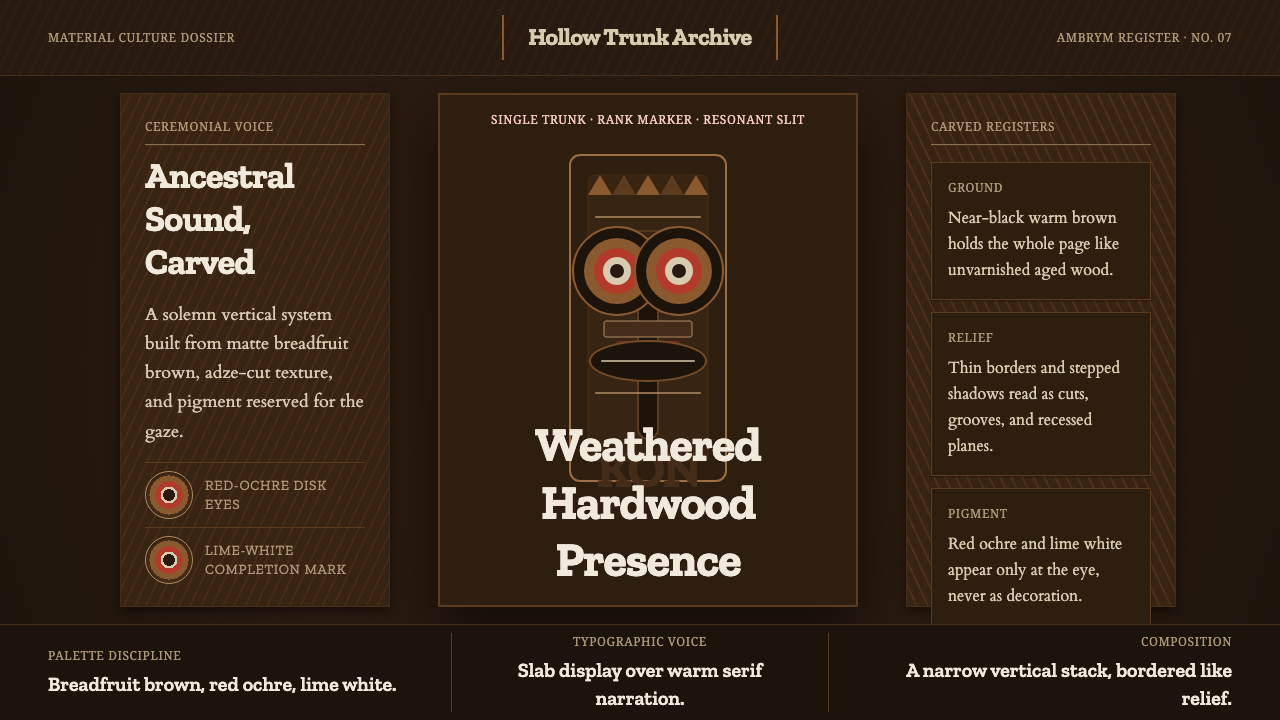 Ni-Vanuatu Slit Gong AmbrymSolemn wood made digital. Dark breadfruit brown, carved borders, red-ochre ey…
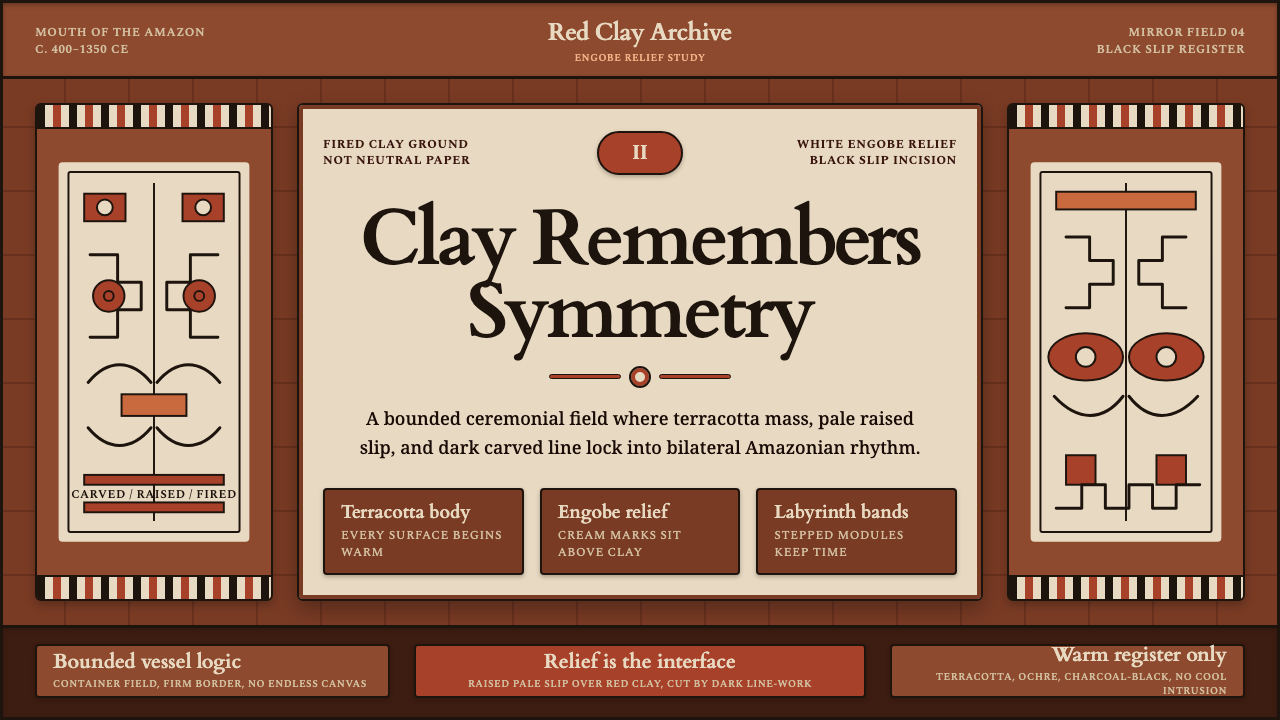 Marajoara Amazon CeramicClay holds memory. Terracotta ground, pale engobe relief, and black slip lock…
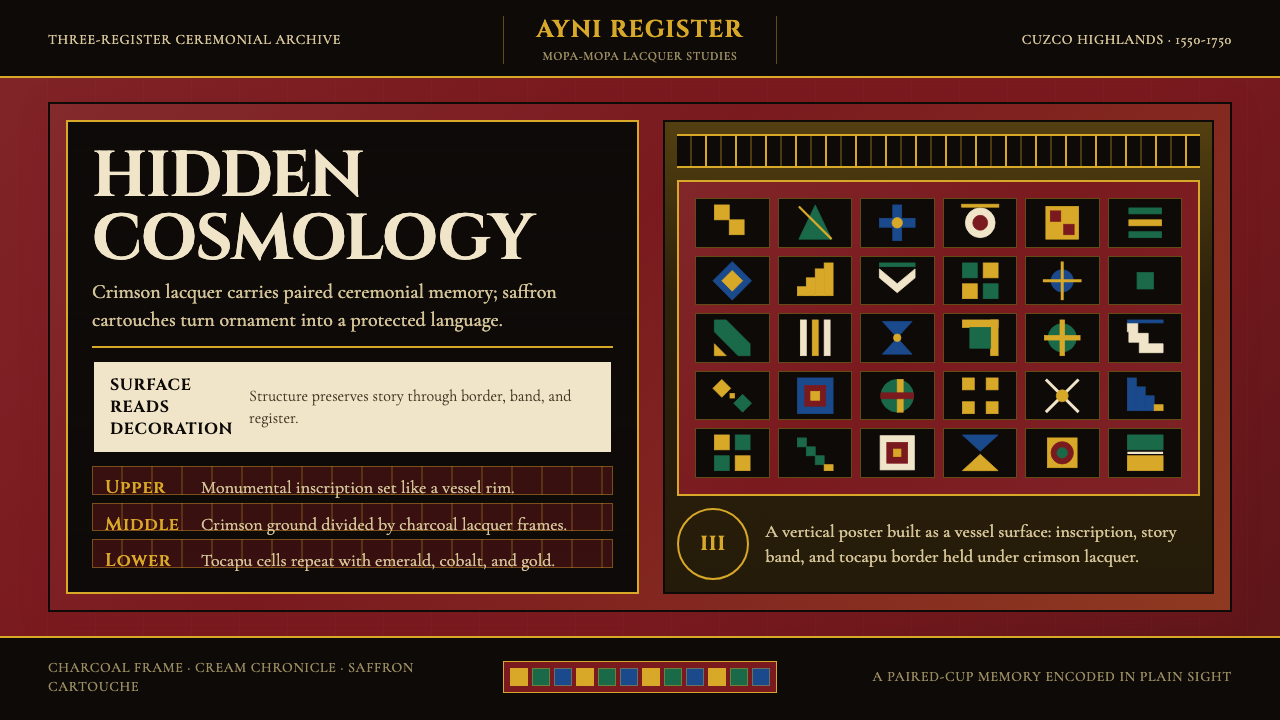 Peruvian Quechua Keros (Andean Cup)Hidden cosmology glows. Crimson lacquer and saffron tocapu grids frame the st…
 Aboriginal Wandjina KimberleyAncestral presence in stone. Chalk white haloes and red ochre outlines sit on…
 Alchi Monastery MuralDevotional depth. Lapis fields and coffered grids glow on terracotta plaster.