What is Greek Backgammon Tavli Board?
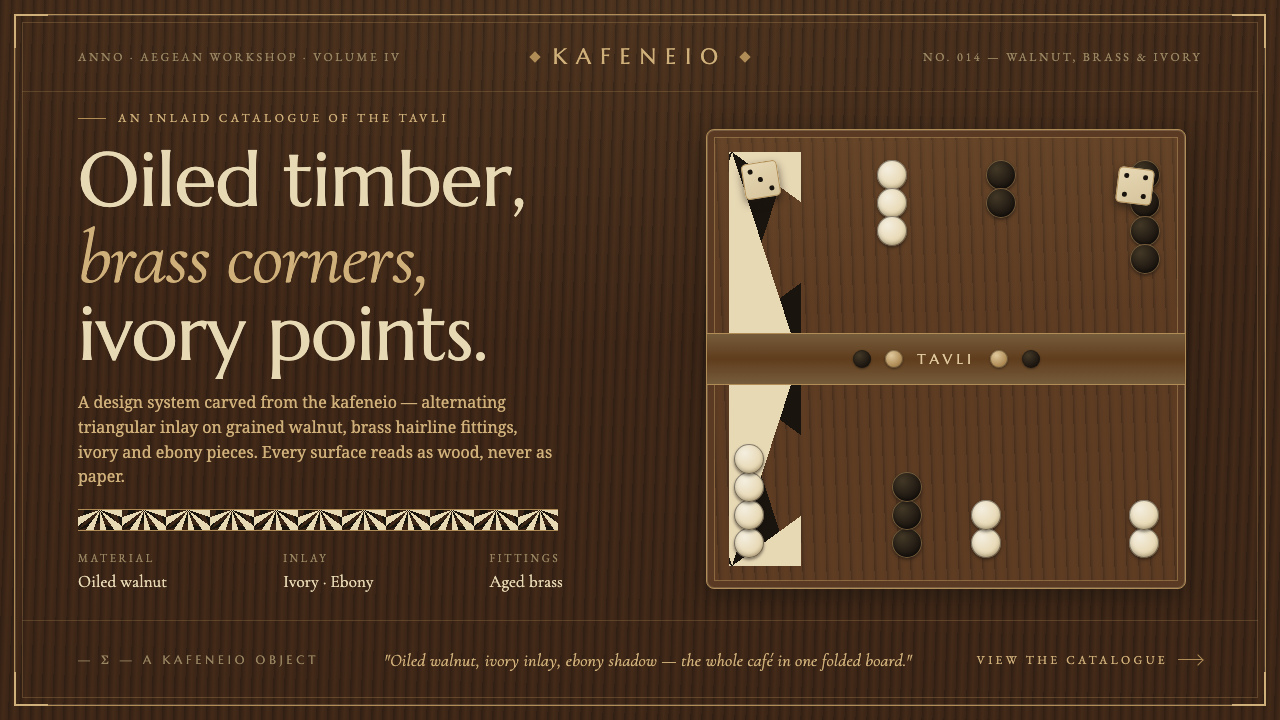
The Greek tavli board folds the kafeneio into a portable world of oiled walnut, alternating ivory and ebony points, aged brass, and the memory of countless games.
Greek Backgammon Tavli Board in brief
The Greek tavli board is a backgammon set shaped by the material and social atmosphere of the kafeneio. A dark walnut case frames a marquetry field of alternating ivory and ebony triangular points, while brass corners protect the object and give it the character of a frequently carried possession. Its beauty is not pristine. Oil, handling, and repeated play deepen the timber and soften the fittings until the board appears seasoned rather than decorated.
Tavli belongs beside Greek coffee, ouzo, and the dry clicking of komboloi worry-beads. The board is therefore more than a game surface: it is a compact stage for conversation, rivalry, waiting, and habitual return. Its strong geometry organizes play, but the surrounding wood grain keeps that geometry warm and particular. Repetition supplies order; natural variation prevents sterility.
As a digital design language, the style translates craft rather than merely illustrating a board. Walnut becomes the environmental ground, alternating points establish rhythm, ivory inlay creates legible emphasis, and aged brass marks joints, corners, or important controls. Paper-like panels and generic cream surfaces break the illusion. The interface should feel assembled from timber, inlay, and metal, then polished through use.
Where does Greek Backgammon Tavli Board come from?
The style belongs most directly to the classic kafeneio culture of 1900–1950, while the game tradition behind it is far older. Its region is the Eastern Mediterranean, centered on Greece but continuous with a wider culture of tavli and backgammon play. The board entered café life as an object that could endure repetition: opened, played, closed, carried, and returned to the table without ceremony.
Its visual identity emerged from tavli woodcraft, marquetry, and inlay. Walnut offered a dark, richly grained body; contrasting ivory and ebony points made the play-field immediately readable. Brass belonged at vulnerable corners and closures, where protection could also become ornament. These materials were not arbitrary decoration applied after construction. Each one explained how the board was made, handled, and expected to age.
The Manopoulos marquetry tradition represents the refined continuation of this craft, while kafeneio board-makers and tavli woodcraftsmen stand for the broader, often less individually credited culture that produced such objects. Their shared achievement was the union of exact geometry with tactile variation. The points had to remain regular enough for play, yet every grain, seam, fitting, and worn edge recorded the hand of the maker and the history of the object.
The kafeneio completed the design by giving it a social setting. Beside coffee, ouzo, conversation, and komboloi, the board became part of a repeated public ritual. Wear was not damage to be visually erased; it was evidence that the object belonged. A contemporary interpretation should preserve that principle. The goal is not theatrical antiquing, but a convincing relationship between durable structure, natural material, and accumulated use.
What defines the Greek Backgammon Tavli Board look?
Walnut Ground
Oiled dark walnut is the governing surface, not a decorative strip around a neutral page. Its grain should remain visible enough to establish direction and tactility without competing with information. The tone feels deep, warm, and polished by handling. Lighter wooden areas may reveal construction or hierarchy, but paper white and cream grounds do not belong to the system.
Alternating Points
Long triangular points form the primary geometric vocabulary. Alternating ivory and ebony creates a steady visual cadence, while the taper of each point directs the eye inward. In digital layouts, the motif works best as an organizing edge, sectional rhythm, chart structure, or focused indicator. Scattering unrelated triangles across the page reduces a functional game geometry to costume.
Ivory and Ebony Contrast
The palette derives its clarity from the opposition between pale inlay and near-black wood. Ivory is warm and material rather than luminous white; ebony is dense and absorptive rather than a generic digital black. Their contrast should identify turns, categories, active states, or opposing sides. Walnut mediates between them, preventing the interface from becoming stark or clinical.
Aged Brass
Brass appears where an actual object would need reinforcement, fastening, or closure. It belongs on corners, hinges, narrow rules, markers, and decisive controls rather than broad ornamental fields. The finish should feel aged and handled, with restrained variation instead of mirror-like brilliance. Used sparingly, brass supplies a ceremonial glint without competing with the play-field.
Tactile Depth
Depth comes from construction: an inlay sits within wood, a frame surrounds a field, and a fitting caps an edge. Shadows should describe these relationships with firmness and restraint. Soft atmospheric effects that make everything float are inappropriate. The desired impression is a compact object with weight, seams, and surfaces that could be opened, closed, and touched.
Wear as Memory
Subtle wear gives the system social credibility. Edges may be softened, timber may darken where hands would rest, and brass may lose its uniform shine. These traces must follow plausible use rather than appear as random distress. The board should feel cared for and repeatedly played, not neglected. Patina is narrative evidence, not a texture filter.
Who shaped Greek Backgammon Tavli Board?
The Manopoulos marquetry tradition represents the polished craft lineage associated with finely made Greek tavli sets. Its importance lies in treating the play-field, case, contrasting points, and fittings as one coherent object. For contemporary designers, it demonstrates that luxury comes from exact joins, balanced material contrast, and finish accumulated across the whole construction rather than from added decoration.
Kafeneio board-makers connect the object directly to café life. Their boards were not isolated display pieces but social tools expected to withstand handling, travel, argument, and repeated play. This practical setting explains the sturdy frame, protected corners, legible point pattern, and valued patina. Their legacy is a design ethic in which durability and conviviality reinforce one another.
Tavli woodcraftsmen embody the broader making culture behind the style. Their work joins regular game geometry to variable natural material, demanding precision without erasing grain or touch. The result is neither rustic improvisation nor mechanical sameness. It is disciplined craft whose warmth emerges from the visible agreement between purpose, material, and handwork.
How do you use Greek Backgammon Tavli Board today?
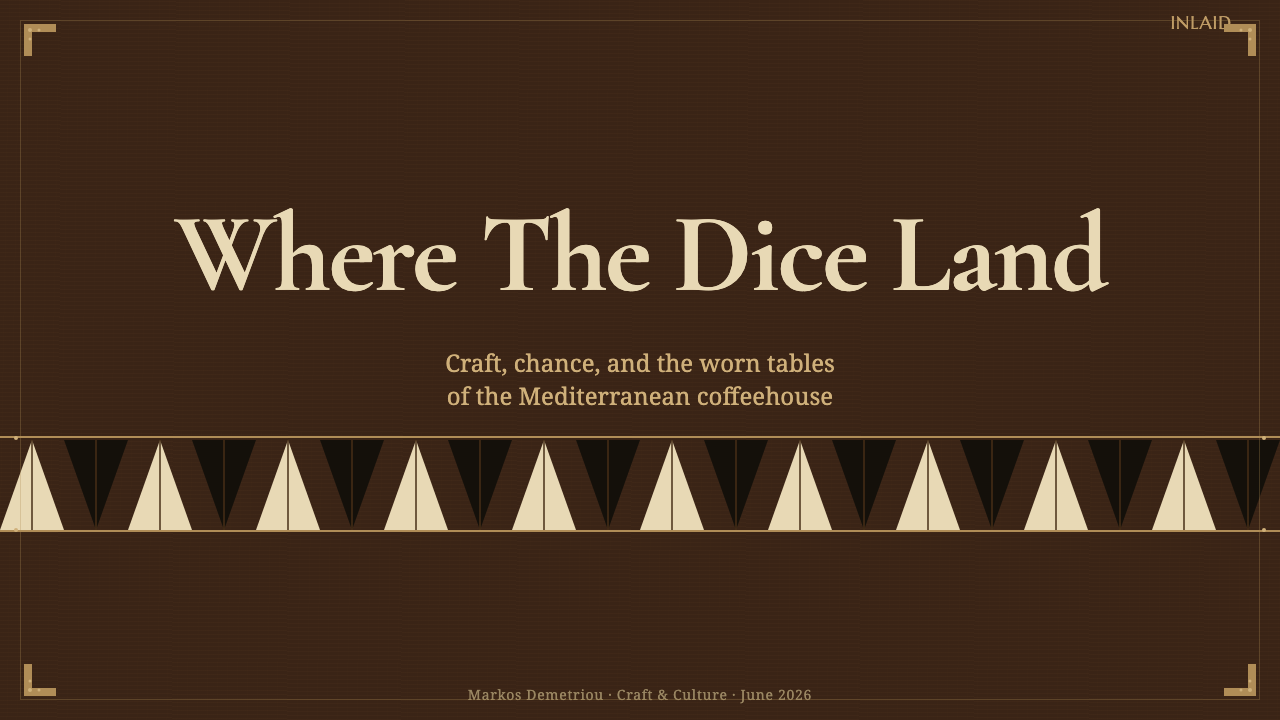
For presentation slides, the style is strongest when the deck is treated as an opened board rather than a collection of wood-textured rectangles. A cover can place the title within a dark walnut field framed by alternating ivory and ebony points, with a restrained brass corner or rule establishing the object-like construction. Content slides should simplify the motif: preserve the timber ground, use inlay-like bands for hierarchy, and let triangular geometry guide the reading path. Data slides can assign contrasting point colors to opposing series, while brass marks totals, thresholds, or decisive outcomes.
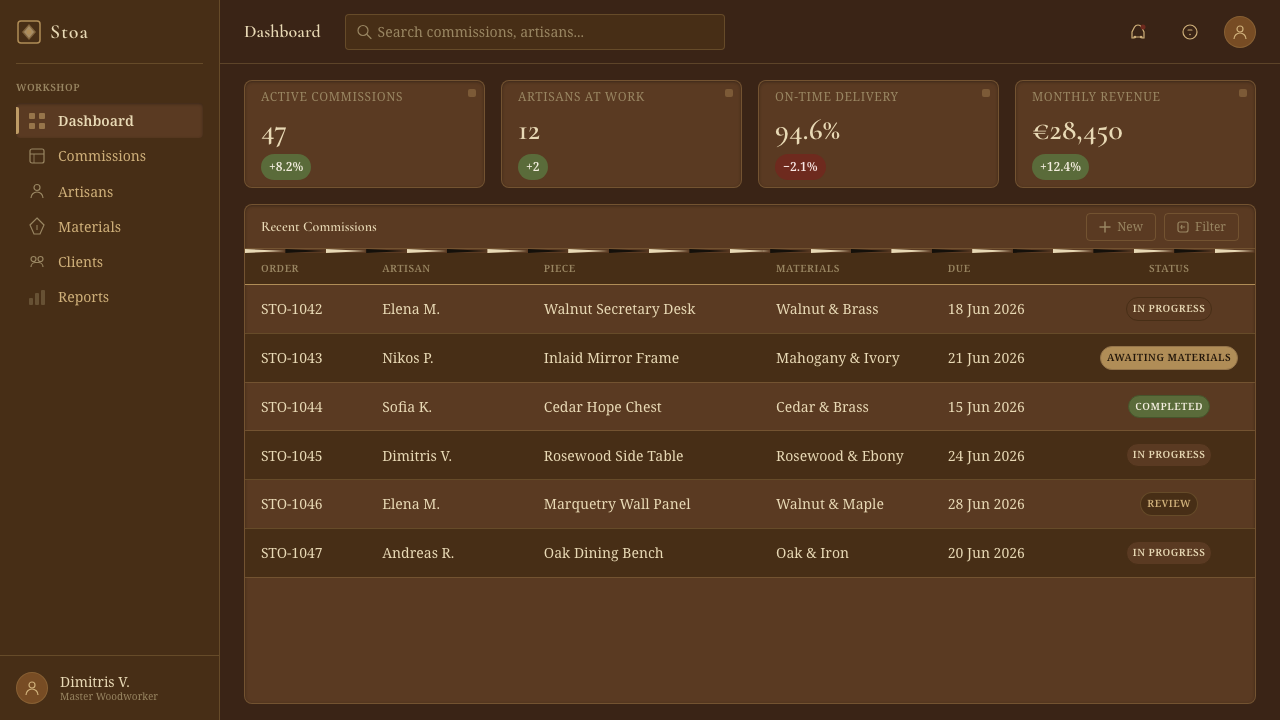
For web dashboards and pricing pages, walnut provides a stable environmental surface while inset panels behave like sections of the play-field. Ivory and ebony distinguish states or categories; brass is reserved for selected controls, premium tiers, or high-value indicators. Navigation can resemble the framed edge of the board, with clear labels embedded into the structure. The interface must remain readable before its material references are noticed: texture supports orientation, and game geometry supports comparison.
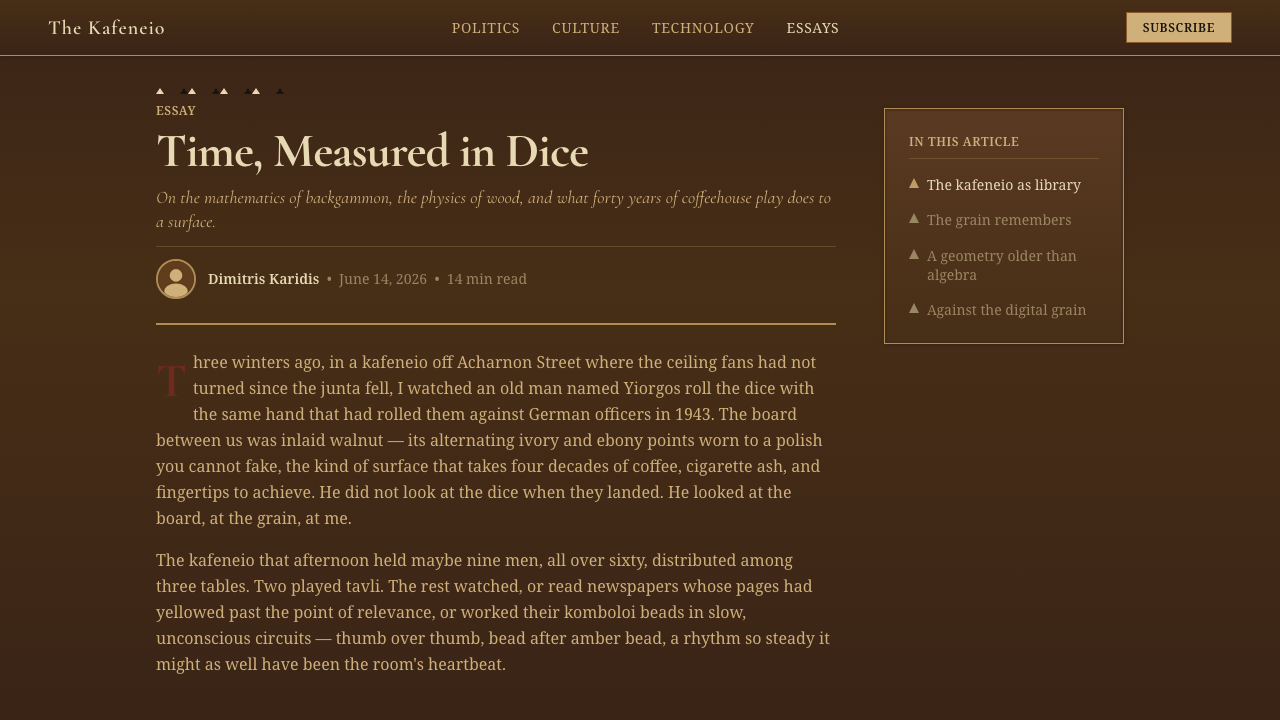
Editorial layouts benefit from the style's mixture of ritual and tactility. A feature article can open with a broad walnut field, a narrow run of alternating points, and an ivory title that feels inlaid rather than printed. Section changes may be marked by brass rules or shifts in wood direction. Marketing pages can use the board-opening metaphor to reveal products, offers, or opposing choices, especially when the message concerns heritage, sociability, strategy, or durable craft.
The most common mistake is applying a generic wood texture behind every element and adding brass highlights indiscriminately. That produces themed decoration, not a tavli-derived system. The authentic logic is constructive: walnut forms the body, inlay organizes the field, triangles direct attention, and brass protects or resolves important edges. Another error is making every surface heavily worn. Patina should gather where use would create it; elsewhere, restraint preserves clarity and makes the signs of handling believable.
Greek Backgammon Tavli Board — FAQ
Is the Greek tavli style simply a dark wood version of backgammon imagery?
No. Backgammon imagery supplies the recognizable triangular points, but the style depends equally on the kafeneio setting, Greek tavli craft, walnut marquetry, ivory and ebony contrast, brass protection, and wear produced by social use. A layout containing triangles on brown is only an illustration of the game. A tavli-derived system makes every material and geometric decision feel connected to the construction and life of the board.
Can the style use a light background?
A pale inlay can occupy a focused panel or information field, but the governing environment should remain oiled timber. Paper white and cream backgrounds undermine the defining sense that information has been fitted into a wooden object. When greater brightness is needed, expand the ivory inlay, lighten the visible wood, or open more space within the composition without replacing the material ground.
How much wood grain should appear in a digital interface?
Enough to establish material direction, warmth, and natural variation, but not enough to interrupt reading. Broad backgrounds can carry calmer grain, while frames and feature areas may show richer figure. Grain should follow the apparent construction of the object rather than run randomly across every component. If the texture becomes the first thing noticed on a dense dashboard, it is probably overpowering the information.
Does every page need the full alternating triangle pattern?
No. The full pattern is most effective on covers, transitions, summaries, or views that directly compare opposing sides. Repeating it at full strength on every page turns a meaningful structure into visual noise. Interior screens can retain the style through tapered dividers, alternating markers, inset frames, walnut grounds, and restrained brass details. Recognition should survive even when the literal board motif recedes.
What kinds of products suit the Greek tavli board aesthetic?
It suits products that benefit from ideas of strategy, ritual, heritage, sociability, and durable craft: game interfaces, cultural storytelling, hospitality presentations, premium comparison pages, and editorial experiences centered on place or tradition. It is less natural for products seeking weightless neutrality or clinical precision. The style carries a strong setting with it, so it works best when the product can meaningfully share that atmosphere rather than merely borrow its surfaces.
Related design styles
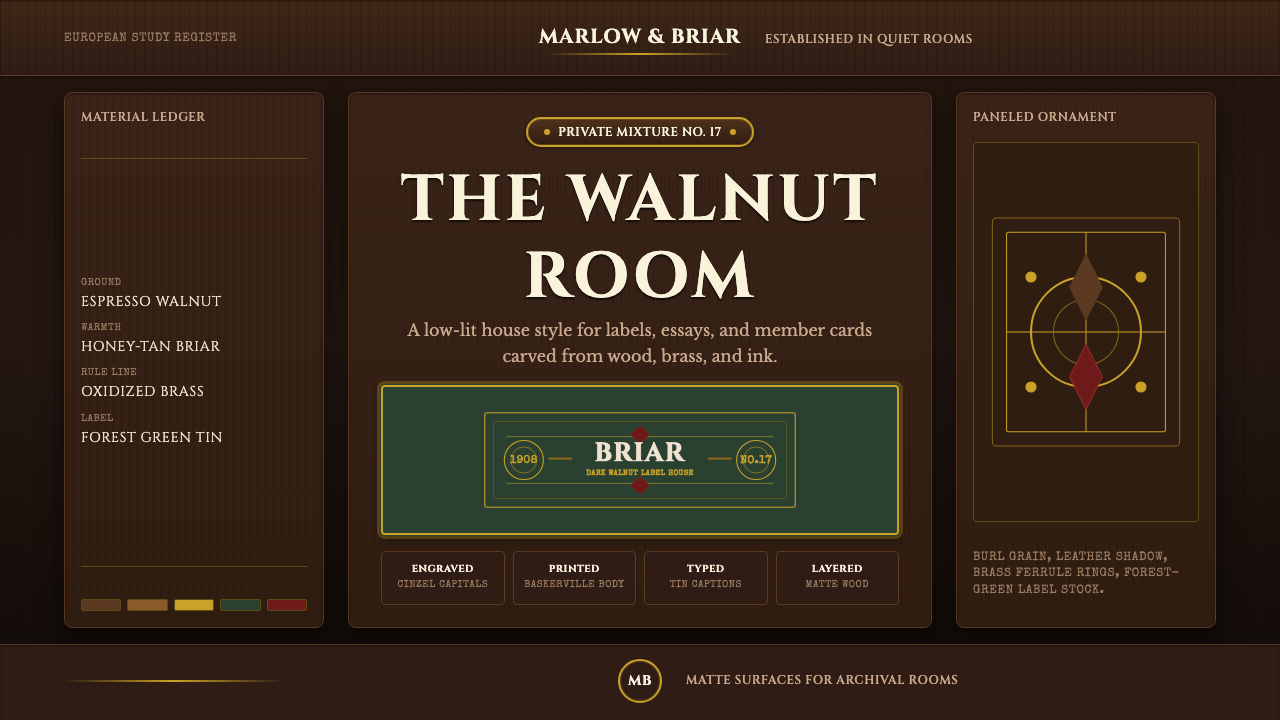 Briar Pipe & TobaccoWarm gloom, precisely aged. Brass rules and Cinzel capitals sit on espresso w…
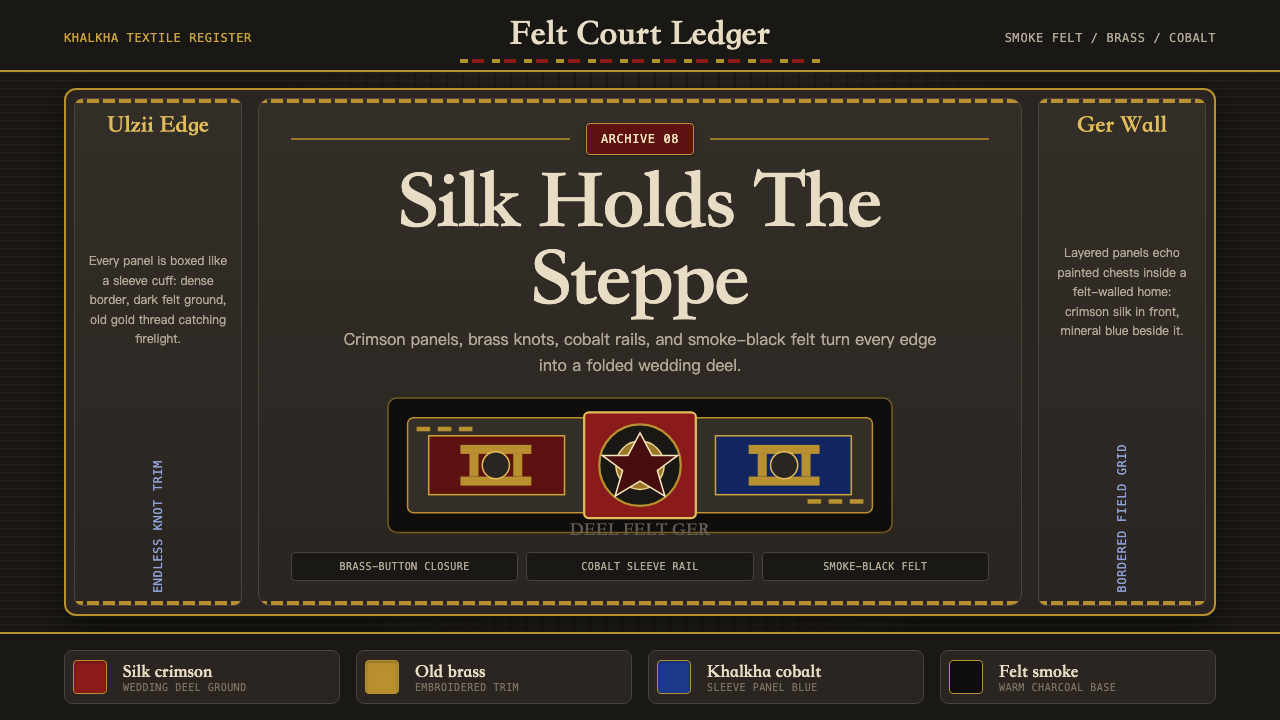 Mongolian Deel & Ger FeltTextile gravity. Smoke-black felt frames crimson silk, brass knot borders, an…
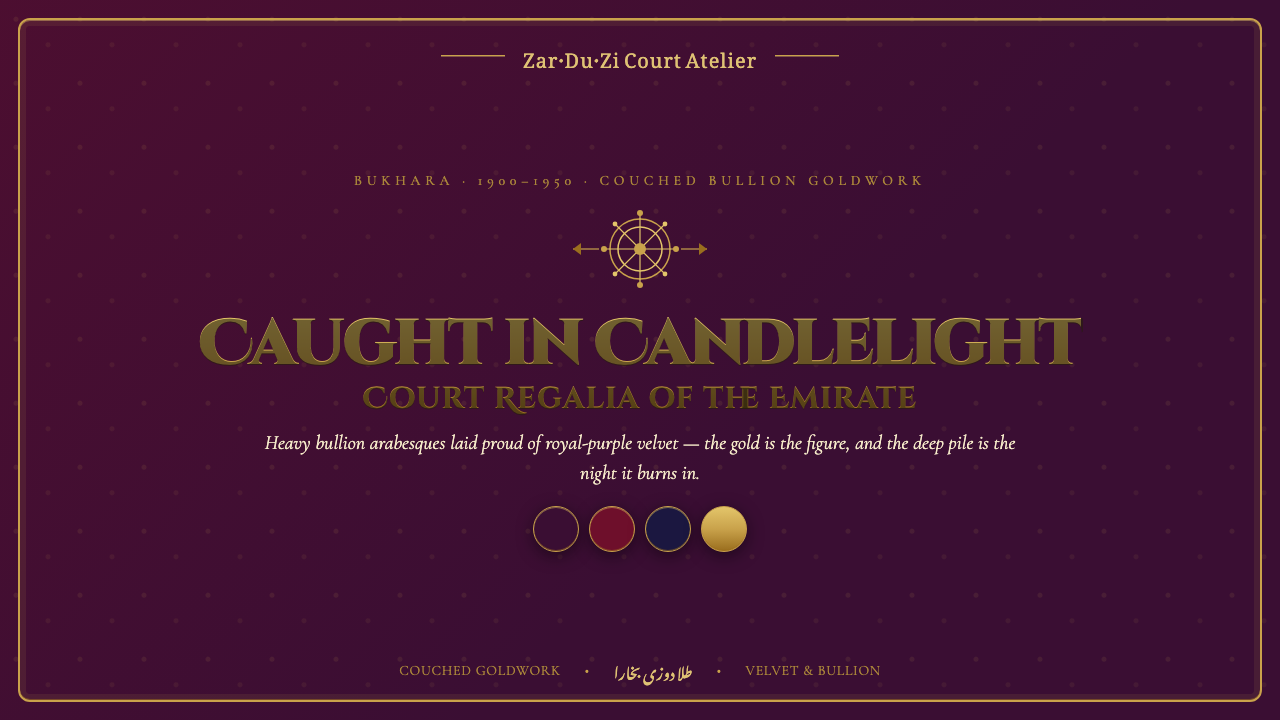 Bukhara Gold-Embroidered ChapanGold is the figure, velvet the night. Bullion arabesques blaze on royal-purpl…
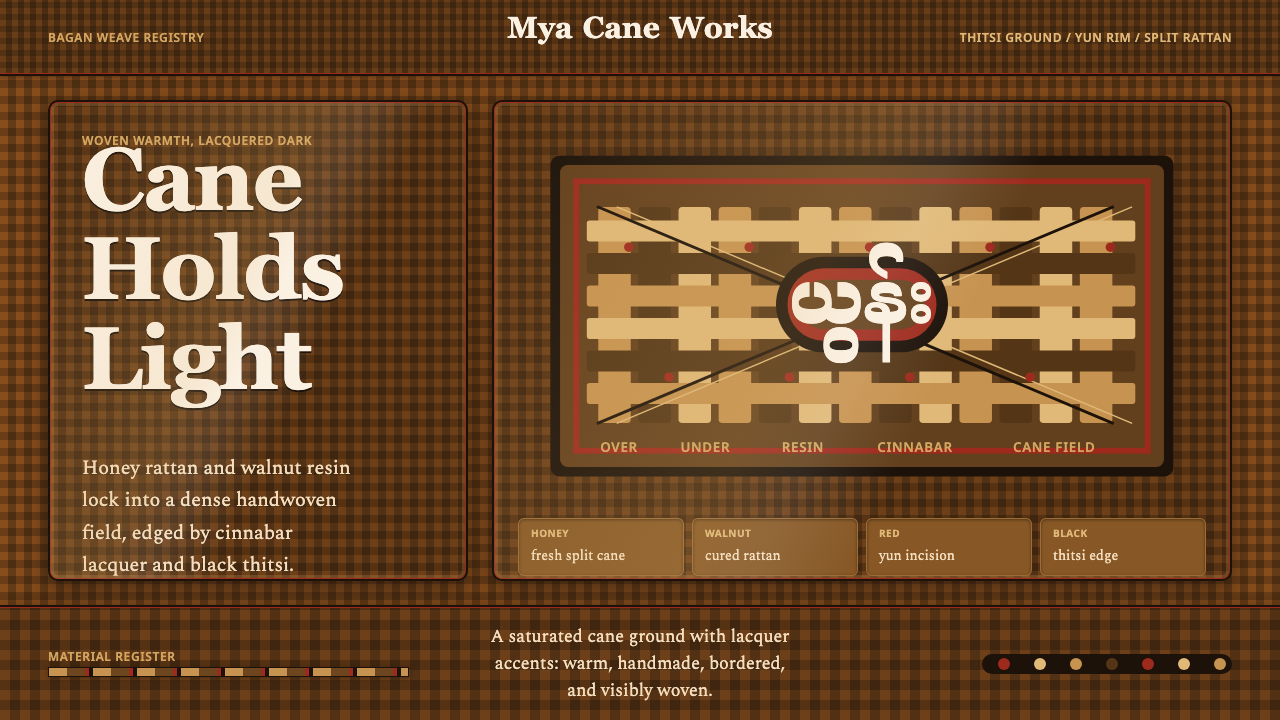 Burmese Cane RattanWoven warmth holds the page. Walnut cane lattice glows with cinnabar rim line…
 Christmas ClassicTradition glows warmly. Evergreen panels, berry-red notes and burnished-gold…
 Dior New Look (1947)Couture speaks softly. Cream ground, navy Didot capitals, and gold hairlines…