What is Go Kifu Record?
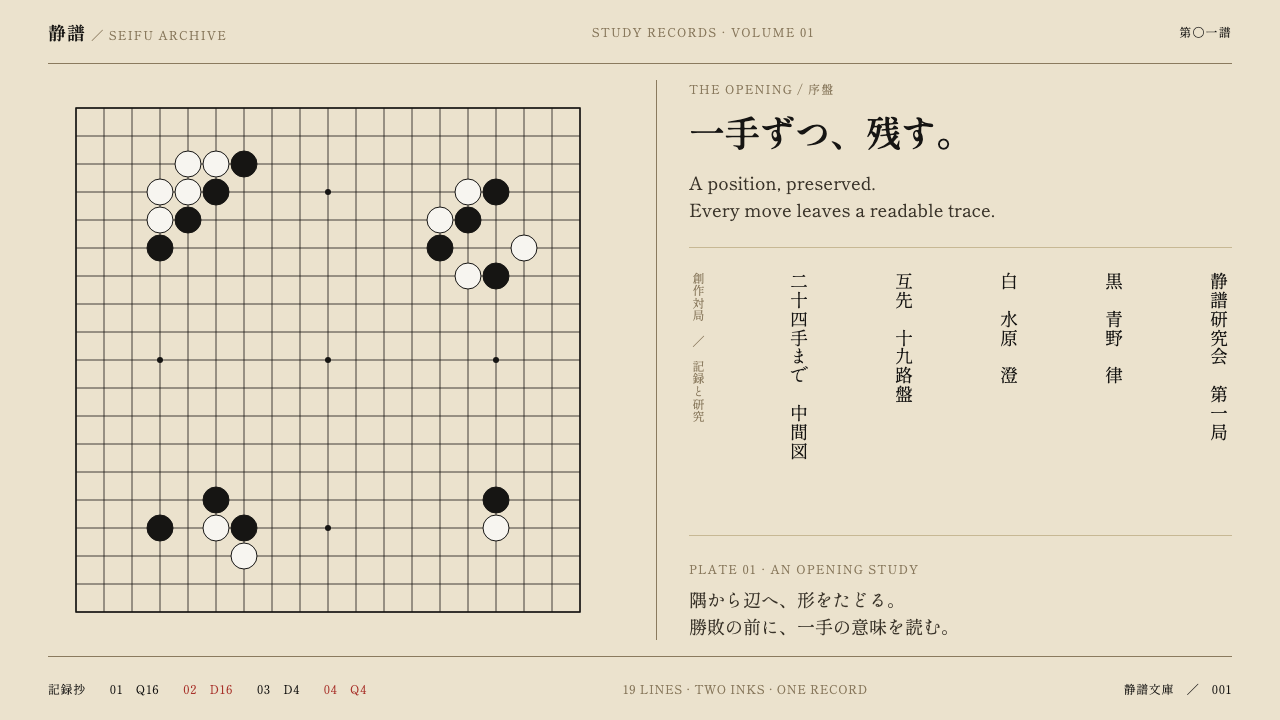
A go kifu gives the whole page to one diagram — fine ink ruling on pale washi, numbered stones, and vermilion used only where the old recording convention asks for it.
Go Kifu Record in brief
A kifu is the move-by-move record of a game of go. In its classic form it is a ruled grid of 19×19 lines, nine star points marked as small dots, and black and white stones set on the line intersections and numbered in the order they were played. Everything else on the page — the names of the players, the date, the result, the commentary — defers to that diagram. The design style built on it takes its principle from the sheet itself: the diagram comes first.
The visual system is quiet and exact. Thin sumi-ink ruling sits on an unbleached, fibrous washi ground. Game information is set vertically in a Mincho serif, in a narrow column down the right edge. A single accent, vermilion, is held back for the old recording convention of writing black in ink and white in vermilion; it is notation, not decoration. And there is no shadow anywhere near the board. Stones are flat discs rather than objects lit from above, because on a record a stone is a piece of data, not a picture of a stone.
It is a style for situations where the image must lead and the words must support it. Text numbers the diagram, annotates it and files it away; it never competes. The result looks less like a designed layout than like a document kept in good order, which is the effect the style is after.

Where does Go Kifu Record come from?
The kifu belongs to the long East Asian tradition of go, a game with roots in China and Korea that Japan developed into a professional world during the Edo period (1603–1868). Recording games was essential to that world: professionals studied each other's play, teachers corrected pupils against the record, and reputations rested on games that others could replay stone by stone. A kifu is the game made portable.
The best-known occasions for such records were the castle games, the oshirogo, played at Edo Castle by players from the go houses. The Hon'inbō and Yasui houses are two of the names the tradition preserves. These games circulated in woodblock-printed manuals, part of the wider wasōbon, the traditional Japanese-bound book production of the period. Printing a game from a woodblock meant cutting a clean grid and clear stone marks into wood, and the discipline of that medium — lines that must hold, a page with no room for ornament — set the visual grammar that survives today.
Among the players the tradition remembers is Hon'inbō Shūsaku, a name from the Hon'inbō house regarded as one of the strongest players of the late Edo period. The games of players like him are exactly the kind that were recorded, reprinted and studied again and again. The records outlived the era that produced them, and the diagram form needed almost no revision to carry them forward.
In the modern period the discipline passed to newspapers and to the professional body, the Nihon Ki-in. A newspaper go column still prints the same diagram with almost nothing changed: the grid, the numbered stones, the notes in a narrow column. That continuity is why the kifu makes such a good source for a design system. It is not a revived style but a working format that has barely needed to change, and the design inherits its restraint directly — sumi on pale paper, vermilion by convention, information set vertically down the right edge, no shadow.
What defines the Go Kifu Record look?
The board as grid
A 19×19 grid of fine lines is the structural spine of the layout. The lines are thin, even and unbroken, ruled in dark ink so they read clearly without ever becoming heavy. Nine star points, the hoshi, mark the orientation of the board as small solid dots. The grid is not decoration but a coordinate system, and the rest of the page is arranged around its edges.
Numbered stones
Stones sit on the intersections, never inside the squares, and carry the number of the move in which they were played. They are flat circles, black stones solid and white stones open, with no highlight, bevel or cast shadow. A stone is a data point, so its numeral must stay legible at small size and the circle must never be dressed up as an object.
Washi ground
The paper is unbleached kozo washi: a pale, warm, slightly fibrous off-white that gives the ink something to sit in. The ground is quiet enough to let fine lines register, but it has enough tone that the page feels like a sheet rather than a screen. There is no pure-white void and no texture strong enough to compete with the grid.
Sumi ruling
The ink is sumi: a soft, dense black used for lines, stone outlines, numerals and text alike. The restraint is chromatic as well as graphic. The page is essentially one ink on one paper, and hierarchy comes from weight and placement rather than from a spread of colours.
Vermilion as notation
Vermilion appears in one role only: the recording convention in which black is written in ink and white in vermilion. It marks information, not mood, which makes it the opposite of a brand accent. If vermilion turns up where no convention calls for it — a button, a divider, a heading — the system has been misread.
Vertical Mincho notes
Game information — players, date, result — is set vertically in Mincho, the serif style of printed Japanese, in a narrow column down the right edge. The vertical setting is both a reading convention and a layout decision: it leaves the body of the page for the board and moves the text out of the diagram's way. The type is small, upright and even.
No shadow, no depth
Nothing on the page is lifted. There are no drop shadows, no glossy stones and no layered panels. The board is a flat plane and the page is a flat plane. This is the strictest rule in the system, because depth would suggest a physical board and distract from the record of play.

Who shaped Go Kifu Record?
Hon'inbō Shūsaku belonged to the Hon'inbō house and is regarded as one of the strongest players of the late Edo period. His name stands for the reason the format exists: great games deserve a record clear enough to be replayed stone by stone, long after the players are gone.
One of the go houses of the Edo period, the Hon'inbō house stands for the institutional side of the tradition. Players from the houses took part in the castle games, and the care with which those games were recorded and printed is the origin of the format's discipline.
The Yasui house is another of the houses the tradition preserves. Records from different houses share one convention, the same grid and the same numbering for everyone, which is why the kifu works as a neutral instrument: the diagram belongs to the game, not to any one author.
The Nihon Ki-in is the modern professional go organisation. Together with the newspaper go column, it carries the record-keeping tradition into the present day, which is why a contemporary diagram looks so close to its Edo ancestor.
How do you use Go Kifu Record today?
The Go Kifu Record style is for work where one diagram is the point and words exist to support it. It rewards projects with a central image or structure that needs numbering, annotation and archiving. It is a style of order and patience, built around the idea that the content should be allowed to stand alone.
For presentation slides, a cover can be a single large figure on a pale washi-toned field with a small, restrained title, set in a quiet serif. Content slides work as one figure per slide, with numbered notes in a narrow column at the right. Data slides can be treated like game diagrams: fine ruled gridlines in dark ink, data points as small numbered discs, and vermilion kept to one consistently applied rule — marking the baseline, say, or the latest entry — instead of being sprinkled for emphasis.
For web interfaces, the style fits documentation sites, reference tools, archives, replay and review products, learning platforms and research notebooks. A dashboard can be a board-like data grid with numbered rows and thin ruled lines. A pricing page works as a plain ruled table with no raised cards and no shadows. Navigation should be minimal and typographic, and any metadata should be tucked into a narrow column at the edge so that the main object stays central.
For editorial and marketing work, the style suits annotated case studies, match and event records, recipes with numbered steps and long-form pieces with one governing figure. Marketing pages can be understated: a single hero diagram, a few lines of vertical or edge-set text, and a great deal of paper. The style is especially natural for CJK typography, where vertical setting is already a familiar convention.
The common mistakes are all forms of decoration. Using vermilion as a brand colour, a button colour or a decorative divider turns notation into ornament. Adding soft shadows to stones, a glossy board or layered cards undoes the rule against depth. Layering on generic Japanese motifs such as waves or blossoms misreads the style entirely, since its whole point is the absence of ornament. Finally, ruling the grid in heavy lines makes the page shout; the lines should be fine enough that the stones carry the weight.

Go Kifu Record — FAQ
What is a kifu?
A kifu is the move-by-move record of a game of go: a ruled 19×19 grid with nine star points, and black and white stones placed on the intersections and numbered in playing order. In the Edo period such records circulated in woodblock-printed manuals, and the newspaper go column still prints the same kind of diagram today.
Why are the stones placed on the intersections and not in the squares?
Because that is how the game of go is played: stones occupy the line intersections of the board, not the spaces between them. The diagram simply records this faithfully. In design terms it means the grid is a field of points rather than cells, which is why layouts in this style hang their content on lines and crossings instead of boxes.
Why is vermilion used so sparingly?
Because in this style vermilion is notation, not decoration. It belongs to the old recording convention of writing black in ink and white in vermilion. Using it as a general accent would turn a piece of information into a mood, and the page would lose its discipline. If your design needs a second signal, use weight, position or a numbered mark in ink first.
Does the style require vertical text?
Vertical setting down the right edge is the signature of the original and works naturally for Chinese, Japanese and Korean content. For Latin-script content you do not have to force it. The principle that matters is that game information, labels and notes step out of the diagram's way: keep them in a narrow, quiet column at the edge, small and upright, so the central figure remains the first thing seen.
Can this style be used for things other than go?
Yes, wherever one diagram deserves to lead and the text exists to number, annotate and file it: match records, other board games, schematics, maps, annotated case studies, archives. Borrow the structure rather than the subject — fine ruled lines, a pale ground, flat numbered marks, one reserved signal colour — and keep the diagram, not the decoration, at the centre of the page.
Related design styles
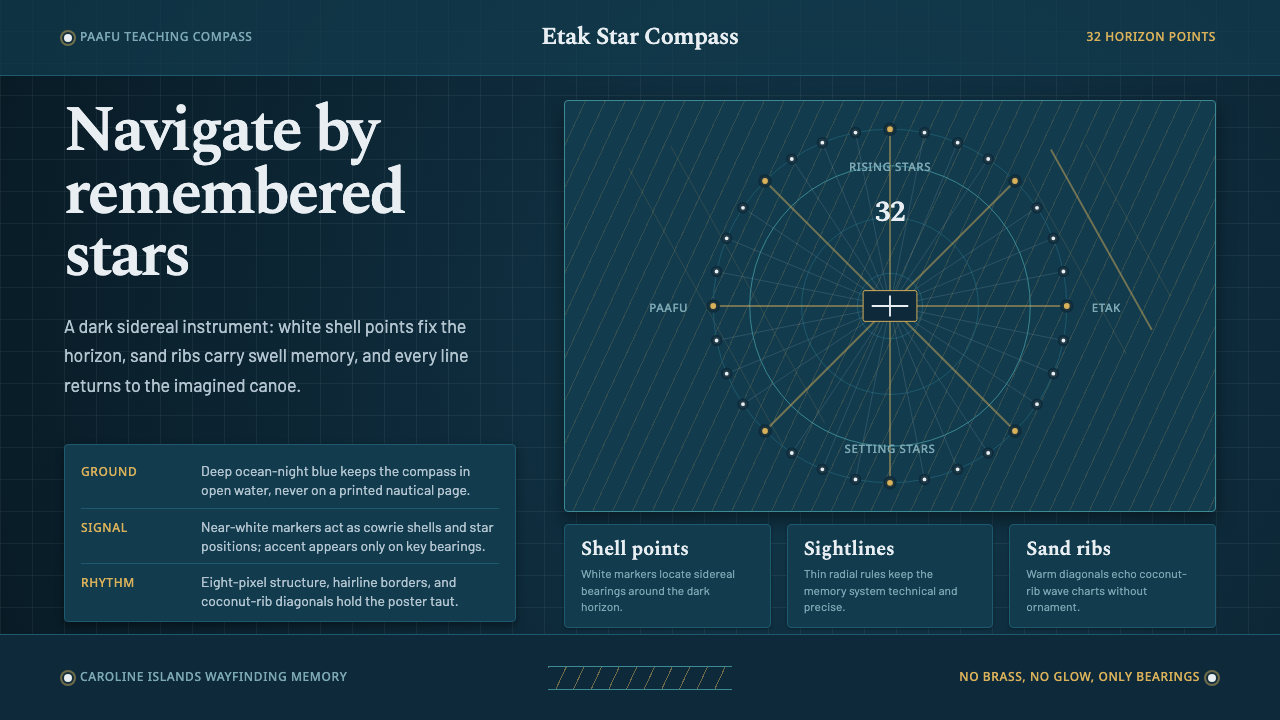 Micronesian Etak Star CompassNavigation as memory. White star points and sand ribs map a 32-point ocean-ni…
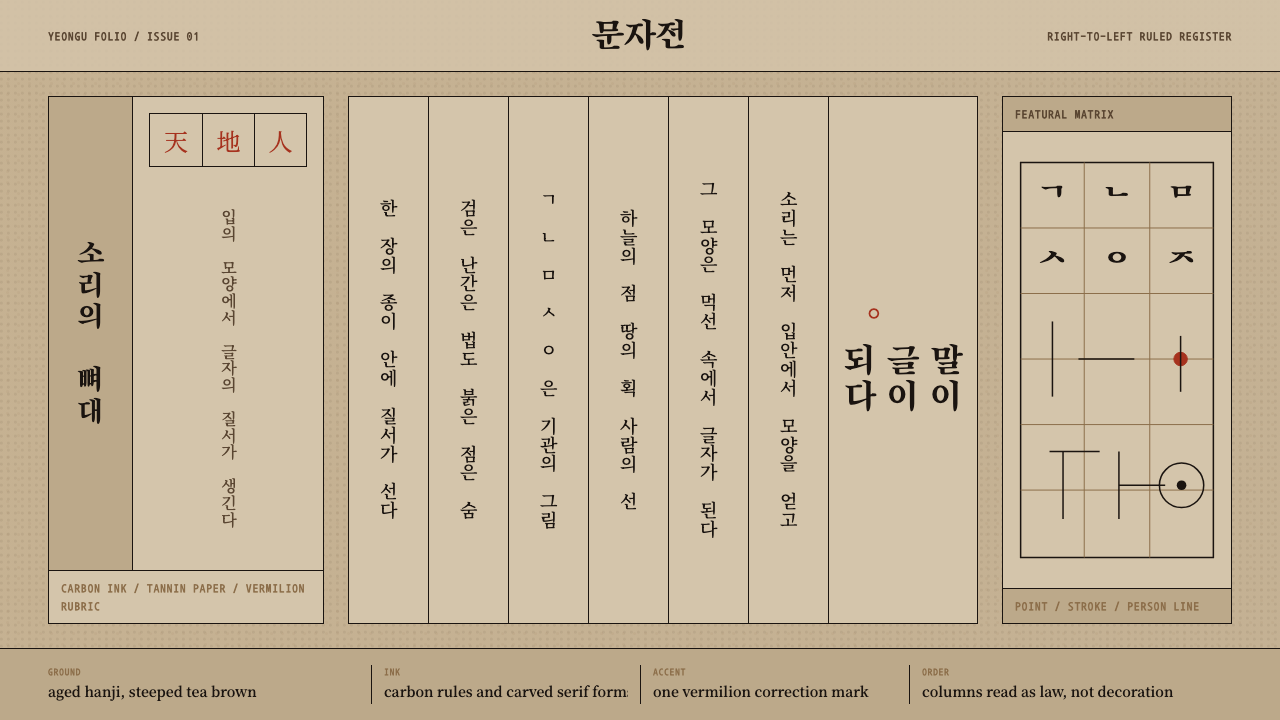 Hangul 訓民正音Ink obeys the grid. Carbon rules, vertical Myeongjo columns, and rare vermili…
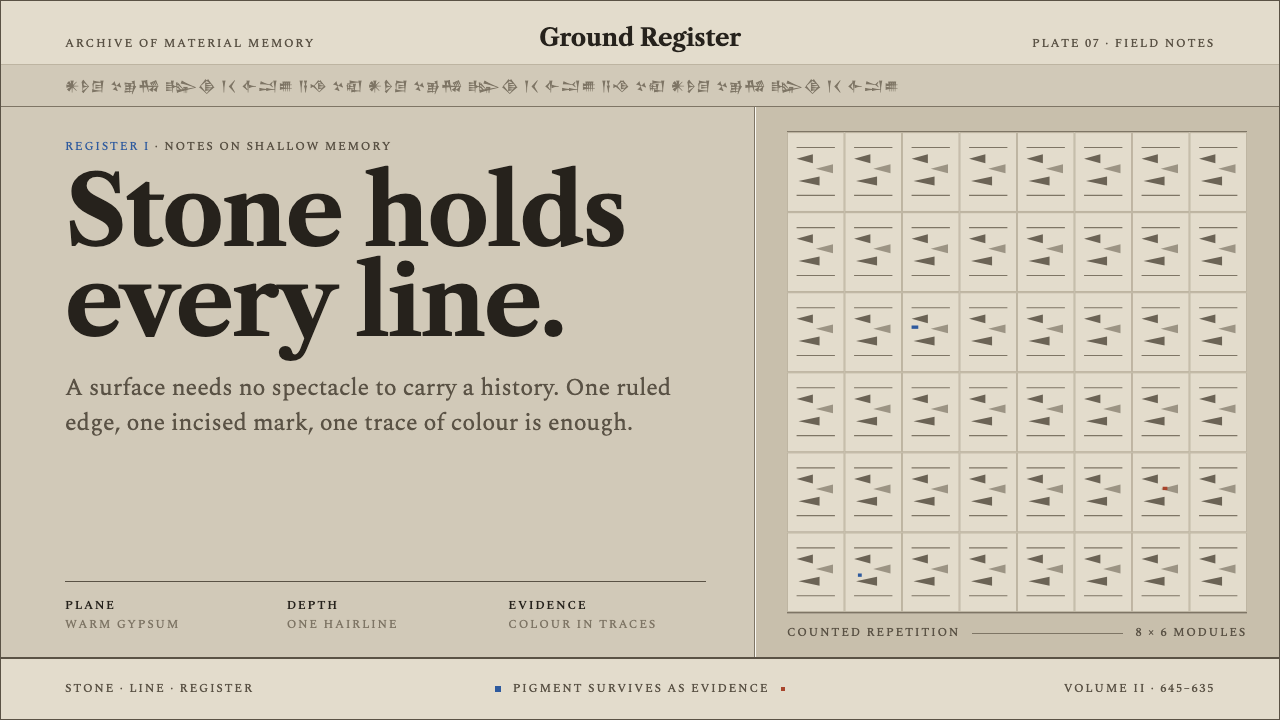 Assyrian Palace ReliefHistory cut to a hairline. Warm gypsum registers hold serif type and rare pig…
 Cherry Blossom HanamiTenderness arrives in dusk. Sakura pink, branch-shadow, and Mincho type leave…
 Cree SyllabicsPlain ink has authority. Carbon columns and red rubrication sit on rag-grey p…
 Everest Expedition (1953)Quiet heroism, precisely measured. Ice-blue contours and mono data cross a sn…