What is FMR (Franco Maria Ricci)?
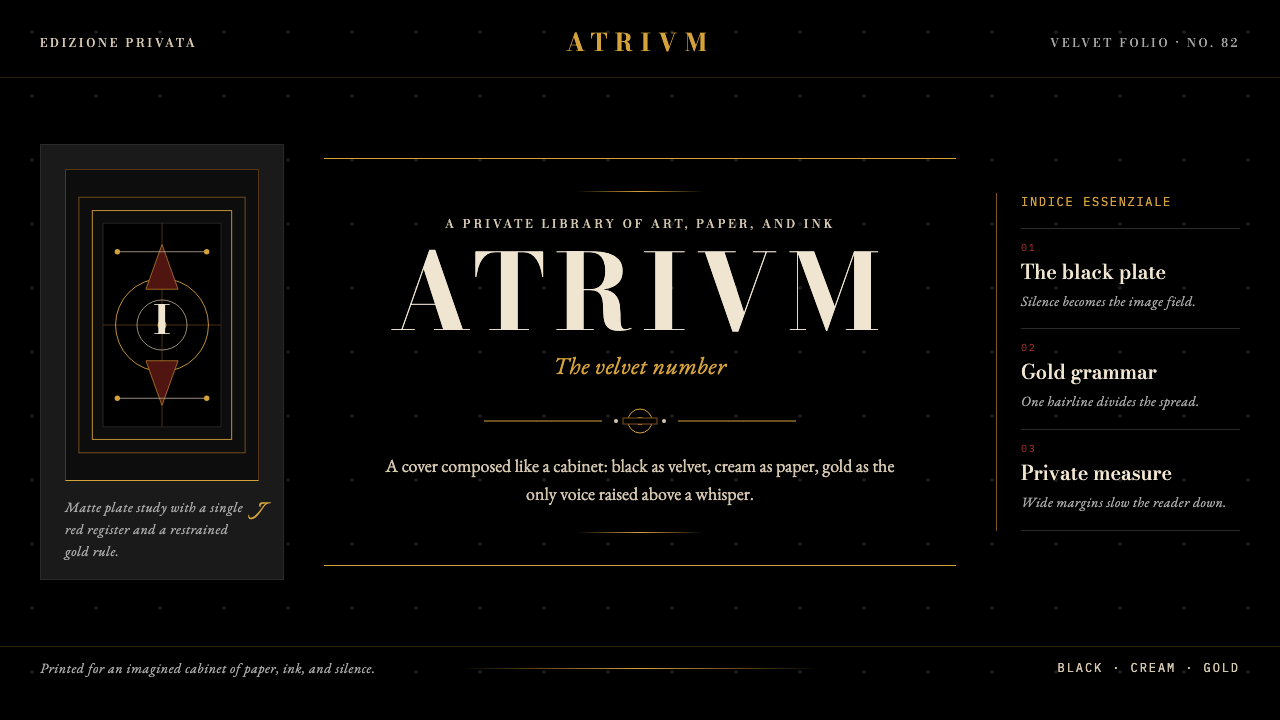
FMR turned the printed page into a shrine — velvet-black grounds, Bodoni serifs spaced like breath, and gold ornament applied with the restraint of a Parma goldsmith.
FMR (Franco Maria Ricci) in brief
FMR is the visual language of a single Italian art magazine founded in Parma in 1982 by publisher Franco Maria Ricci, and declared by Le Monde 'the most beautiful magazine in the world.' Its aesthetic is built on three pillars: a deep, matte-black ground that absorbs light rather than reflecting it; the Bodoni typeface — originated by the Parma printer Giambattista Bodoni in the eighteenth century — deployed at generous letter-spacing across cream-white editorial pages; and warm gold hairlines and ornaments applied as structural dividers and chapter marks. The result is a page that reads less like information design and more like a printed collector's plate.
The style's central tension is restraint dressed as opulence. FMR does not achieve luxury through addition — through gradients, textures, photography at full bleed, or dense colour. It achieves it through subtraction and spacing: wide margins, long silences between elements, ink laid flat and deep. Every typographic decision is an act of considered patience. The aesthetic belongs to a tradition of Italian bibliophile publishing that treats the page as an architectural object, each opening a room with proportioned walls.
Because the system is so tightly bound to its own historical references — Bodoni's Parma workshop, Renaissance engraving, the golden-ratio page layouts of early Italian printing — FMR occupies a different category from most revival styles. It is not a mood or a palette that can be lightly borrowed. Applied with discipline, it communicates scholarly seriousness, tactile luxury, and an almost archival permanence. Applied carelessly, it collapses into generic 'dark luxury' without identity.

Where does FMR (Franco Maria Ricci) come from?
Franco Maria Ricci was born in Parma in 1937 — the same city where Giambattista Bodoni had worked as the royal printer to the Duke of Parma in the late eighteenth century. This geographical inheritance was not accidental. Ricci grew up in a city where the Bodoni punches and matrices were still housed in the Museo Bodoniano, and where the memory of Bodoni's fanatical precision — his insistence on the thinnest hairlines, the widest counters, the most deliberate letter-spacing — was a local point of civic pride. When Ricci began publishing in the 1960s, he adopted Bodoni not as a historical costume but as a living inheritance: the right typeface for printing about beautiful things on beautiful paper.
Ricci launched FMR in 1982 as a bilingual Italian-English art magazine. The name combined his initials with the Italian word for 'film' — a reference to the photographic reproductions of art and architecture that filled its pages. The magazine was designed in an unusually large format, printed on thick paper stock, and bound with a care that made each issue feel closer to a monograph than a periodical. Its subjects were Renaissance painting, Baroque architecture, rare manuscripts, gardens, jewels, and curiosities — the private obsessions of a Borges-reading, cabinet-of-wonders aesthete.
The visual system Ricci developed for FMR drew from multiple historical sources simultaneously. The deep-black cover and gold ornament echoed the vellum-and-gilt bindings of sixteenth-century Venetian books. The generous page margins and deliberate spacing between lines referenced the humanist manuscript tradition of the fifteenth century. The use of Bodoni at wide letter-spacing — an approach Bodoni himself recommended for display use — echoed the title pages of eighteenth-century Italian opera libretti and scientific treatises. Ricci assembled these references not as pastiche but as a coherent personal canon: the visual equivalent of a private library curated over a lifetime.
Jorge Luis Borges — the Argentine writer whose fiction mapped labyrinths, libraries, and infinite books — became one of FMR's intellectual presences, contributing essays and serving as a kind of spiritual patron of the magazine's obsession with the book as object and idea. The magazine's photographer Massimo Listri contributed images of grand interiors — libraries, palaces, archives — that shared the aesthetic's preference for deep chiaroscuro, theatrical staging, and an archival stillness. Together, Ricci's editorial vision, Bodoni's typographic legacy, Borges's metaphysics of the book, and Listri's photography produced a magazine that was as much a manifesto for a certain idea of civilization as it was a publication.
What defines the FMR (Franco Maria Ricci) look?
Ground Color
The defining ground is a deep, light-absorbing black — not the flat digital black of a screen default, but a quality of darkness associated with fine printing ink laid thickly on uncoated stock. This ground is never relieved by texture, pattern, or gradation. It functions as a void: a space from which other elements emerge with the clarity of objects illuminated in a darkened room. On interior pages, the ground shifts to warm cream or ivory, which reads as a continuation of the black aesthetic rather than its negation — the cream carries the warmth of aged paper and fine-art printing.
Typography
Bodoni is the irreducible core of the FMR typographic system. Designed by Giambattista Bodoni in Parma in the late eighteenth century, it is a typeface of extreme contrast: hairline thin strokes against broad thick strokes, with flat, unbracketed serifs that give each character a lapidary precision. FMR deploys Bodoni at generous letter-spacing — further apart than normal reading convention — which slows the eye and transforms text blocks into visual objects of near-sculptural weight. Headlines are set large, with the confidence of a title page from an eighteenth-century folio. Body text is set at a considered measure, neither cramped nor sprawling, with leading that gives each line space to breathe.
Gold Ornament
Gold in FMR is structural, not decorative in the frivolous sense. Warm gold hairlines function as section dividers, column rules, and chapter marks — the visual equivalent of the red-ink rubrications in medieval manuscripts. Gold is also used for drop capitals, initial letters, and occasional ornamental frames around images. The warmth of the gold — neither the cold yellow of cheap metallic printing nor the orange-gold of heraldic schemes — is essential: it harmonizes with the cream of the paper, the depth of the black, and the ivory of the body text to produce a palette of extraordinary restraint and richness simultaneously.
Spacing and Silence
FMR treats empty space with the same editorial seriousness as text or image. Page margins are wide — often wider than they would be in conventional magazine publishing — creating a frame effect that elevates whatever appears within them. Gutters between columns are generously proportioned. Space between paragraphs is deliberate and consistent. This disciplined use of silence means that each element on the page appears chosen and placed with intention. Nothing crowds, nothing competes. The effect is closer to museum display than to the density of editorial design driven by commercial urgency.
Image Treatment
FMR reproduces works of art and architecture as full-page or double-page plates — treated with the care of a fine-art monograph rather than a magazine spread. Images are bordered, often by thin gold rules, and placed on black grounds that isolate them from the surrounding page like objects in a vitrine. Colour photography is reproduced at the highest fidelity the printing process allows. The photographic sensibility — particularly in Massimo Listri's architectural interiors — favours deep shadow, controlled highlights, and a theatrical stillness that aligns with the overall aesthetic of archival permanence.
Palette Restraint
Outside of art reproductions, the FMR palette is three-colour: black, cream, and gold. No additional accent colours are introduced. No decorative gradient or tonal variation softens the black. This chromatic austerity is what distinguishes the aesthetic from generic luxury dark themes, which typically rely on multiple metallic accents, colour temperature variation, or ambient glow effects. FMR's restraint is absolute on the typographic pages: the black is pure, the cream is warm, and the gold is singular.
Material and Print Consciousness
FMR was designed with an acute awareness of physical production. The weight of the paper, the depth of the ink, the tactile quality of the binding — all were considered design elements. This material consciousness translates into the digital register as a preference for visual decisions that feel considered and finished: no rough edges, no experimental rawness, no ironic imperfection. Every element reads as though it has been committed to permanently, as though changing it would require resetting type and reprinting.

Who shaped FMR (Franco Maria Ricci)?
Born in Parma in 1937, Ricci began as a graphic designer and publisher before founding FMR in 1982. His earlier publishing imprint, also called FMR, had already established his reputation for high-production-quality art books — particularly a celebrated series devoted to Giambattista Bodoni and to the visual culture of Parma. Ricci's contribution to design history is the demonstration that a single individual's aesthetic obsessions, pursued with sufficient conviction and craft, can produce a visual language coherent enough to influence designers internationally for decades. He continued publishing under the Edizioni FMR imprint and remained involved in the aesthetic direction of his publications until late in his life.
Bodoni (1740–1813) was the royal printer to the Duke of Parma and one of the most influential typographers in the history of Western printing. His typeface designs — characterized by extreme contrast between thick and thin strokes, hairline serifs without brackets, and an almost industrial precision of form — represented a radical departure from the old-style types of the preceding century. Bodoni's Manuale Tipografico, published posthumously in 1818, presented 373 typefaces and remains one of the great documents of typographic craft. FMR's adoption of Bodoni was not simply a font choice: it was an act of civic and cultural fidelity to Parma's most celebrated artisan.
The Argentine writer Borges (1899–1986) contributed essays to FMR and served as a kind of presiding intelligence over its aesthetic project. Borges's fiction — with its labyrinths, infinite libraries, and meditations on the book as a metaphysical object — aligned perfectly with Ricci's editorial sensibility. The presence of Borges in FMR signalled that the magazine was not simply about art history or luxury aesthetics but about a certain philosophical relationship to knowledge, collecting, and the act of reading. Borges's association lent FMR a literary gravity that distinguished it from the illustrated magazines of its era.
Listri is an Italian photographer whose images of grand interiors — historical libraries, baroque palaces, monastic archives, princely collections — became closely identified with FMR's aesthetic identity. His photographs share the magazine's preference for deep shadow, theatrical symmetry, and a quality of suspended time. Listri's work demonstrates how a photographic style can reinforce and amplify a typographic system: the visual weight and darkness of his images sit naturally against the magazine's black grounds, and the architectural grandeur of his subjects mirrors the formal ambition of its pages.
The Manuale Tipografico itself — published in Parma in 1818, five years after Bodoni's death, by his widow Margherita Dall'Aglio — deserves recognition as a direct design ancestor of FMR. Its layout principles: wide margins, generous leading, type displayed against white space, ornaments used sparingly as structural markers rather than decoration, and an insistence on the highest-quality presswork available — all anticipate FMR by more than a century and a half. Ricci owned a copy and drew on it consciously when developing the magazine's visual system.
How do you use FMR (Franco Maria Ricci) today?
FMR's aesthetic is among the most demanding to apply correctly in contemporary design contexts, because it depends not on a loose arrangement of visual features but on an extremely specific combination of typographic discipline, proportional restraint, and chromatic austerity. When the system is understood as a set of principles — rather than a mood board of black and gold — it becomes transferable to slides, interfaces, and editorial contexts with genuine authority.
For presentation slides, the FMR approach requires commitment to the black ground from the first cover through to the final section break. A cover page works as a single composed plate: the title in Bodoni or a high-contrast serif at generous letter-spacing, positioned in the upper third or lower quarter of the field with deliberate asymmetry, accompanied by a thin gold rule above or below. Content slides should treat each page as a printed page from a monograph: the heading isolated from body text by proportionate space rather than decorative dividers, pull quotes set at increased size with extended tracking, and data presented as clean typographic tables rather than chart-heavy graphics. Section dividers can carry a single ornamental element — a thin rule, a small geometric mark — as a structural signal rather than decoration.
For web interfaces and dashboards, the FMR sensibility translates best to contexts where the product makes a deliberate case for authority, connoisseurship, or premium quality. A dashboard in this mode uses the black or very deep ground for its primary surface, reserves cream or near-white for data-heavy reading areas, and marks navigation and hierarchy with typographic scale and gold accent lines rather than colour-coded chips or icon sets. Pricing pages benefit from the isolating effect of wide margins: each tier presented as a typographic card with generous internal spacing, distinguished from adjacent tiers not by background-colour shifts but by weight and leading in the type.
For editorial and marketing work, FMR's language supports long-form reading experiences, cultural brand storytelling, and luxury product presentation. An editorial layout in this mode gives the body text room to breathe — a narrower column measure than is typical for web reading, with a wide outer margin for footnotes, captions, or secondary material. Section openings carry a large numeral or Bodoni initial against a deep ground. Marketing pages for premium goods can use a full-cover black ground with a single large product image bordered in gold, the copy set in cream against black with extended tracking. In every case, the ratio of empty to filled space should lean toward empty: FMR earns its richness through what it withholds.
The most common mistake when applying FMR-derived aesthetics is substituting gold quantity for gold quality — using many gold elements rather than a few precisely placed ones, or choosing an orange-leaning metallic that cheapens against deep black. A related error is filling the dark ground with ambient glows, neon accents, or gradient transitions, which convert the aesthetic from archival quietude to generic dark luxury. The system requires a single warm gold applied only where it carries structural or hierarchical meaning, and a black that is truly flat — not softened, not textured, not relieved by light effects. Any element that creates visual noise, rather than visual weight, is working against the aesthetic.

FMR (Franco Maria Ricci) — FAQ
Is FMR the same as generic dark luxury design?
No, and the distinction matters practically. Generic dark luxury design typically uses deep backgrounds with multiple metallic accents, ambient glows, gradient transitions, and an overall sensory density meant to signal premium quality through visual richness. FMR's approach is the opposite: a single warm gold, flat black without light effects, and a deliberate use of emptiness as the primary mark of quality. The test is simple: if a dark design needs visual complexity to feel luxurious, it is not FMR-derived. If it feels luxurious precisely because of what it removes, it is.
Can FMR work without Bodoni or a similar high-contrast serif?
The system can be adapted, but Bodoni — or a typeface sharing its core quality of extreme stroke contrast — is load-bearing. The hairline-to-bold contrast of Bodoni, deployed at generous letter-spacing, is what gives FMR-derived typography its particular tension: the text reads as simultaneously delicate and monumental. Sans-serif substitutions produce a fundamentally different feeling — cleaner, more contemporary, less historically grounded. If the context requires a sans-serif for legibility or brand reasons, the recommendation is to treat it as a departure from FMR rather than an adaptation, and to compensate by making the spatial and chromatic discipline even more rigorous.
How does FMR handle colour imagery in an otherwise monochromatic system?
FMR was built precisely to showcase colour art reproductions, and it manages this by treating images as isolated plates — bordered, given generous surrounding space, and presented on grounds that do not compete with the image's own colours. The deep black ground is ideal for this: it has no colour of its own to harmonize or conflict with, and it makes saturated art reproductions appear to glow by contrast. In digital applications, the principle holds: full-colour images should be treated as primary visual events, surrounded by space, and not crowded by competing chromatic elements in the surrounding layout.
Is FMR appropriate for digital products aimed at broad consumer audiences?
Generally no, and the reasons are structural rather than stylistic. FMR's aesthetic values — historical weight, typographic discipline, deliberate slowness, the celebration of rarity — are misaligned with the values most consumer digital products need to project: approachability, speed, warmth, and accessibility. The style works best when the product's audience already shares the aesthetic's implicit assumptions: that quality is worth waiting for, that restraint is a mark of confidence rather than coldness, and that a page without visual noise is a reward rather than an absence. Cultural platforms, high-end retail, archival tools, and institutional publishing are natural homes. Mass-market consumer apps, children's products, and high-energy social platforms are not.
What is the most important single principle to carry when applying FMR?
Emptiness is the content. In most design contexts, space is what you have left over after placing elements. In FMR, space is placed first and elements are introduced into it with justification. This reversal of priority — treating silence as the primary material and text or image as the intervention — is what produces the aesthetic's characteristic quality of stillness and weight. If you find yourself adding space to a layout to make it feel more FMR, you are working in the wrong direction: the space should have been there first, and the elements should have been introduced one by one only when they earned their place.
Related design styles
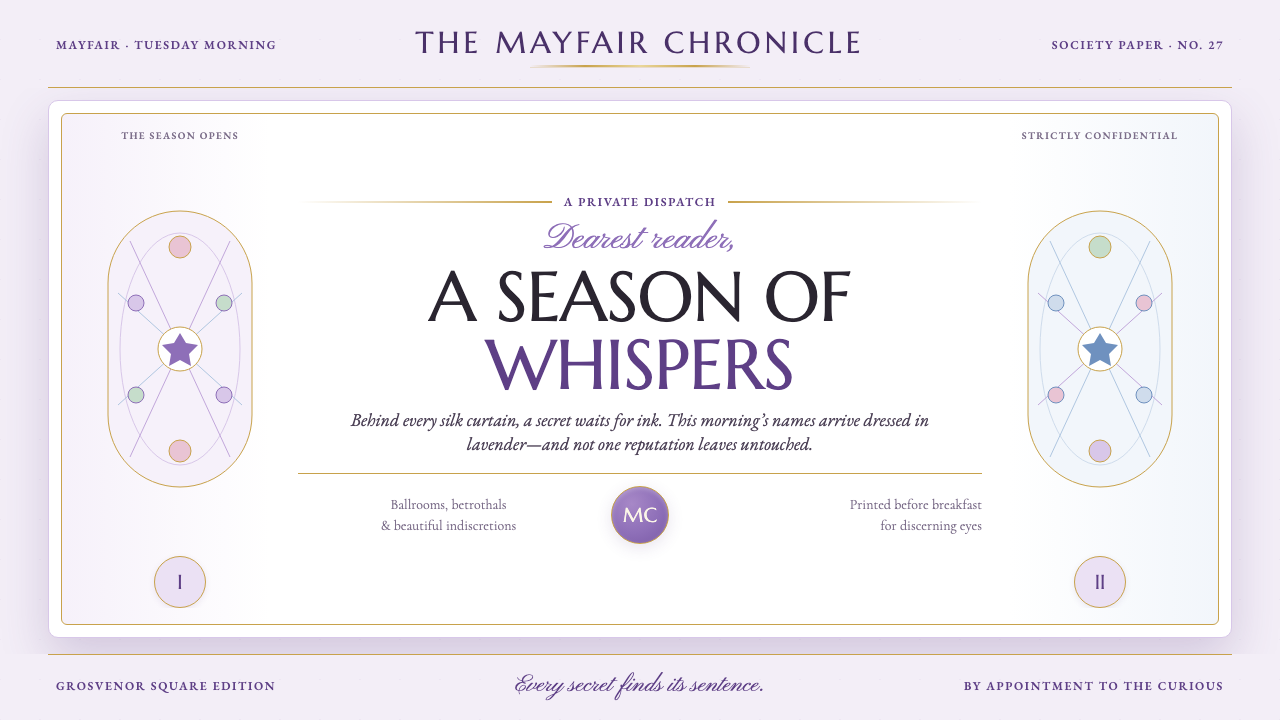 Bridgerton Regency (2020)Scandal wears lavender. Wisteria pastels and gilt rules frame a sharp letterp…
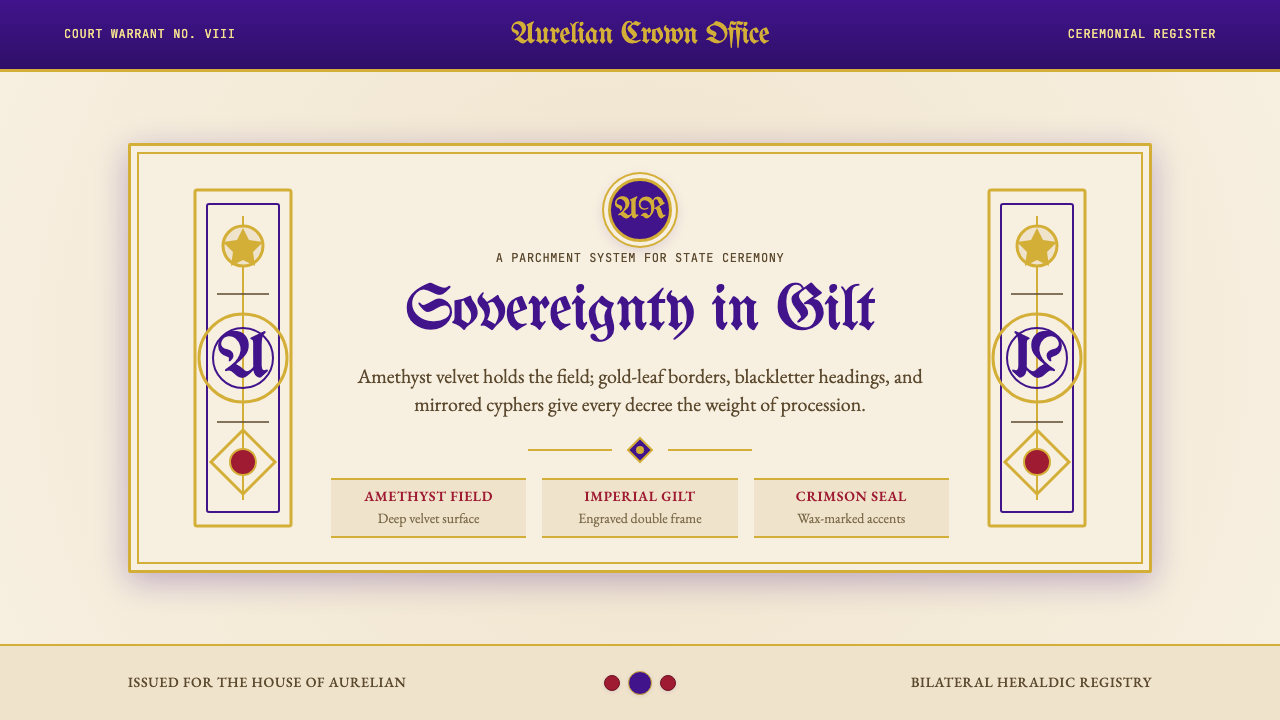 British Royal MonarchyCeremony becomes structure. Amethyst panels, gilt borders, blackletter, mirro…
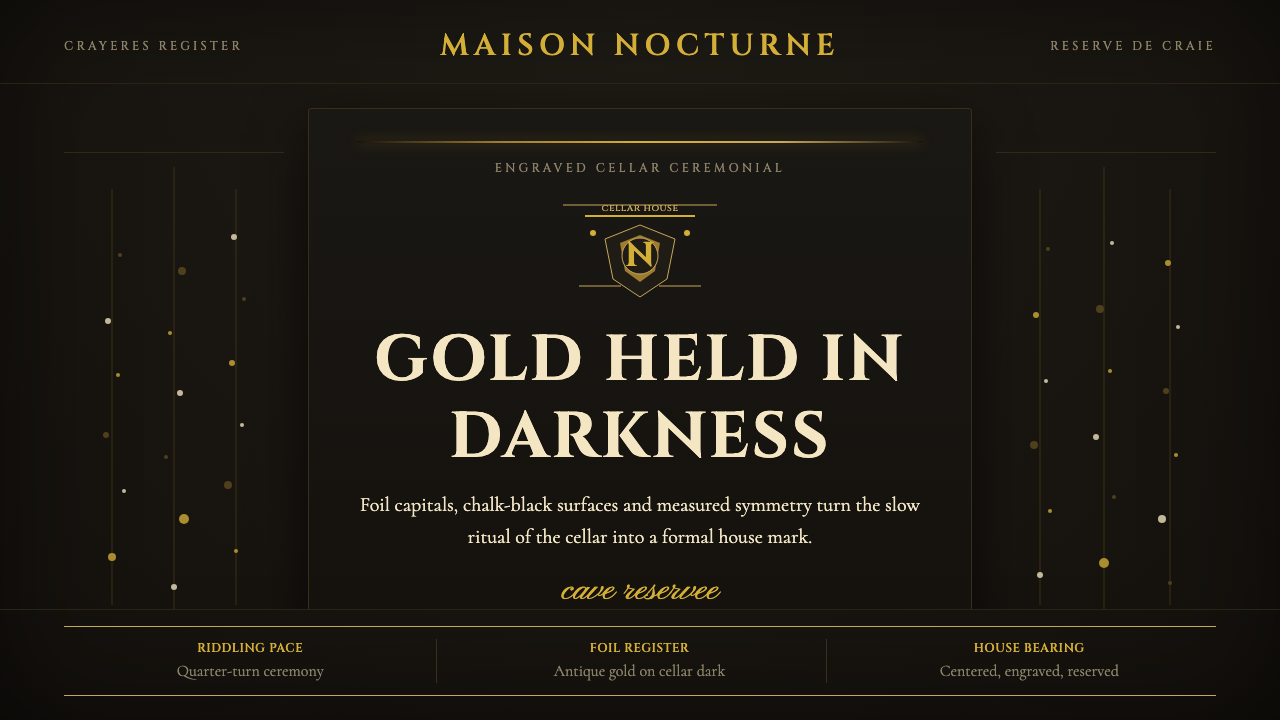 Champagne MaisonGrandeur without glitter. Cinzel capitals and gold foil rules glow in cellar…
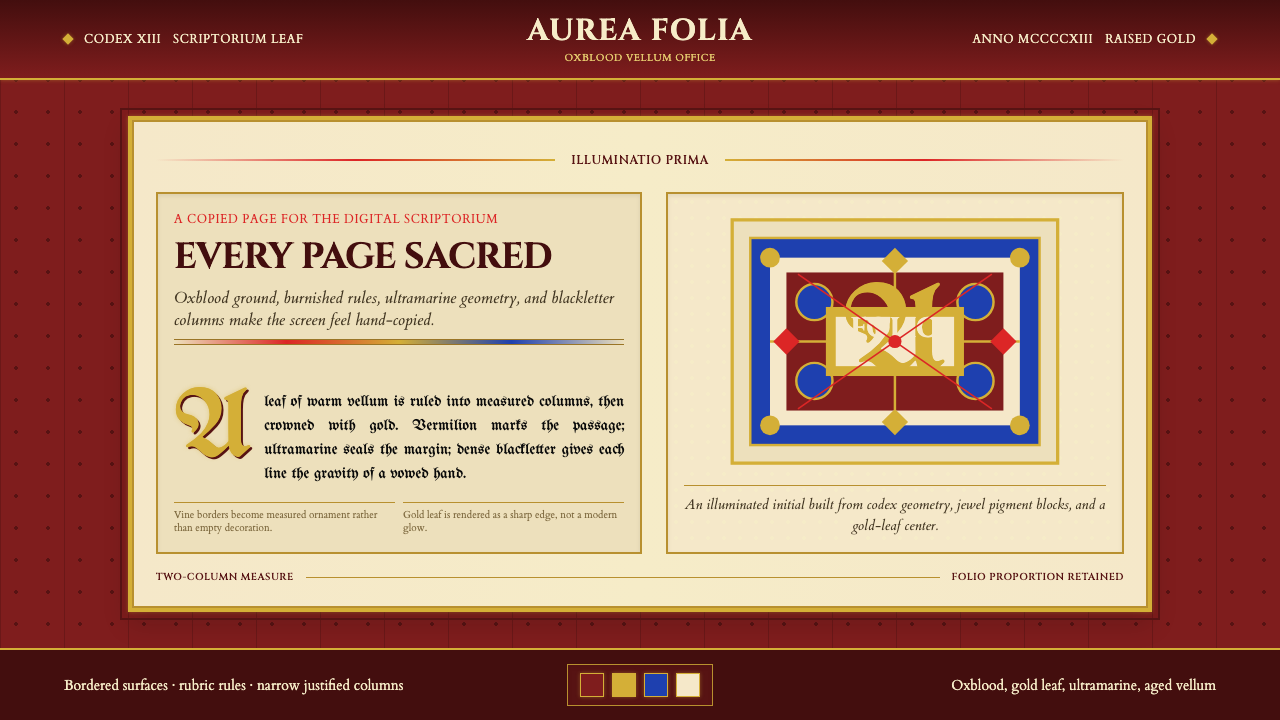 Medieval Illuminated ManuscriptTreats every page as sacred. Oxblood vellum, Cinzel capitals, gold-rule borde…
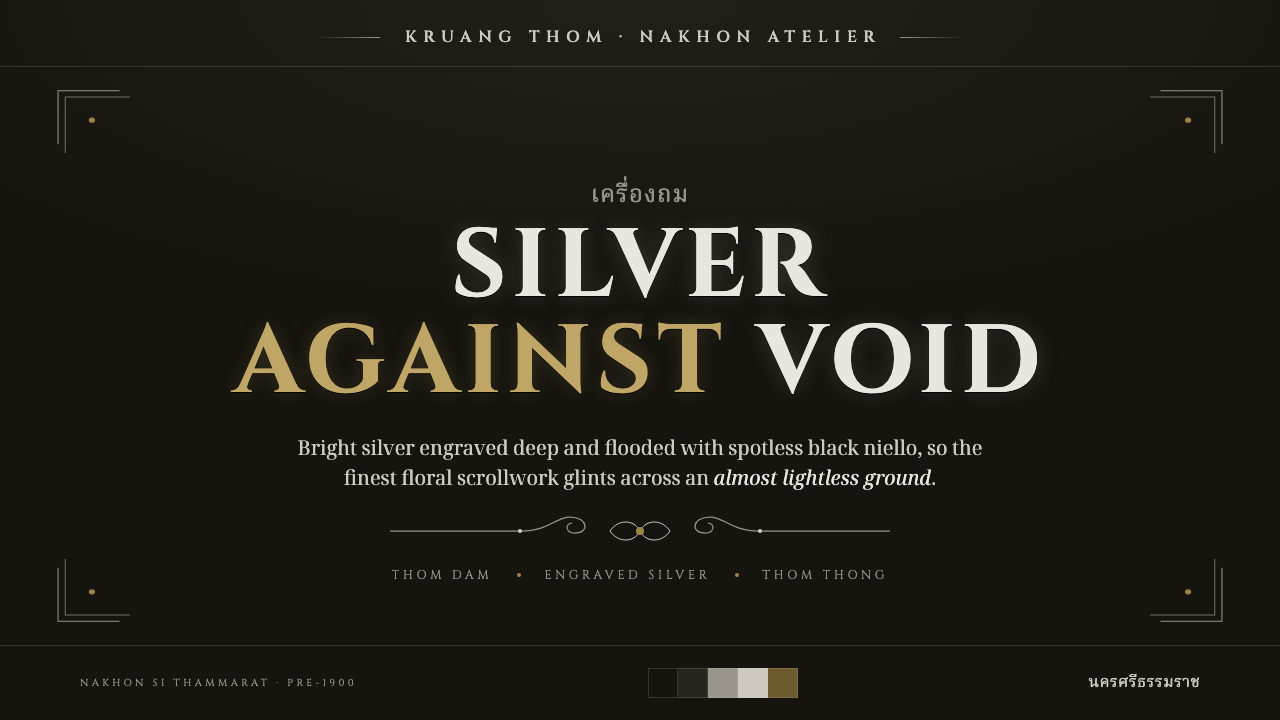 Thai NiellowareSpotless black, one bright line. Silver scrollwork engraved into near-lightle…
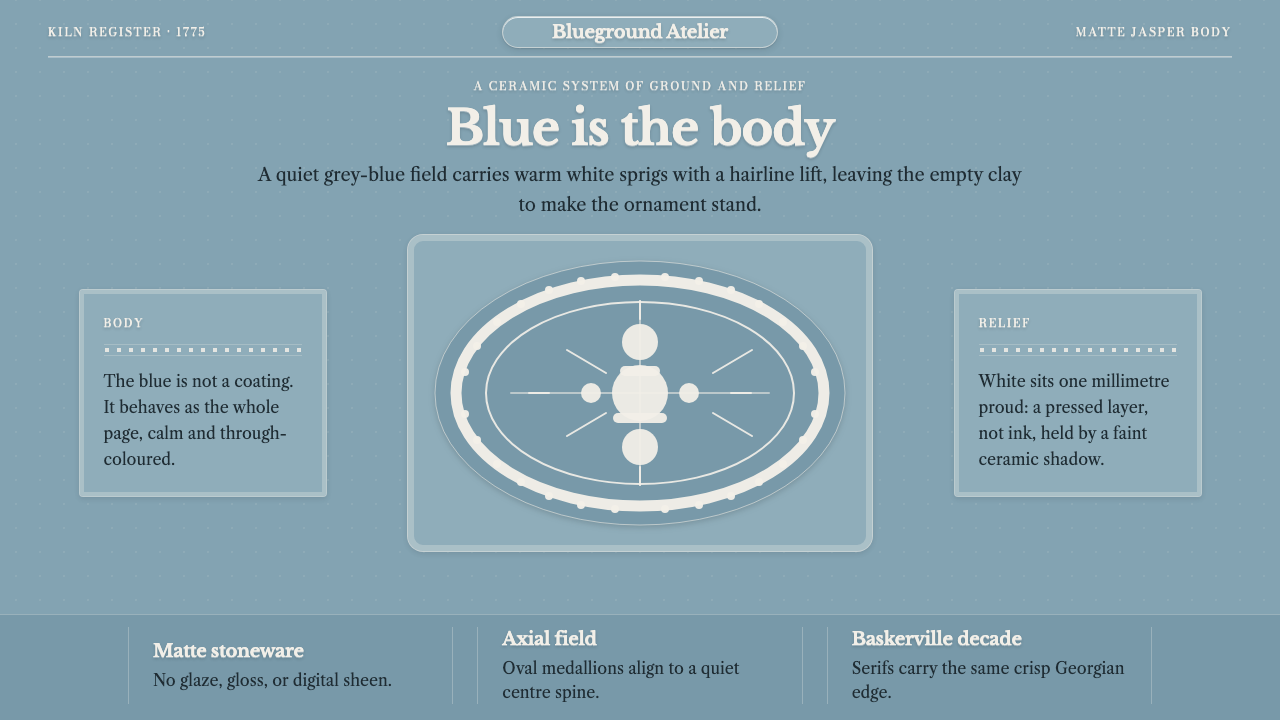 Wedgwood JasperwareMatte authority. Blue-grey clay ground carries raised white Baskerville relie…