What is Flamsteed Atlas Coelestis?
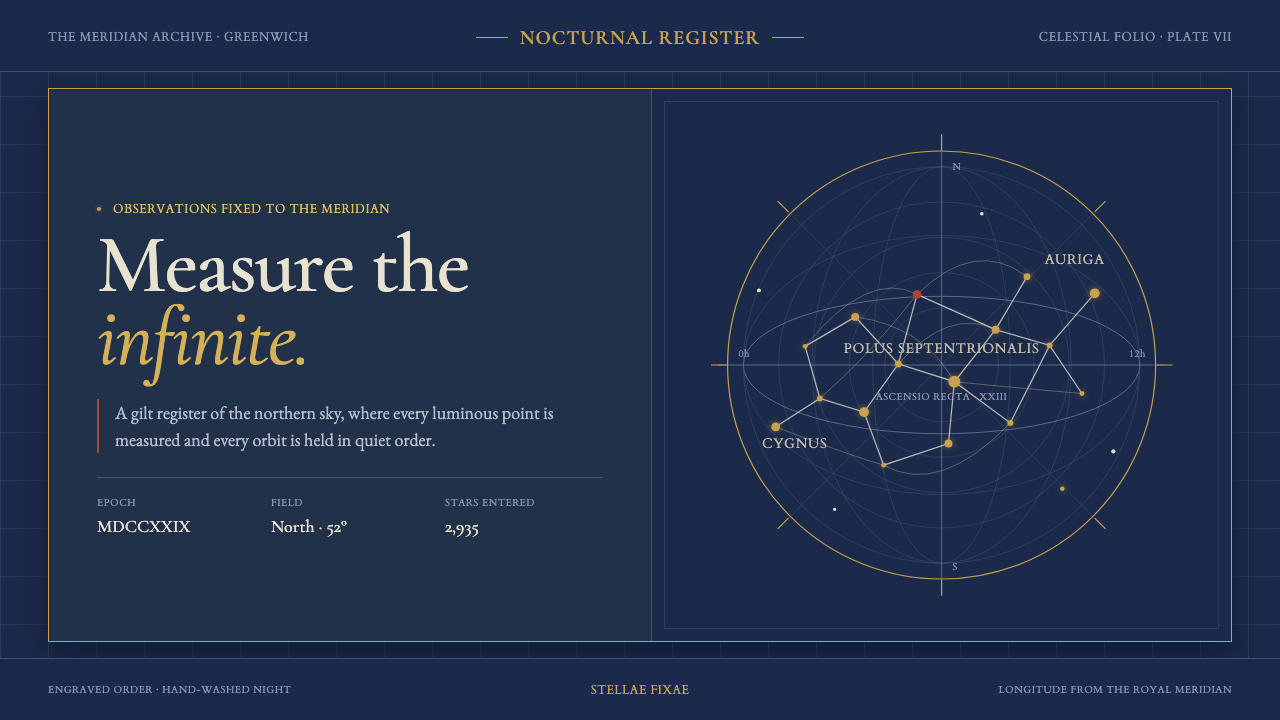
Measurement wears mythology: ivory engravings and gilt stars cross a deep indigo grid beneath a late-Baroque sky.
Flamsteed Atlas Coelestis in brief
The Atlas Coelestis is John Flamsteed’s folio of twenty-eight copperplate engravings, published in London in 1729, sixteen years after the death of England’s first Astronomer Royal. It presents celestial measurement as a visual world rather than a bare technical record: a hand-washed indigo sky carries ivory constellation figures, gilt stars, and a finely articulated coordinate grid.
Its distinctive tension comes from the coexistence of precision and ornament. The coordinate network belongs to observatory astronomy, while the constellations drawn by Sir James Thornhill move through the field with Rococo line, flowing drapery, and classical theatricality. Stars are picked out in gilt and scaled by magnitude, so decoration also carries information.
The result is a style of classical restraint wrapped in celestial opulence. The ground is dark and disciplined; the marks are pale, measured, and legible. Yet the constellation figures introduce movement and mythology, turning the atlas into Baroque celestial cartography: a system of observation dressed as an illuminated drama.

Where does Flamsteed Atlas Coelestis come from?
The atlas belongs to England’s late-Baroque observatory culture and is associated with Greenwich and the Royal Observatory. Its defining premise is already contained in the source material: measurement does not have to exclude ornament. A coordinate grid can share the page with celestial figures, and a star’s visual emphasis can communicate magnitude without breaking the authority of the chart.
John Flamsteed gives the work its astronomical foundation. As the first Astronomer Royal, he is identified with the atlas as its author and intellectual center. The publication was posthumous, appearing in London in 1729, sixteen years after his death. That distance between the work’s maker and its printed appearance gives the object the character of a preserved instrument, carried forward into a later moment without losing its original gravity.
Sir James Thornhill gives the sky its figurative language. His Rococo constellation figures are not incidental illustrations placed beside the data; they occupy the same field as the coordinate system. Ivory linework, flowing drapery, and celestial symbolism make the measured sky readable as both diagram and scene. The atlas therefore joins English observatory astronomy with Baroque celestial cartography.
The style’s historical identity rests on this union. It is neither pure ornament nor pure instrumentality. The indigo ground establishes night, the ivory engraving establishes structure, the gilt stars establish hierarchy, and the grid establishes measurement. Together they create a visual grammar in which classical restraint controls the composition while celestial ornament gives it memory, movement, and myth.
What defines the Flamsteed Atlas Coelestis look?
Indigo Ground
The deep indigo field is the style’s atmospheric foundation. It establishes night without requiring pictorial scenery, allowing every ivory line and gilt star to read as a deliberate mark. The color should feel continuous and enveloping rather than decorative, like a hand-washed sky that gives the chart its depth and solemnity.
Ivory Engraving
Ivory is used for the line figures, coordinate marks, and other structural drawing. Against indigo, it feels archival and tactile rather than digitally bright. The line should remain fine but assured, carrying the authority of an engraved plate. Its role is to reveal form through contour, not to imitate soft illumination.
Gilt Stars
The stars are the brightest accents, but their emphasis is not arbitrary. They are picked out in gilt and scaled by magnitude, allowing ornament to become a system of hierarchy. A restrained application keeps the field celestial rather than glittering: the stars should appear as measured signals scattered through darkness.
Coordinate Grid
The coordinate grid is the rational skeleton beneath the mythology. It should remain visible enough to establish measurement, yet quiet enough to let the constellation figures and stars lead the eye. Its lines create a field of orientation, making the dark surface feel ordered rather than empty.
Rococo Figures
The constellation figures introduce movement into an otherwise measured composition. Their ivory contours and flowing drapery should feel theatrical, classical, and slightly weightless. They are not realistic portraits; they are symbolic forms that make the celestial field memorable while remaining integrated with the chart.
Baroque Drapery
Drapery is the principal ornamental gesture. It supplies rhythm and softness without requiring gradients or atmospheric effects. Used with discipline, it creates a counterpoint to the grid: the chart remains fixed and measured, while the cloth appears to curl, fold, and travel through the same space.
Measured Opulence
The style depends on controlled excess. Indigo, ivory, and gilt create a rich impression, but the composition remains governed by measurement and restraint. Ornament should clarify the celestial subject, not compete with it. The most convincing result feels precious because every accent has a reason to exist.

Who shaped Flamsteed Atlas Coelestis?
Flamsteed is the author and astronomical center of the Atlas Coelestis. Identified as England’s first Astronomer Royal, he anchors the work in observatory measurement. Its posthumous publication in London in 1729 gives the atlas the gravity of a completed intellectual instrument preserved beyond its maker’s lifetime.
Thornhill supplies the atlas’s figurative and Rococo dimension. His constellation figures are drawn as ivory line forms across the indigo sky, bringing flowing drapery and classical theatricality into direct contact with the coordinate grid.
The grid is the atlas’s structural figure. It represents the measured, observatory side of the design and prevents the mythological imagery from becoming detached ornament. Its quiet geometry gives every constellation and star a place within an ordered celestial field.
The gilt star field transforms information into ornament. Stars are highlighted in gold and scaled by magnitude, so brightness becomes both a visual hierarchy and a celestial fact. The field should feel scattered but never random.
The indigo sky is more than a background. It is the continuous atmosphere that holds engraving, stars, figures, and grid together. Its darkness creates the conditions for ivory and gilt to function as precise signals rather than disconnected decoration.
How do you use Flamsteed Atlas Coelestis today?
For presentation covers, begin with a deep indigo field and let an ivory constellation figure or coordinate fragment establish the subject before the title appears. Gilt stars can act as restrained points of emphasis. On content slides, treat the grid as the organizing plane: headings, annotations, and diagrams should feel placed within a measured sky. Data slides work especially well when magnitude, priority, or scale is expressed through the relative prominence of star-like marks rather than through a crowded palette.
For web dashboards and pricing pages, the style can turn information architecture into celestial cartography. Use indigo as the continuous field, ivory for labels and structural lines, and gilt for selected states, featured plans, or important values. Cards should feel like plates within an atlas, while the grid provides orientation across the page. The decorative constellation layer should remain secondary to the data, reinforcing hierarchy instead of making the interface difficult to scan.
For editorial work, the atlas language supports long-form material that needs both authority and atmosphere. A dark opening spread can introduce a subject with an engraved figure, a restrained title, and a small constellation of metadata. Subsequent sections can use coordinate rules, ivory annotations, and occasional gilt emphasis to separate historical context from interpretation. The visual rhythm should alternate between dense information and generous dark space.
For marketing, the style is effective when the product or institution wants to appear precise, rare, and culturally grounded. A campaign can frame its central message as a celestial plate, using the indigo field for ceremony and the grid for credibility. Ivory linework carries the explanatory content, while gilt is reserved for the promise, feature, or call to action that deserves attention.
The common mistake is to treat the style as a generic luxury treatment by covering every surface in gold, ornament, or elaborate figures. That destroys the essential relationship between measurement and mythology. Keep the coordinate structure visible, allow the indigo field to remain substantial, and use gilt sparingly. The design should feel like an instrument illuminated by ceremony, not a decorative surface with technical marks added afterward.

Flamsteed Atlas Coelestis — FAQ
Is Flamsteed Atlas Coelestis a historical reconstruction or a contemporary design style?
It is a contemporary design interpretation grounded in the supplied visual and historical material. Its authority comes from the late-Baroque relationship between observatory measurement, deep indigo, ivory engraving, gilt stars, coordinate grids, and Rococo constellation figures. The goal is not to reproduce a plate mechanically, but to preserve the tension between instrument and mythology.
Why is the coordinate grid as important as the constellation imagery?
The grid supplies the rational structure that keeps the decorative material meaningful. Without it, the stars and figures could become a generalized fantasy sky. With it, every ornament exists inside a field of measurement. The style depends on both sides being visible: the grid establishes credibility, while the figures and gilt marks establish memory and drama.
Can the style work without a dark indigo background?
A variation is possible, but the dark indigo field carries much of the style’s identity. It creates the night atmosphere and gives ivory and gilt their authority as luminous marks. A lighter version would need to preserve the same contrast between a continuous atmospheric ground, measured linework, and selective celestial emphasis; otherwise it may become ordinary decorative cartography.
How should gold be used in a modern interface?
Use it as a selective signal rather than a general surface treatment. In the atlas, gilt stars are tied to magnitude, so gold should identify importance, focus, or distinction. It can mark a featured plan, a key measurement, or an active state, but it should not replace the ivory structural language or compete with the coordinate grid.
Related design styles
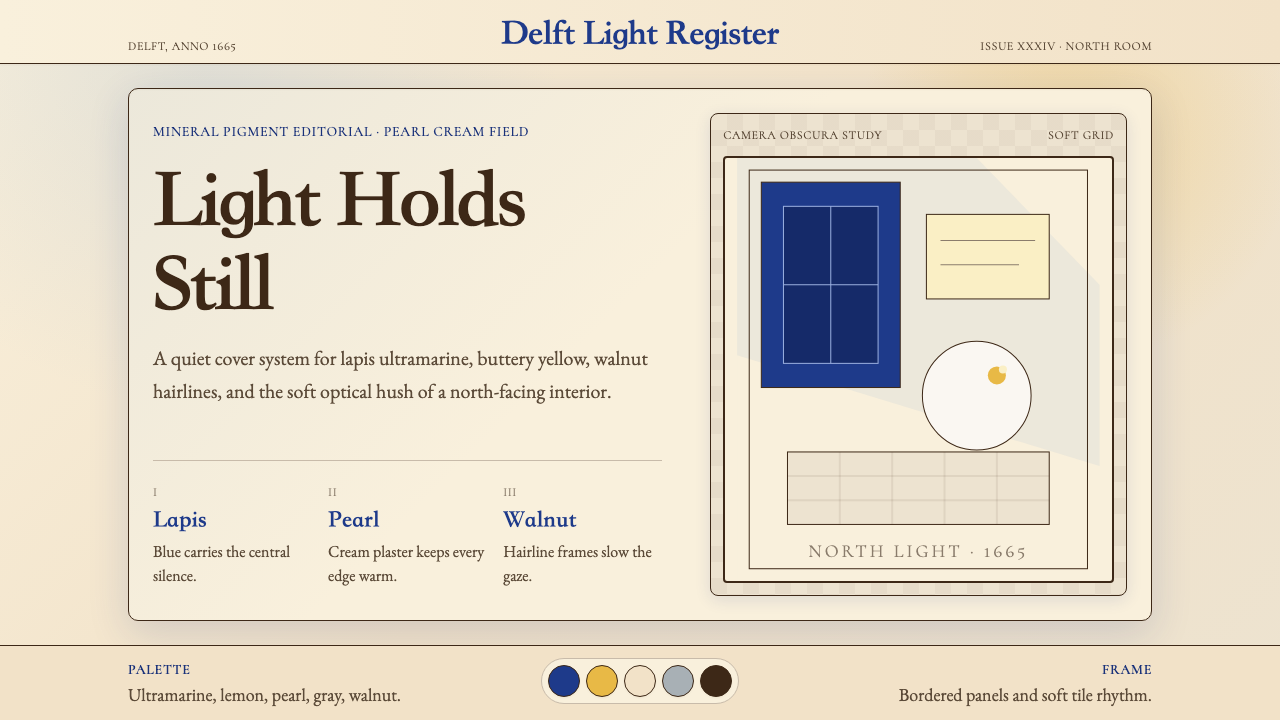 Vermeer Dutch Golden AgeStillness glows. Lapis ultramarine, pearl cream, and walnut frames hold north…
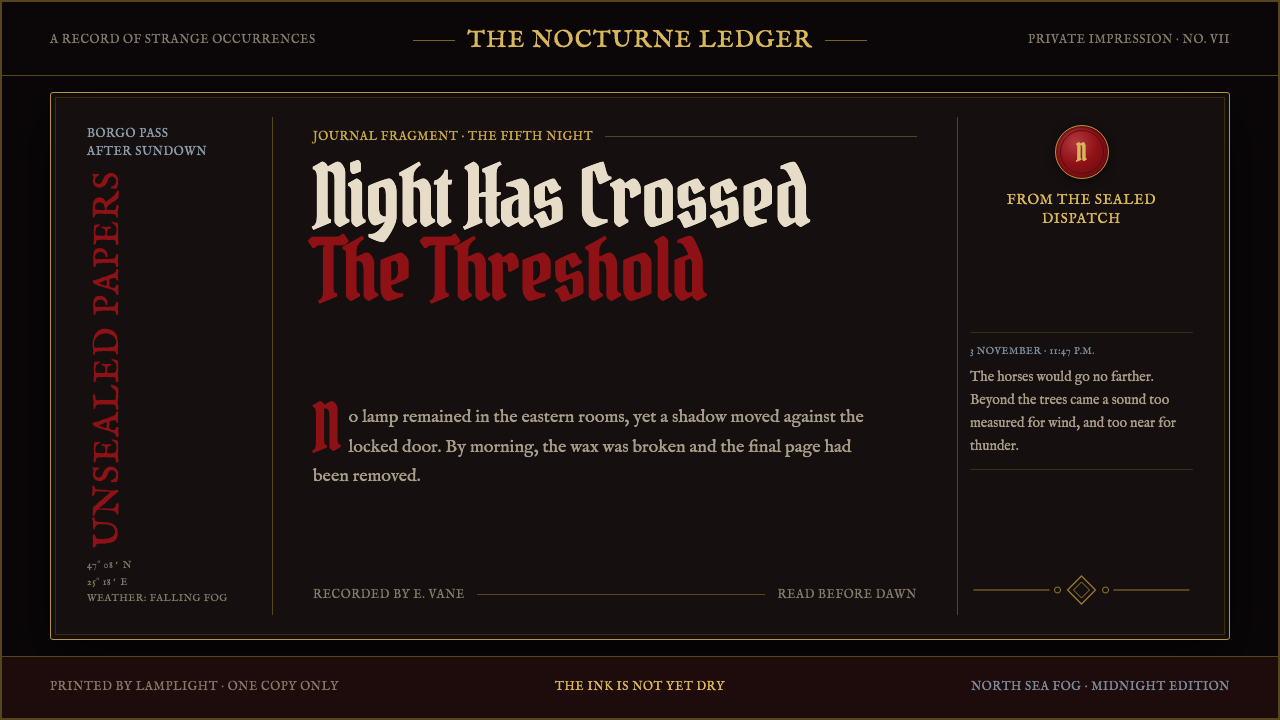 Dracula Gothic (1897)Victorian dread after dark. Blood-red initials and tarnished gilt haunt coffi…
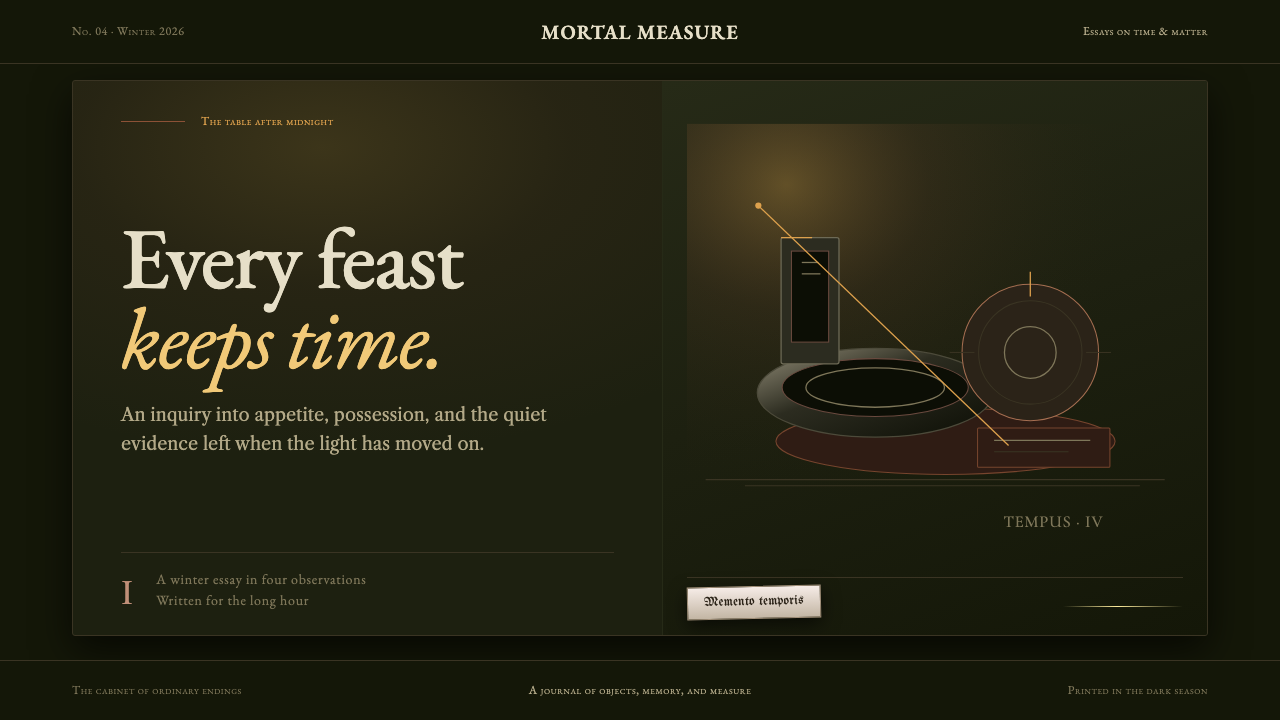 Dutch VanitasTime waits at the table. Olive-black depths, earth-brown type, and one candle…
 Ex Libris BookplateScholarly ownership, cut in ivory. Cinzel caps and crosshatch rules rise from…
 Mauveine (Perkin 1856)Electric purple, framed as luxury. Gilt rules and Playfair serifs turn dye in…
 Rembrandt BaroqueDarkness becomes theatre. Honey-gold spotlight and blackletter rise from Van…