What is Finnish Marimekko Unikko (1964)?
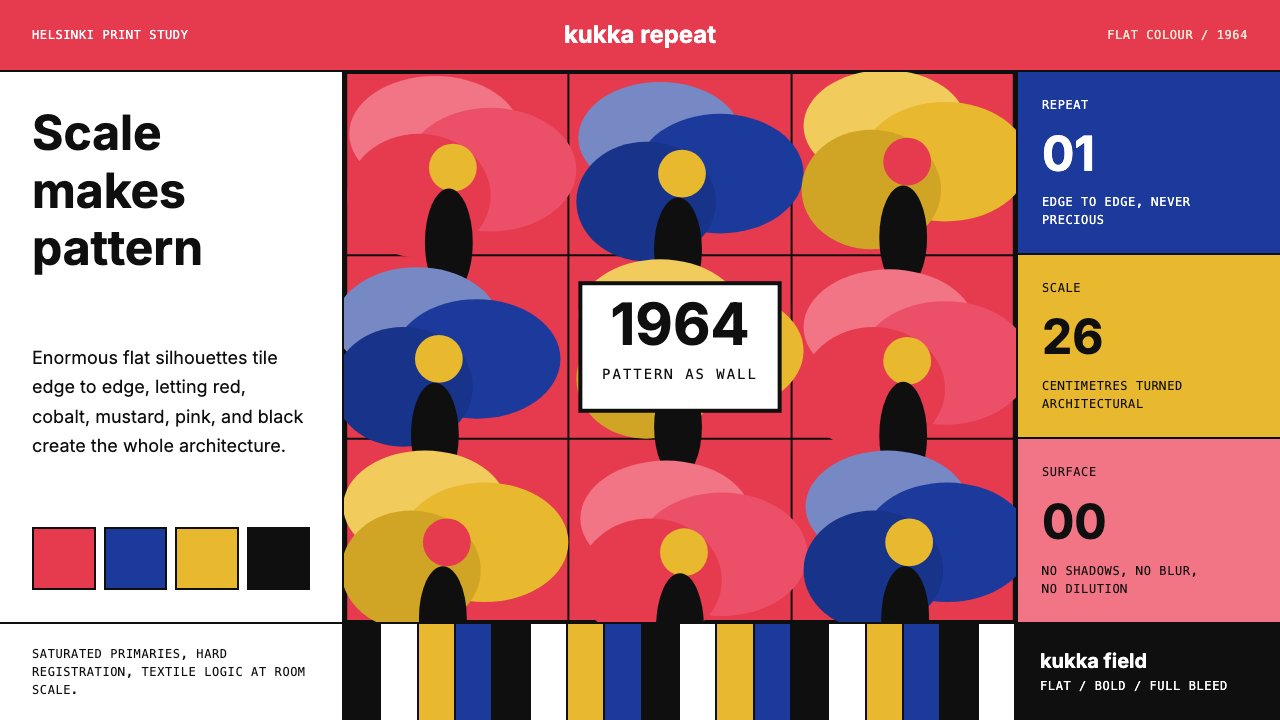
A Finnish designer defied her founder's ban on flowers and created the world's most recognized Nordic textile pattern — a flat, saturated poppy so large it turns any surface into pure color.
Finnish Marimekko Unikko (1964) in brief
Finnish Marimekko Unikko (1964) is a textile-rooted design language built around a single radical premise: that a flat, boldly coloured floral silhouette, repeated at near-architectural scale, needs nothing else to communicate visual authority. No gradient, no shadow, no ornament beyond the outline of the flower itself. The result is a graphic vocabulary that feels simultaneously ancient — flowers have been decorative motifs for millennia — and completely modern in its flatness and scale.
The visual system rests on a palette of intense, saturated primaries: poppy red, cobalt blue, mustard yellow, and hot pink, each laid down as a solid field of unmodulated colour. These hues do not blend, shadow, or fade into one another. They meet at crisp boundaries, and the contrast between them — positive shape against negative ground — provides all the depth the composition needs. Depth here is structural, produced by the scale relationship between figure and field, not by the illusion of three-dimensional light.
What distinguishes Unikko from decorative floral pattern in the conventional sense is the role of scale. The petals, stems, and stamens of the Unikko poppy are enlarged to a size that makes them architectural elements rather than surface embellishment. Seen up close, a single petal fills an entire panel. Seen at distance, the repeat creates a rhythm as regular and deliberate as a modernist grid. This is pattern as structure, not pattern as decoration.
Where does Finnish Marimekko Unikko (1964) come from?
Marimekko was founded in Helsinki in 1951 by Armi Ratia and her husband Viljo Ratia. Armi's original mission was straightforward but radical for its time: to produce printed textiles of genuine artistic quality that could be worn and used in everyday Finnish life. The company's name — a compound of the Finnish word for Mary and the word for a simple girl's dress — signalled its intent to ground high design in the domestic and the wearable.
By 1964, Marimekko had already established an international reputation through its bold graphic textiles, and Armi Ratia had developed strong views about the direction of the brand. One of those views was a personal distaste for floral motifs, which she considered sentimental and commercially predictable. She declared that Marimekko would no longer produce floral prints. It was into this atmosphere of prohibition that Maija Isola introduced Unikko.
Maija Isola had joined Marimekko in 1949, two years before the company's official founding, and would go on to design over five hundred prints for the brand. When Ratia issued her anti-floral directive, Isola responded not with compliance but with the Unikko poppy: an enormous, flat, aggressively saturated floral pattern that was the opposite of everything sentimental or conventional about floral design. Whether the print was a direct act of defiance or simply a response to an open creative challenge is a matter of historical debate, but the outcome was unambiguous. Ratia recognized the print's power, reversed her position, and approved it for production.
The timing placed Unikko within a broader moment in Finnish and Nordic design history. Post-war Scandinavia was working through a productive tension between craft tradition and modernist abstraction. Finnish designers, in particular, were developing an approach — visible also in Alvar Aalto's furniture and Tapio Wirkkala's glassware — that combined modernist formal rigour with a deep responsiveness to natural form. Unikko represents a specific resolution of that tension: nature rendered flat, scale rendered architectural, decoration rendered structural. The pattern became one of the most copied and recognized textile prints of the twentieth century, entering the permanent collections of museums worldwide and remaining in continuous production since 1964.
What defines the Finnish Marimekko Unikko (1964) look?
Flat Colour Fields
Every shape in the Unikko vocabulary — petal, stamen, stem, leaf — is filled with a single unmodulated colour. There are no highlights to suggest reflected light, no gradients to imply curvature, no shadows to anchor forms to a surface. The flatness is absolute and intentional. This commitment to flat colour removes all illusionism and makes each shape a graphic decision rather than a representation of nature.
Architectural Scale
The Unikko poppy was designed at a scale that was, for 1964, startling: individual petals large enough to dominate an entire panel of fabric. This enlargement is not decorative exaggeration — it is the core concept. Scale transforms a floral motif into a structural pattern. At Unikko's intended size, the viewer does not see a flower decorated with repetition; they see a repeat rhythm of bold shapes whose floral origin is almost secondary to their graphic force.
Saturated Primary Palette
The canonical Unikko colours — poppy red, cobalt blue, mustard yellow, hot pink — are deployed at full saturation with no desaturation or tinting to ease the eye. Colour contrast does the work that shadow and dimension do in other design systems: it separates foreground from background and gives each element its visual weight. The palette changes across colourways — Unikko has been produced in dozens of combinations — but the saturation principle holds regardless of the specific hues chosen.
Organic Silhouette with Graphic Precision
Unikko's petals and forms are recognisably floral — loose, rounded, slightly irregular in the way natural things are — but they are drawn with graphic decisiveness. The outlines are not botanical illustrations; they are simplified shapes that retain just enough of a flower's character to read as flowers while functioning as pure graphic blocks. This balance between the organic and the geometric is the aesthetic tension that gives the pattern its lasting appeal.
Pattern as Structure
The repeat in Unikko is not a surface treatment laid over a neutral ground — the pattern itself is the composition. There is no separate grid, no typographic framework, no neutral zone of rest. The flowers tile edge to edge, and the rhythm of their repetition creates the visual order that a grid would provide in a conventional layout system. This makes Unikko particularly powerful as a full-bleed element: when used at scale, it establishes spatial authority without requiring any supporting structure.
Colourway Flexibility
One of Unikko's most significant design achievements is its adaptability across radically different colour treatments. The same silhouette reads as joyful in red and pink on white, as sober and elegant in black on cream, as bold and contemporary in monochrome, and as warm and nostalgic in ochre and terracotta. Because the pattern's power comes from shape and scale rather than from any specific hue, it can absorb almost any palette without losing coherence. This flexibility has sustained its commercial relevance across six decades.
Nordic Modernist Restraint
Despite its visual intensity, the Unikko system is deeply restrained in the number of decisions it makes. The entire language is essentially one motif, one scale principle, and one flat-colour rule. There are no secondary patterns, no secondary motifs, no textural variation within shapes. This economy of means — achieving maximum visual impact with minimum graphic vocabulary — is characteristic of Nordic modernism and distinguishes Unikko from decorative maximalism that superficially resembles it.
Who shaped Finnish Marimekko Unikko (1964)?
Isola joined Marimekko's creative team before the company officially launched and remained a central designer there for decades, producing over five hundred prints. Her work ranged from geometric abstractions to large-scale nature-derived forms, but Unikko became her most enduring contribution. The poppy's combination of organic warmth and graphic boldness defines the particular territory Isola carved out — neither purely abstract nor purely botanical, but something that uses natural reference as a launching point for a fully independent graphic language.
Ratia co-founded Marimekko and served as its creative and commercial driving force for decades. Her instinct for bold visual identity — and her willingness to reverse a public position when confronted with work of genuine quality — shaped the company's culture of creative risk. Her initial ban on florals, and the subsequent approval of Unikko, illustrates the productive tension she maintained between directorial authority and openness to surprise. Ratia also understood that textiles were not just commercial products but cultural statements, and she positioned Marimekko accordingly on the international design stage.
Rimala was among the core designers who expanded Marimekko's vocabulary beyond the signature large-scale prints. Her contribution was particularly important in translating the brand's graphic textile identity into wearable, practical garments — demonstrating that the boldness of patterns like Unikko could function in clothes designed for everyday movement and use. Her work reinforced the founding principle that Marimekko was not a luxury brand but a democratic design proposition: bold beauty accessible to ordinary life.
Eskolin-Nurmesniemi was a defining early designer at Marimekko whose geometric abstract prints established much of the visual language the brand was known for before Unikko. Her work leaned toward pure geometry and structural simplicity, providing a counterpoint to Isola's more nature-derived forms. The coexistence of these two approaches — abstract geometric and organic botanical — within a single brand's output demonstrates the breadth of the Nordic modernist project that Marimekko represented.
How do you use Finnish Marimekko Unikko (1964) today?
Unikko is among the most legible historical textile patterns to translate into digital and presentation contexts, because its logic — flat colour, architectural scale, no illusionism — is already native to screen. Applying it well, however, requires understanding what the system is actually doing and resisting the temptation to decorate or soften it.
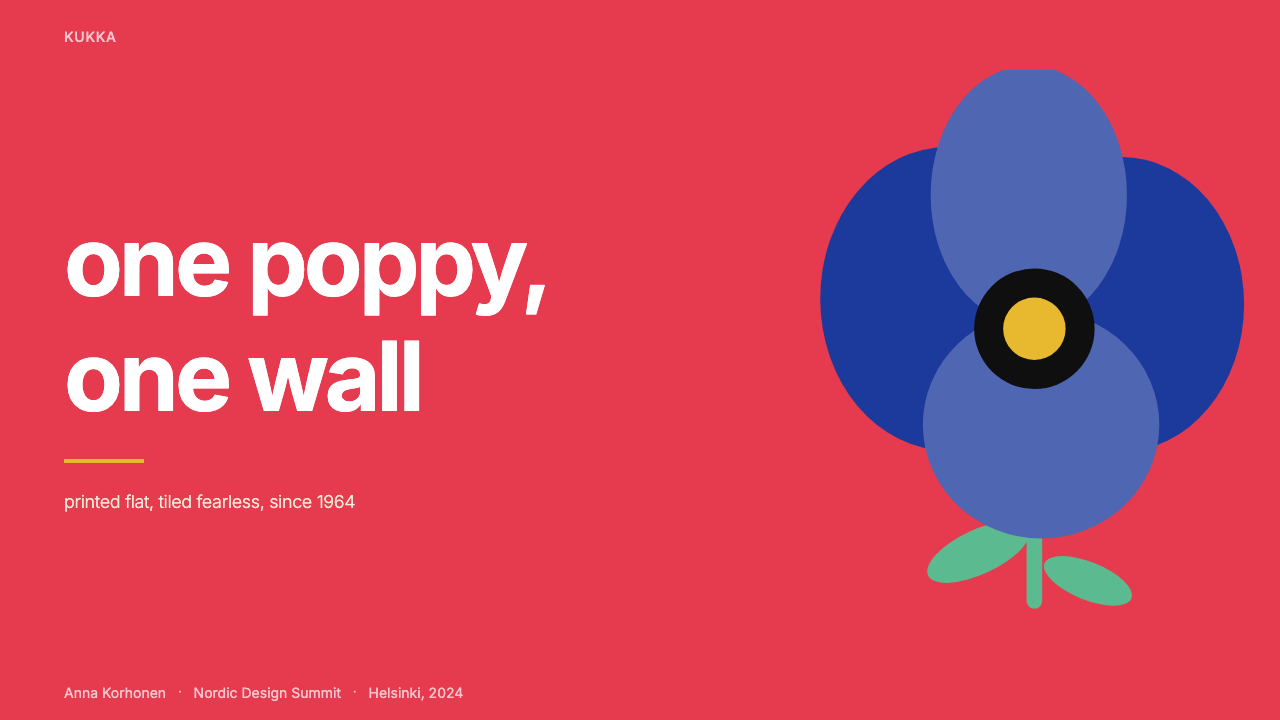
For presentation slides, Unikko works with particular power as a full-bleed cover or section-divider element. A single colourway of the pattern — cropped closely enough that individual petals fill the frame — creates an immediate visual statement without any accompanying type treatment. For content slides, the principles of the system apply even without the literal pattern: use a restricted palette of two saturated hues, keep all shapes flat and unshaded, and let scale contrast between large and small elements provide the hierarchy. Data slides take on a bold, poster-like quality when bars and areas are filled with the Unikko palette — solid colour blocks, no gradients, hard edges between segments.
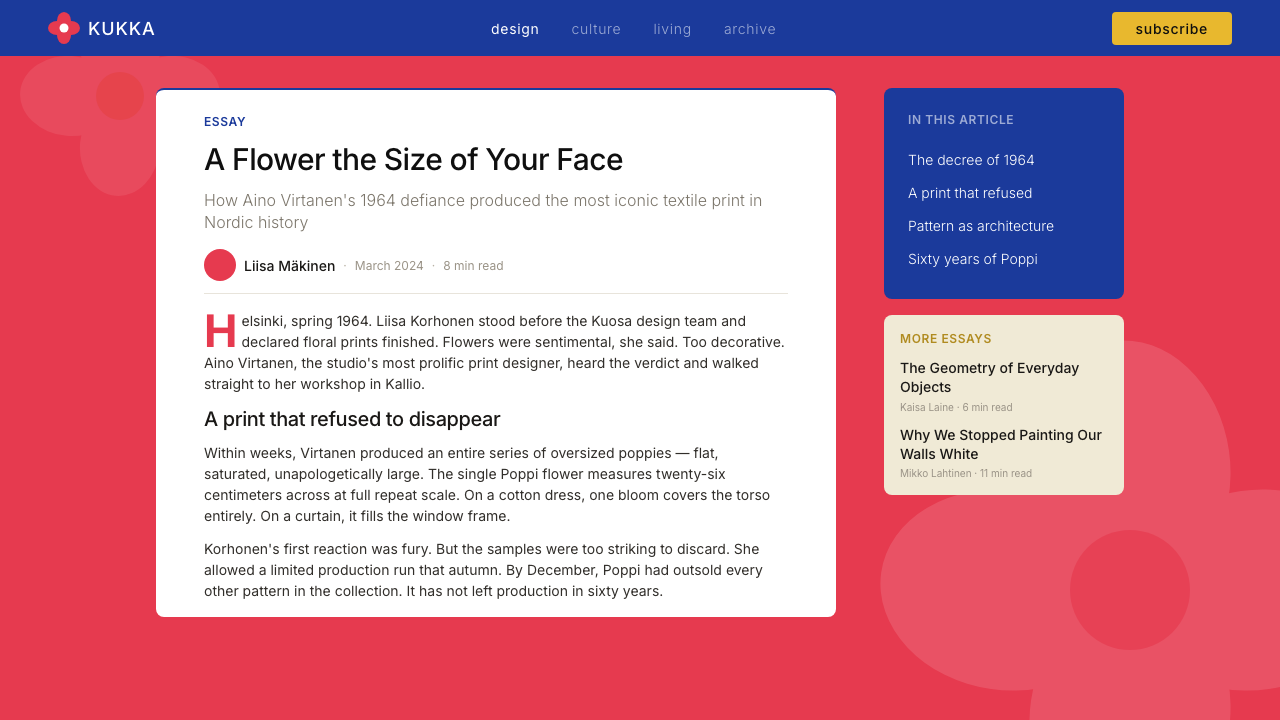
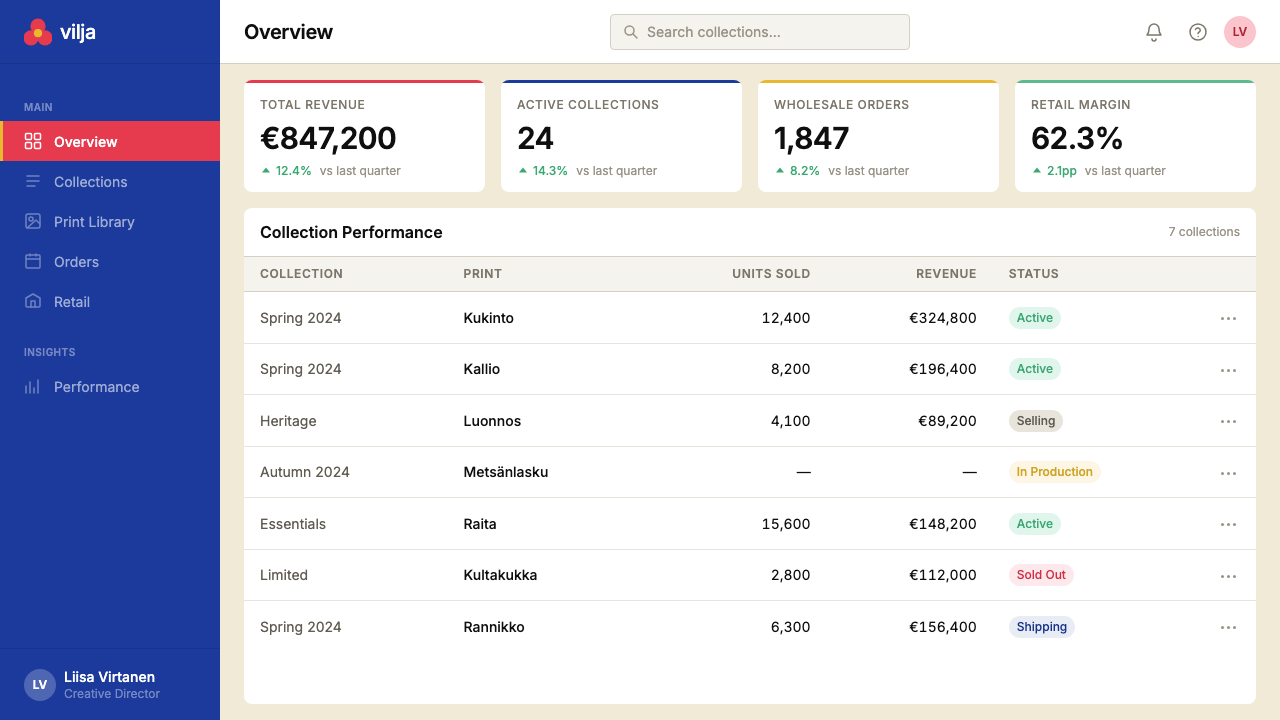
For web interfaces, Unikko is most appropriate in contexts that can carry its visual intensity: editorial feature pages, hero sections, marketing landing pages, or any surface where the goal is immediate visual authority rather than quiet utility. As a UI system for dashboards or dense information displays, the full pattern can overwhelm — here it is better to extract the palette and apply the flatness principle to component design, using solid fills and crisp edges in place of soft shadows and neutral greys. A pricing page can use a single large petal silhouette as a background element behind a feature tier, creating differentiation through pattern rather than through colour alone.
For editorial and marketing work, the style's poster heritage is its greatest asset. A full-page spread anchored by a large Unikko colourway in a single bold hue, with typography reversed out in white or black, produces a result that reads at distance before the copy is legible. Campaign imagery benefits from the pattern's ability to function as both background and subject: the flowers are identifiable but abstract enough to carry any messaging without competing with it. For printed materials — packaging, campaign posters, tote bags — the flat-colour silhouette reproduces cleanly in any print process, including single-colour and two-colour runs.
A common mistake when working with this system is reducing the scale. Unikko at small scale loses its architectural authority and becomes merely decorative — the point is that the flower is large enough to be read as structure, not ornament. Similarly, adding drop shadows, inner glows, or any simulation of three-dimensional light breaks the foundational rule of the system. The flatness is not a limitation; it is the source of the pattern's graphic strength. A second common error is using the pattern at full saturation across every surface of a layout, which produces visual noise rather than visual authority. Unikko works best when it occupies one clearly defined zone — a hero, a background panel, a section break — with clean, neutral space elsewhere for content to breathe.
Finnish Marimekko Unikko (1964) — FAQ
Is Unikko a modernist pattern or a decorative one?
Both, and the tension between the two descriptions is exactly what makes it interesting. Unikko uses a floral motif — one of the oldest decorative traditions in human making — but applies to it a set of formal decisions that are entirely modernist: flat colour, large scale, no illusionism, no representational detail beyond the minimum necessary for recognition. The result is a pattern that looks decorative at first glance but operates structurally. This duality is also why it has proved so durable: it satisfies the human appetite for natural reference while delivering the graphic clarity that modernist visual culture demands.
Why does Unikko work so well in so many different colour combinations?
Because the pattern's visual power comes from shape and scale, not from any specific hue. The large flat silhouettes create strong figure-ground contrast regardless of which colours fill them, as long as the relationship between foreground and background has sufficient contrast. A black Unikko on a white ground, a white Unikko on a navy ground, or a red Unikko on a cream ground all work by the same principle. This colour-independence is unusual in historically significant patterns, which are often inseparable from their original colourway. Unikko's abstract graphic logic gives it an adaptability that has allowed it to remain visually current across six decades of shifting colour trends.
How should Unikko be used alongside type?
The pattern's visual intensity means that type must be handled with care. The most reliable approach is to keep type in a neutral zone — white, cream, or black — and let the pattern occupy a separate, clearly defined region. Reversing white type out of a dark-coloured petal area works, but requires that the petal be large enough and flat enough in colour to provide consistent legibility across the full line length. Setting type directly over the pattern without a solid ground almost always fails: the irregular pattern edges create inconsistent contrast that makes extended reading difficult. For editorial contexts, a wide clear margin or a solid colour panel alongside the patterned area is more reliable than attempting to overlay the two.
Is Marimekko Unikko appropriate for digital product UI, or is it primarily a surface/brand element?
Primarily a surface and brand element, and understanding this distinction matters for application quality. The pattern is visually dominant — when present, it organizes the entire visual field around itself, which is valuable for brand-establishing contexts but disruptive in dense functional UI where multiple elements need to coexist at equal weight. In product UI, the better approach is to derive from the system rather than apply it literally: use the flat-colour principle for component fills, extract one or two hues from the palette for interactive states, and use scale contrast as the primary organizational device. The literal Unikko motif works best at defined moments — a welcome screen, an empty state illustration, a marketing overlay — where its visual authority is useful rather than competing with functional hierarchy.
What is the difference between using Unikko and simply using a bold floral pattern?
The difference lies in the formal commitments that define the system: flat colour with no shading, architectural scale that makes the motif structural rather than decorative, and a palette at full saturation rather than softened tones. Many bold floral patterns retain elements that Unikko deliberately strips away — shading, multiple scales of detail, softened edges, naturalistic colour relationships. Applying a generic bold floral in the Unikko register requires making those same formal commitments: every petal must be a flat colour field, the scale must be large enough that the repeat reads as rhythm rather than texture, and the colour relationships must be high-contrast rather than harmonious. Without those commitments, the result looks like a floral pattern inspired by Marimekko rather than a genuine application of the design logic Unikko represents.
Related design styles
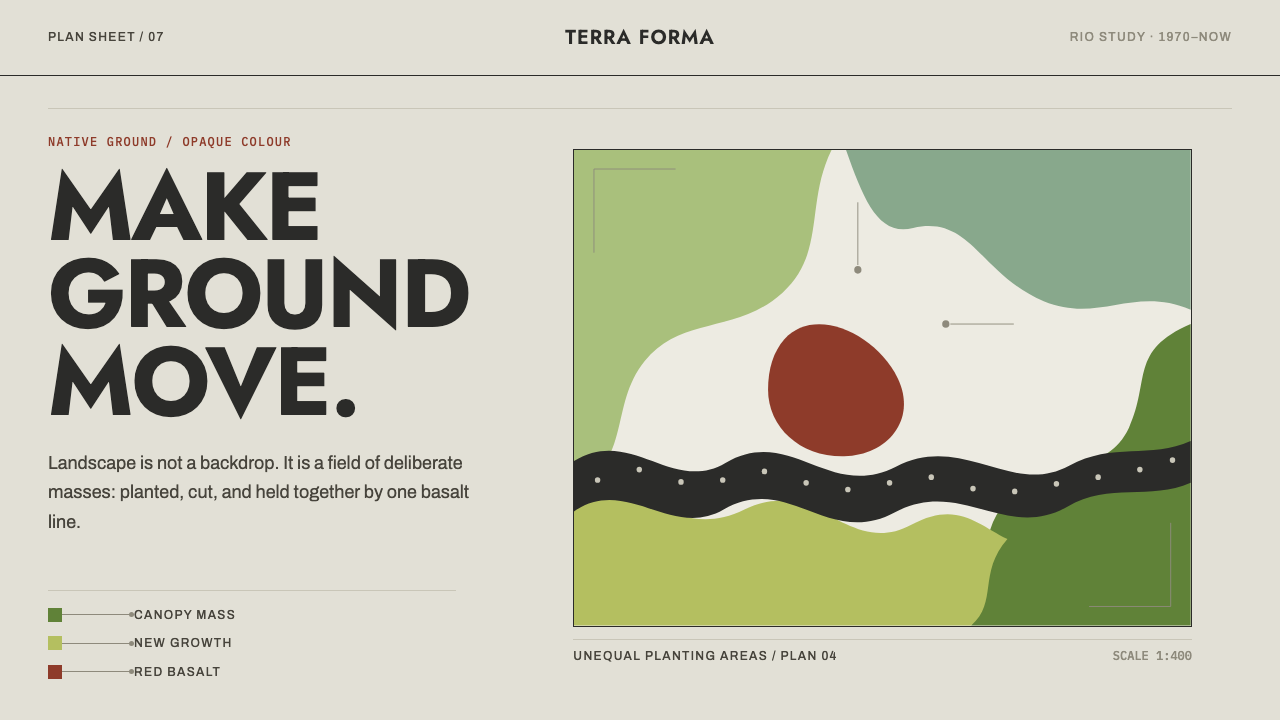 Burle Marx LandscapeGround moves with intent. Gouache greens cross limestone, cut by one basalt w…
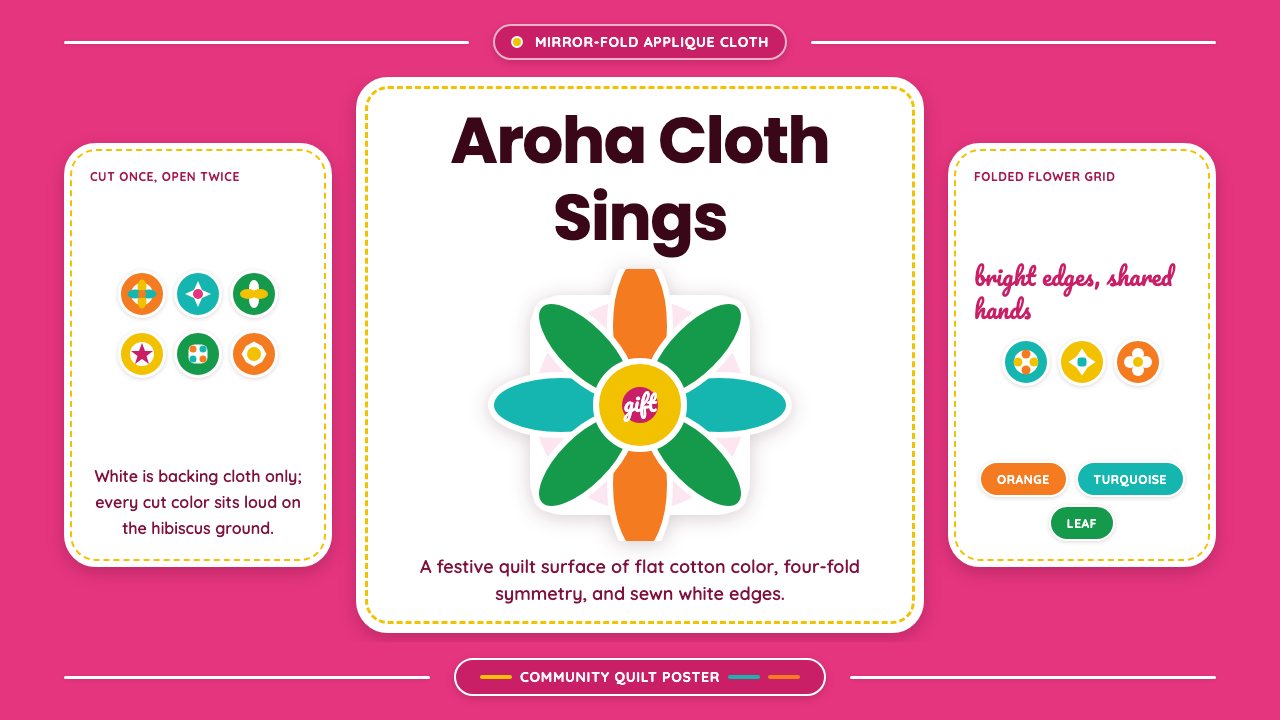 Cook Islands TivaevaeSaturated craft sings. Hibiscus pink carries mirror-fold florals in flat appl…
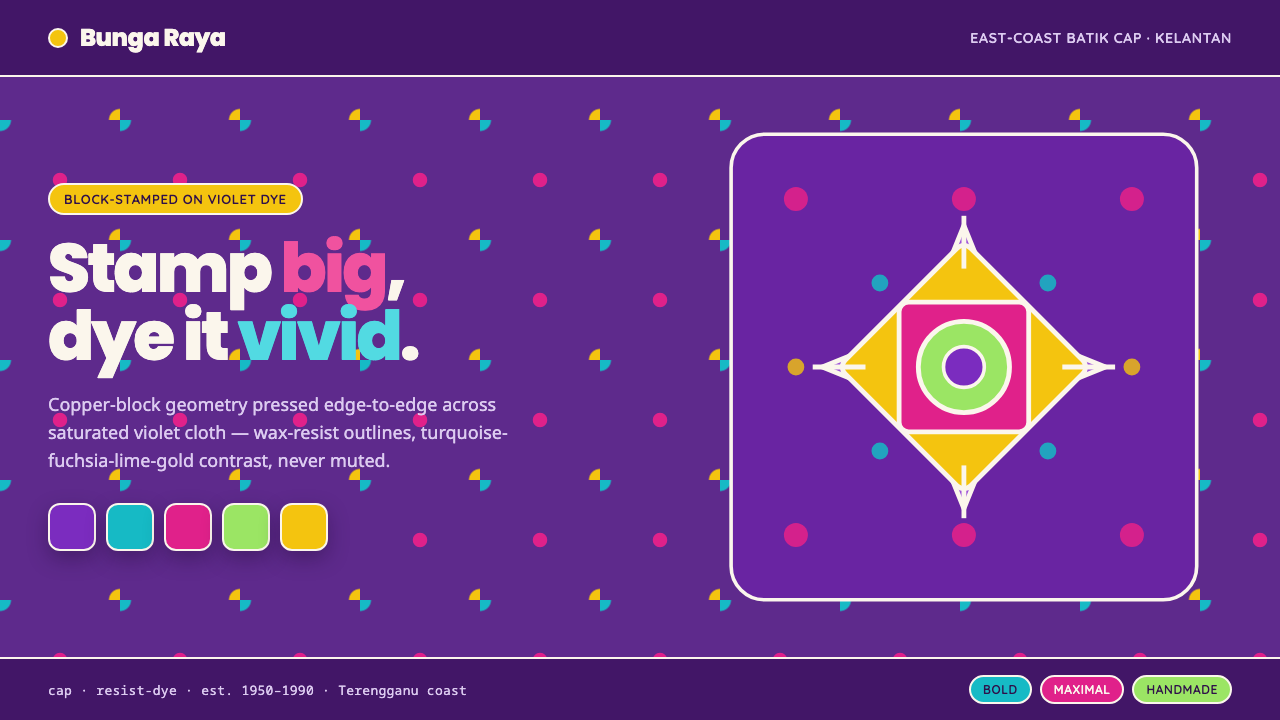 Kelantan Block BatikBright Malay batik, not Javanese brown. Oversized hibiscus stamped turquoise-…
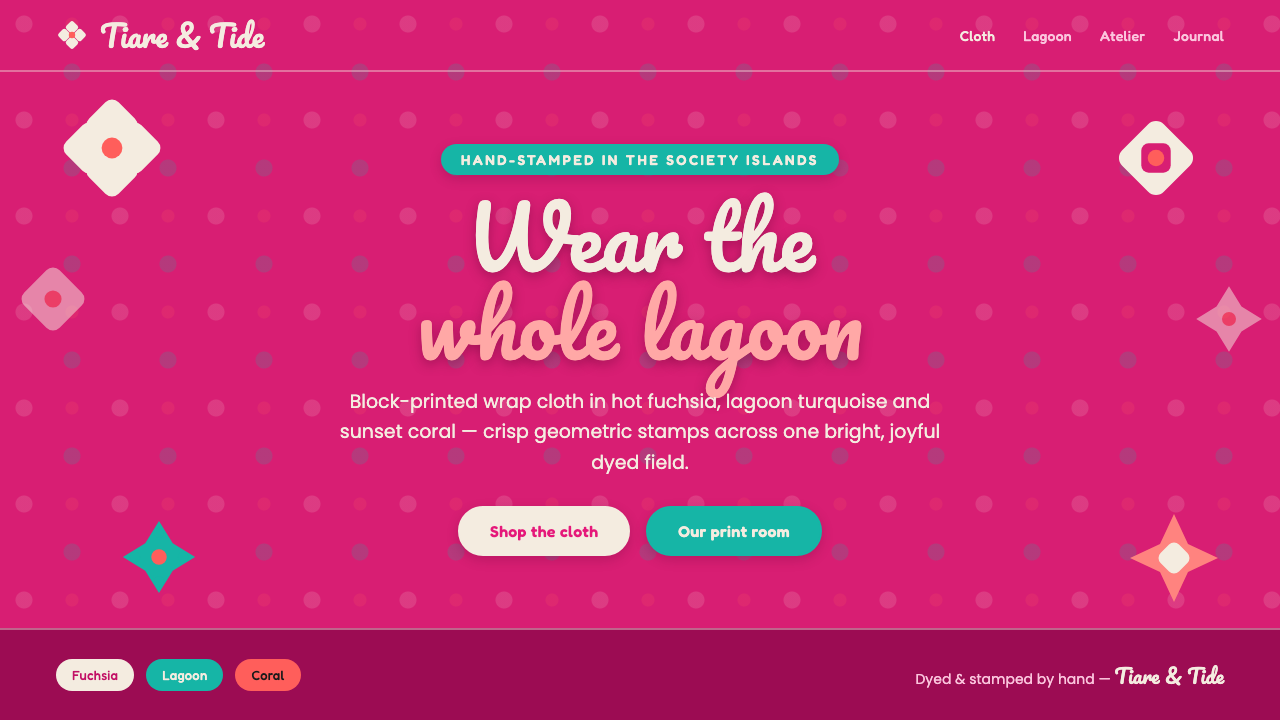 Tahitian Pareu PrintWear the whole lagoon. White hibiscus block-printed on hot-fuchsia cloth, wit…
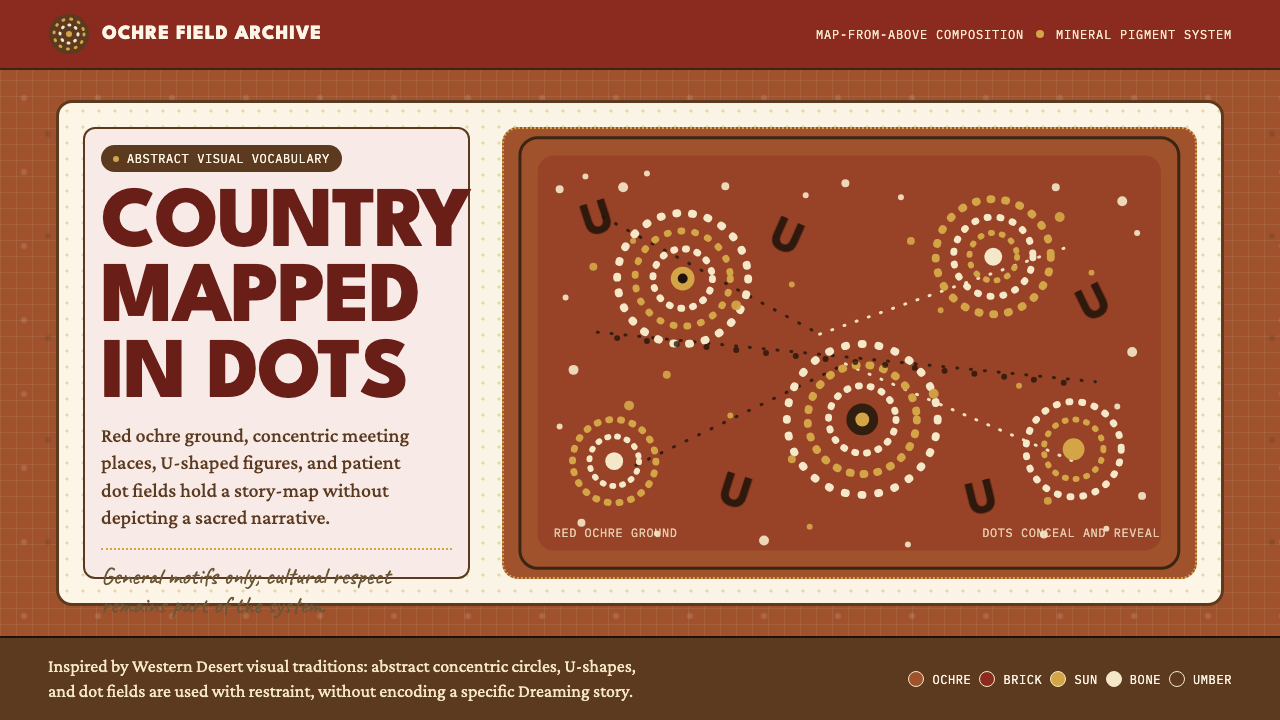 Aboriginal Dot PaintingAncient story-map energy. Red ochre, bone dots, concentric circles, and U-mar…
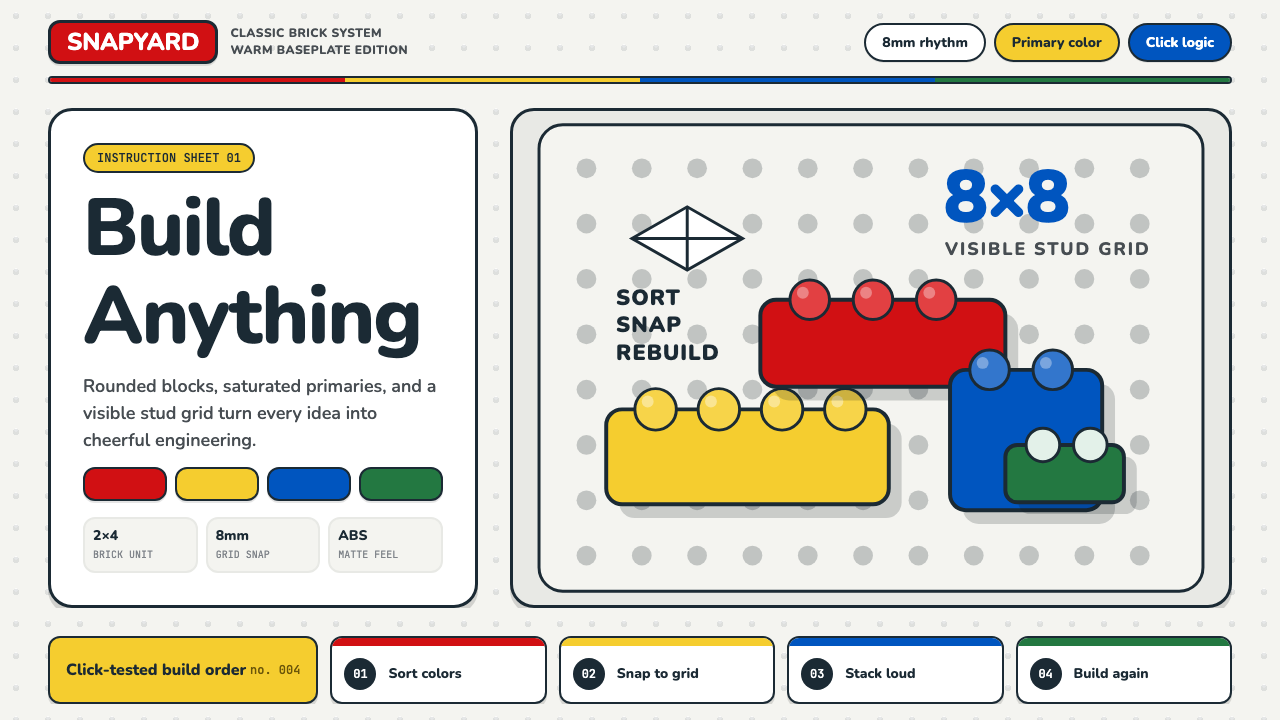 LEGO ClassicCheerful engineering. Primary bricks snap across a warm gray stud grid.