What is Ethiopian Hide Shield?
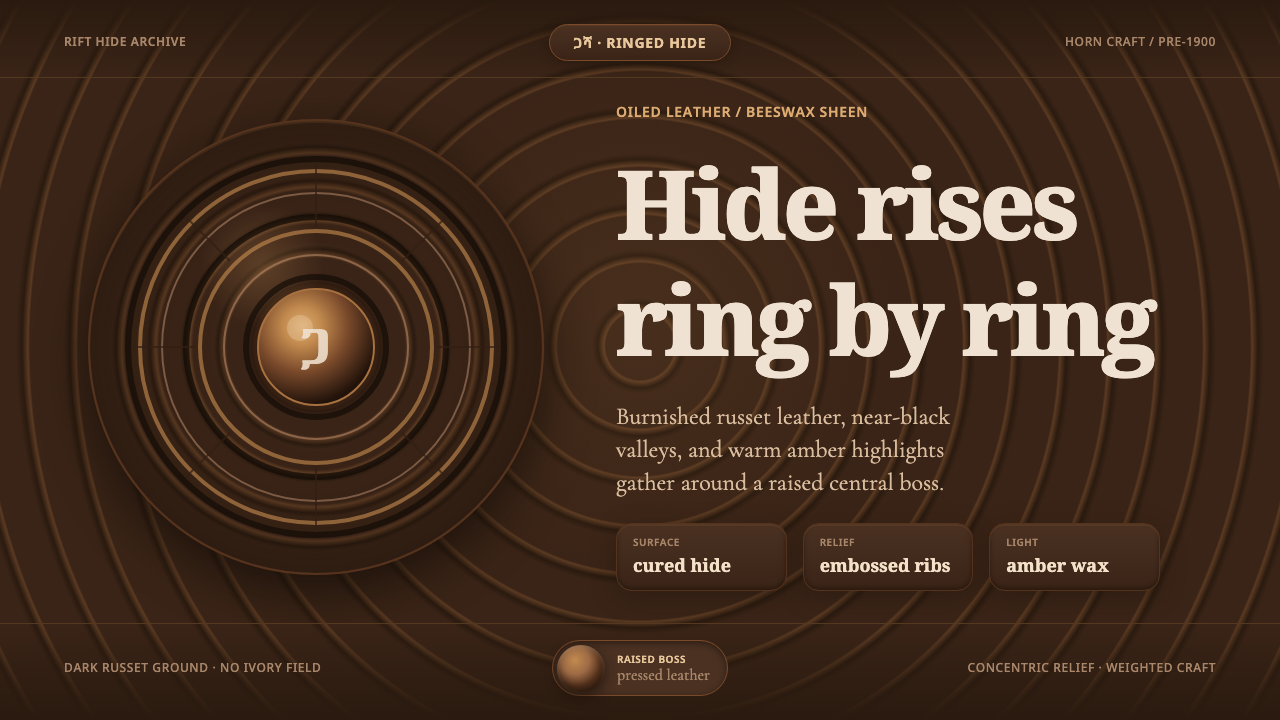
Ethiopian Hide Shield turns darkness into substance — near-black leather, russet relief, and amber beeswax light shaped by the memory of ceremonial armor.
Ethiopian Hide Shield in brief
Ethiopian Hide Shield is a dark visual style distilled from the parade shields of the Horn of Africa, particularly the hide-working traditions associated with Oromo, Amhara, Sidamo, and Arussi communities in Ethiopia. Its central image is a circular shield cut from heavy animal hide, then oiled, pounded, embossed, and burnished until concentric rings gather around a raised central cone.
The style is defined less by applied decoration than by transformed material. Its ground moves between russet brown, deep leather brown, and near-black, while ridges catch warm amber light like wax rubbed into a cured surface. Dark areas should retain depth and variation rather than becoming empty black. Highlights belong to the leather: they suggest pressure, oil, age, and polish, never metal leaf or gilding.
On screen, the shield becomes an organizing system. Concentric relief establishes hierarchy, the central boss creates focus, and incised or inscriptional details provide measured articulation. The result is solemn, tactile, and ceremonial. It does not imitate a museum object literally; it translates the shield’s material logic into interfaces and pages whose structure appears pressed, carved, and brought forward by grazing light.
Where does Ethiopian Hide Shield come from?
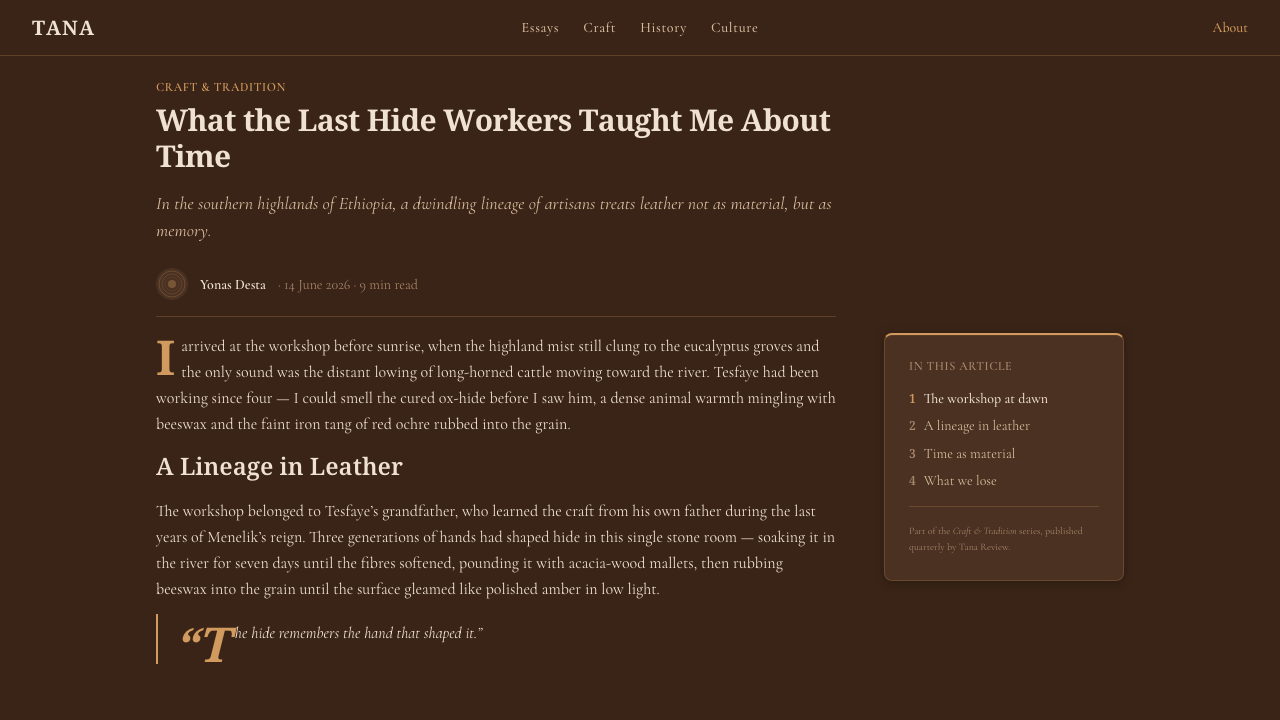
The style originates in the pre-1900 hide-shield tradition of East Africa, centered here on Ethiopia and the peoples identified with Oromo, Amhara, Sidamo, and Arussi craft. Shields were formed as discs from hippopotamus, ox, or rhinoceros hide. Their identity came from the hide’s thickness and from the labor applied to it: oiling made it workable, pounding established its form, and burnishing produced a dense russet-brown face beneath an aged patina.
Embossing converted the shield’s surface into structure. Concentric rings radiated around a raised central cone, making reinforcement, handwork, and visual authority legible at once. Incised leatherwork could introduce another register of controlled mark-making. The surface was never merely a flat field receiving an image; the image emerged through compression, displacement, and polish within the hide itself.
Several linked communities sustain the source material rather than a single named designer. Oromo hide-shield makers, Amhara leatherworkers, and Sidamo or Arussi shield craftsmen represent regional bodies of knowledge carried through practice. Warrior-notables who bore embossed parade shields completed the object’s public meaning: the craft was encountered not only at the workshop but through ceremonial display, where circular form, dark mass, and raised ornament conveyed presence.
Ge’ez inscriptional craft belongs to the wider visual context named by the source. Within this design language, its relevance is disciplined rather than illustrative: inscriptions suggest ordered marks cut or impressed into a resistant surface. Together, embossed leatherwork and inscriptional craft establish a vocabulary of rings, ridges, scars, and deliberate signs. Ethiopian Hide Shield preserves that vocabulary while avoiding claims of direct replication.
What defines the Ethiopian Hide Shield look?
Leather Darkness
The ground ranges from burnished russet through deep brown to near-black, always reading as aged hide rather than neutral darkness. Subtle irregularity suggests cured fibers, absorbed oil, and accumulated handling. Pale or cream grounds contradict the style’s material premise; even open areas should feel cut from the same dark leather field.
Concentric Relief
Circular rings are the primary structural motif. They may frame a title, organize a diagram, divide interface zones, or appear as partial arcs entering from beyond the composition. Their force comes from apparent pressure and elevation: each ring should seem raised or impressed, not simply drawn as a decorative outline.
Central Boss
The raised central cone supplies a natural focal model. In layouts, it becomes a dominant emblem, key statistic, product image, or decisive call to action surrounded by quieter rings. The composition should gather toward this center without requiring perfect symmetry; the boss is a source of visual gravity, not a mandate for radial repetition everywhere.
Beeswax Light
Highlights are warm amber, russet, or softly coppery, appearing where raised leather would catch grazing light. They remain narrow and restrained, with broad regions held in darkness. The sheen must feel rubbed and organic rather than glittering. If the surface begins to resemble polished metal or gold ornament, the material illusion has failed.
Incised Mark
Lines and symbols should look cut, pressed, or scored into resistance. This favors compact labels, deliberate dividers, and inscription-like sequences over floating ornamental scripts. Ge’ez inscriptional craft may inform the sense of ordered marking, but signs should not be invented or presented as authentic historical text without a verified source.
Weight and Restraint
Forms are broad, grounded, and sparingly distributed. A few substantial rings or panels are more convincing than a field crowded with tiny motifs. Typography should carry similar gravity: firm shapes, measured spacing, and decisive hierarchy. Delicacy may appear in incised details, but the overall silhouette remains protective and ceremonially composed.
Material Unity
Every layer should appear to belong to one worked hide surface. Borders become raised seams, shadows become recesses, and panels read as changes in pressure or polish rather than separate floating cards. This unity prevents the style from collapsing into a generic dark theme decorated with circles.

Who shaped Ethiopian Hide Shield?
Oromo hide-shield makers represent one of the craft communities named in the East African tradition behind this style. Their importance lies in material knowledge rather than individual authorship: selecting and shaping heavy hide, developing the disc form, and giving the shield presence through pounding, embossing, oiling, and burnishing. The design system honors this collective craft logic by making worked surface and structural relief inseparable.
Amhara leatherworkers embody the wider leather-working knowledge included in the source tradition. Their place in the article clarifies that the aesthetic is not only about the shield’s circular silhouette; it is equally about curing, handling, finishing, and reading hide as a responsive material. The dark patina and waxed light central to the style derive their authority from that material discipline.
Sidamo and Arussi shield craftsmen are named as makers within the Ethiopian hide-shield region. In the visual system, their relevance is expressed through the disciplined relationship between circular construction and embossed detail. Rings are not added motifs but evidence of forming, and the central cone is not an icon placed on top but a raised event within the shield’s body.
Warrior-notables who carried embossed parade shields connected workshop craft to public ceremony. Their role explains the style’s combination of protection, rank, and display: the shield was a substantial object meant to be seen in the presence of its bearer. Contemporary applications can translate that authority into strong focal hierarchy, but should avoid turning ceremonial gravity into theatrical luxury or metallic spectacle.
How do you use Ethiopian Hide Shield today?
For presentation covers, use the shield as a compositional principle rather than a literal background photograph. A partial ring can enter from one edge, while a raised central form anchors the title or emblem. Keep most of the field in deep leather darkness and allow only selected ridges to catch amber light. Content slides work best when headings, notes, and images occupy distinct bands that feel pressed into one continuous surface.
Data slides should translate information into relief. Circular comparisons can follow concentric bands, while linear charts may use shallow ridges and recessed tracks. Emphasize the most important value with the visual logic of the central boss: greater elevation, clearer polish, and stronger surrounding quiet. Avoid decorating every data point with texture, because excessive surface treatment weakens comparison and makes the leather metaphor more important than the information.
For web interfaces, the style suits dashboards, archives, premium catalogues, and pricing pages that benefit from solemn authority. Navigation can occupy an incised outer band, with primary content gathered toward a central panel. Pricing tiers should be distinguished through hierarchy, relief, and controlled amber emphasis rather than unrelated colors. Inputs and cards should appear inset or pressed from the shared hide ground, preserving material unity across interactive states.
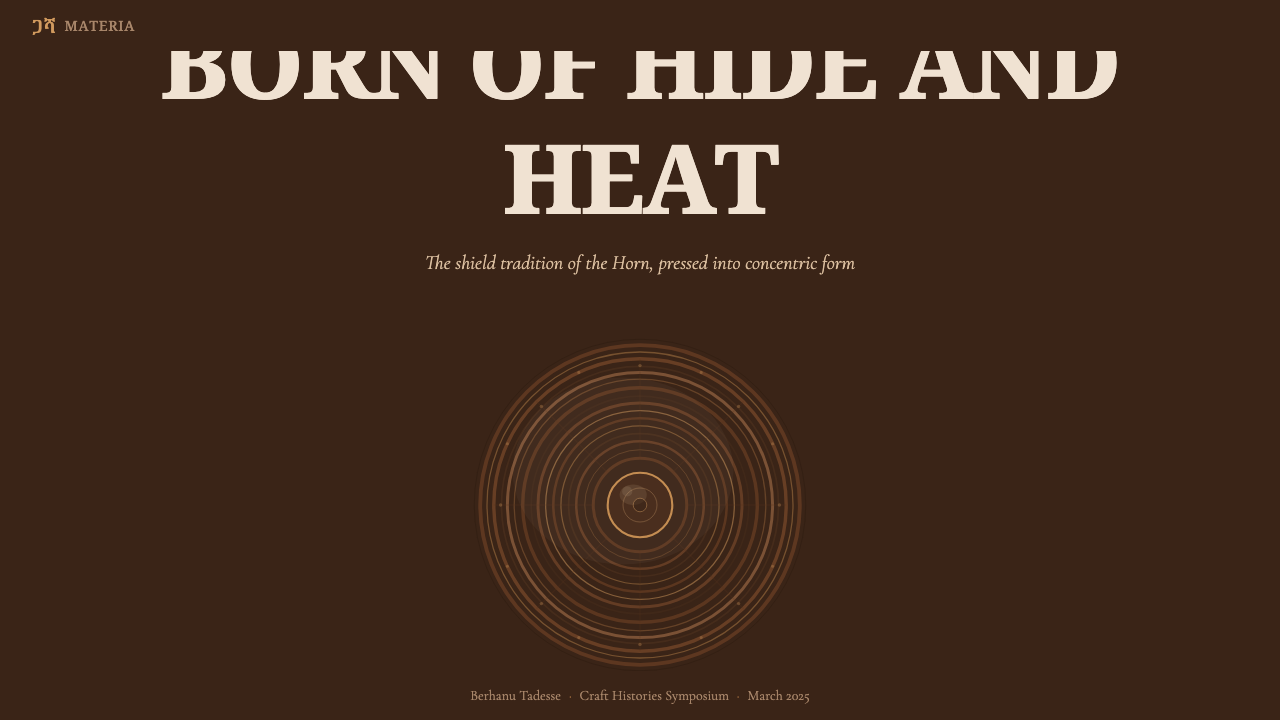
Editorial and marketing layouts can use wide dark fields, circular crops, and inscription-like metadata to frame long-form storytelling. A feature article may open with a shield-like image or diagram, then shift into quieter bands of text separated by scored lines. Campaign pages should reserve the brightest waxed highlight for a single promise or action. Product photography belongs when it is tightly integrated into the dark field, not when it floats inside a glossy, unrelated frame.
The common mistake is to confuse this style with generic dark luxury. Gold lettering, jewel-like glows, smooth black gradients, and ornamental metallic borders replace leather craft with a prestige cliché. Another error is covering every surface with concentric rings until hierarchy disappears. Authentic application begins with hide darkness and physical relief, uses amber as reflected wax light, and gives each ring a structural reason to exist.
Ethiopian Hide Shield — FAQ
Is Ethiopian Hide Shield simply a dark African-inspired theme?
No. Its identity comes from a specific material and construction logic associated with Ethiopian hide shields: heavy cured leather, a disc form, concentric embossing, a raised central cone, aged patina, and beeswax sheen. Removing those relationships leaves only a generic dark palette. The regional reference should guide structure and material behavior, not serve as a loose label for unrelated ornament.
Why must the amber highlights avoid looking like gold?
Because the source surface is cured hide treated with oil and wax, not a gilded object. Amber light describes where polished leather catches illumination and reveals relief. Gold introduces a different material story centered on metal, wealth, and applied ornament. Once metallic shine dominates, the design loses the shield’s tactile honesty and drifts toward generalized luxury branding.
Does every layout need to be circular and symmetrical?
No. The circular shield provides a grammar of focus, enclosure, and radiating hierarchy, not a compulsory template. Partial arcs, off-center bosses, cropped rings, and linear bands derived from relief can all preserve the style. Symmetry is useful for ceremonial emphasis, but asymmetric layouts may be clearer for reading. What matters is that elements share a believable relationship of pressure, depth, and material.
How should Ge’ez-inspired details be handled responsibly?
Use the source material’s reference to Ge’ez inscriptional craft as guidance for rhythm, incision, and ordered marking. Do not fabricate text and present it as a translation, historic inscription, or culturally authoritative statement. If authentic language is required, it should come from a verified source. Otherwise, abstract scored lines and clearly non-linguistic marks can evoke inscriptional discipline without impersonating it.
Where does this style work poorly?
It struggles where an interface must feel airy, casual, playful, or visually weightless. The dark ground, concentrated focus, and ceremonial mass can overwhelm dense administrative forms, cheerful children’s content, or products built around softness and spontaneity. It also performs poorly when accessibility depends on many competing highlight colors. The style is strongest when authority, tactility, heritage, and deliberate focus align with the subject.
Related design styles
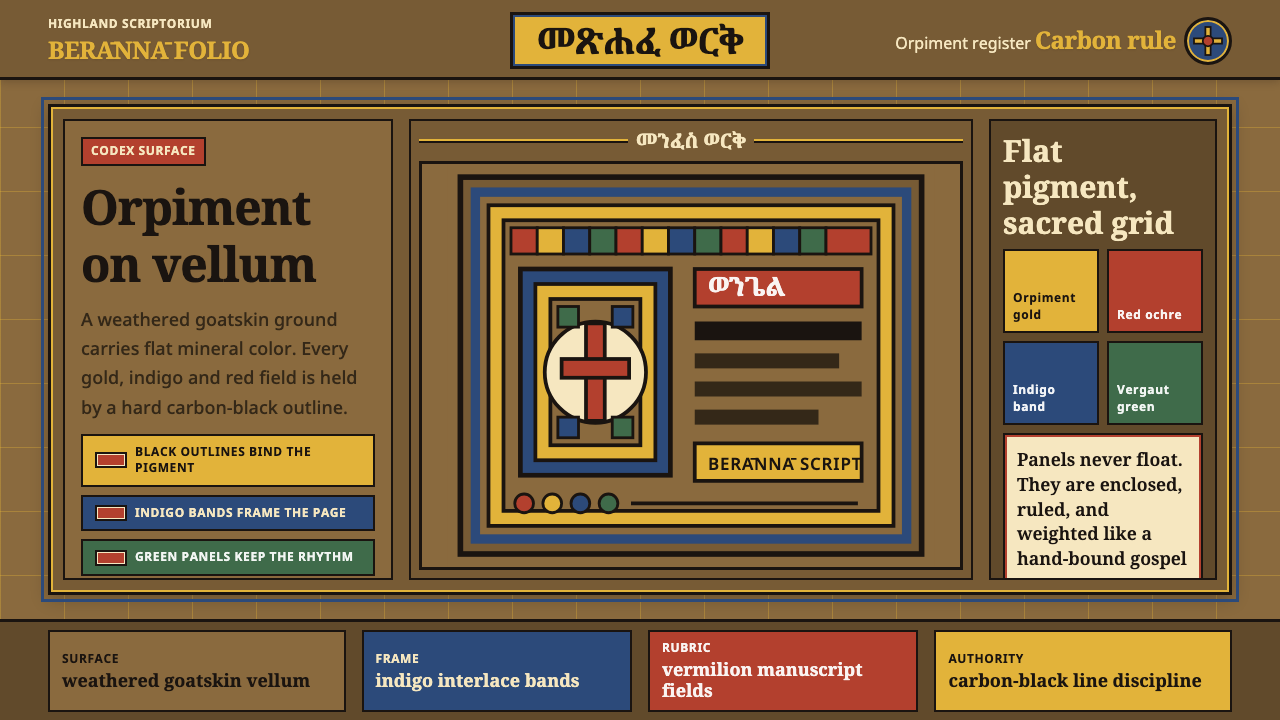 Ethiopian Geez GospelSacred color held in line. Orpiment gold and indigo panels sit on weathered v…
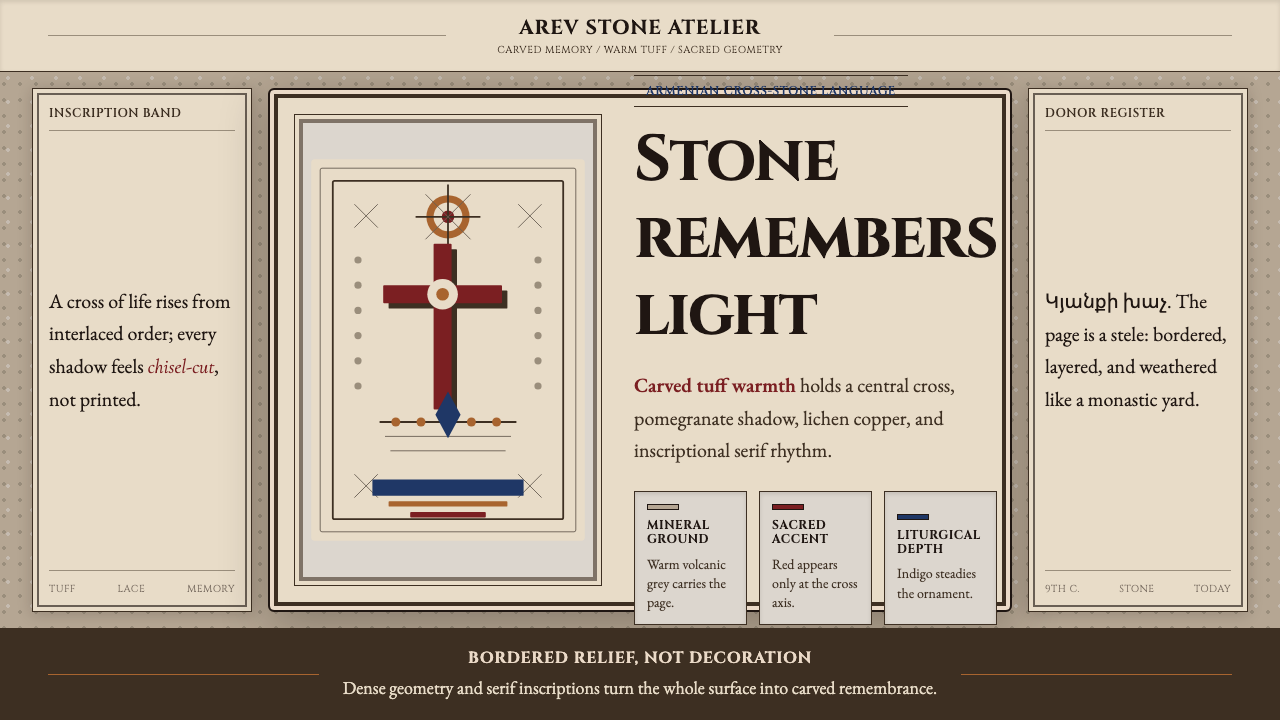 Armenian Khachkar Cross-StoneStone becomes memory. Tuff grey, pomegranate red, and carved borders hold the…
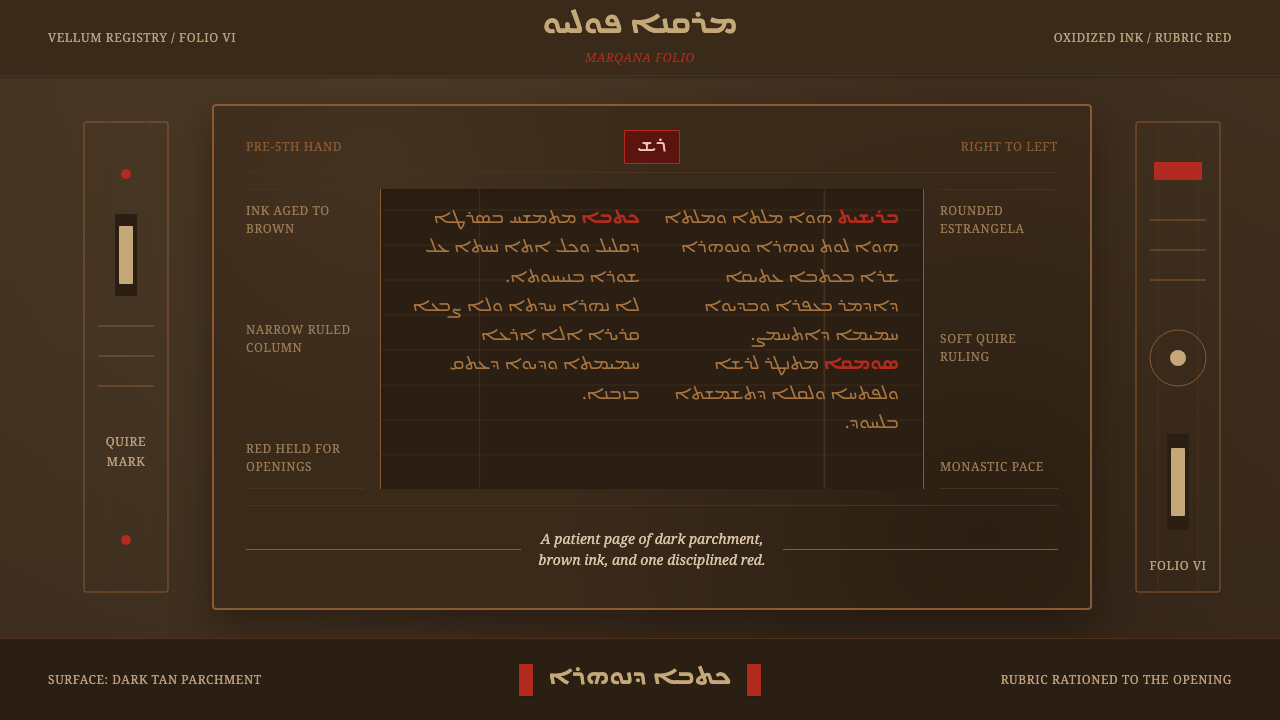 Syriac EstrangelaAncient warmth survives. Brown parchment, right-to-left columns, rationed rub…
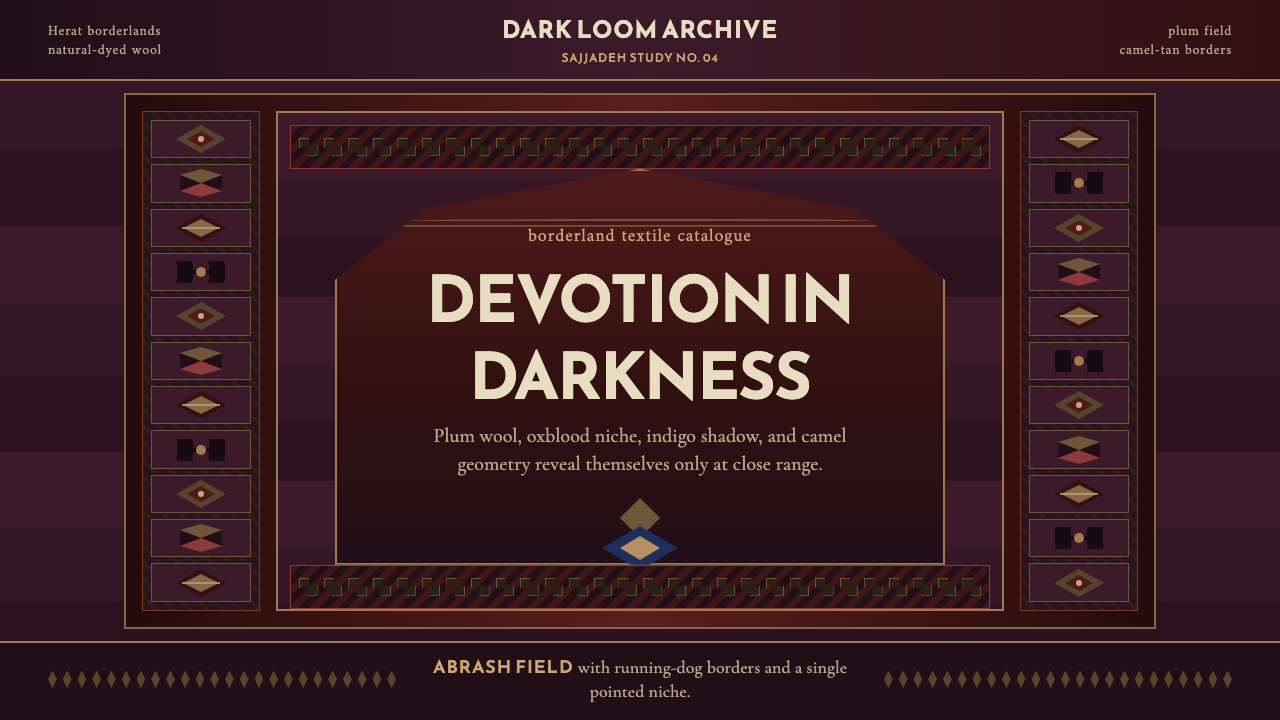 Afghan Baluchi Prayer RugDevotional darkness glows. Plum field, oxblood mihrab, and camel borders surf…
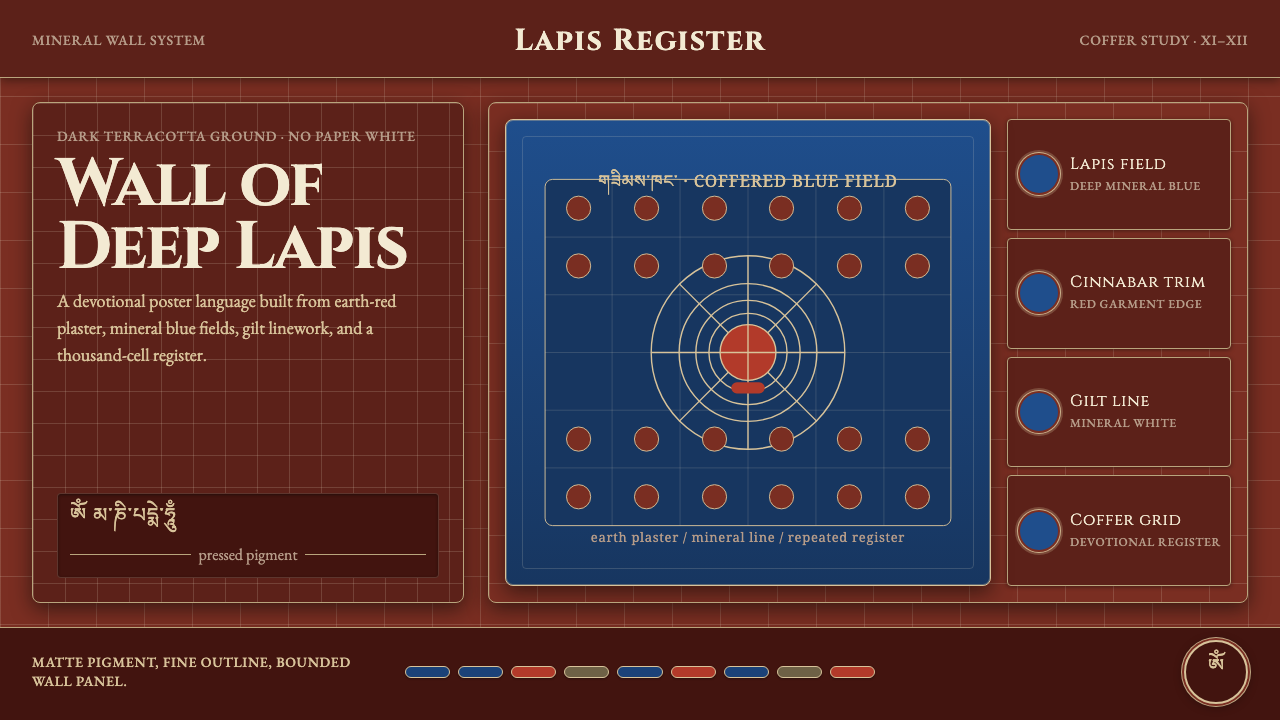 Alchi Monastery MuralDevotional depth. Lapis fields and coffered grids glow on terracotta plaster.
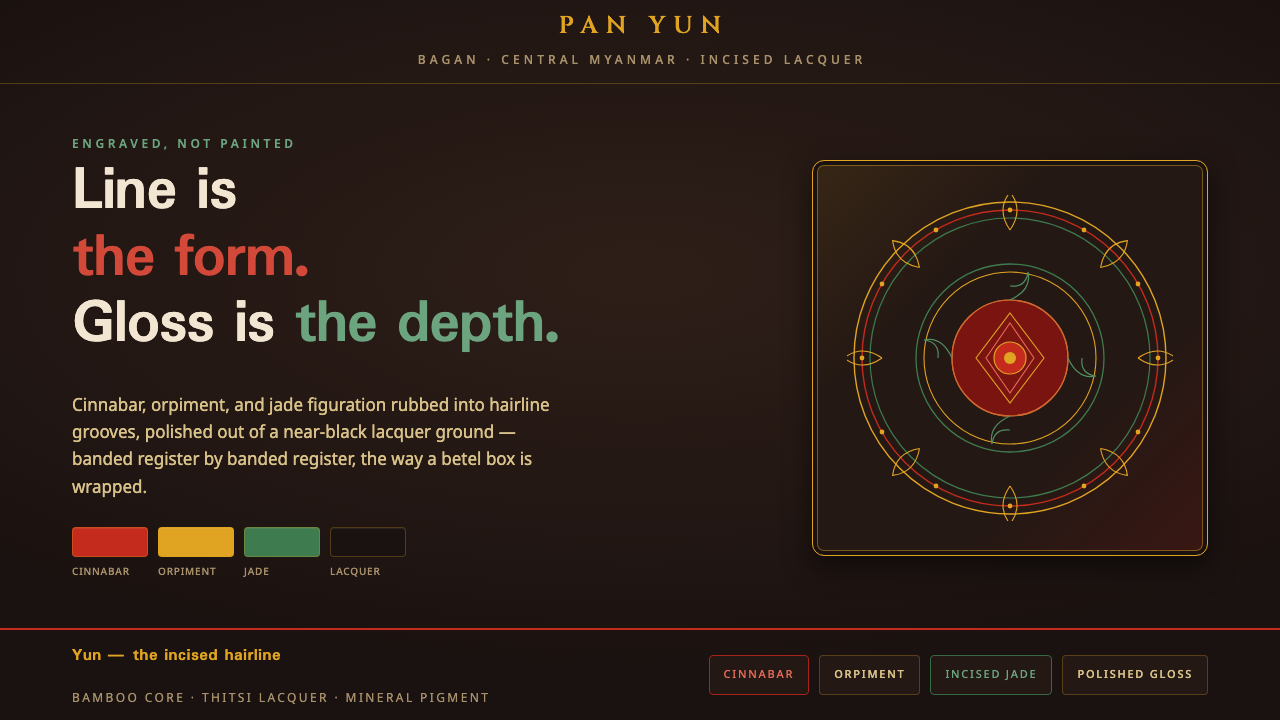 Bagan Yun LacquerwareEngraved, not painted. Cinnabar, orpiment and jade hairlines polished from ne…