What is Ed Fella Hand-Drawn (1990)?
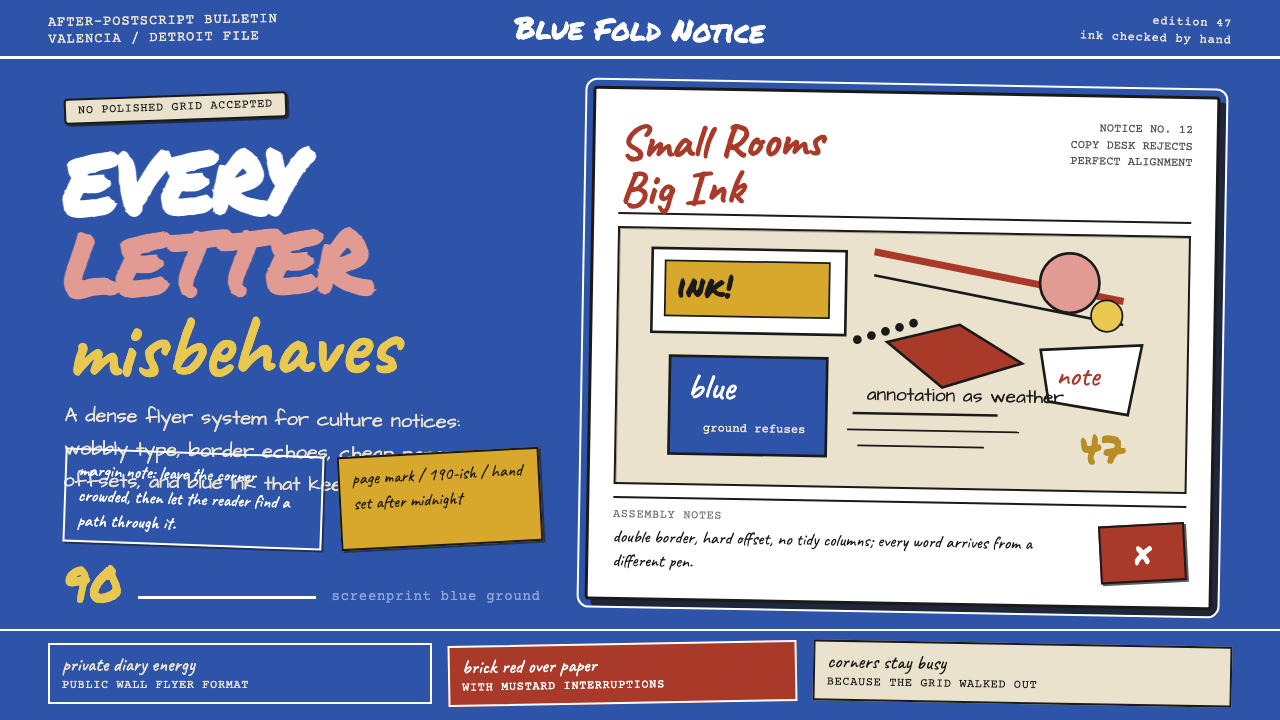
Ed Fella abandoned the computer at the peak of its promise and spent fifteen years proving that the hand could say things PostScript never could.
Ed Fella Hand-Drawn (1990) in brief
Ed Fella Hand-Drawn is a graphic design style rooted in the flyers Ed Fella produced for the Detroit Focus Gallery between 1987 and 2001. Where the dominant design culture of that era moved toward clean digital output and the smooth authority of PostScript type, Fella moved in the opposite direction — toward the imprecision, density, and personal energy of the hand. Each flyer was a one-of-a-kind object: letters drawn individually so that no two shared the same proportion, margin notes crowding every white corner, multiple hand-lettered voices competing on the same page.
The visual character of the style is immediately distinct. A screenprint-blue ground — flat and slightly industrial, the color of a mimeograph gone electric — anchors the compositions. Against it, hand-drawn letterforms wobble and lean, each one carrying the pressure and hesitation of the moment it was made. The page is dense rather than airy, layered rather than hierarchical in the conventional sense. Annotations and asides accumulate in the margins the way a working notebook does, not a publication. The overall effect is of a document that is also a diary, a proof that also argues with itself.
This is not naive art or outsider design — Fella spent twenty-five years as a professional commercial illustrator before turning this direction, and the work is deeply knowledgeable about the conventions it refuses. The wobble is controlled. The crowding is composed. The apparent disorder is the result of specific, repeated decisions about what draws the eye and where the page needs rest. Understanding the style means understanding the difference between calculated irregularity and genuine accident.
Where does Ed Fella Hand-Drawn (1990) come from?
Ed Fella was born in Detroit in 1938 and spent the bulk of his professional life in that city's commercial art scene. For over two decades he worked as a graphic designer and illustrator for advertising agencies, producing polished, client-ready work that had no visible connection to what would come later. He was competent, employed, and entirely within the mainstream. Then, at the age of forty-seven, he enrolled as an MFA student at Cranbrook Academy of Art — an unusual move for a practicing professional in the middle of his career — and graduated in 1987.
That same year, Fella joined the faculty at the California Institute of the Arts (CalArts) in Valencia, where he would teach for the next twenty-six years. But the work that defines his legacy began not in California but in Detroit, where he continued to produce flyers for the Focus Gallery — a nonprofit contemporary art space — as a kind of personal research project. These were not commissioned pieces in the conventional sense; they were self-assigned experiments, produced for a real audience but freed from the requirements of a paying client. Fella described them as work made 'after the fact,' meaning outside the commercial constraints that had governed his professional life.
The context matters. The late 1980s and early 1990s were a moment of significant transition in graphic design. Desktop publishing had arrived; the Macintosh and applications like PageMaker and QuarkXPress were transforming what could be produced by a single designer without a print shop. For most practitioners, this was liberation — access to precision, variety, and speed that had previously required expensive specialists. Fella read it differently. He saw the computer as producing a kind of typographic homogeneity, a smoothing-out of the personal and the imprecise. His response was to move entirely in the opposite direction: to make the hand visible, to refuse PostScript's clean curves, to produce work that could only have come from one specific person at one specific moment.
The movements associated with this style — Vernacular Modernism, Post-PostScript, Anti-grid Hand-lettering — reflect an intellectual environment at CalArts and Cranbrook that took seriously the idea that graphic design could be critical practice, not just a service. Lorraine Wild, a colleague and collaborator, developed parallel arguments about vernacular typography. Jeffery Keedy and P. Scott Makela, both associated with the same institutional milieu, were also producing experimental typefaces and layouts that challenged the computer's authority. Fella was not an isolated eccentric but a participant in a specific, historically situated conversation about what design could and should do at the end of the twentieth century.
What defines the Ed Fella Hand-Drawn (1990) look?
Hand-Drawn Letterforms
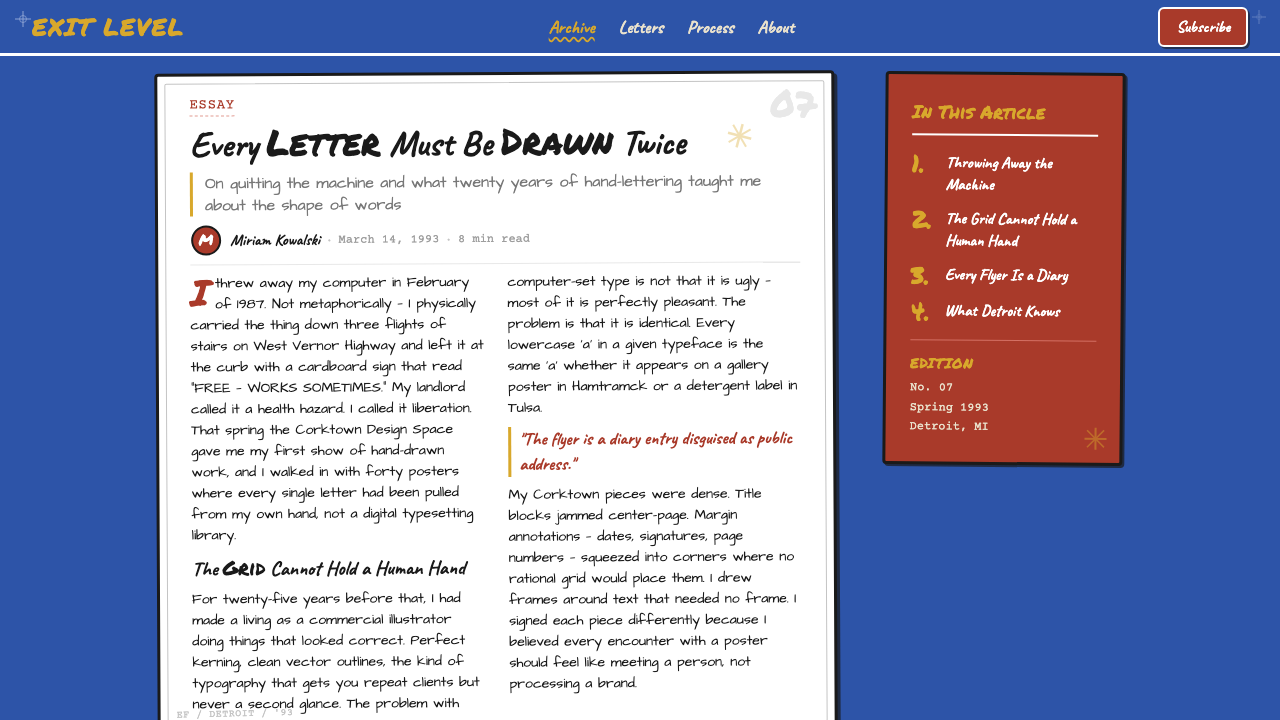
Every letter in the Fella system is drawn individually rather than set from a font. This means each character carries traces of its making — variations in stroke weight, slight tilts, the idiosyncratic loops and terminals of a specific hand working under specific conditions. No two letterforms repeat exactly. The result is a headline that reads as a singular event rather than a repeatable specification, and a page that could not have been generated by any tool other than a human hand with a pen or brush.
Screenprint Blue Ground
The characteristic background tone is a mid-value blue with the flat, slightly chalky quality of screenprint ink — neither the precise blue of digital color nor the variable blue of hand-mixed paint, but something between industrial and handmade. It reads as deliberate, as a prepared field rather than a default, and it gives the compositions a consistent identity even when every other element changes from piece to piece.
Marginal Annotation
Margins in the Fella style are not empty. They are filled with secondary text — dates, labels, credits, asides, and comments — written in a smaller, more cramped hand than the main headline. These annotations treat the white space around the central composition as available real estate rather than necessary breathing room. The page becomes a document that has been worked on rather than laid out, with the evidence of process visible in every corner.
Mixed Typographic Voices
A single Fella composition typically contains several distinct lettering modes — a large, wobbly display hand for the headline; a smaller, more controlled printed hand for supporting information; occasional cursive or script passages for dates or names; and perhaps a stencil-like quality for certain words or numbers. These modes coexist without hierarchy in the typographic sense: they are all hand-drawn, which gives them a family resemblance even while their characters differ.
Asymmetric, Anti-Grid Composition
Where Bauhaus asymmetry is still governed by an underlying structural grid, Fella's compositions resist the grid entirely. Elements are placed by intuition and adjusted by eye rather than by mathematical relationship. The result is a kind of balance that cannot be reduced to a rule — dense in one area, sparse in another, with diagonal axes cutting through the page in ways that a grid-based system would never generate. The page feels discovered rather than planned.
Paper Offsets and Registration Marks
The Fella flyers often showed evidence of their production process — slight misregistrations between layers, the visible edges of cut-and-pasted paper, registration marks left in the composition rather than trimmed away. In the design system, these production artifacts become intentional visual elements: the page acknowledges that it was made, that it exists as a physical object with a history, not as a purely digital surface.
Deliberate Imperfection as Tone
The imperfection in Fella's work is not a failure of execution but a communicative choice. A perfectly drawn letterform says nothing about the moment of its making; a slightly off-axis letter with uneven stroke pressure says that someone made this, here, now, in a particular state. That record of presence is the tone the style carries — intimate, specific, irreproducible. To apply this quality well is to understand that the wobble must feel natural rather than performed, which is the hardest thing to achieve.
Who shaped Ed Fella Hand-Drawn (1990)?
The originator of this visual language, Fella spent over two decades as a Detroit commercial illustrator before pursuing his MFA at Cranbrook at age forty-seven. The flyers he produced for the Detroit Focus Gallery from 1987 onward became some of the most discussed examples of post-digital graphic design — not because they rejected technology in principle, but because they showed what technology's dominance had made invisible. At CalArts, he became one of the most influential graphic design educators of his generation, shaping students who went on to define experimental American typography in the 1990s and 2000s.
A graphic designer, educator, and critic closely associated with CalArts and the intellectual milieu from which Fella's work emerged. Wild developed extended arguments about vernacular typography — the visual language of ordinary, non-professional, or pre-modernist printing — as a source of legitimate design knowledge rather than noise to be corrected. Her theoretical work provided an intellectual framework for understanding what Fella was doing formally, and her own design practice ran in parallel: thoughtful, historically aware, and resistant to the idea that design progress required leaving all pre-digital forms behind.
A type designer and writer who taught at CalArts and was among the key voices of the experimental typography movement of the late 1980s and 1990s. Keedy designed typefaces that deliberately broke or subverted modernist type conventions — letterforms with unexpected quirks, references to vernacular lettering, or structural decisions that no rational type system would sanction. His critical writing argued that typography should be culturally situated and historically aware rather than pretending to a universal neutrality that modernism had always claimed but never achieved.
A graphic designer who studied at Cranbrook and became one of the most distinctive visual voices of the 1990s before his early death in 1999. Makela's work pushed in a different direction from Fella — toward the digital, the overloaded, the MTV-influenced high-velocity image — but both shared a commitment to graphic design as something that could carry subjective pressure and cultural argument. The association between Fella and Makela in the critical literature of the period reflects the breadth of the experimental typography conversation, which contained voices from the hand-made and the machine-made ends of the spectrum simultaneously.
How do you use Ed Fella Hand-Drawn (1990) today?
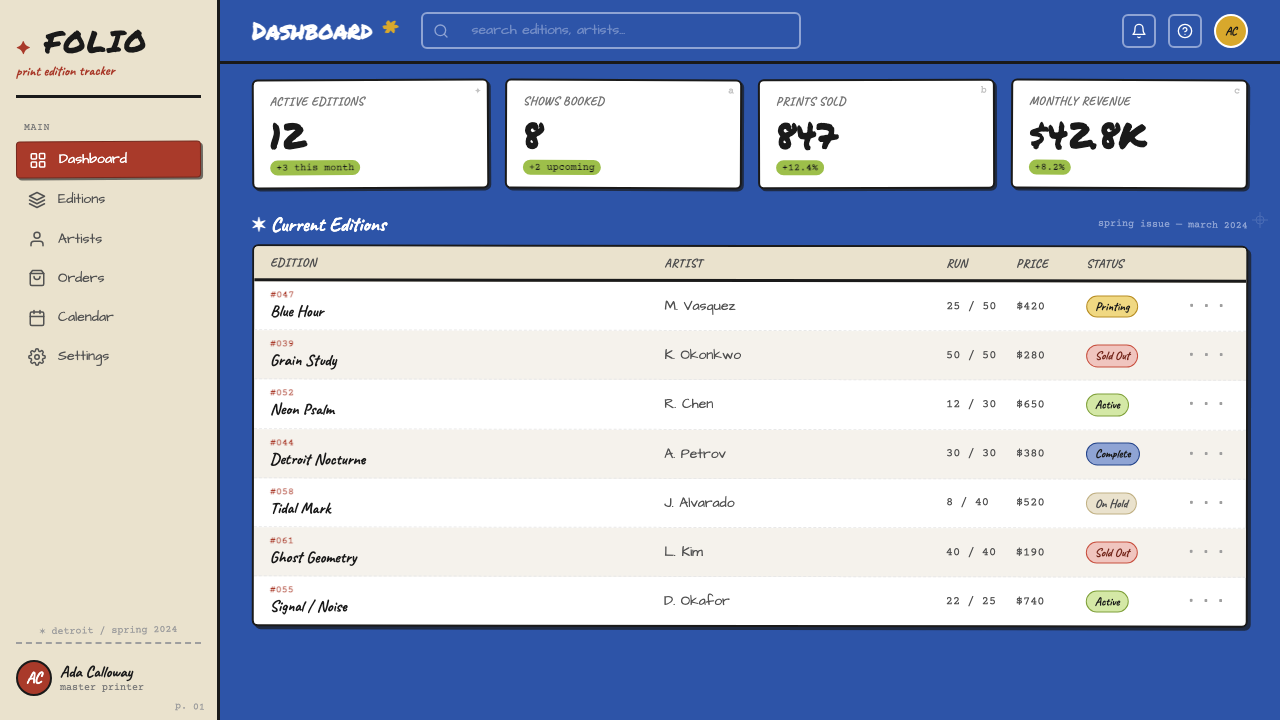
Applying the Ed Fella Hand-Drawn style in contemporary contexts requires accepting that its power comes from specificity and irreproducibility — qualities that are genuinely difficult to achieve without developing a personal hand. It is not a style that can be assembled from found assets or replicated by mixing existing digital typefaces with rough-texture overlays. Those approaches produce something that looks like Ed Fella the way a costume looks like a person: the silhouette is present but the interiority is missing. That said, the style's organizational principles — density, layering, annotation, and the deliberate embrace of imperfection — can be applied with intent even by designers working digitally, provided the hand remains genuinely involved.
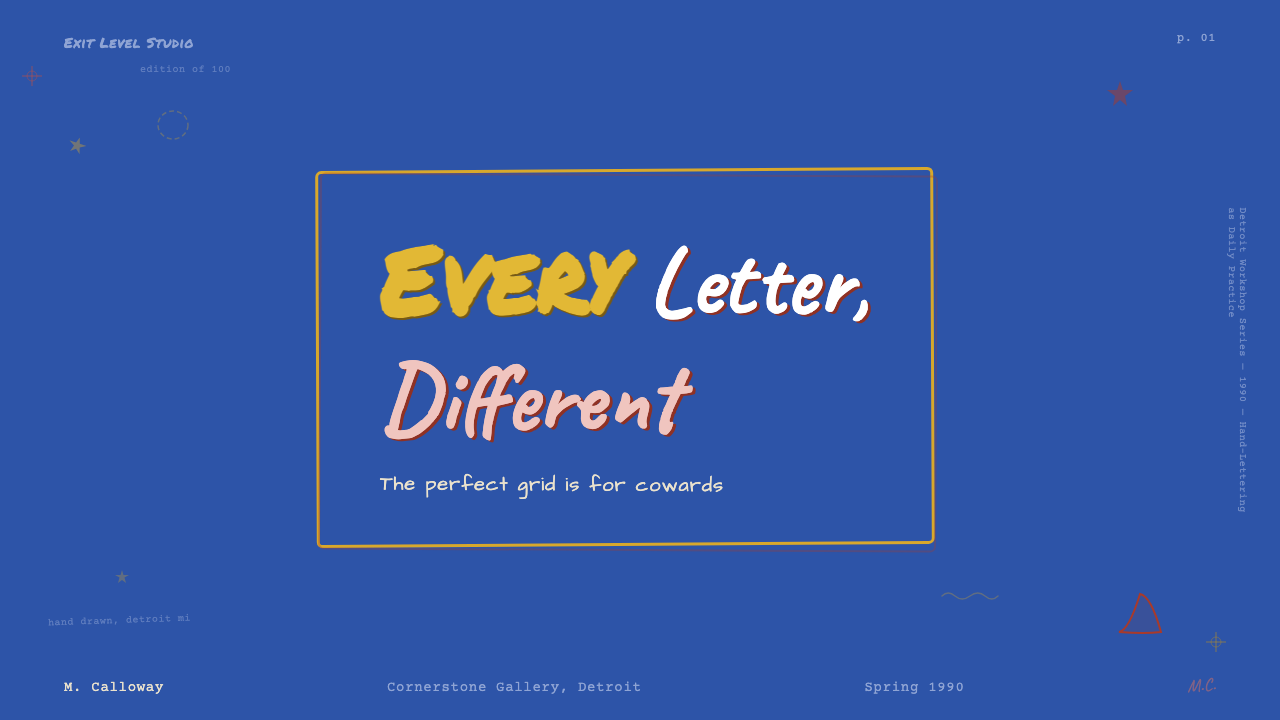
For presentation slides, the Fella approach inverts most conventional assumptions. A cover page in this style should feel like a found document rather than a designed artifact: the title drawn by hand in a large, slightly uneven script, subsidiary information in a smaller, denser hand crowding the edges, the background a flat non-white ground. Content slides abandon the clean grid: key terms might be circled or underscored in a hand that looks like it was added in review; arrows connect elements in a way that breaks the slide's geometric frame. Data, where it appears, is annotated rather than formatted — numbers written out, relationships indicated with drawn lines rather than chart types. The effect is intimate and assertive at the same time.
For web interfaces and interactive contexts, the style is most powerful where it is used selectively rather than comprehensively. A website built entirely in this style risks becoming illegible at smaller scales and straining users who expect interactive affordances to read clearly. More productive approaches use the Fella aesthetic at high-impact moments — a landing page headline, a section break, an error state — while keeping functional interface elements in a more legible system. The hand-drawn elements serve as an affirmation of human presence within a digital context, which can be a significant communicative gesture in the right product category.
For editorial and marketing work, the style is most naturally suited to cultural contexts: arts organizations, independent publishing, music, fashion, and brands that want to signal that they operate outside corporate design norms. An event poster, a zine, a music release, an exhibition announcement — these are formats where the Fella style's origins are legible and its energy is appropriate. In marketing contexts, the density and irregularity of the style work well for audiences who read the absence of polish as authenticity rather than as incompetence. It is a style that flatters a sophisticated, culturally aware audience and can alienate one that is not.
The most common mistake is treating imperfection as a visual filter rather than as an approach to mark-making. Designers who apply texture overlays, distress effects, or deliberately misaligned digital elements to otherwise clean, grid-based layouts produce work that announces its roughness without earning it. The Fella style's authority comes from the fact that every stroke on every page was made by a specific person with a specific intention. Digital approximations of that quality succeed only when the designer has internalized the logic of the hand — when the irregularity comes from decisions, not from software presets.
Ed Fella Hand-Drawn (1990) — FAQ
Is Ed Fella Hand-Drawn a style that can be learned, or does it require a unique personal hand?
Both are true. The organizational principles of the style — dense layering, marginal annotation, deliberate imperfection, the rejection of the grid — can be understood and applied by any designer willing to engage with them seriously. But the specific quality of Fella's hand cannot be reproduced, and attempts to imitate it directly tend to produce work that feels either mimicry or parody. The productive approach is to understand what the style is doing conceptually and then find equivalent approaches in your own hand. The result will look different from Fella's work, which is as it should be — the point of the style is that it carries the specific presence of one person, not that it creates a recognizable brand.
How does this style relate to the broader history of vernacular typography?
Vernacular typography refers to the visual language of ordinary, non-professional, or pre-modernist printing — hand-painted signs, letterpress handbills, trade cards, announcement posters, the whole vast category of graphic production that predates the modernist commitment to clean, rational, universal type. Fella's work draws explicitly on this tradition: the wobbly letters, the crowded margins, and the heterogeneous mix of lettering modes all reference the look of pre-modernist printed matter that modernism declared obsolete. The difference is that Fella's use of vernacular forms is knowing and critical rather than naive — he is not producing vernacular typography, he is quoting it with full awareness of what the quotation means in a post-PostScript context.
What is the relationship between this style and legibility?
Fella's flyers are legible — the event information they communicate is retrievable — but legibility is not their first commitment. The style assumes a reader who is willing to slow down, to work slightly against the composition's density, to reward close attention with more detail. This is appropriate for the cultural contexts in which the style operates best: gallery announcements, arts events, design publications, and other venues where the audience has already signaled interest by picking up the piece. It is not appropriate for contexts where fast, frictionless information retrieval is the primary need — transportation signage, medical instructions, emergency alerts, or any interface where the user's default state is hurried rather than curious.
How is this style different from just scanning handwritten notes and using them as texture?
Using scanned handwriting as a texture layer treats the hand as a surface effect rather than a structural principle. The scanned notes sit on top of a designed layout; in authentic Fella-derived work, the hand-drawn elements are the layout. There is no underlying grid that the roughness is applied to — the composition is built entirely through the act of drawing. This distinction matters practically: scanned-texture approaches typically produce work that is polished underneath and rough on the surface, whereas the Fella style is rough at every level of structure. The former feels like a digital product that has been aged; the latter feels like a document that was made.
Can this style work for brands, or is it only appropriate for one-off cultural artifacts?
A small number of brands have successfully deployed aesthetics adjacent to this style — typically independent record labels, art book publishers, independent fashion houses, and cultural institutions comfortable with deliberately unpolished visual identities. The challenge for brand application is consistency: the style derives its energy from the fact that each piece is unique, and a brand system requires a degree of repetition and recognition that can work against that energy. The most successful approaches treat the style's elements as a general approach rather than a specific look — the brand commits to hand-drawn letterforms, to annotation, to deliberate density — while allowing those elements to be interpreted differently across applications. The result is coherent without being repetitive.
Related design styles
 90s Aggressive Inline SkateX-Games attitude in plastic and paint. Fluoro lime and magenta slash across m…
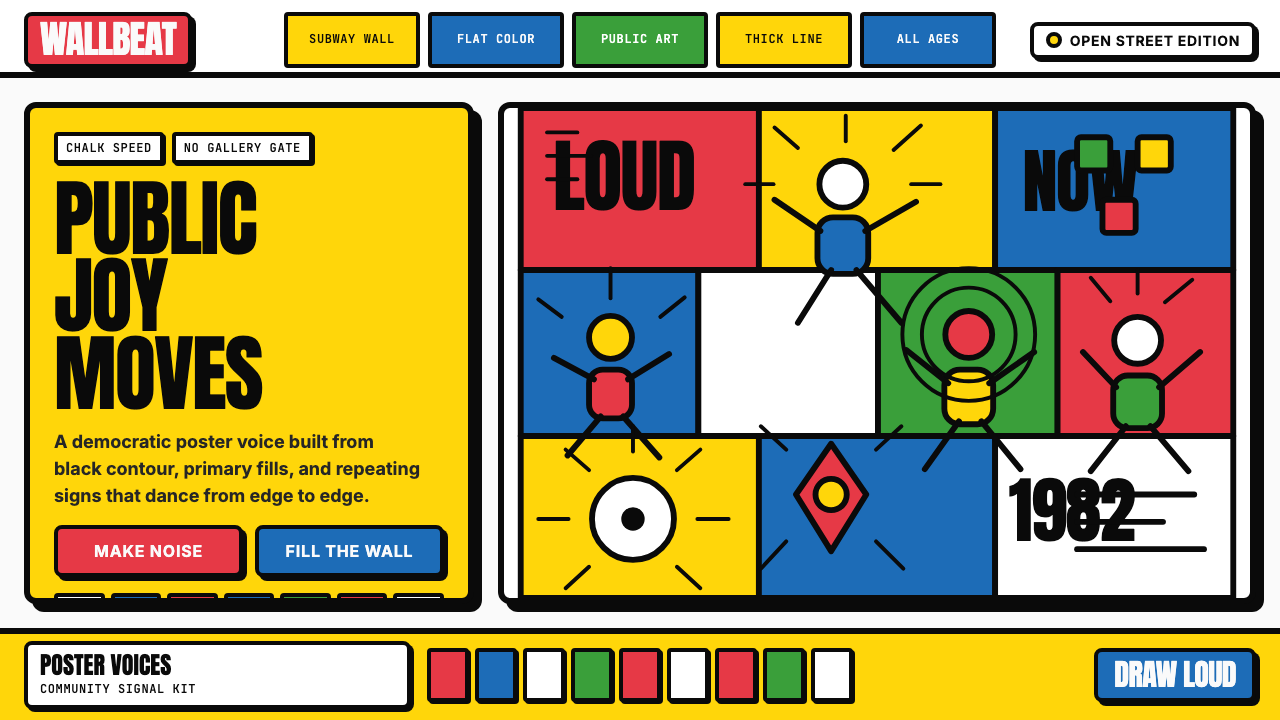 Keith Haring PopJoy refuses the gallery. Thick black contours pack primary color into a danci…
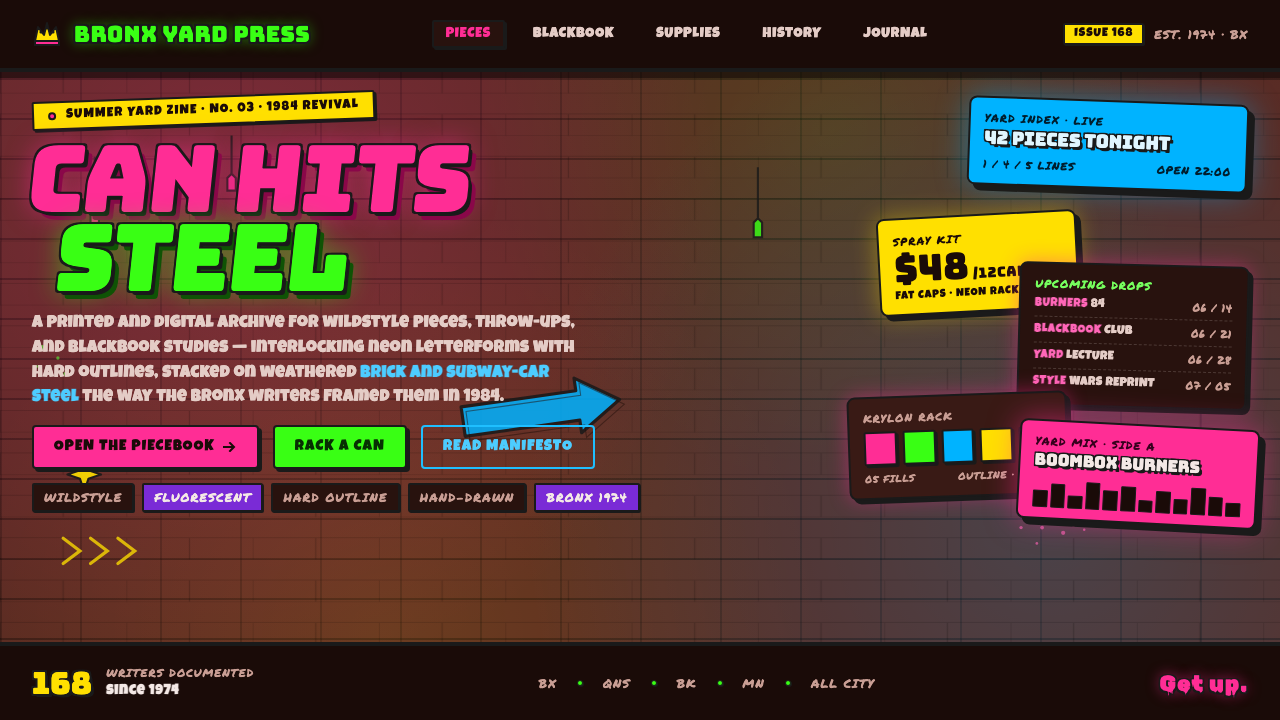 Wildstyle GraffitiBronx walls, sprayed loud. Neon pink-and-green fills, hard black outlines, Bu…
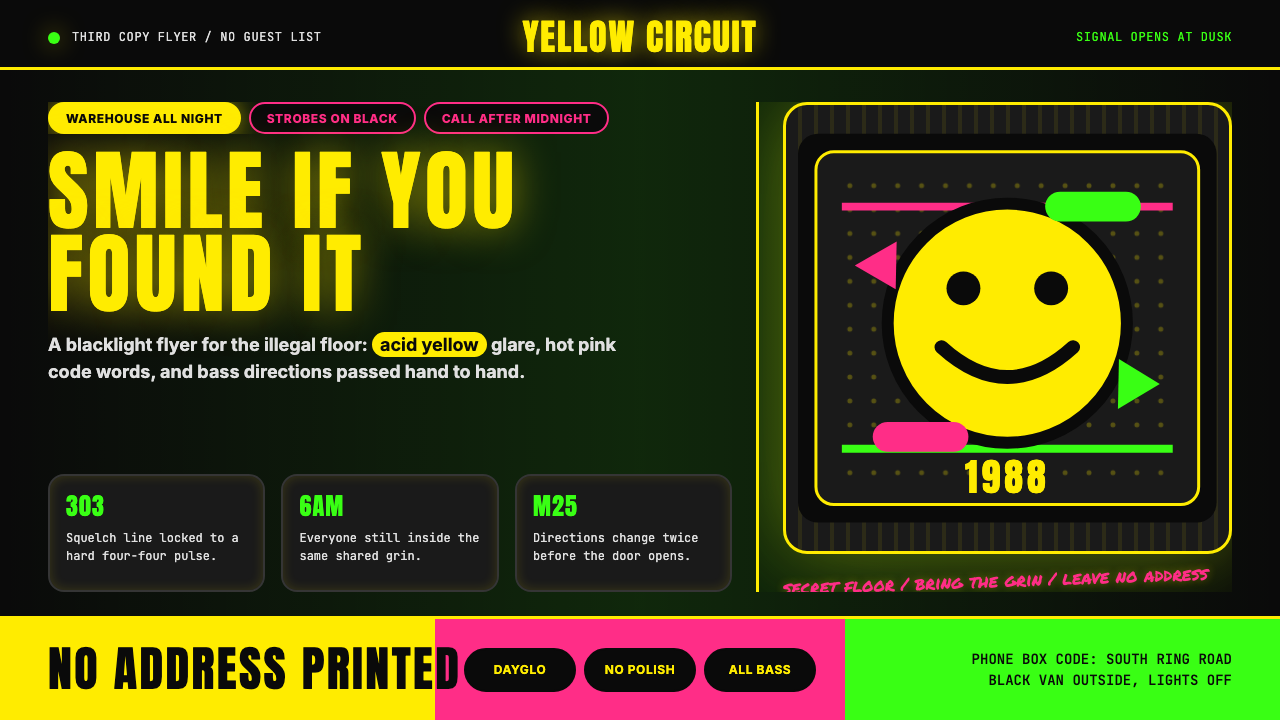 Acid House Smiley (1988)Rave energy hits first. Acid yellow on black, Anton caps, smiley glow.
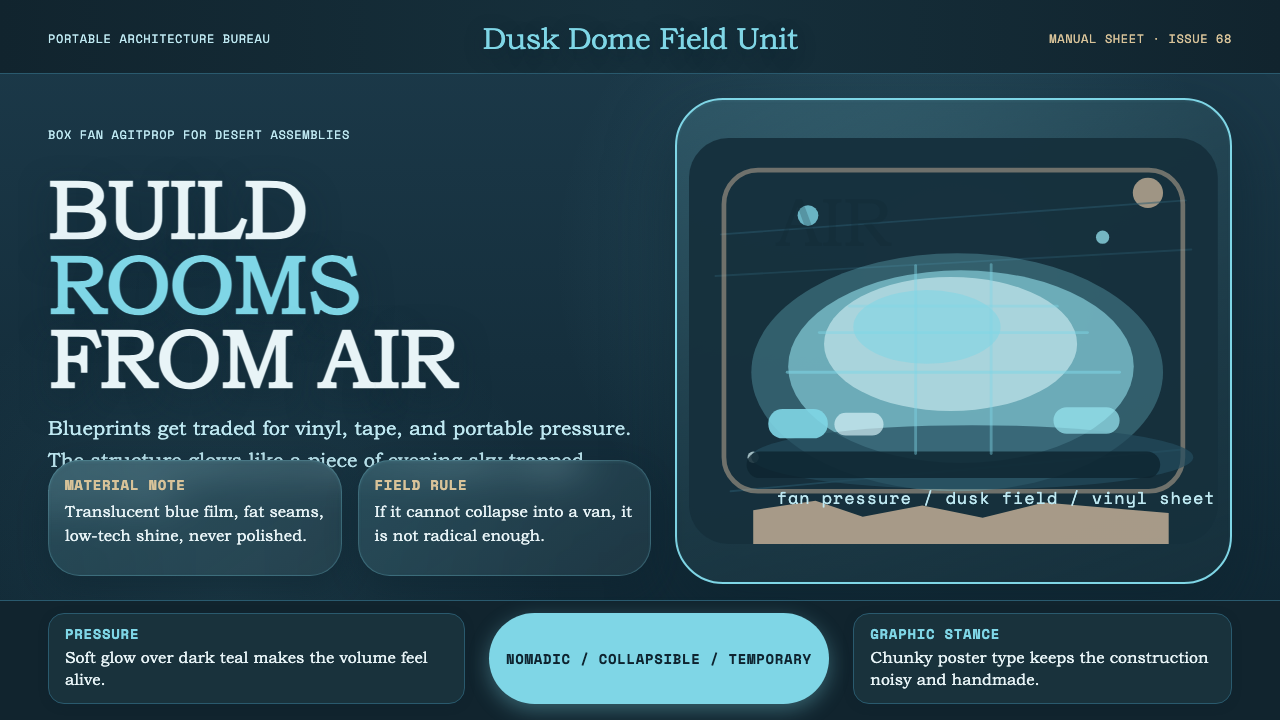 Ant Farm InflatablesTemporary architecture glows. Vinyl-blue domes swell over dark desert teal.
 Basquiat Neo-ExpressionismExplodes off raw linen. Cadmium red, cobalt blue, Anton blocks, and struck ma…