What is Dunhuang Mogao Murals?
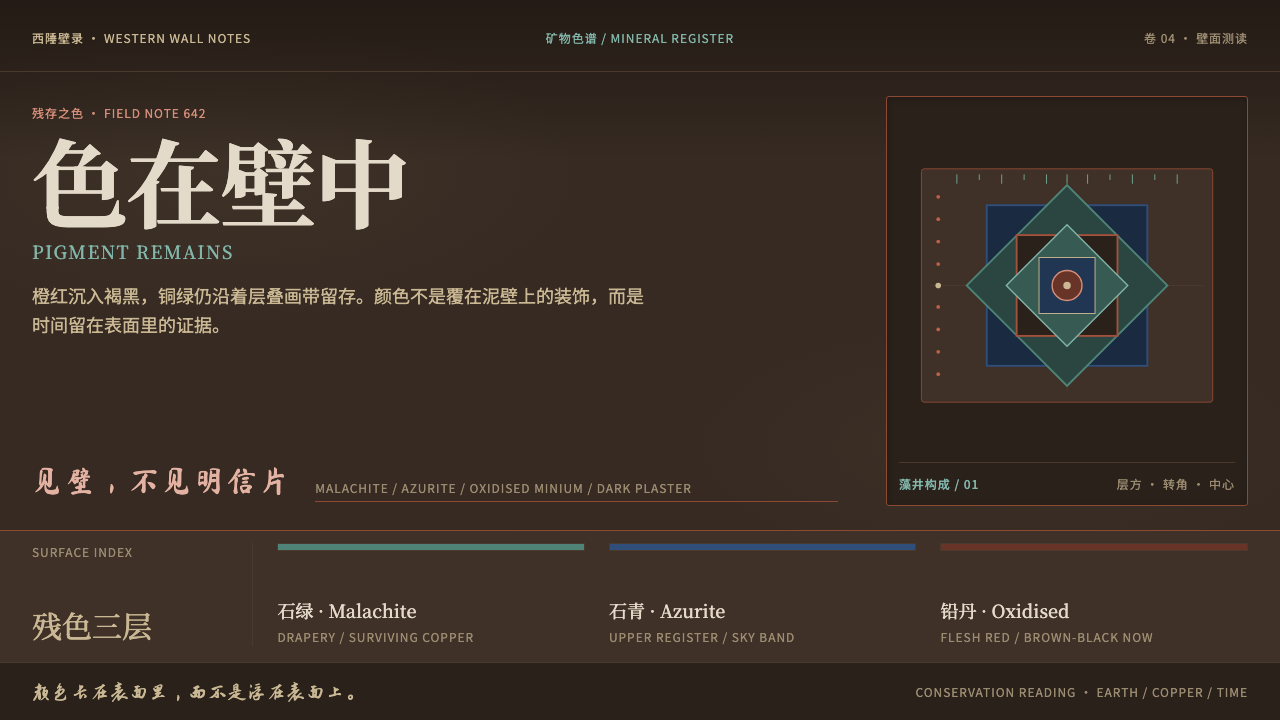
Dunhuang's Mogao murals prove that time itself can become a palette: a millennium of oxidation stripped away the Silk Road orange, leaving mineral copper-green to carry a thousand years of Buddhist painting.
Dunhuang Mogao Murals in brief
The Mogao caves are a sequence of Buddhist cave temples cut into a cliff face in Gansu, China, containing roughly 45,000 square metres of wall painting laid down across a thousand years by every dynasty that controlled the Hexi Corridor, the trade route linking China to Central Asia. Popular imagery often sells a bright, warm Silk Road orange, but the walls themselves do not show that color today — the lead minium pigment once used for skin tones and drapery has oxidized into a dark brown-black lead dioxide, so faces and bodies that were originally painted in warm flesh tones now read as dark earth.
What has survived intact is the mineral copper-based color: malachite and atacamite green still carry the drapery, canopies, and ribbons of the flying celestial figures known as feitian, with azurite blue holding the sky bands above them. This system is built from that surviving half of the original palette rather than from a reconstructed, idealized version of the murals' first appearance.
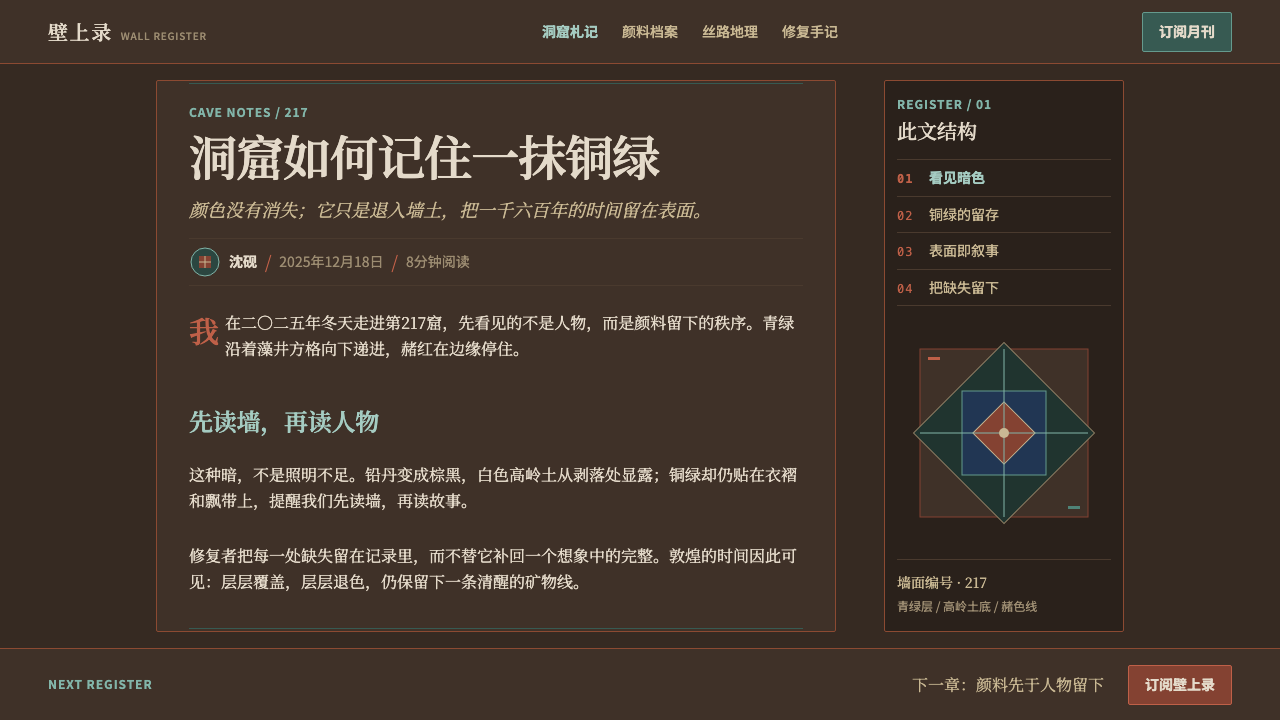
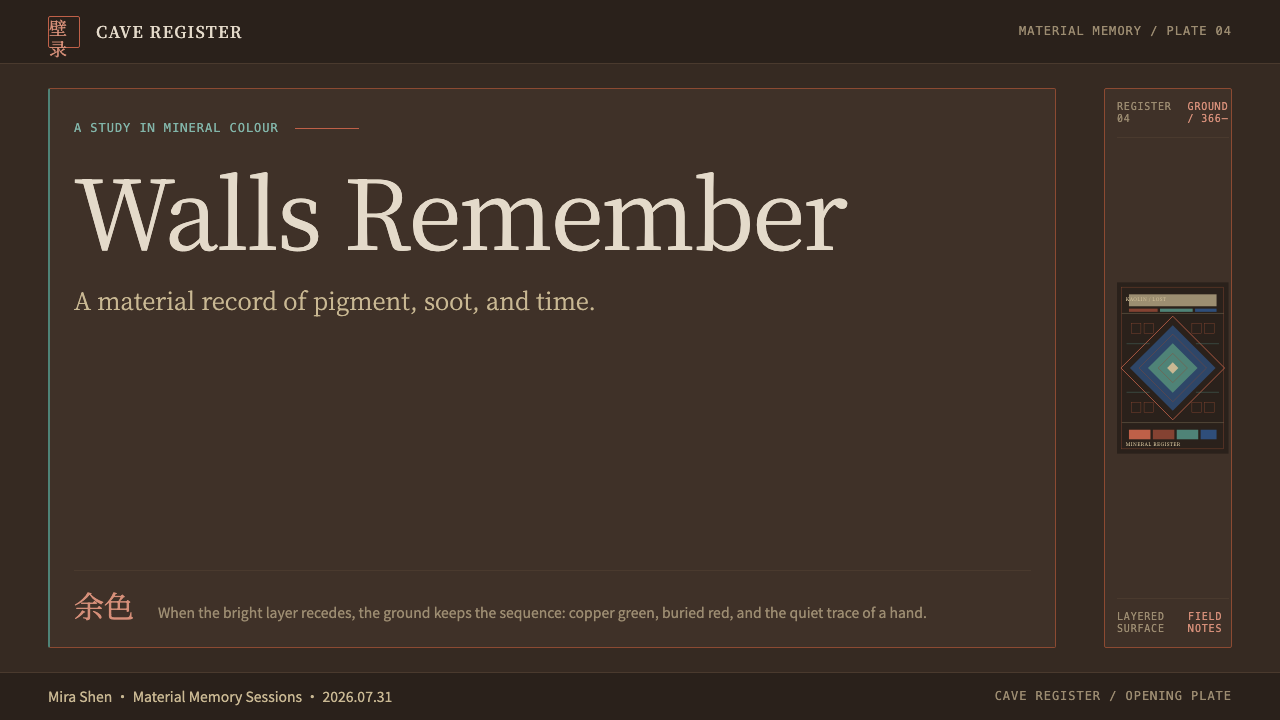
The result is a visual language where color sits inside a dark, encrusted plaster ground rather than floating on top of it — mineral green as the dominant hue, azurite blue in supporting sky passages, earth red used for line work, and the pale ground of the original plaster only showing through in small patches where pigment has been lost.
Where does Dunhuang Mogao Murals come from?
The Mogao caves were cut into the Gansu cliff face beginning in 366 CE and continued to be painted through the fourteenth century, spanning the Northern Wei, Sui, and Tang dynasties among others. Peak painting programmes from the Tang dynasty survive in Cave 220, dated to 642 CE, and in Cave 217, both representing the high point of the site's mural tradition.
The caves sit at the western end of the Hexi Corridor, the overland route through which Buddhist iconography from Gandhara, in the region of present-day Pakistan and Afghanistan, was transmitted into China. This makes Mogao part of the broader movement of Silk Road transmission of Gandharan iconography, alongside its more specific identity as a site of Northern Wei, Sui, and Tang Buddhist cave painting.
Tradition credits the monk Yuezun with cutting the first cave in 366 CE, beginning a sequence of excavation that later dynasties continued for a thousand years. Centuries afterward, the Daoist monk Wang Yuanlu found and cared for the caves following a long period of neglect, and his discovery of a sealed chamber packed with manuscripts and paintings drew renewed attention back to the site.
In the twentieth century, the painter Zhang Daqian spent an extended period at Mogao producing large hand-copies of the murals, carrying the caves' color and iconography to painters and audiences who could not travel to Gansu. Chang Shuhong dedicated much of his career to establishing organized study and protection of the caves, work that grew into the ongoing field known as Dunhuang studies, or 敦煌学.
What defines the Dunhuang Mogao Murals look?
Oxidised Earth Skin Tones
Figures and faces that were originally painted in warm flesh tones using lead minium now read as dark brown-black, the result of that pigment oxidising into lead dioxide over centuries. This system treats that oxidised earth tone as the true, current color of the figures rather than reconstructing an imagined original flesh color.
Mineral Green Dominance
Malachite and atacamite green, copper-based mineral pigments, dominate the surviving color record, carrying drapery, canopies, and the ribbons of flying celestial figures. This green is the system's primary hue, not a secondary or accent tone.
Azurite Sky Blue
Azurite blue appears specifically in the sky bands above figural scenes, functioning as a supporting color that frames the mineral-green figures rather than competing with them for dominance.
Earth-Red Line Work
Outlines and structural drawing across the murals are rendered in earth red, a warm, muted tone distinct from the cooler mineral greens and blues it defines. This linework carries the compositional structure beneath the color fields.
Dark Encrusted Ground
The plaster wall itself reads as a dark, textured, encrusted surface rather than a clean neutral backdrop. Color is treated as embedded within this ground — living in the surface — rather than floating cleanly on top of a pristine wall.
Sparing Pale Losses
The original pale plaster ground only shows through in small, irregular patches where pigment has flaked away over the centuries. These pale losses are used sparingly, as evidence of age and damage rather than as a dominant background tone.
Who shaped Dunhuang Mogao Murals?
Yuezun is traditionally credited with cutting the first Mogao cave in 366 CE, beginning the sequence of excavation and painting that later dynasties would continue for the following thousand years.
Wang Yuanlu, a Daoist monk, found and cared for the caves after a long period of neglect, and his discovery of a sealed chamber packed with manuscripts and paintings drew renewed international attention back to Mogao.
Zhang Daqian spent an extended stay at Mogao producing large hand-copies of the murals, carrying the caves' color and iconography to painters and audiences who could not travel to Gansu to see the originals.
Chang Shuhong dedicated much of his career to establishing organized study and protection of the caves, work that grew into the ongoing field known as Dunhuang studies, or 敦煌学.
How do you use Dunhuang Mogao Murals today?
Because this system is built from mineral green, azurite blue, and earth red sitting inside a dark, textured ground, it suits projects that want a sense of deep history, craft, and material weight — cultural and heritage sites, archival platforms, and editorial work about art history or the Silk Road.
For presentation slides, a cover slide can use the dark encrusted ground as a full background with a single passage of mineral green carrying the visual weight, echoing the way drapery and celestial ribbons dominate the surviving murals. Content slides should keep azurite blue and earth red as supporting accents rather than primary tones, reserving mineral green for the elements that need the most visual emphasis.
For web interfaces, the palette suits museum and heritage digital collections, long-form cultural editorial, and any brand wanting to evoke deep time and material authenticity rather than a contemporary, bright aesthetic. Structural elements — navigation, dividers — read well in the dark ground tone, with mineral green reserved for highlighted or active states.
For editorial and marketing layouts, this system rewards treating color as embedded texture rather than flat decoration: large photographic or textural fields of the dark encrusted ground, with mineral green and azurite blue appearing as if surfacing from within the material rather than printed cleanly on top of it. Pale losses — small patches of lighter tone — can be used sparingly as compositional accents that read as age rather than damage to be hidden.
The most common mistake is reaching for the bright, warm orange that popular imagery associates with the Silk Road, or restoring the oxidised earth tones back to an imagined original flesh color. Both moves discard the actual surviving palette — mineral green, azurite blue, oxidised earth, earth red — in favor of a version of Dunhuang that does not match what has actually survived on the walls.
Dunhuang Mogao Murals — FAQ
Why do the murals look brown and dark instead of the bright orange often seen in photos of Dunhuang?
The lead minium pigment once used for skin tones and drapery has oxidised over the centuries into dark brown-black lead dioxide. What is often marketed as a bright Silk Road orange is a stylized, idealized rendering rather than the murals' actual current state — this system is built from what genuinely survives on the walls today.
Why is green the dominant color instead of the gold often associated with Buddhist art?
Because the copper-based mineral pigments — malachite and atacamite — are simply what survived best over a thousand years, while other original colors, including the warm flesh tones, oxidised or faded. The dominant green in this system reflects material survival, not an original design choice to favor green over other colors.
Should this palette be used for any historical or Silk Road theme, or is it specific to Dunhuang?
The palette is specifically drawn from Mogao's surviving pigment record and carries the most authenticity when tied to Dunhuang, Buddhist cave painting, or Silk Road transmission themes directly. For other historical themes, it is more accurate to look for that context's own surviving material record rather than borrowing this exact palette as a generic historical placeholder.
Can this style work with a light background instead of the dark encrusted ground?
A light-ground treatment loses the core relationship this system depends on — color sitting inside a dark, textured surface rather than printed cleanly on top of a clean one. Mineral green and azurite blue were chosen because they read as embedded within dark plaster; on a light ground they would need to be treated more like ordinary flat color, losing the sense of pigment surviving within material that defines this look.
Related design styles
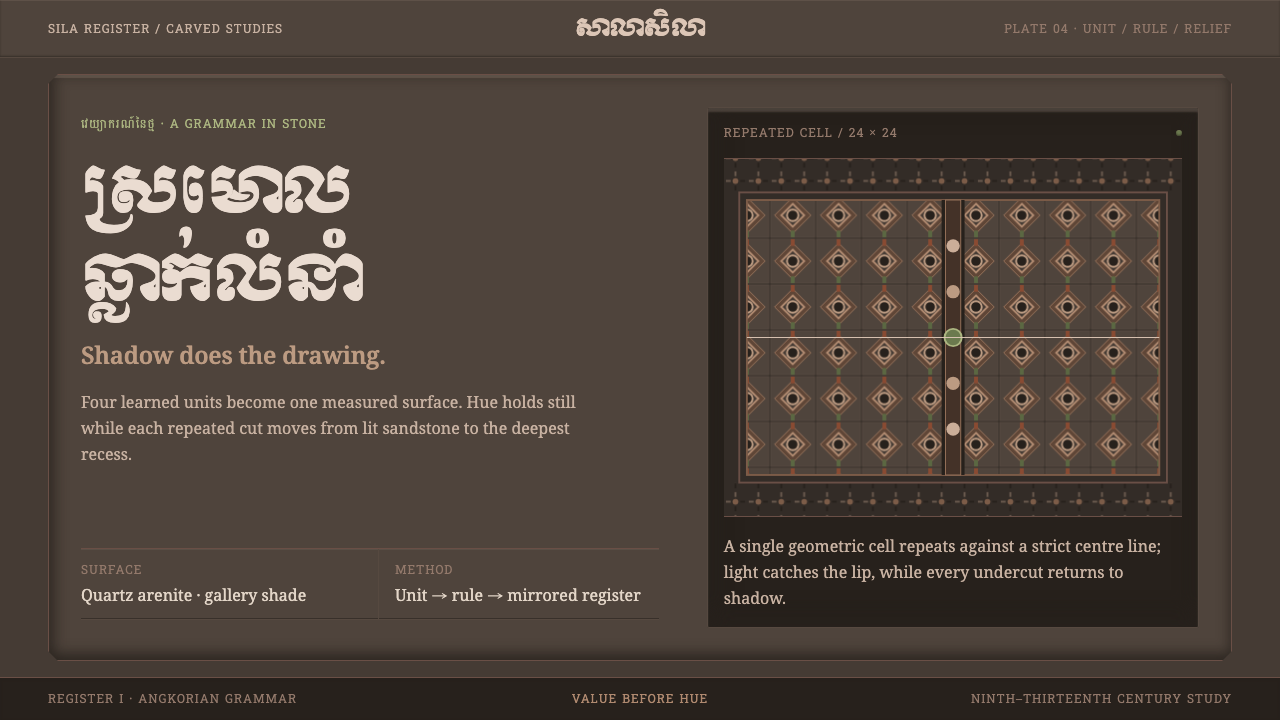 Khmer Kbach MotifShadow carves the grammar. Repeated stone cells turn a narrow sandstone palet…
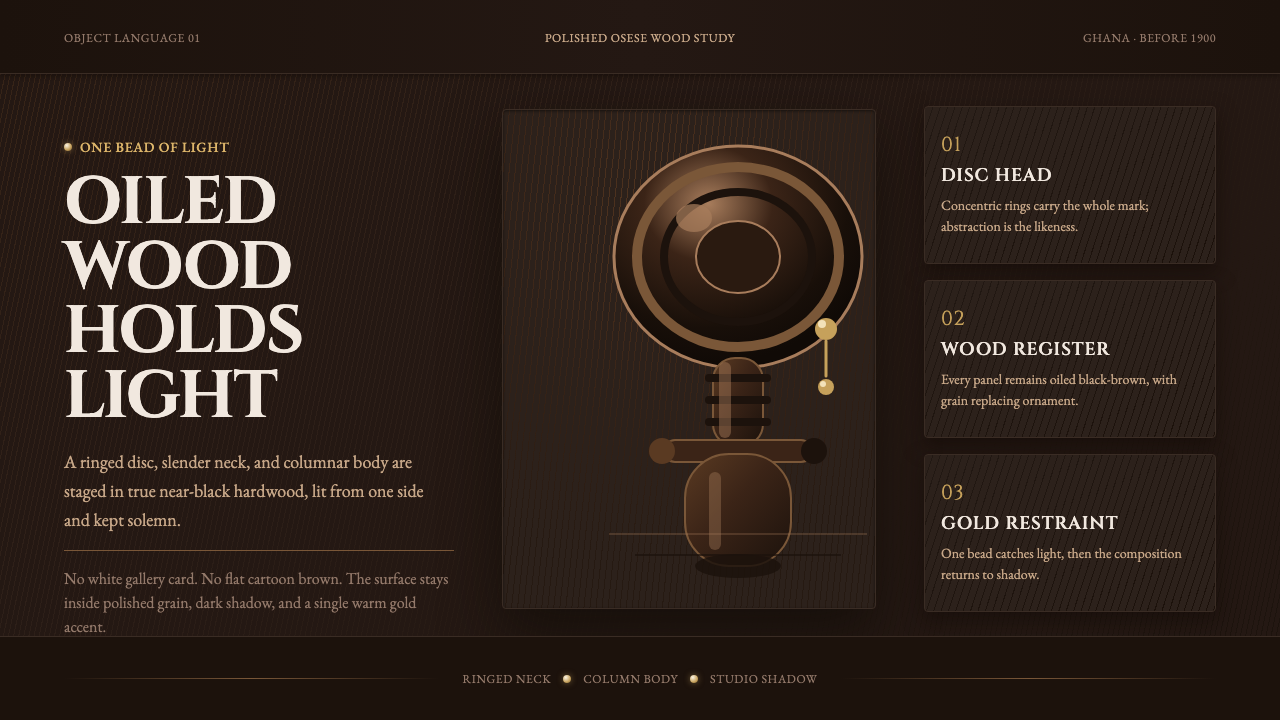 Akuaba Akan Fertility DollDarkness becomes sculpture. Near-black wood, ringed geometry, and one gold be…
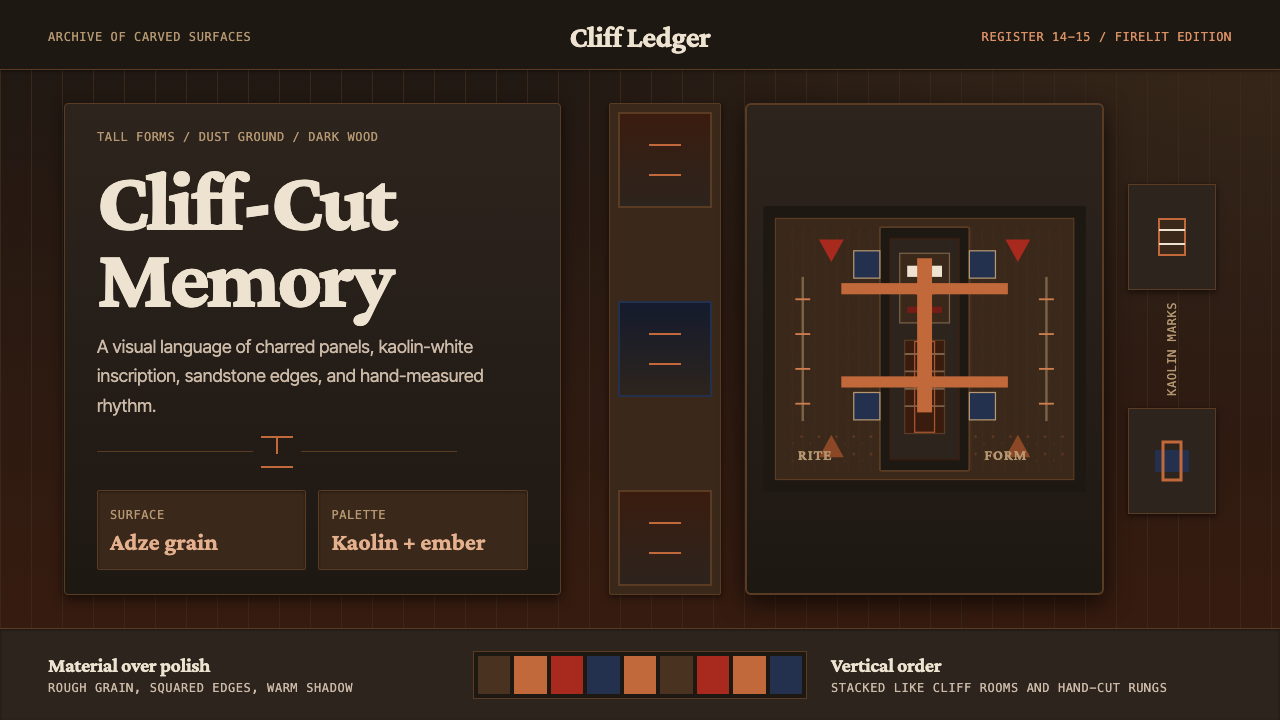 Dogon Bandiagara Cliff MaskHand-hewn gravity. Charred wood, kaolin type, and sandstone geometry stack li…
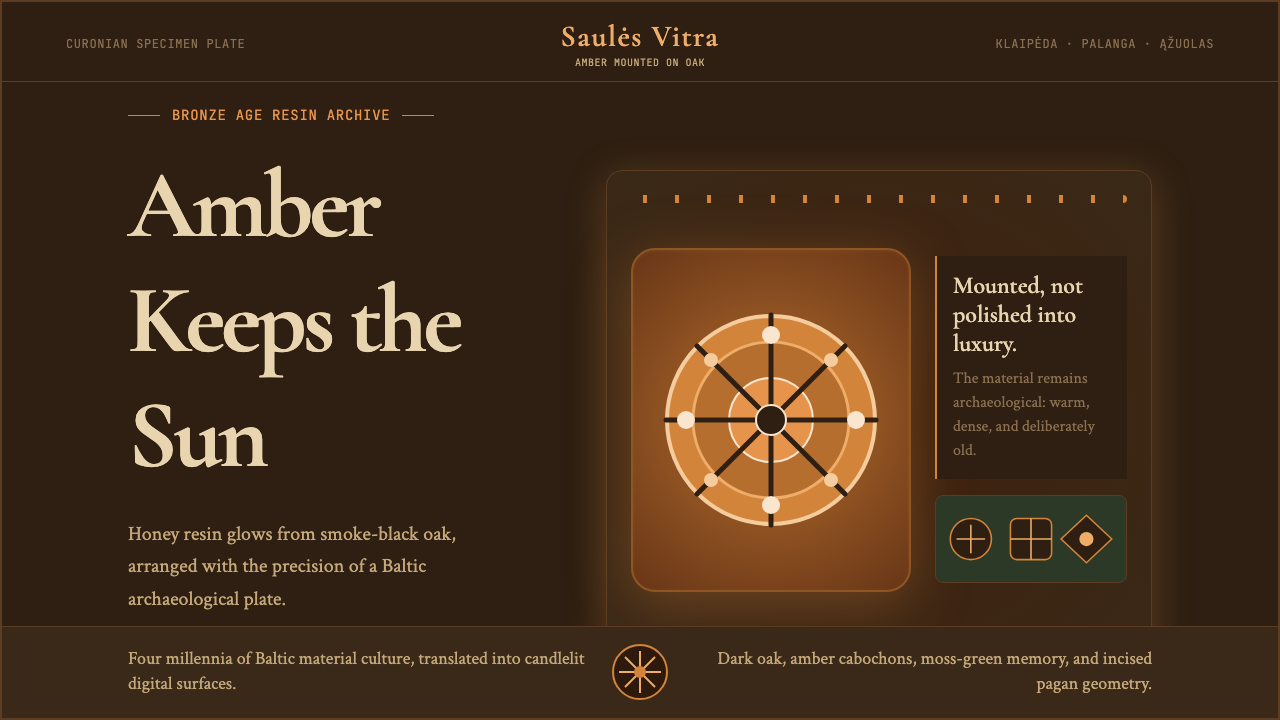 Lithuanian Amber (Baltic Pagan)Ancient amber glows. Honey resin on smoked oak, framed by saulė geometry.
 Okinawan Bingata Resist DyeOrnate without clutter. Persimmon ground, vermilion type, emerald-cobalt sten…
 Ottoman Ebru MarblingLiquid, never tiled. Indigo bath, ochre veins, and glassy bloom edges carry t…