What is Khmer Kbach Motif?
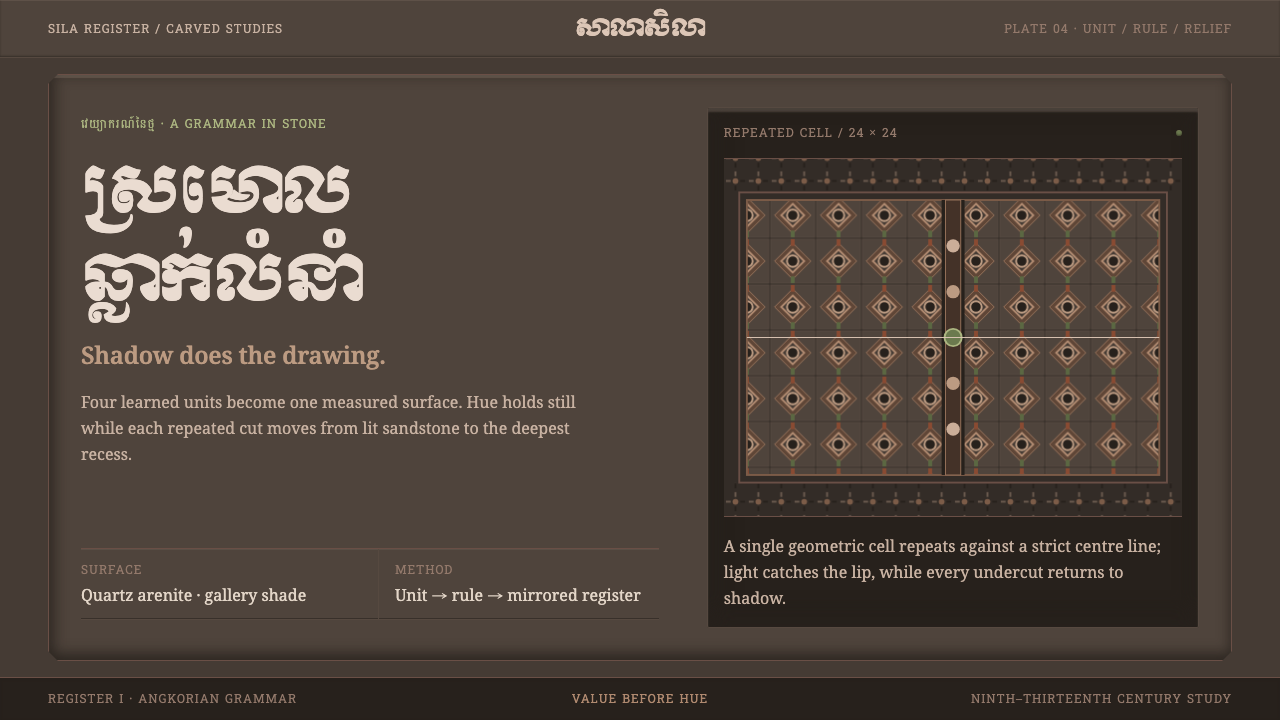
Khmer kbach is a carved grammar, not a decoration: four named families of unit, learned in strict order, whose relief is drawn entirely by shadow across a narrow band of stone.
Khmer Kbach Motif in brief
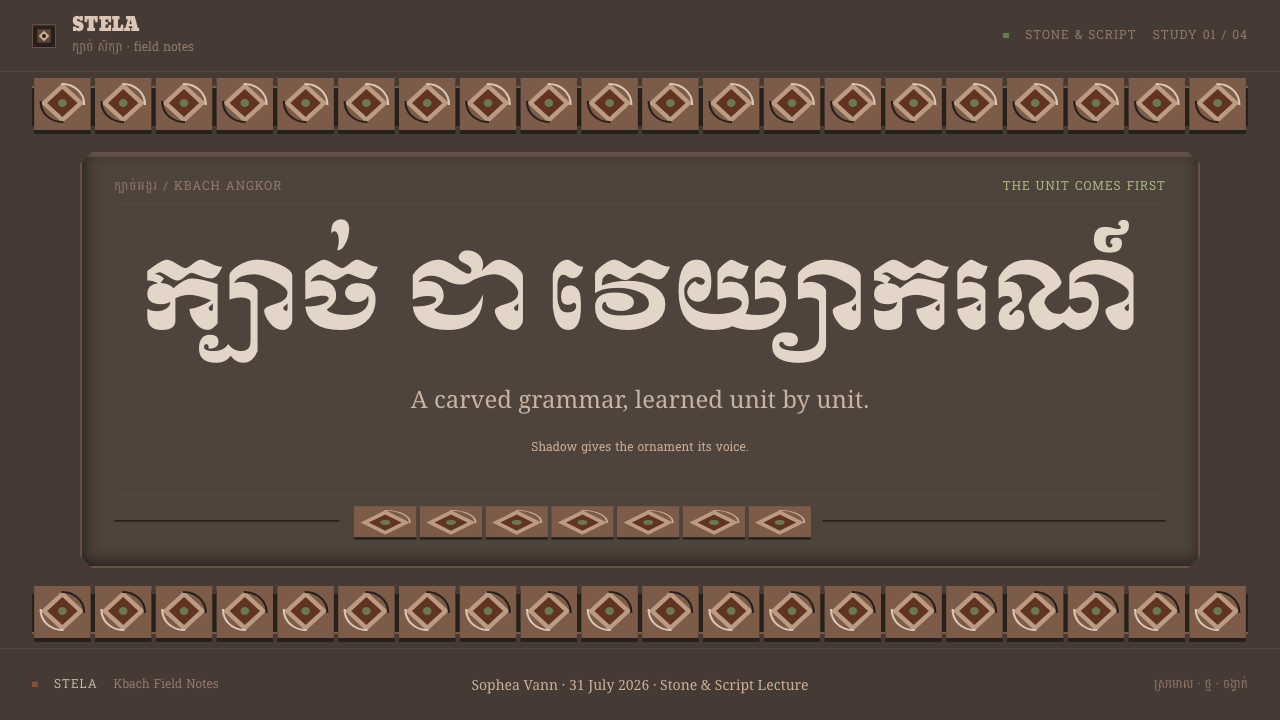
Kbach is the Khmer system of ornamental motif carved into Angkorian temple stone, and it is best understood as a grammar rather than a style of decoration. There are four named schools of unit — kbach angkor, built from snail-curl spirals; phñi tes, built from poppy-pod forms; phñi voal, in which animal heads surface out of carved vine; and phñi phleung, an abstracted flame form. A carver traditionally learns each unit in order and is not permitted to compose freely until all four have been mastered, which means every mark on an Angkorian lintel or pediment belongs to a specific, nameable place within this system.
Because the ornament is carved rather than painted or printed, its visual identity depends on surface and light rather than pigment. The stone itself is grey-to-brown quartz arenite, darkened over roughly a thousand years by biological growth and iron staining, or in places a harder pink sandstone that allowed carvers to cut far deeper relief that has kept its sharp edges. Hue barely varies across a kbach surface; what carries the composition is value — how light falls from one side and lets shadow do the work of drawing.
This system treats the stone as its actual surface, not as a reference photograph to be recolored. The palette stays narrow and warm-neutral, close to the true range of Angkorian sandstone, and depth is expressed the way it is on the temple itself: through the depth of the carving and the direction of a single light source, not through gradients or applied shading.
Where does Khmer Kbach Motif come from?
Kbach belongs to the Angkorian empire, which produced its great temple complexes across the ninth to thirteenth centuries in what is now Cambodia. Banteay Srei, carved in pink sandstone, was completed in 967 CE. Angkor Wat, the empire's largest temple, was built roughly between 1113 and 1150. Bayon, known for its carved faces, followed around 1190 to 1220. Across these three centuries, the four kbach families were refined and passed down as a settled pedagogical system rather than invented anew with each building project.
Banteay Srei is closely associated with Yajnavaraha, and its pink sandstone allowed for unusually deep, crisp relief carving that survives with sharper edges than the grey sandstone used elsewhere. Angkor Wat was built under Suryavarman II, and its scale made it the empire's most extensive single canvas for kbach ornament. Bayon was built under Jayavarman VII, whose reign produced some of the most distinctive carved surfaces in the Angkorian record.
This body of work sits within the broader movements of Khmer temple architecture and Angkorian bas-relief carving, but kbach itself is best classified as its own pedagogical tradition — an ornament grammar taught and transmitted independently of any single building. That transmission is why the motif families remained legible and consistent across temples built more than two centuries apart, under different kings, in different sandstones.
What survives today is not a finished, pristine surface but stone that has spent a millennium in a tropical climate: darkened by biological growth, stained by iron, softened where the material was weaker, and kept sharp where it was harder. The kbach system as a visual language today is inseparable from that long weathering.
What defines the Khmer Kbach Motif look?
Kbach Angkor Spirals
The kbach angkor family builds its units from tight, snail-like curls that recur in bands or clusters. It functions as a foundational, almost structural motif — often the first family a carver learns — and reads as a rhythmic, repeating curve rather than an isolated ornament.
Phñi Tes Poppy Forms
Phñi tes takes the rounded, bud-like form of the poppy pod as its base unit, giving it a softer, more organic silhouette than the tighter spirals of kbach angkor. It is typically deployed in repeating rows that create a steady, textural rhythm across a band of stone.
Phñi Voal Emergent Heads
Phñi voal combines vine-like carved lines with animal heads that appear to surface from within the vine itself. This family introduces a figurative element into an otherwise abstract system, and the heads are placed as focal punctuation within an otherwise continuous ornamental band.
Phñi Phleung Flame Abstraction
Phñi phleung reduces flame into an abstracted, angular form, distinct from the rounded curls and vine-work of the other three families. It reads as more dynamic and directional, often used where a composition needs a sense of upward movement or energy.
Value-Driven Relief
Because the ornament is carved rather than colored, all of its legibility comes from how deeply the stone is cut and how a single light source falls across it. Hue stays nearly constant across a kbach surface; the entire sense of depth and pattern comes from graded value — light stone catching illumination, deeper cuts falling into shadow.
Weathered Stone Palette
The base color range stays narrow and warm-neutral, moving between grey-brown quartz arenite darkened by centuries of biological growth and iron staining, and the harder pink sandstone used where deeper relief survives. Neither extreme is a clean, neutral gray — both carry the accumulated tint of a millennium outdoors.
Ordered Composition
Because each of the four kbach families has a fixed identity and a learned order of mastery, compositions built from them read as governed by an underlying grammar rather than assembled freely. Units repeat in disciplined bands and clusters rather than scattering irregularly across a surface.
Who shaped Khmer Kbach Motif?
Yajnavaraha is closely associated with Banteay Srei, the pink-sandstone temple completed in 967 CE, whose harder stone allowed for the unusually deep, crisp kbach relief that has kept its sharp edges over the following millennium.
Suryavarman II built Angkor Wat, roughly between 1113 and 1150 CE, the empire's largest temple and its most extensive single surface for kbach ornament across lintels, pediments, and galleries.
Jayavarman VII built Bayon, around 1190 to 1220 CE, known for its carved faces and for a body of relief work that represents one of the most distinctive stages in the Angkorian kbach tradition.
How do you use Khmer Kbach Motif today?
Because kbach's identity comes from value contrast and a strict compositional grammar rather than color, it transfers well to any context where texture, hierarchy, and restraint matter more than a wide color palette — cultural and heritage projects, editorial pieces about craft or architecture, and interfaces that want warmth without visual noise.
For presentation slides, kbach works best as a textural and structural reference rather than a literal background photo on every slide: a cover slide can use a single deep-relief motif — one of the four families — carved into a corner of the warm stone tone, while content slides keep the palette narrow and let hierarchy come from spacing and weight rather than added color.
For web interfaces, the narrow warm-neutral palette suits editorial and cultural sites, museum or heritage digital collections, and any brand wanting a handcrafted, historically grounded feel. Borders, dividers, and section markers can borrow the repeating-unit logic of kbach bands — a disciplined rhythm rather than a single decorative flourish — while keeping the overall palette close to the stone's true tonal range.
For editorial and marketing layouts, kbach motifs work well as border treatments, section dividers, or corner ornaments rather than covering an entire surface, echoing how the original carving frames rather than fills temple architecture. A single family — spirals, poppy forms, vine-heads, or flame — used consistently throughout a piece reads as more authentic than mixing all four indiscriminately.
The most common mistake is treating kbach as a generic 'Southeast Asian pattern' and recoloring it in saturated, non-stone hues, or smoothing its carved edges into soft vector curves. Both moves strip away the value-driven relief logic and the narrow stone palette that make the system recognizable, leaving only a pattern with none of its structural grammar.
Khmer Kbach Motif — FAQ
Do all four kbach families need to appear together in a single design?
No — traditionally a carver masters all four before composing, but that does not mean every composition uses all four at once. On real Angkorian surfaces, different bands and panels often draw on a single family at a time. A design can commit to one family throughout a piece and read as more disciplined and authentic than one that mixes spirals, poppy forms, vine-heads, and flame indiscriminately.
Can kbach be rendered in bright colors instead of the stone's grey-brown and pink tones?
It can, but doing so trades away the specific quality that makes kbach recognizable — a relief system where depth is carried entirely by value and a single light direction, not by hue. If color is introduced, keeping the relief logic (light stone catching illumination, deep cuts falling into shadow) intact matters more than matching the exact historic tones.
Why does the stone color differ between temples like Banteay Srei and Angkor Wat?
Banteay Srei was built in pink sandstone, a harder material that allowed carvers to cut unusually deep relief that has kept sharper edges over time. Angkor Wat and most other Angkorian temples used grey-to-brown quartz arenite, which has darkened over roughly a thousand years through biological growth and iron staining. Both are legitimate parts of the kbach stone palette, representing different points on the same narrow, warm-neutral range.
Is kbach only suitable for temple or heritage-themed projects?
Its subject matter is historically specific to Angkorian temples, but the transferable design logic — narrow warm-neutral palette, depth carried by value and directional light rather than color, disciplined repeating units governed by a fixed grammar — can inform any project that wants restraint, texture, and craft-grounded hierarchy, well beyond literal temple or heritage themes.
Related design styles
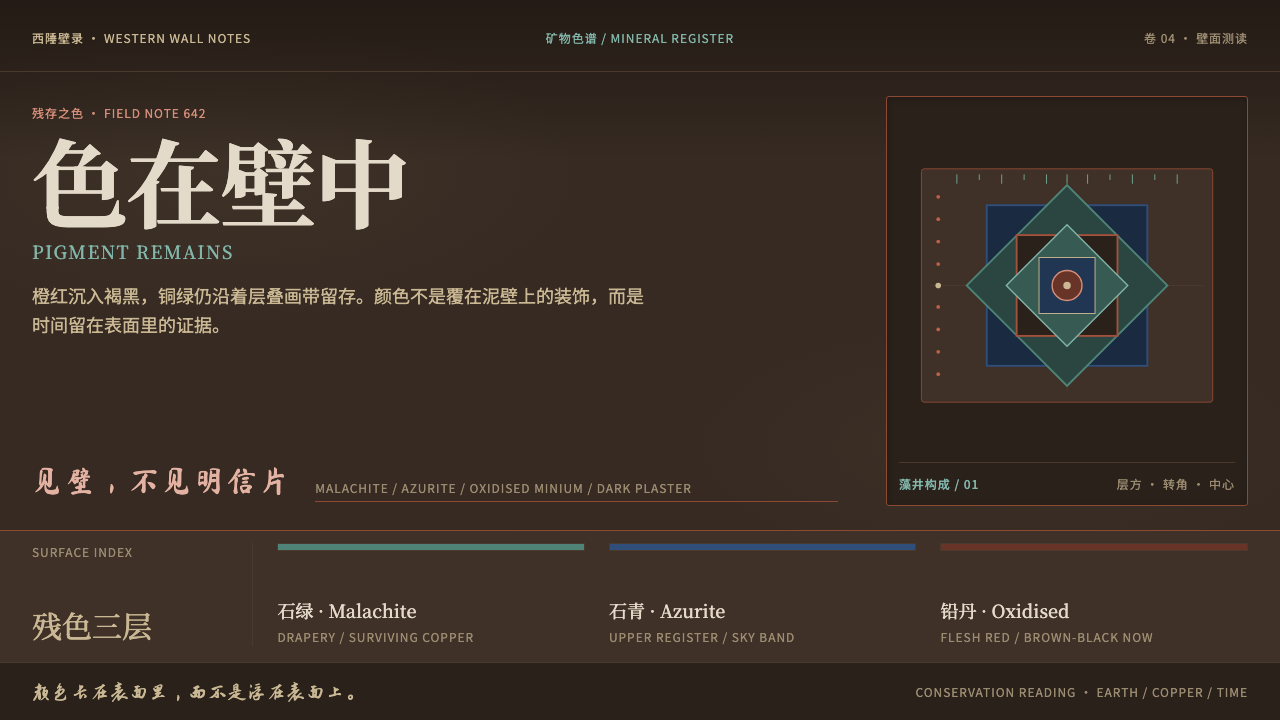 Dunhuang Mogao MuralsTime lives in the wall. Mineral green and azurite endure on oxidised brown pl…
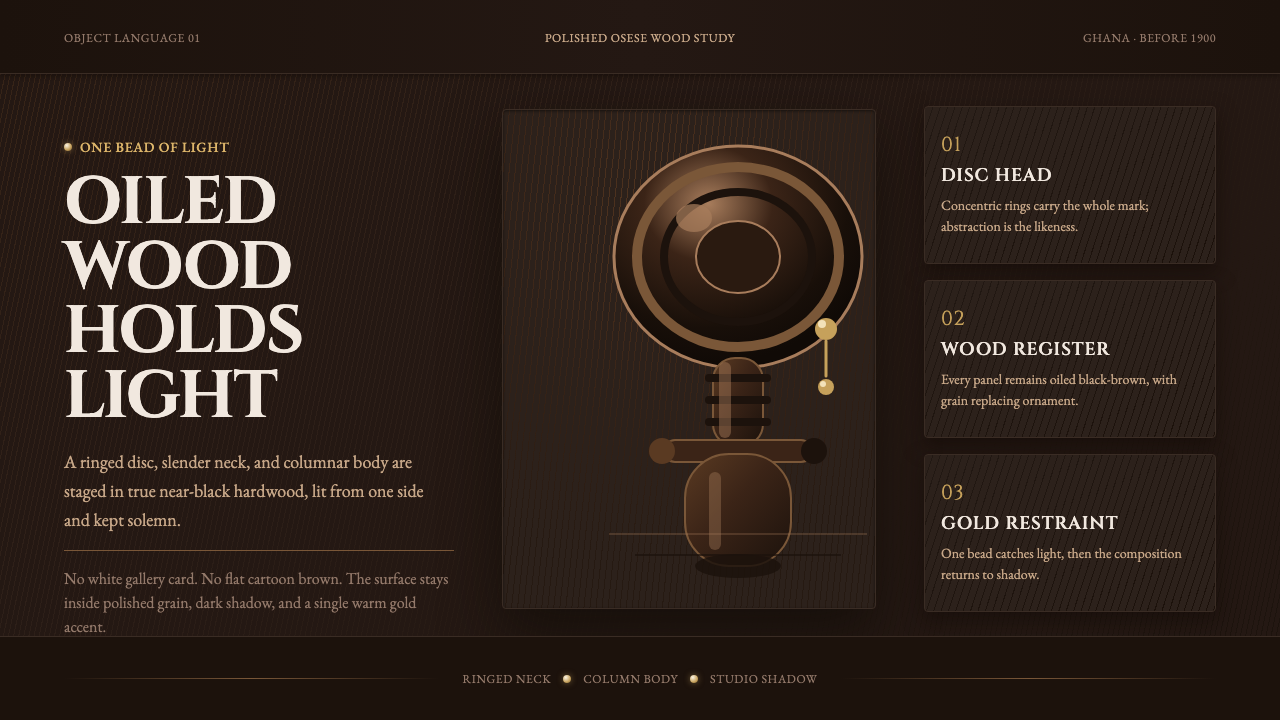 Akuaba Akan Fertility DollDarkness becomes sculpture. Near-black wood, ringed geometry, and one gold be…
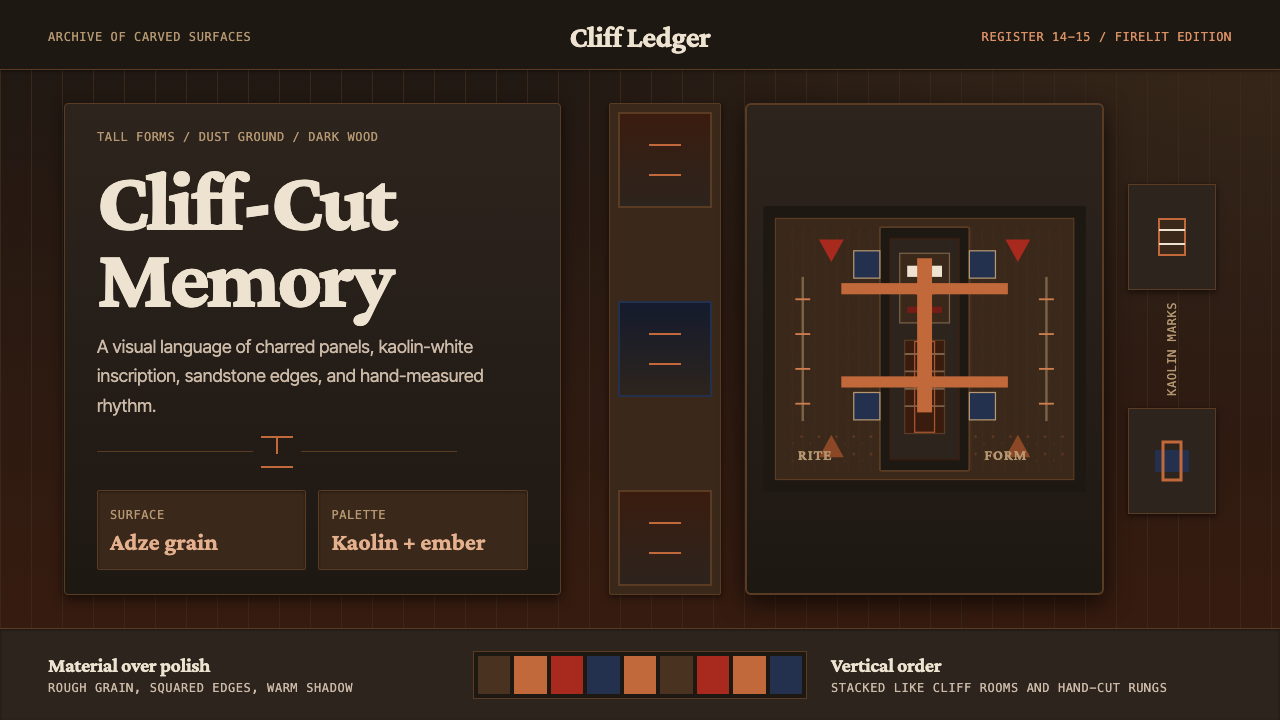 Dogon Bandiagara Cliff MaskHand-hewn gravity. Charred wood, kaolin type, and sandstone geometry stack li…
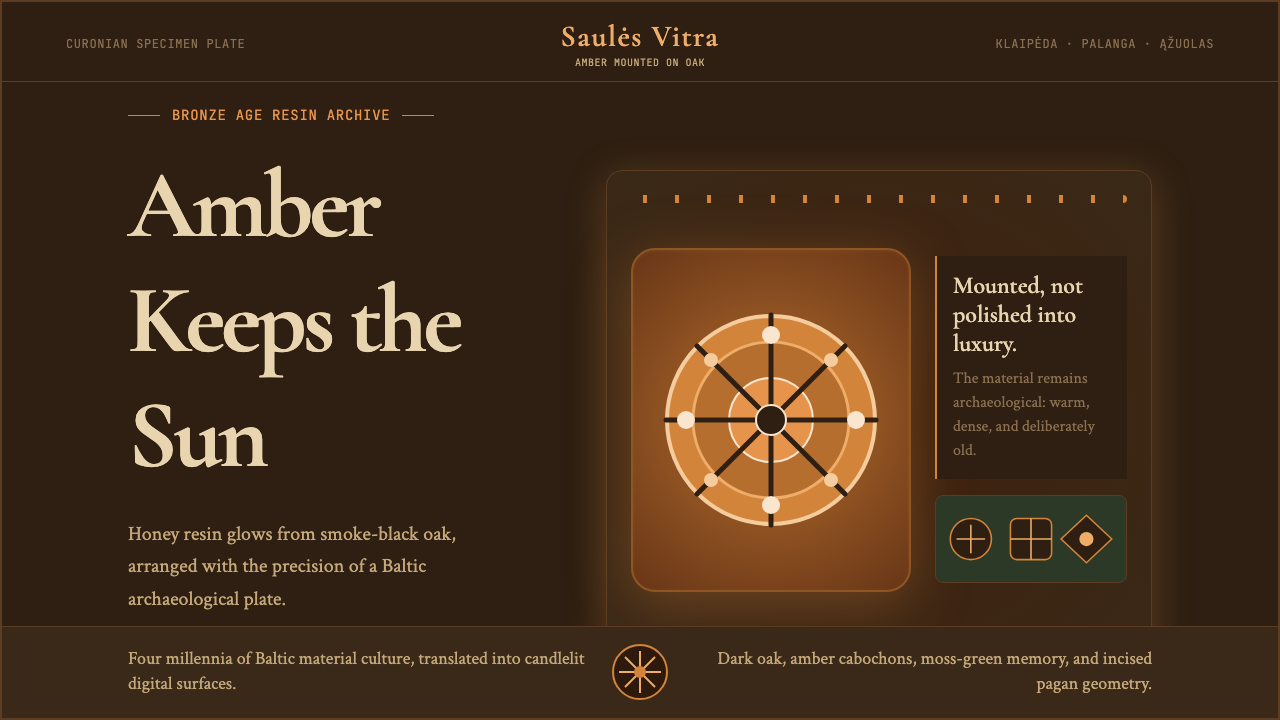 Lithuanian Amber (Baltic Pagan)Ancient amber glows. Honey resin on smoked oak, framed by saulė geometry.
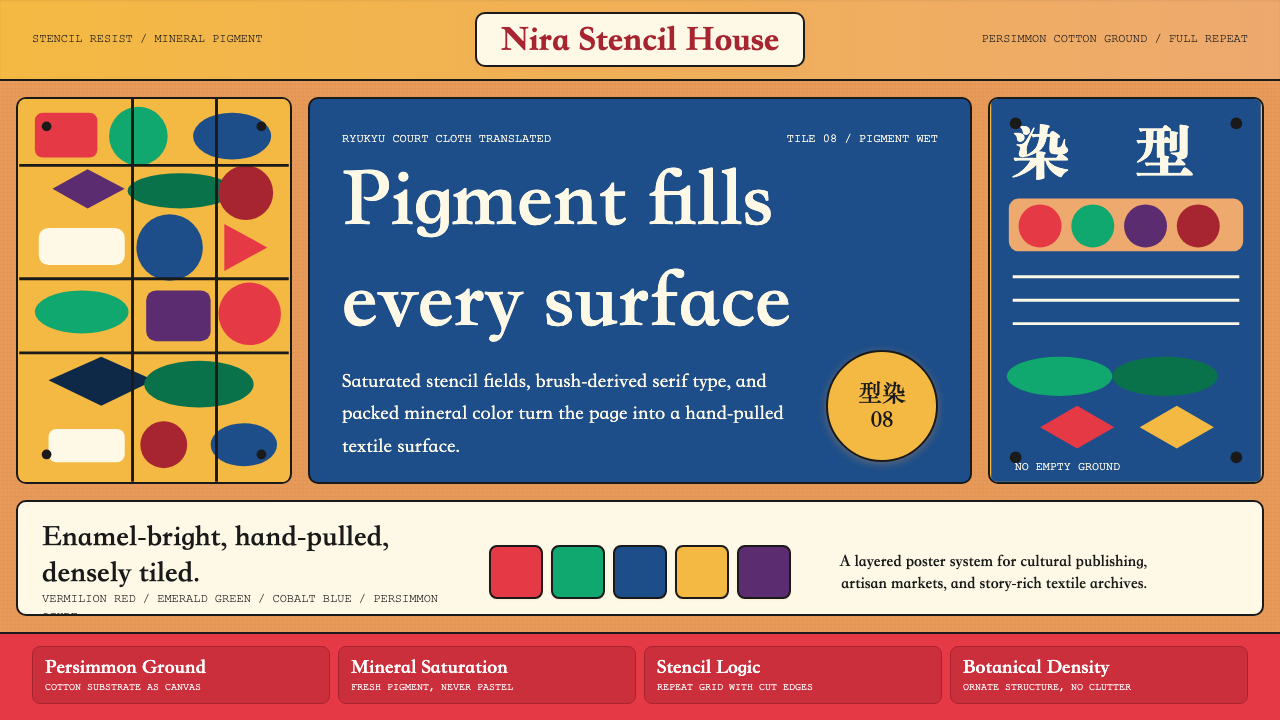 Okinawan Bingata Resist DyeOrnate without clutter. Persimmon ground, vermilion type, emerald-cobalt sten…
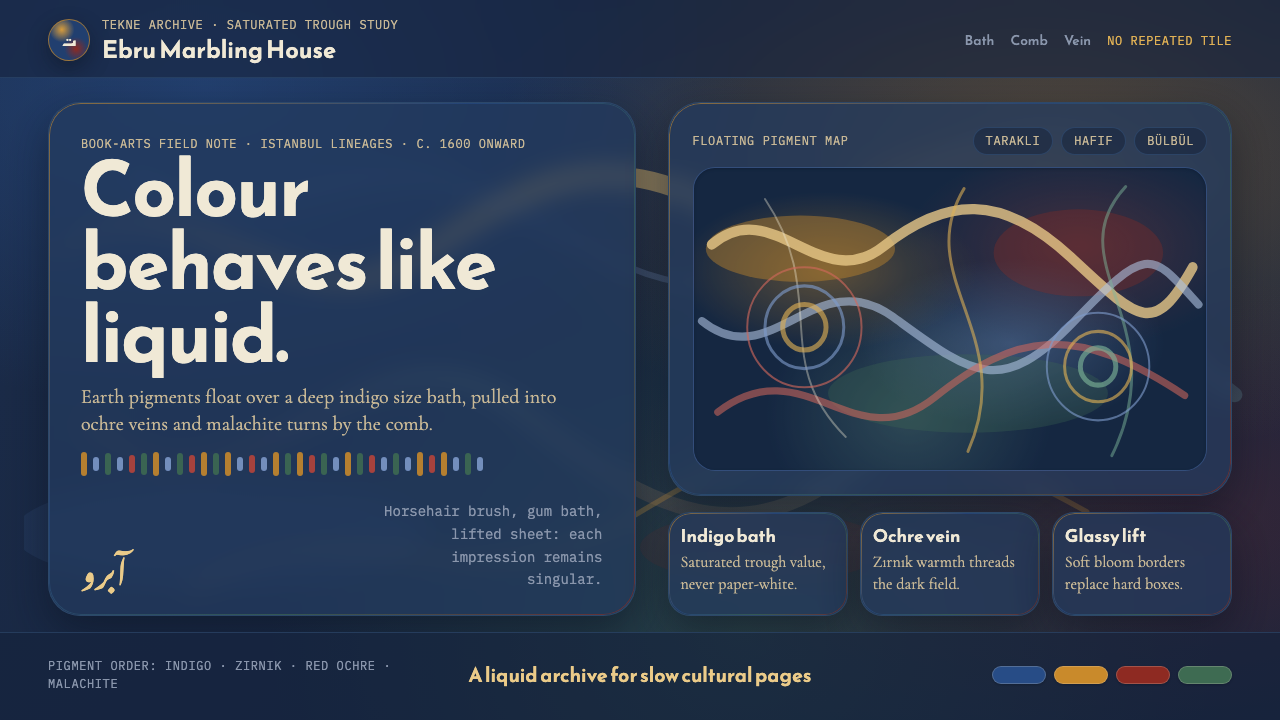 Ottoman Ebru MarblingLiquid, never tiled. Indigo bath, ochre veins, and glassy bloom edges carry t…