What is Donald Judd Milled Aluminum?
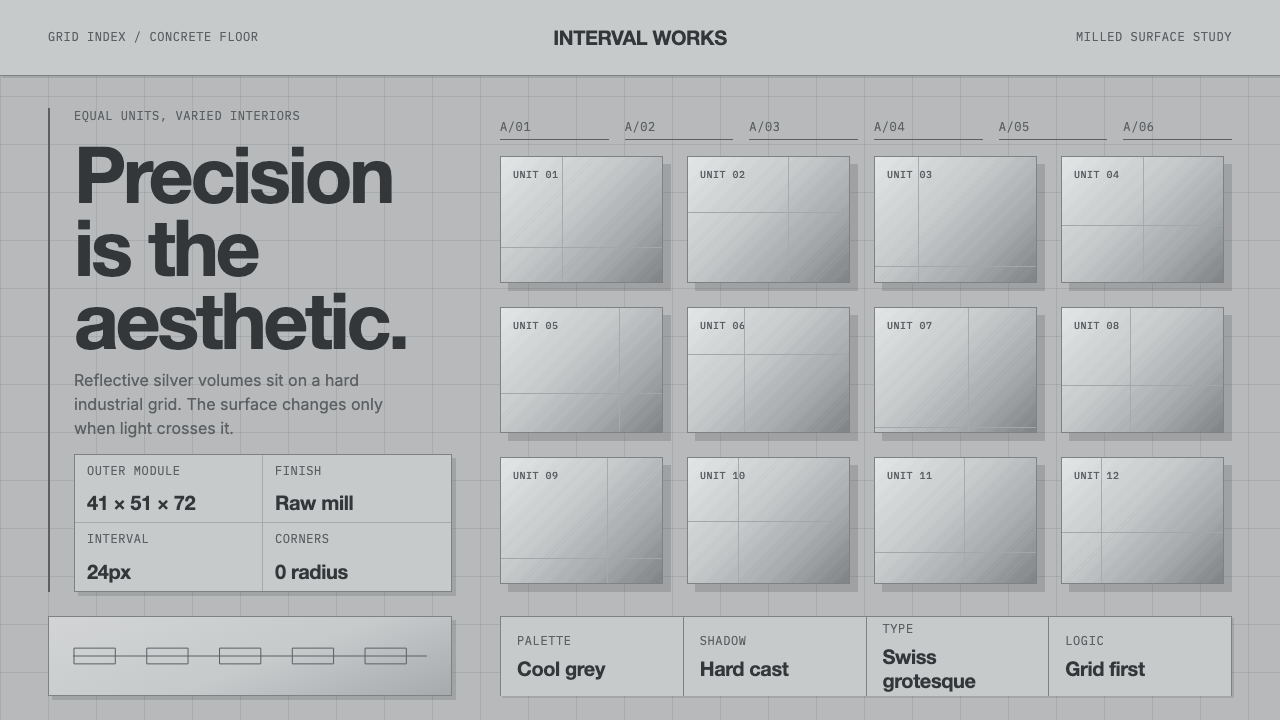
Precision becomes the subject: cool mill-silver boxes repeat across concrete, with light, interval, and fabrication doing all the visual work.
Donald Judd Milled Aluminum in brief
Donald Judd Milled Aluminum translates Judd’s Marfa installation into a visual system of equal intervals, reflective aluminum volumes, hard concrete grounds, and Swiss grotesque typography. Its defining sensation is cool exactness. The boxes do not decorate a space; they establish a measured field in which repetition, distance, shadow, and daylight become the visible content.
The material is raw mill-finished aluminum: neither anodized white nor matte gray, but a cool silver surface that catches raking light and changes subtly as the viewer moves. This reflectivity is not ornamental polish. It makes fabrication legible, allowing the industrial surface to register the surrounding light while remaining restrained and impersonal.
The style depends on a disciplined refusal. There are no softened edges, warm colors, simulated textures, or expressive gestures. Hard planes meet hard planes. Identical exteriors repeat across a concrete grid, while differently partitioned interiors introduce variation without disturbing the system’s outer order. Precision is not a detail within the aesthetic; it is the aesthetic.

Where does Donald Judd Milled Aluminum come from?
The source installation belongs to Donald Judd’s mature period, within an era spanning 1950 to 1990 and associated here with Minimalism, Specific Objects, and Industrial Fabrication. Its decisive setting is Marfa, Texas, where Judd worked with scale, material, placement, and repetition as direct conditions rather than as symbols for something else.
Between 1982 and 1986, Judd filled two converted artillery sheds at the Chinati Foundation with one hundred identically sized aluminum boxes. Their exteriors established a strict visual order, while each interior was partitioned differently. The contrast is fundamental: the installation repeats what the viewer can measure from outside, yet preserves structural variation within each volume.
The raw mill finish gives the work its particular visual temperature. The aluminum is not treated into a uniform white and not dulled into anonymous gray. Under the raking daylight of Texas, it shimmers cool silver against the concrete floor. The surrounding architecture and landscape are therefore not a neutral backdrop; they provide the light, distance, and hardness through which the boxes become perceptible.
This design system extracts the installation’s logic rather than reproducing it literally. Equal spacing becomes the organizing rule, concrete becomes the grounding field, reflective volumes become the primary visual units, and hard shadow planes replace atmospheric depth. Swiss grotesque type extends the same discipline into language: clear, measured, and stripped of decorative personality.
What defines the Donald Judd Milled Aluminum look?
Mill-Finished Aluminum
The surface is cool silver rather than white or matte gray, preserving the evidence of industrial fabrication. Its reflection is controlled and contingent on daylight, so the material appears active without becoming glossy decoration. The finish should feel made, not embellished: a record of machining, handling, and light.
Equal-Interval Repetition
Repetition is the primary compositional device. Identical volumes are placed at measured intervals, making distance as legible as object. The rhythm should remain steady and impersonal; variation comes from the viewer’s movement through the field or from internal structure, not from arbitrary changes in scale or ornament.
Concrete Ground
Concrete supplies a hard, neutral ground that supports the aluminum without competing with it. It is architectural rather than atmospheric: a plane for alignment, shadow, and weight. The relationship should feel infrastructural, as though the boxes belong to a precise site system rather than being casually placed objects.
Reflective Daylight
Light should skim across surfaces instead of dissolving them into soft illumination. Raking daylight reveals planes, seams, and changes in orientation, allowing the aluminum to shimmer while retaining its cool restraint. Reflection is treated as a consequence of material and position, never as a special effect applied afterward.
Hard Shadow Planes
Shadows are clear extensions of the boxes’ geometry. They sit beside, beneath, or between volumes as firm planes, reinforcing the measured arrangement. Avoid atmospheric blur and diffuse softness. A shadow should clarify where an object stands and how far it is separated from its neighbor.
Swiss Grotesque Type
Typography should be plain, controlled, and structurally aligned with the grid. A Swiss grotesque voice supports the boxes by making language feel measured rather than expressive. Hierarchy comes from placement, scale, and weight, while labels remain concise and functional. Type should occupy the same disciplined world as the aluminum.

Who shaped Donald Judd Milled Aluminum?
Judd is the central figure behind the installation logic. His work in Marfa treats material, scale, placement, and repetition as direct visual facts. The aluminum boxes demonstrate an approach in which an object does not need expressive surface treatment to hold attention; its presence comes from exact fabrication and its relationship to the surrounding field.
The Chinati Foundation is the site that gives the system its architectural and geographic force. Two converted artillery sheds hold the repeated aluminum volumes, allowing concrete, daylight, distance, and enclosure to participate in the work. The foundation is therefore not merely a location in the background; it is part of the conditions that make the installation legible.
The one hundred identically sized boxes are the system’s primary units. Their shared exterior establishes repetition and order, while their differently partitioned interiors prevent the work from becoming mechanically identical in every respect. Together they show how strict external consistency can coexist with controlled internal variation.
How do you use Donald Judd Milled Aluminum today?
For a presentation cover, use one decisive field of cool silver or concrete-like neutrality and let a repeated box structure establish the visual premise immediately. Place the title in a Swiss grotesque voice, aligned to the same underlying order as the volumes. The cover should feel like a site plan or a measured installation view, with one clear focal relationship rather than a collection of decorative accents.
For content and data slides, treat every page as part of one continuous grid. Use repeated blocks for categories, comparisons, or stages, and allow spacing to communicate grouping. Charts should appear as constructed volumes or hard planes rather than colorful illustrations. Keep labels concise, align baselines and edges carefully, and let differences in position, proportion, or density carry the information.
For web interfaces, the style suits dashboards and pricing pages that need authority, clarity, and disciplined comparison. Use cool neutral surfaces, firm borders, measured card repetition, and restrained reflective accents for active states. Pricing tiers can be differentiated through placement and structural contrast instead of unrelated colors. Interaction should feel exact and dependable, with no ornamental motion or soft visual excess.
For editorial and marketing work, build a strong relationship between image, caption, and interval. Product stories can use repeated modules that resemble the aluminum boxes, while a large concrete-like field gives text room to remain legible. Marketing compositions should emphasize fabrication, specification, and evidence: show the object, identify its material, and let the surrounding emptiness communicate confidence.
The common mistake is confusing industrial precision with a generic gray minimalist surface. Flat gray backgrounds, random spacing, and fashionable sans-serif type are not enough. The system depends on equal intervals, visible material logic, hard shadows, and a deliberate relationship between volume and ground. Adding warm gradients, decorative textures, or too many accent colors weakens the central idea that precision itself is the ornament.

Donald Judd Milled Aluminum — FAQ
Is this style simply industrial minimalism?
It shares minimalism’s restraint, but its identity depends on more than reduced decoration. The decisive elements are the repeated aluminum volumes, equal intervals, concrete ground, hard shadow planes, and the cool response of raw mill finish to daylight. Remove the measured spacing or the material logic and the result becomes generic minimalism rather than a Judd-derived system.
Why use raw mill-finished aluminum instead of white or matte gray?
The raw finish keeps the surface tied to fabrication and light. White would make the boxes feel more uniformly graphic, while matte gray would suppress the changing response to daylight. Mill silver occupies a precise middle ground: it remains cool and restrained, yet reveals orientation, surface, and surrounding illumination through controlled reflection.
Can the system include variation, or must every element be identical?
Variation is possible when it remains subordinate to the external order. The source installation uses identically sized boxes whose interiors are partitioned differently, proving that sameness and difference can coexist. In application, keep the outer rhythm, alignment, and material language consistent, then allow controlled differences inside that framework to carry information.
How should light and shadow be handled in a digital interface?
Treat them as structural consequences rather than atmospheric effects. Use clear tonal planes to show separation, hierarchy, and placement, and keep shadows firm enough to read as extensions of the geometry. Avoid soft, decorative depth that turns the interface into a simulated environment. The goal is to make the arrangement more measurable, not more luxurious.
Related design styles
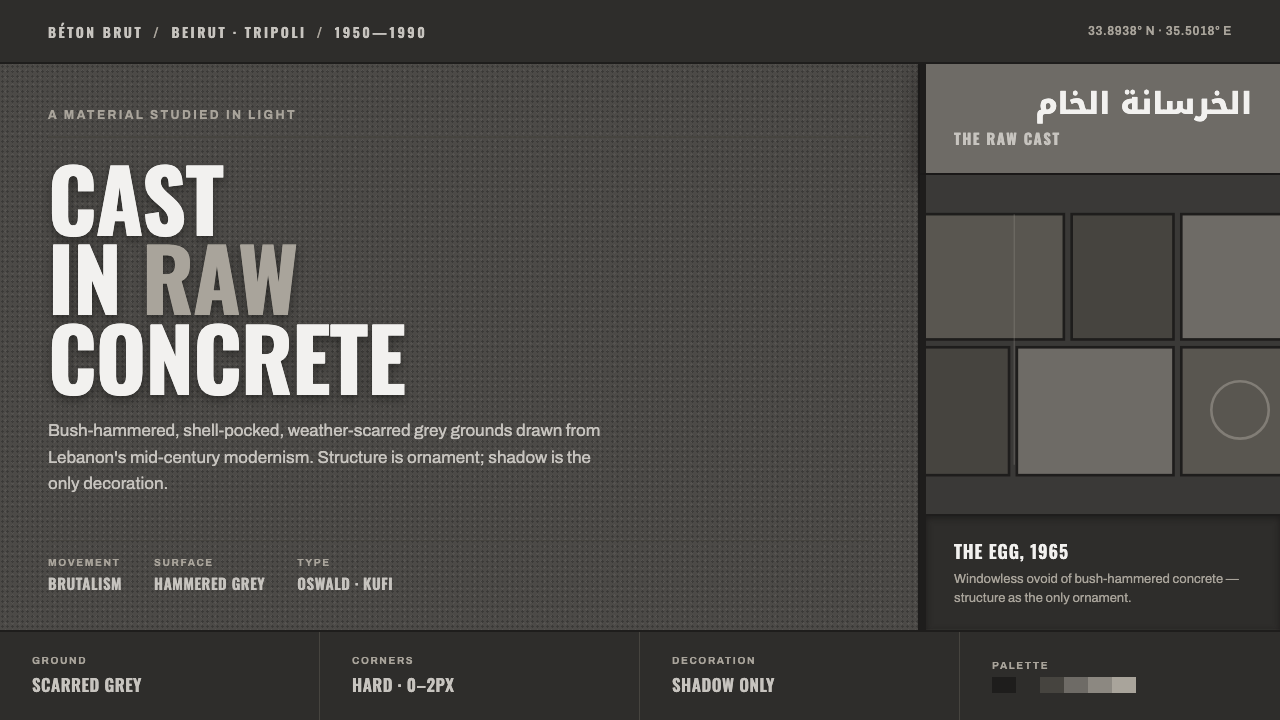 Beirut Brutalist GrayStructure is the only ornament. Scarred bush-hammered grey, monumental Oswald…
 Doctor's Clinical Lab CoatSterile by design. Cool clinical white, teal signals, and seam-line grids enf…
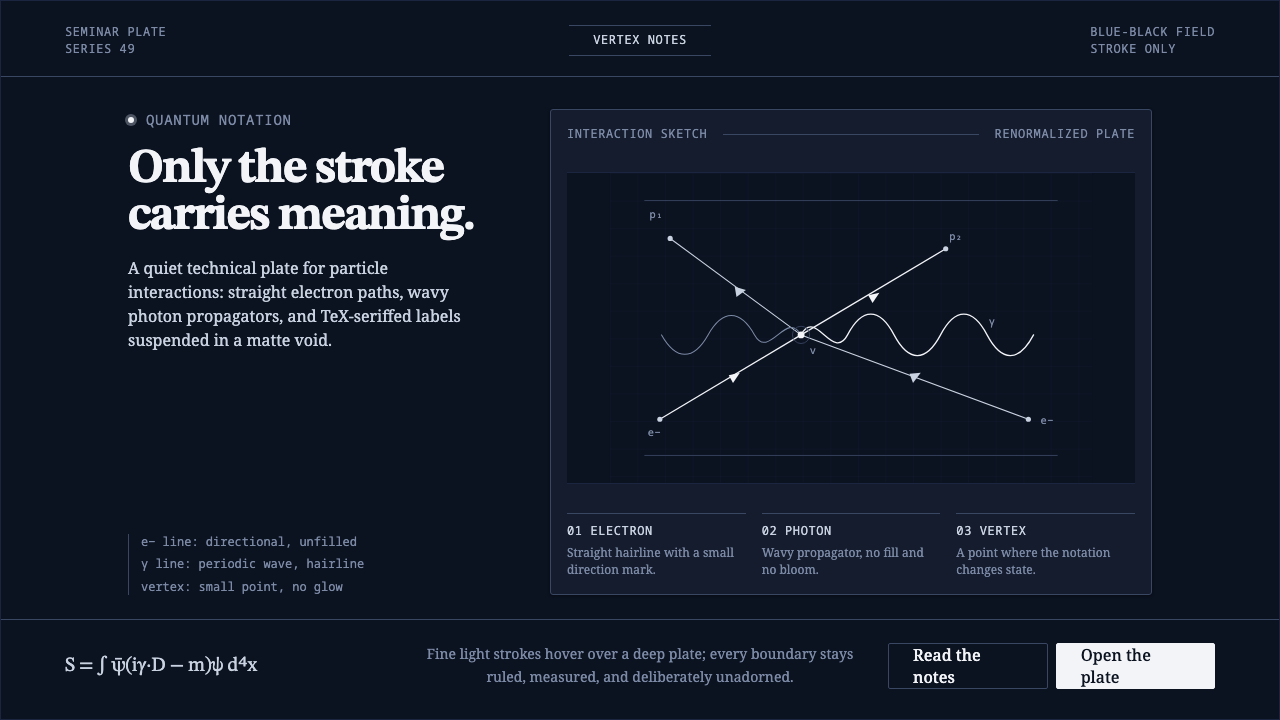 Feynman Diagram QEDMeaning reduced to strokes. Pale QED lines and TeX serif type float on blue-b…
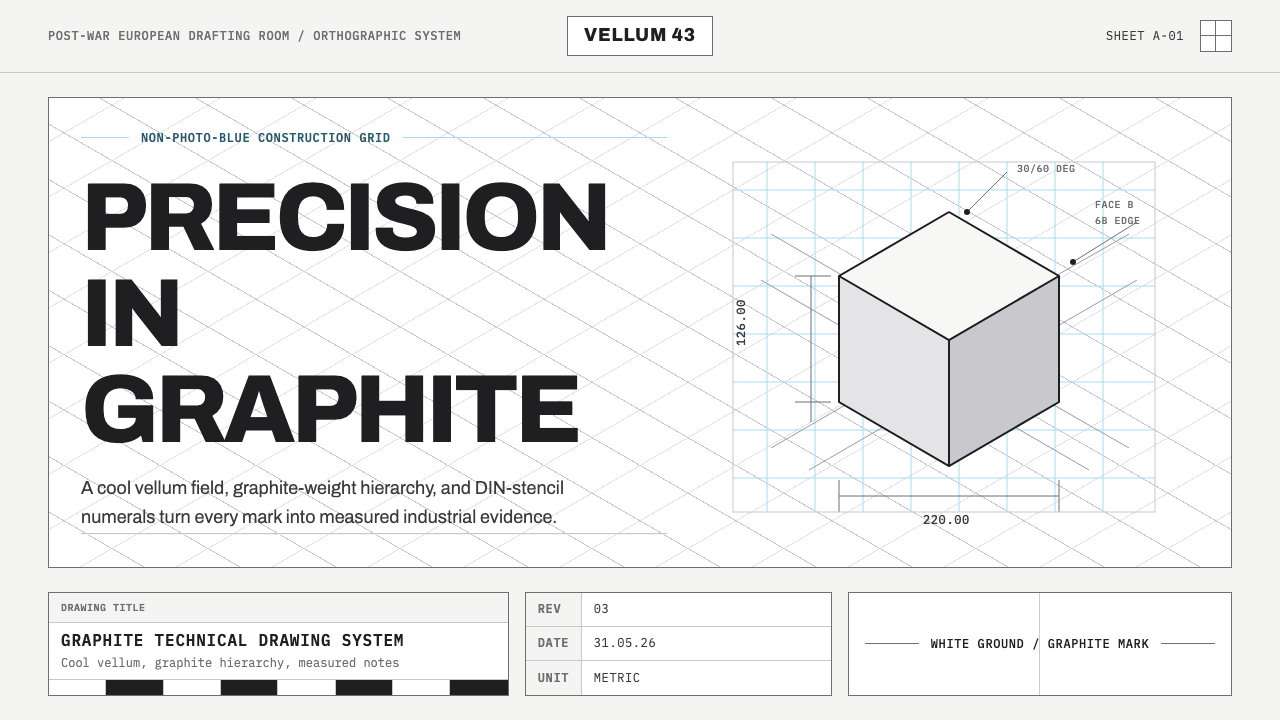 Graphite Technical DrawingDrafting-room precision. Non-photo-blue grid and graphite DIN lettering do th…
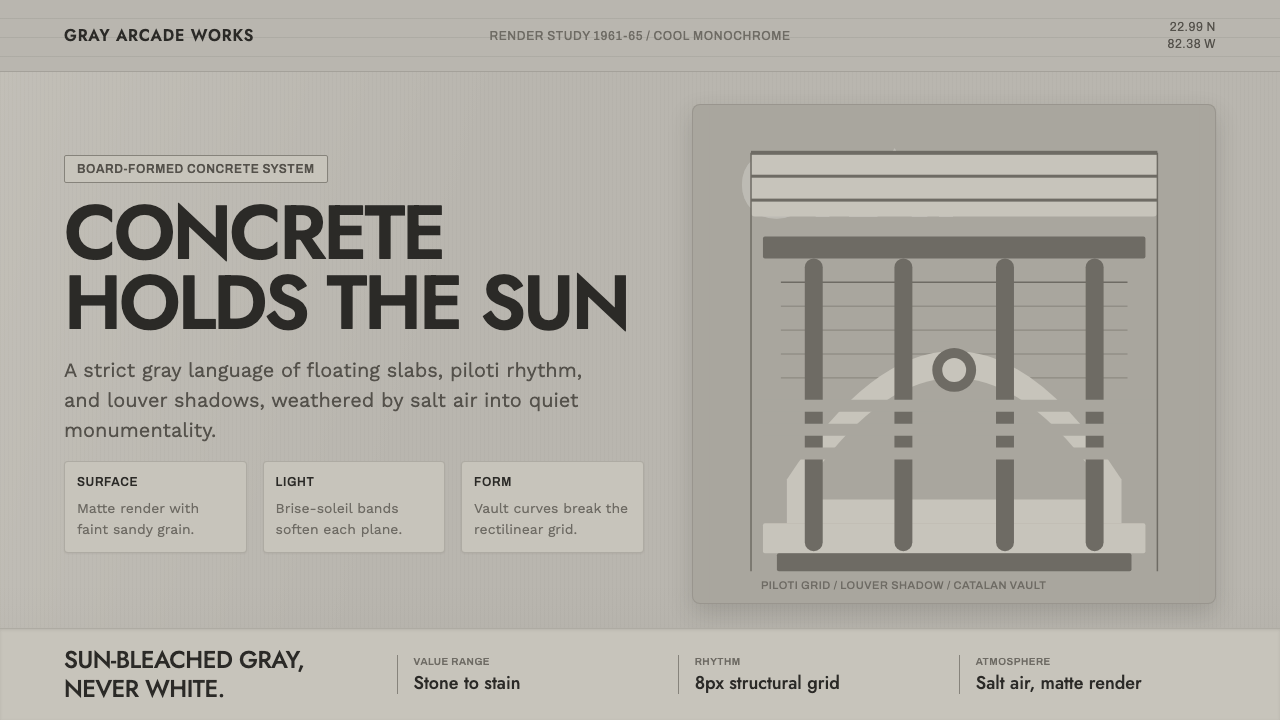 Havana Modernist GrayQuiet monumentality. Jost type, louver bands, and concrete grays hold tropica…
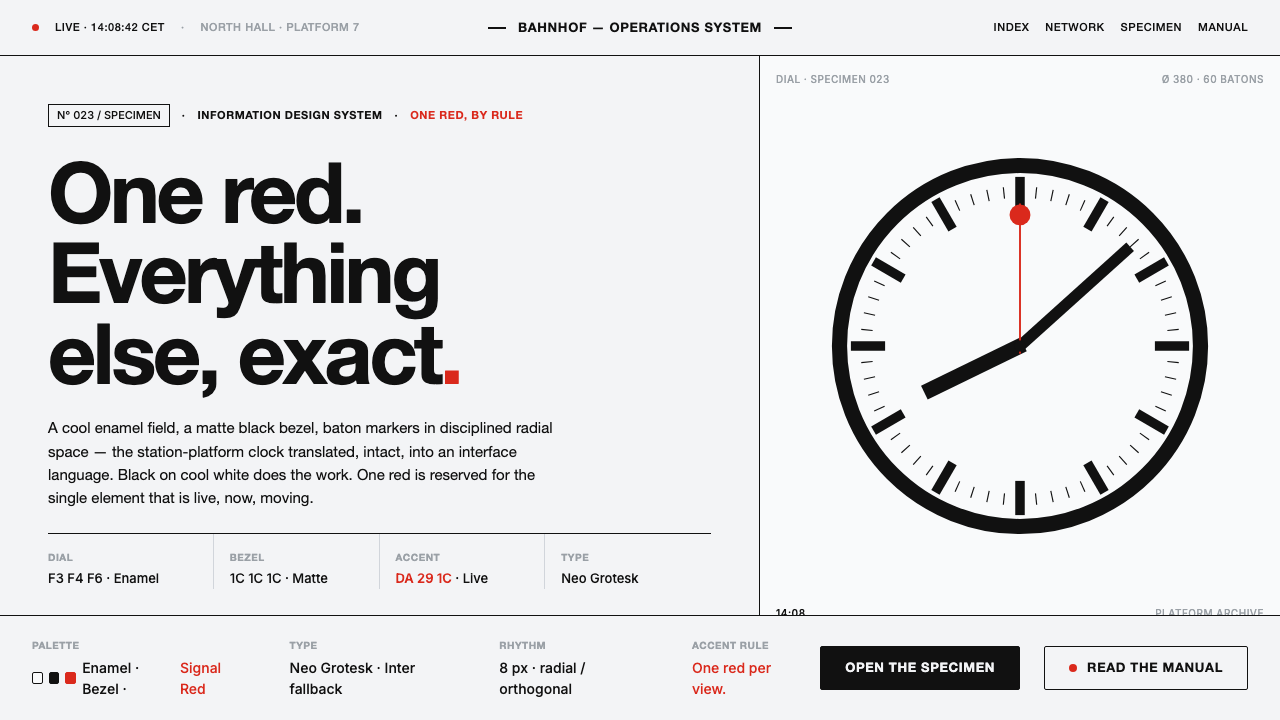 Hilfiker Railway ClockEverything exact, one thing live. Black hands on cool enamel white — one red…