What is Direct Air Capture Plant?
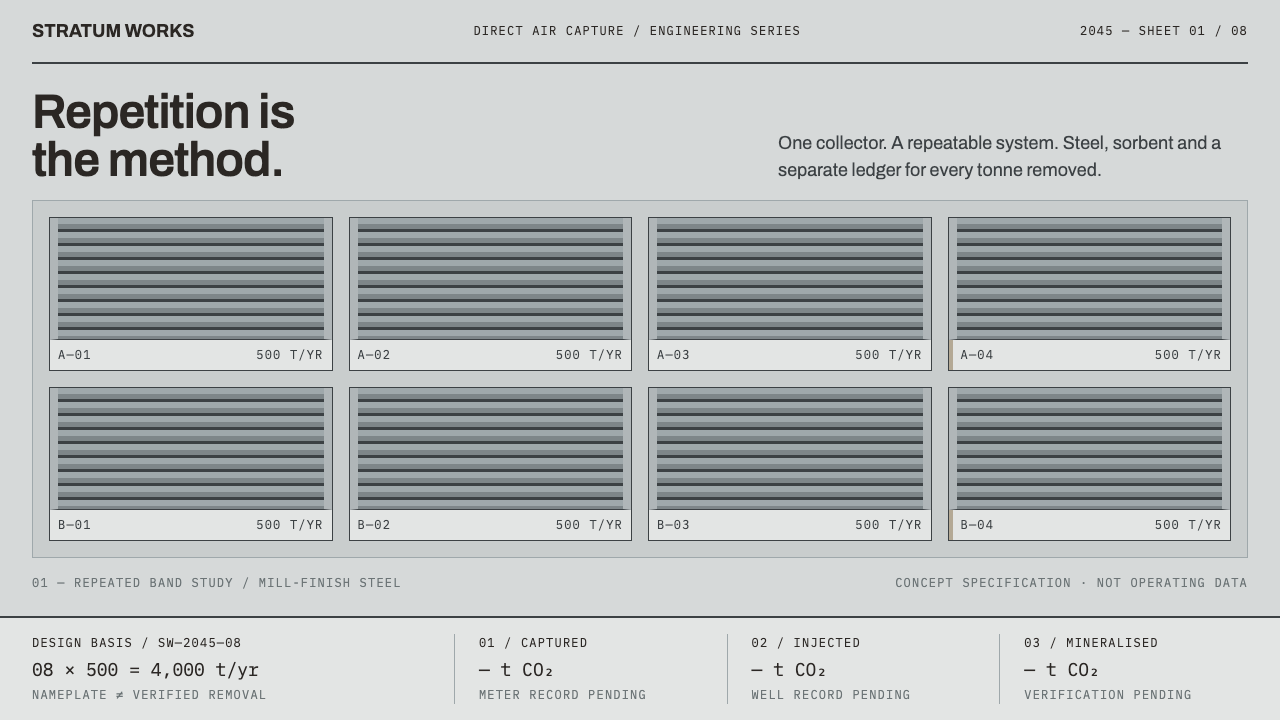
A direct air capture plant is a repeated object — steel louvre boxes in a row, with every tonne written down as a ledger entry rather than a slogan.
Direct Air Capture Plant in brief
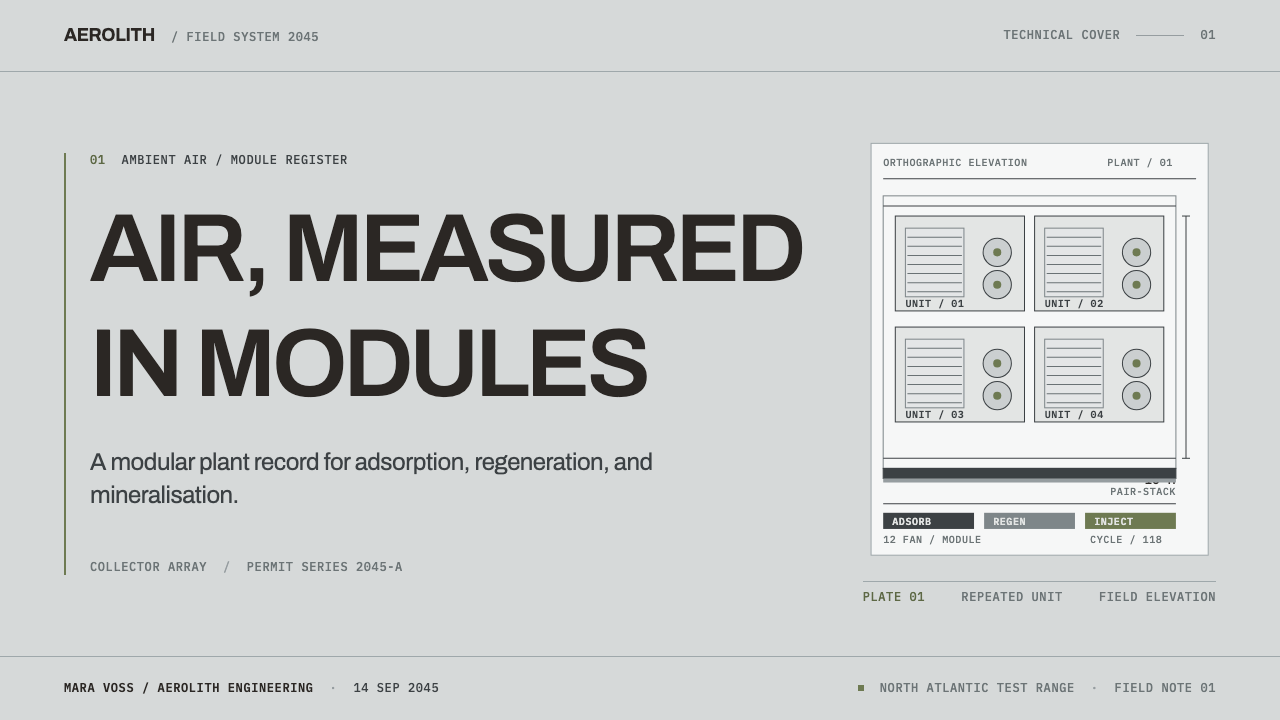
A direct air capture plant is a modular industrial facility that draws carbon dioxide out of ordinary air. Its design logic is repetition. Climeworks' Orca plant is made of eight steel collector boxes, each capturing roughly five hundred tonnes of carbon dioxide a year, arranged in a U around a central process hall. The front of each box is slatted like a large venetian blind, with twelve fans behind. The Mammoth plant takes the same container idea and stacks the units in pairs up to ten metres high, seventy-two of them in all.
The Direct Air Capture Plant style follows the hardware. Its materials are mill-finish steel, galvanized spangle, cast concrete and an earthy cladding tone chosen to settle the plant into its lava-field site. Its surfaces are steel-grey bands of louvres, repeated cell after cell. Numbers are written the way permits and registers write them, in monospaced type, so that tonnes captured, injected and mineralised read as rows in a ledger and not as marketing claims.
What the style leaves out is just as telling. There are no chimneys, no green leaves and no globe icons. Air enters through the louvres and leaves through the fans, and nothing visible happens. The style therefore cannot rely on symbolism; it relies on counting. Its principle is repetition, not rhetoric: the plant earns trust by being the same well-made module many times over, and by keeping an exact record of what each module does.

Where does Direct Air Capture Plant come from?
The style takes its first reference from Hellisheiði in Iceland, where Climeworks built its Orca plant, which dates from 2021, beside a geothermal power station. Climeworks is a Swiss company whose co-founders, Christoph Gebald and Jan Wurzbacher, are among the central names in the field. The setting is not incidental. A geothermal station supplies heat and power close at hand, and the surrounding lava field supplies the geology that makes permanent storage possible. The plant is designed to sit in that landscape without trying to disguise itself.
The captured carbon dioxide leaves the plant in the hands of a second organisation. Carbfix takes it and injects it underground, at a depth of roughly seven hundred metres, into basalt, where it reacts with the rock and mineralises into stone. This is the fact that gives the style its three-part vocabulary of captured, injected and mineralised. Each stage is a separate number in a separate row, and each has its own accountability: what the machine pulled out of the air, what was put into the ground, and what has become rock.
From Orca the idea scaled. The Mammoth plant followed in 2024, using the same container logic stacked in pairs, and in 2025 attention turned to STRATOS, the Texas project in Ector County associated with 1PointFive. The style extends this trajectory to a 2045 build-out, a future in which such plants are common enough to be thought of as infrastructure, as a utility rather than a demonstration. The look is the look of that ordinariness: unglamorous, standardised and quietly vast.
Three design lineages meet in this approach. The first is Swiss engineering functionalism, which values clarity, restraint and visible logic. The second is modular container-scale industrial architecture, in which buildings are assembled from repeatable units that can be shipped, stacked and expanded. The third is carbon-removal accounting practice, with its insistence that every claim be backed by a measured quantity, a method and a permit number. Together they explain why the visual identity looks like engineering documentation more than environmental advocacy.
What defines the Direct Air Capture Plant look?
Mill-finish Steel Grey
The dominant tone is the grey of unpainted, rolled steel: cool, slightly dull and quietly metallic. It avoids both the brightness of polished chrome and the darkness of black. Large surfaces in this grey feel industrial and honest, like panelling that has not been dressed up for the camera.
Louvre Bands
Horizontal slats, repeated in even rhythm, are the signature graphic motif. They echo the front of the collector boxes and give the page its structure: sections, headers and cards can all be built from stacked parallel bands. The pattern suggests airflow without drawing anything that moves.
Galvanized Spangle and Cast Concrete
Two materials supply subtle texture. Galvanized steel shows a crystalline spangle, a faint mottled pattern in the grey, while cast concrete shows a soft, slightly uneven grain. Used lightly, they give surfaces tactile depth. They should be felt as a trace rather than a decoration.
Earthy Cladding Tone
A single earthy tone, chosen so the plant settles into a lava landscape, is the main accent. It works like a background tint for panels and callouts rather than a bright highlight, and it keeps the page grounded in a physical place. It is the colour of rock and soil, not the colour of marketing.
The Monospaced Ledger
Quantities are set in monospaced type and arranged in rows and columns, like entries in a register. Captured, injected and mineralised tonnes sit side by side, with cycle times and permit identifiers close by. The effect is of a document that could be audited line by line, and precision itself becomes the visual identity.
Modular Repetition
Identical units are repeated on a regular grid, whether they are cards, tiles or table rows. The design never celebrates one special item; it shows that the system is made of many identical parts that each do the same job. Variation is introduced through data, not through form.
No Eco Symbolism
Leaves, trees, globes, clouds and arrows curling in circles are all excluded. The subject is removing carbon dioxide from the air, but the style declines the familiar green vocabulary of environmentalism. It lets the machinery, the materials and the numbers speak, which makes the claim feel more engineered than promoted.

Who shaped Direct Air Capture Plant?
Gebald is a co-founder of Climeworks, the Swiss company that built the Orca and Mammoth plants. His name is tied to the move from laboratory concept to repeated industrial hardware, and to the engineering mindset that gives direct air capture its modular, container-scale look.
Wurzbacher is the other co-founder of Climeworks, and together with Gebald is one of the central names in the field. The pairing of two founders from engineering backgrounds helps explain why the company's public language emphasises hardware, measurement and operation over advocacy.
The Swiss company behind the Orca plant of 2021 and the Mammoth plant of 2024, both at Hellisheiði in Iceland. Its collector boxes, with louvred fronts and fans behind, are the visual source of the style's key motif. The company stands for the idea of capture as an industrial product that can be repeated, shipped and scaled.
Carbfix takes the captured carbon dioxide and injects it into basalt about seven hundred metres underground, where it mineralises into stone. Its role provides the second and third entries in the style's accounting: injected and mineralised. Without this step, the ledger would end at the louvres.
The developer associated with the Texas project, STRATOS, in Ector County. It extends the story from Iceland to the United States, and from a pilot-scale demonstration toward the large build-out the style imagines for 2045. Its presence marks the move from a single site to a repeatable programme.
How do you use Direct Air Capture Plant today?
The Direct Air Capture Plant style is a light, industrial, evidence-first look. It suits any subject that is large, technical and in need of credibility, and where the honest answer to 'how do we know?' is a table of measured numbers. Its guiding rule is that repetition and records carry the message. If a layout needs a slogan to make its case, it is not yet using the style properly.
For presentation slides, build the cover from steel-grey bands: a field of horizontal louvre lines, a plain title set in an industrial sans, and a monospaced line below giving a site and a date. Content slides work as ledgers. Place key figures in a grid of identical cells, show captured, injected and mineralised quantities in separate rows, and use the earthy tone only to mark the row that matters. Data slides can use bar charts made of stacked identical blocks, one per unit, so that a total is literally a count of modules.
For web interfaces, the style suits climate-technology platforms, emissions and carbon accounting tools, energy and infrastructure dashboards, registries, and reporting portals. Build with repeated cards and table rows, give identifiers and quantities a monospaced treatment, and keep buttons square and plain. Avoid hero images of landscapes or glowing globes. A photograph of the actual hardware, shown in a bordered frame with a caption, is more convincing than any illustration.
For editorial and marketing work, treat the page as a site report. Open with the facts of the plant, such as its location, number of modules and annual capacity, then move to how the carbon dioxide is stored. Use captions in monospaced type, refer to permit numbers where they exist, and let layout repeat. Photographs work best when they show the plant at working distance, with the louvres in rows, and are not edited for drama.
The most common mistake is to soften the style with environmental clichés: green gradients, leaf icons, cloud illustrations. They contradict the premise and make the claim look like advertising. Another mistake is to write numbers in a decorative display face or round them for effect; permit-grade means exact, set in mono, and sourced. Finally, do not break the grid. The credibility of the plant comes from the fact that every module looks the same.
Direct Air Capture Plant — FAQ
What is direct air capture?
It is a technology that removes carbon dioxide directly from ambient air using machines, as opposed to capturing it at a smokestack. In the plants this style refers to, air passes through louvred collector boxes with fans behind them, and the captured carbon dioxide is then sent for storage, in some cases injected into basalt where it mineralises into stone.
Why are there no leaves or globes in the design?
Because the plant itself shows nothing of the kind. Air goes in through louvres and out through fans, and there are no chimneys or visible emissions. The style prefers to show the real hardware and the real numbers, which feels more credible than familiar environmental symbols and avoids the sense of advertising.
Why are numbers set in monospaced type?
Because the numbers are treated as permit-grade records, like ledger rows. Monospaced characters align in columns so that quantities can be compared and checked quickly, and the typeface signals that these are measured values, not claims. Tonnes captured, injected and mineralised are shown as separate, exact entries.
What does the 2045 in the name refer to?
It points to an imagined build-out of such plants, extending the sequence of Orca in 2021, Mammoth in 2024 and STRATOS in 2025. The look is intended for a future in which direct air capture is routine infrastructure, so the design aims for ordinariness and scale rather than novelty.
Which products does the style fit?
It fits climate technology, carbon accounting, energy and infrastructure products, registries and reporting tools, and industrial brands that need to appear measured and rigorous. It is less suited to consumer products that depend on warmth, playfulness or emotional storytelling, where its restraint and its dense numerical detail would feel cold.
Related design styles
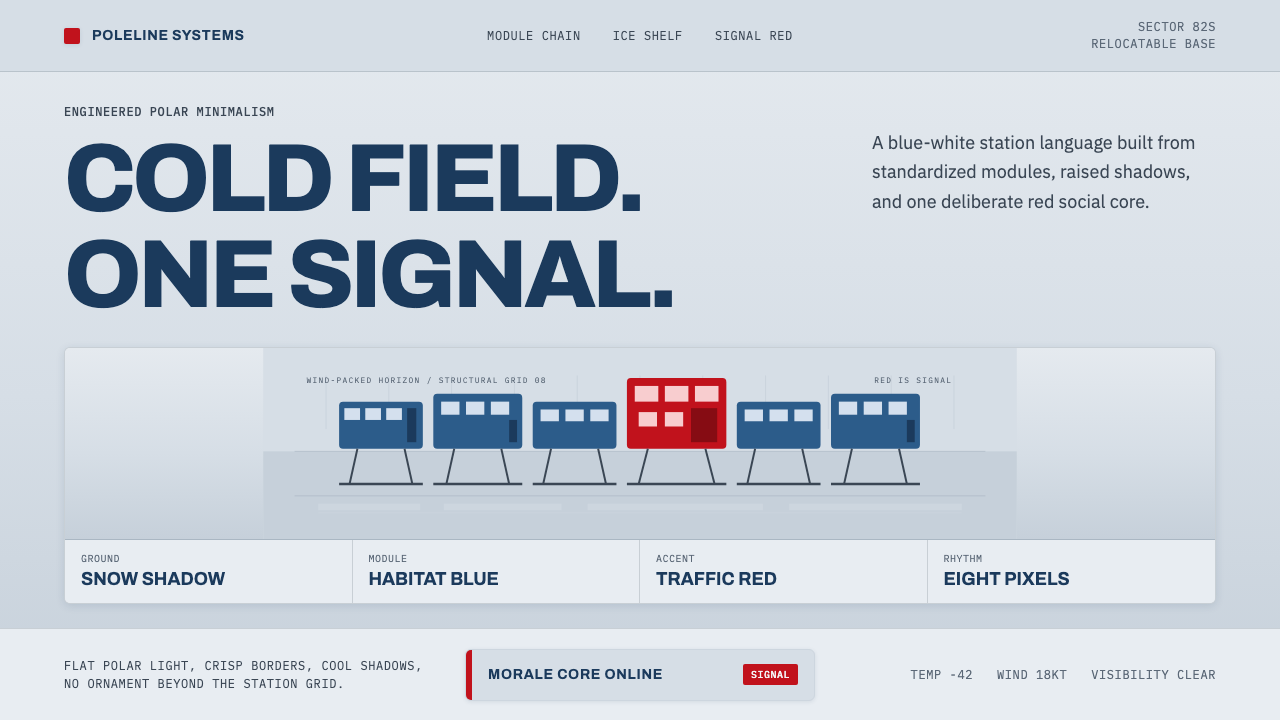 Antarctic StationCold precision, one red signal. Archivo modules ride a blue-white horizon gri…
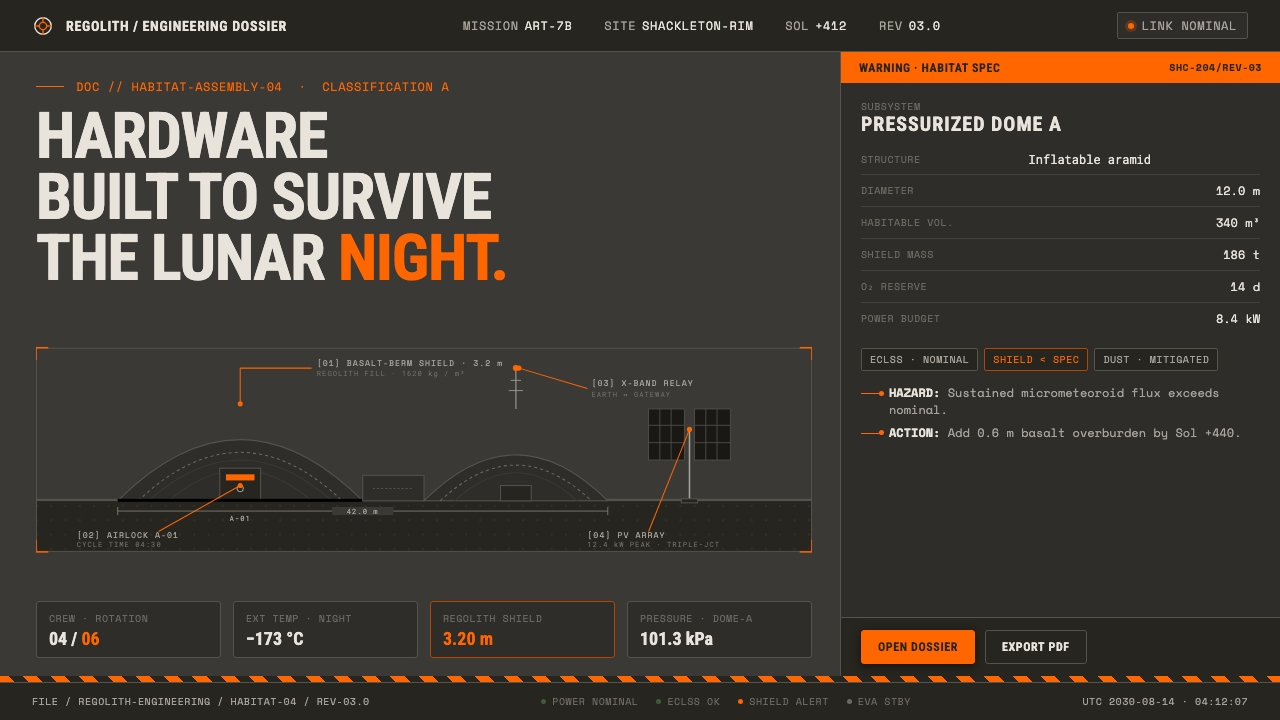 Lunar Base 2030Hardware built to survive the lunar night. Regolith gray, ANSI hazard orange,…
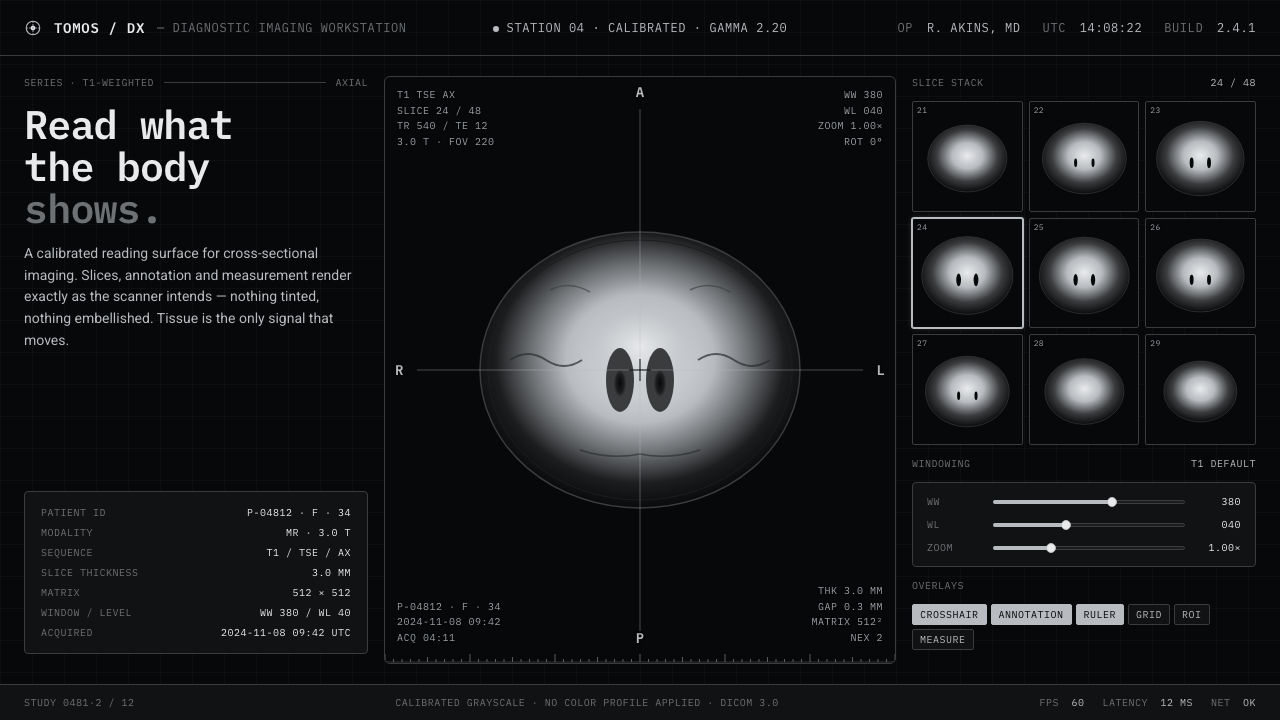 MRI ScanReads like a radiology viewport. Tissue-gray tomograms on pure black, IBM Ple…
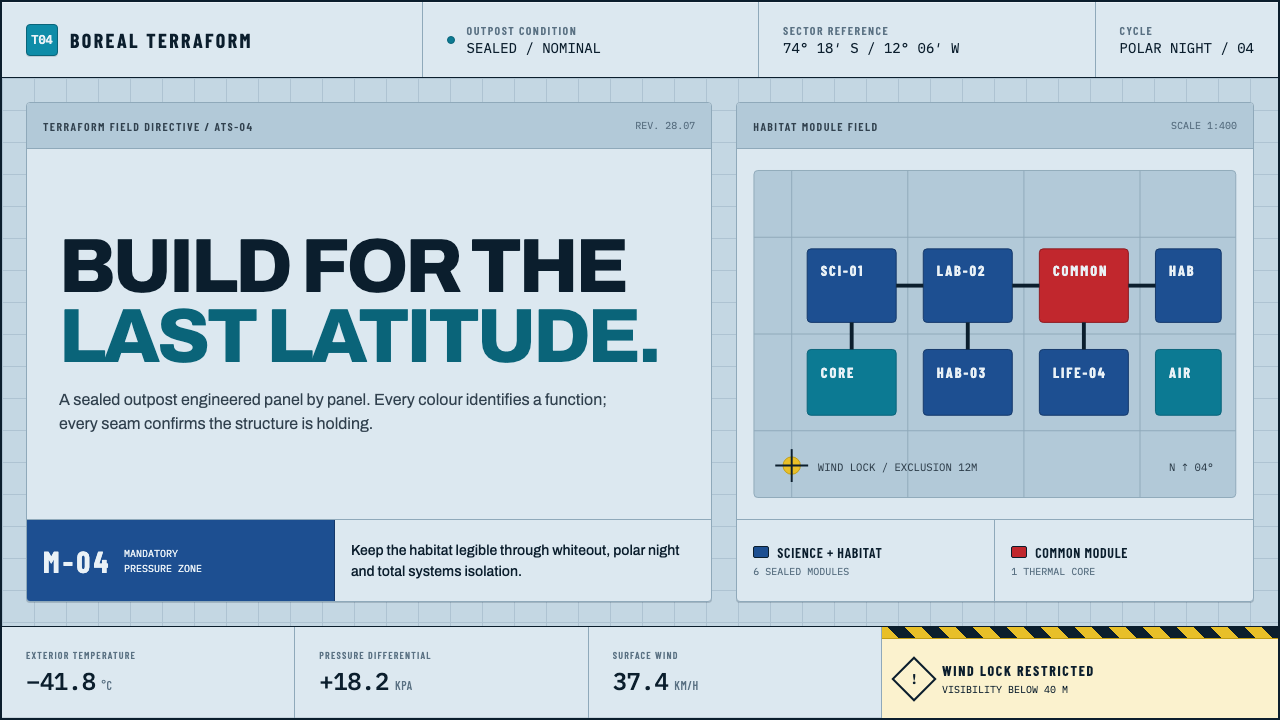 Arctic Terraform StationEvery colour carries a duty. Sky-blue panels, coded modules and hard seams en…
 Autonomous Cargo Ship BridgeColour is protocol. Near-black chart grids reserve orange for decisions that…
 Cell MicroscopySignal on total dark. DAPI blue-violet and FITC green bloom as soft point-emi…