What is Dahomey Amazons (1840)?
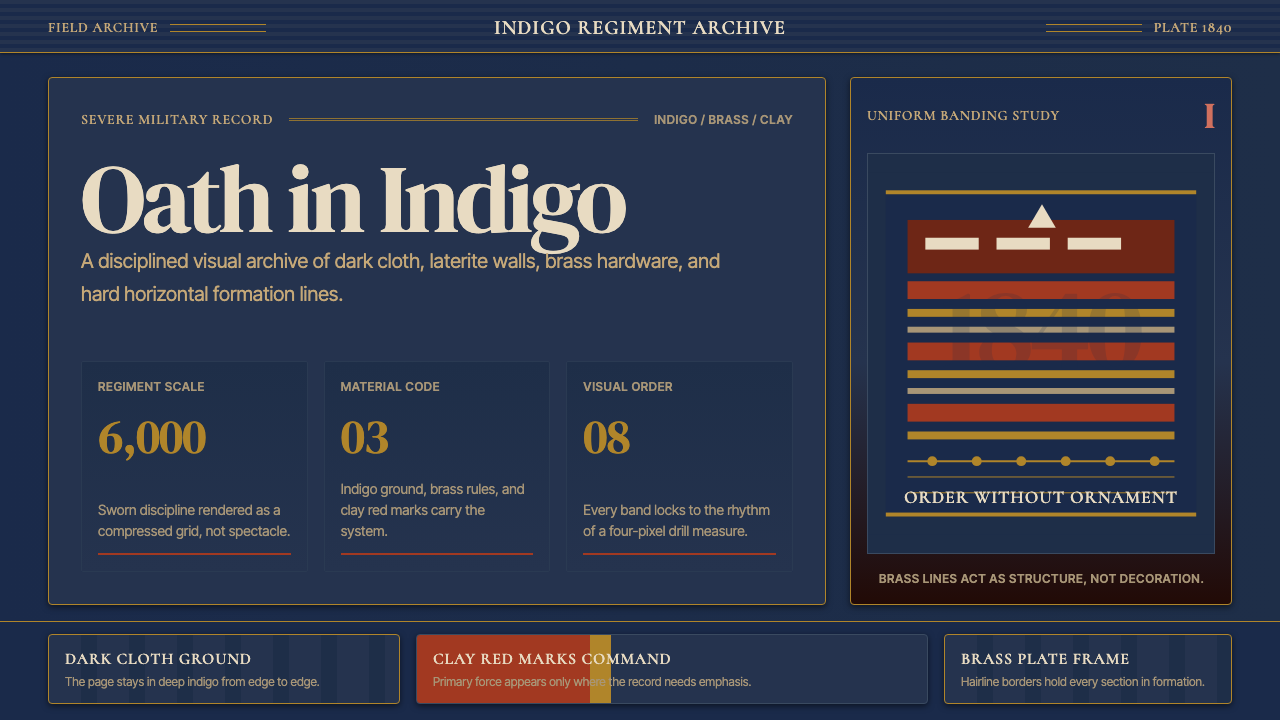
The Mino were the only all-female standing army in modern history — six thousand sworn warriors whose severe indigo-and-brass visual language became one of West Africa's most distinctive martial aesthetics.
Dahomey Amazons (1840) in brief
The Dahomey Amazons (1840) design system distills the visual discipline of the Mino, the all-female royal guard of the Kingdom of Dahomey. At its core, the style operates on deep indigo grounds interrupted by warm clay-red horizontal bands and punctuated by brass — not as ornament, but as functional detail: the cartridge belt, the rivet, the insignia edge. The result reads less like decoration and more like an archive document — dark, compressed, and uncompromising.
Where many historical military aesthetics lean on gold for prestige, the Mino palette chose brass: a harder, duller alloy that implies utility rather than ceremony. The indigo-on-clay contrast is stark rather than warm, reinforcing the sense that every element in the composition earns its place through function. Horizontal banding derived from uniform stripes provides the primary structural rhythm, and that rhythm is relentless — it imposes order the way rank imposes discipline.
This is a dark-ground system, which gives it a gravity that light-ground military styles typically lack. The deep indigo base absorbs and anchors; the clay and brass accents emerge from it with controlled intensity. Nothing fades or softens at the edges. The aesthetic has the quality of objects under strong directional light in a shaded interior — precise boundaries, compressed tonal range, and an absence of ambient warmth.
Where does Dahomey Amazons (1840) come from?
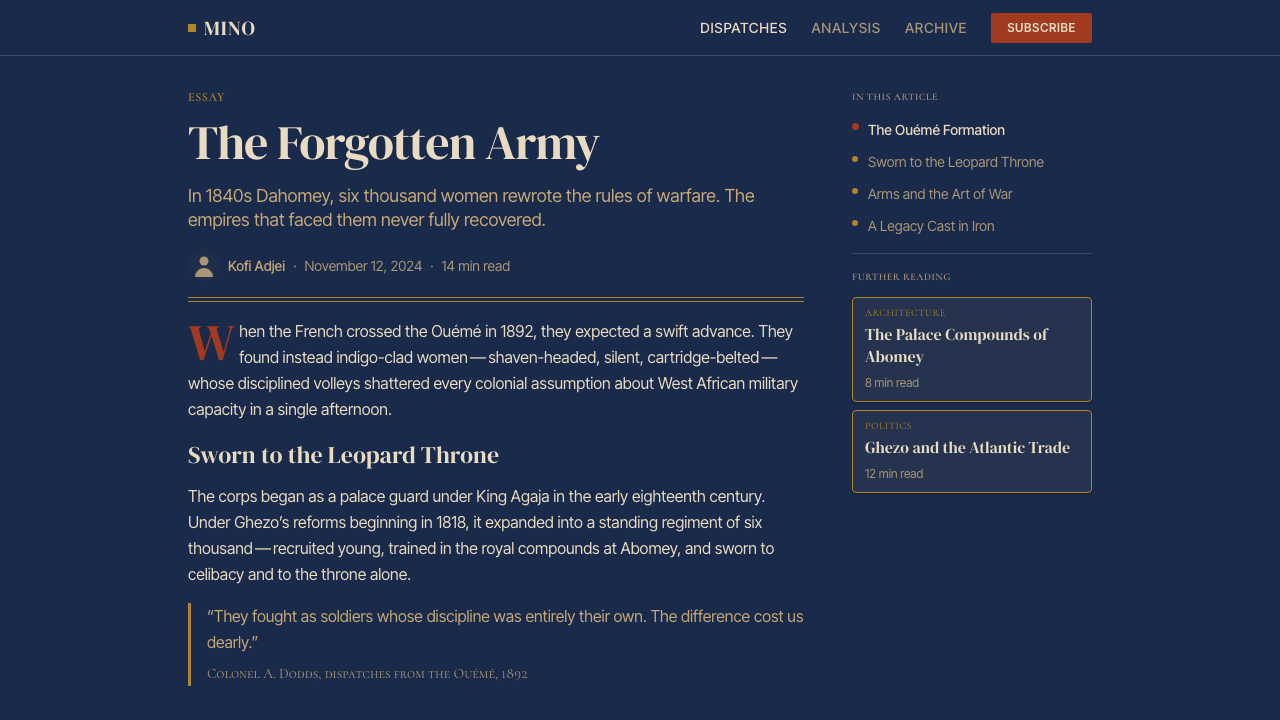
The Mino — whose name in the Fon language means 'our mothers' — were established as a formal military corps in the Kingdom of Dahomey, a powerful state in what is now the Republic of Benin, sometime in the early eighteenth century. Accounts differ on precise origins: some scholars trace the corps to palace elephant hunters (gbeto) who proved themselves in combat, while others see continuity with earlier female royal guards dating to the reign of King Houegbadja in the 1680s. What is certain is that by the early nineteenth century, the Mino were a recognized, armed, and trained force integrated into the royal palace structure.
Their peak came under King Ghezo, who ruled from 1818 to 1858 and transformed the corps from a palace guard into the kingdom's frontline shock troops. By the 1840s — the era this style captures — Ghezo had expanded the Mino to somewhere between three thousand and six thousand women, depending on the source, organized into regiments with distinct insignia, weapons specializations, and territorial duties. Each regiment was identified visually: by the design of their tunics, the cut of their short swords, and the configuration of their cartridge belts and bandoliers. Uniformity within each regiment was precise; distinction between regiments was equally precise. This visual taxonomy of differentiation through controlled parameters is one of the system's deepest structural principles.
The Mino swore oaths of celibacy and complete loyalty to the king. Their training was, by contemporary accounts — both Dahomean oral histories and accounts left by European visitors including the British officer Frederick Forbes and the French explorer Jean Bayol — extraordinarily rigorous. They trained in pain tolerance, ran obstacle courses, and engaged in live-combat exercises against male soldiers. The shaven heads that became a signature visual element were practical: they offered no handhold in close combat and created a uniformity of appearance that subordinated individual identity to collective function.
French colonial conquest ended the Mino's active military role. The First Franco-Dahomean War in 1890 and the decisive Second Franco-Dahomean War in 1892 brought the Kingdom of Dahomey under French control. In the final campaigns, the Mino fought alongside male Dahomean forces against a French force equipped with superior firepower, suffering catastrophic losses at the Battle of Adégon in 1892. The kingdom was formally dissolved in 1894. A small number of surviving Mino attempted to continue resistance as guerrilla fighters but were suppressed by 1900. The last documented survivor, a warrior named Nawi, died in 1979 at a reported age exceeding one hundred years — an astonishing coda to a history that had seemed definitively closed by French colonialism.
What defines the Dahomey Amazons (1840) look?
Color
The palette is organized around three held relationships: deep indigo as the dominant ground, warm clay-red as the primary contrasting element, and brass — a muted, slightly greenish gold — as the accent that carries functional connotation. The indigo is not a soft navy; it is dense and absorptive, closer to the dye extracted from West African indigo plants than to any synthetic blue. The clay reads as earth under heat: neither orange nor brown, but the specific reddish-ochre of the laterite walls of Abomey. Brass appears sparingly and structurally, never decoratively. No pastels, no pure whites, no warm neutrals — this is a palette of disciplined severity.
Horizontal Banding
The dominant compositional device is the hard horizontal band, derived directly from military uniform stripes and cartridge-belt configurations. Bands do not taper or soften at their edges; they are absolute registers of color that divide the composition into hierarchical zones. The spacing between bands is deliberate and consistent within any given layout, producing a rhythm that reads as regulation rather than expression. This banding serves as the primary organizational grid — not columns or margins, but layered horizontal strata.
Texture and Material
Unlike purely flat digital aesthetics, this system admits controlled texture — but only textures that read as aged, functional, or archival. Woven linen grain, worn leather, oxidized metal surfaces. These textures evoke the material reality of mid-nineteenth-century West African military equipment: tunics that absorbed dust and sweat, brass that dulled with use. The textures are never decorative in themselves; they reinforce the sense of objects that have been used and endured rather than designed for display.
Typography
Type in this system carries a compressed, utilitarian authority. Extended letterforms with slightly condensed proportions suit the horizontal register of the banding structure. Type set within bands reads as captioning or classification — rank, regiment, designation — rather than as expressive headline copy. Weight contrasts are functional: heavy labels differentiate category from content, but neither level reaches the decorative. Lettering placed on dark grounds uses the lightest possible warm neutral rather than pure white, preserving the palette's overall restraint.
Contrast and Light
This is a high-contrast, low-ambient system. The relationship between indigo and clay-brass operates at maximum contrast for a dark-ground palette: warm against cool, earthen against mineral. But there is no fill-light softening the transitions. Shadows, where they appear, are flat and hard — geometric decisions, not lighting simulations. The effect is similar to archival war photography under harsh noon sun: every surface is either in light or in shadow, with minimal gradation between. This hard-contrast approach gives the system a legibility and gravity that gradients would immediately dissolve.
Composition and Hierarchy
Compositions are structured rather than expressive. The horizontal band system creates a pre-imposed order into which all other elements must fit — there is no gestural arrangement or organic balance. Elements align to band edges rather than to optical centers. Hierarchy within any zone is established by size and placement rather than color variation, since the palette is already fully committed. The overall effect is one of command rather than invitation: the composition tells you where to look, in what order, with no ambiguity.
Restraint and Anti-Ornament
The visual system draws its power from what it withholds. No decorative borders beyond the functional bands, no pattern fills, no illustrative flourishes, no gradient transitions, no ambient glow. Ornament was not part of the Mino's aesthetic logic; their visual identity came from precision, repetition, and the collective discipline of uniform. The design system inherits that logic: every element present is load-bearing. Removing anything makes the composition collapse into something incomplete; adding anything makes it collapse into something decorative. The discipline is absolute.

Who shaped Dahomey Amazons (1840)?
Ghezo ruled Dahomey from 1818 to 1858 and is the historical figure most responsible for transforming the Mino from a palace institution into a frontline military force. He expanded their numbers dramatically, gave them expanded property and social rights within the kingdom, and deployed them in the wars that extended Dahomean territorial control across much of what is now southern Benin. Ghezo treated the Mino as an elite corps deserving distinct material recognition — their weapons, belts, and insignia were distinguished by quality from ordinary soldiers' equipment. The visual system associated with this style reflects the peak of Ghezo-era military organization.
Béhanzin, who ruled from 1889 to 1894, was the last sovereign of the Kingdom of Dahomey and the king under whom the Mino fought their final campaigns against the French. He is a figure of profound ambivalence in the historical record: celebrated in Beninese national history as a symbol of resistance, but also the ruler who presided over the kingdom's defeat. The Mino who fought under Béhanzin against French forces at Adégon and in the subsequent guerrilla phase were the last generation of the corps to see active combat. The style's archival quality — its sense of documents and objects preserved from a closed era — carries the weight of Béhanzin's reign.
Nawi is the last documented survivor of the Mino, reportedly present at the Second Franco-Dahomean War in 1892. She was interviewed in the 1970s and died in 1979 at an age reportedly exceeding one hundred years. Her survival into the late twentieth century — and her willingness to speak with historians — provided some of the most direct oral testimony about Mino training, daily life, and combat experience. Her existence as a living witness through much of the twentieth century makes her a singular figure: the human link between the historical Mino and contemporary understanding of the corps.
Alpern, an American historian, published the most comprehensive scholarly study of the Mino in English — 'Amazons of Black Sparta' (1998) — drawing on oral histories, European accounts, and archival materials. Before Alpern's work, much of what circulated about the Mino in Western writing was filtered through the distortions of French colonial sources and popular sensationalism. Alpern's research established a more rigorous factual baseline for understanding the corps' organization, combat role, social status within Dahomean society, and visual identity. His work is one of the reasons the Mino are now recognized as a serious subject of military and gender history rather than a colonial-era curiosity.
Forbes was a British Royal Navy commander who visited Dahomey in 1849 and 1850 on diplomatic missions and published 'Dahomey and the Dahomans' in 1851. His account includes some of the most detailed eyewitness descriptions of the Mino in active service: their drills, their weapons, their bearing, and their visual presentation at court ceremonies. While Forbes's perspective was shaped by British imperial assumptions and he was fundamentally unsympathetic to Dahomean slave-trading practices, his physical descriptions of the Mino — their uniforms, equipment, and organization — remain among the most valuable primary sources. The brass cartridge belts and shaven heads he described are among the visual details that anchor this design system.
How do you use Dahomey Amazons (1840) today?
The Dahomey Amazons (1840) style is not a versatile all-purpose aesthetic — it is a strong directional system with a specific emotional register: gravity, authority, archival weight, and a refusal of decoration that reads as principled rather than minimalist. Applied correctly, it signals that whatever it frames matters and endures. Applied incorrectly — lightened, rounded, made approachable — it collapses into a generic dark theme with African-print accents.
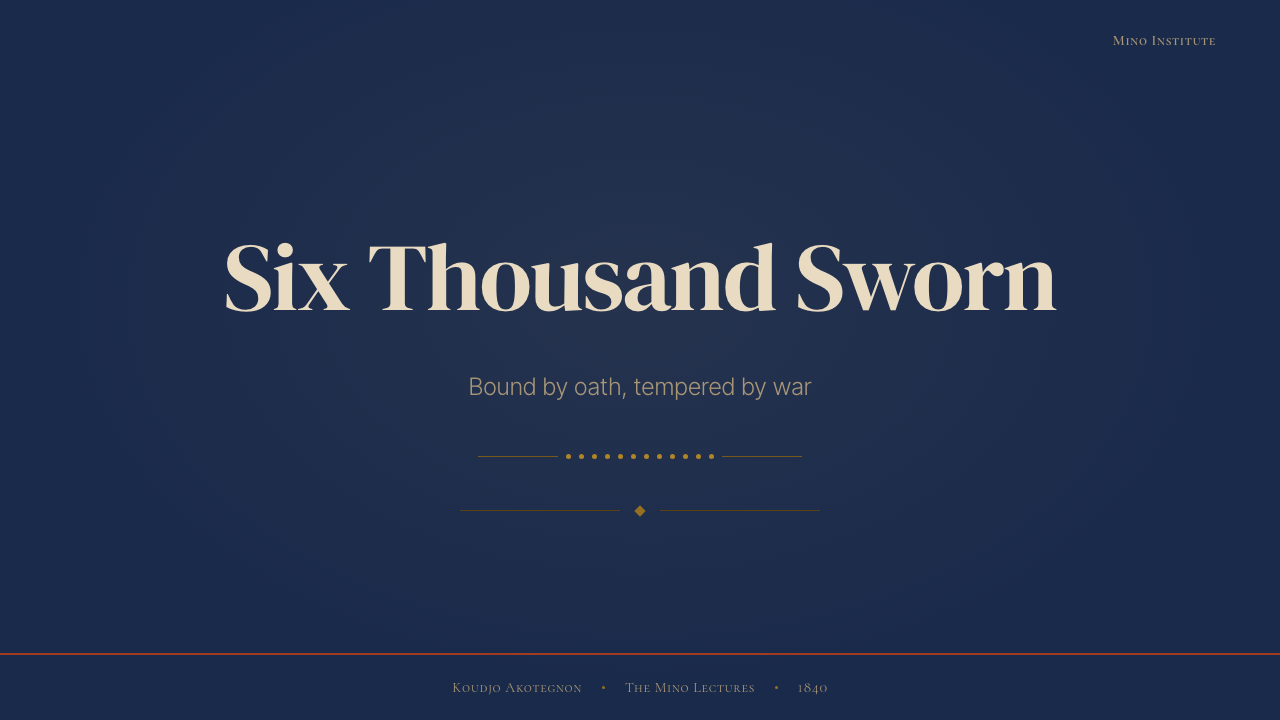
For presentation slides, this style is best suited to content that needs to communicate importance without performing it. A conference keynote on institutional history, a strategic briefing, an organizational retrospective. The cover page should commit to the deep indigo ground with clay banding across the lower third and the title in compressed letterforms in the brass register. Content slides work best as clean zones within the band system: one dominant band for the section header, a clear field below it for the content. Data slides can use the clay and brass tones to distinguish data series in charts — this is one context where the palette naturally assigns hierarchy to information without requiring additional design decisions.
For web interfaces, the style suits contexts that benefit from institutional authority: archival platforms, cultural heritage organizations, academic publishers, defense and security firms, and high-stakes analytical tools. A dashboard built in this system should use the indigo as the sidebar and header ground, clay banding to mark section transitions or active states, and brass-register tones for interactive highlights and data emphasis. Avoid using this palette for e-commerce or consumer wellness products — its severity works against the warmth those categories require.
For editorial and marketing work, the style excels at creating the visual weight of a printed artifact: an anniversary retrospective, a monograph cover, a cultural institution's annual report. Full-bleed indigo spreads with clay headline bands and sparse brass accents create pages that feel like they have physical presence even in digital form. Marketing applications should be selective: this palette carries conviction well for launches and announcements where gravitas is the goal, but it can feel oppressive if used for content that calls for accessibility or playfulness.
The most common mistake when applying this style is softening it for approachability — lightening the indigo toward navy, warming the clay toward terracotta, rounding corners, adding ambient glow. Each of those adjustments individually seems modest, but collectively they transform a system of disciplined severity into a generic dark aesthetic that retains the colors but loses the authority. The system's power comes from maintaining all of its hardness simultaneously. A second common mistake is decorating within the bands — adding pattern, gradient, or illustration to the horizontal register zones. The bands work because they are absolute; the moment they become decorative surfaces, they stop functioning as structural divisions.
Dahomey Amazons (1840) — FAQ
Is this style appropriate for brands that have no connection to West African history?
The question of cultural context is legitimate and worth thinking through carefully. The visual system is derived from a specific historical reality — the military aesthetics of an actual corps of warriors in a specific kingdom in a specific century. Applying it to unrelated commercial contexts is not inherently disrespectful if the source is acknowledged and the adaptation is done with understanding rather than surface extraction. What makes an application thoughtful is knowing what the system actually encodes — severity, collective discipline, archival weight — and deploying it only where those values are genuinely relevant to the context, not simply for the visual impact of an unfamiliar color palette.
How does this style differ from other West African-inspired design systems?
Most design systems described as 'West African' draw on the region's rich textile traditions — Kente cloth, Ankara prints, Adinkra symbols — which are characterized by vivid multicolor geometry, dense repetitive pattern, and celebratory visual energy. The Dahomey Amazons system is categorically different. It draws not from textile tradition but from military material culture: uniform construction, brass fittings, weapon design, and the spatial logic of regimental organization. The result is architectural rather than textile, compressed rather than exuberant, and monumental rather than decorative. The only element it shares with most 'West African' aesthetics is the laterite clay-red, which is a geological and architectural reality of the region rather than a stylistic choice.
Can this style be adapted for a lighter, daytime feel without losing its character?
Not in any straightforward way. The style's character is inseparable from its dark ground. Inverting to a light background forces a complete reconception of how the palette operates — clay on cream reads as terracotta folk art rather than military severity; brass on white reads as jewelry rather than armor fitting. If a lighter application is genuinely required by the context, it is better to treat it as a separate derived variant than to attempt a simple inversion. A light variant might retain the horizontal banding structure and the compressed typographic logic while shifting to sand, clay, and a restrained brass-gold on a warm off-white ground — acknowledging the source but accepting that the result is a fundamentally different emotional register.
How should the brass accent be used without making the design feel precious or luxurious?
The key is understanding the difference between brass as material culture and gold as status symbol. In the Mino context, brass appeared on functional objects: cartridge belts, sword guards, rivets. It was a working metal, not a precious one. Translating this into a design system means using the brass tone for elements that perform a function — interactive states, data highlights, structural indicators — never as a finish applied to areas simply to make them look rich. The brass register should appear in relatively small quantities, and the surrounding dark indigo ground should do enough visual work that the brass reads as purposeful emphasis rather than decorative sheen.
Is the Mino's story well documented, or is much of what is known disputed?
The historical record is genuine but uneven. Dahomean oral history preserved substantial detail about the Mino's organization, oath-taking, training practices, and role in specific campaigns. European accounts — from French, British, and Portuguese visitors — provided additional detail, though those accounts were filtered through colonial frameworks and occasional sensationalism. The most significant scholarly synthesis in English, Stanley Alpern's 'Amazons of Black Sparta' (1998), worked to reconcile oral and documentary sources and established a reasonably solid factual baseline. What remains uncertain includes precise numbers at various periods, the internal hierarchy and command structure, and the specific visual details of different regimental insignia. The core facts — that the Mino existed as an all-female professional military corps, that they were regarded as elite fighters, and that they played a significant role in Dahomean military operations from at least the early eighteenth century through 1894 — are not seriously disputed.
Related design styles
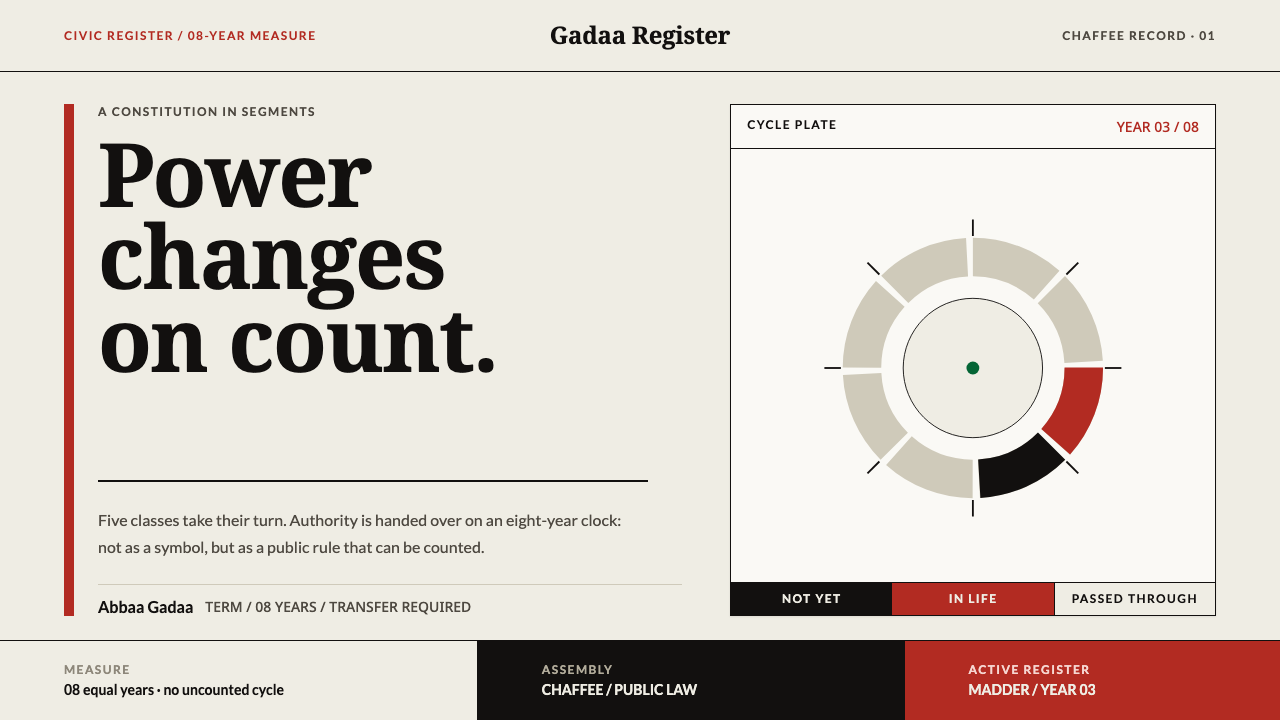 Oromo GadaCivic time made countable. Madder, black and white turn an eight-part ring in…
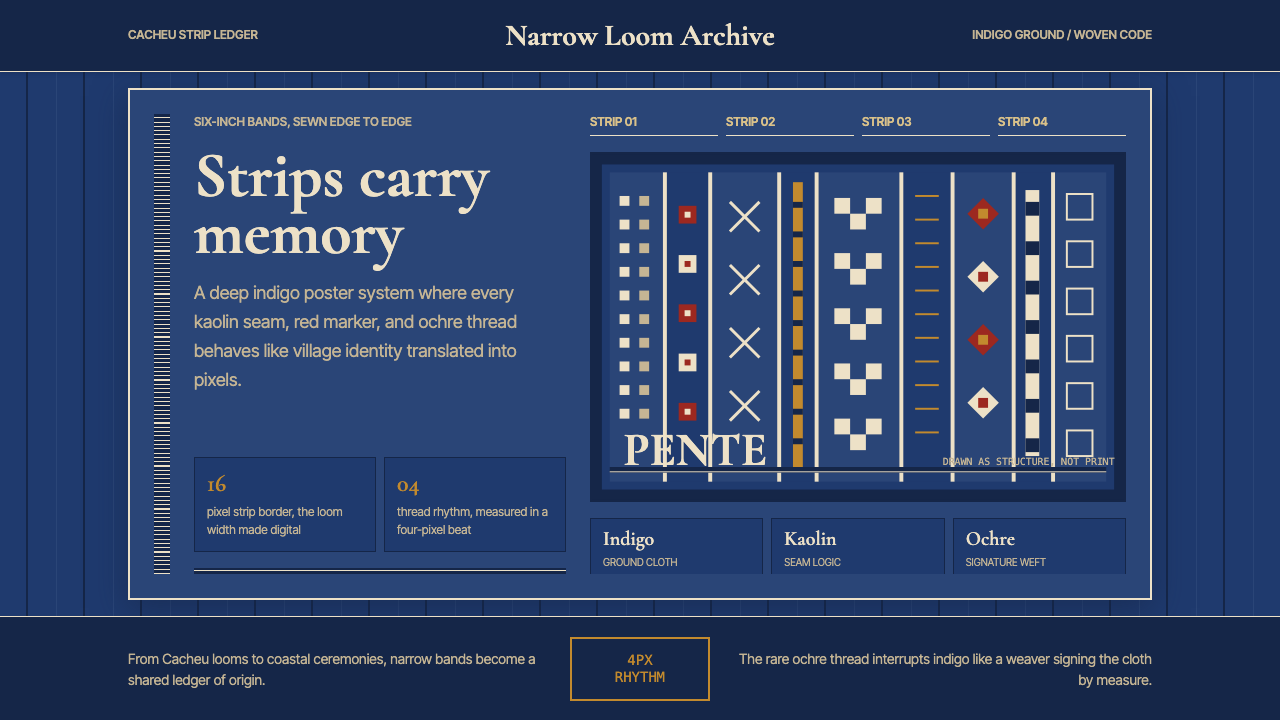 Bissau-Guinean Pano de PenteIndigo remembers. Narrow bands and kaolin seams turn weave grammar into pixel…
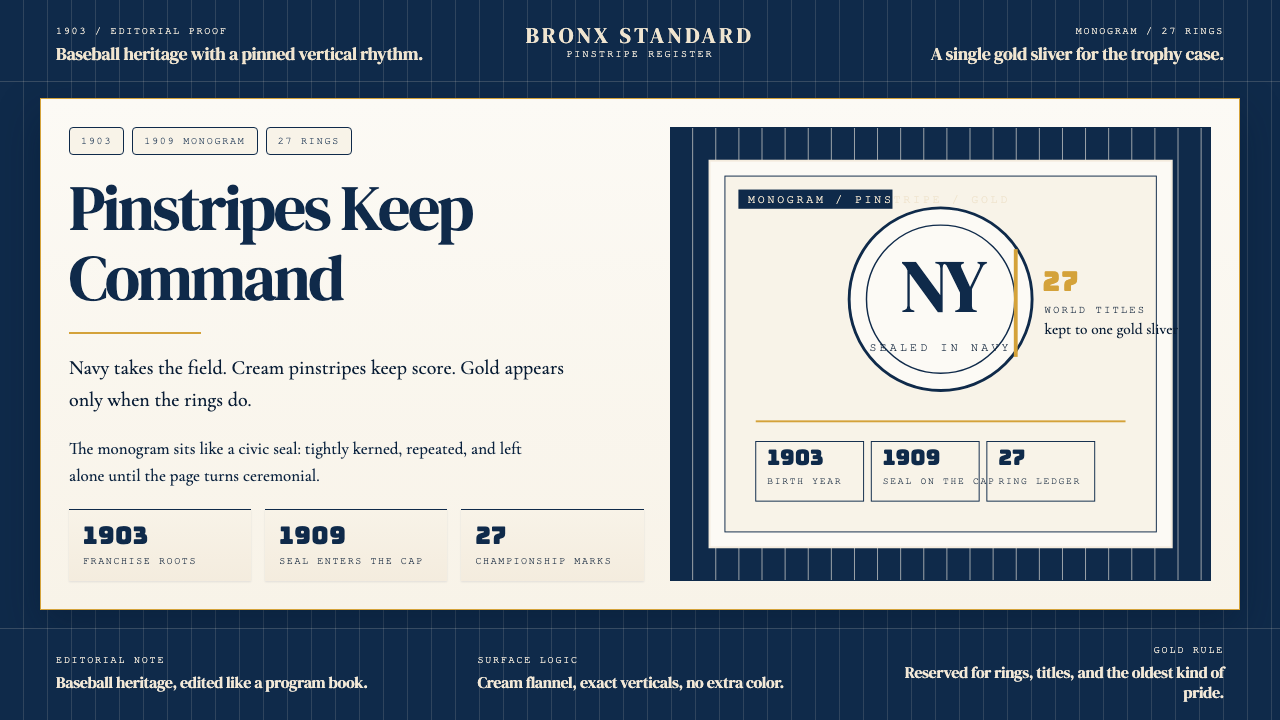 New York Yankees (Navy-Pinstripe)Navy restraint, not noise. Cream pinstripes and a gold monogram seal do the w…
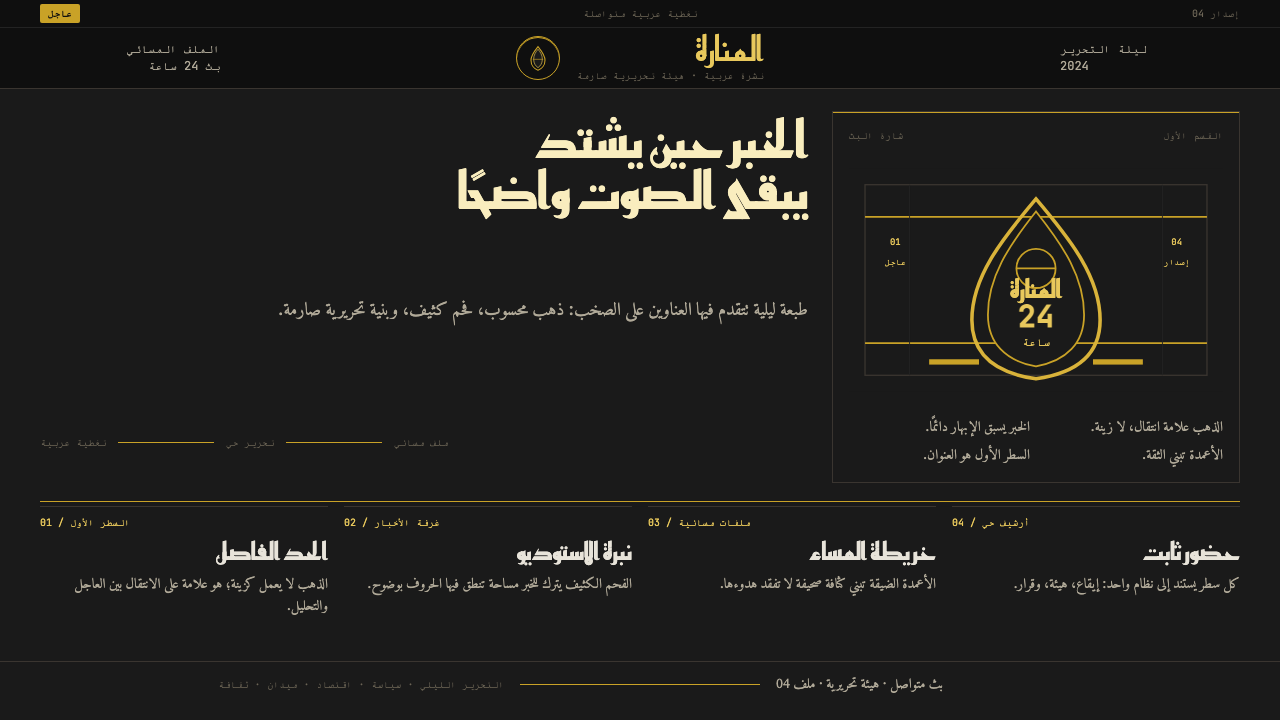 Al Jazeera Arabic NewsAuthority, stripped bare. Gold seal, dense Arabic type, matte charcoal.
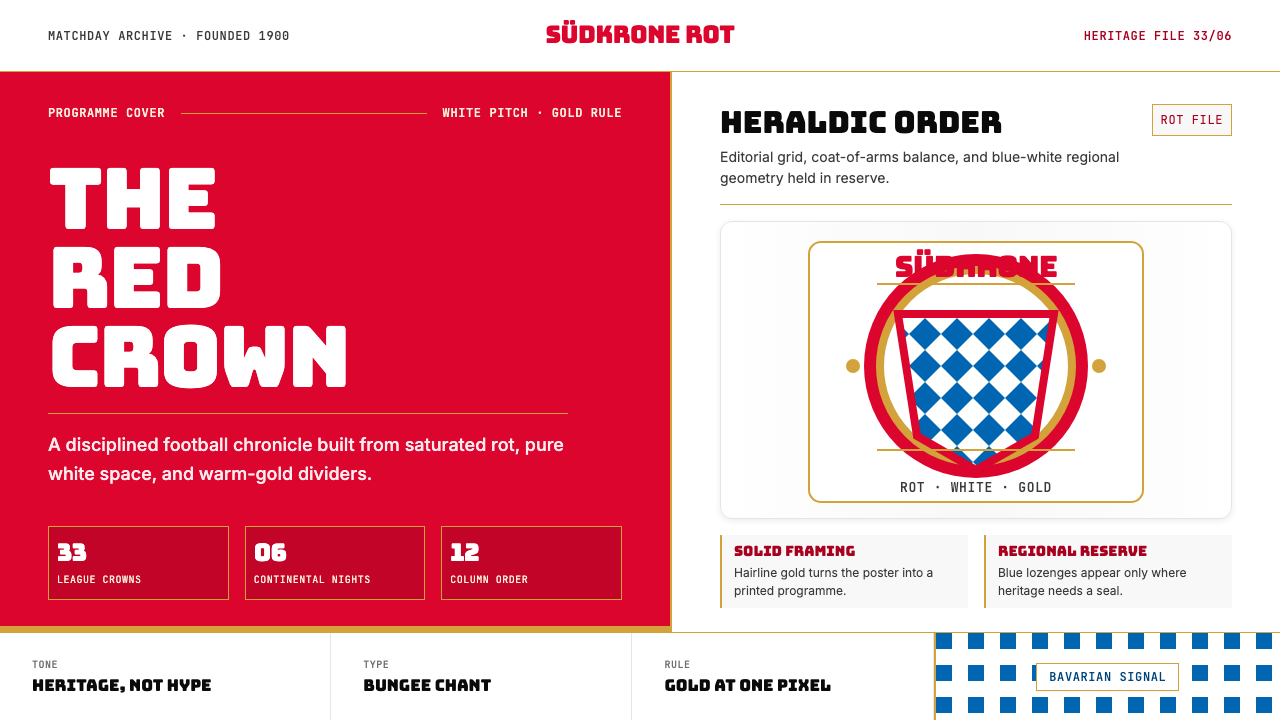 Bayern Munich (Rot)Heritage, not hype. Saturated rot fields, gold rules, and blue lozenges enfor…
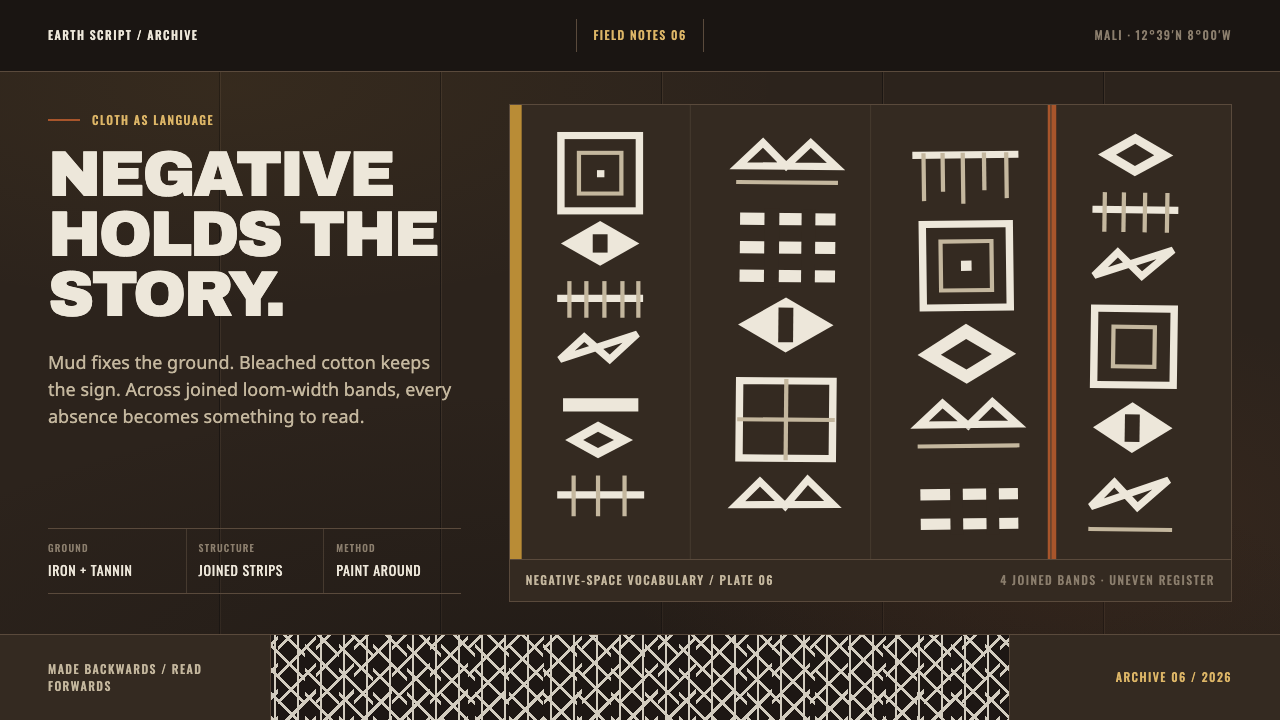 Bogolanfini MudclothAbsence becomes language. Warm iron-black bands hold uneven bleached-cotton s…