What is Cybergoth Rave?
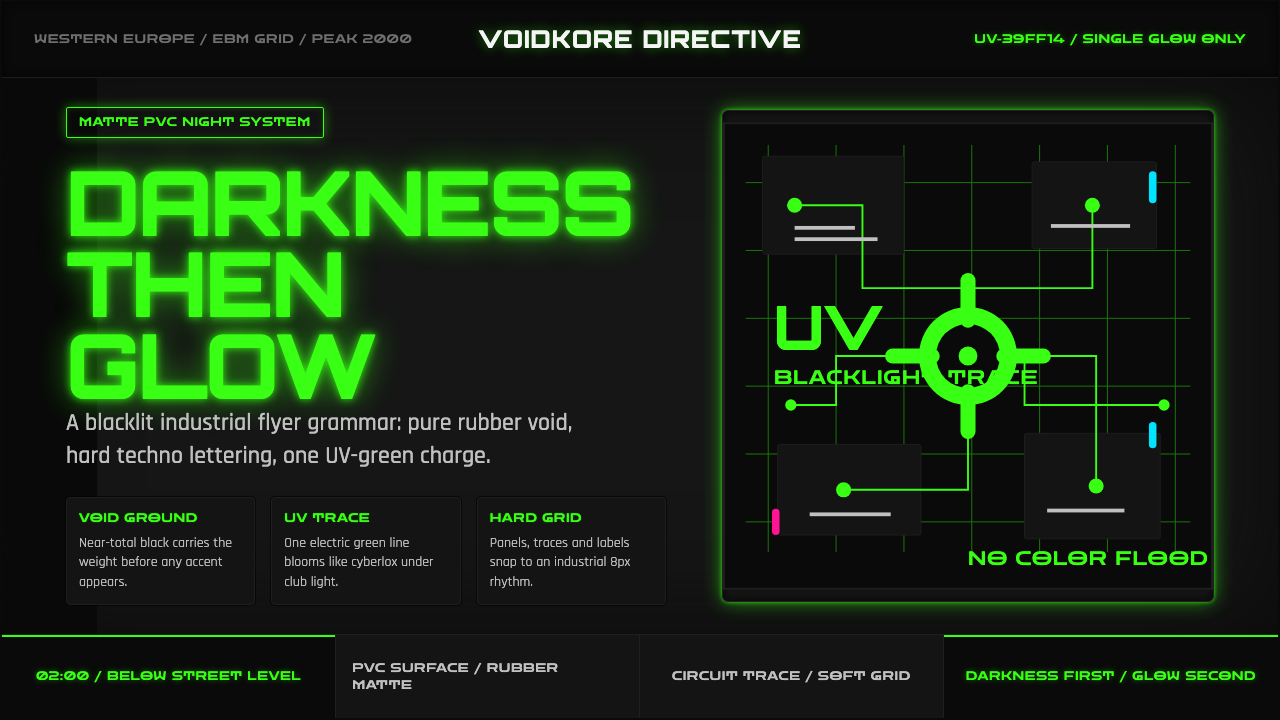
Cybergoth Rave compresses the UV-lit underground club at the turn of the millennium into a single, absolute rule: total matte black, cut by exactly one searing glow.
Cybergoth Rave in brief
Cybergoth Rave is the visual language of a very specific dance floor: a European industrial or EBM (electronic body music) club around the year 2000, lit almost entirely by blacklight, where the crowd wears matte black PVC, rubber, and vinyl and the only relief from the darkness is whatever happens to fluoresce under UV — a cyberlox hair fall, a pair of goggles, a strip of reflective tape. The style takes that literal lighting condition and turns it into a design rule: everything starts from near-total black, and exactly one electric, UV-reactive color is allowed to cut through it.
It sits at the collision point of three separate scenes that had been drifting toward each other through the 1990s — goth's black-clad theatricality, industrial and EBM's mechanized, body-conscious sound and dress, and the emerging cyberpunk and rave imagery of computer-age club culture. None of those three scenes alone produces this look; it is specifically the fusion, concentrated in Western European club nights around the turn of the millennium, that gives Cybergoth Rave its particular combination of goth's darkness, industrial's hardware fetish, and rave's neon-lit night-world energy.
The discipline that makes the style legible is restraint, not abundance. A dance floor lit by a single blacklight tube does not produce a rainbow — it produces a field of near-total black interrupted by whatever specific pigments happen to fluoresce, and everything else stays void. Translated to an interface, that means one saturated accent color, never two, set against a black so complete it reads as an absence rather than a hue. Circuit-trace linework, goggle and gas-mask silhouettes, and cyberlox-like braided motifs supply the recurring iconography, but they are drawn thin and precise against the dark rather than piled on as texture.
Where does Cybergoth Rave come from?
The sonic and sartorial groundwork was laid by industrial and EBM music in the 1980s and early 1990s. Belgian act Front 242 helped popularize the very term 'electronic body music' with their stripped, percussive, militaristic sound and stage presentation, and British industrial-EBM group Nitzer Ebb built a similarly harsh, body-forward aesthetic around the same years. Both acts, along with the broader industrial scene, cultivated an audience already dressed in black synthetic materials, combat boots, and utilitarian hardware long before the word 'cybergoth' existed — the darkness came first, and the glow came later.
Through the 1990s, that industrial and EBM crowd increasingly shared floor space and festival bills with rave and early cyber-fashion culture, which contributed the blacklight-lit, UV-reactive club environment and an appetite for goggles, masks, and futuristic accessories drawn from an imagined machine-age future. The two scenes did not merge everywhere, but in specific Western European club circuits — clustered especially around the UK, Germany, and the Netherlands — they overlapped enough by the late 1990s to produce a recognizably new hybrid look on the dance floor.
That hybrid was given an explicit visual vocabulary in the early 2000s, most notably by the UK-based fashion collective Contagious Skin, widely credited within the scene with codifying and popularizing the look's signature accessories — cyberlox falls, industrial goggles, and gas-mask-adjacent headgear — into something recognizable enough to be called its own subculture rather than a loose fusion. Around the same period, large annual gatherings such as the Wave-Gotik-Treffen festival in Leipzig, Germany, founded in 1992 as a meeting point for the broader goth and industrial scene, became one of the places where this cybergoth strand was visible en masse, cross-pollinating with adjacent styles.
By the peak years around 2000, Cybergoth Rave had settled into a recognizable, if niche, subcultural uniform — one still documented largely through scene photography, club flyers, and fan community accounts rather than formal design history, since it grew from the floor up rather than from any single designer's studio. Some of the finer details of who wore what first are, appropriately for a dance-floor subculture, closer to community folklore than verified record; what is well documented is the underlying pattern — near-total black clothing worn under blacklight, with UV-reactive accessories providing the only color — which this design system translates directly into an interface grammar.
What defines the Cybergoth Rave look?
Color
The base is a near-total, matte black — treated as a void rather than a background hue — against which exactly one saturated, UV-reactive color is permitted, canonically an acid, electric green. There is no second accent; wherever a system needs to signal difference, it varies the size, position, or intensity of that one glow rather than introducing a second color, mirroring how a single blacklight tube can only make specific pigments fluoresce.
Surface and material
Surfaces read as matte synthetic material — PVC, rubber, vinyl — rather than glossy plastic or soft fabric, with only narrow, controlled highlights suggesting a sheen. This keeps large black fields feeling dense and physical, like club-wear, rather than flat and empty; the material quality is doing structural work, giving weight to areas that would otherwise be pure negative space.
Iconography
Recurring motifs are drawn straight from the scene's physical uniform: goggle and gas-mask silhouettes, circuit-board trace patterns, and braided, cyberlox-like linework. These are rendered as thin, precise line art rather than filled illustration, so they read as technical diagrams of the subculture's own accessories rather than decorative icons borrowed from elsewhere.
Contrast and void
The relationship between black and glow is a hard cut, not a gradient — a field either sits in darkness or it fluoresces, with nothing washing gradually between the two states. Large expanses of unbroken black are treated as deliberate, load-bearing composition rather than empty space to be filled, echoing the physical experience of standing in a mostly-dark room lit by a single light source.
Typography
Letterforms lean angular and mechanical, closer to a rave flyer's stencilled urgency or an industrial equipment label than to a soft display face. Body text stays quiet and legible against the black, while the one accent color is reserved for the rare word or numeral that needs to feel like it is glowing under blacklight rather than simply printed.
Composition and rhythm
Layouts are dominated by generous black negative space punctuated by one focal glowing element, echoing a strobing dance floor rather than a fully lit room. Rhythm is created by spacing and repetition of the glow motif — a single accent recurring at intervals across an otherwise dark composition — rather than by varying color across the page.

Who shaped Cybergoth Rave?
The Belgian act helped popularize the term 'electronic body music' itself in the mid-1980s with a stripped, percussive, militaristic sound and stage presentation. Their audience's black synthetic clothing and utilitarian hardware predate the word 'cybergoth' by well over a decade, but that crowd's look is the direct sartorial ancestor of the style's matte-black base.
The British industrial-EBM group built a similarly harsh, body-forward visual and sonic identity across the same years as Front 242, reinforcing the sound and look that the industrial and EBM club circuit carried into the 1990s. Their fan base's uniform of black gear and combat boots is part of the same lineage that Cybergoth Rave later layered a UV glow onto.
The UK-based fashion collective is widely credited within the cybergoth scene with codifying its signature accessories in the early 2000s — cyberlox hair falls, industrial goggles, and gas-mask-adjacent headgear — turning a loose fusion of goth, industrial, and rave dress into a recognizable, nameable subculture uniform.
Founded in 1992 in Leipzig, Germany, this annual festival became one of the central gathering points for the broader goth and industrial scene, and by the turn of the millennium it was one of the places where the cybergoth strand became visible en masse alongside related styles, helping the look circulate across a wider European audience.
How do you use Cybergoth Rave today?
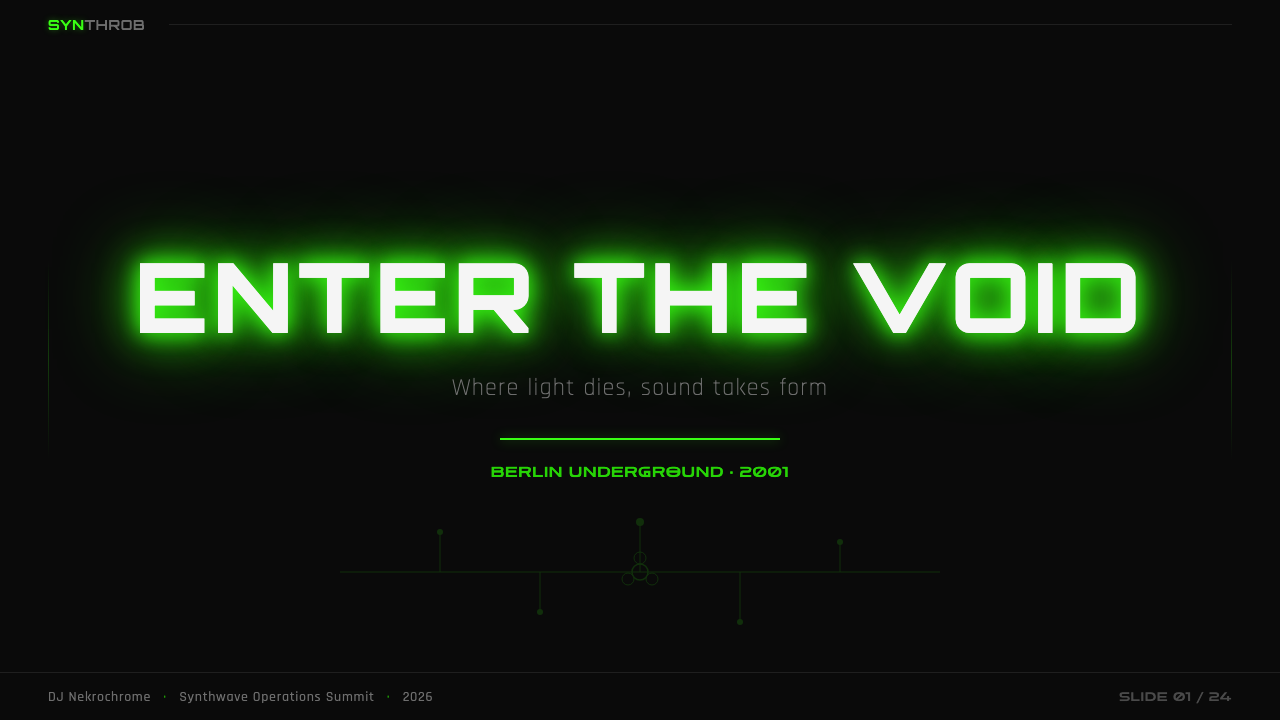
On a presentation cover, the style works as a near-black field with a single glowing headline element — the title or logo rendered in the one accent color while everything else, including any supporting text, stays dark enough to feel like it is standing in shadow. Content slides should keep body text and structural elements in restrained dark tones and reserve the glow strictly for the single most important word, number, or icon per slide; spreading the accent color across multiple elements collapses the whole effect. Data slides suit the style surprisingly well for anything meant to feel urgent or alarm-like — a single spiking metric rendered in the glow color against an otherwise dark chart reads as genuinely dramatic, precisely because nothing else on the slide is competing for that same visual weight.
In web interfaces, the style fits dashboards and monitoring tools built around a single critical signal — a live status, an alert count, an anomaly — because its entire grammar is built to make one element seem to glow against darkness. A pricing page can use the accent color exclusively on the recommended tier, so that tier reads as genuinely lit up rather than merely highlighted with a border, while every other tier stays part of the surrounding dark field. The discipline here is the hardest part: interfaces default toward using an accent color liberally for buttons, links, and states, and this style requires resisting that default everywhere except the one place that actually needs to feel like it is glowing.
For editorial and marketing pages, the style suits content about music culture, nightlife, technology-with-an-edge, or anything positioning itself as underground rather than mainstream. A marketing hero section can commit fully to the void-and-glow relationship — a mostly black composition with one illuminated headline or product shot — while an editorial layout can use the accent color sparingly for a single pull-quote or section marker, treating it the way the physical subculture treated its own UV accessories: rare, deliberate, and load-bearing.
Photography needs the same restraint as everything else in the system. Images work best when they are genuinely low-key and high-contrast — dark environments with one bright practical light source — rather than evenly lit product photography, because evenly lit imagery breaks the club-lighting logic the rest of the system depends on. A photograph shot in flat, even light will always look out of place dropped into this system, no matter how well its subject matter fits.
The most common mistake is treating 'cyber' as license for a broader neon palette — adding a second or third accent color, or a gradient between two hues, in the name of feeling more futuristic or more colorful. That instinct undoes the entire premise. The style's power comes specifically from the discipline of one glow against total darkness; a second color does not make the system feel more electric, it makes it feel like a generic neon theme that has lost the exact physical logic — one blacklight, one fluorescing pigment — that gives Cybergoth Rave its identity.
Cybergoth Rave — FAQ
Why does the system allow only one accent color instead of a full neon palette?
Because the style is modeled on a real physical condition, not a generic idea of 'neon.' A room lit by a single blacklight tube only makes specific UV-reactive pigments fluoresce; everything else, no matter how colorful in daylight, reads as flat black under that light. One accent color is what that condition actually produces, and the design system holds to that limit deliberately — adding a second or third color would break the logic the whole aesthetic depends on.
Is Cybergoth Rave the same as general 'cyberpunk' design?
They are related but not identical. Broad cyberpunk visual language typically layers multiple neon hues, dense HUD-style overlays, and glitch effects over a busy composition. Cybergoth Rave is narrower and more austere: it descends specifically from a real club subculture's physical dress code and lighting condition, and its defining move is subtraction — near-total black with exactly one glow — rather than the maximal, layered density typical of cyberpunk media.
What does 'cyberlox' mean, and why does it show up as a motif?
Cyberlox refers to the synthetic hair falls and extensions, often braided or wrapped in bright UV-reactive material, that became one of the cybergoth scene's signature accessories in the early 2000s. In this design system, that braided, strand-like form is abstracted into a recurring linework motif — thin, looping lines that echo the physical accessory without literally illustrating hair.
Does this style work with any color other than green as the accent?
The canonical, most historically grounded accent is an acid, UV-reactive green, since that particular hue fluoresces especially strongly under blacklight and was extremely common in scene photography of the period. Other saturated UV-reactive colors — an electric magenta or cyan, for example — are consistent with the same underlying logic, provided the system still commits to exactly one accent against total black rather than mixing several.
Why is so little formally documented about who started this look?
Cybergoth grew up on dance floors and in club-scene community spaces rather than through any formal design institution or single studio, so its early history lives mostly in scene photography, flyer archives, fan forums, and oral memory rather than published design criticism. That is typical of subculture-born aesthetics generally — the pattern is well documented even where individual firsts are not, and this design system is built from that well-documented pattern rather than from any single claimed origin point.
Related design styles
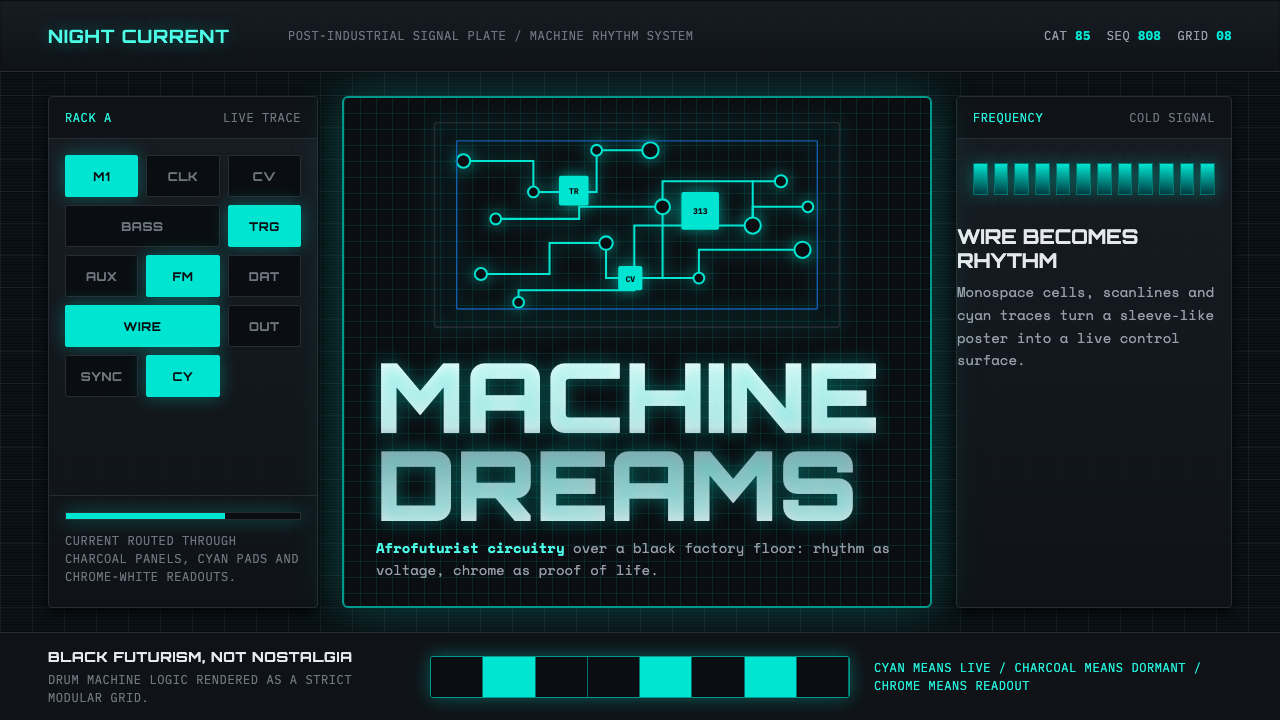 Detroit TechnoCold machines dream. Electric cyan circuits and chrome display type lock to a…
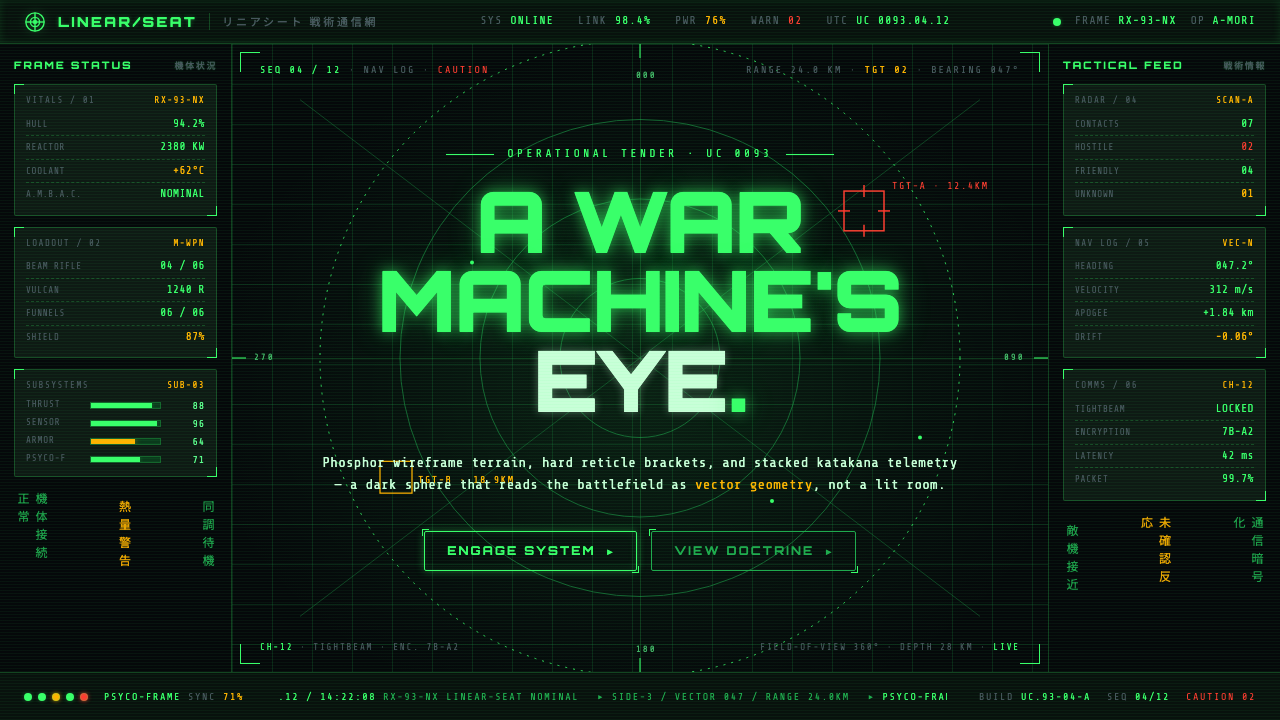 Gundam Universal Century UIA war machine's eye. Phosphor wireframe and katakana telemetry glow inside a…
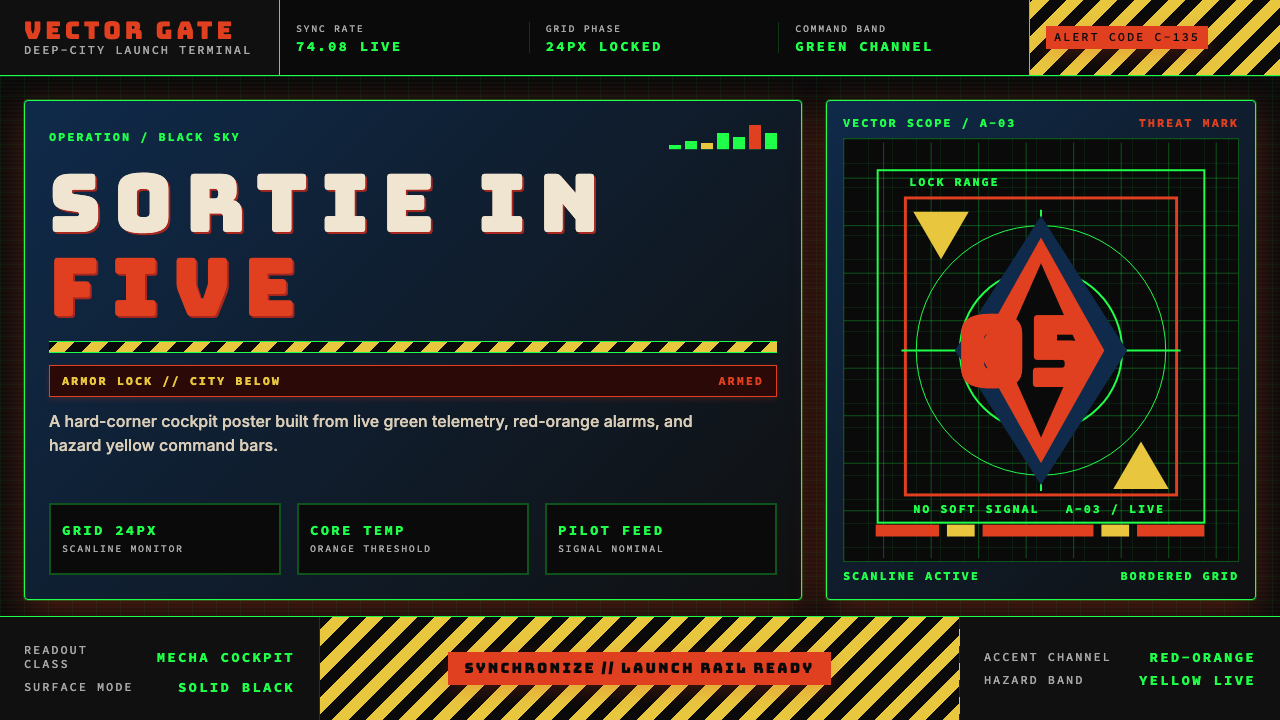 Neon Genesis EvangelionCockpit dread at launch. Tech-green grids, red-orange alarms, and hazard yell…
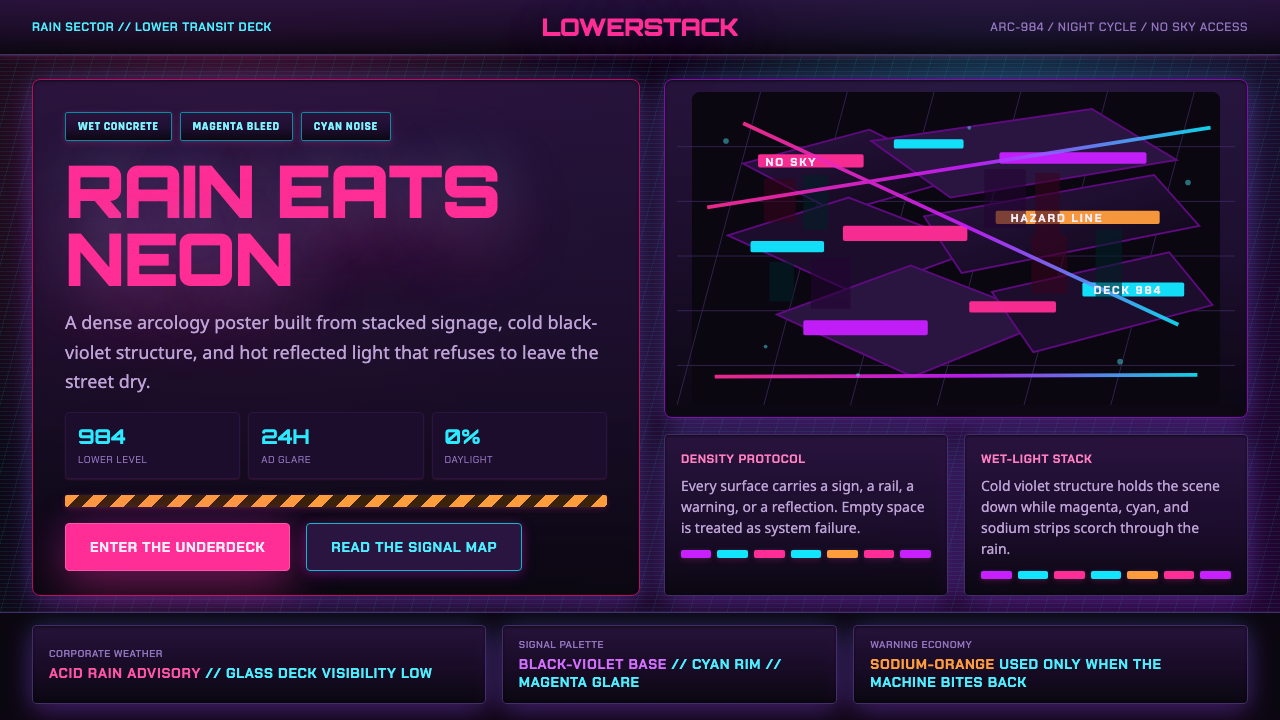 The Ascent ArcologyNeon suffocates the dark. Magenta and cyan signage stacks over wet black-viol…
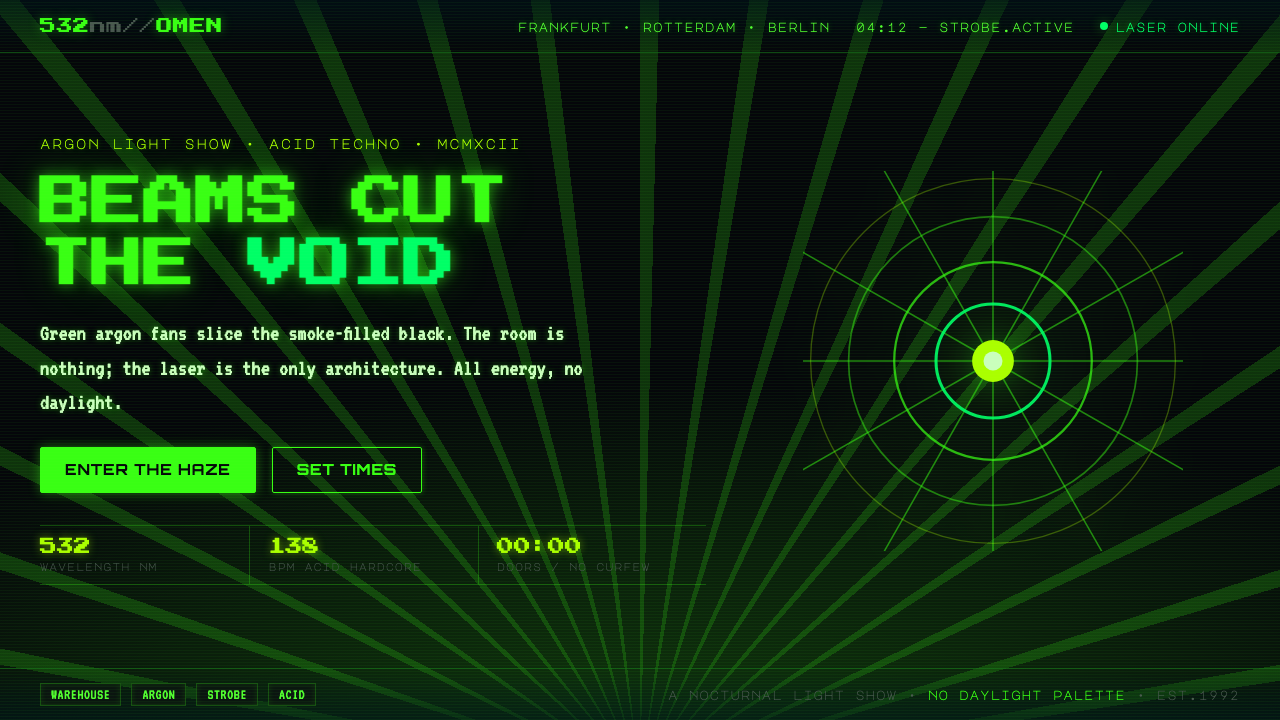 Acid Rave Laser Show 1992Beams cut the void. Argon green on pitch-black smoke, pixel marquee type, add…
 Edgerunners NeonNeon overload. Fluorescent yellow, cyan HUD grids, and magenta glitches burn…