What is Cuban Salsa Cabaret (1950)?
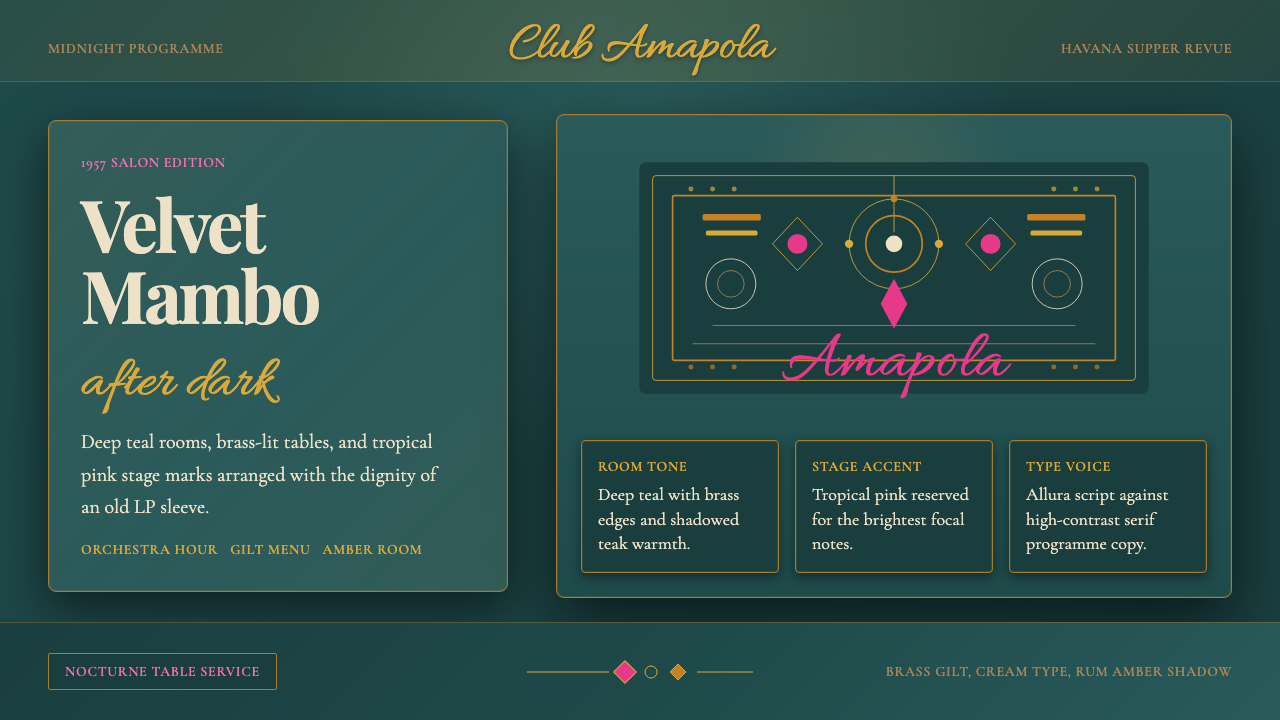
Havana's golden-age cabarets — Tropicana, Sans Souci, Cabaret Parisién — staged an era of deep teal rooms, warm amber light, and handwritten gilt script that the world has never quite forgotten.
Cuban Salsa Cabaret (1950) in brief
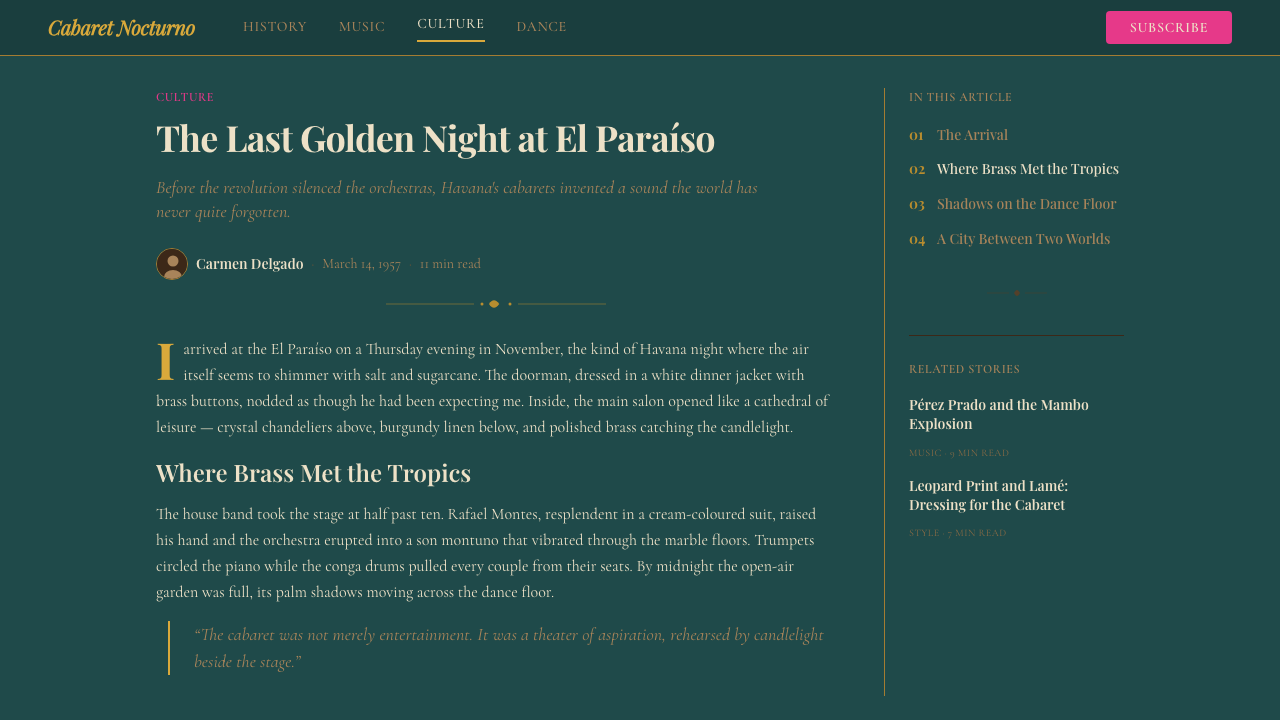
Cuban Salsa Cabaret (1950) is a design style rooted in the visual language of pre-revolution Havana nightlife at its most extravagant and dignified. It draws from the theatrical interiors of the great Caribbean cabarets — open-air arcades, crystal chandeliers, teak wall paneling, hand-painted menu cards — and translates that atmosphere into a graphic and digital vocabulary defined by depth, warmth, and ceremony.
The palette is built around a rich, saturated teal that anchors compositions the way velvet drapes frame a stage, paired with warm amber and brass tones that evoke the glow of chandeliers and polished fixtures. Against this deep ground, accents of tropical pink and ivory appear like spotlights cutting through a darkened room. Gold, treated not as gaudy decoration but as embossed script on fine menu cards, provides the defining typographic texture.
Where many dark or glamorous styles risk visual noise, the Cuban Salsa Cabaret aesthetic maintains a sense of composed elegance — the dignity of a dining room that happens to contain a seventeen-piece orchestra. Everything is intentional: the script lettering suggests handcraft and hospitality; the layered warmth of the color palette suggests candlelight without imitating it literally; even the textural references to leopard upholstery and gilded surfaces are absorbed into a system that stays controlled and purposeful.
Where does Cuban Salsa Cabaret (1950) come from?
The Cuban cabaret circuit took shape in the late 1930s when Havana was positioning itself as the playground of the Americas. The Tropicana opened in Marianao in 1939, originally as a small social club before expanding into an open-air theatrical venue that would become the most famous nightclub in Latin American history. Sans Souci, Cabaret Parisién at the Hotel Nacional, and the Montmartre followed, each competing to offer the most sophisticated staging of Caribbean music and dance for an international audience that included Hollywood celebrities, Latin American statesmen, and wealthy tourists from the United States and Europe.
The visual culture of these venues was defined by an unusual collision of influences. European Art Deco, which had arrived in Cuba through architecture and graphic design in the 1930s, provided the structural vocabulary: arched ceilings, geometric ironwork, monumental lettering. Afro-Cuban artistic traditions contributed vitality and color warmth — the tropical palette was not a European imposition but a genuine synthesis. American jazz and big-band aesthetics, arriving via radio broadcasts and LP sleeve design, shaped the typographic sensibility of advertising and programs. The result was neither European nor purely Caribbean but a genuinely creole visual language.
The decade between 1948 and 1958 — often called the Golden Age of the Cuban cabaret — coincided with the height of the mambo craze and the global spread of Cuban music. Choreographer and designer Roderico Neyra, known as Rodney, transformed the Tropicana's stage spectacle into an internationally recognized art form, dressing performers in elaborate tropical costumes and staging shows that were as visually complex as any Broadway production. The graphic materials produced during this period — program covers, advertising posters, LP sleeve artwork, cocktail menus — represent some of the most distinctive visual design ever produced in the Caribbean region.
The Cuban Revolution of 1959 ended the Golden Age abruptly. The great cabarets closed or were nationalized; the international clientele vanished; the flood of American tourism that had sustained the circuit dried up overnight. Tropicana survived under state management and continues to operate, but the particular cultural and commercial energy that produced the style was gone. The aesthetic resurfaced in the 1990s as Cuba reopened to international tourism, with nostalgic reproductions appearing in hotels, restaurants, and the global salsa revival. Contemporary designers encounter it chiefly through vintage LP covers, surviving cabaret programs, and the architecture of Havana's Vedado and Marianao districts — preserved less by intention than by the relative absence of development over the intervening decades.
What defines the Cuban Salsa Cabaret (1950) look?
Color
The palette is built on a deep, jewel-toned teal that functions as both background field and primary identity color — saturated enough to read as luxurious, dark enough to absorb ambient warmth without becoming muddy. Against this ground, brass and amber tones provide the central warmth, evoking gilded metal rather than raw gold. Tropical pink appears as an accent that feels unexpected yet inevitable — the color of bougainvillea visible beyond a terrace railing. Ivory and off-white reserve the brightest points of the composition for typography and fine-line ornament. The system reads as rich and layered without becoming heavy because the warmth is distributed across a narrow, purposeful range.
Typography
Script and handwritten letterforms occupy the expressive center of the style, recalling the hand-painted gilt signage and calligraphed menu cards of the cabarets themselves. These fluid, looping forms convey hospitality, ceremony, and a sense that someone took time and care with the communication. They are paired with the kind of condensed, elegant serif letterforms associated with 1950s entertainment advertising — proportions that read as refined rather than theatrical. Headlines feel like stage announcements; supporting text feels like fine-print program notes. The interplay between the flowing script and the upright serif creates the dual register of the style: intimate and grand simultaneously.
Texture and Surface
The style carries a persistent sense of material richness without relying on literal photographic surface reproduction. Velvet, brass, teak, and leopard-print upholstery are the reference materials — but in the designed system they translate into tonal depth, embossing-like effects in type treatment, and a slight organic irregularity that prevents the palette from reading as flat or digital. This is a style that should feel as if it has physical weight: like a menu card you can hold, not a screen you scroll through. That physical quality is achieved through the strategic deployment of texture-suggesting elements rather than literal material simulation.
Composition and Drama
Layouts in this style are theatrical in their staging — elements are placed with the deliberateness of objects arranged on a stage set. Large, centrally weighted compositions suit ceremonial contexts: an event announcement, a cover, a hero section. Asymmetry is used carefully rather than as a default, since the style's historical sources favored the balanced formality of a restaurant menu or a concert program. When asymmetry appears, it mirrors the asymmetry of a performance: an orchestra positioned to one side, a spotlight trained on the other. White space is used sparingly; the style tolerates a richer density than most contemporary idioms.
Ornament and Restraint
Unlike modernist styles that reject ornament entirely, the Cuban Salsa Cabaret style treats decoration as functional — it signals occasion and register in the way that a chandelier signals the formality of a room. Fine-line flourishes around titles, subtle border frames, and embossed-effect text treatments are permitted and expected. But the ornament never overwhelms the information hierarchy; it frames rather than fills. The test is whether a decorative element contributes to the sense of occasion or merely clutters the surface. Restraint here means knowing which ornaments to include, not whether to include any at all.
Dark Ground and Light
The style is defined by its dark-ground orientation — compositions are built on deep, richly saturated backgrounds rather than white or cream fields. This inversion from most print traditions is intentional and historically grounded: the cabarets themselves were dark rooms punctuated by pools of warm light, not bright, evenly lit spaces. The design language replicates that experience by treating lighter elements as sources of illumination rather than as the default ground. This requires a different compositional logic: the hierarchy is built by adding light rather than by adding color to white.
Musical Energy
At its best, the style carries a sense of contained rhythmic energy — the visual equivalent of a mambo arrangement building to a clave pattern. This does not mean layouts should be busy or syncopated in a literal sense, but that there should be a sense of organized momentum: a deliberate flow from one element to the next, sections that feel like movements in a suite. The script letterforms embody this quality most directly; their fluid strokes suggest motion even in stillness. The style resists the purely static and the purely decorative in equal measure, arriving instead at something between composition and choreography.

Who shaped Cuban Salsa Cabaret (1950)?
Known as El Bárbaro del Ritmo — the Barbarian of Rhythm — Beny Moré was the defining vocalist and bandleader of the Cuban cabaret golden age. His ability to move between son, mambo, bolero, and guaracha within a single performance made him the human embodiment of the style's synthesis: formal and spontaneous, refined and exuberant, in equal measure. His stage presence — white linen suit, cane, a commanding physical authority — translated directly into the visual iconography of the era's promotional materials and LP artwork.
Celia Cruz began her international career performing in the cabarets and clubs of Havana before the revolution, and the visual extravagance she brought to her costumes and stage presentation became inseparable from the style's visual identity. Her instinct for theatrical color — layered, saturated, always in conversation with her performers — mirrors exactly the palette logic of the design system: nothing timid, nothing accidental, everything calibrated for maximum warmth under stage light. After leaving Cuba following the revolution, she became the global ambassador for the sound and visual culture of that era.
Pérez Prado was the architect of mambo as an international phenomenon, transforming a Cuban dance music idiom into a global craze through a combination of musical showmanship and visual spectacle. His recording covers and concert promotional materials — often featuring bold lettering, tropical color washes, and silhouetted figures mid-movement — are among the most direct antecedents of the design style. As a bandleader who understood that the visual package of music mattered as much as the sound, Prado helped define what the aesthetic of Cuban entertainment should look like in print and on record.
As the chief choreographer and artistic director of the Tropicana from the late 1940s through the 1950s, Rodney was responsible for the visual total production — costume design, staging, lighting, and the integration of performance into the architectural space of the outdoor venue. He approached the cabaret show as a unified visual event, not simply a musical performance with costumes attached, and in doing so established the theatrical grammar that defines how the style uses space and spectacle. His work demonstrates that the style's visual extravagance was not incidental excess but the result of deliberate artistic direction.
As an institution rather than an individual, the Tropicana is the single most important material source for the design style. Founded in 1939 in the Marianao district of Havana, its open-air performance space — the Arcos de Cristal (Crystal Arches) hall designed by architect Max Borges Recio in 1951 — combined modernist structure with tropical excess in a way that has never been replicated. The visual documents produced for and by Tropicana over two decades of operation constitute the richest surviving archive of the Cuban cabaret aesthetic: programs, posters, menu cards, and publicity photographs that remain the primary reference for anyone working in this style today.
How do you use Cuban Salsa Cabaret (1950) today?
The Cuban Salsa Cabaret aesthetic is among the more demanding historical styles to apply well precisely because its richness is so seductive. The temptation is to pile on the teal, the gold script, the tropical pink, and the textural references simultaneously — resulting in something that feels costume-like rather than designed. Correct application requires treating the palette as a system of roles rather than a set of ingredients: the deep teal is the room, the amber warmth is the lighting, the script is the signage, and the tropical accents are the flowers in the arrangement. Each element has a function; none is simply decorative.
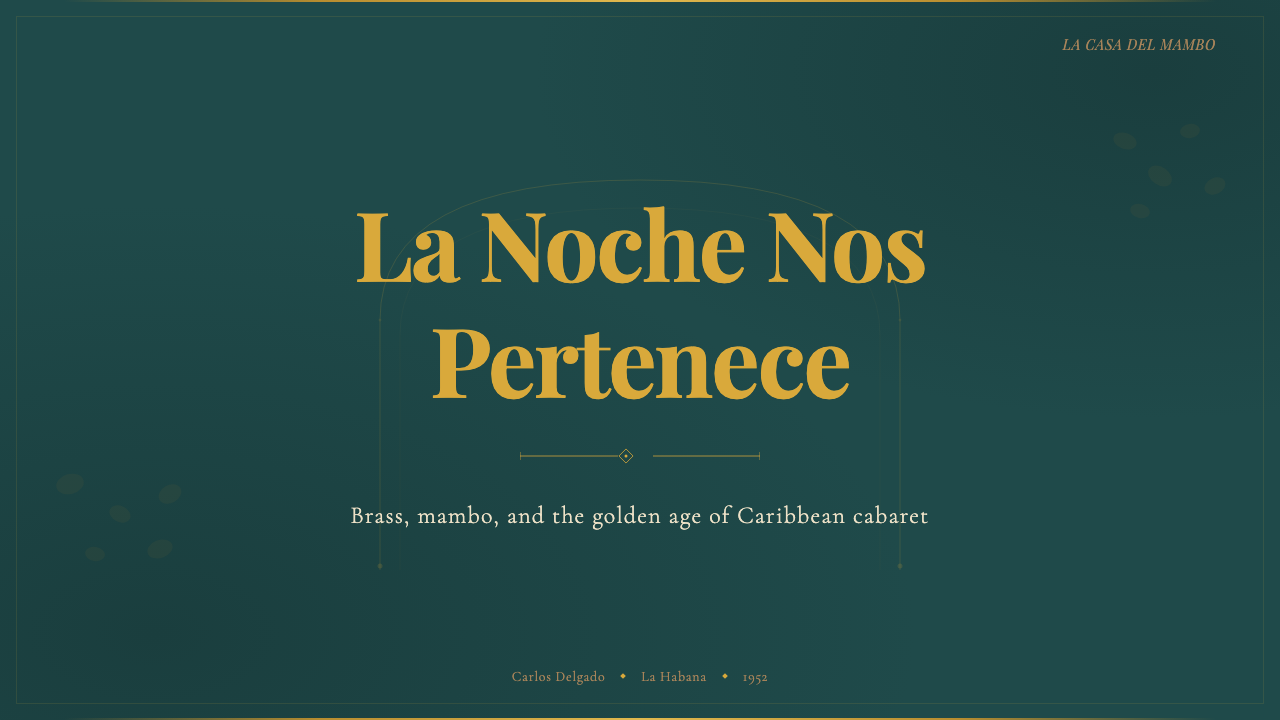
For presentation slides, this style works exceptionally well in contexts that call for ceremony and occasion: a creative agency pitch, a cultural institution's annual report, an event proposal for a hospitality brand. Cover slides should lean into the theatrical composition — large script headline centered against the deep teal ground, a horizontal rule in brass tone, a subtle textural field suggesting velvet or embossed card. Content slides require more discipline: reduce the palette to the teal ground with amber and ivory type, keep the script to headlines only, and maintain generous spacing so the richness of the background does not overwhelm the information being presented.
For web interfaces, this style is best suited to landing pages, event pages, and brand narrative sections rather than functional application UI. The dark ground and ornate typography create a strong sense of place and occasion that works well when the goal is to establish atmosphere — a premium cocktail brand, a music event platform, a cultural tourism site. Navigation and functional UI should be simplified significantly within this context: the style's richness is most effective as a hero or feature block, with cleaner, more neutral zones reserved for form inputs, data, and user action areas.
For editorial and marketing work, the Cuban Salsa Cabaret style excels at establishing a premium, culturally specific sense of occasion. A print or digital editorial spread using this visual language should treat the page like a stage: the typography enters from the top or one side, the visual elements are placed with deliberate asymmetric balance, and whitespace — when it appears — has the quality of silence between musical phrases rather than generic breathing room. Marketing campaigns in this style work well for any product associated with music, travel, hospitality, or cultural heritage, provided the brand has the confidence to commit to the aesthetic fully rather than applying it superficially.
The most common mistake when working with this style is treating the script typography as the only reference and neglecting the compositional and tonal sophistication that makes it work. Script letterforms applied over an ordinary dark background with generic layout produce pastiche. The style requires that color, texture, composition, and typography all operate together as parts of a single theatrical production. A secondary common error is over-brightening: on dark grounds, even small areas of high-saturation tropical pink or bright ivory can overwhelm the composition. The warmth should feel like candlelight — present and inviting — not like a spotlight aimed directly at the viewer.
Cuban Salsa Cabaret (1950) — FAQ
How is this style different from Art Deco?
Art Deco, as it developed in Europe and the United States in the 1920s and 1930s, tends toward cooler metallics — silver, chrome, platinum — geometric precision, and a certain machine-age austerity beneath its glamour. The Cuban Salsa Cabaret style shares Art Deco's commitment to ornament and theatrical presentation, but diverges decisively in warmth and sensory register. Where Deco is cool, this style is warm. Where Deco tends toward symmetry and geometric order, this style tolerates the asymmetry of musical performance and the organic curves of tropical flora. The dominant visual metaphor is not the ocean liner or the skyscraper but the open-air stage under a Havana sky.
Can this style work effectively in a light-background context?
The style was built for dark grounds, and its most characteristic effect — the sense of pools of warm light in a deep space — depends on that dark orientation. A light-background inversion is possible but requires careful rethinking rather than a simple palette swap. On a cream or ivory ground, the deep teal shifts roles from background to accent; the brass tones become primary structural color; the script lettering in dark teal on cream evokes the handwritten programs of the era without the theatrical depth. The result is closer to a refined Caribbean daytime aesthetic — appropriate for hospitality menus, cultural event programs, or editorial layouts — than to the cabaret atmosphere itself. It works, but it is a different emotional register.
Is this style appropriate for digital product interfaces, or is it primarily suited to print and brand contexts?
The style's richness and ceremony make it best suited to contexts where atmosphere and brand identity are the primary goals rather than functional efficiency. For full application software — navigation-heavy interfaces, data tables, form-dense workflows — the ornate typography and deep palette would create friction rather than clarity. The sweet spot is content-led digital experiences: a music streaming service's promotional layer, a cultural venue's landing page, a luxury hospitality brand's digital marketing. In these contexts, the style functions as a front door rather than a working interior — establishing the emotional register before the user moves into more neutral functional zones.
How should this style handle photography and image content?
Photography in this context should be treated as a tonal element rather than a documentary one. High-contrast images, particularly those with warm practical lighting — candlelight, stage lighting, amber-gelled fixtures — integrate naturally into the palette. Images should be cropped to serve the composition rather than to convey complete visual information; a close detail of a brass instrument bell, the arc of a dancer's arm, the pattern of a beaded dress — these work better than full-scene establishing shots. Period photography from the Havana cabaret era has a distinctive quality of warm grain and high contrast that complements the style; contemporary photography used in this context should be processed to share those qualities without literal grain simulation.
What is the relationship between this style and contemporary salsa or Latin music branding?
Contemporary salsa and Latin music branding often draws on the iconography of the golden age — the deep teals, the brass script, the tropical accents — but usually in a more compressed and commercially legible form. The Cuban Salsa Cabaret style is the historical source, not a contemporary genre aesthetic; working from the original rather than its contemporary derivatives produces richer and more authentic results. The distinction matters most in typography and ornament: contemporary Latin music branding tends toward bold, high-contrast display type and reduced ornamentation for legibility at small digital sizes, while the historical style sustains more intricate letterforms and layered decoration. Knowing which register you are working in — historical fidelity or contemporary reference — determines which design decisions are correct.
Related design styles
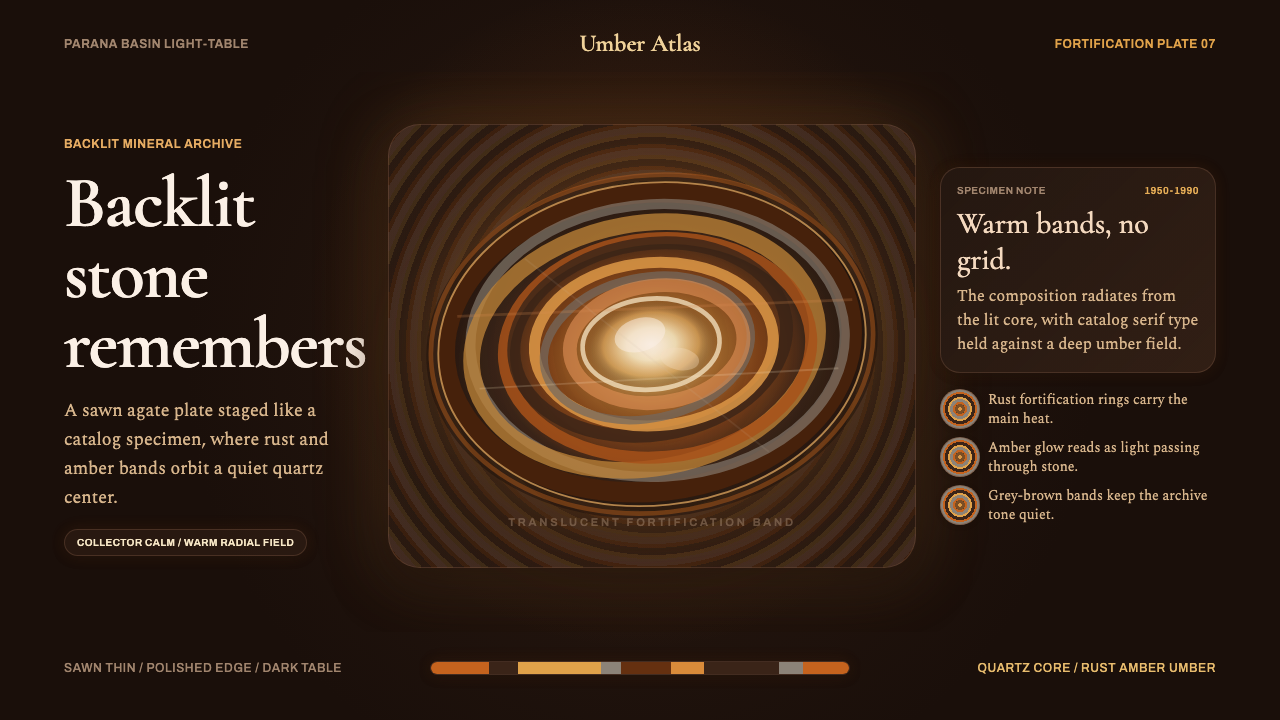 Banded Agate SliceCollector-calm glow. Rust and amber rings orbit a quartz core on near-black b…
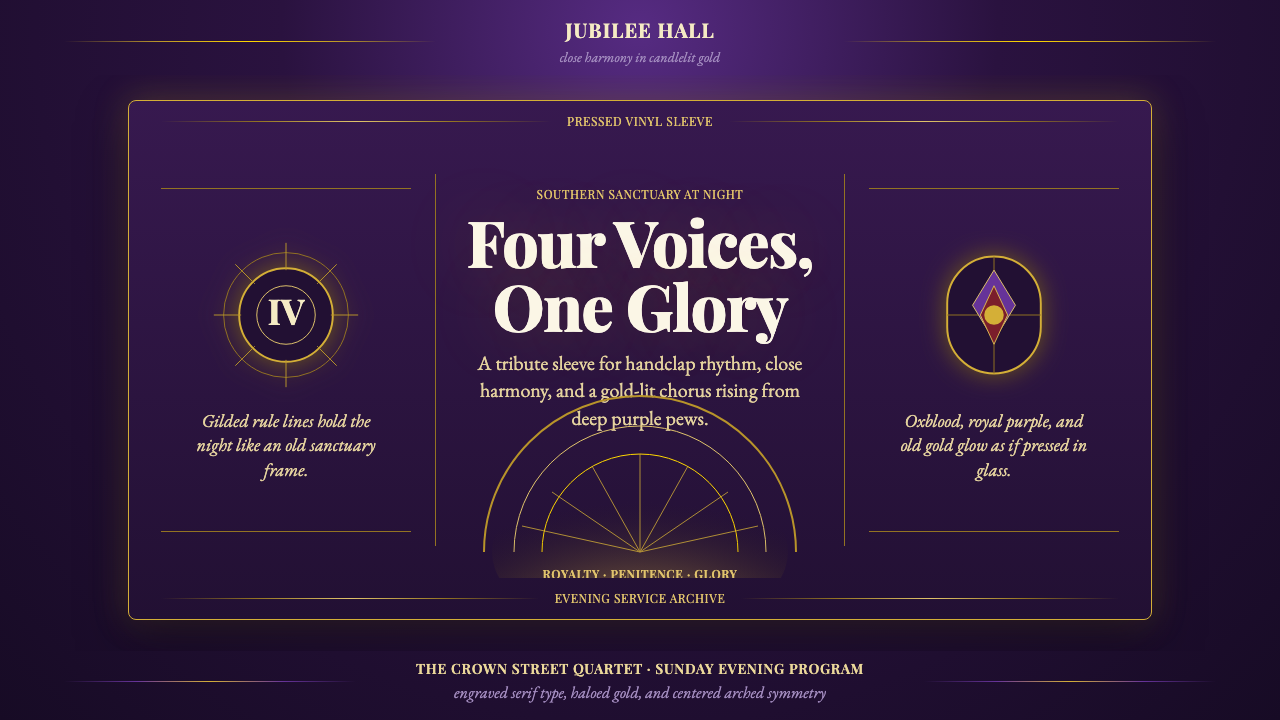 Gospel QuartetReverent and radiant. Liturgical purple, Playfair serifs, and arched gold rul…
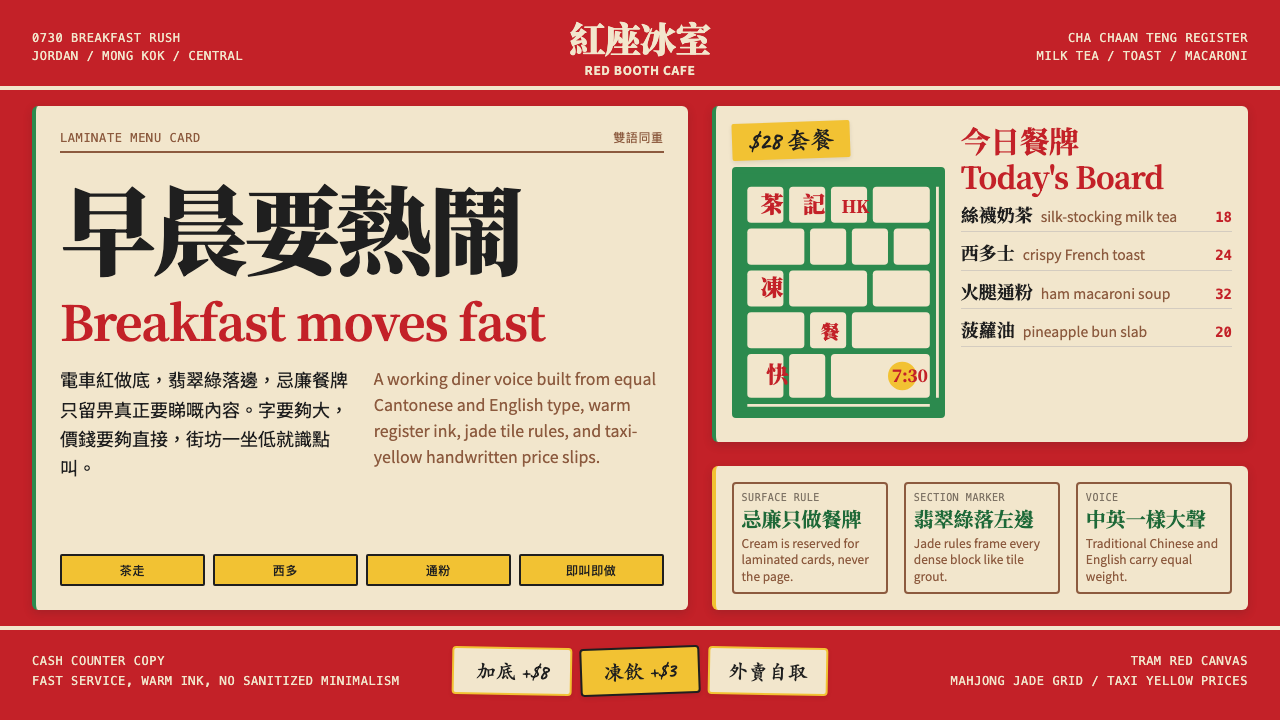 Hong Kong Cha Chaan TengDemocratic diner warmth. Tram red, jade rules, cream menu cards, equal Canton…
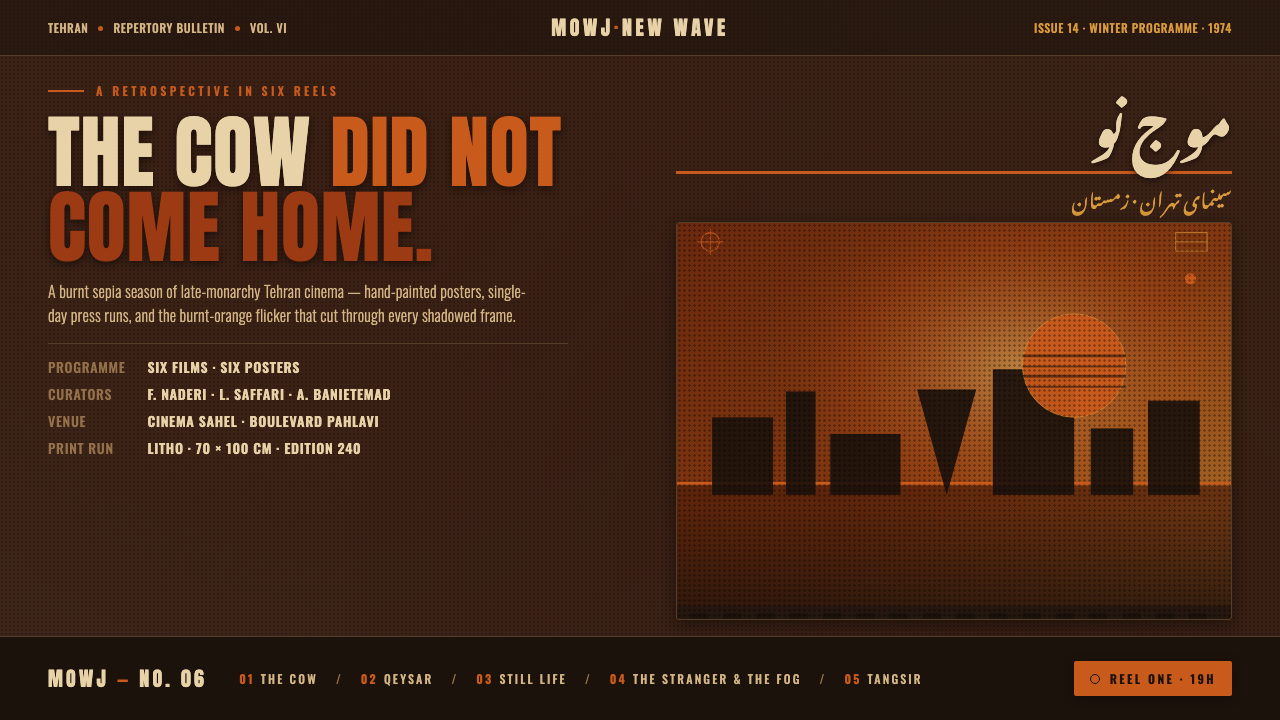 Iranian New Wave PosterPre-revolution Tehran cinema, burnt. Grainy ochre duotone over dark sepia, st…
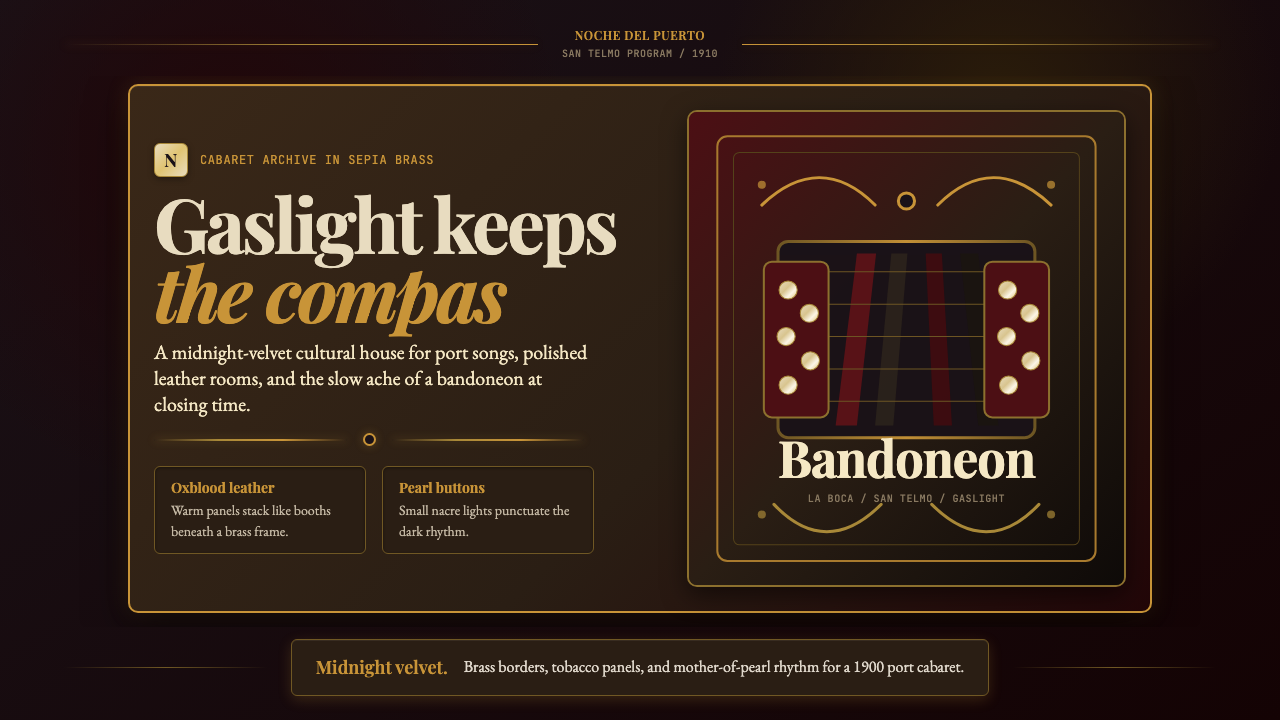 Argentine Bandoneón 1900 (Tango)Gaslit tango luxury. Midnight velvet, brass fileteado, and pearl-button geome…
 Cuban Malecón 1960 PosterPublic voice in flat ink. Turquoise wall, cream stock, brick red and cobalt b…