What is Coral Assisted Evolution?
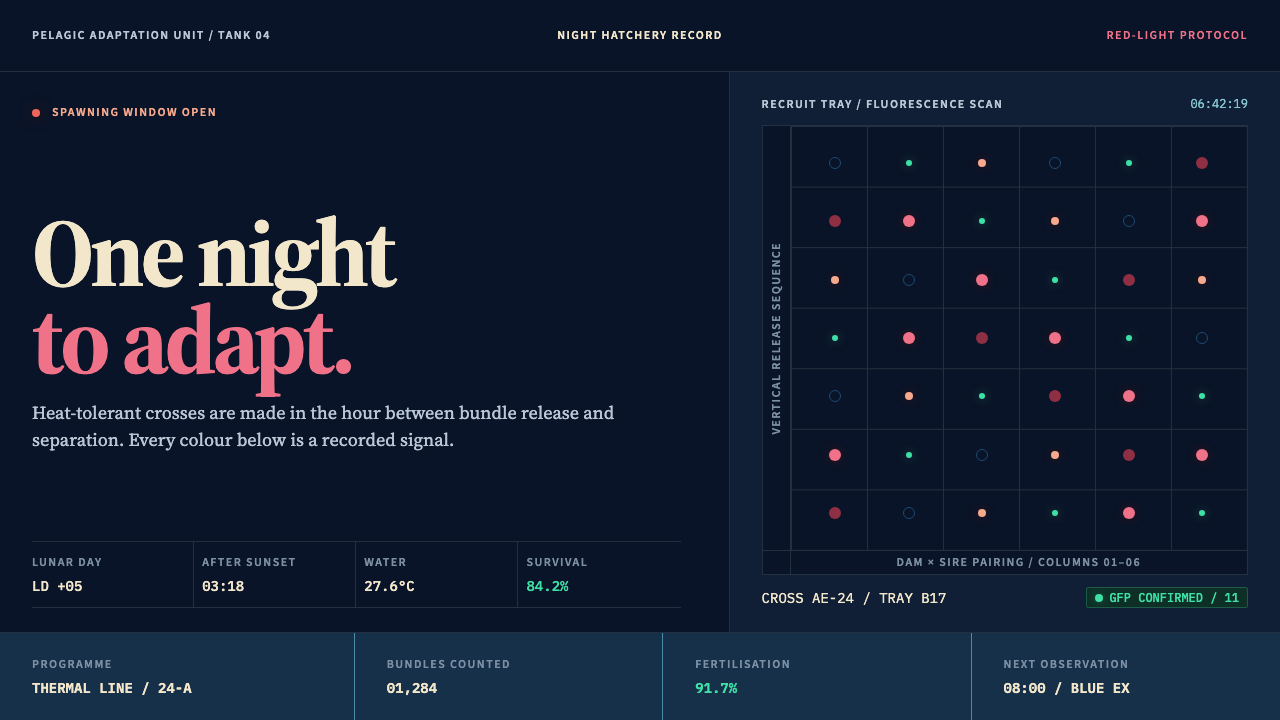
Coral Assisted Evolution is a night-shift design language — near-black seawater, coral-pink spawn, red lamp light and fluorescent green on a strict logbook grid, where every color is a signal someone recorded.
Coral Assisted Evolution in brief
Coral Assisted Evolution is a dark, night-time design system drawn from the nurseries and aquariums where reef-building corals are bred to survive warmer seas. It sets three signal colors — coral pink, red lamp light and fluorescent green — against a near-black blue ground, arranges them on a strict grid, and treats each of them as evidence rather than ornament. The mood is a laboratory at the most important hour of its year, not a tropical postcard.
The subject is assisted evolution: breeding corals together with the microscopic algae that live in their tissue, the Symbiodinium partners, so that the next generation tolerates heat. The methods named in the source are selective crossing, symbiont shuffling and fluorescent tagging of recruits, the young corals that settle after spawning. Almost all of this work comes down to one or two nights a year, when the broodstock tanks spawn and a season's worth of genetics is released into the water in the dark hours after sunset.
Visually, that produces three things. A dark ground that behaves like deep seawater. A very small set of colors, each tied to something that was genuinely seen or recorded on that night. And a layout in the manner of a night-watch logbook, where the lunar day, the hours since sunset, parent identifiers and survival rates are the content, and the type is pressed directly onto fields of water-colored ground with hard, unsoftened edges.
Where does Coral Assisted Evolution come from?
Reef-building corals live in partnership with Symbiodinium, algae that dwell inside their tissue. When the water grows too warm, that partnership breaks down and the reef bleaches. Assisted evolution is a response to that problem: rather than waiting for corals to adapt on their own, researchers breed them for heat tolerance, cross selected parents, shuffle the symbiont partners they carry, and tag the offspring so that their fate can be followed. The source dates this approach from 2015 onward and says its visual language was shaped by the 2016–2017 Great Barrier Reef bleaching events, which gave the work its urgency and its sober tone.
The look comes directly from the spawning night. The water in the broodstock tanks is black-blue. The head-lamps worn by the team are red, because corals cannot see red light, and white light would interrupt the release. Then the spawn comes: pink-orange bundles rise in strings through the dark water and spread into a slick on the surface. The next morning the same recruits are placed under blue excitation light and glow green against a deep blue-violet ground. The source states the principle plainly — nothing here is decorative, and every color is a signal someone recorded.
The tradition is geographically scattered but tightly linked. The source places it in Townsville, Australia, where the aquarist teams of the AIMS National Sea Simulator (SeaSim) run the tanks; at the Flower Garden Banks in the Gulf of Mexico; and in the Caribbean Acropora nurseries, where a genus of fast-growing reef-building corals is raised for restoration. Three disciplines are named as influences: restoration ecology, which supplies the purpose; coral husbandry and larval propagation, which supply the tanks, the timing and the logbook; and fluorescence microscopy, which supplies the green glow on a dark field.
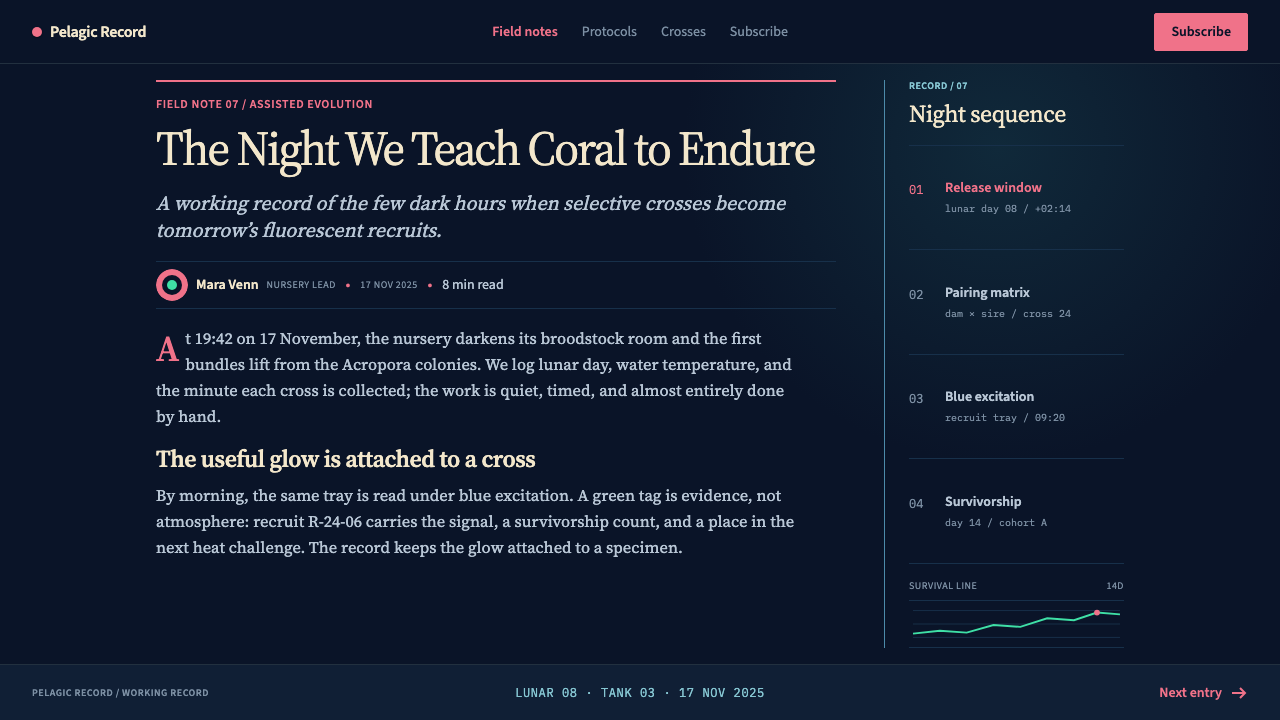
The visual system translates those practices literally. The logbook becomes the grid: lunar day, hours after sunset, parent number and survival rate are the columns that organize the page. The lamp becomes a color rule: red is the observer's light, the one that does not disturb the animals. The fluorescent tag becomes the confirmation color: green on dark means a recruit has been identified and followed. The result is a style whose color palette cannot be rearranged for mood, because each hue is bound to a procedure that happened in a real tank on a real night.
What defines the Coral Assisted Evolution look?
Night Ground
The ground is a near-black blue, the color of tank water at night, with a deeper blue-violet reserved for the fluorescence morning. It is a working darkness, not a decorative one: it exists so that faint signals can be seen, and it should stay flat and quiet enough that a single small mark of color carries real weight.
Coral Pink
A warm pink-orange stands for the spawn itself: the bundles of eggs and sperm rising toward the surface. It marks the biological subject, the thing being studied, and is best kept for primary data points and the largest numbers. Because it is the one warm hue on a cold ground, it naturally pulls the eye to what matters.
Red Lamp Light
Red is the observer's color. The team works under red lamps because corals cannot see red, so it is the light that lets people watch without interfering. In the design, red belongs to the human side of the record: time stamps, operator notes and warnings, rendered in a saturated tone that stays legible on a dark field without competing with the pink.
Fluorescent Green
The green is the color of a fluorescent tag under blue excitation, the protein marker known as GFP. It reads as confirmation: this recruit was identified, this result was verified. It works best as a small, intense, flat shape on the deep blue-violet ground, and it loses its meaning the moment it is spread across large surfaces as a general accent.
Logbook Grid
Structure comes from a strict night-watch logbook: lunar day, hours after sunset, parent identifier, survival rate. Columns are even, rows are numbered, and values sit in their own cells. The grid is what separates this style from generic dark-mode neon, because it insists that the page is a record to be filled in and checked, not a scene to be admired.
Hard Edges on Water
Type is pressed onto the water-colored ground, and edges are cut hard. Even the fluorescent green is drawn as a crisp flat shape rather than a soft blurred glow. This keeps the numbers readable in low light and matches the seriousness of a laboratory record, where an indistinct edge would mean an indistinct measurement.
Color as Evidence
The governing rule is that no color is decorative. Each hue is tied to something observed or recorded: spawn, lamp, tag, tank water. A designer using this system should be able to say what every colored element on the page is evidence of. If a color cannot be explained that way, it does not belong in the composition.
Who shaped Coral Assisted Evolution?
A marine biologist whose research on corals and their algal symbionts places her at the center of the field the source describes. Together with Ruth Gates and colleagues she helped set out the case for assisted evolution in the mid-2010s, and her work is closely associated with the AIMS research setting in Townsville. For design purposes she stands for the scientific seriousness behind the look.
A marine biologist best known for promoting assisted evolution as an explicit strategy for coral conservation: the idea that corals could be helped to adapt faster than a warming ocean would otherwise allow. Her name carries the optimism of the field. The theme's disciplined, evidence-first palette can be read as an answer to that optimism, urgent but restrained.
The aquarists of the AIMS National Sea Simulator in Townsville run the tanks, control the light and timing, and catch the spawn on the nights it happens. They are the people who actually saw the black-blue water, wore the red head-lamps and recorded the survival numbers. The logbook character of the theme is, in effect, their working practice turned into a layout.
How do you use Coral Assisted Evolution today?
Coral Assisted Evolution suits any project where a dark, serious, data-forward presentation should feel earned: science, conservation, climate, biotech and monitoring tools above all. Its power comes from restraint. Before adding any color, ask what it is evidence of. The style looks best when most of the page is quiet dark ground and a very small number of colored marks do all the talking.
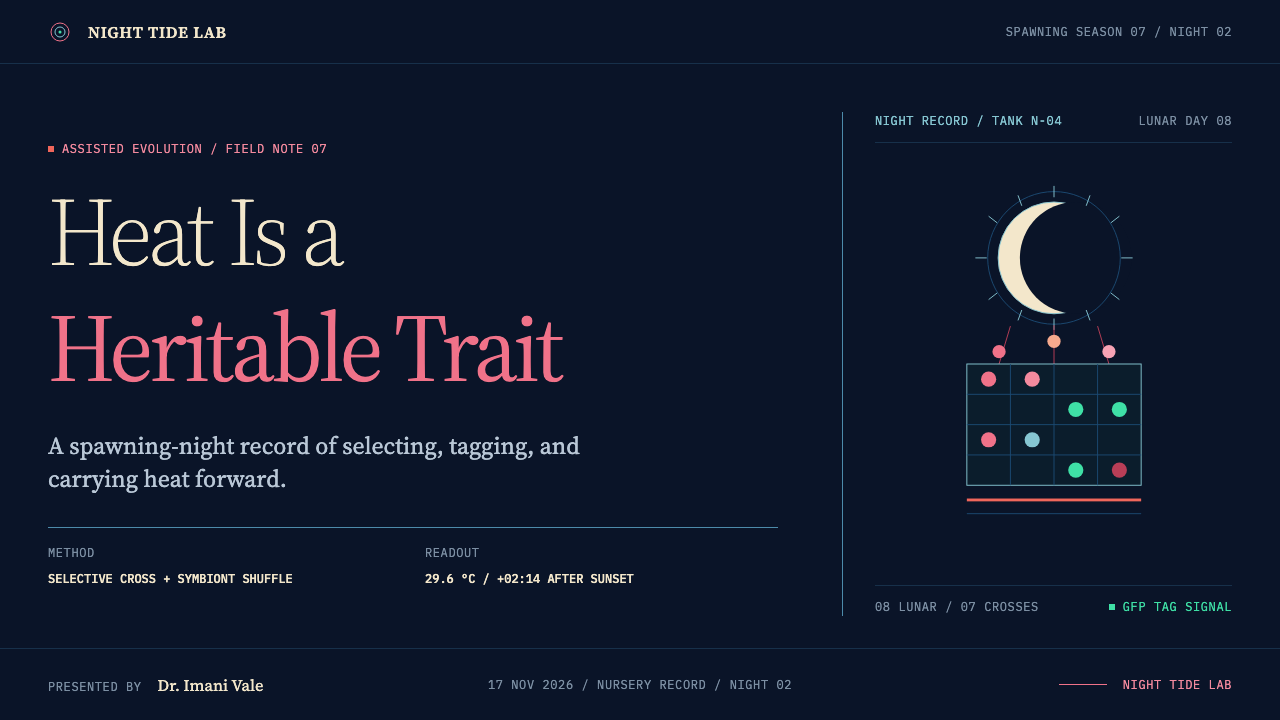
For presentation slides, a cover can be nearly empty: a dark field, one large pink figure or number, and a small green mark that works like a tag. Content slides should be organized as logbooks, with a row of labeled columns, a date or time marker in red, and values set cleanly in their cells. Data slides are a strong fit: survival rates, counts and comparisons can use pink for the main series, green for a confirmed or tagged subset, and red only for time and operator notes, so the chart explains itself without a legend.
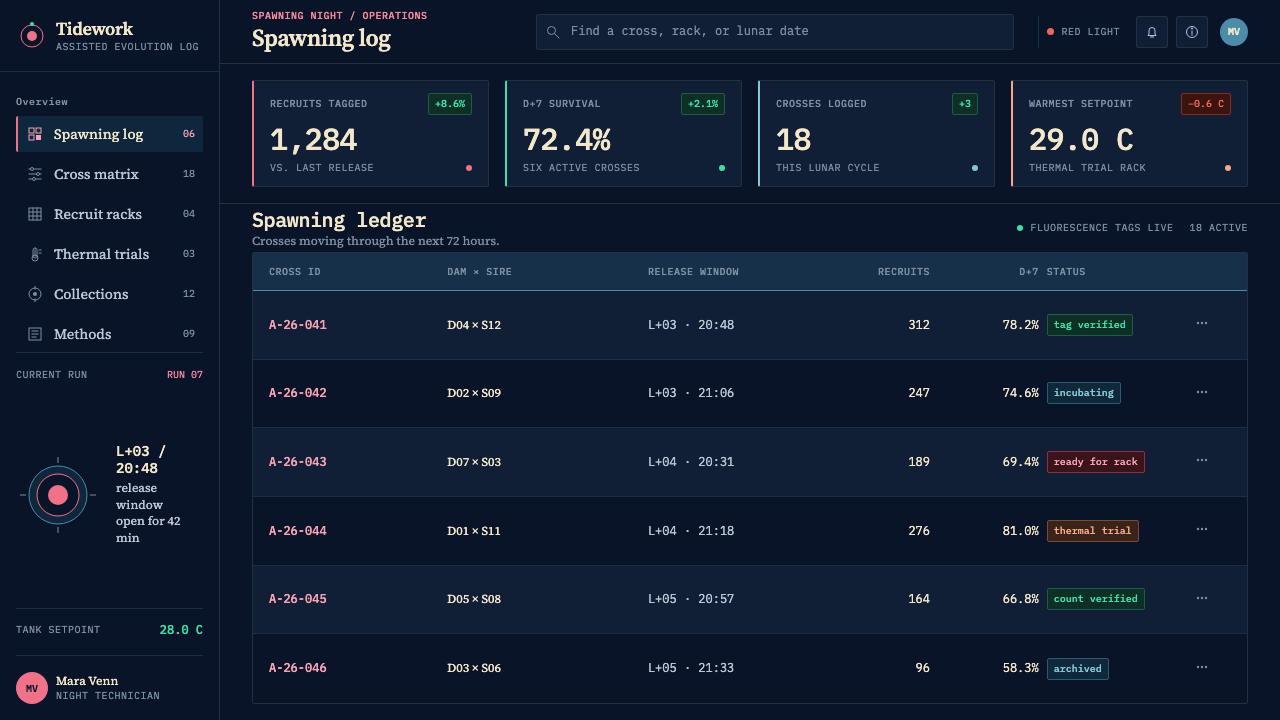
For web interfaces, the style is well suited to monitoring dashboards, lab notebooks, field-data viewers, sustainability reports and any product that tracks living or changing things over time. Use the dark ground for the whole application, a strict column grid for tables, and a restrained scheme where pink means subject, green means verified and red means a human note or alert. Keep controls flat and hard-edged. Avoid glossy gradients, blurred glows and rounded pill buttons, which turn the lab record into a generic dark theme.
For editorial and marketing work, the style gives a nocturnal documentary voice. A long-form story about a spawning night can be set with narrow text columns on the dark ground, timestamped captions in the logbook manner and one fluorescent-green accent used for the pull quote or the key number. Campaign pages can borrow the same structure: one large claim, a ruled grid of evidence beneath it, and no decorative imagery that is not itself a record of something real.
The most common mistake is to treat the three colors as neon and spread them around for atmosphere. Used that way, the palette collapses into a generic cyber look and loses the one quality that defines it. A second mistake is to add marine decoration such as waves, fish or bubbles; the style never illustrates the sea, it records what happened in it. Keep the tank, the lamp and the tag as the only sources of color.
Coral Assisted Evolution — FAQ
Is this an ocean-themed style with waves and fish?
No. It is an evidence-first, laboratory style whose subject happens to be coral. The ocean appears only as a dark, flat ground. There are no waves, fish or bubbles, because the style records what was seen and measured instead of illustrating the sea. If a visual element does not correspond to something that was observed in a tank or a nursery, it does not belong.
Why is red used for lamps and notes instead of warnings only?
Because in the source red is the observer's light: the head-lamps are red since corals cannot see red, and white light would interrupt spawning. That makes red the color of the person watching. In a dashboard it can still flag alerts, but its primary job is to mark human-side information such as time stamps and operator notes, which keeps it meaningful.
What is the green, and when should I use it?
It is the green fluorescence of a tagged recruit under blue excitation light, the glow produced by the protein marker known as GFP. Use it as a confirmation color: a verified result, a tagged subject, a completed step. Keep it small and flat on a dark ground. Spread across large areas, it stops meaning anything and becomes ordinary neon.
Can I make a light-mode version?
It is not recommended. The theme is dark by definition: the night ground is what lets the pink, red and green read as signals. A pale version would need a different logic for every color, and at that point it would no longer be this style. If you need light output, keep the logbook grid and the evidence rule but choose a different theme for the surface.
Can I use it for products outside science, such as games or nightlife?
You can borrow the structure, but you will lose the point if you use it only for atmosphere. The strongest uses are products that track something living or changing and want to show their evidence plainly. For purely decorative nocturnal moods, the strict logbook grid and the rule that every color must mean something will feel too severe.
Related design styles
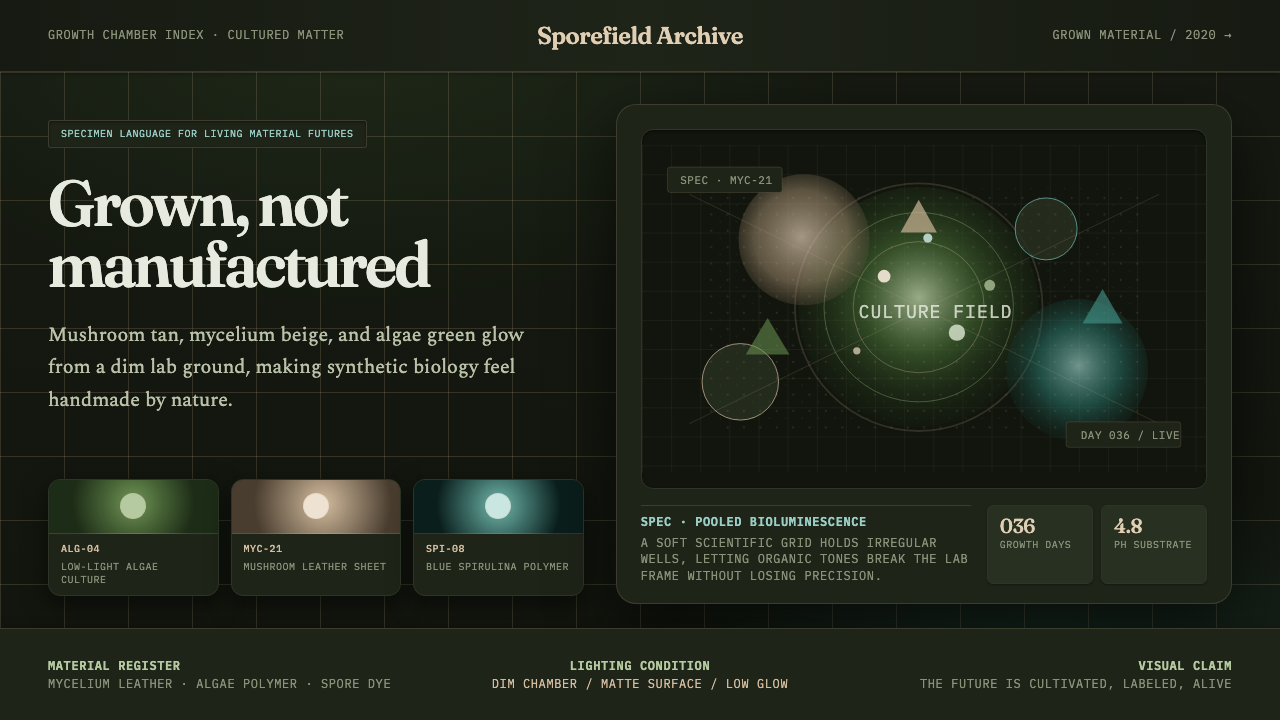 Biopunk GrownLife replaces industry. Algae green glows on chamber dark with serif voice an…
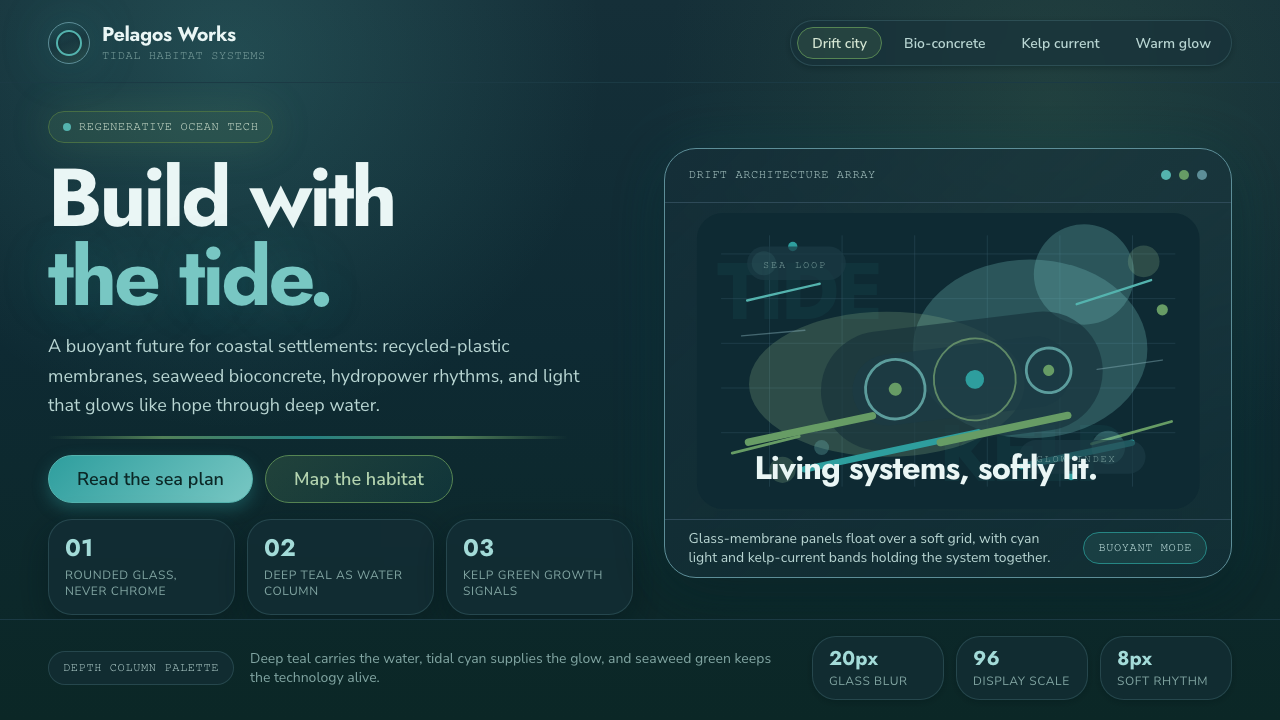 TidalpunkHope glows underwater. Deep teal glass, tidal cyan light, and kelp-green curr…
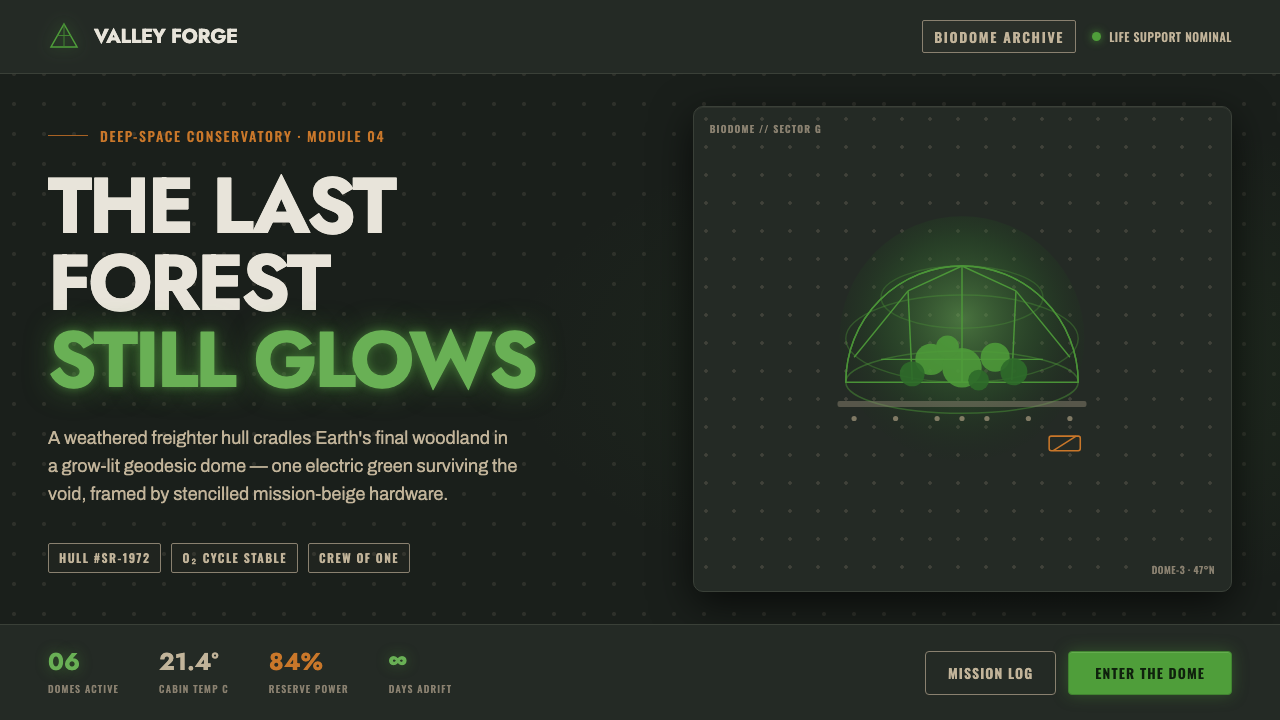 Silent RunningEarth's last forest in a freighter hull. One glowing green against near-black…
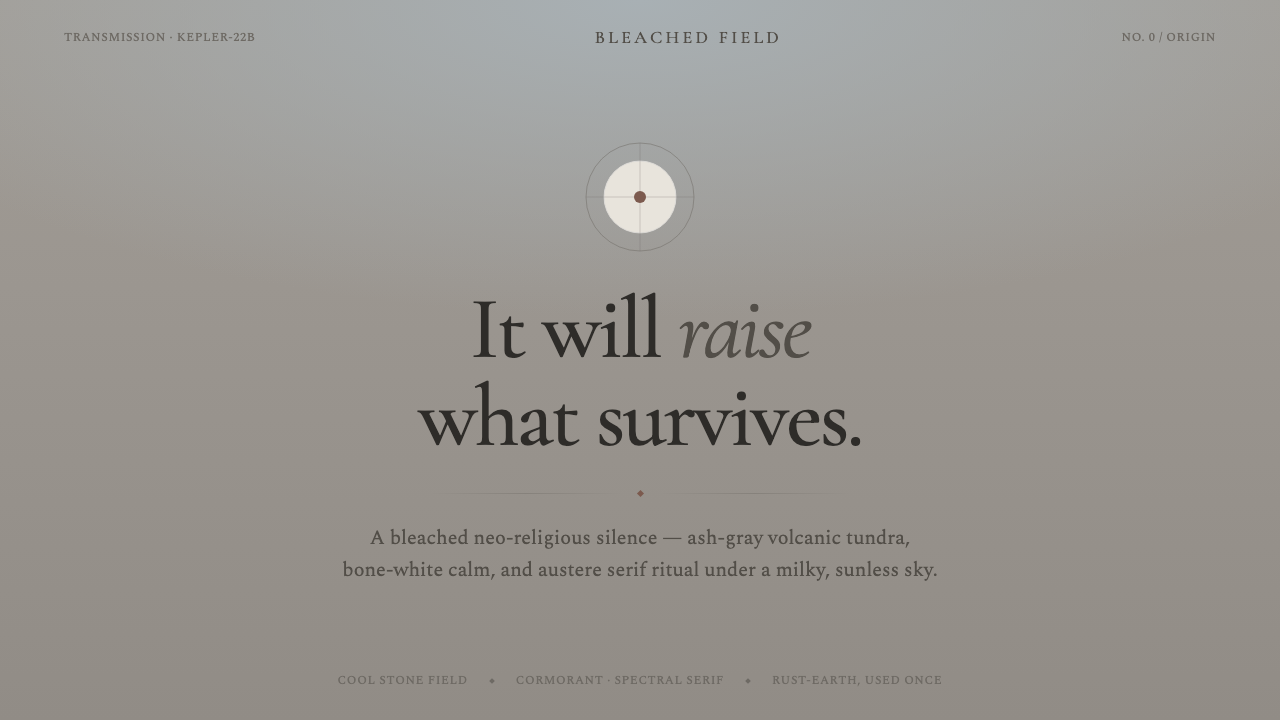 Raised by WolvesBleached neo-religious silence. Ash-gray tundra, austere Cormorant serif, one…
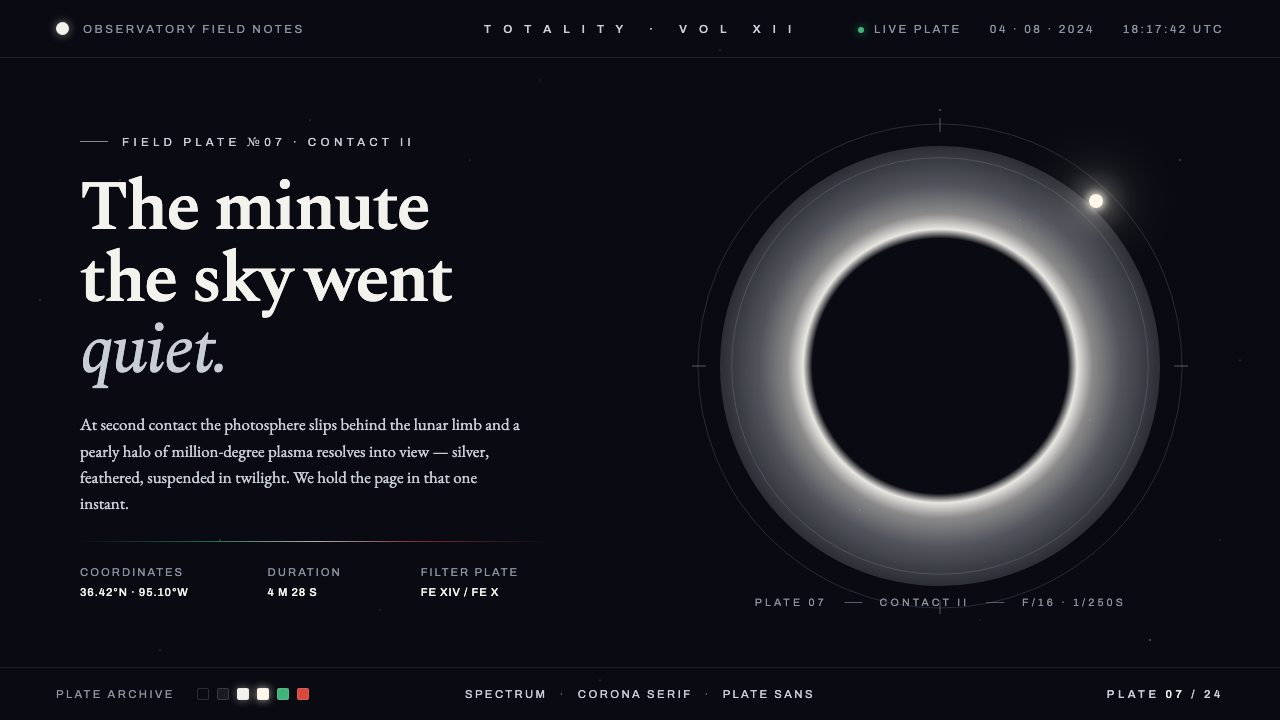 Solar Eclipse CoronaThe minute the sky went quiet. Pearly silver corona on twilight-black, one wa…
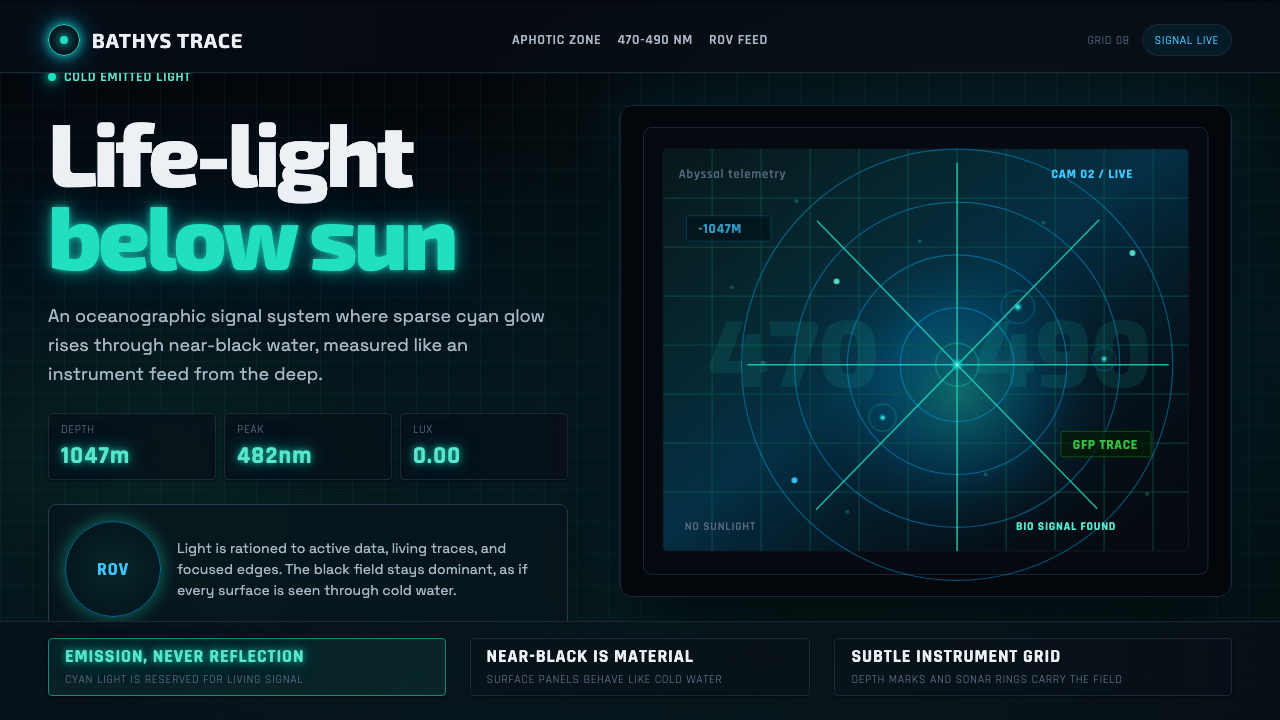 Abyssal BioluminescenceDark carries the signal. Electric cyan pins and Exo 2 readouts surface from a…