What is Chuvash Surpan?
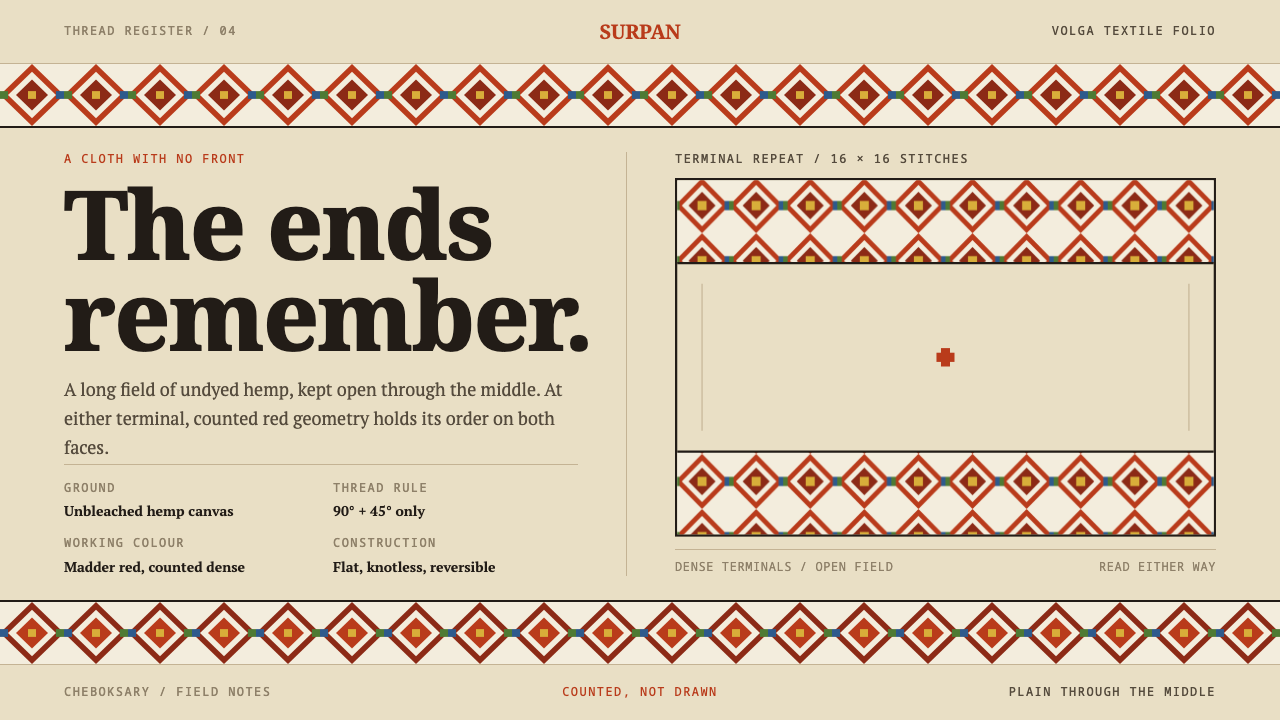
The Chuvash surpan is counted design: red thread on unbleached hemp, built from small geometric units and made to read the same from both sides.
Chuvash Surpan in brief
The surpan is the head-cloth of a married Chuvash woman: a long strip of thin homespun, left plain through the middle and worked heavily at both ends. The Chuvash live in Chuvashia and the middle Volga region of Russia, and the surpan belongs to a married-women's headdress tradition in which the cloth itself was part of how a woman dressed once she was married.
Its ground is unbleached hemp, the yellowish white of the homespun canvas, never dyed. On that ground everything is counted. Stitches run straight and on the diagonal only, the work is dense and knotless, and the ornament reads the same on both faces because the cloth is worn folded and seen from either side. Red carries the pattern; green, blue and straw appear in small quantities; nothing curves.
As a design style, the surpan is light, open and strictly geometric. Madder-red patterns frame a field of open hemp, with ornament concentrated at the ends and calm in the middle. It offers a ready-made logic for pages where content needs a quiet centre and marked borders: pattern is for the edges, and the middle is left for the reader.
Where does Chuvash Surpan come from?
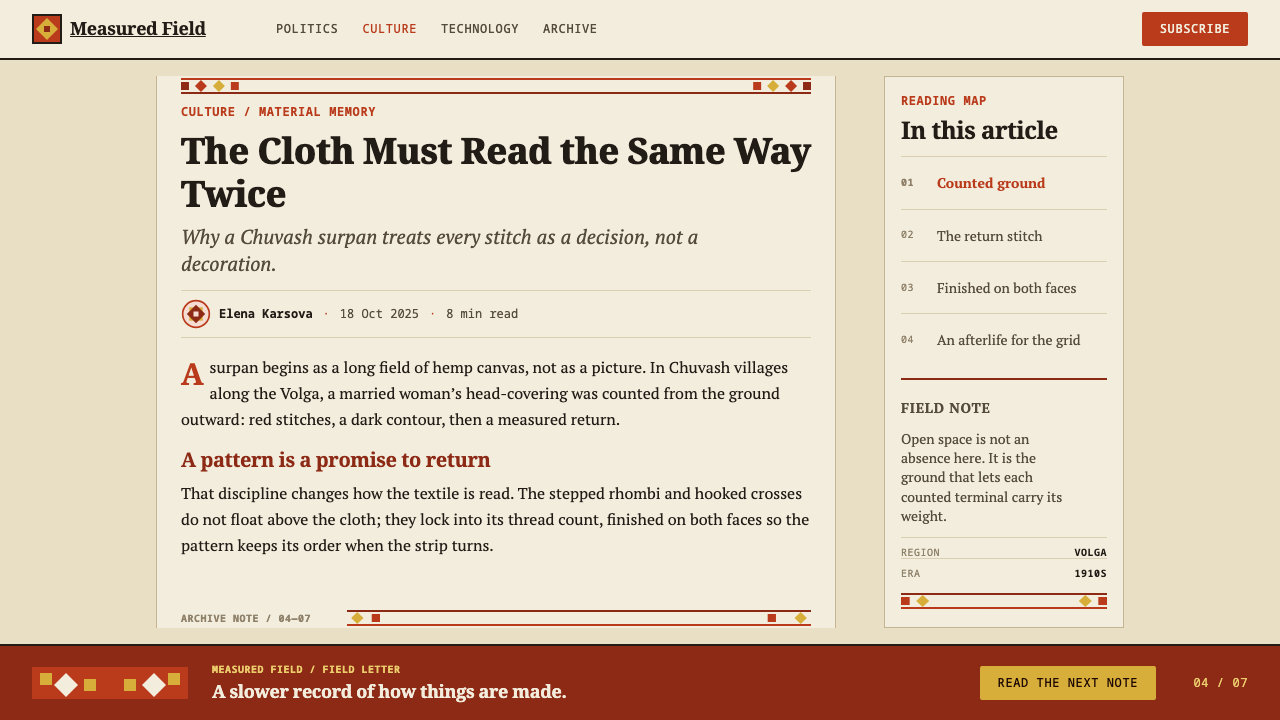
The surpan belongs to Chuvashia and the middle Volga, in a region where Volga-Finnic and Turkic ornamental traditions meet. The tradition is pre-1900, and by the first half of the twentieth century the surpan had passed out of everyday use. What survives is therefore known largely as a historical craft, preserved in village memory and in museum collections, and the style is cast in the past tense: this is how the cloth was made and worn when it was part of ordinary dress.
Hemp was the foundation of the whole object. Grown, spun and woven at home into a thin, even cloth, it supplied the unbleached yellowish white ground and the strength to carry heavy stitching at the ends. The embroidery is counted-thread work: stitches are placed by counting the threads of the weave rather than by following a drawn outline. This is why the patterns are made of small repeated units, and why the angles are limited to straight and diagonal lines. A curve cannot be counted in this way; a stepped edge can.
The patterns are built from a small set of motifs: the stepped diamond, the hooked cross, the eight-pointed star, and edge rows of teeth and thorns. Each is a unit of a few counted stitches that can be repeated, mirrored and combined into bands. Red is the pattern colour, with green, blue and straw added in very small amounts for accent. Because the cloth is worn folded and seen from either face, the stitching is dense and knotless so that the back is as finished as the front.
The carriers of this tradition are not named individuals but the Chuvash village embroiderers, women who learned the counted vocabulary and passed it on, and the cloth is preserved in places such as the Chuvash National Museum in Cheboksary. The design system takes the cloth's logic rather than its picture: an unbleached ground that is never dyed, a pattern that is built from counted units, ornament weighted to the ends, and the rule that everything must hold from both sides.
What defines the Chuvash Surpan look?
Unbleached Hemp Ground
The ground is the yellowish white of undyed hemp canvas: a warm, slightly greyed cream with a faint woven texture. It is never bleached to a pure white and never tinted by design. This ground is the hero of the style, because it is the open space the pattern frames. Large areas of it must be left empty. If every area is filled, the cloth loses its rhythm of ornament and rest.
Madder Red
Red carries the pattern. It is a madder red, a deep, slightly earthy red with a warm brown undertone rather than a bright screen red, and it is used in dense, saturated passages along the ends and edges. As the dominant thread colour, it fixes the identity of the whole piece. It reads best against the hemp ground, where its density can be seen as stitching, not as a flat colour block.
Small Doses of Green, Blue and Straw
Green, blue and straw yellow appear only as small accents among the red, in a single row of stitches or in the centre of a star. They are muted, thread-like colours that sit beside the red without competing with it. The rule of proportion is firm: red is the pattern, and the others are punctuation. A page in which three colours share equal weight has left the style.
Counted Geometry
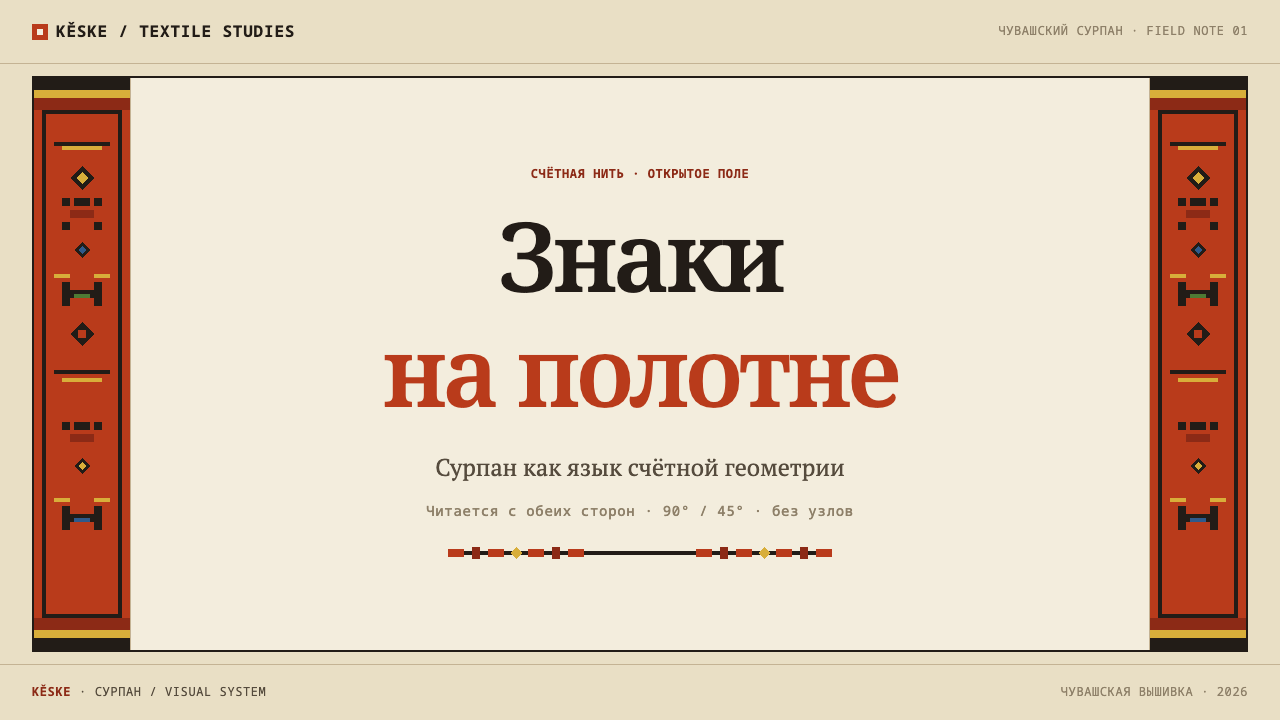
Every shape is built from small whole cells on an invisible grid. The vocabulary is the stepped diamond, the hooked cross, the eight-pointed star and the rows of teeth and thorns. Lines run straight or on the diagonal; there are no curves, no gradients and no free-drawn shapes. This pixel-like logic gives surprising precision to a handmade object. When in doubt, build shapes from repeated square units and let the stepped edge show.
Ornament at the Ends, Calm in the Middle
The cloth is plain through the middle and worked hard at both ends. As a layout principle this means density is weighted to the borders: a heavily patterned band at the top and bottom, or at both sides, with a wide, open centre for content. It also defines hierarchy: the pattern frames meaning without competing with it. A uniform, all-over pattern would contradict the structure of the original.
Reads the Same on Both Faces
The cloth is worn folded and seen from either side, so the embroidery is dense and knotless, with no messy reverse. Design translates this into symmetry and finish: elements should hold when mirrored or flipped, edges are clean on every side, and nothing depends on a single privileged view. It is a discipline of honesty, since the back of the work is as carefully made as the front.
Thread-Like Texture and Density
Texture comes from stitching, not shadow. Stitched areas read as slightly raised, finely grained, and tightly packed, set against the soft open grain of the hemp. There are no drop shadows, no glows, no glossy surfaces, and depth is created only by the contrast between dense thread and open canvas. Used with restraint, a faint woven grain in backgrounds is enough to suggest the cloth without distracting from text.
Who shaped Chuvash Surpan?
The surpan was made by Chuvash village embroiderers, women who worked from home-grown hemp and carried the counted vocabulary of diamonds, stars, hooks, teeth and thorns from one generation to the next. No single author's name stands behind the cloth. The tradition is a collective one, preserved by memory and practice. For a designer, the right credit is to the community and its craft, not to an individual.
The Chuvash National Museum in Cheboksary is a keeper of the region's textile heritage and one of the places where surviving cloths are held and studied. Since the surpan had passed out of everyday use by the first half of the twentieth century, museum collections are a central way the tradition is known today. A design that cites this museum is crediting the institution that preserves what the village embroiderers made.
The surpan is a married woman's headdress, which means the women who wore it were also, in the main, the women who embroidered, and the cloth belonged to a married-women's tradition of dress. This shapes its character: the object is intimate, personal and worn close to the body, not a decorative panel on a wall. A design that borrows its logic should keep that sense of something made carefully to be lived with.
How do you use Chuvash Surpan today?
Chuvash Surpan works best where content needs a clear centre and a decorated frame. It is a border-and-field system: a calm, open middle with dense, patterned ends. The discipline is to keep the hemp ground open, to build every pattern from counted units, and to keep red the dominant thread.
On slides, a cover can be an open hemp-coloured field with a heavy red pattern band across the top and bottom edges, and the title in the quiet middle. Content slides keep a narrow pattern band at the base or sides only, with all text in the open centre. For data slides, draw charts from square units: stepped bars, stepped area fills and counted dots in red, with green, blue or straw reserved for one highlight.
For web interfaces, the style suits cultural, craft, heritage and education sites, e-commerce for textiles and handmade goods, and pricing or onboarding pages that want a warm, human frame around simple content. Use the hemp-toned ground for pages, a pattern band as a header or footer divider, and red for links, buttons and key states. Cards can have a counted stepped edge. Keep forms and body text in the quiet middle, away from the pattern.
In editorial and marketing work, the style supports craft, folk-culture and slow-living stories, and works for packaging, invitations and posters. Photography should be natural and close, with fabric, hands, thread and hemp in soft daylight. Pattern bands frame photographs and headlines as borders, and a counted motif can mark chapter breaks. Headlines are modest, and the open ground does the work of making the page feel calm.
The most common mistake is to fill the whole page with pattern. The cloth works because its middle is empty, and an all-over repeat turns it into generic folk wallpaper. A second mistake is bending the geometry: smoothing the stepped edges into curves or adding gradients removes the counted logic. A third is treating the motifs as free decoration: they come from a real tradition, so cite the Chuvash source and keep to its vocabulary.
Chuvash Surpan — FAQ
Why does the style avoid curves entirely?
Because the embroidery is counted-thread work. Stitches are placed by counting threads of the weave and run only straight or on the diagonal, so shapes are built from small whole cells and come out as stepped edges. A curve cannot be counted this way. Keeping to straight and diagonal lines is what preserves the logic of the original, and it also gives the style its crisp, almost pixel-like clarity.
Why does the middle stay empty?
Because the surpan is plain through the middle and worked heavily at both ends. The empty hemp is not a lack of design but a deliberate rest, and it gives the ornament something to frame. In layout, it becomes the content area: keep the middle open for text, forms and key images, and push density to the borders. Filling the middle destroys the rhythm that makes the cloth readable.
How many colours should a page use?
Red leads, and green, blue and straw appear in small quantities beside it. In practice, treat red as the only major colour, with the hemp ground as the second large field, and add at most one of the minor threads as a small accent per section. The ground is never bleached to pure white. A palette in which several colours share equal weight reads as a different, busier style.
Does the style work in dark mode?
It is designed as a light style, because the undyed hemp ground is the core of the identity. A dark mode is possible but changes the character: the pattern would sit on a deep ground instead of framing open cloth. If you need one, keep the hemp cream as the colour of the open middle panels, use the dark ground only outside, and retain red for the pattern bands so the cloth logic is still visible.
What kinds of product suit it?
It suits products with a handmade, human or cultural character: craft and textile shops, heritage and museum sites, education and storytelling tools, food and gift packaging, and welcoming onboarding pages. It also suits any layout that benefits from a clear border-and-centre structure. It is less suited to high-tech, neon or glossy products, where its counted, woven honesty would feel out of register.
Related design styles
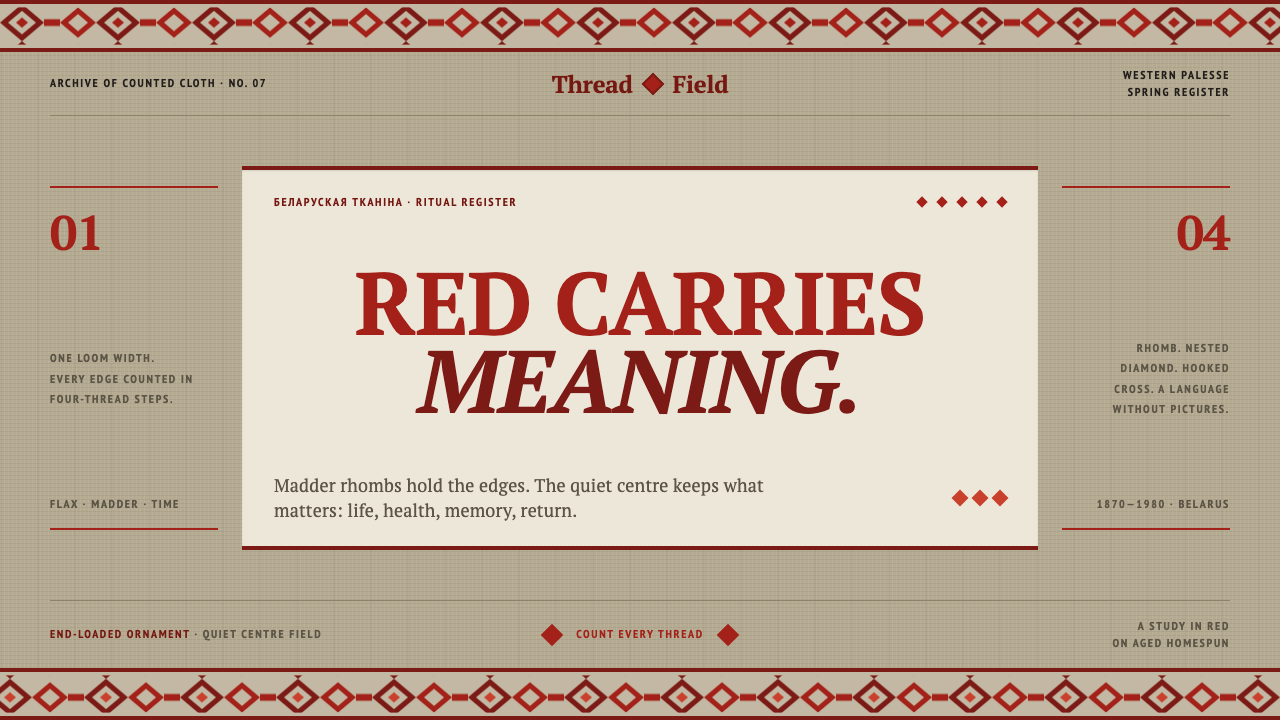 Belarusian RushnykRed carries meaning. Madder rhombs crowd aged flax edges while the woven cent…
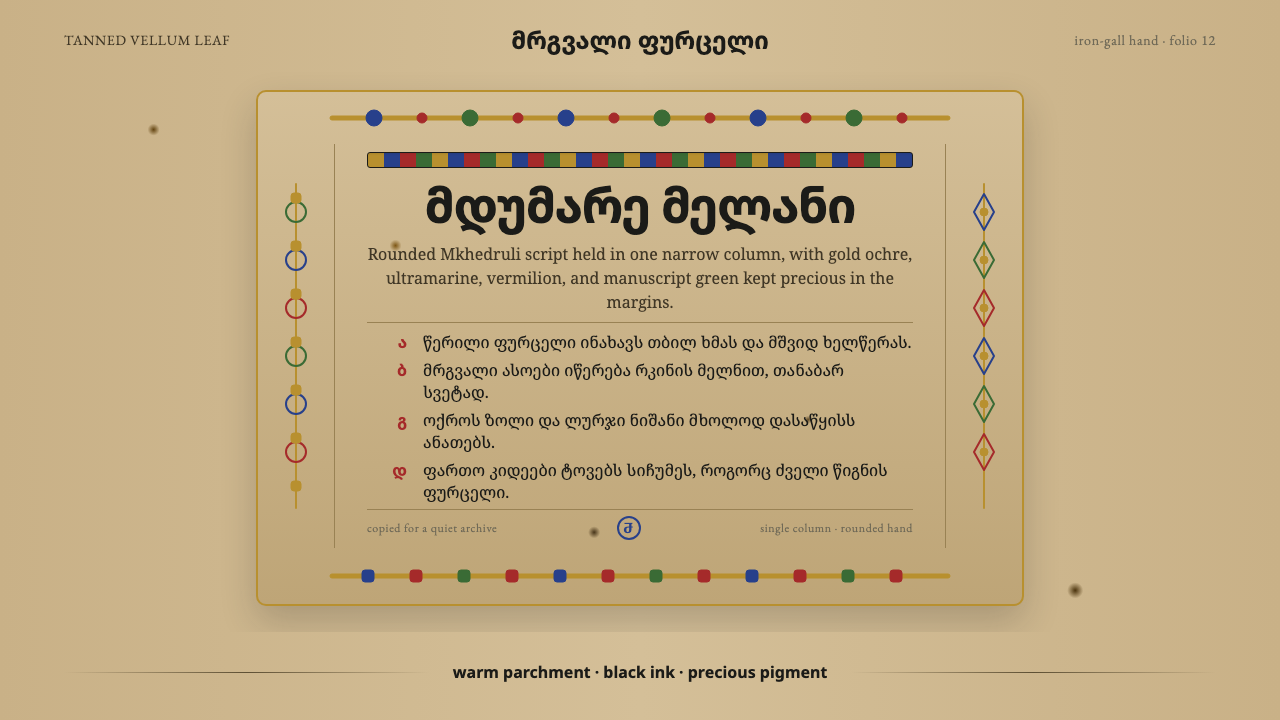 Georgian MkhedruliA manuscript breathes slowly. Tanned vellum, round Mkhedruli ink, ochre and u…
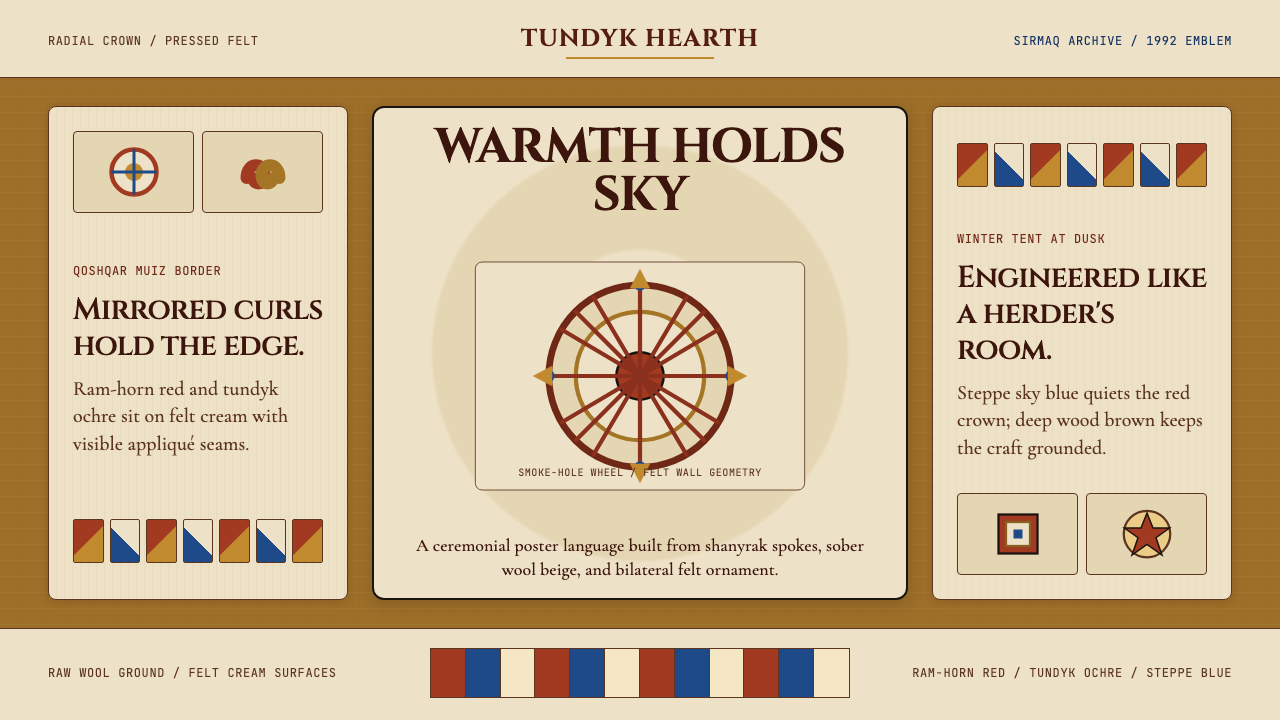 Kazakh Shanyrak Yurt FeltDomestic warmth, engineered. Ram-horn red felt curls around a radial shanyrak…
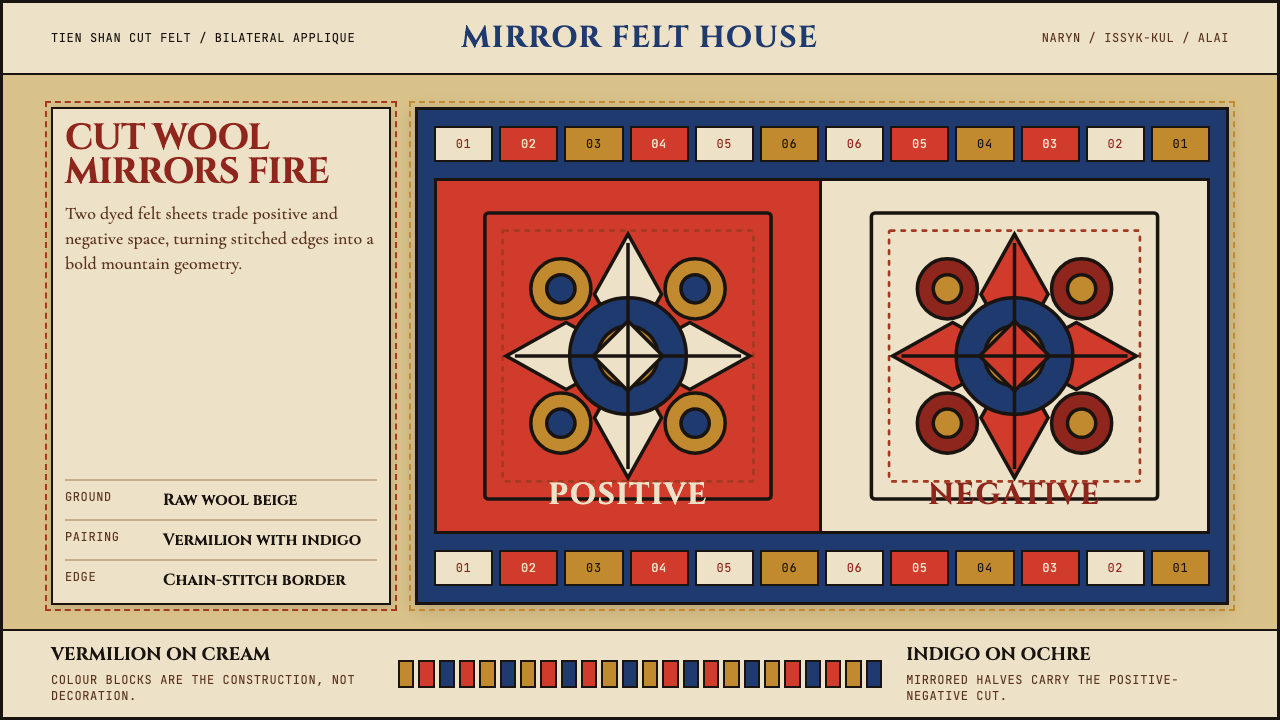 Kyrgyz Shyrdak Felt RugCut felt becomes structure. Vermilion-indigo mirror blocks stitch positive to…
 Maramureș Wooden ChurchLight survives the soot. Ochre type and earth-red geometry rise through smoke…
 Ukrainian Vyshyvanka EmbroideryRed is life, black is protection. Stepped rhombus motifs counted thread by th…