What is Chuukese Love Stick Carving?
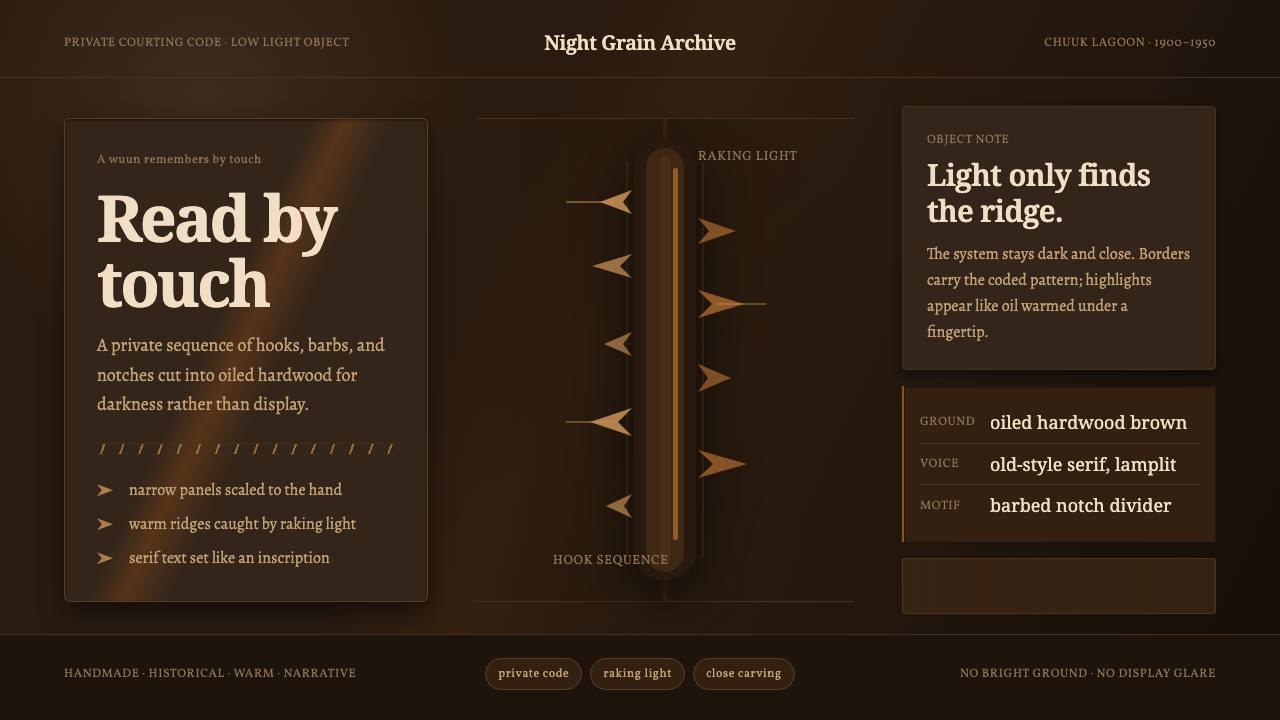
Chuukese Love Stick Carving makes intimacy legible in darkness: oiled island hardwood, close-grained warmth, and a private sequence of hooked notches meant to be recognized by touch.
Chuukese Love Stick Carving in brief
Chuukese Love Stick Carving refers to the courting custom of carving a long wooden wand called a wuun in Chuuk Lagoon between 1900 and 1950. A young man courting in secret cut a barbed and hooked notch pattern unique to him alone, then passed the stick through a thatch wall at night. The woman he courted read the sequence by touch, confirming his identity without speech or light.
The wuun was not made for display. It was a dense island hardwood object, worked by hand and repeatedly oiled until the surface held a low, warm sheen. Its grain belonged to the object, while its notch pattern carried its private message. Each cut was close, small, and tactile: a mark designed to live beneath a fingertip rather than announce itself to the eye.
As a visual language, the style is intimate, dark, and materially direct. Brown wood, subdued sheen, close grain, and raking light establish the atmosphere; hooked interruptions provide recognition and rhythm. The design does not imitate darkness with theatrical effects. It treats darkness as the natural setting in which meaning emerges through contact, memory, and restrained form.

Where does Chuukese Love Stick Carving come from?
The custom belongs to Chuuk Lagoon, also known as Truk Lagoon, in the Caroline Islands of Micronesia. Its documented period is 1900–1950, when secret courtship could be carried through a physical object rather than spoken openly. The wuun made identity portable: the suitor’s hand cut a pattern that could be recognized privately by the person receiving it.
The defining act was nocturnal and tactile. The young man passed the long wand through a thatch wall, while the woman read its hooked sequence in darkness. This gave the carving a purpose beyond ornament. Its form had to remain distinct under touch, its marks had to follow a memorable sequence, and its surface had to be handled closely rather than viewed from a distance.
The material language followed that purpose. Dense island hardwood provided a firm body for the carving, while hand-applied oil brought out a low warm sheen in the brown grain. The object therefore joined personal making, material knowledge, and courtship communication. Its visual restraint was not a later aesthetic decision imposed from outside; it came from the conditions of use.
The source material identifies Chuukese carvers and suitors, the Hudson Museum collection, and the Denver Museum of Nature & Science collection as key figures in the record of this tradition. The carving was documented and collected through the twentieth century, allowing the wuun to be understood as part of Micronesian personal-adornment and courtship carving rather than as an isolated decorative artifact.
What defines the Chuukese Love Stick Carving look?
Oiled Hardwood
The material is dense island hardwood with a brown grain brought forward by hand-applied oil. Its surface should feel worked and handled, never synthetic or excessively polished. In design applications, the material can be suggested through deep brown fields, close tonal variation, and a quiet warmth that lets the grain remain present without becoming decorative texture.
Raking Light
The notches are read when light travels across the surface rather than striking it head-on. Raking light creates a narrow relationship between illumination and relief: the grain stays subdued while the cuts briefly catch definition. The resulting depth is quiet and directional, more like a revealed trace than a modeled three-dimensional effect.
Hooked Notches
The barbed and hooked notch pattern is the style’s central graphic vocabulary. It should feel cut into a surface, not drawn on top of one. Repetition creates rhythm, but the marks remain individual and slightly resistant, preserving the sense of a private code made by a particular hand.
Tactile Legibility
The design is organized for a fingertip. Marks need separation, sequence, and enough relief to be recognized without visual assistance. This produces a different hierarchy from ordinary display graphics: the most important feature is not the loudest shape, but the trace that remains intelligible when sight is removed.
Low Warm Sheen
The oiled surface carries a restrained glow rather than a hard reflection. Warmth comes from the relationship between brown wood, hand treatment, and darkness. Contemporary applications should favor softened highlights and close tonal transitions, keeping the object grounded and intimate instead of turning it into a glossy luxury surface.
Darkness as Context
Darkness is not merely a background color. It is the condition that makes touch, memory, and slight relief meaningful. A dark composition should therefore leave room for partial visibility: the grain may recede, while a notch or edge emerges under a controlled beam. The atmosphere depends on withheld information as much as on visible form.

Who shaped Chuukese Love Stick Carving?
The source places Chuukese carvers and suitors at the center of the tradition. Their handwork joins making and message: each suitor carved a wuun with a hooked pattern unique to him, turning dense island hardwood into a private confirmation of identity.
The Hudson Museum collection is identified in the source as part of the documented and collected record of Chuukese Love Stick Carving. Its presence connects the private courting object with the continuing twentieth-century record through which the tradition can be studied.
The Denver Museum of Nature & Science collection is also named in the source as a key part of the tradition’s documented presence. Together with the other collection reference, it keeps attention on the wuun as a culturally situated object rather than a generic carved wand.
How do you use Chuukese Love Stick Carving today?
Chuukese Love Stick Carving is most transferable when its underlying logic is preserved: intimacy over spectacle, material presence over polish, and recognition through a small number of meaningful marks. Use darkness as an active condition, then let grain, relief, and angled illumination establish hierarchy. The style becomes weaker when it is reduced to brown decoration without the idea of a private message.
For presentation slides, the cover should feel like an object discovered at night. A deep brown or near-black field can hold a quiet title, with a narrow band of warm grain or a hooked notch sequence emerging under oblique light. Content slides should remain spacious and tactile in spirit: restrained type, short blocks of information, and carved-like rules or marks used only when they help organize the reading. Data slides can treat bars, paths, or labels as traces revealed from darkness rather than as bright dashboard graphics.
For web interfaces, the style suits dashboards and pricing pages that need a sense of quiet focus. Use dark surfaces, warm text, subdued borders, and clear states that appear through tonal change or a directional highlight. A dashboard may use notch-like indicators for status, while a pricing page can let each tier feel like a distinct carved object. Interaction should remain legible and calm; the atmosphere must never obscure essential information.
For editorial and marketing work, the strongest approach is intimate documentation. Give the article a dark field, a narrow reading measure, and generous breathing room around captions or material notes. Marketing pages can frame a product as something passed from hand to hand: close crops, grain-led backgrounds, hooked marks, and restrained light can create a sense of secrecy without resorting to theatrical mystery. The visual language works best when every detail feels handled rather than merely styled.
The common mistake is treating the style as a generic dark wood theme. Adding loud glow, glossy highlights, excessive texture, or many decorative hooks turns a private tactile code into surface ornament. Another mistake is making every mark equally visible. The visual system depends on selective revelation: the grain can remain quiet, the notches can emerge only where light catches them, and the composition should preserve enough darkness for recognition to feel earned.

Chuukese Love Stick Carving — FAQ
What is a wuun?
A wuun is a long wooden wand used in the Chuukese secret-courting custom documented in Chuuk Lagoon between 1900 and 1950. A young man carved it with a barbed and hooked notch pattern unique to him. At night, he passed it through a thatch wall so the woman he courted could identify him by touch.
Why is darkness essential to the style?
Darkness is part of the object’s use, not simply an aesthetic backdrop. The wuun was passed at night, and its notch sequence was read by touch without light. A visual interpretation should therefore allow information to recede and emerge gradually, using raking light and restrained contrast to suggest recognition rather than immediate display.
How should the wood and oil be represented?
Represent them through dense brown grain, a low warm sheen, and close tonal variation. The surface should feel substantial and hand-worked rather than glossy, synthetic, or heavily textured. The goal is not to simulate a luxury finish, but to preserve the quiet material presence described in the source.
Are the hooked marks decorative symbols?
No. In the source custom, the barbed and hooked sequence functioned as a personal code. It was unique to the suitor and was read by touch as confirmation of identity. When adapted into visual design, the marks should therefore behave like meaningful traces with rhythm and distinction, not like a repeated ornamental pattern added for atmosphere.
Can this style work in a bright layout?
It can be adapted, but a bright layout changes the central condition of the style. The source tradition depends on nighttime use, touch, and relief revealed by raking light. If the background becomes bright, retain the material cues, subdued warmth, selective visibility, and hooked rhythm so the work still feels tactile and private rather than becoming ordinary rustic decoration.
Related design styles
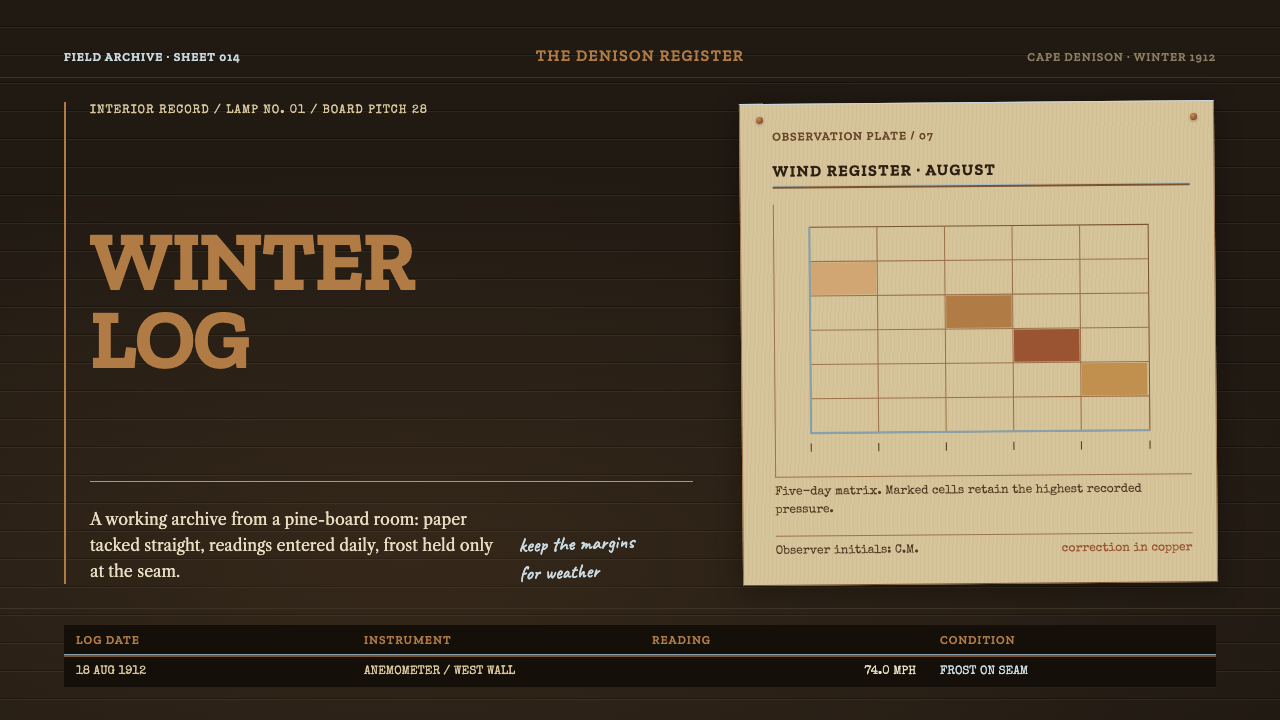 Mawson's Hut ExpeditionAn archive that stays at work. Buff survey paper, slab type and frost-thin ru…
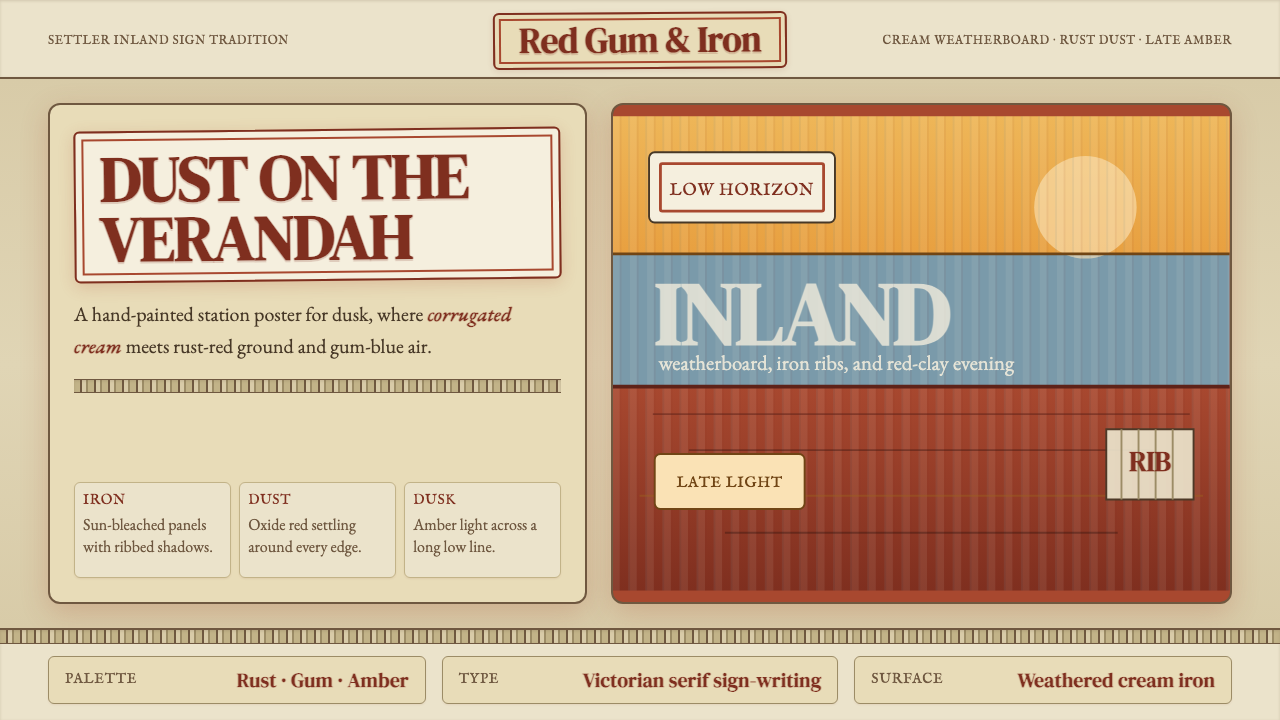 Australian Outback VernacularWeather is the voice. Rust dust, gum-blue bands, and serif sign-writing age t…
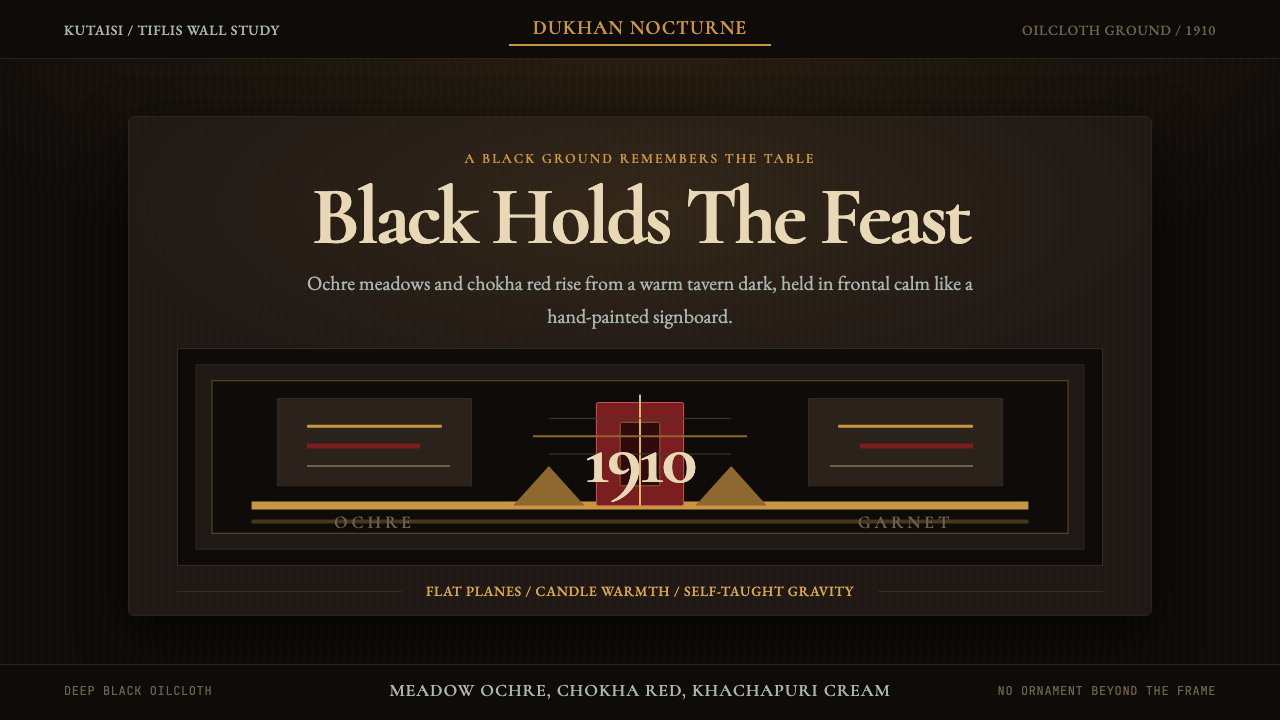 Georgian Pirosmani 1910Oilcloth black turns memory ceremonial. Ochre panels and Cormorant type hold…
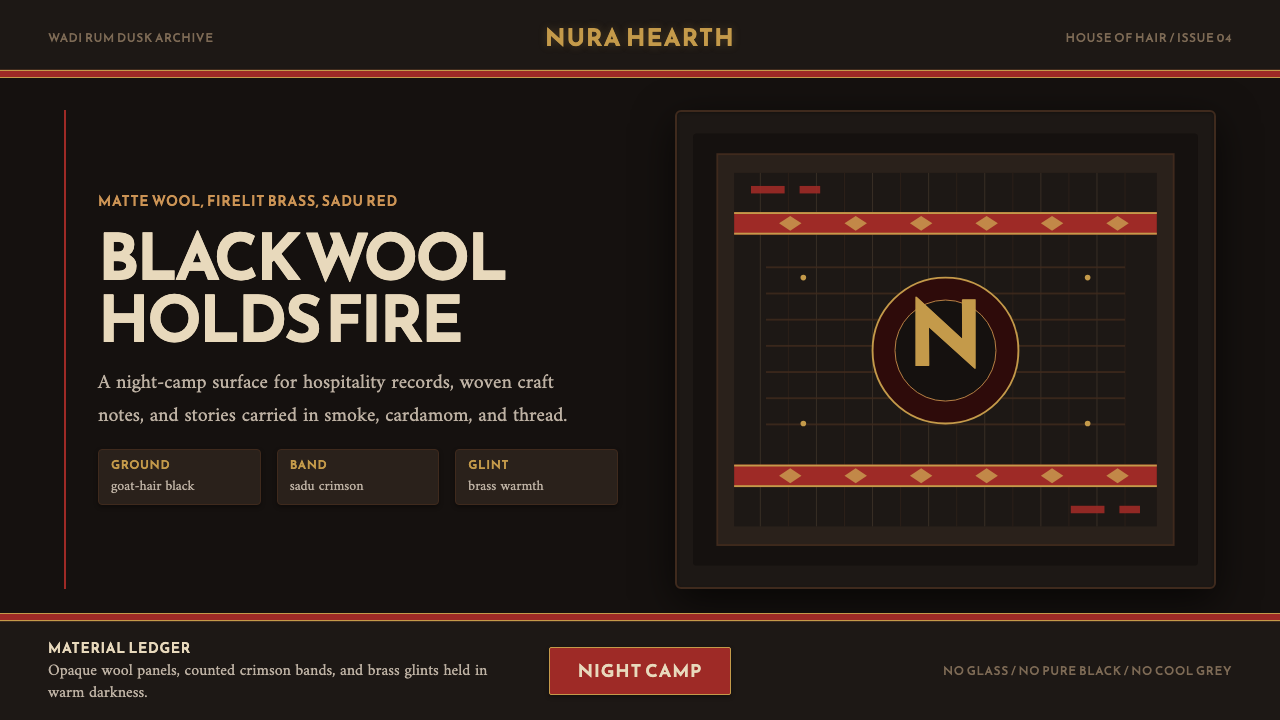 Jordanian Bedouin Black TentNight camp honesty. Goat-hair black, sadu crimson, brass lines.
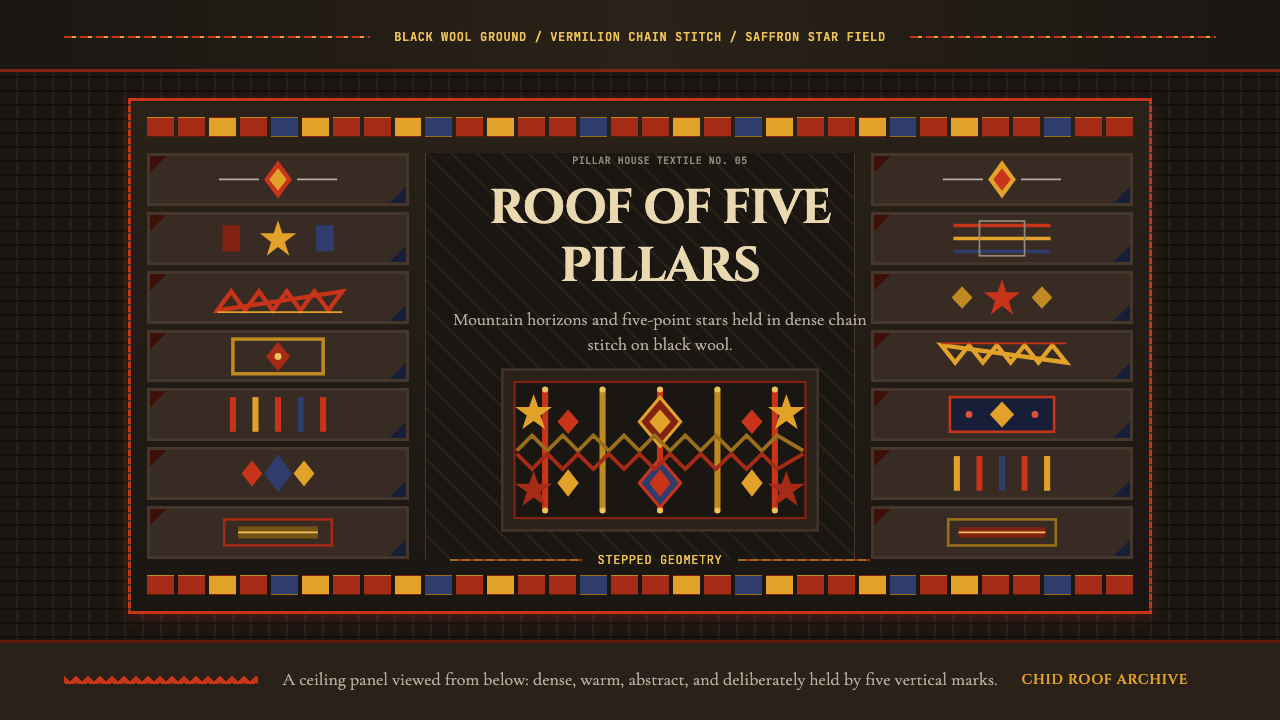 Tajik Pamir Needlework (Chid Roof)Cosmos stitched into wool. Vermilion diamonds and saffron stars hold a five-p…
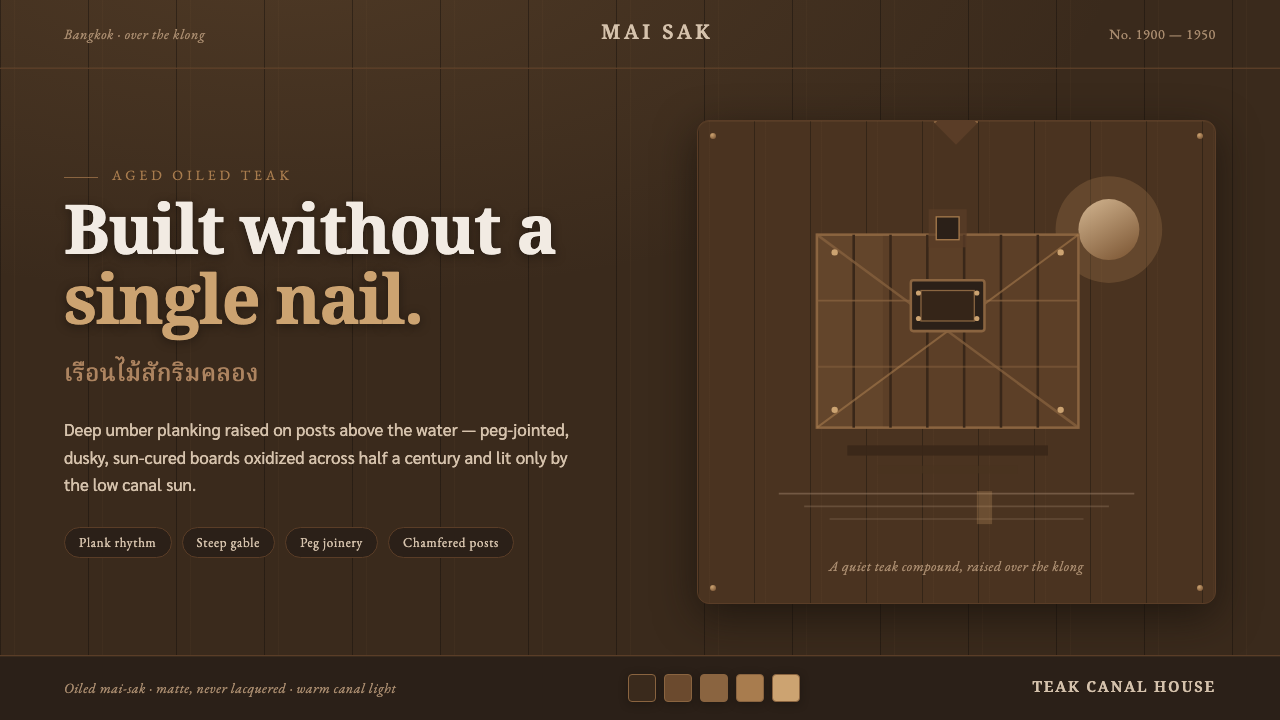 Thai Teak Canal HouseAged oiled teak, never fresh-sawn. Deep umber planks raised over the klong, l…