What is Charro Suit?
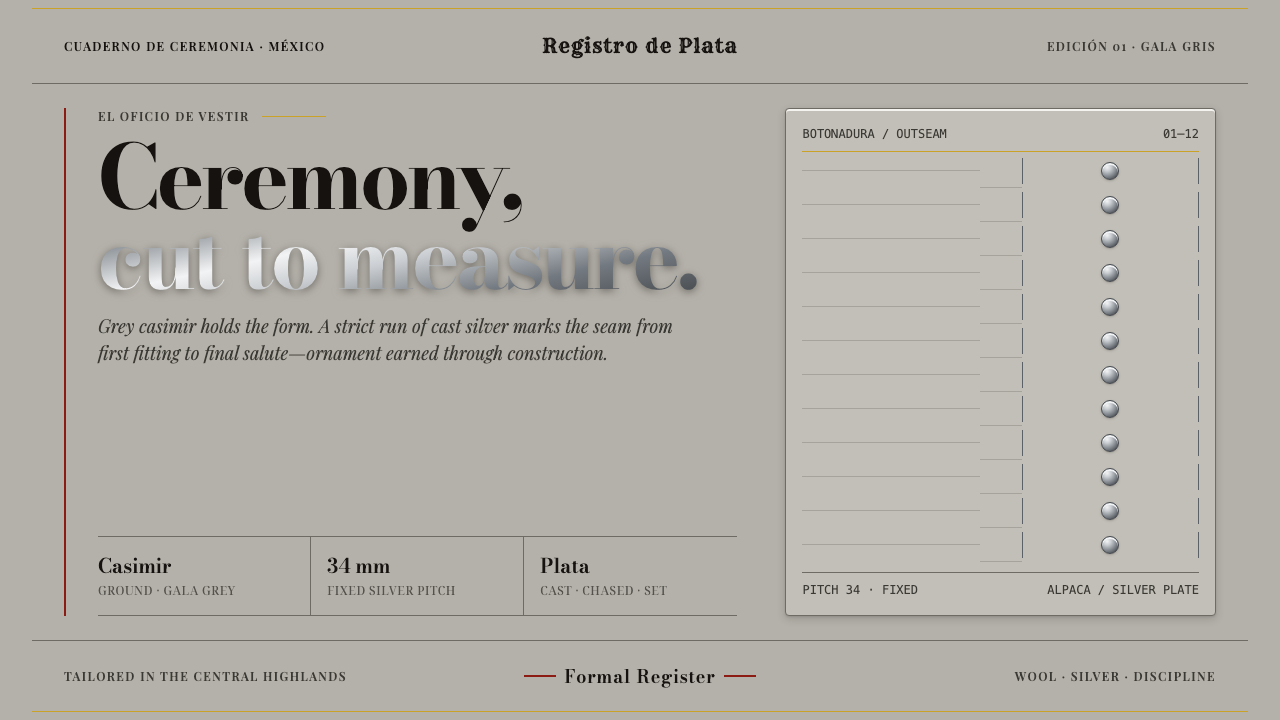
Charro Suit is tailoring made visual — gala-grey wool as the ground, chased silver as the primary, and a fixed vertical run of buttons as the spine of the whole layout.
Charro Suit in brief
The traje de charro is the formal dress of the Mexican horseman: a short embroidered jacket and high-waisted trousers cut in casimir wool or gamuza suede, with a botonadura — a run of cast alpaca-and-silver-plate buttons — descending the outer seam from hip to ankle. Charro Suit is the design system that takes this garment literally. Grey wool is the ground, silver is the primary, and the botonadura's fixed vertical pitch becomes the spine of the layout.
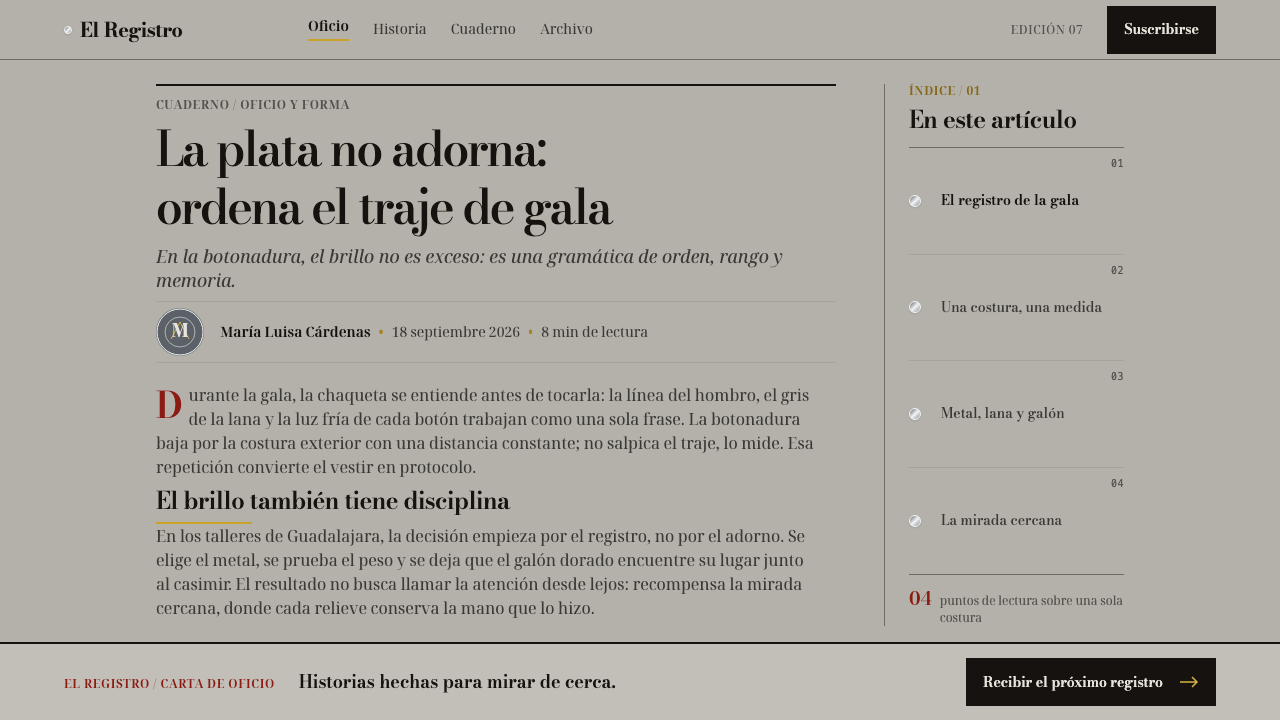
Its governing idea is that ornament is tailoring, not decoration. On a charro suit the silver does not float on the cloth; it sits on a seam, runs along a cuff, edges a collar. The ornament marks how the garment is built. The system keeps the rule: a silver mark either sits on a structural line — an edge, a divider, a column seam — or it does not appear. Nothing is scattered for atmosphere.
The register is formal and festive at once. The regulations name it plainly: gala grey, dark blue or black, a braid-trimmed wide-brimmed hat, silver throughout. Visually that gives a grey wool field with metallic highlights, patterned edging in the stepped greca motif, and display type of the kind actually printed on charrería and mariachi posters: a high-contrast Didone-style serif alongside a Western slab display face. Everything ornamental has to look cast, chased and able to catch light, like metal, not like flat grey ink.
Where does Charro Suit come from?
The charro is the horseman of the Mexican highlands, and the suit grew out of charrería, the riding tradition that took its modern form in the nineteenth century. The reference places the style in the Bajío and the central highlands — Jalisco, Guanajuato, Hidalgo and Puebla — horse-and-ranch country where the rider's dress mattered as much as his skill. Over time the clothing of the working rider became something more: a formal garment worn for ceremony, competition and celebration, with a vocabulary that is both practical and splendid.
The reference traces the codification of this dress to the reign of Maximiliano I, when the horseman's clothes were fixed into a recognised formal register. That codification was carried forward by the charro associations, the asociaciones de charros, whose dress regulations are famously exact. They name the colours of gala dress, the trim of the hat and the extent of the silver, and they treat deviations as errors. The strictness is what gives the suit its recognisable grammar and is the reason the design system can speak of a fixed pitch and a fixed seam.
A second line of descent runs through the rurales, the rural mounted police whose light-grey uniform with silver embroidery and silver buttons is a different formal suit drawn from the same tailoring vocabulary. The reference also records that the charro suit was carried into mariachi dress, which is why the musicians' costume shares its short jacket, its trouser-seam buttons and its silver. Three overlapping traditions — riding, uniform and music — thus share one visual code, and the code is what the system borrows.
Behind all of it is craft. The reference names Mexican silversmithing and gold-thread embroidery among the movements behind the style. The botonadura buttons are cast, with an alpaca base, a white-metal alloy that is not the animal despite the name, and silver-plated, then chased by hand so that the surface catches light in small facets. The embroidery that edges the jacket is worked in metallic thread. In every case the finish is the point: this is dress that is meant to shine at close range and read from across an arena.
What defines the Charro Suit look?
Gala-Grey Wool Ground
The ground is gala-grey cloth: even, matte and fine-woven, with the quiet density of good wool. It is a mid-light grey rather than white or black, neutral enough to let metal read as the brightest thing on the page. A very fine textile feel is acceptable; heavy texture or visible weave is not. Think of the cloth as a stage on which the silver performs, not as a feature in itself.
Silver as Primary
Silver is the primary colour and the only one the page leans on. It is a cool, bright metal tone that reads as reflective against matte wool, and in this system, unlike most flat styles, a controlled sheen is correct. It lives in small, deliberate zones: studs, rules, badges, button faces, border lines. Used in large flat fills it dies into plain grey. The art is a lot of quiet cloth and a few bright points of metal.
Botonadura Spine
The botonadura is a run of identical round buttons at a fixed vertical pitch, running down the outer seam from hip to ankle. In layout it becomes the spine: a column of evenly spaced silver marks that runs down a side, a card edge or a navigation rail. The pitch is the unit of measure for the page. Vertical gaps, row heights and block sizes are multiples of it, so everything feels as if it was cut from one pattern.
Seam-Only Ornament
Ornament is tailoring: it sits on a seam or it does not appear. In a layout, seams are edges, dividers, column joins, headers and footers, and any silver mark or pattern must sit on one of them. There are no ornaments floating in the middle of a field, no decorative corner flourishes, no background patterns. That constraint is what lets a heavily embellished style still read as ordered, since decoration always tells you where the structure is.
Greca Border
The greca is a stepped fret pattern, a continuous angular band that runs along cuffs, collars and card edges. It is edging, never filling. Repeated at an even rhythm, it works as the system's equivalent of a decorative border, but a precise one: crisp, geometric and consistent in scale. It suits the rims of cards, the ends of sections and the borders of invitations, where it frames content the way trim frames a sleeve.
Chased Metal Detail
Every metal element should look cast and chased, not printed: a raised rim, a fine engraved pattern, a crisp highlight and a small dark recess. This is the one place where the system allows depth effects, and only inside metal marks. Cloth stays flat; metal has relief. The contrast between a matte ground and small, faceted, light-catching objects is what gives the style its luxury without a single gradient on the page background.
Poster Type
Two kinds of letters carry the voice, both taken from real charrería and mariachi posters. A high-contrast Didone-style serif gives headlines dignity and formality; a Western slab display face adds the festive, fairground side for occasional titles and labels. Use them in a clear hierarchy: the serif leads, the slab accents. Body text should be plain and readable, since all the personality is already in the display type and the metal.
Who shaped Charro Suit?
The reference traces the codification of charro dress to the reign of Maximiliano I, the point at which the horseman's clothes were fixed as a recognised formal register. For the design system, this is the origin of its strictness: a dress code is a set of rules, and rules are what turn a costume into a grammar. The same discipline appears in the system as a fixed pitch, a fixed seam and a restricted palette.
The rurales, the rural mounted police, wore a formal uniform in light grey with silver embroidery and silver buttons, a second suit built from the same tailoring vocabulary. They matter to the system as proof that the grey-and-silver code is not tied to a single occasion: it can stand for ceremony, authority or celebration depending on context. The system borrows the vocabulary, grey wool, silver as the line of the uniform, and leaves the associations behind.
The charro associations maintain the dress regulations, naming the colours of gala dress, the trim of the hat and the amount of silver. Their rules are the reason the suit has a stable form across regions and generations. In design terms they are the guardians of consistency: a reminder that a recognisable style depends less on inspiration than on agreed constraints that everyone keeps.
The reference lists Mexican silversmithing and gold-thread embroidery among the movements behind the suit. They are the makers of the botonadura, the studs, the chased fittings and the metallic edging. Their work explains why the system is so insistent that metal must look like metal: the whole ornamental vocabulary comes from hands that cast, plated, chased and stitched, and a flat grey imitation would betray that craft.
How do you use Charro Suit today?
Charro Suit is a style of craft, ceremony and celebration, and it works when a design needs to feel crafted and dignified at the same time. It rewards rhythm and punishes clutter. The main discipline is to think like a tailor: put each mark on a seam, keep the pitch constant, and let metal be the only thing that shines.
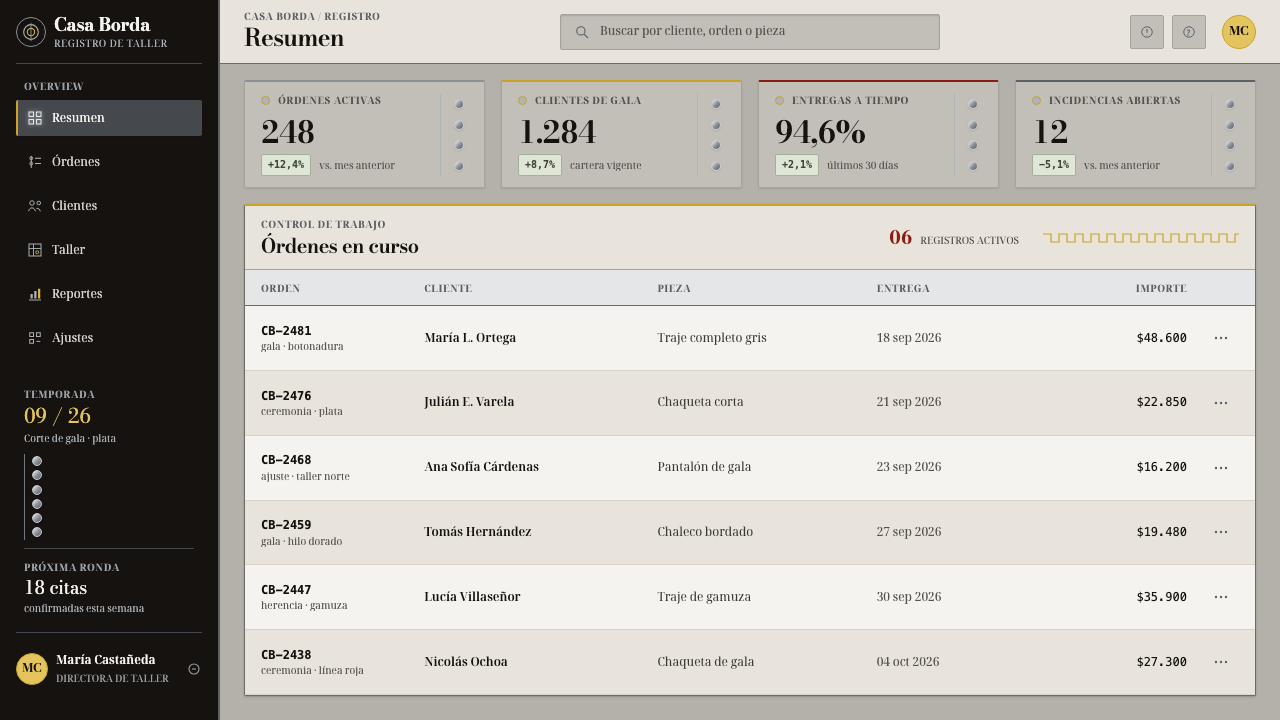
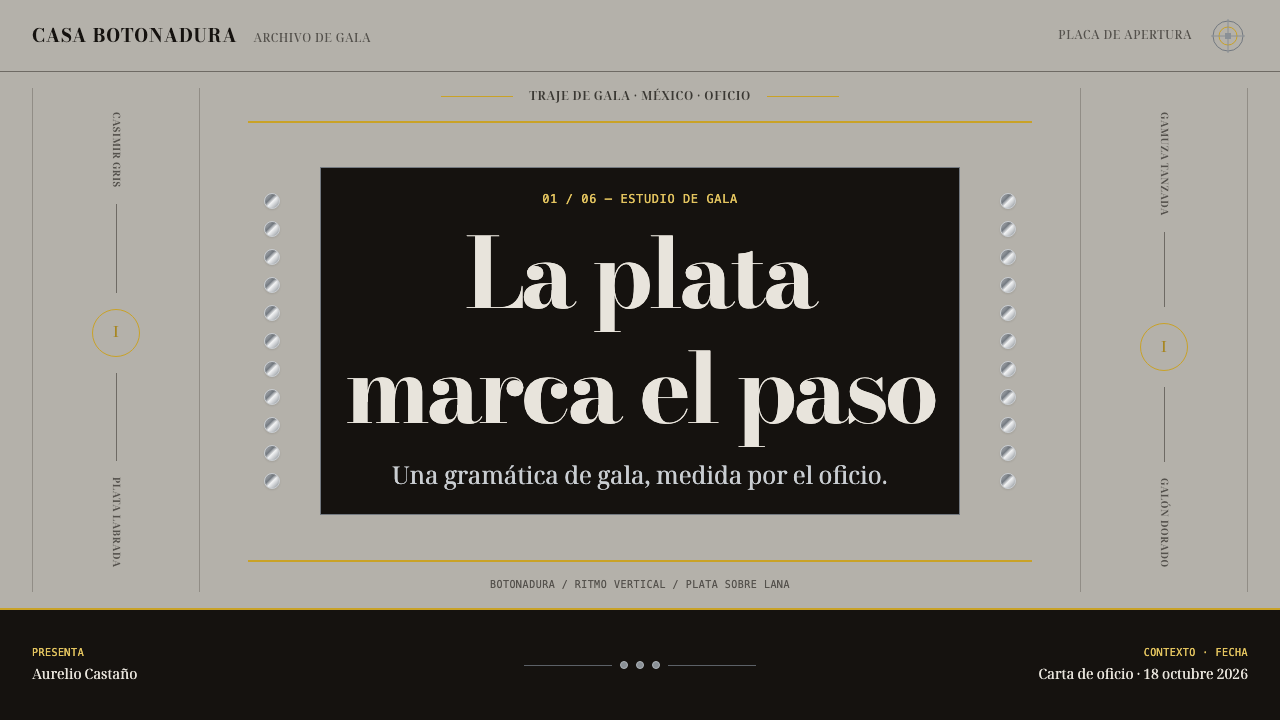
For presentation slides, a cover can set a high-contrast serif title on grey wool with a vertical run of silver studs down one edge as the botonadura. Content slides measure their rows against the stud pitch, with the greca as a thin footer or header band. For data slides, draw bars, lines and markers in silver on the grey ground, keep gridlines faint, and reserve the one brightest chased mark for the number that matters.
For web interfaces the style suits heritage brands, event sites, hospitality, music and craft commerce. A sidebar or progress rail can be a literal botonadura, with evenly spaced round markers as steps or navigation. Cards take a greca edge or a single silver rule; buttons and badges are the small chased metal objects; large fields stay plain wool. Dashboards work if the data stays quiet and silver marks only the controls and the key figures.
For editorial and marketing work, the poster tradition provides a ready vocabulary: a Didone headline, a slab-face date or label, a greca border, and a vertical stud column down one side. Pull quotes can be framed by a thin silver seam. Photography of horsemanship, silverwork, embroidery and festivals fits best, and should be credited. Event invitations and formal announcements are the natural home, since the style already speaks the language of an occasion.
The most common mistake is flattening the metal: silver rendered as one plain grey fill reads as dead, and the style collapses into a dull grey page. The second is scattering ornament away from seams, which turns tailoring into costume jewellery. The third is slipping into a generic cowboy theme with ropes, stars and wood grain; the suit is a Mexican tradition with its own precise code, and the system has none of those props. Keep the cloth quiet and the metal exact.
Charro Suit — FAQ
What is a botonadura?
A botonadura is the run of cast, silver-plated buttons that descends the outer seam of charro trousers from hip to ankle. The buttons are identical and set at a fixed pitch. In the design system the botonadura becomes the layout spine, a vertical column of evenly spaced silver marks whose spacing is the unit of measure for the rest of the page.
Is this a cowboy or Western style?
No. The charro suit is a Mexican horseman's formal dress with its own regulations, materials and silverwork, and the system follows that code. It borrows some display letterforms that also appear on Western-style posters, but the grey wool, the botonadura, the greca and the seam rule are specific to charrería and mariachi dress. A rope-and-star Western theme is a different, much looser thing.
Why silver rather than gold?
Because the formal register named in the regulations is silver throughout, with the buttons and fittings in cast silver-plated metal. Braid trim on the hat can add warmth, and a small amount of gold-toned detail is historically defensible, but the system stays silver-led. Mixing gold and silver at equal strength weakens the cool, reflective contrast against the grey wool.
Can the style work in a dark variant?
Yes, with precedent. The charro register itself includes dark blue and black alongside gala grey, and silver reads even more strongly against dark cloth. A dark variant keeps silver as the primary and the seam rule intact, and treats the dark wool as a matte ground. The reference system uses the grey register, so a dark version should be presented as a variant, not as a replacement.
Where does the style struggle?
It struggles where speed and anonymity are the goal, such as dense admin tools or utilitarian apps, because its value is ceremony and craft. It also depends on controlled sheen, which is easy to get wrong in tight spaces: a screen full of metallic buttons becomes noisy. It is strongest on pages that have room for a rhythm, a border, a headline and a few well-made objects.
Related design styles
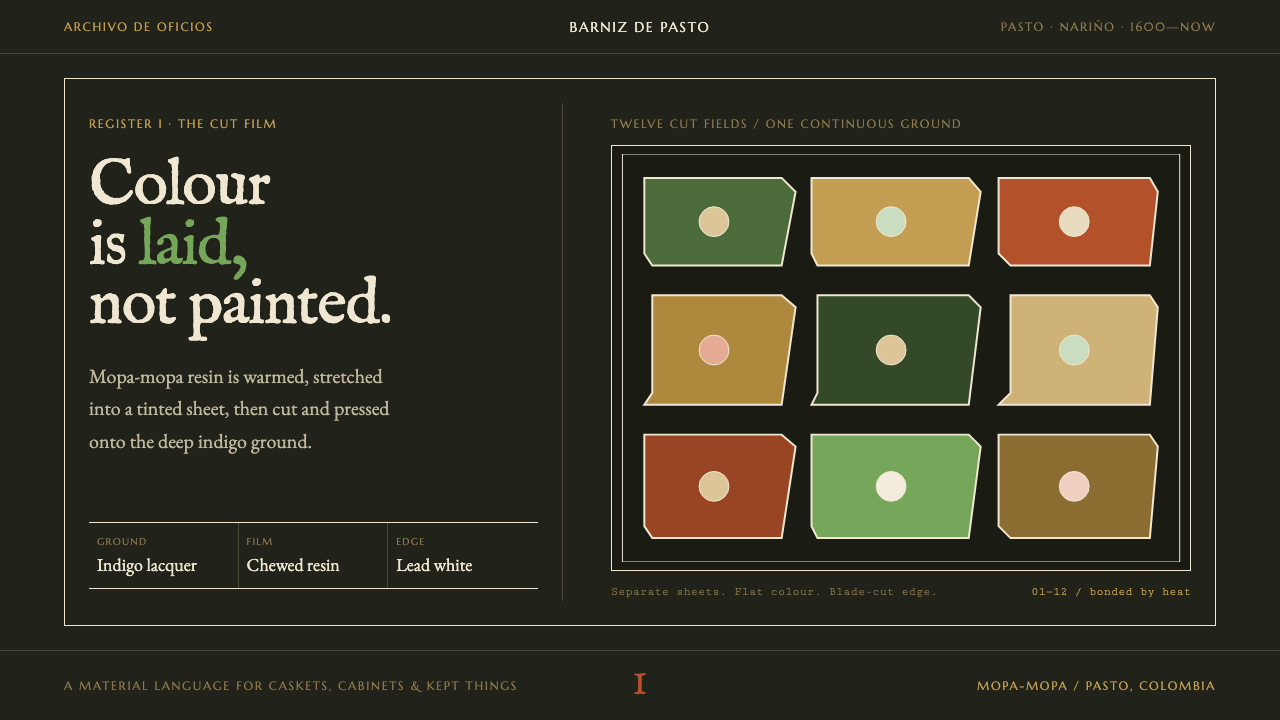 Barniz de PastoColour is laid, not painted. Cut green, gold, and red resin sheets glow on in…
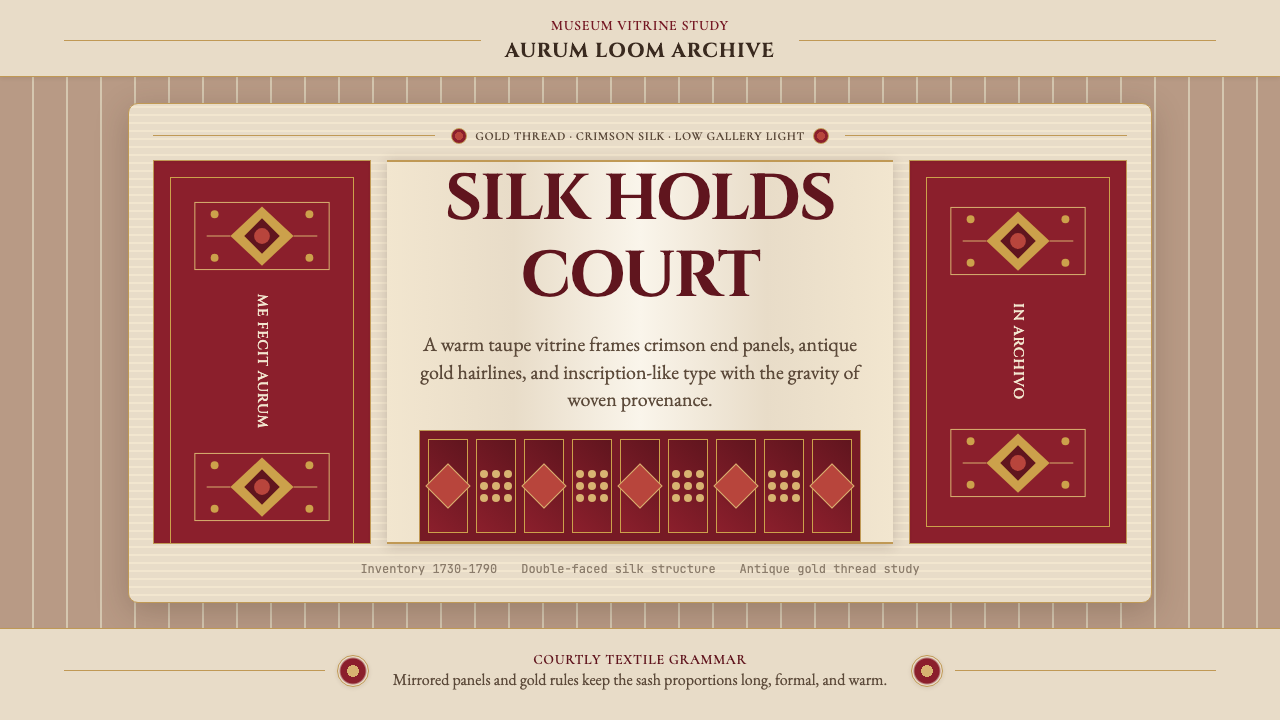 Belarusian Slutsk SashCourtly silk, vitrined. Taupe ground, crimson panels, Cinzel type, antique go…
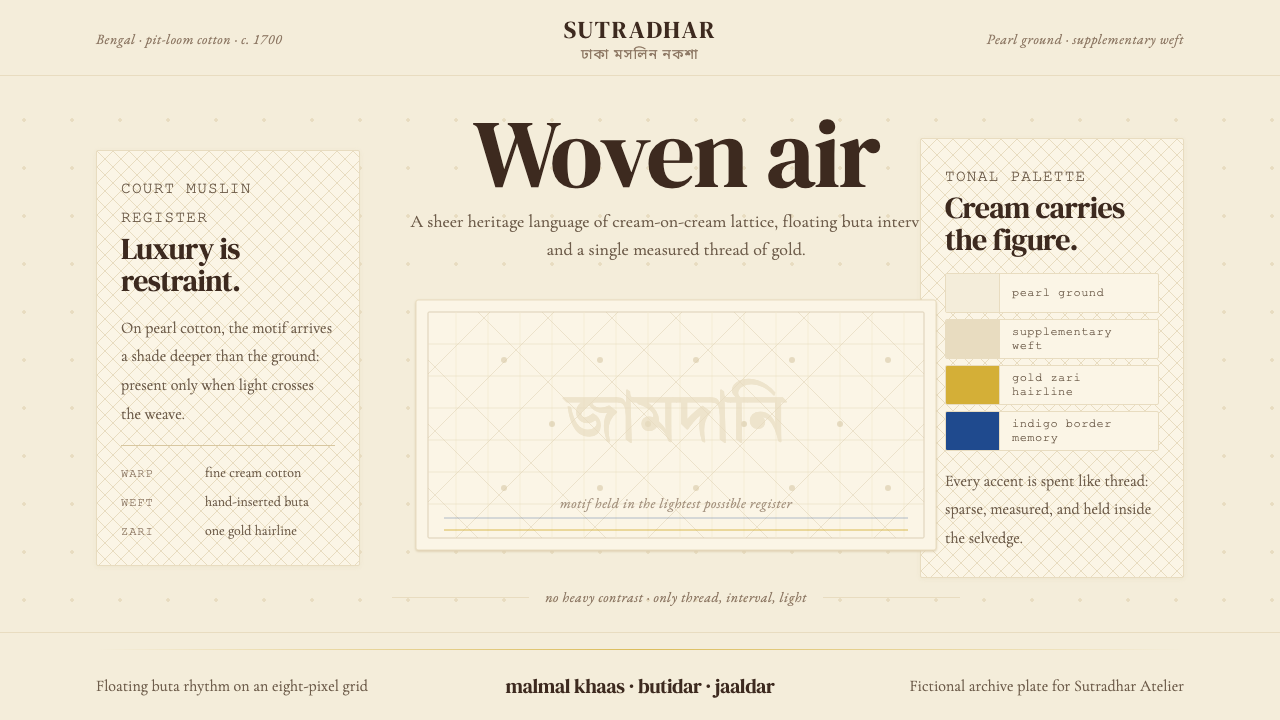 Bengali Jamdani WeavingLuxury whispers. Pearl cream, tonal buta, and one gold hairline make woven ai…
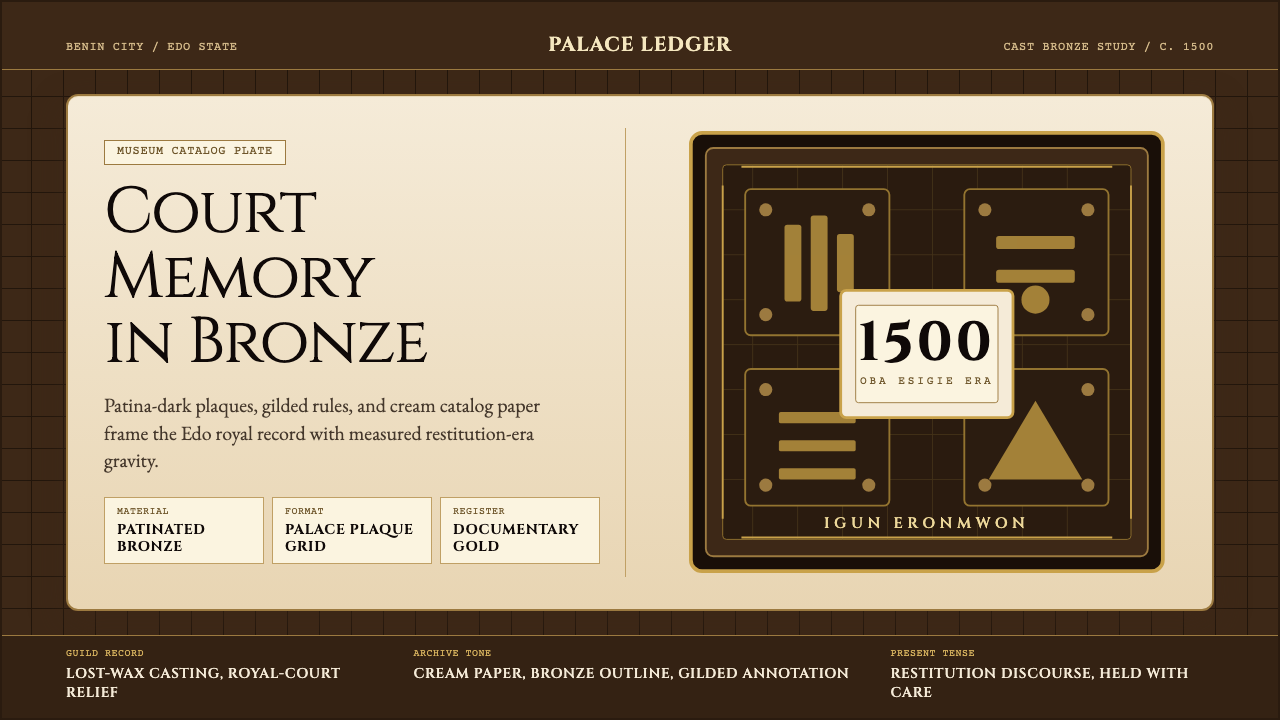 Benin Bronze (Edo, 1500)Royal memory, cast in bronze. Cream plaques and gilded lines carry museum gra…
 Church of the East LiturgyStructure is a second voice. Red rubrics cut brown-black Syriac across ruled…
 Engraved Monochrome MapThe gravity of an old printed sheet. Warm carbon-black ink on foxed rag paper…