What is Chaotic Academia?
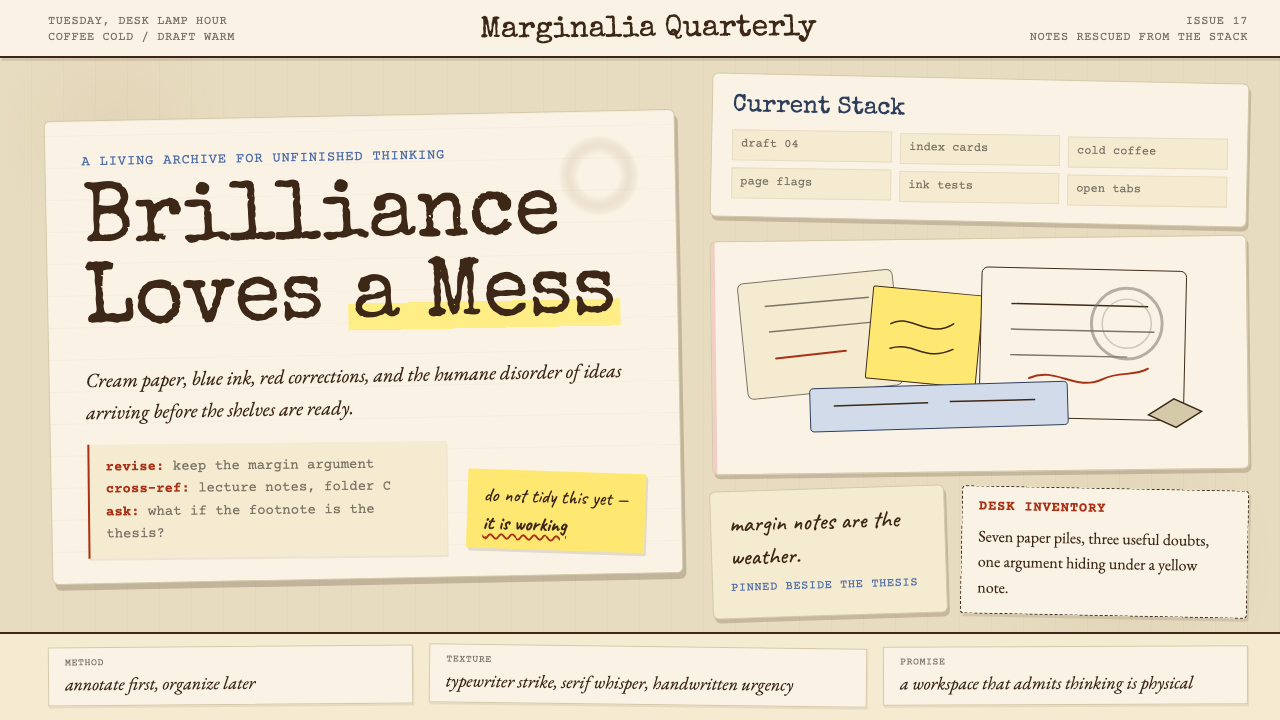
Chaotic Academia is the productive mess you actually live in — coffee rings, margin scribbles, and half-finished essays that somehow cohere into brilliance.
Chaotic Academia in brief
Chaotic Academia is the messy-desk branch of the internet's academic aesthetic family tree. Where Dark Academia broods in candlelit gothic libraries and Light Academia basks in airy Mediterranean sunlight, Chaotic Academia captures something more honest: the productive disorder of a real working scholar. The visual vocabulary includes cream paper stained by coffee rings, margin annotations layered in two or three ink colors, sticky notes obscuring half the monitor, stacks of open books with dozens of loose slips marking half-read chapters, and a desktop that looks catastrophic from a distance but maps a coherent intellectual system up close.
The aesthetic does not romanticize mess for its own sake. It insists that the mess is evidence — proof of genuine intellectual labor as opposed to the performative tidiness of a study space staged for a photograph. A highlighted, dog-eared paperback with handwritten queries in the margins tells a richer story than a pristine hardcover spine arranged for visual effect. Chaotic Academia privileges the working copy over the display copy, the annotation over the original, the process over the finished artifact.
Visually, the style layers warm neutrals — aged cream, parchment, sepia, dusty taupe — with the saturated punctuation of ink: deep forest green, burgundy, cobalt, and the orange-amber of a highlighter dragged across a passage. Type is mixed without apology: a mechanical typewriter face sits beside a flowing cursive hand, which sits beside a serif body text family. Photographs, diagrams, index cards, and manuscript pages coexist in compositions that feel collaged rather than designed. The overall effect is dense, warm, and intellectually alive.

Where does Chaotic Academia come from?
The academic aesthetic family — Dark Academia, Light Academia, and their offshoots — emerged from Tumblr's obsessive micro-taxonomy culture in the mid-2010s, a period when the platform's users were cataloguing the internet's visual inheritance into ever-finer named subcategories. Dark Academia crystallized first, drawing on gothic literary imagery, prep-school uniforms, and the romantic melancholy of nineteenth-century European scholarship. Chaotic Academia was named on Tumblr around 2020 as an explicit counter-proposal: what if the aesthetic acknowledged that real intellectual work is disorderly, that the scholar's desk is not a stage set but a working surface?
TikTok's short-form curation amplified the movement from 2021 onward, particularly through the study-with-me genre — videos in which creators film themselves working at cluttered desks for hours, offering ambient company rather than instructional content. These videos normalized the visible mess as a form of intellectual authenticity. The cluttered background — piles of books, scattered notes, a cold half-drunk mug — became a deliberate aesthetic signal rather than an accidental backdrop, distinguishing 'real studying' from the aspirationally ordered aesthetics that had dominated the study-space genre.
The movement drew visual authority from archival photographs of actual intellectual workspaces. Umberto Eco's apartment in Milan, documented in photographs, was legendary for its labyrinthine floor-to-ceiling shelves and the dense sediment of papers, letters, and objects that accumulated across decades of use. Susan Sontag's elaborate index-card systems — she maintained thousands of cards cataloguing ideas across her entire working life — offered a model of productive disorder that was systematically chaotic rather than randomly messy. The annotated manuscripts of Beat Generation writers, with their marginal revisions, pasted-in additions, and multi-colored underlining, provided another visual precedent for the layered, time-accreted surface that defines the style.
The timing of Chaotic Academia's peak, roughly 2021 to 2024, was not accidental. It coincided with an anti-perfectionism backlash in online culture — a widespread fatigue with the curated, optimized, and performance-ready aesthetics that dominated social media in the preceding decade. Dark Academia had already romanticized scholarly life, but its imagery remained aspirational and theatrically composed. Chaotic Academia went a step further by refusing to clean up before the camera arrived. In this sense, it belongs to a broader cultural current that values visible process, visible labor, and visible imperfection over polished presentation — the same current that valorizes in-progress sketchbooks over finished illustrations and draft manuscripts over published editions.
Hannah Arendt and Susan Sontag function as patron figures not because they endorsed any aesthetic category, but because their intellectual personas — fiercely independent, voluminously note-taking, working across multiple unfinished projects simultaneously — embody the disposition the aesthetic celebrates. The Chaotic Academia figure is not the aristocratic scholar of Dark Academia, aloof and perfectly lit; she is the working intellectual, mid-thought, surrounded by the material evidence of her thinking.
What defines the Chaotic Academia look?
Warm Neutral Grounds
The palette begins with aged paper tones — cream, parchment, sepia, and dusty warm grey — rather than clean white. These grounds carry the suggestion of time elapsed, of surfaces that have been lived on and worked upon. The warmth is not decorative; it signals authenticity, the difference between a fresh page and a page that has been part of a process. The ground color is the aesthetic's emotional foundation: it makes everything placed on top of it feel weighted by the seriousness of real intellectual work.
Layered, Multi-Ink Annotation
The defining mark of Chaotic Academia is visible annotation: margin notes, underlines, circled passages, bracketed sections, and handwritten responses to the printed text. These marks appear in multiple ink colors — a first reading in pencil, a second in blue ballpoint, a third in red pen, passages re-highlighted in orange or yellow — producing a visual stratigraphy of intellectual engagement over time. The layering is not mere decoration; it is a readable record of a mind returning repeatedly to the same material.
Mixed and Colliding Type
Where a clean typographic system insists on a single typeface family, Chaotic Academia embraces the mix. A mechanical typewriter monospace face, a flowing cursive hand, a traditional serif body text family, and a rubber-stamp display face may coexist within the same composition. The logic is archival rather than designed: a real document accumulates type from multiple sources — printed books, handwritten notes, typed drafts, stamped dates — and the collision of these voices is part of its authenticity. The mix should feel found rather than assembled.
Ephemera and Found Objects
Sticky notes, index cards, library-card envelopes, pressed leaves, ticket stubs, bookmark ribbons, rubber bands, and paper clips are as much a part of the aesthetic as the books themselves. These ephemera serve two functions: they are organizational tools — marking places, holding associations, flagging questions — and they are visual texture, interrupting the surface of a page or screen with the physical evidence of a working system. In digital applications, this quality is evoked through collaged image layers, torn-paper edge masks, and translucent card overlays.
Warm Ink Accent Colors
Against the warm neutral ground, accent colors arrive as saturated ink tones rather than bright digital primaries: deep forest green, dark burgundy, cobalt or navy, the orange-amber of a highlighter, the muted teal of an old fountain pen fill. These colors feel absorbed rather than applied — the difference between dye soaking into paper fiber and paint sitting on a surface. They punctuate without overpowering, and their variety reads as natural accumulation rather than color-system design.
Density and Productive Clutter
Chaotic Academia resists the white space and breathing room that minimalist design has accustomed many designers to treat as mandatory. Compositions are dense: margins are colonized by notes, backgrounds are layered with overlapping documents, and no surface remains empty for purely aesthetic reasons. The density is not carelessness — it is intentional fullness, the visual argument that intellectual richness produces material richness. A layout that feels cluttered by minimalist standards reads as thrillingly alive within this aesthetic system.
Time-Accreted Texture
The style prizes surfaces that show their age: paper that has yellowed slightly at the edges, ink that has faded unevenly, coffee-ring stains whose edges are a deeper brown than their centers, tape that has gone amber with age. In digital work, this temporal texture is invoked through grain overlays, paper texture fills, imperfect hand-drawn borders, and the deliberate imprecision of collaged edges. The goal is not distress for distress's sake, but the suggestion of a surface that has been part of an ongoing, living intellectual life rather than produced for a single presentation.

Who shaped Chaotic Academia?
The Italian semiotician and novelist maintained one of the most celebrated working libraries in living memory — floor-to-ceiling shelves labyrinthine enough that he reportedly gave visitors a map. Documented photographs of his Milan apartment became canonical visual references for Chaotic Academia, illustrating how an extreme density of books, manuscripts, and accumulated objects can constitute not disorder but a highly personal organizational logic. His essay on the anti-library — the idea that unread books are more valuable than read ones because they represent future knowledge — became a philosophical touchstone for the aesthetic's embrace of productive incompleteness.
Sontag maintained an elaborate system of index cards across her entire intellectual life, cataloguing quotations, ideas, and observations on thousands of individual cards organized by theme, date, and association. This system — systematic in structure, chaotic in volume — embodies the paradox at the heart of Chaotic Academia: rigorous intellectual method producing a surface that looks, from outside, like productive disorder. Her annotated books, many held in the archives of the UCLA library, show dense layers of underlining, marginal commentary, and cross-referencing that make the annotation itself a form of secondary intellectual production.
Arendt's working style — characterized by simultaneous engagement with multiple unfinished projects, extensive correspondence, dense marginal annotation, and a thinking process explicitly tied to the physical act of writing and rewriting — embodies the disposition Chaotic Academia celebrates. Her photograph at her desk, surrounded by papers and an ashtray, became one of the most circulated images in the aesthetic's online communities. She represents the figure of the working intellectual who thinks through writing rather than before it, whose desk surface is a map of the mind's current state.
The unnamed, collective authorship of Tumblr's academic aesthetic taxonomy deserves acknowledgment as a cultural force. From roughly 2014 onward, Tumblr users developed an increasingly fine-grained vocabulary for visual subcultures, distinguishing Dark Academia from Light Academia, then generating Chaotic Academia as a descriptive category for the aesthetic of productive disorder that the former two elided. This community practice — naming aesthetics to make them discussable, shareable, and reproducible — is itself a form of folk design theory, and Chaotic Academia would not exist as a coherent aesthetic without the naming infrastructure that Tumblr culture built.
The manuscript pages of Allen Ginsberg, Jack Kerouac, William S. Burroughs, and their contemporaries provided an early visual precedent for the layered, annotation-dense surface that defines Chaotic Academia. Kerouac's scroll manuscript of On the Road, Ginsberg's heavily revised drafts of Howl with their inter-linear insertions and marginal alternatives, and Burroughs's cut-up collages — these documents treat the page as an active, accumulating surface rather than a neutral carrier for finalized text. Archival photographs of Beat writer workspaces, circulated widely through literary culture and later through online aesthetic communities, established the association between intellectual seriousness and visible working disorder.
How do you use Chaotic Academia today?
Chaotic Academia is one of the more demanding styles to apply deliberately, because its authority depends on the appearance of the undeliberate. A composition that looks too designed — too symmetrical, too color-coordinated, too precisely aged — defeats the aesthetic's essential argument. The skill is in controlled looseness: every apparently spontaneous element is in fact chosen, but chosen to produce the effect of accumulation rather than arrangement. The designer's role is closer to that of a curator or archivist than an art director.
For presentation slides, Chaotic Academia works best when it is allowed to break the conventions of presentation design rather than simply texture them. A cover slide benefits from a collaged composition: layered paper grounds, a title set in a mix of typefaces as though the slide were a pinboard, decorative ephemera — a coffee-ring watermark, a sticky-note overlay — placed to interrupt the surface without obscuring the information. Content slides should resist the clean grid; instead, treat each slide as a working page with a dominant text zone and margins that can hold annotations, pull quotes, or index-card style call-outs. Data visualization can adopt a hand-drawn or typewriter quality — bars and lines that look sketched rather than generated — which reinforces the working-draft atmosphere without sacrificing legibility.
For web interfaces, the style suits editorial platforms, personal portfolios, note-taking or knowledge-management applications, and academic or research-adjacent products where the work itself is the primary value proposition. The implementation approach: use a warm off-white or light parchment background rather than pure white, introduce paper texture through a subtle overlay, set body text in a traditional serif typeface, and allow visual elements to break the grid slightly — a sidebar annotation that intrudes a few units into the main column, a pull quote that sits at a slight angle, a header that appears to have been stamped rather than typeset. Interactive states can invoke ink behavior: hover effects that look like underlines drawn by hand, focus states that suggest a pen circling an input field.
For editorial and marketing work, the aesthetic supports long-form content formats particularly well: journal-style articles, newsletters, reading lists, and research reports. The style provides a ready-made visual argument that the content has depth, that it rewards careful reading, and that it comes from a tradition of serious intellectual engagement rather than content-marketing optimization. Marketing pages can use the style to differentiate a product positioned around knowledge, learning, or creative process — a writing tool, an educational platform, an academic publisher's consumer-facing presence. The key is maintaining the density and warmth that give the style its authority; a Chaotic Academia marketing page that is too sparse or too clean loses its signal entirely.
A common mistake when applying this style is mistaking it for the Dark Academia palette and treating the brown-and-cream base as the entire aesthetic. Chaotic Academia's critical differentiator is not color but layering and accumulation — the suggestion of time passing across a surface. A composition in warm neutrals with clean organization is not Chaotic Academia; it is warm minimalism. The style requires visible process: multiple overlapping layers, type that appears to have been added at different moments, at least one element that seems to have been physically attached rather than designed. Designers who apply it without the layering typically produce something that feels vintage rather than intellectually alive.

Chaotic Academia — FAQ
How is Chaotic Academia different from Dark Academia?
Dark Academia and Chaotic Academia share an academic subject matter and a preference for warm, aged tones, but they differ fundamentally in emotional register and visual logic. Dark Academia is theatrical and aspirational: it curates the romantic image of scholarly life — gothic libraries, candlelight, moody portraiture, the beautiful sorrow of intellectual pursuit. Its compositions are deliberately staged and emotionally heightened. Chaotic Academia is anti-theatrical: it refuses the staging in favor of the working reality, prioritizing the visible mess of genuine intellectual labor over any curated image of what scholarship should look like. The distinction is the difference between a photograph of a scholar at a desk and a photograph of the desk after the scholar has left.
Can Chaotic Academia work in a clean digital interface without actual texture?
It can, but only partially, and it requires a clear-eyed decision about which aspects of the aesthetic to prioritize. The warmth of the palette — off-white backgrounds, ink-tone accents, serif typography — can be applied in a clean, texture-free interface and will produce something warm and readable without being visually demanding. What gets lost is the layering and time-accreted quality that gives the style its strongest signal. A clean Chaotic Academia-derived interface reads more as 'warm editorial' or 'scholarly serif' than as Chaotic Academia proper. If the product context makes heavy texture inappropriate — a productivity tool, a data-dense dashboard — the warm editorial variant is a defensible choice. Just be honest about what the style is actually delivering.
Is there a risk of the style looking messy rather than productively chaotic?
Yes, and this is the central execution challenge of the style. The difference between productive chaos and plain mess is legibility of system: in an authentic Chaotic Academia composition, a viewer can sense — even if they cannot articulate — that the disorder has an underlying logic, that the accumulation is the product of a mind at work rather than inattention. This requires that the primary hierarchy of information remain clear regardless of the surrounding density, that every layered element can be traced to a plausible reason for its presence, and that the chaos operates within a consistent tonal and textural range. Disorder that fails all three tests reads as mere carelessness. The discipline of the style is knowing exactly how far to push the density before it tips from alive to unreadable.
What kinds of products or brands should avoid this aesthetic?
Chaotic Academia is poorly suited to contexts where speed, precision, and transactional efficiency are the dominant values. A financial platform, a logistics dashboard, a healthcare application, or an e-commerce checkout flow all depend on the user's immediate trust that the system is under control and that important information will not be obscured. The style's density and deliberate imprecision actively undermine these needs. Similarly, brands positioned on cleanliness, hygiene, or physical wellness — food products, personal care, medical devices — rely on an aesthetic language of order and clarity that Chaotic Academia directly contradicts. The style is strongest where the product's value is tied to depth, process, learning, or creative work; it is weakest where the product's value depends on speed, precision, or the reassurance of perfect order.
How do you age a digital composition without it looking like a cliché vintage filter?
The distinction lies in specificity and restraint. Vintage filters apply aging uniformly across an image — the same vignette, the same grain, the same color shift applied to everything simultaneously. Authentic time-accreted texture in Chaotic Academia is local and varied: a coffee ring appears in a specific corner because something was placed there, a margin annotation is heavier on one page than another because that page received more attention, an edge is torn rather than cropped because something was physically removed. To evoke this digitally, apply texture selectively rather than globally, introduce imperfections at specific points of visual interest rather than across the entire surface, and ensure that each aging element can be rationalized as the trace of a specific action rather than the application of a filter. The goal is archaeology, not antiquing.
Related design styles
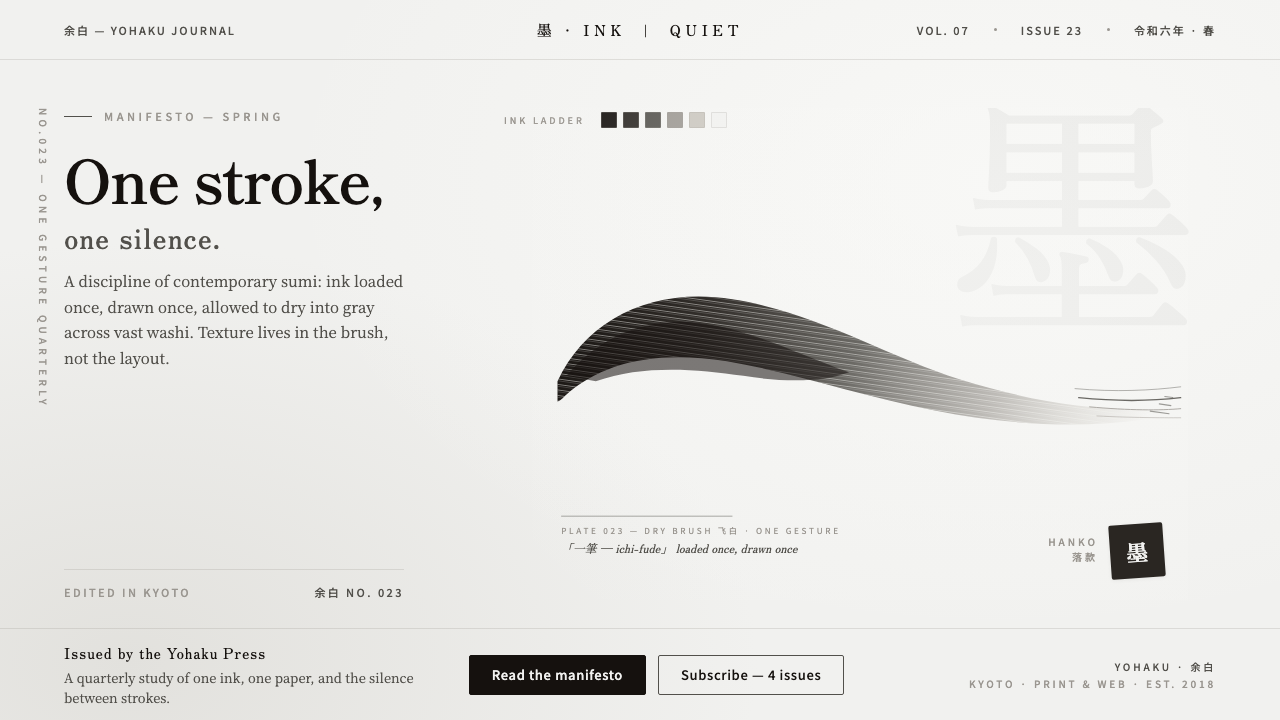 Modern Sumi BrushOne stroke, one silence. Warm sumi ink graduating through dry-brush gray acro…
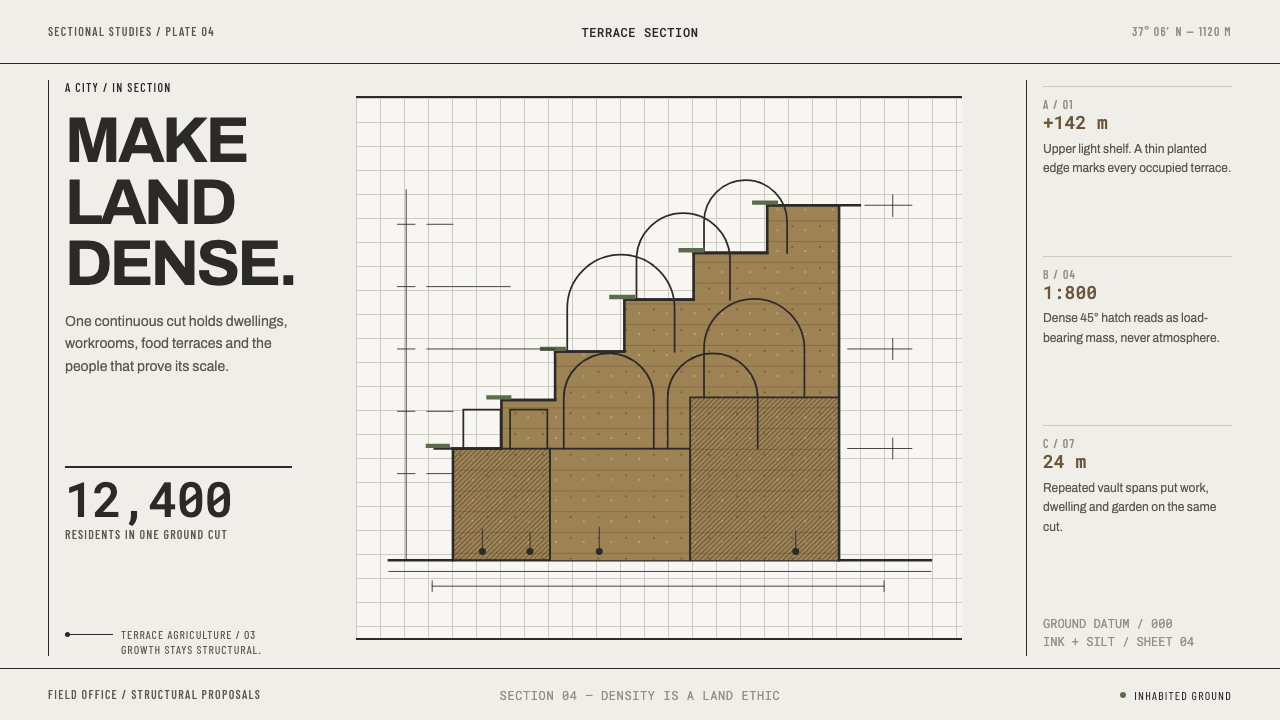 Arcology Section DrawingDensity makes a land ethic. Ink-cut terraces and silt ochre turn a city into…
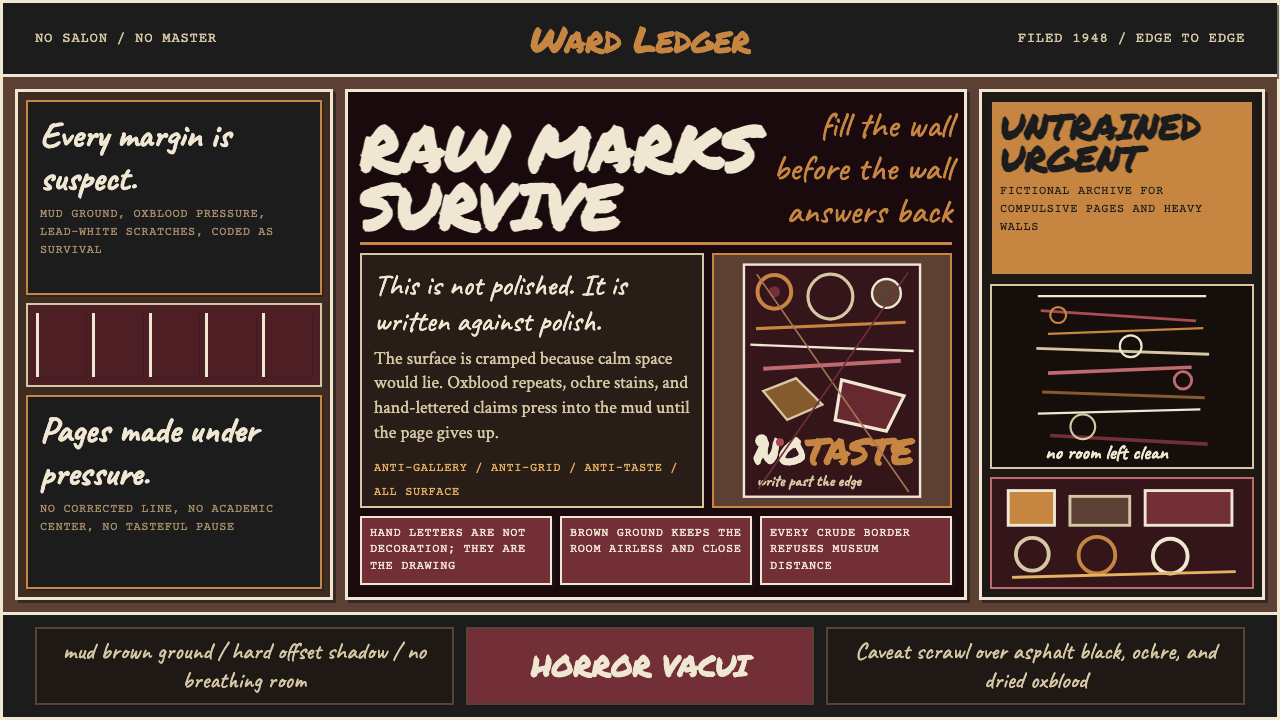 Art Brut (Dubuffet, 1948)Rawness crowds the frame. Mud brown, oxblood marks, and hand scrawl erase the…
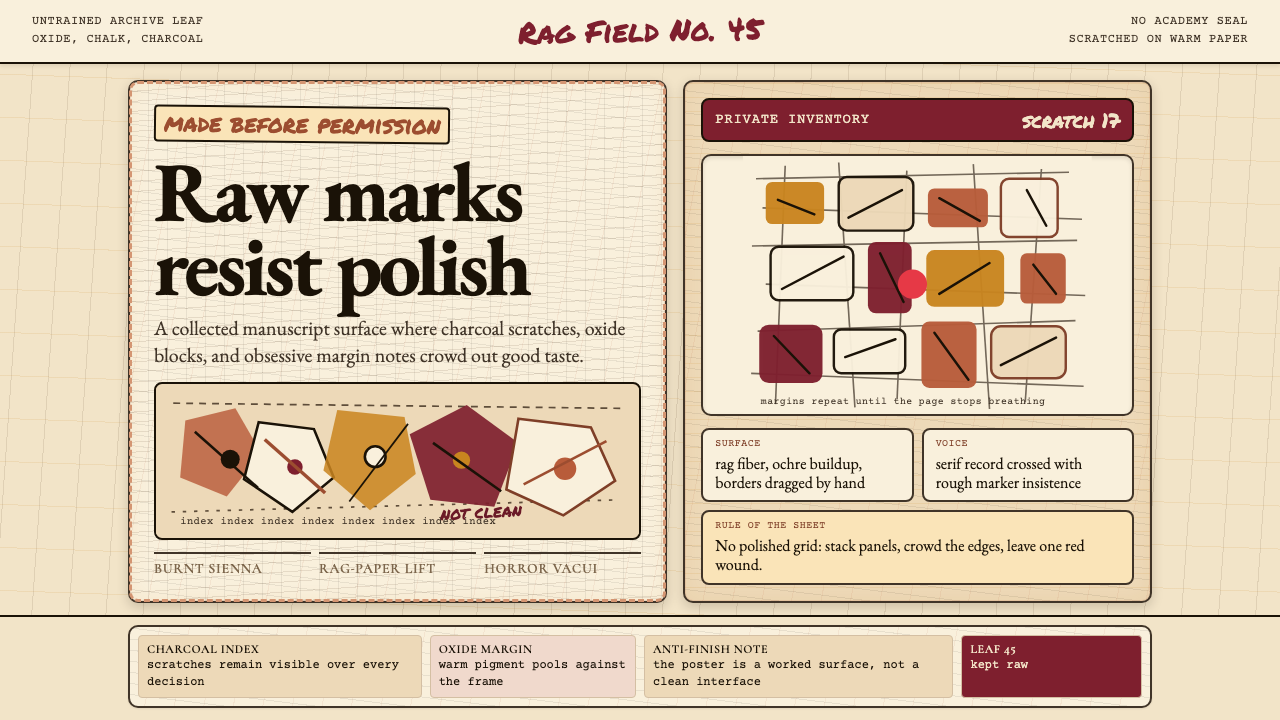 Art Brut (Dubuffet)Polish is refused. Bone-cream paper, earth pigments, scratched borders, dense…
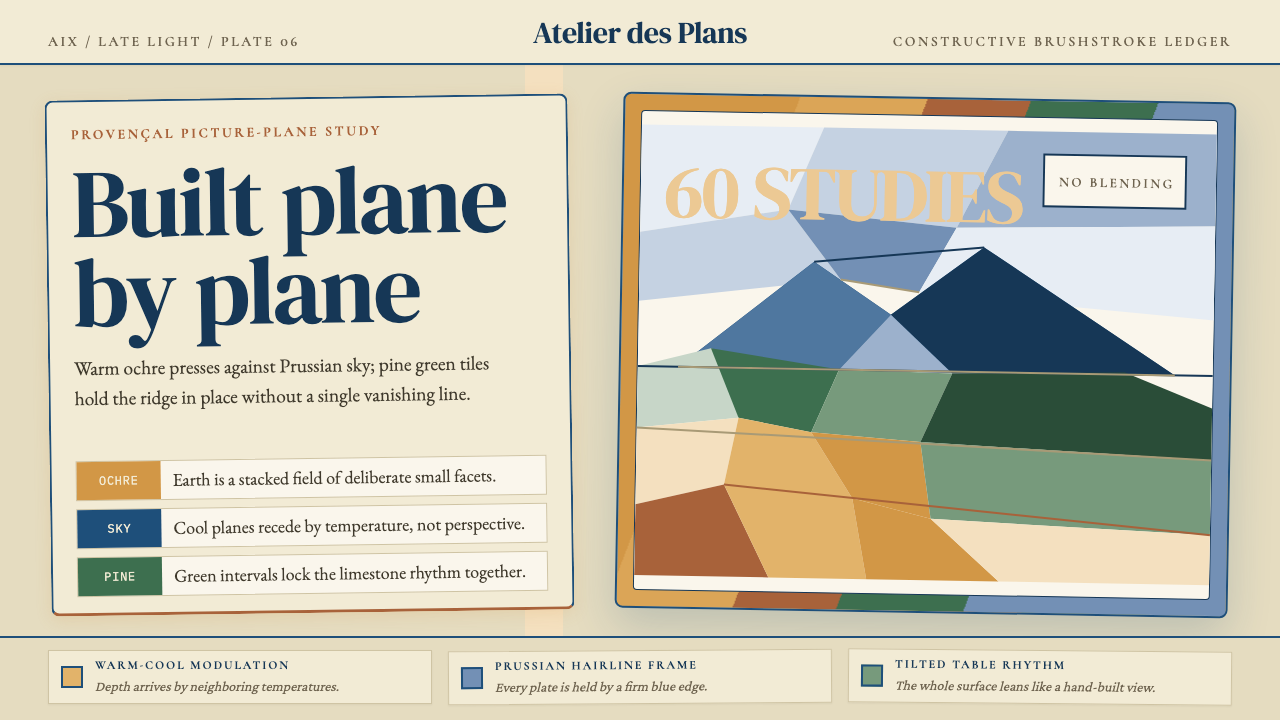 Cézanne — Mont Sainte-VictoireBuilt, not blended. Ochre, Prussian blue, and pine facets tilt into a constru…
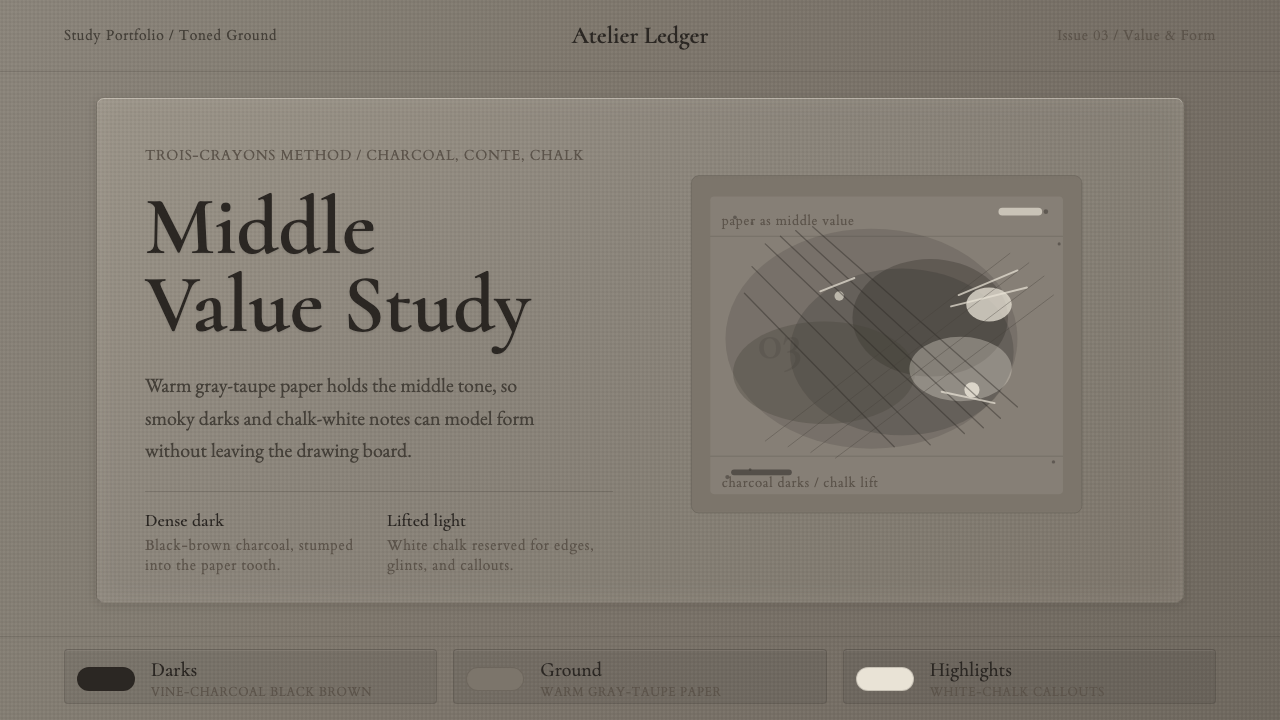 Charcoal & Conté DrawingAtelier calm, in middle value. Gray-taupe tooth, smoky charcoal, and chalk-wh…