What is Sbek Thom Shadow Puppet?
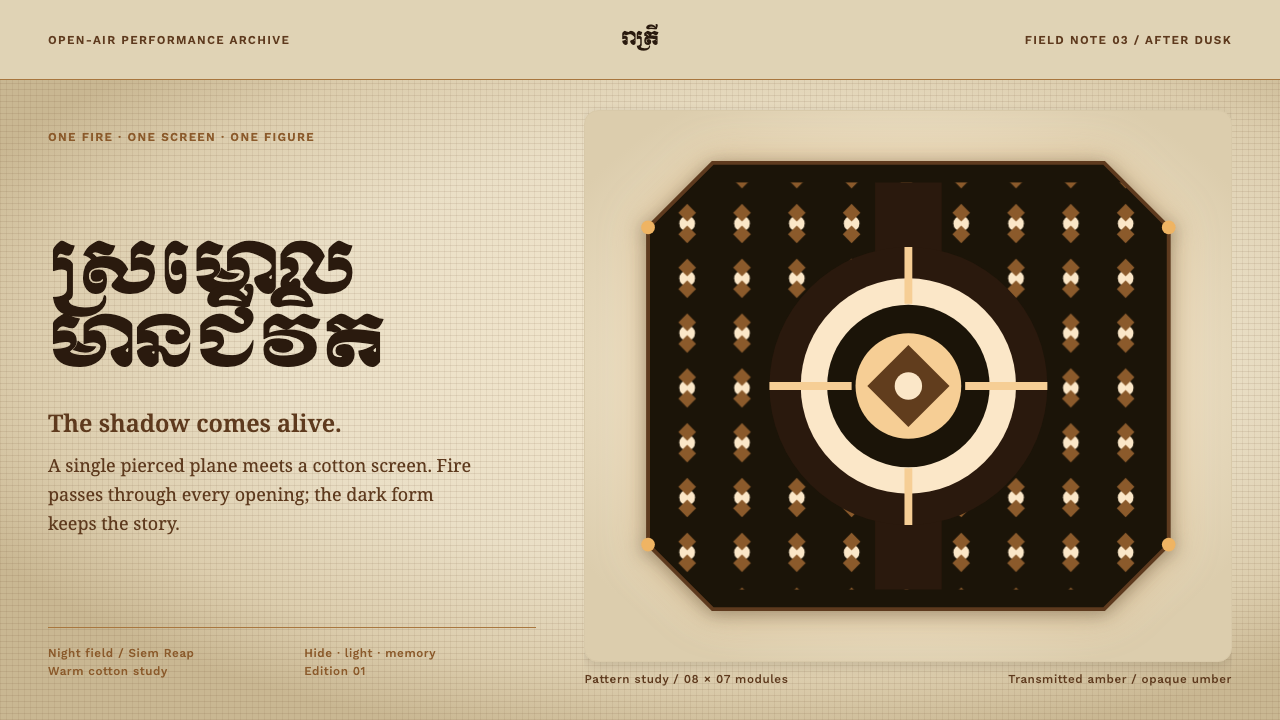
Sbek thom turns a cowhide, a wood fire and a cotton screen into ceremony — dark pierced forms floating on a warm amber glow.
Sbek Thom Shadow Puppet in brief
Sbek thom is Khmer large shadow theatre, performed three or four times a year at night beside a rice field or a pagoda. Its figures are two-metre panels cut from a single piece of cowhide, dyed with kandaol bark, and pierced so that light passes through the cut-away areas. They have no joints. The dancer carries the whole panel overhead on two bamboo sticks and animates it with the movement of the dancer's own body.
This design system takes the audience's view. A white cotton sheet is stretched between bamboo poles and lit from behind by a single wood fire, so the screen reads warm amber at its centre and falls off toward the corners. Content sits on that glow as dark form. There is one dominant figure per view and a generous expanse of empty screen around it.
The craft the style borrows is threefold: the piercing that turns hide into pattern, the firelight that makes the pattern visible, and the soft edge that appears when a figure lifts away from the screen. Together they turn a flat surface into something closer to ceremony than to display. It is a quiet, monumental and patient visual language.
Where does Sbek Thom Shadow Puppet come from?
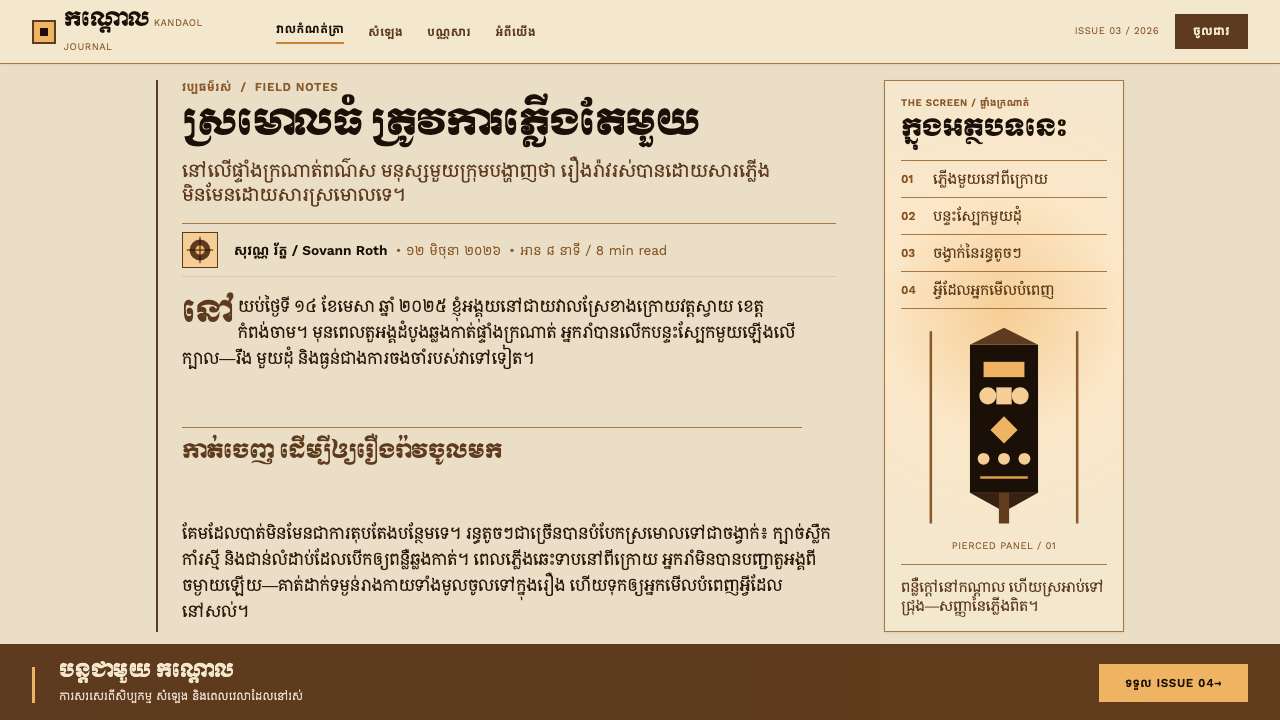
Sbek thom belongs to the older layers of Khmer culture. Its roots are pre-Angkorian, and UNESCO recognised it as intangible cultural heritage in 2005. The name pairs two Khmer words, sbek for hide and thom for large: it is shadow theatre made from big pieces of leather, as distinct from smaller shadow puppets used elsewhere in the region. It is kept alive by troupes in Siem Reap and Kandal provinces.
It is a sacred performing art rather than entertainment on demand. It is staged only three or four times a year — at the Khmer New Year, on the king's birthday, and in rites of remembrance for the ancestors and sages — and always at night, on open ground by a rice field or in front of a temple. The stories come from the Reamker, the Khmer telling of the Ramayana, and the performance sits within the tradition of Khmer sacred performing arts.
The making is as important as the performance. Each panel is cut from a single cowhide, which is why the figures are large and unjointed. The hide is dyed to a deep umber with the juice of kandaol bark, then cut by hand, stroke by stroke, until the surface becomes a lattice of openings. When light passes through, the figure appears on the screen as patterned detail; without light, it is only a dark, heavy plank of leather. The pattern is made of absence.
The performance is physical. Because the figures cannot articulate, the dancer is the mechanism: walking, turning, lifting and lowering the panel overhead, and using the whole body to give a rigid piece of hide the appearance of action. When a figure is pressed against the screen its edges are sharp, and when it is lifted away they soften into a halo, so distance from the cloth becomes a kind of depth. Ty Chean, Mann Kosal and Pich Tum Kravel are the names cited as key figures in the tradition, among the people through whom the craft and its repertoire are carried forward.
What defines the Sbek Thom Shadow Puppet look?
Firelit Amber Field
The screen is not a flat white. A cotton sheet lit from behind by one wood fire glows warm amber at its centre and darkens gradually toward the corners, a natural vignette produced by a single point of light. The ground is therefore a warm, radial glow rather than an even fill, and it is the main source of atmosphere.
Dark Form on Light
Content is shown as shadow: umber-dark silhouettes against the glow. The figure is defined by where light is blocked. This inverts the usual interface logic of light elements on a dark field; here the ground is the light, and the content is the darkness cast on it. Contrast comes from the fire behind the cloth, not from a drop shadow.
Pierced Umber Geometry
The dark form is not solid. It is pierced with dense, repeating cut-outs that let firelight through, so the figure reads as pattern, with fine geometry across its body and clean silhouettes at its edge. The hide is a deep umber, a warm brown-black, never pure black. In graphic terms this means ornamental repetition, perforation and lattices, with silhouettes whose interiors are drawn by what is missing.
One Figure, Generous Empty Screen
Each view offers one dominant figure and a large area of untouched screen around it. The empty cloth is not wasted space; it is where the light lives, and it gives the figure room to be monumental. Layouts therefore avoid crowding: a single hero element, supporting elements at a much lower visual weight, and wide margins.
Soft Halo at the Edge
When a figure lifts away from the cloth, its edges blur and spread into a soft halo; when it presses against the cloth, the edges snap sharp. This is the style's depth cue and its only softness. Depth is expressed by the sharpness of an edge, not by a drop shadow or a gradient. A restrained blur around a lifted element evokes the effect; blur everywhere does not.
Natural Materials
The palette and texture come from the stage's materials: cowhide dyed with bark, cotton cloth, bamboo poles, wood fire. Surfaces carry a fine cloth weave rather than a polished gloss, bamboo supplies pale straw tones for supporting elements, and nothing is chrome, glass or plastic. The warmth of the whole system is the warmth of fire seen through fabric.
Type as Another Shadow
The tradition has no lettering on the screen, so typography is left to interpretation. A faithful approach treats text as one more dark form on the glow: simple, unadorned, high in contrast with the amber ground, set sparingly and with generous space around it. Ornament belongs in the pierced shapes, not in the letterforms, and the text should never compete with the single dominant figure.

Who shaped Sbek Thom Shadow Puppet?
Ty Chean is among the names cited as key figures of sbek thom. The tradition this name belongs to teaches pacing: a two-metre hide is carried slowly, one figure at a time, with the weight and patience of ceremony. For a designer, that is the lesson of the whole system, which moves slowly and gives each view a single subject.
Mann Kosal is another name cited among the key figures of the tradition. The craft that surrounds such figures makes one thing clear: a pierced hide has no meaning without light. The panel and the fire depend on each other, which in design terms means the dark form and the glowing ground have to be designed together, never one without the other.
Pich Tum Kravel is the third name cited among the tradition's key figures. The practice they belong to is held as sacred and handed on through troupes, not treated as a decorative motif. The design lesson is custodianship: when you borrow the look of a living ritual, you borrow its restraint and its seriousness as well.
How do you use Sbek Thom Shadow Puppet today?
Sbek Thom is a style for work that wants to feel ceremonial, patient and warm. Its parts are few — an amber glow, a dark pierced form, empty space — and the effect depends on keeping them few. To apply it, design each view as a lit screen with one subject.
For presentation slides, a cover works as a warm amber field brightest at the centre, with a single dark pierced motif or silhouette and a restrained title. Content slides should carry one idea each, the main element set as a dark form on the glow with a great deal of empty screen around it. Data slides suit one dark series on the amber ground, with the key figure given the dominant place and supporting values at a lower visual weight; avoid multi-colour charts that fight the single light source.
For web interfaces, the style suits cultural, heritage and storytelling products, long-form reading, travel and hospitality, meditation or ritual-adjacent services, and landing pages that present one idea at a time. Use a warm radial glow as the page ground, dark umber for text and primary shapes, and soft edges only on elements that lift from the surface, such as menus and modals. It is less suited to dense dashboards; where one is needed, use the glow only as a frame and keep the data area plain and legible. Pricing can show a single highlighted plan as the dominant figure, with the others receding.
For editorial and marketing work, the style gives museum and festival communications, travel features, documentary projects, tea, incense or craft brands, and long-form essays a calm, ceremonial presence. Pierced patterns work well as section dividers and ornaments, always as dark cut-outs rather than gold or colour. Photography should be warm and low-key, with silhouettes against firelight or screens, rather than bright and busy.
The most common mistake is to treat the style as generic Asian-themed decoration: temple clip-art, stock ornament, or gold-and-red palettes. This style is about one lit screen and one dark form. A second mistake is flattening the glow into a uniform beige, which loses the centre-to-corner fall-off that makes it feel like firelight. A third is crowding the view with several equally dominant figures, or filling the empty screen. Finally, remember this is a sacred performing tradition: credit it, and do not turn its figures into casual icons.
Sbek Thom Shadow Puppet — FAQ
What does the name sbek thom mean?
In Khmer, sbek refers to hide or leather and thom means large, so the name describes large shadow figures cut from hide. It is a different art from the smaller shadow puppets found elsewhere in the region. Keep the name as sbek thom when you refer to it, and avoid generic labels such as Asian shadow puppets, which erase what makes this tradition specific.
Why is the screen amber rather than white?
Because the light source is a single wood fire behind a white cotton sheet. The cloth glows warm amber where the fire is strongest, at its centre, and darkens toward the corners. A flat white or an even beige would lose that fall-off and with it the feeling of firelight. The amber is the evidence of the fire, and the reason the dark pierced forms look lit from within.
Can Sbek Thom be used for dense interfaces such as dashboards?
It can frame them, but it is not built for density. The style depends on one dominant figure and generous empty screen, which is the opposite of a dashboard's many small values. If you need to use it, let the glow and pierced motifs form the shell, and give the data panel a plain, high-contrast treatment where every number is readable without atmosphere getting in the way.
Does the style work in a dark mode?
The system is built around a lit screen, so dark mode needs care. The glow is the light, and the content is the dark form on it; invert that and the figure loses its reason to be dark. If you need a low-light version, keep the amber glow but dim it, as if the fire had burned lower, and keep the figure as the darkest element on a warm, lit area rather than pale shapes on black.
How should the cultural context be handled respectfully?
Sbek thom is a sacred performing art, recognised by UNESCO in 2005 and kept alive by troupes in Siem Reap and Kandal. Use its name accurately, credit the Khmer tradition where the context allows, and borrow its structure of light, pierced form and empty screen rather than reproducing specific sacred figures as decoration. When a project depicts or refers to its stories, consult people who know the tradition.
Related design styles
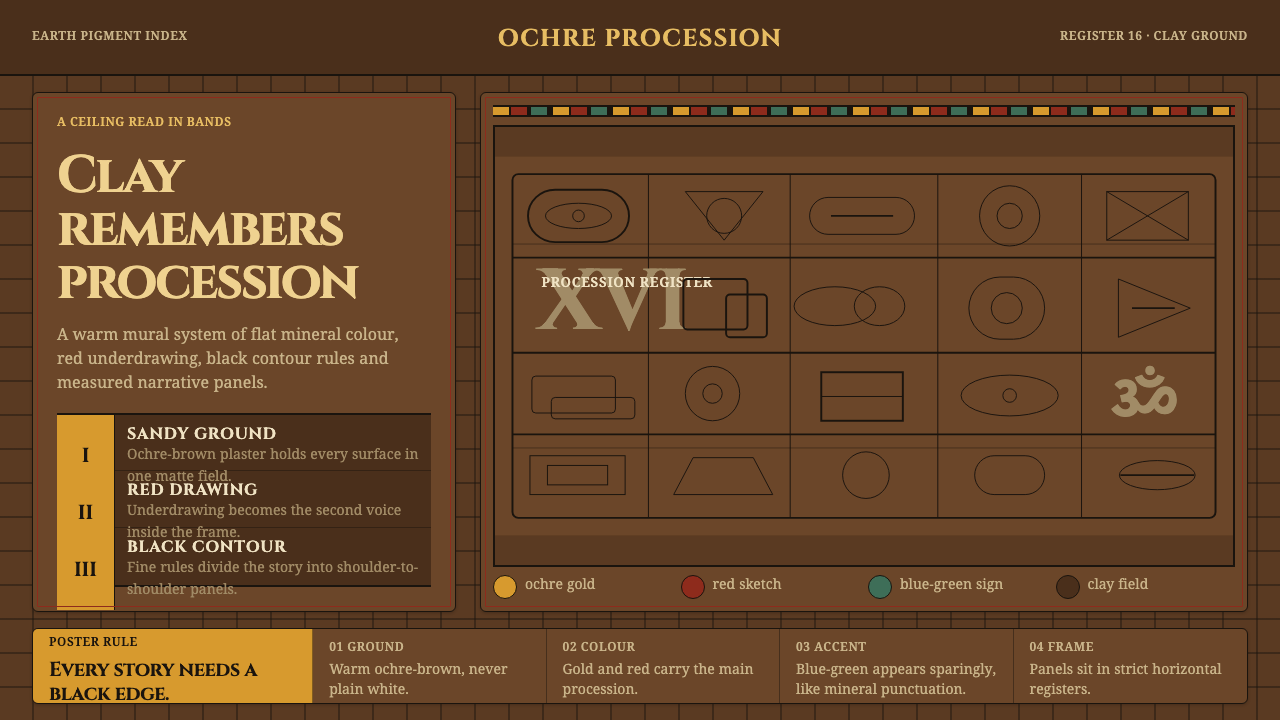 Lepakshi Vijayanagara CeilingEarth remembers in registers. Ochre gold, red underdrawing and black rules ma…
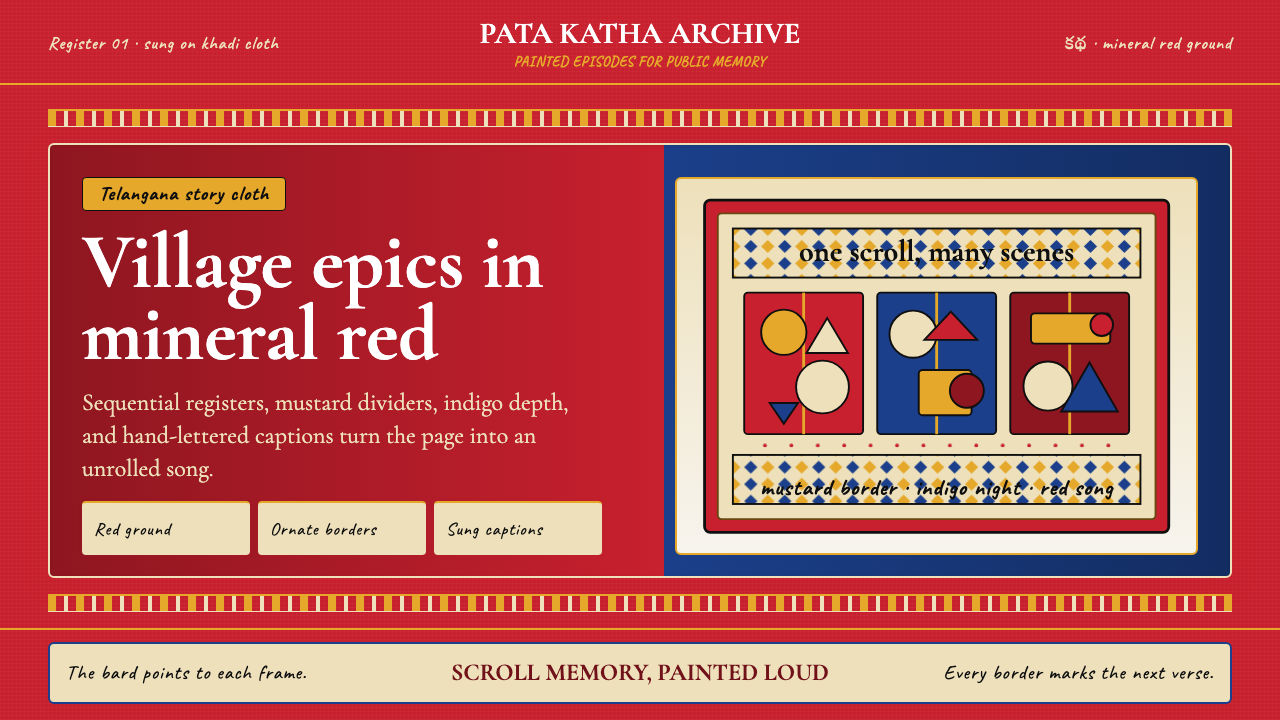 Andhra Cheriyal Scroll PaintingSaturated oral memory. Mineral red registers, mustard diamonds, and serif son…
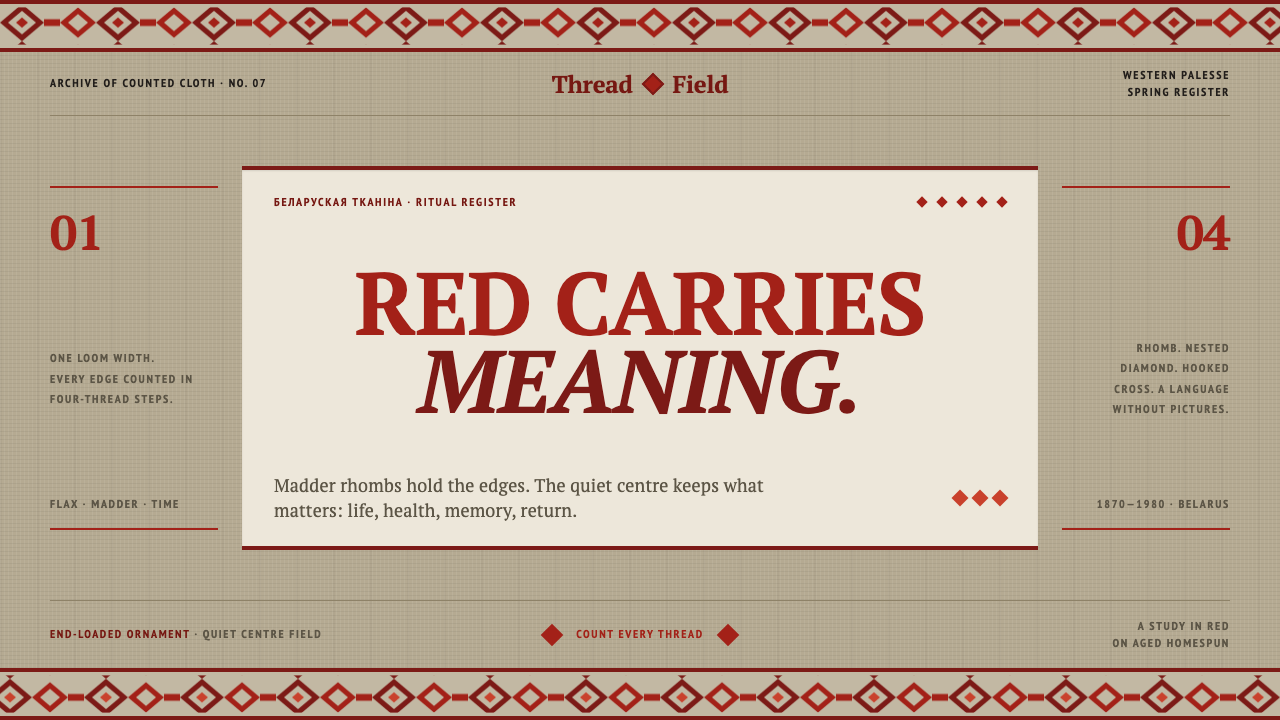 Belarusian RushnykRed carries meaning. Madder rhombs crowd aged flax edges while the woven cent…
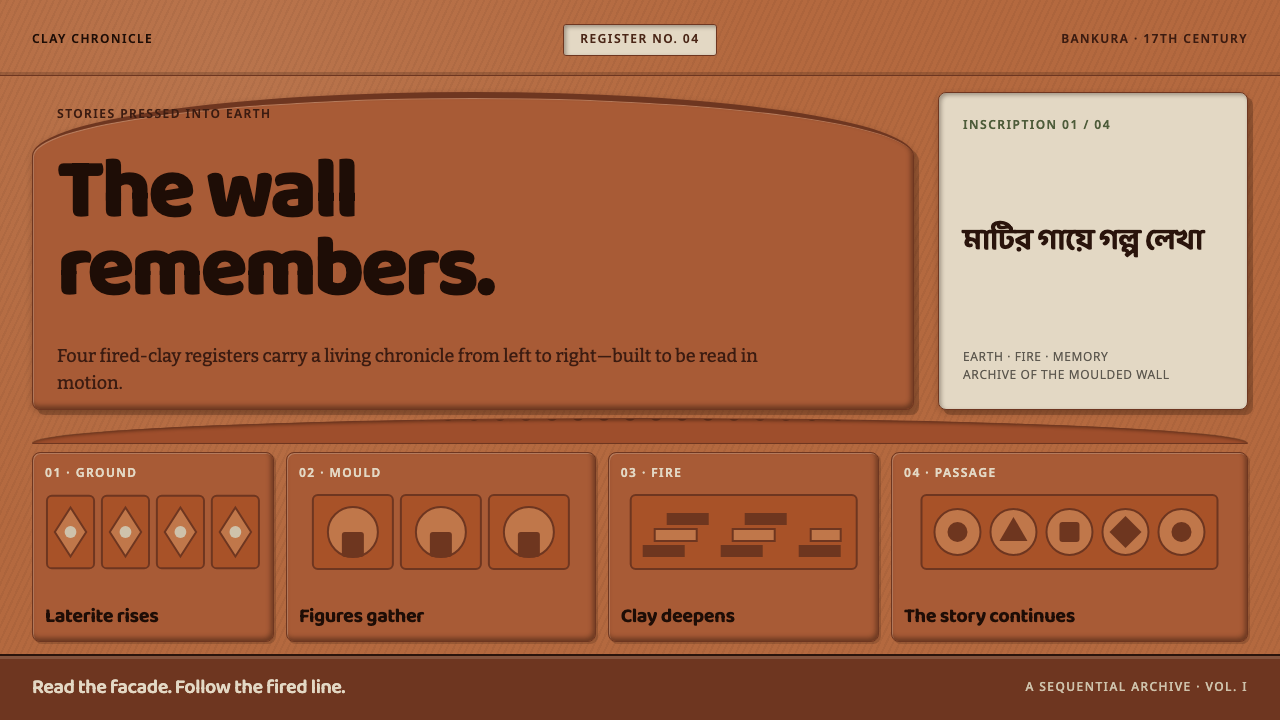 Bishnupur Terracotta TemplesThe wall tells the story. Fired-clay relief panels unfold in warm horizontal…
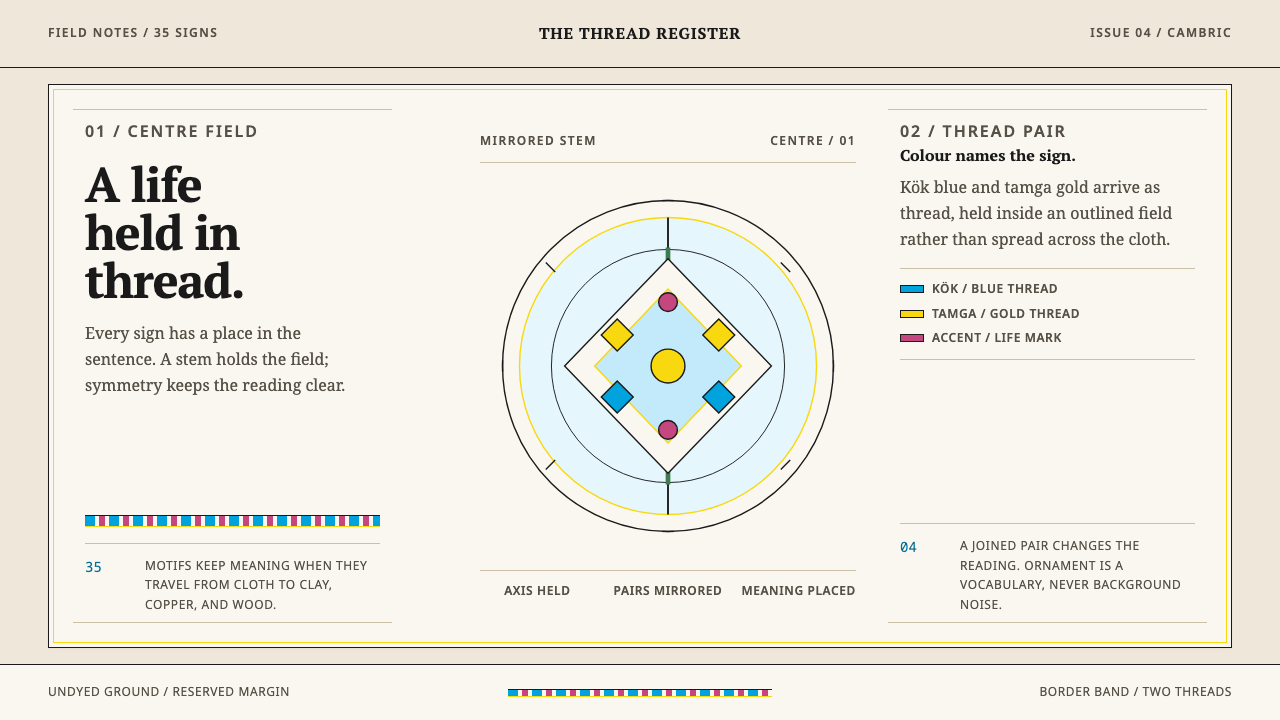 Crimean Tatar OrnekOrnament that can be read. Kök blue and tamga gold hold a mirrored stem on un…
 Derge Woodblock Sutra PrintHand-pulled scripture gravity. Cinnabar uchen and ochre rules press into dark…