What is Buryat Ongon?
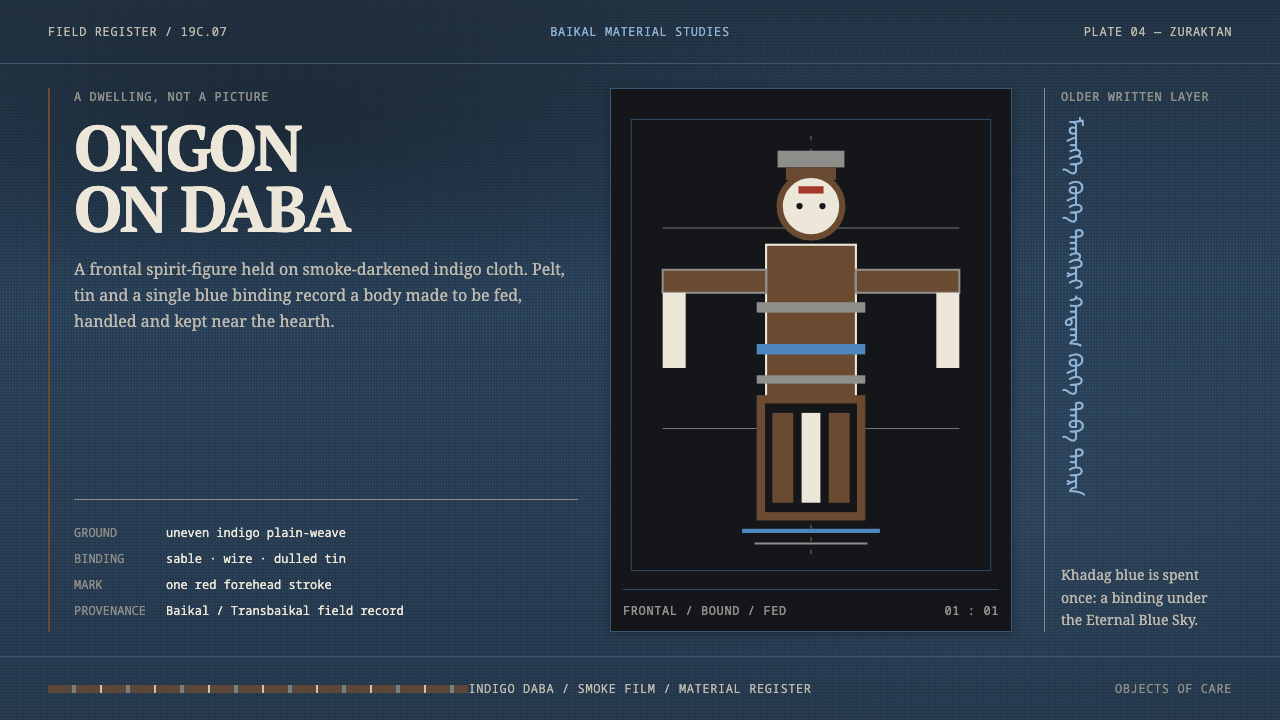
The Buryat ongon is a spirit's dwelling made of cloth, fur and hearth smoke — a flat, frontal figure that was fed and handled, never merely looked at.
Buryat Ongon in brief
The Buryat ongon is a ritual object from the Lake Baikal and Transbaikal region of Siberia: a small human figure drawn or cut onto a scrap of cloth, bound about with fur, hair and bent strips of metal, then fed with milk and fat and kept in the smoke of the household hearth. It belongs to the world of Mongolic shamanism and Tengrism, where spirits are given places to live, and an ongon is exactly that — a dwelling for a spirit, not a portrait of one.
That distinction is the whole aesthetic. Because an ongon is used rather than displayed, nothing about it is composed for a viewer. The figure is frontal, flat and symmetrical, with both arms stretched out to the sides, no perspective, no modelling and no individual face. Its surface is a working surface: darkened by smoke, stiffened by grease, handled and re-bound over years. The visual language is one of material evidence — what the object has been through is what you see.
As a design style, Buryat Ongon is a dark one. The ground is smoke-filmed indigo, the single cool blue is the blue of the ceremonial scarves tied to sacred cairns, and every other colour is a named material: animal fur, lamp-black, dulled tin, a mark of red on the forehead. It is a style of weight, hush and reverence rather than ornament — a system for interfaces and pages that want to feel like something kept.
Where does Buryat Ongon come from?
The Buryats are a Mongolic-speaking people whose homeland lies around Lake Baikal and across the Transbaikal steppe and forest. Their older religious world — what scholars group under Mongolic shamanism, Tengrism and Siberian animism, with its veneration of the Eternal Blue Sky — organised life around specialist intermediaries, the böö, and around a crowded landscape of ancestral and place spirits. Spirits in this world were not abstract. They needed somewhere to be, and a household or a shamanic lineage made them somewhere: an ongon.
The recorded ongon Zuraktan, the specimen at the heart of this style, is painted on blue daba, a cheap plain-weave cotton made in China and traded the length of Siberia. The detail matters. The ground is not a precious silk or a carefully prepared hide but an everyday commodity textile, dyed unevenly in indigo, which tells us that the ritual world of the Baikal region was tied by trade to far larger systems and used what trade brought. The colour that answers the indigo is khadag blue — the colour of the Eternal Blue Sky, and of the scarves tied onto ovoo, the stone cairns raised at passes and sacred places.
What we know of ongons as physical objects comes largely through collecting. The surviving specimens were catalogued in the nineteenth century, and institutions such as the Kunstkamera — the Peter the Great Museum of Anthropology and Ethnography — are among the places that hold and record them. A catalogue entry is a snapshot of a practice caught at one moment; the tradition itself is older than any inventory, and it was never static. This is why the style is dated simply as pre-1900: it is a pre-modern religious object seen through the nineteenth-century record.
The design system takes its logic from the object's life rather than from its outline. Because an ongon is fed and kept in hearth smoke, surfaces are treated as things lived with: dark, matte and slightly filmed. Because the figure is frontal and bound, compositions are centred and symmetrical around one focal form. And because every colour in the object is a material — sable and ermine for the fur, lamp-black, dulled tin, a red-marked forehead — the palette reads as a list of substances rather than a spectrum. The result feels devotional without relying on any imagery beyond the object itself.
What defines the Buryat Ongon look?
Smoke-Darkened Indigo Ground
The page begins with cloth, not paper. The ground is a deep, unevenly dyed indigo of the kind found on trade cotton — dull rather than glossy, and filmed over as if by years of hearth smoke. It is close to black but never black: a little lighter where the weave has worn, a little heavier where it has been handled. Large dark areas therefore feel woven and kept rather than flat-filled. Pure black and pure white are both absent from the ground; the darkness has a colour and a history.
Khadag Blue
Against the indigo sits the style's one cool accent: khadag blue, the colour of the Eternal Blue Sky and of the ceremonial scarves tied onto cairns. It is clearer and lighter than the ground and is spent on whatever must be seen first — a primary action, a rule, a key figure. Because it is the only clean, sky-like colour on the page, it works as an address upward rather than a decoration: the one place where the surface opens.
A Palette of Materials
Every other colour is named for a substance. Sable and ermine supply a warm dark brown and a pale off-white; lamp-black is a soft carbon dark rather than a screen black; dulled tin is a flat grey-silver metal; a single red marks the forehead of the figure. Nothing is saturated for its own sake. The palette is closer to a tray of materials than a colour wheel, and that is why it stays calm even when it carries several hues at once.
The Frontal Figure
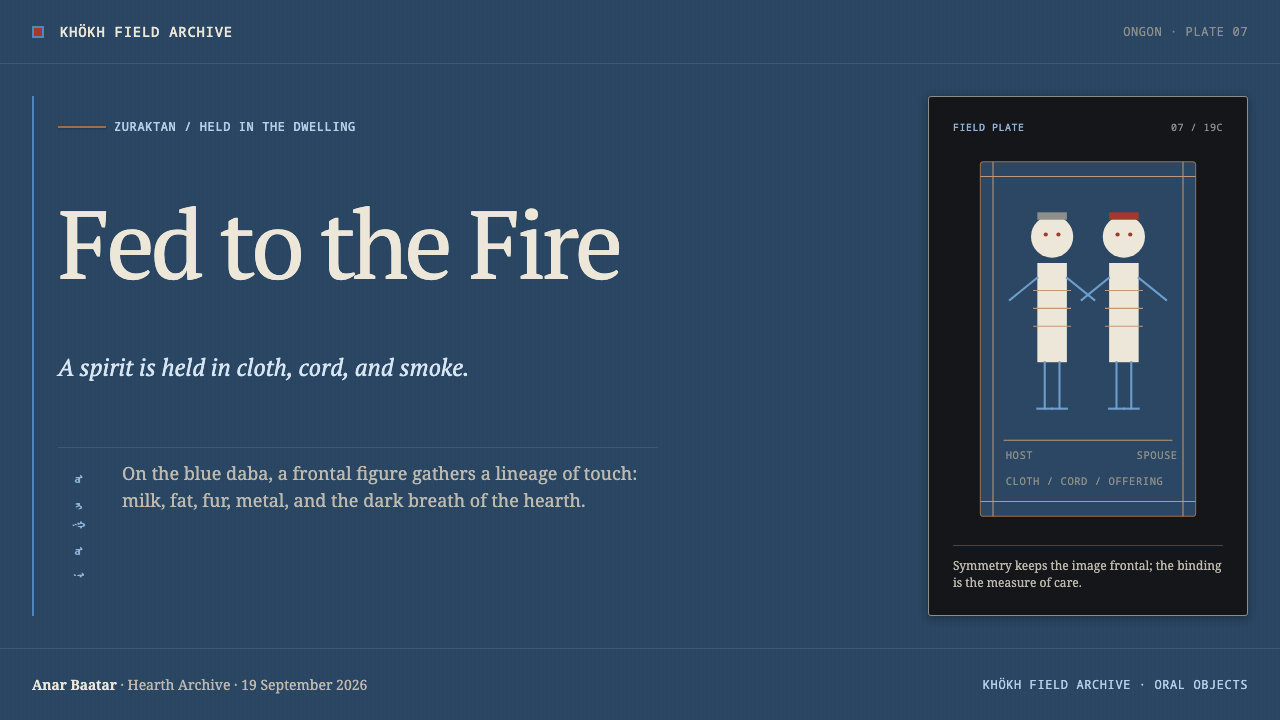
The central motif is a human form seen from the front: flat, symmetrical, arms outstretched, with no perspective and no individual features. It is a diagram of presence rather than a portrait. In layout terms this licenses a strictly centred, mirrored composition around one focal form, and it also licenses emptiness where a face would be. The figure invites projection precisely because it declines to describe anyone.
Binding and Fastening
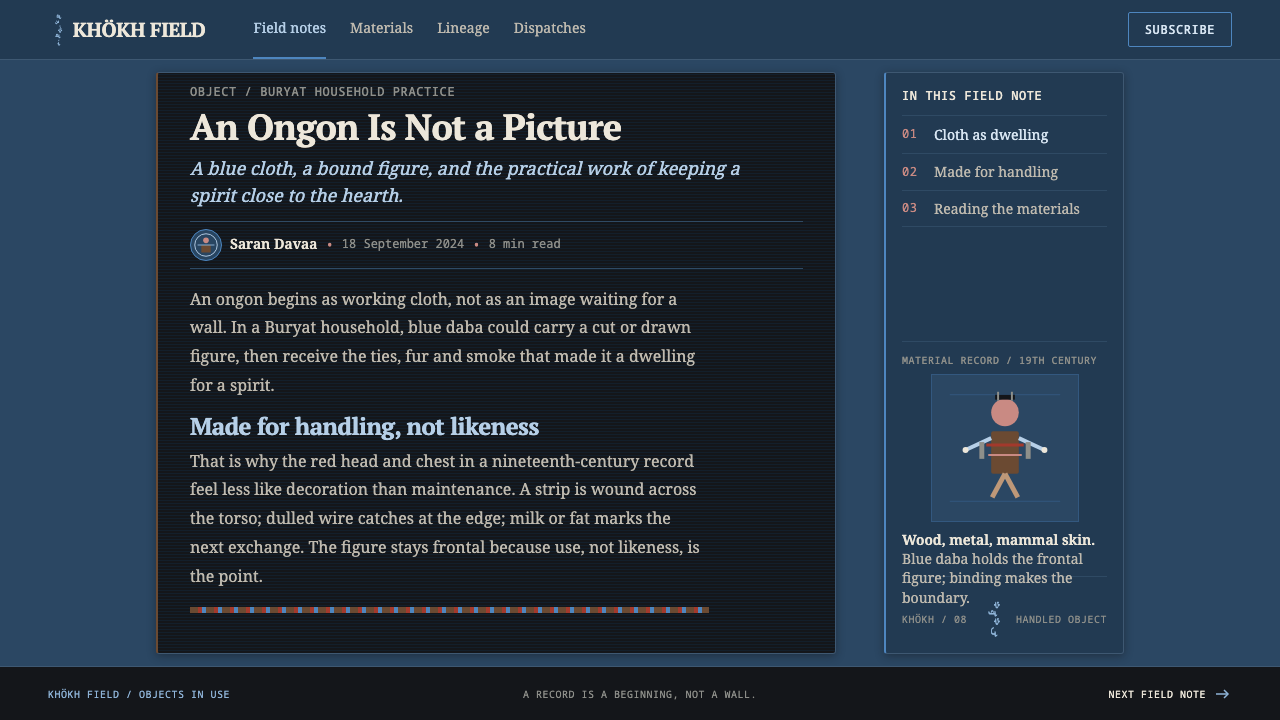
The ongon is held together by wrapping: fur, hair and bent strips of metal are bound around the cloth body. The style carries that act into structure. Bands, ties and tight edge-wrappings take the place of boxes and borders, and elements look bound onto the ground rather than floating above it. Metal appears as short bent strips and dull tin accents, never as polished chrome or glossy gradient.
Coarse, Filmed Surface
Texture is carried by weave and film, not by decoration. A coarse plain weave, a faint smoky haze over the whole surface, and the slightly greasy sheen of something fed with fat are the surface vocabulary. Used lightly this produces depth without any shadow tricks: the page feels as though it has hung in a room with a fire for a very long time. Texture should stay low in contrast so that it never competes with text.
Flat Depth, Held Not Hung
There is no perspective, no cast shadow and no simulated lighting. Depth comes from layering — a bound band over the cloth, a tuft of fur over the band — and from the difference between matte cloth and dull metal. Because the object was meant to be held, the style leans toward things that feel graspable: compact, close-set, with reverent space around the main form rather than decorative filler.
Who shaped Buryat Ongon?
The böö are the shamans of Buryat tradition, and their lineages are the real authors of the ongon as a living form. Not a single named maker stands behind the cloth figure: the object belongs to households and shamanic lineages that cut, bound, fed and kept it. For a designer this is the right way to read the style — as an inheritance held by a community of practice, not a signature style by one hand, and as something that should be credited and approached with care.
The Kunstkamera, the abbreviation MAE RAS standing for the Museum of Anthropology and Ethnography of the Russian Academy of Sciences, is among the institutions that preserve and record Buryat ongon specimens. Its role in this style is documentary: the nineteenth-century catalogue is how a household object became legible to outsiders, and the pre-1900 dating of the style rests on that record. Without such collecting, the cloth, fur and metal construction we now read as a design vocabulary would be far harder to know.
This is the full formal name of the same museum that is commonly called the Kunstkamera, and it appears in the source record as a keeper of Buryat material. It is worth naming separately because the name signals the scholarly frame through which ongons are usually met: as ethnographic specimens with provenance, not as decorative art. A designer working in this style should keep that frame in view, cite the collection where the object is shown, and avoid presenting a sacred object as a free-floating pattern.
How do you use Buryat Ongon today?
Buryat Ongon is best understood as a mood-and-material system rather than a layout kit, and it rewards restraint. Before applying it, decide what in your project deserves to be 'kept' — an archive, a collection, a ritual, a long story — because the style gives a sense of custody and weight, and it feels wrong when applied to something disposable or breezy.
On slides, a cover works best as a single centred composition on the smoke-indigo ground: one frontal form or one bold word, a thin band of khadag blue, and a great deal of dark space around it. Content slides stay symmetrical and sparse — one heading, one idea, a quiet sans-serif in a soft, pale tone — with the material colours kept for labels and emphasis. Data slides suit the style when the data is small and consequential: a few figures set large, charts drawn flat in blue, and a single red for the one value that matters. Dense multi-series charts fight the hush and should be avoided.
For web interfaces, the style fits archives, museum and collection sites, reading tools, journaling and memorial products, and dark-mode dashboards where calm matters more than speed. Keep the page ground dark and matte; use khadag blue for links, focus states and primary actions; let cards sit as slightly lighter, cloth-like panels with tight, bound edges rather than glowing shadows. A pricing page should have few tiers, centred, with one plan marked in blue and the red held back for a single deliberate mark.
In editorial and marketing work, the style supports slow, reverent storytelling: a long read on craft, a heritage product launch, an exhibition poster. Photography should be close and quiet — textiles, fur, metal, hands — cropped to emphasise material and toned toward the indigo ground so that it feels part of the cloth. Headlines can stay modest in size, because the weight comes from darkness and space rather than from large type.
The most common mistake is treating the figure as a mascot or a pattern. An ongon belongs to a living religious tradition; repeating it as wallpaper, giving it a face, or using it as cute decoration strips out the very seriousness that makes the style work. A second mistake is lightening the ground into a casual navy, which loses the smoke that defines it. A third is spreading the red across the page: it works only as a single, small, deliberate mark.
Buryat Ongon — FAQ
Is Buryat Ongon a religious design, and is it appropriate to use?
The source object is a ritual one, made and used within Buryat shamanic practice, so the style deserves the respect you would give any sacred material. Using its palette, materials and compositional logic for products that value gravity and custody is the intended use. Using the figure itself as a logo, mascot or repeated wallpaper pattern is not. When in doubt, borrow the cloth, the smoke and the blue, and leave the figure alone unless the project is genuinely about the tradition and credits it.
Why is the style dark?
Because the object lives in the smoke of a hearth and the cloth beneath it is deep indigo. The darkness is a material fact: the surface has been darkened by use. It is not the glossy black of a screen but a warm, filmed, slightly uneven dark. That is also why the style does not convert well to a white ground; take away the smoke and the object loses its gravity.
Can I use it on a lighter ground?
A lighter variant is possible in principle, but it becomes a different style. If you must, take the pale tones of ermine and tin as the ground, keep indigo for broad bands and key panels, and hold the single red mark and khadag blue exactly where they were. In practice it works better as a dark hero section inside a lighter page than as a full inversion, because the smoke-filmed indigo is what carries the identity.
How is it different from a generic tribal or ethnic pattern style?
It contains almost no repeated pattern. Pattern styles are about surface repetition; Buryat Ongon is about one bound object and its material evidence — cloth, fur, metal, smoke. If your layout is wallpapered with motifs, you have left the style. The system asks for a single centred form, quiet space and honest materials, which is nearly the opposite of a busy ornamental surface.
What typography pairs well with it?
A plain, quiet sans-serif or a modest humanist text face, set in a soft pale tone on the dark ground, with generous line spacing and no decorative display type. The object has no face and no ornament, and the type should be similarly unadorned. Let weight and space, not flourish, signal importance, and keep any labels short, in the manner of a museum tag rather than an advertisement.
Related design styles
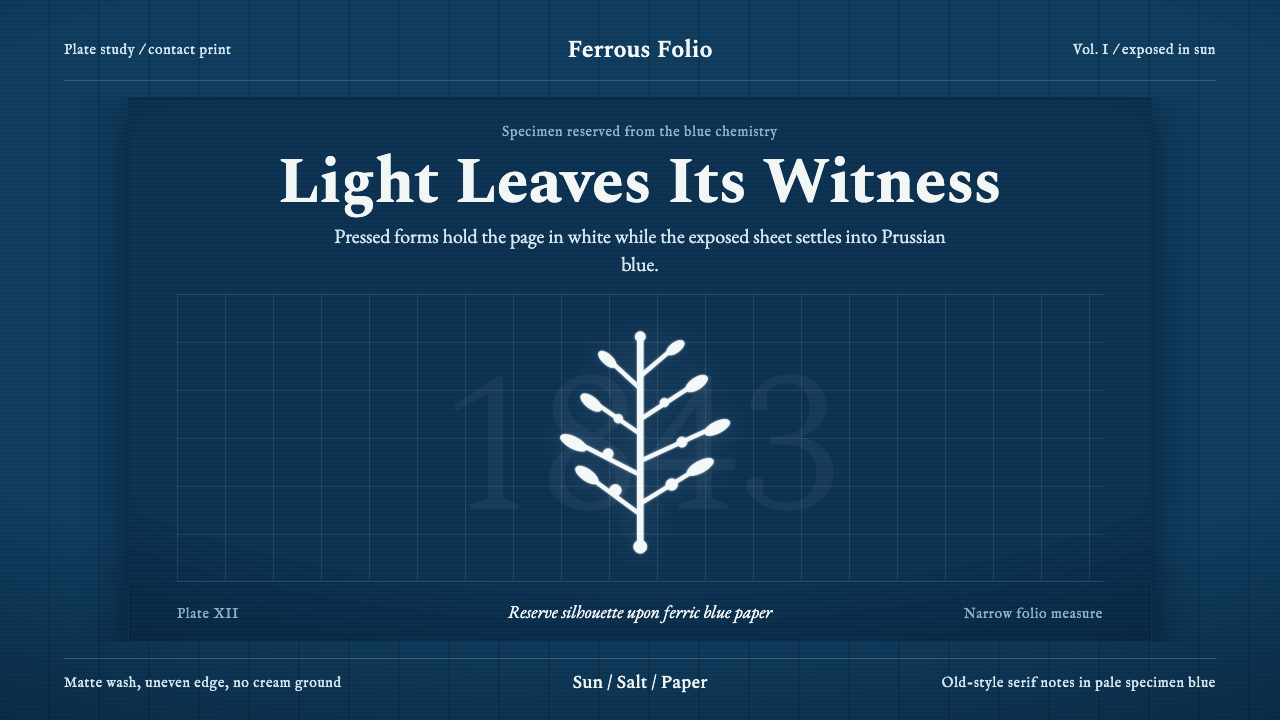 Anna Atkins CyanotypeScience turns spectral. Prussian blue ground, white reserves, Victorian serif…
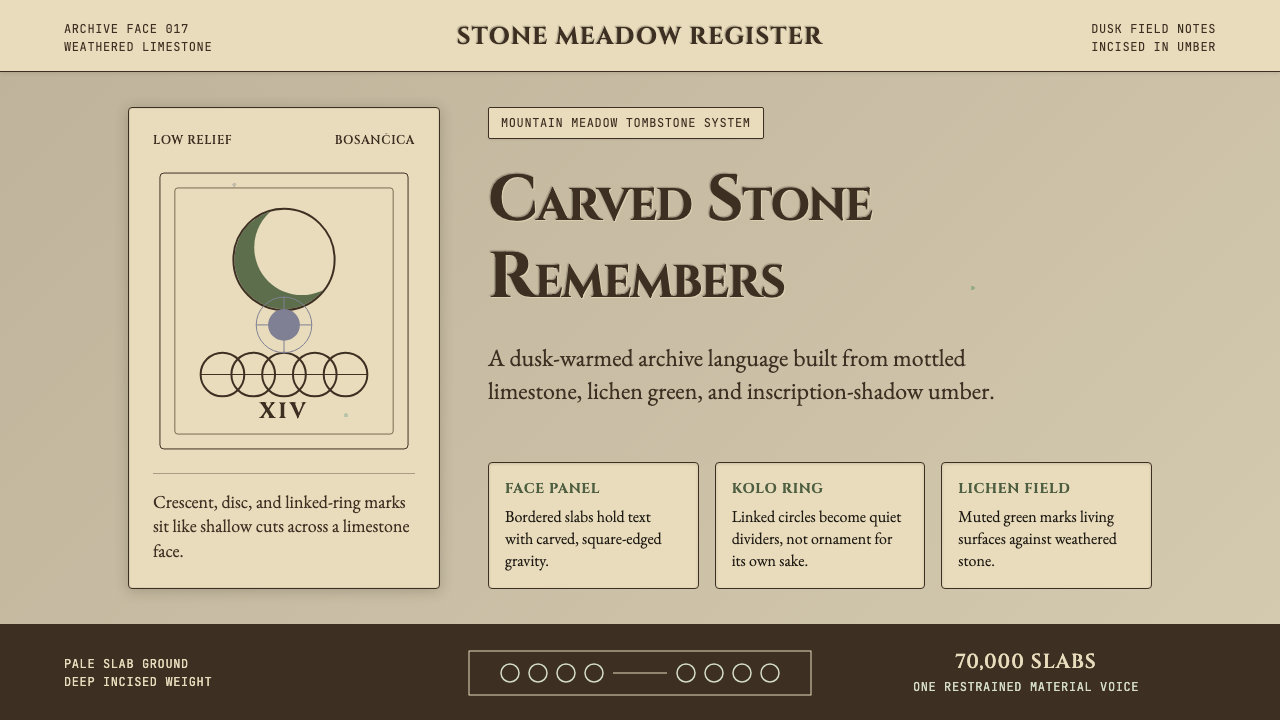 Bosnian Stećak Medieval TombstoneStone remembers quietly. Lichen green and Cinzel cuts sit on weathered limest…
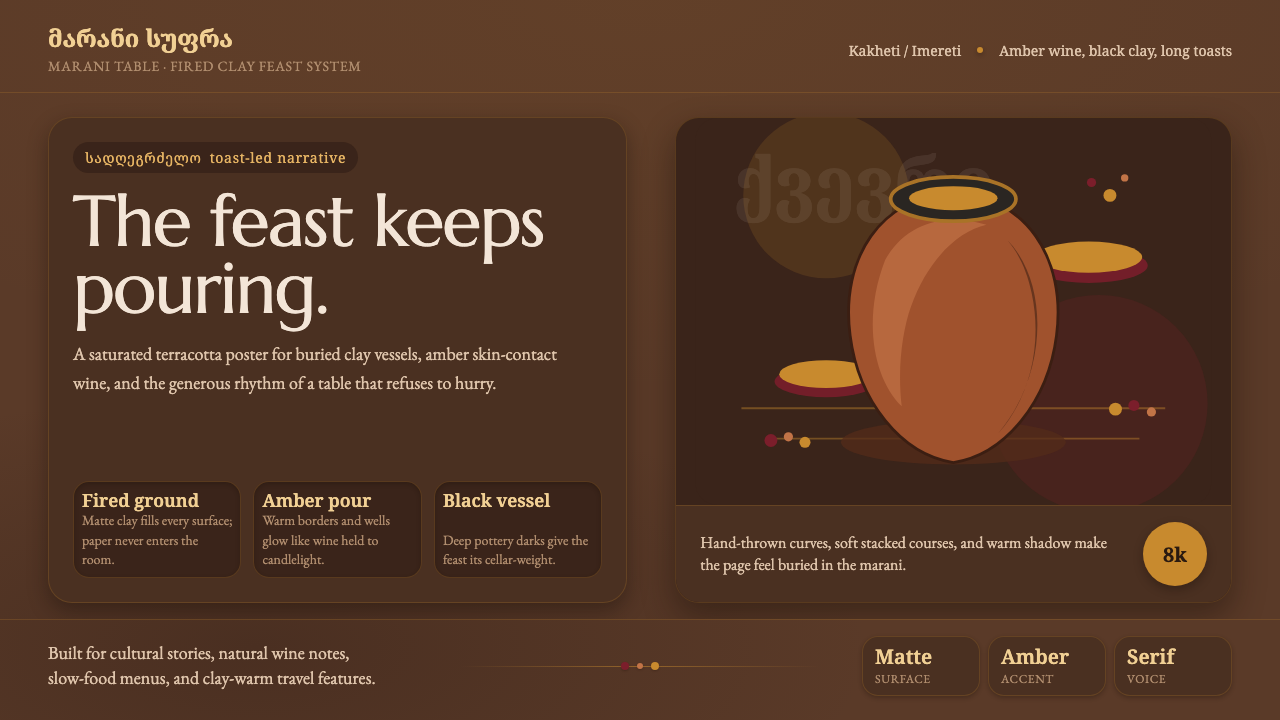 Georgian Qvevri Supra FeastHospitality made earthen. Terracotta ground, amber wine, Georgian serif curve…
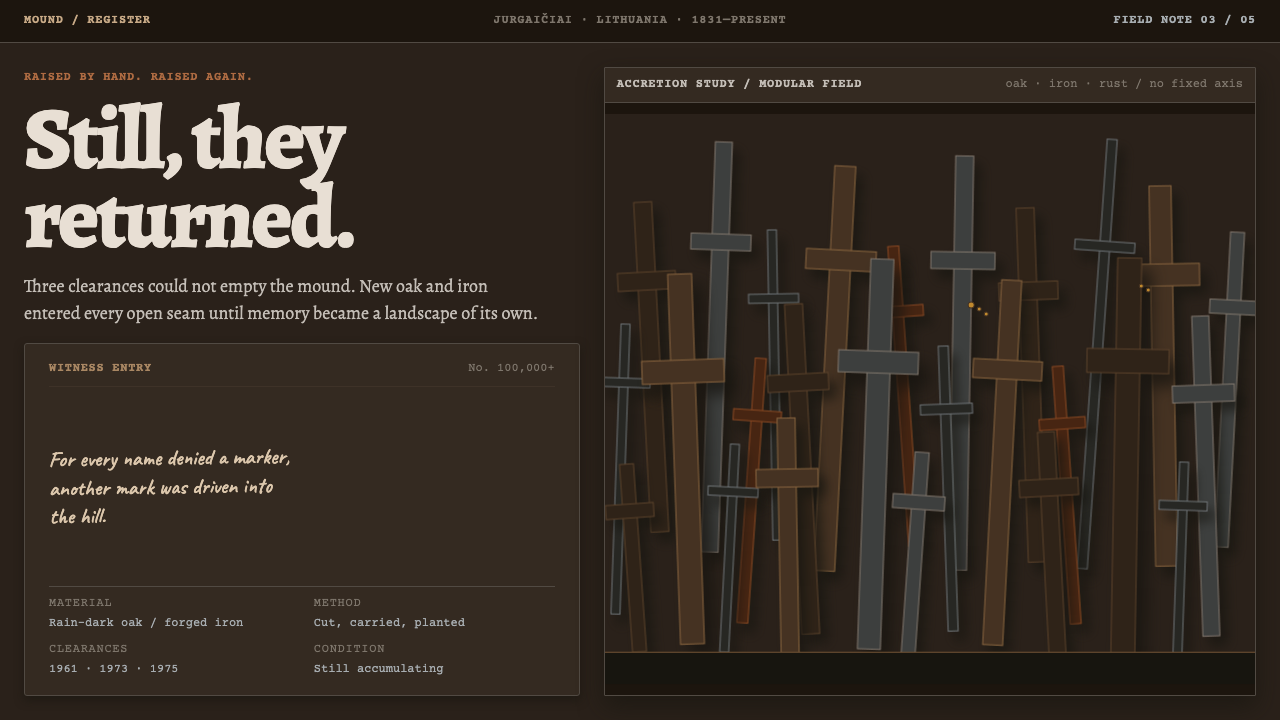 Hill of CrossesMemory returns by hand. Rain-black oak and rusted iron overlap until density…
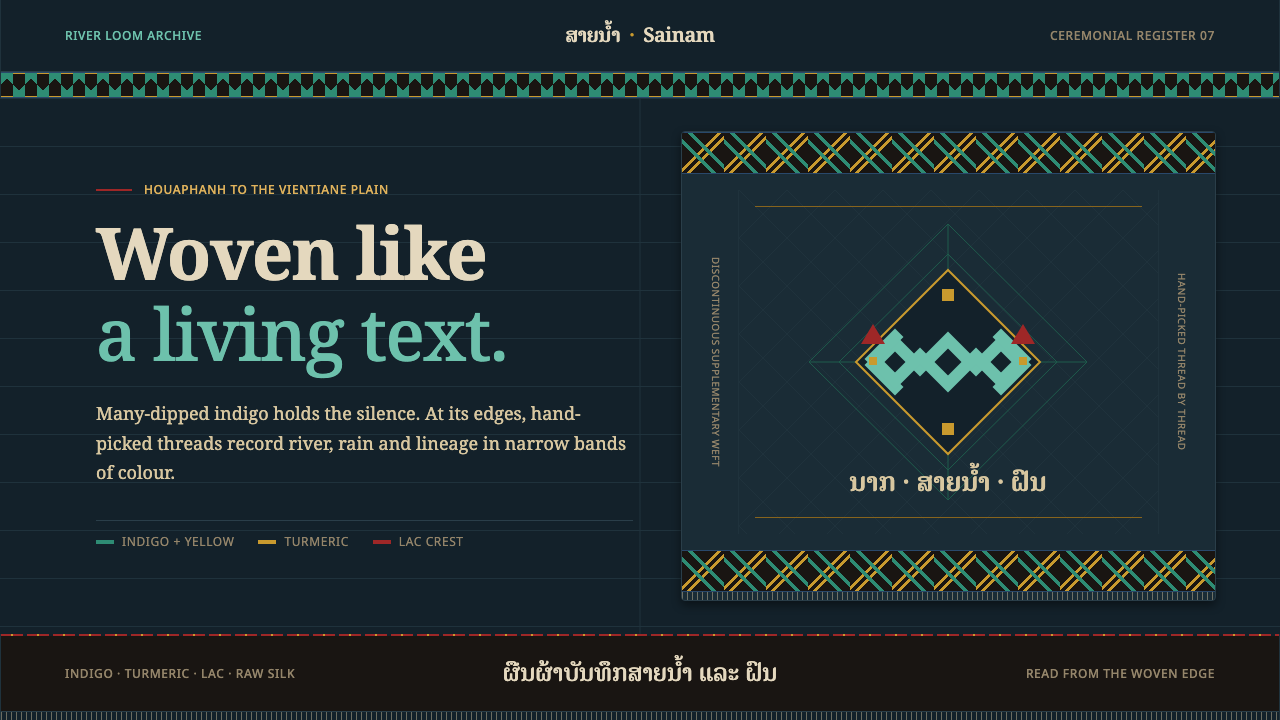 Lao Naga TextileDarkness becomes woven memory. Turquoise and turmeric bands speak across many…
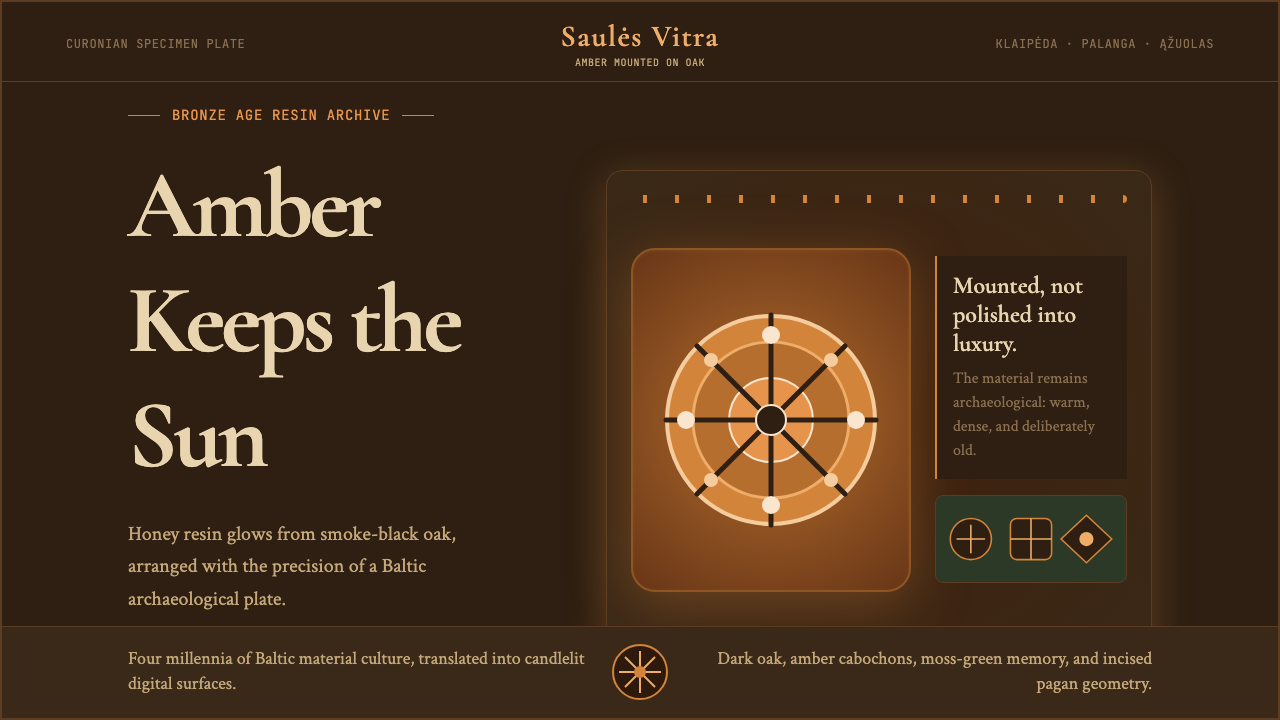 Lithuanian Amber (Baltic Pagan)Ancient amber glows. Honey resin on smoked oak, framed by saulė geometry.