What is Bruneian Jong Sarat?
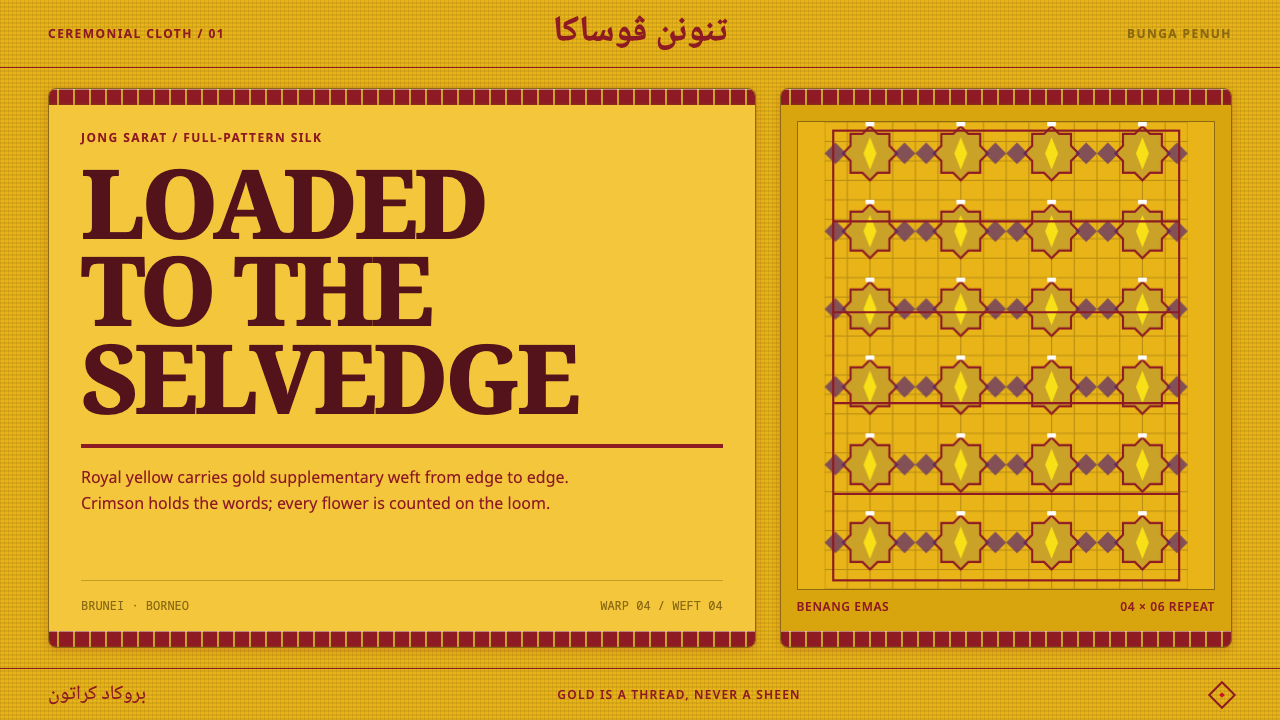
Jong sarat is the 'fully laden boat' of Bruneian cloth: a royal-yellow silk ground that disappears under gold thread, with no resting space from edge to edge.
Bruneian Jong Sarat in brief
Jong sarat is a type of songket, the Malay brocade in which patterns are formed by extra weft threads woven into the cloth. The name means 'a fully laden boat', and the cloth earns it: a single-colour silk ground vanishes beneath gold supplementary weft, with motif touching motif from selvedge to selvedge. It is the richest of Brunei's six songket types, and belongs to the bunga penuh, or full-pattern, class, meaning that there is no resting ground anywhere on the cloth.
The visual effect is distinctive. Gold is not laid on; it is built thread by thread, so the metallic surface has a fine, granular grain rather than a smooth sheen. Because gold set against yellow gives very little contrast, a deeper red does the work of legibility. Motifs such as flower heads, eight-pointed stars and lozenges step across the weave grid, with the small row-to-row drift that a hand loom always leaves behind.
As a design system, jong sarat becomes a royal-yellow field carrying a continuous, geometric repeat, with gold constructed from small units and crimson used wherever something must be read. It is ceremonial, rich and highly ordered, and it shows how fullness and clarity can coexist when each colour has a clear job. The yellow is the sheet, the gold is the labour, and the crimson is the voice: three roles, kept strictly apart.
Where does Bruneian Jong Sarat come from?
Jong sarat comes from Brunei Darussalam on the island of Borneo, specifically from the weaving kampongs of Brunei-Muara and Kampong Ayer, the water village. Weaving in Brunei is recorded from the reign of Sultan Bolkiah, who ruled from 1485 to 1524. The cloth belongs to the family of Malay songket brocade and, more broadly, to Nusantara supplementary-weft weaving, the long tradition in which extra threads are woven in to form pattern. In Brunei it is also described by the term kain tenunan, woven cloth.
The cloth's status was fixed under Sultan Omar Ali Saifuddien III, when jong sarat was established as court dress. It is worn by couples at weddings and at royal and state occasions, and the tradition has been continuous to the present day. This is not an archive piece but a living ceremonial textile, and its rules, including the yellow ground reserved for royal use, carry social weight that a designer should be aware of.
Within Brunei's six songket types, jong sarat is the richest, and the reason is its fullness. It belongs to the bunga penuh class, the full-pattern class, which is defined by the absence of any resting ground: wherever you look on the cloth, there is pattern. That fullness is a measure of both labour and status, because more gold, placed by hand thread by thread, means more time, more skill and more cost. A cloth like this is not the product of a single afternoon, and the density visible on its surface is a direct record of the hours that went into it.
For designers the lesson is that this style's richness is organised. Each element sits on the weave grid; the gold has a defined way of being built; crimson is assigned the task of reading. Borrowing the look without that discipline gives a generic gold-on-yellow decoration, whereas borrowing the logic gives a design that feels genuinely woven.
What defines the Bruneian Jong Sarat look?
Royal-yellow ground
The ground is a single colour of silk: a bright, saturated yellow associated with the royal court. It acts as the sheet on which everything else is placed. Because it is the ground rather than an accent, the whole design takes on its warmth, and the yellow is kept clean and uniform while the gold and crimson do the varied work above it.
Thread-built gold
Gold is the supplementary weft, picked in thread by thread, and it should look that way. Instead of a smooth gradient or a foil sheet, the metallic areas are made of small, regular, slightly granular units, so the surface catches light unevenly. A gradient reads as printed foil; a built-up field reads as woven metal.
Full-pattern density
The bunga penuh class means the pattern fills the cloth from selvedge to selvedge, motif touching motif, with no resting ground. The system keeps this fullness. Where other styles use empty space to organise attention, this one organises it through repetition, scale and colour, leaving no blank area to rest on.
Crimson for legibility
Gold on yellow does not read, so a deep crimson, along with a state-emblem red, carries everything that must be read: text, key marks and focal points. This is the system's clearest rule of function. Gold is for richness and crimson is for meaning, and swapping their roles makes the design look grand but impossible to read.
Weave-grid geometry
Motifs such as flower heads, eight-pointed stars and lozenges are geometricised and set on the weave grid. Their edges step rather than curve, because a weft can only turn where a warp thread allows it. The effect is a crisp, regular geometry that is also warm, since every shape is visibly constructed from small units.
Hand-loom drift
Rows do not line up perfectly. A hand loom leaves a small row-to-row drift, and the system keeps it as a trace of the hand. Without it the repeat becomes mechanical and the gold loses its character; with it, the design looks made rather than generated.
Who shaped Bruneian Jong Sarat?
Brunei's weaving is recorded from the reign of Sultan Bolkiah, who ruled from 1485 to 1524. He stands as the earliest named figure associated with the weaving tradition from which jong sarat descends.
Under his reign jong sarat was fixed as court dress, establishing it as the ceremonial cloth worn at weddings and royal and state occasions. His role in formalising the cloth's status is why it is still read as a royal textile today.
The communities where the cloth is woven, in Brunei-Muara and in the water village of Kampong Ayer. Their weavers hold the hand skills of picking gold thread by thread and setting motifs on the grid, and they are the primary credit for the style.
How do you use Bruneian Jong Sarat today?
The jong sarat system suits subjects that want ceremony, heritage and a sense of occasion: weddings and invitations, cultural festivals, hospitality, luxury goods, fashion and craft brands. It also works for institutions that wish to convey tradition with warmth, such as cultural centres, heritage tourism and gift or craft retailers. It is less suited to utilitarian tools, where the fullness of the pattern could compete with the work, and it asks for more care than quieter styles because the whole surface is always doing something.
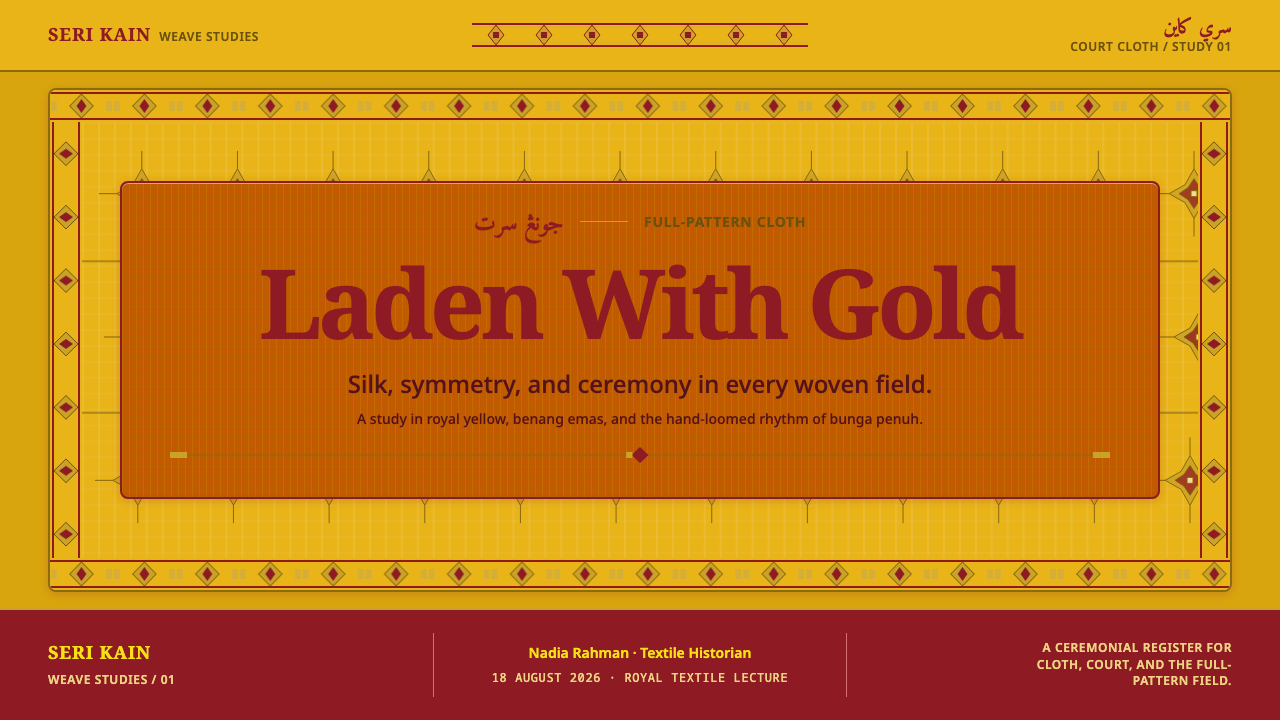
For slides, a cover can carry the continuous repeat across the whole yellow field, with the title placed on a solid crimson panel so that it stays readable. Content slides can use a yellow ground with a narrow gold border and crimson text, and section headers can sit on crimson bands. On data slides, charts should be built from crimson and thread-built gold units on the yellow ground, with labels always in crimson, because gold type on yellow will not read.
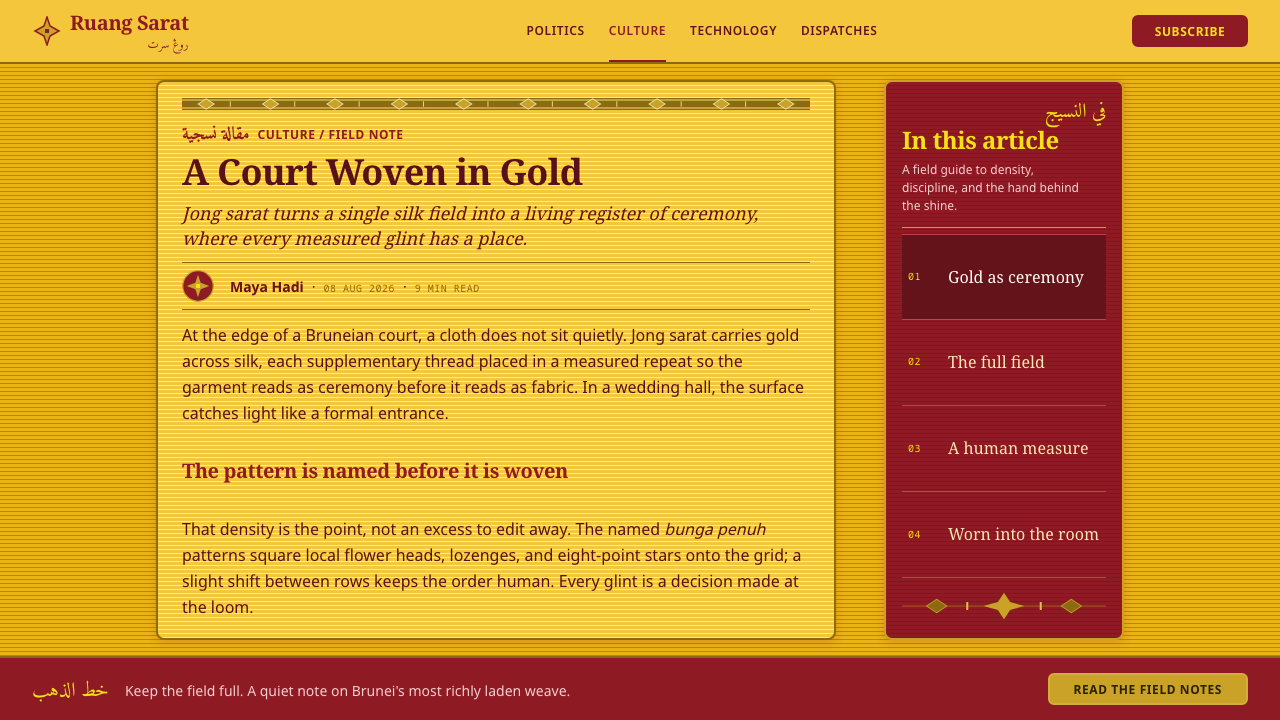
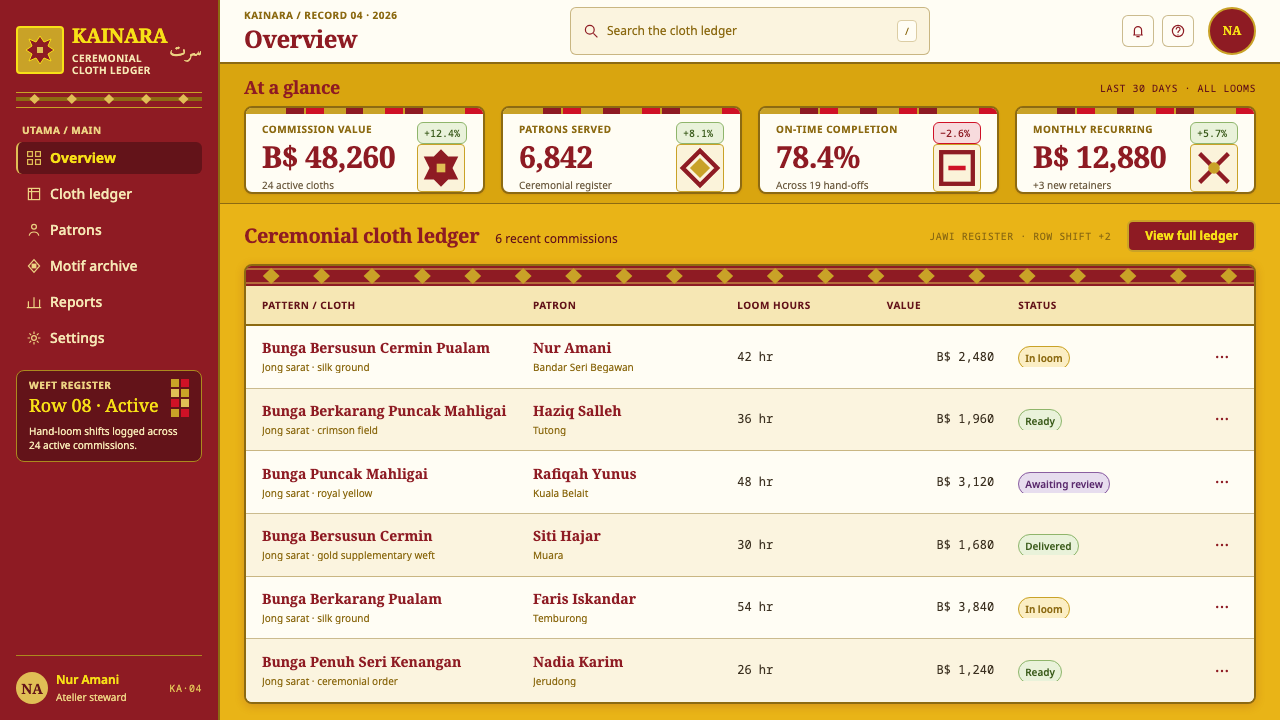
For web interfaces, treat the patterned field as a frame rather than a work surface. A dashboard or pricing page can keep the full-pattern repeat on its outer shell, headers or empty states, and place working content in crimson-edged panels with clear contrast. A featured pricing tier can be given extra gold density, while body text and form fields remain in crimson or dark ink on a plain yellow field.
For editorial and marketing work, the style offers an immediate sense of ceremony. Campaign pages, event announcements and cultural features can use the full repeat in the hero area and a calmer yellow ground for text. Photography of cloth, hands and looms pairs well with it, as long as captions and headings keep to crimson so that the golden pattern is never asked to carry reading.
The most common mistakes are predictable. Using a smooth metallic gradient for the gold turns woven thread into printed foil. Setting text in gold on yellow makes it unreadable. Leaving large empty areas undermines the full-pattern logic that defines the cloth. Aligning every row perfectly erases the hand-loom drift. Finally, because the yellow ground has royal associations in its home context, apply it with awareness of where it comes from.
Bruneian Jong Sarat — FAQ
What does jong sarat mean?
It means 'a fully laden boat'. The name describes the cloth well: a silk ground so covered with gold supplementary weft that nothing is left bare, with motif touching motif from edge to edge. Jong sarat is the richest of Brunei's six songket types and belongs to the bunga penuh, or full-pattern, class.
What is songket, and what is supplementary weft?
Songket is a Malay brocade in which pattern is made by extra weft threads woven into the cloth, in this case gold thread picked in over a silk ground. Supplementary weft means the added threads sit in addition to the weft that forms the cloth itself, and they are placed only where the pattern calls for them. Because each unit is set by hand, the pattern looks built up rather than printed.
Why does the system use crimson for text?
Because gold set against yellow gives too little contrast to read. A deep crimson, along with a state-emblem red, carries everything that must be legible, while gold is reserved for richness. Dividing the roles this way keeps the design full without making it unreadable, and it is the most important functional rule in the system. In practice this means headings, labels, buttons and numbers are set in crimson, while gold supplies borders, repeats and ornament.
Why not use a metallic gradient for the gold?
Because the gold in this cloth is built thread by thread, not poured or foiled. A smooth gradient suggests printed foil and removes the granular, hand-set quality that defines the weave. Build metallic areas from small repeated units with slight variation, so that the surface catches light in a patchwork of tiny steps.
Are there cultural considerations in using the yellow ground?
Yes. In its home context the yellow ground is associated with the royal court, and jong sarat is worn as court dress at weddings and at royal and state occasions. Designers can draw on its logic of density, gold and crimson, but should credit Brunei and the weaving tradition, and avoid using the look in contexts that would trivialise its ceremonial meaning.
Related design styles
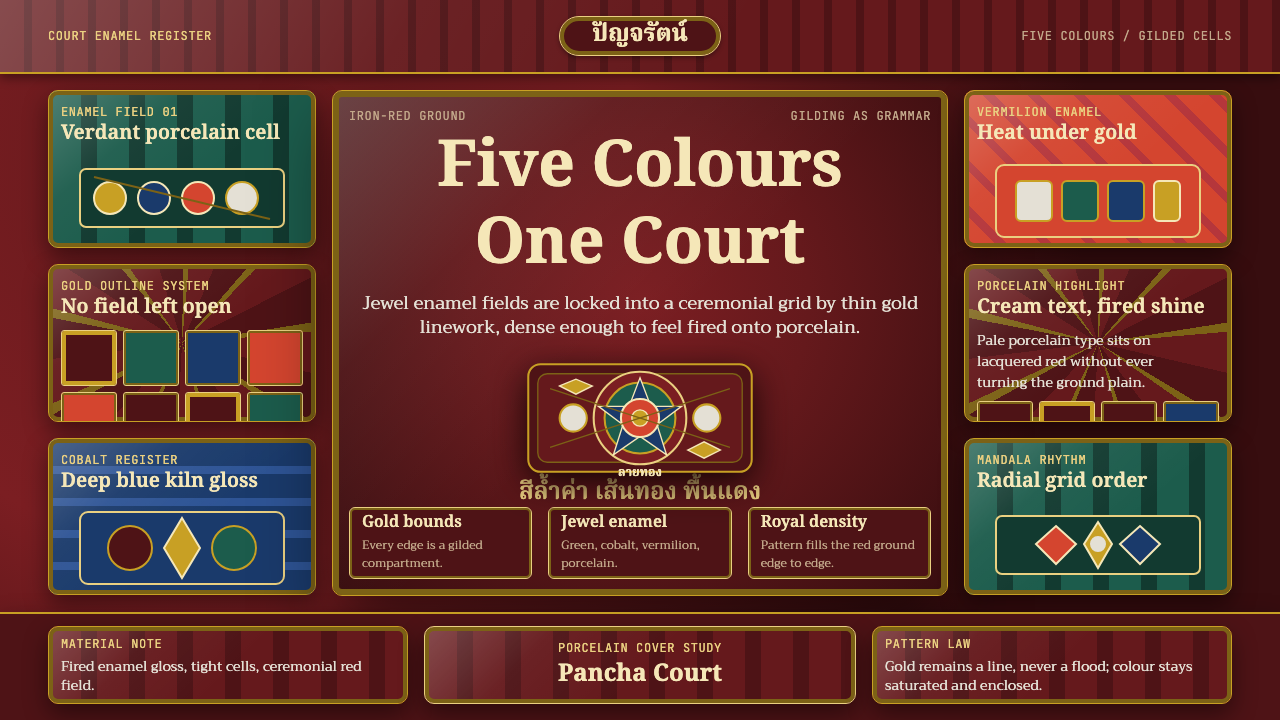 Thai BenjarongRoyal density. Gold-line enamel cells pack green, cobalt, and vermilion on ir…
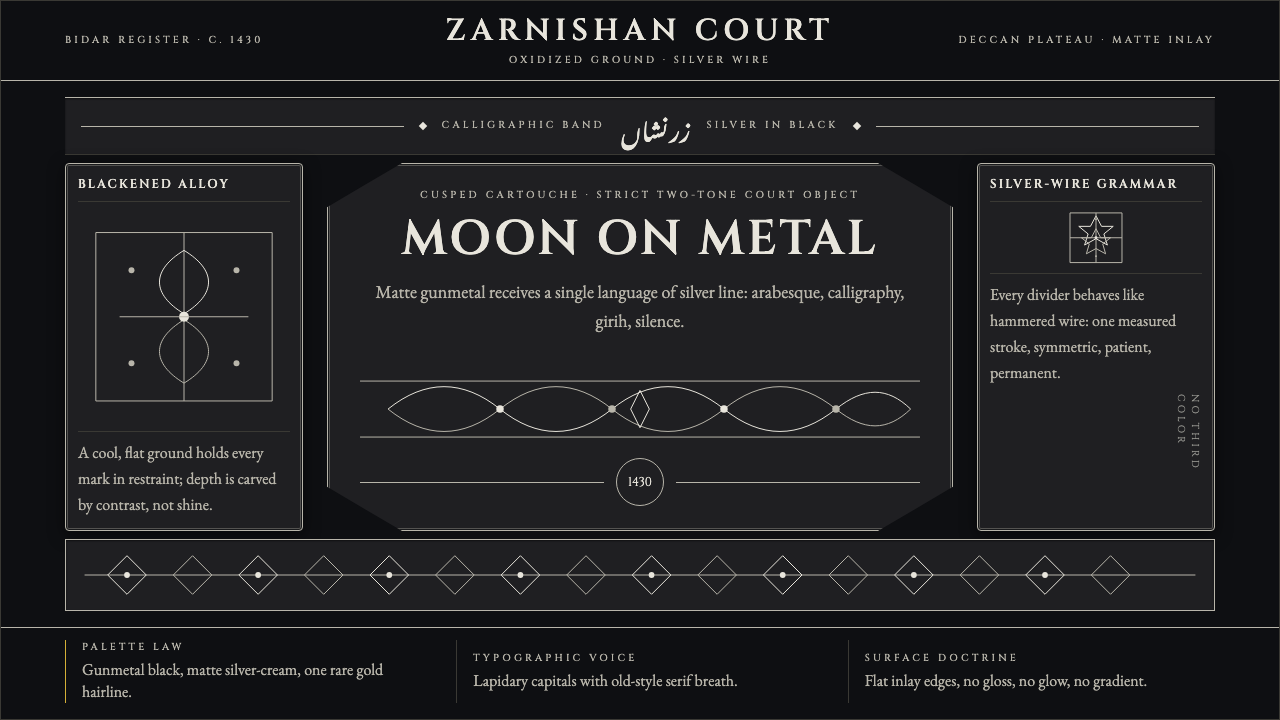 Bidri Deccan MetalworkCourtly darkness, tooled by silver. Cinzel caps and hairline arabesques cut g…
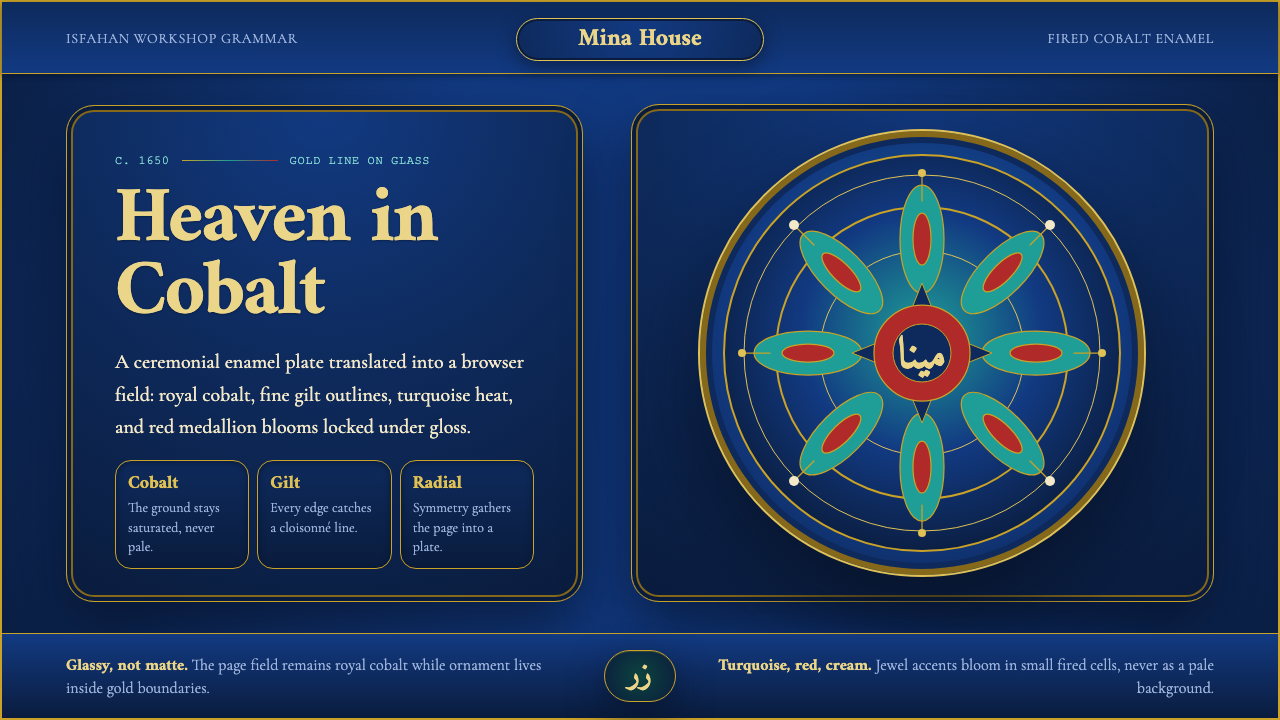 Isfahan Minakari EnamelJewel-bright ceremony. Cobalt enamel, gold cloisonné lines, and radial blooms…
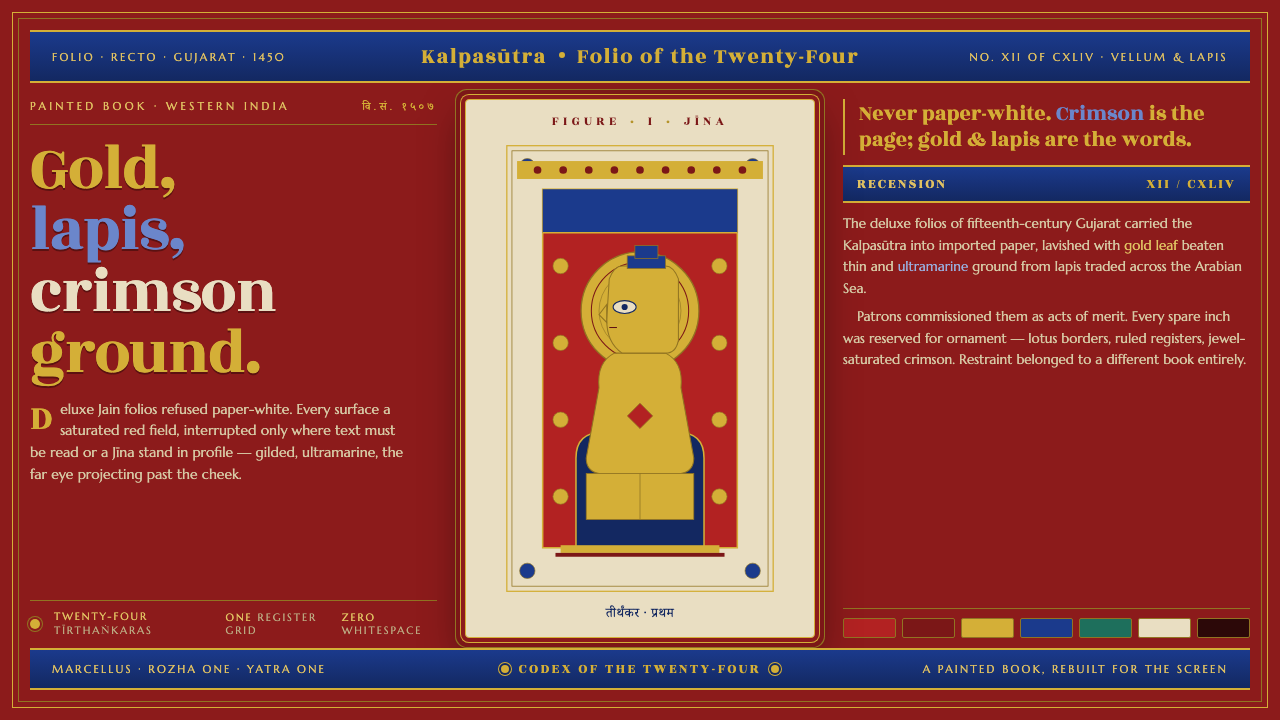 Jain Kalpasutra ManuscriptNever paper-white. Gold leaf and lapis figures on jewel-crimson, lotus-ruled…
 Javanese Batik Tulis (Keraton Sogan)Patience made visible. Sogan brown, indigo, and cream wax-lines form dense co…
 Maharashtra Paithani Peacock SareeSilk carries ceremony. Peacock green, Mughal magenta, and gold grids shimmer…