What is Isfahan Minakari Enamel?
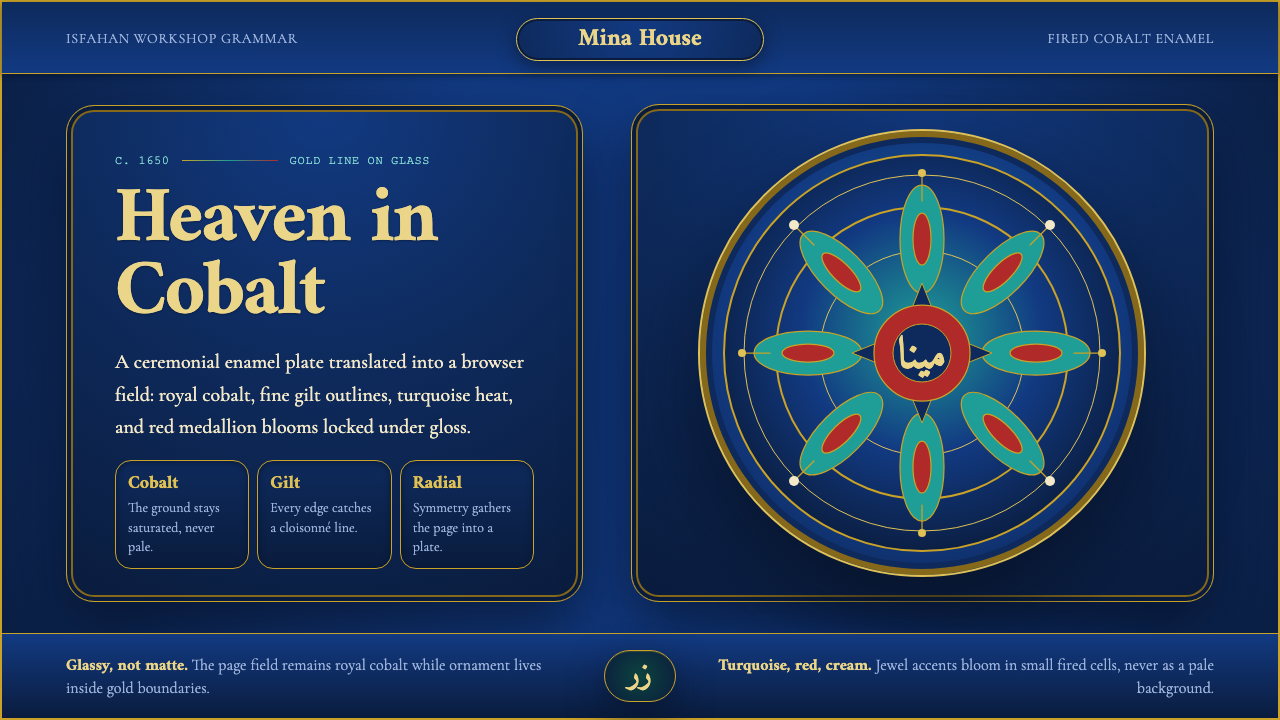
Isfahan Minakari turns a ceremonial enamel plate into a visual world of cobalt depth, gold-line precision, and flowers that appear to glow from within fired glass.
Isfahan Minakari Enamel in brief
Minakari is the vitreous enamelwork associated with Isfahan, Iran, where powdered glass is fused onto a copper or gold base and repeatedly fired into a jewel-bright surface. Its name, mina, evokes the azure of heaven, and that celestial association is visible in the craft’s characteristic cobalt field: a saturated blue ground that does not behave like background color so much as an illuminated space.
Across that blue field, fine gold cloisonné-like outlines organize arabesque curves, floral forms, and gol-o-morgh, the bird-and-flower motif. Enamel-red, turquoise, green, and pale flower details punctuate the composition, but cobalt remains the visual authority. The result is ceremonial rather than casual: every line encloses, every bloom radiates, and every colored element appears held inside a luminous gilded structure.
As a contemporary visual system, Isfahan Minakari translates the logic of an enamel plate into digital composition. It favors deep cobalt grounds, gold boundaries, radial mandala rhythm, jewel-toned blooms, and a polished fired-glass finish. It rejects the softened restraint associated with matte surfaces and pale neutral layouts. Even when the design is simplified for screens, it should preserve the feeling that color has been fused, outlined, and made precious.
Where does Isfahan Minakari Enamel come from?
The source tradition is Persian minakari enamelling in Isfahan, Iran, a Middle Eastern craft associated with the city’s bazaar culture and still practised today. Its Safavid Isfahan form is dated here to around 1650, when enamelwork was expressed through cobalt grounds, gold-line ornament, and highly ordered floral and arabesque decoration. The tradition belongs not to a single author but to a sustained workshop knowledge carried through making.
The material process is central to the aesthetic. Powdered glass is fused onto copper or gold, producing a vitreous surface rather than a painted imitation of one. That origin explains why Minakari’s color feels unusually dense and why shine is not an optional embellishment. The glossy field is the identity of the craft: color appears fired into the object, not laid gently over it.
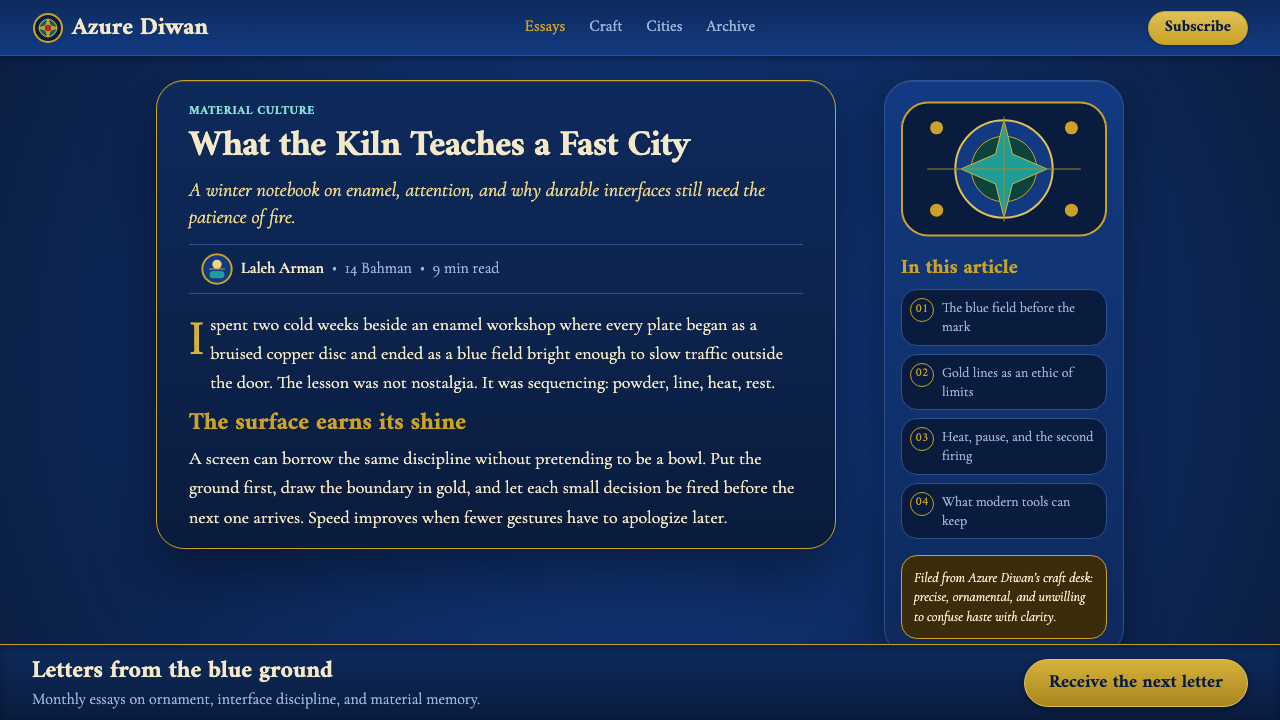
Safavid gol-o-morgh decorative arts supplied one of the system’s enduring visual languages. Bird-and-flower motifs place living forms inside patterned order, while arabesque lines give the surface a continuous movement that can expand across a plate without becoming chaotic. Floral detail is therefore not incidental ornament. It is a disciplined way of filling space, directing the eye, and maintaining ceremonial richness.
The bazaar workshop guilds and hereditary mina-kar masters preserved this language as a living craft. Their importance lies in continuity: the relationship among deep blue enamel, fine gold outlines, radial ornament, and jewel-bright color remains legible because it is repeatedly made rather than merely archived. A digital interpretation should respect that continuity by treating Minakari as a material and compositional system, not as a decorative pattern pasted onto an unrelated interface.
What defines the Isfahan Minakari Enamel look?
Cobalt Ground
Deep lapis cobalt is the dominant field and emotional foundation of the style. It should read as saturated, glossy, and spatially deep, like enamel beneath glass rather than flat digital blue. Large pale surfaces weaken the system’s nighttime, jewel-box intensity; small light flower details are the meaningful exception.
Gold-Line Enclosure
Fine gold lines behave as boundaries, not as loose glitter. They trace arabesques, divide petals, contain colored fields, and make the composition feel constructed. Their delicacy matters: the line should retain a drawn, cloisonné-like precision while remaining visibly bright against cobalt.
Radial Rhythm
Minakari compositions often feel organized from a center outward, like a ceremonial plate whose floral energy expands in rings and spokes. This radial rhythm gives dense ornament a stable order. A center may be quiet or elaborate, but the surrounding forms should imply recurrence, balance, and outward bloom.
Gol-o-Morgh Motif
Bird-and-flower imagery introduces life without breaking the ornamental system. Birds and blooms belong to the same gilded network: they are shaped by outlines, surrounded by arabesque movement, and integrated into the field rather than staged as naturalistic illustrations. The effect is lyrical but contained.
Jewel-Toned Bloom
Enamel-red, turquoise, green, and small pale floral marks animate the cobalt field. These colors should be treated as fired accents with visual density, not as a broad rainbow palette. Each bloom needs a clear role: a petal, a leaf, a center, or a directional interruption within gold-line order.
Fired-Glass Gloss
Nothing in the system should feel chalky, dusty, or casually matte. The desired surface is jewel-bright and polished, with light seeming to gather inside color. This does not require literal material simulation; it requires preserving the contrast between dark cobalt depth, bright gold boundaries, and luminous enamel blooms.
Who shaped Isfahan Minakari Enamel?
The hereditary enamel masters of Isfahan represent the craft knowledge behind Minakari: the continuity of vitreous enamel, cobalt grounds, gold-line drawing, and jewel-bright floral work. Their role is best understood as custodial rather than individualistic, preserving a made tradition through repeated practice.
Safavid bazaar workshop guilds provided the workshop context in which Isfahan enamelling could be practised as an enduring decorative art. They anchor the style in collective production, where ornament, material handling, and recognizable surface language belonged to a living craft culture.
Persian minakari enamelling is the larger craft tradition from which the Isfahan visual language draws its material authority. It establishes the crucial relationship between fused glass, metal support, luminous color, and fired gloss, making surface brilliance a consequence of process rather than a decorative afterthought.
How do you use Isfahan Minakari Enamel today?
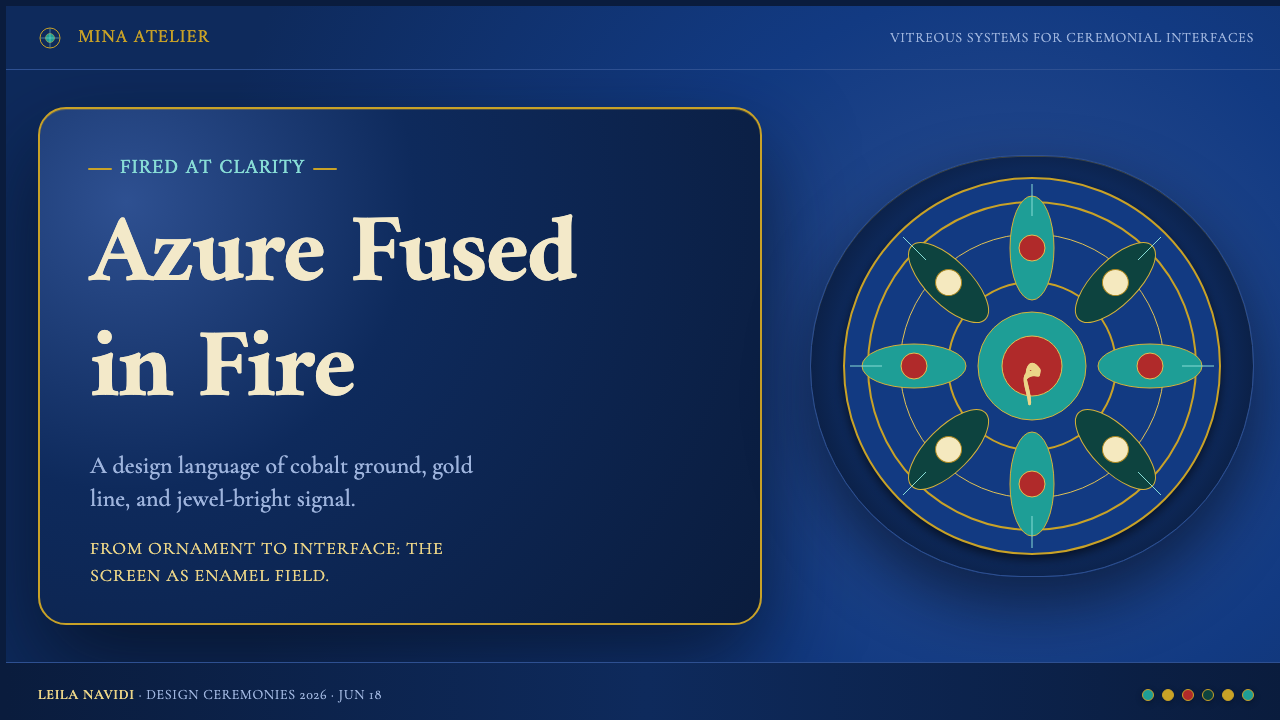
For presentation covers, Minakari works best when a cobalt field establishes the entire atmosphere before information appears. A radial floral or arabesque structure can gather around a title, frame a central emblem, or emerge from one edge as though part of a larger plate. Use gold-line detail to organize the title area, but allow the headline to remain legible rather than dissolving into ornament.
Content and data slides need more restraint. Use the cobalt field and gold line as the persistent framework, then reserve turquoise, green, enamel-red, and pale flower marks for hierarchy and data distinction. Charts should retain their analytical clarity, but their bars, segments, labels, and separators can participate in the style’s enclosed jewel-like logic. Dense decoration belongs at edges, dividers, or section moments, not behind every number.
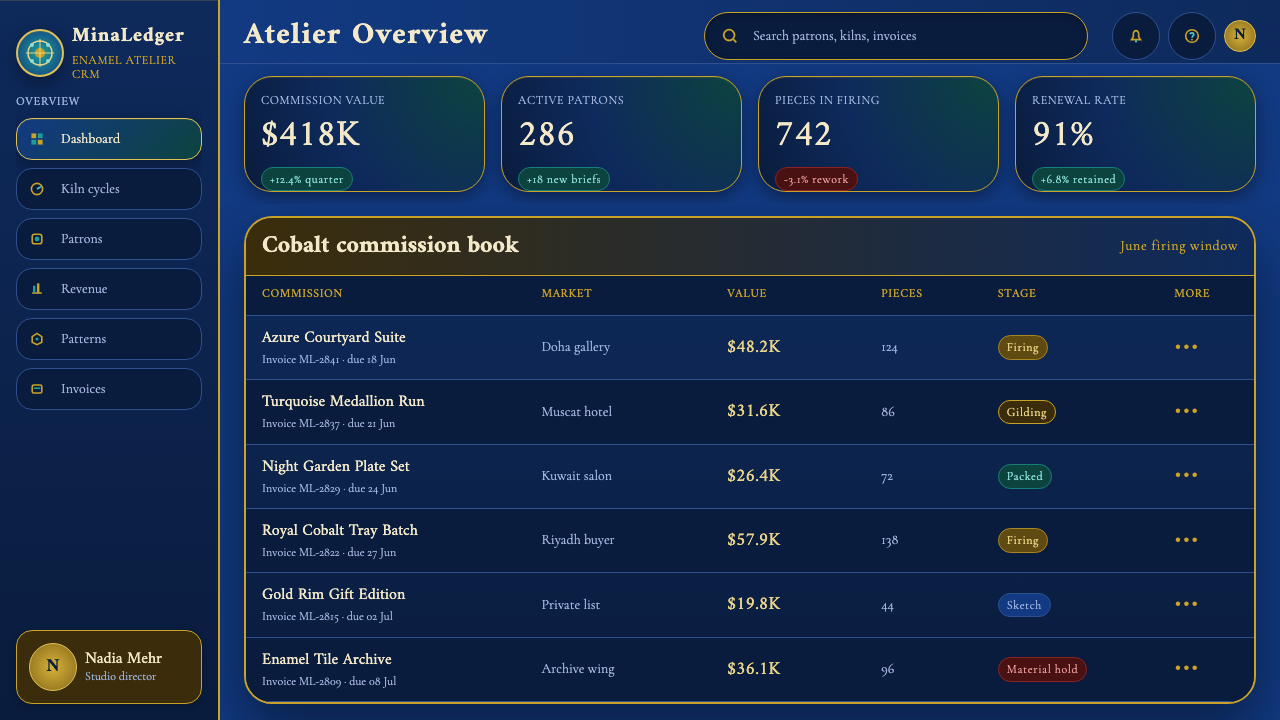
For web interfaces, the style suits dashboards, member areas, collections, and pricing pages that benefit from a sense of value, ceremony, or collected richness. A deep cobalt shell can hold clear panels bounded by fine gold lines, while radial motifs mark navigation hubs, featured states, or premium moments. Interaction should still be immediately readable; visual richness must not make controls feel ceremonial at the expense of usability.
Editorial and marketing work can use Minakari to create a strong sense of invitation and occasion. Feature stories benefit from cobalt title panels, gold-line floral frames, and bird-and-flower details that enter at section transitions. Product or collection pages can treat imagery as a jewel set within an ornamental field, using ornament to direct attention toward the object rather than competing with it.
The common mistake is to reduce Minakari to dark blue plus arbitrary gold decoration. The style depends on a specific relationship among glossy cobalt depth, fine enclosing lines, radial organization, and disciplined blooms of enamel color. Another mistake is applying ornament uniformly everywhere. Authentic use needs areas of rest, clear information hierarchy, and a reason for every floral or gilded intervention.
Isfahan Minakari Enamel — FAQ
Is Minakari simply a blue-and-gold decorative style?
No. Cobalt and gold are essential, but the style also depends on vitreous gloss, fine enclosing outlines, arabesque movement, radial order, and controlled floral color. Blue and gold without those structural relationships can suggest luxury, but they do not communicate the specific logic of Isfahan enamelwork.
Can Minakari work without a dark cobalt background?
A reduced interpretation is possible, but cobalt is the system’s primary field and gives gold outlines their luminous contrast. Without it, the composition loses much of its enamel depth and ceremonial intensity. Pale grounds are most convincing when used sparingly in small flower work rather than as the dominant surface.
How should gold outlines be used in a digital Minakari layout?
Use them as a compositional grammar. Gold lines should frame fields, trace petals, carry arabesque motion, separate information zones, and establish hierarchy. When gold appears only as scattered sparkle or oversized ornament, it loses the cloisonné-like discipline that makes the style feel crafted.
Is Minakari appropriate for data-heavy interfaces?
Yes, if ornament is assigned a supporting role. Cobalt, gold boundaries, and jewel accents can make a dashboard distinctive, while charts and controls remain clear through disciplined grouping and contrast. The style becomes ineffective when every panel, label, and data point receives equal decorative attention.
Related design styles
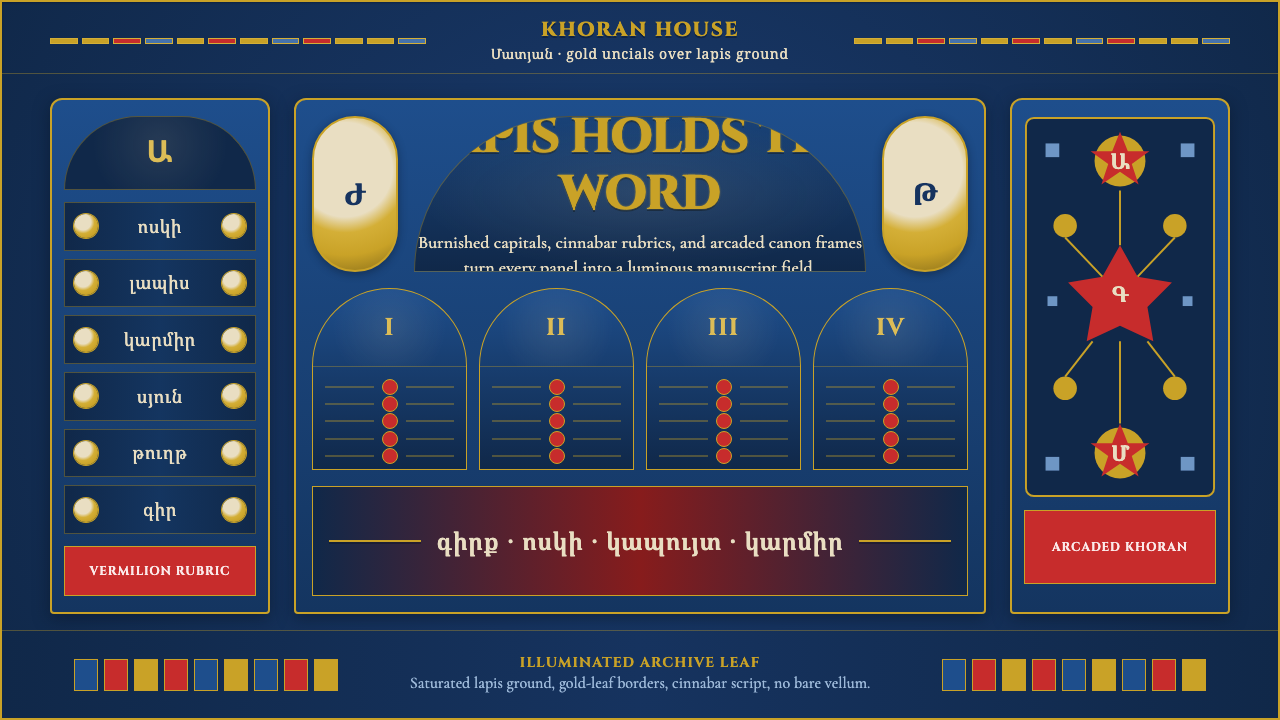 Armenian Manuscript FolkloreJewel-dense devotion. Lapis ground, gold uncials, and vermilion arcades fill…
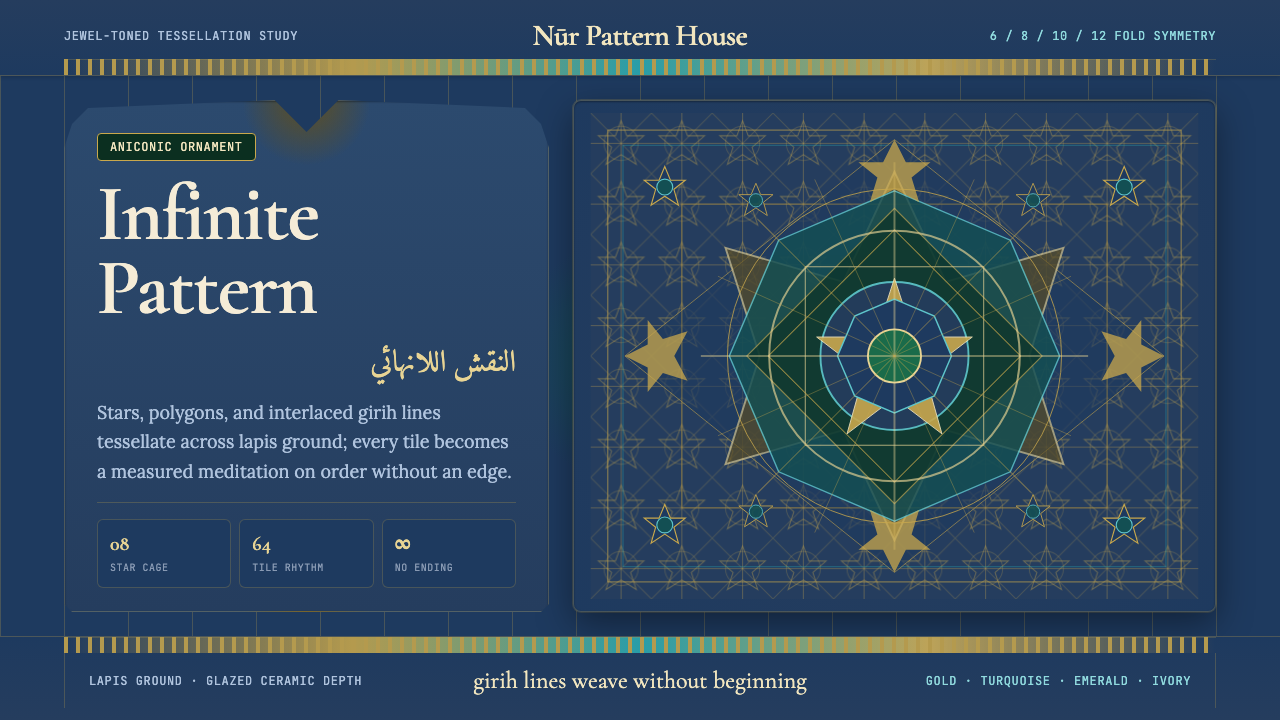 Islamic Geometric ArtInfinite order, fully tiled. Lapis ground with gold girih lines and turquoise…
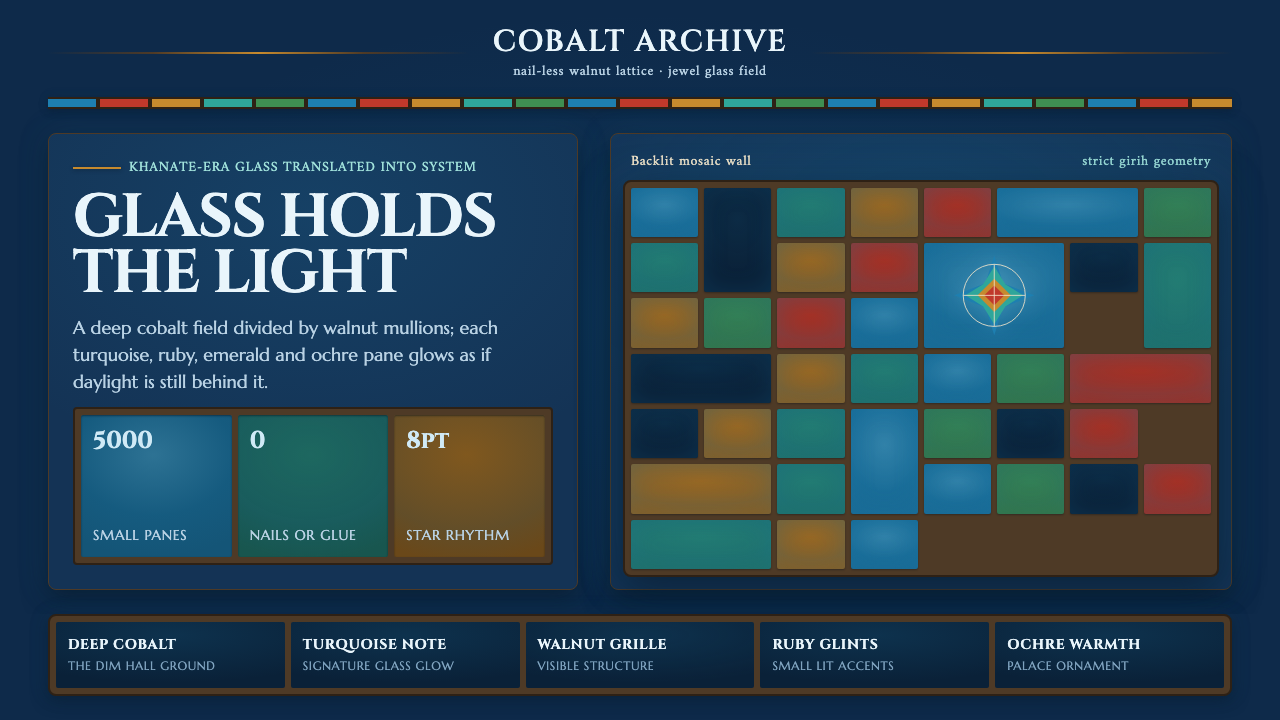 Sheki Shebeke Stained LatticeLight caught in lattice. Cobalt glass, walnut bars and jewel panes glow in st…
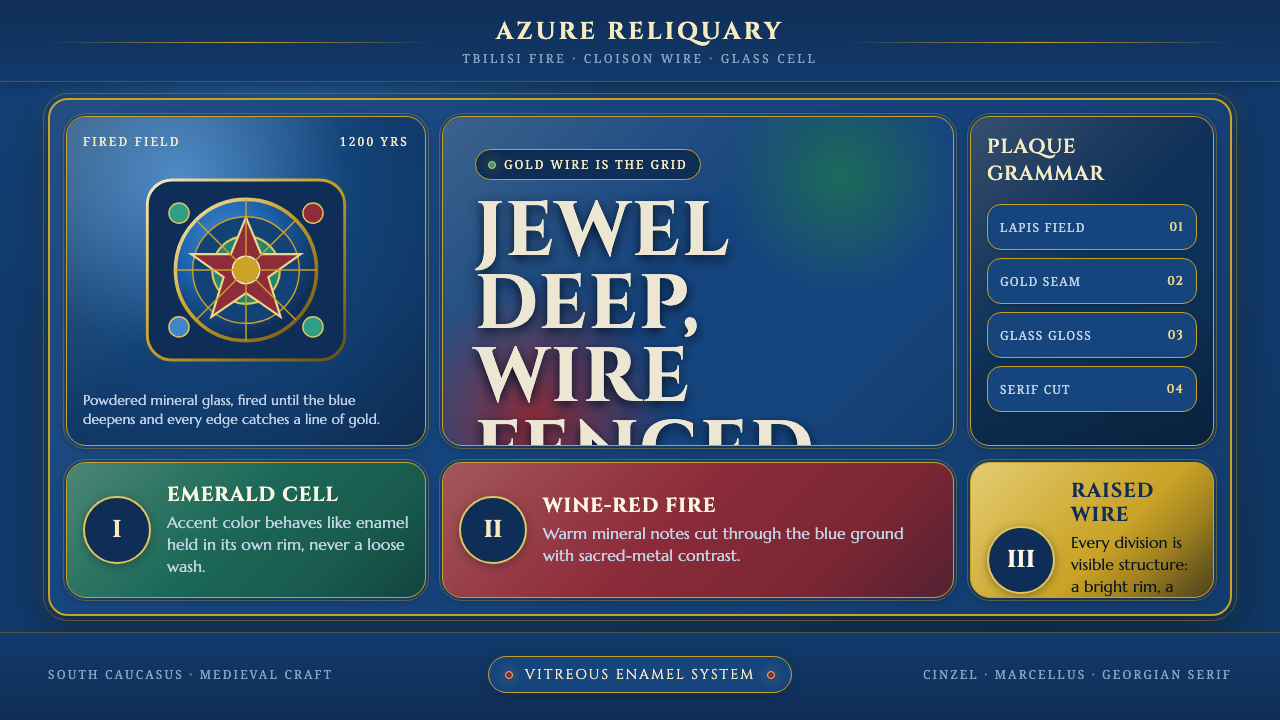 Georgian Minankari CloisonnéJewel-deep and wire-fenced. Lapis enamel, gold seams, emerald cells, glossy s…
 Syrian Damascene BrocadeDark silk shimmers. Aubergine ground, Cormorant SC, gold medallion grid.
 Thai BenjarongRoyal density. Gold-line enamel cells pack green, cobalt, and vermilion on ir…