What is Cholet — Freddy Mamani?
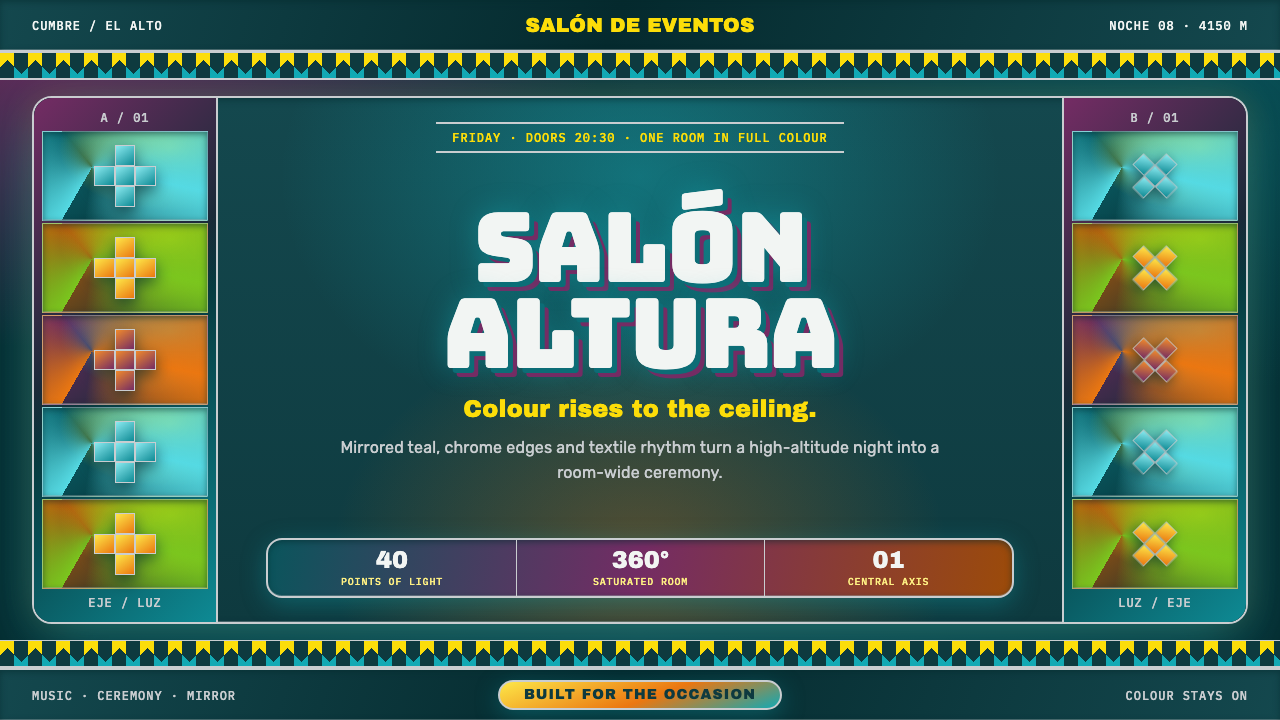
A bricklayer in a high-altitude city invented a building type where saturated color isn't applied to the architecture — it is the architecture.
Cholet — Freddy Mamani in brief
Cholet — Freddy Mamani is a design language taken from a real, still-growing building type invented by the Bolivian architect Freddy Mamani in El Alto, the high-altitude city that sits above La Paz. A cholet stacks several distinct functions inside one facade: shopfronts at street level, a vast event hall above capable of hosting weddings and large celebrations, apartments higher still, and a raw, undecorated brick shell crowning the entire structure. The name itself fuses 'cholo' — a term historically used to describe Aymara and mestizo identity, now reclaimed with pride by the community that builds and fills these buildings — with 'chalet'.
The facades that face the street are mirrored teal curtain-wall glass, chrome trim, and hand-painted acrylic panels — every pattern applied brush stroke by brush stroke rather than printed or mass-produced. Inside the event halls, dozens of chandeliers throw violet, emerald, and turquoise light across expanses of white marble, and wave-form balconies wrap the upper levels in Andean geometric trim. Mamani draws his palette from two specific sources named directly in the record of his work: the ancient site of Tiwanaku, and the awayo — the woven cloth Aymara mothers use to carry their children on their backs.
This is not a revival of any historical Andean architectural style, and it is not what outsiders often label generically as 'Latin American flavor.' It is a genuinely new vernacular, built from textile logic rather than architectural modernism, produced by and for an Aymara community whose economic rise gave it, for the first time, the means to build monumental structures according to its own visual values rather than borrowed European ones.
Where does Cholet — Freddy Mamani come from?
Freddy Mamani Silvestre began his working life as a bricklayer, not an architect, in El Alto — a city of nearly a million people sitting on the Andean altiplano at roughly 4,150 meters above sea level, and one where roughly three quarters of residents are Aymara. His transition from construction labor into building design happened within this specific economic and cultural context, and it is central to understanding why the cholet reads as an insider's architecture rather than an outsider's fantasy of one.
The building type he invented emerged from and alongside the economic rise of an Aymara commercial class in El Alto during the 2000s, a group whose growing wealth from trade and commerce had no existing architectural vocabulary built to represent it — European-derived modernist and colonial styles carried associations that did not fit a newly prosperous, proudly Aymara clientele. Mamani built one from scratch, and the building boom that followed peaked through the 2010s into the 2020s, transforming stretches of El Alto's skyline.
Mamani has described his color choices in terms that explicitly bypass architectural precedent altogether: he draws them from Tiwanaku, the pre-Columbian archaeological site whose monumental stonework and iconography represent one of the oldest visual traditions on the Andean altiplano, and from the awayo, the everyday woven textile Aymara mothers use to carry their children. This combination of ancient monument and living domestic craft, rather than any borrowed international style, is what gives the cholet its specific, non-generic color logic.
This body of work has been given a name within architectural discourse — Nueva Arquitectura Andina, or New Andean Architecture — and is also described as part of a broader Aymara cholo-boom vernacular, a building culture that emerged directly from a specific community's economic ascent rather than from any professional design movement imposed from outside.
What defines the Cholet — Freddy Mamani look?
Saturation as Structure
Color here is not an applied finish layered onto a neutral building; it is treated as load-bearing to the identity of the structure itself. Mirrored teal, chrome, and hand-painted panels are not accents on the architecture — collectively, they are what makes the building read as a cholet at all.
Mirrored Teal Curtain Wall
The dominant facade material is a deep, mirrored teal glass that reflects its surroundings while asserting a strong hue of its own — a color choice that reads as confident and specific rather than the neutral reflective glass common to generic commercial towers.
Chrome and Hand-Painted Acrylic Trim
Trim elements combine polished chrome with acrylic panels painted entirely by hand, brush by brush, rather than printed. The visible evidence of hand execution — slight variation, brush character — is part of the authenticity of the style, not a flaw to be smoothed into machine precision.
Chandelier-Lit Jewel Tones
Interior event halls are lit by dozens of chandeliers casting violet, emerald, and turquoise across white marble floors. Light is theatrical and abundant rather than restrained, treating illumination itself as a decorative and celebratory element rather than a purely functional one.
Wave-Form Balconies with Andean Trim
Upper-level balconies curve in wave forms rather than sitting as flat, rectilinear ledges, and their edges are wrapped in Andean geometric ornament. The curving form itself is a departure from the rectilinear vocabulary of conventional modernist commercial architecture.
Textile-Derived Geometry
Ornamental pattern follows the logic of woven textile design — the awayo cloth in particular — rather than architectural ornament traditions. This gives the surface pattern a rhythmic, repeated, hand-crafted quality distinct from carved stone or classical architectural motifs.
Raw Brick Crown
The topmost level of a cholet is often left as undecorated, unfinished raw brick, a stark contrast to the saturated, ornamented floors below. This is a genuine feature of how these buildings are actually built and occupied over time, not a stylistic affectation.

Who shaped Cholet — Freddy Mamani?
Mamani began as a bricklayer and went on to invent the cholet building type in El Alto, combining shopfronts, event halls, apartments, and a raw brick crown within one structure, and drawing his color and ornament directly from Tiwanaku and Aymara textile tradition rather than any imported architectural style. His personal path from construction labor to architectural authorship is inseparable from why this building type reads as authentically of its community.
Named as the movement this body of work belongs to, Nueva Arquitectura Andina situates the cholet within a broader architectural discourse that recognizes it as a genuine contemporary style rather than a folk-art curiosity, distinct from both colonial-era architecture and imported international modernism.
Named as the second movement this work belongs to, this vernacular describes a building culture that emerged directly from the economic ascent of El Alto's Aymara commercial class in the 2000s onward — a style built by and for a specific community's newly achieved prosperity, rather than a professional design trend imposed from outside it.
How do you use Cholet — Freddy Mamani today?
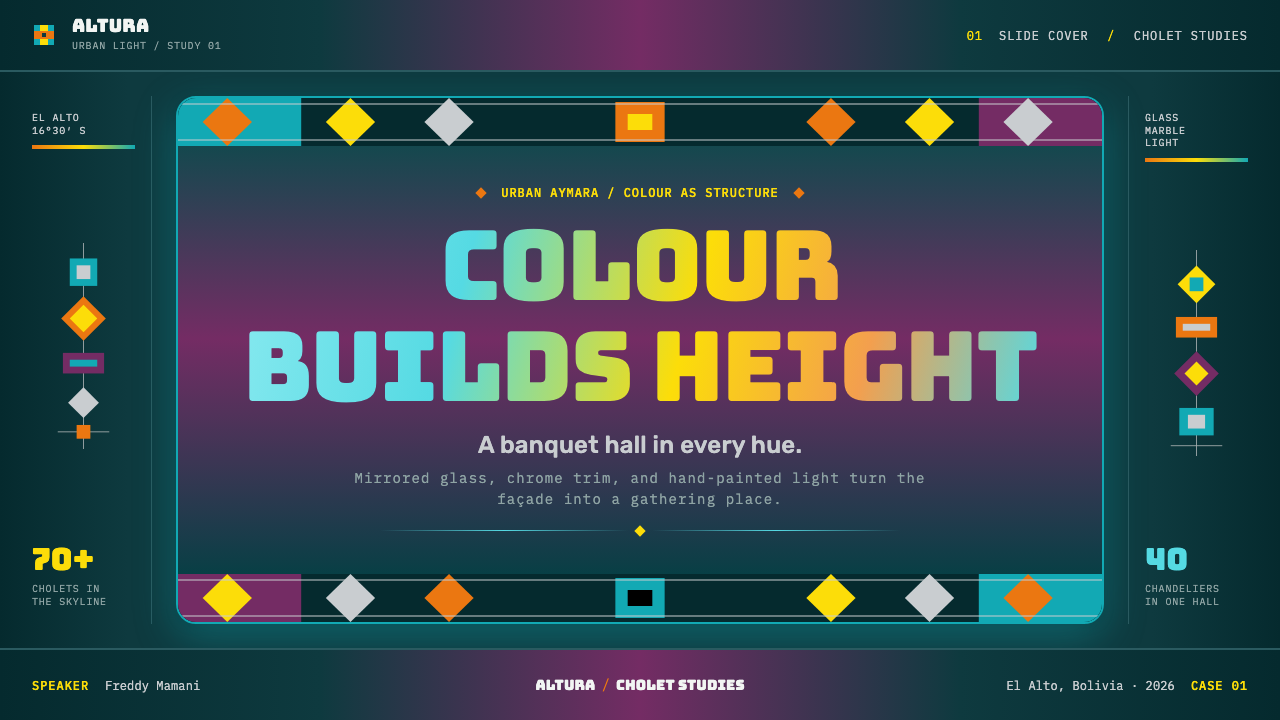
This system is a strong fit for presentation decks that want to project celebration, cultural pride, and bold visual confidence rather than corporate restraint. A cover slide benefits from a single saturated teal or jewel-toned field with a bold geometric border drawn from textile logic, and titles should be set with confident scale rather than minimalist restraint — this style does not whisper. Content slides can use jewel-tone accent blocks — violet, emerald, turquoise — against a clean ground to mark section changes, echoing the way chandelier light washes across a cholet's interior.
For web interfaces, the aesthetic suits hospitality, events, celebration, and cultural-heritage products that want to signal warmth, abundance, and festivity rather than minimal restraint. Mirrored or glossy surface treatments on cards and buttons echo the teal curtain-wall glass, while geometric borders drawn from textile pattern make strong dividers and frame elements. Because the style's power comes from boldness and saturation used with confidence, avoid muting the palette into pastel — a washed-out version of this system loses the very quality that defines it.
In editorial and marketing contexts, the style supports storytelling about cultural identity, economic self-determination, and architecture that emerges from a community rather than being imposed on it. Feature headers benefit from a saturated jewel-tone field with hand-drawn or textile-derived pattern framing the title, and photography should be allowed to show genuine color richness rather than being desaturated toward a cooler, more restrained palette.
The style also carries weight in event and hospitality branding directly, given its origin in buildings purpose-built for weddings and large celebrations — a natural fit for invitation design, event signage, and venue branding that wants to communicate abundance and celebration rather than understatement.
The most common mistake is treating this as generic 'Latin American' or 'tropical' decoration and softening its palette or simplifying its geometry into something more universally palatable. The style's specific power comes from its precise sources — Tiwanaku and the awayo — and from its confident, undiluted saturation; smoothing either away turns a genuinely new vernacular into a vague, borrowed exoticism.
Cholet — Freddy Mamani — FAQ
Is the cholet a revival of a historical Andean architectural style?
No. It is a genuinely new building type invented by Freddy Mamani, beginning in the 2000s, that draws its color and ornamental sources from ancient Tiwanaku and from living Aymara textile tradition, but combines them in a form — stacked shopfronts, event hall, apartments, and raw brick crown — that has no direct historical precedent. It is contemporary architecture with deep cultural sources, not a reconstruction of an older style.
Why is the top floor left as raw, undecorated brick?
This reflects a genuine feature of how cholets are actually built and used — construction and occupancy often proceed in stages, and the raw crown is a real, documented characteristic of the building type rather than an invented stylistic contrast. Applying this feature in a design system signals authenticity to the real building type rather than a fully idealized, uniformly finished fantasy version of it.
Why does this style avoid muted or pastel tones?
Because saturation is structural to the style's identity, not an intensity level that can be dialed down without consequence. Mamani's own facades commit fully to deep mirrored teal, chrome, and jewel-toned interior light; a muted version would misrepresent the actual buildings this system is drawn from and would lose the confident, celebratory character that defines the cholet.
Does this style suit corporate or financial-services products?
Generally not. Its bold saturation, celebratory lighting, and hand-painted ornamental character project abundance and cultural pride rather than the restraint, neutrality, and quiet trust that corporate and financial products typically need to convey. It is a much stronger match for hospitality, events, cultural-heritage, and celebration-oriented brands.
Where do the specific colors and patterns actually come from?
Mamani has named two specific sources: Tiwanaku, the ancient pre-Columbian site on the Andean altiplano, and the awayo, the woven textile Aymara mothers use to carry their children. Both sources are named directly rather than inferred, which is what allows this system to be documented rather than a generalized guess at 'Andean' or 'Latin American' color.
Related design styles
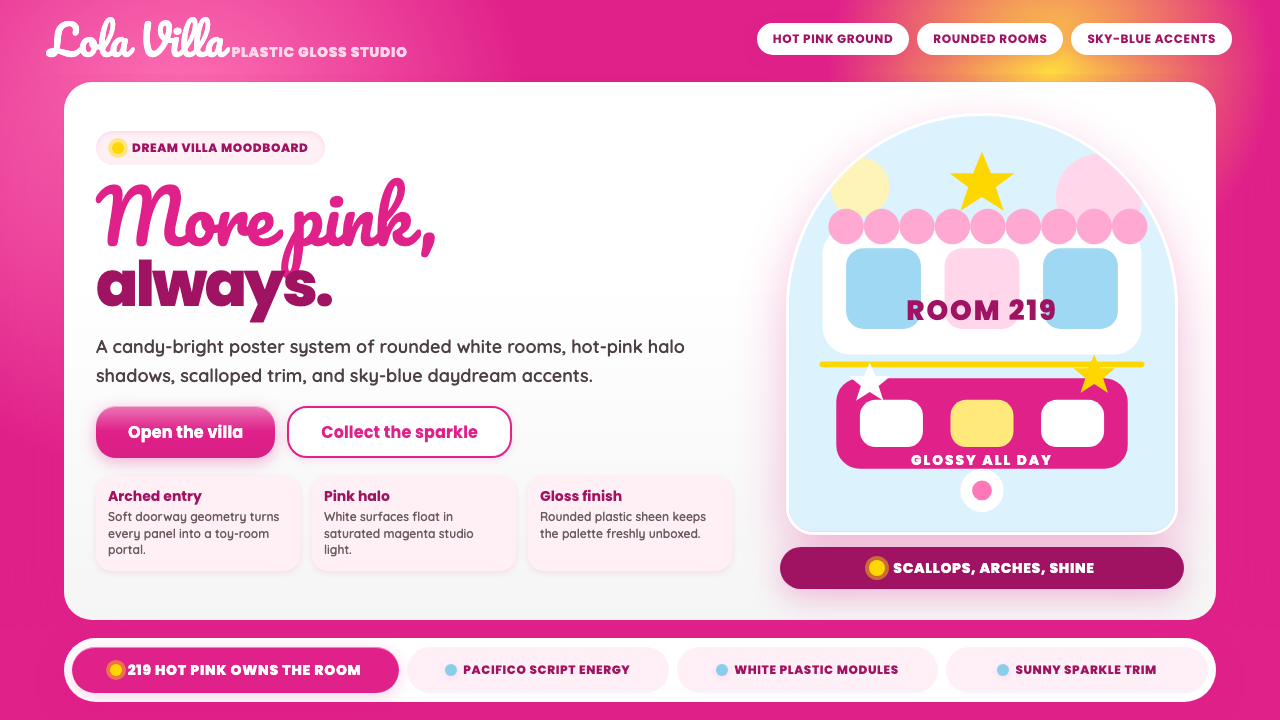 Barbie DreamhousePink is the whole world. Hot magenta ground, Pacifico script, scallops and gl…
 Bollywood Neon MumbaiMumbai pop burns bright. Khand stacks glow over night-black, with pink-purple…
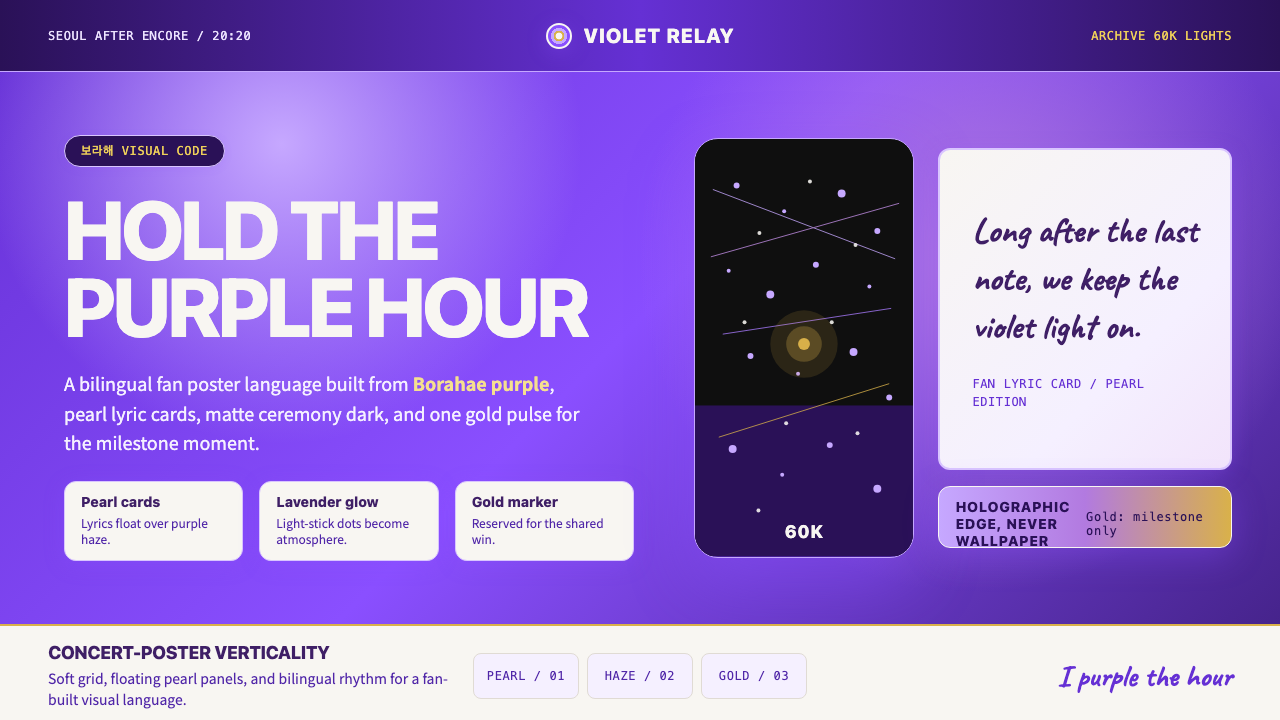 BTS Army Purple 2020Fandom becomes atmosphere. Borahae purple, pearl cards, lavender glow, one go…
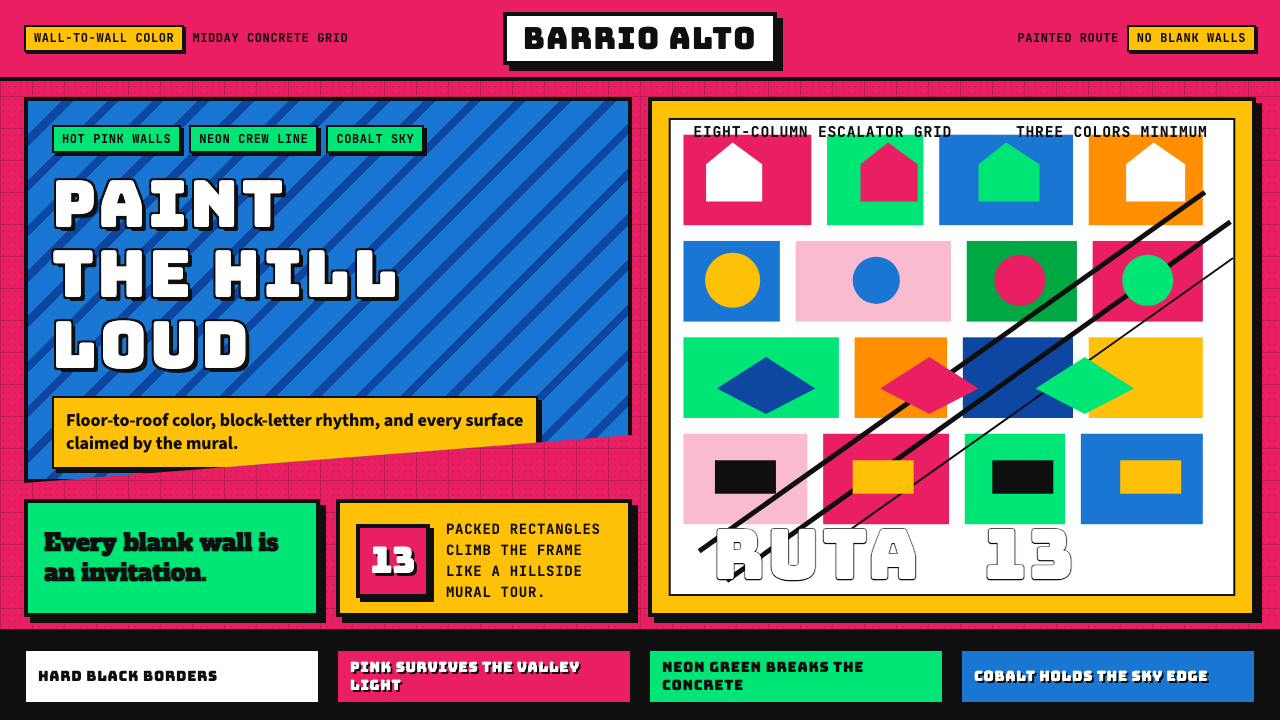 Medellín Comuna 13 MuralsRefuses blank walls. Hot pink, neon green, and cobalt blocks pack the grid li…
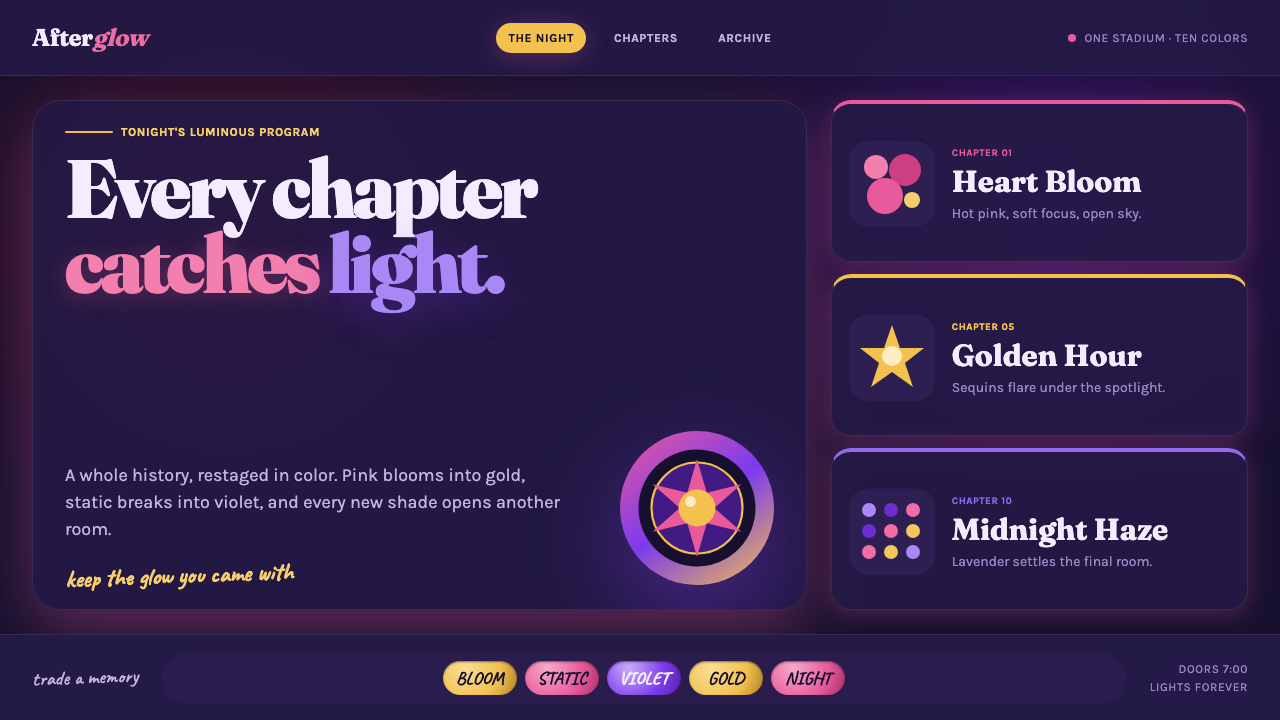 Taylor Swift Eras (2023)Every chapter catches light. Hot pink, lavender, gold and beadwork glow on mi…
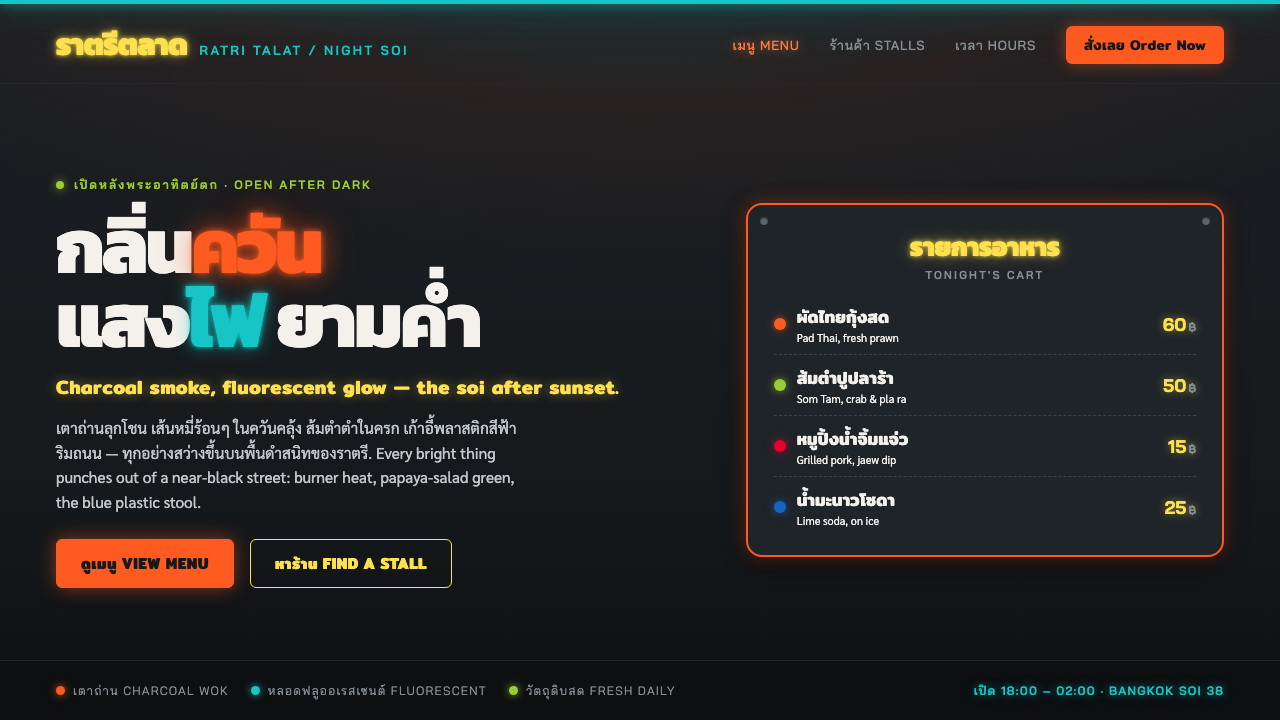 Thai Night Market Street FoodLit against the night. Chili-orange and fluorescent glow punch off a black so…