What is Bitcoin Maximalist Orange?
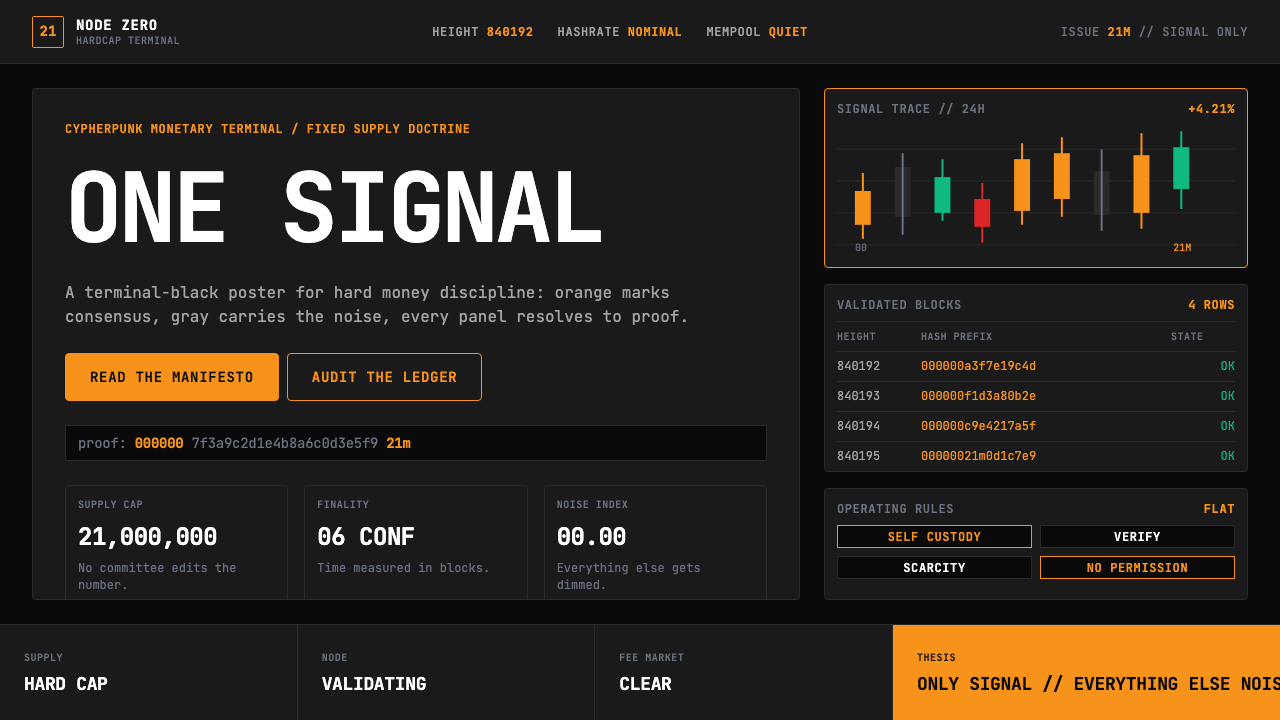
Bitcoin Maximalist Orange collapses the entire language of money into a single visual conviction: one sovereign orange on terminal black, where every pixel is signal and nothing is decoration.
Bitcoin Maximalist Orange in brief
Bitcoin Maximalist Orange is a design ideology translated into a visual system. Its palette — a single vivid orange on pure black grounds, accented by the cool glow of monospace type — does not aspire to beauty in the conventional sense. It aspires to legibility under conditions of maximum information density, the same legibility demanded by a price terminal at 3 a.m., a block explorer refreshed in real time, or a hardware wallet confirming a transaction worth years of savings.
The system is built around refusal. No gradients. No ambient shadows. No rounded corners that signal friendliness. No secondary brand colors admitted into the composition. Every element that survives the editing process does so because it carries information — price movement, block height, mempool depth, confirmation count — and not because it improves the emotional experience of the viewer. This is design as proof-of-work: only the essential survives.
What makes the aesthetic distinctive is not minimalism in the contemporary sense, which often prioritizes comfort and soft negative space. Bitcoin Maximalist Orange prioritizes density and signal. A well-executed screen in this style is saturated with monospace numerals, sparse labels in neutral gray, and orange used exclusively at moments of salience — a confirmed transaction, a live price, an alert threshold crossed. The darkness of the ground is not mood; it is contrast engineering.

Where does Bitcoin Maximalist Orange come from?
The visual roots of Bitcoin Maximalist Orange trace to 1970s and 1980s computing culture — the green phosphor glow of early terminals, the amber displays of IBM PC monitors, the command-line interfaces that required operators to think in structured text rather than spatial metaphor. When Satoshi Nakamoto published the Bitcoin whitepaper in October 2008, no visual identity accompanied it. The whitepaper was a technical document, typeset plainly, circulated on a cryptography mailing list. Visual identity accrued slowly, organically, as developers, node operators, and forum participants built the infrastructure around the protocol.
The orange now universally associated with Bitcoin — a warm, saturated amber-orange — emerged gradually through community consensus rather than deliberate brand design. Early Bitcoin forums used orange avatars and header graphics almost reflexively, partly because the hue stood out against the dark backgrounds common to developer-culture websites, and partly because it read as energetic and valuable without mimicking the gold tones that would have felt derivative of traditional finance. By 2014, the orange had become canonical enough to anchor the Bitcoin Foundation's visual materials and the growing ecosystem of exchanges, wallets, and explorers.
The terminal-black ground has a parallel and equally important genealogy. Cypherpunk culture — the movement that provided the ideological soil for Bitcoin through figures like Timothy May, whose 1992 Crypto Anarchist Manifesto preceded the whitepaper by sixteen years — operated aesthetically in the register of command-line computing. Dark terminals, monospace fonts, and information-dense layouts were not stylistic choices so much as the natural visual output of a community that worked in Unix shells and IRC channels. When Bitcoin's visual identity crystallized between 2017 and 2024, this heritage was absorbed wholesale.
The ideological intensification of Bitcoin maximalism — the conviction that Bitcoin is the only legitimate cryptocurrency and that all others are noise or fraud — hardened the aesthetic simultaneously. Saifedean Ammous's 2018 book 'The Bitcoin Standard' gave the movement a theoretical framework rooted in Austrian economics, and its influence is legible in the design language: zero tolerance for visual complexity mirrors zero tolerance for monetary inflation. Michael Saylor's MicroStrategy communications, Nic Carter's data journalism, and the block explorer aesthetic pioneered by sites like Blockchair and mempool.space all contributed to the codification of the style as it exists today — dense, dark, orange, and uncompromising.
What defines the Bitcoin Maximalist Orange look?
Color
The palette is built around a single vivid orange — warm, saturated, and unambiguous — deployed against a pure black or near-black ground. This is a monochromatic system in practice: the orange functions as the sole accent, while neutral grays of varying lightness handle secondary information and structural division. No secondary brand colors are admitted. The orange does not shift across the composition; it appears at full intensity or not at all, reserving its visual weight for moments of genuine salience: live prices, confirmed states, alert thresholds. The black ground is chosen not for moodiness but for maximum contrast, reducing eye strain during extended screen sessions in low-light environments typical of traders and node operators.
Typography
Monospace typefaces dominate, chosen for their precision and their visual alignment with terminal and code aesthetics rather than for warmth or personality. Every character occupies the same horizontal width, which means columns of numbers align vertically without manual adjustment — a property that is functionally critical when displaying price tables, block data, or transaction histories. Proportional typefaces, when they appear at all, are reserved for explanatory prose or navigational labels; they are kept subordinate and are rarely set at display scale. The type system enforces a clear hierarchy through scale and weight alone, never through color variation or decorative styling.
Density and Grid
Where most contemporary design systems optimize for spaciousness and breathing room, Bitcoin Maximalist Orange optimizes for information throughput. Layouts are dense: tight line spacing, narrow gutters, small but legible type at body scale. The underlying grid is rigid and columnar, derived from the tabular structures of spreadsheets and trading terminals rather than the editorial grids of magazine design. Negative space is not generous; it appears only where content genuinely ends, not as padding inserted for aesthetic relief. This density is a deliberate argument: unnecessary whitespace is waste, and waste is ideologically inconsistent with the hard-money philosophy the system embodies.
Zero Decoration
Gradients, soft shadows, rounded corners beyond functional minimum, illustration, photography, and any element whose primary purpose is visual pleasure rather than information delivery are absent. Card components, when used, have hard edges or thin border lines — not the diffuse glows that signal friendliness in consumer app design. Dividers are structural lines, not decorative ornaments. Icons, where they appear at all, are reduced to the simplest geometric form capable of carrying the required meaning, and they are never animated for engagement purposes. The restraint is not accidental or lazy; it is the visual counterpart of the monetary thesis that all additions beyond the minimum viable protocol introduce attack surface and fragility.
Data as Aesthetic
Charts, tables, and numerical displays are not utility elements subordinated to a visual design system — they are the design system. Candlestick charts, block height counters, fee rate histograms, and mempool visualizations are treated as visual compositions in their own right, not as data visualizations inserted awkwardly into a polished interface. The orange accent color, when applied to a live price or a chart line, is not decoration; it is a data encoding choice. This inversion of the typical design hierarchy — where visual form is primary and data display is a necessary functional intrusion — is what gives the style its distinctive character and separates it from both conventional fintech design and from the broader crypto aesthetic.
Ideological Legibility
The style communicates a position before any content is read. A dark-ground, orange-accent, monospace interface signals: this is infrastructure, not entertainment; this is for operators, not consumers; this system will not compromise its precision for your comfort. This ideological legibility is intentional and valued within the maximalist community — the visual language functions as a form of self-selection, filtering for users who share the underlying convictions about monetary hardness, censorship resistance, and the subordination of UX polish to protocol integrity. In this sense, the aesthetic is not just a design choice; it is a declaration of values.
Consistency Over Expression
Individual expressive variation is suppressed in favor of systematic consistency. A designer working within this style does not introduce a second accent color to create visual interest on a particular page, does not vary the typeface to signal a different section's tone, and does not add illustration to lighten a dense information block. Consistency is the primary value: across screens, across context, across time, the system presents the same austere face. This is analogous to the Bitcoin protocol itself, which changes through consensus only and resists modification for the sake of convenience. The design system enacts the same logic.

Who shaped Bitcoin Maximalist Orange?
The pseudonymous creator of Bitcoin, whose 2008 whitepaper and subsequent code established the protocol that the aesthetic ultimately serves. Nakamoto's communications — technical, spare, and free of promotional language — set a stylistic precedent for Bitcoin culture that persists in the visual language: nothing is asserted without evidence, and nothing is added without function. The minimalism of the whitepaper itself — plain text, numbered sections, no visual branding — is a kind of ur-document for the aesthetic.
The economist whose 2018 book 'The Bitcoin Standard' gave the maximalist movement its most rigorous theoretical articulation, grounding Bitcoin's value proposition in Austrian monetary theory and the concept of stock-to-flow hardness. Ammous's framework — which explicitly positions Bitcoin against central bank monetary policy and all other cryptocurrencies — provided the ideological vocabulary that the visual style encodes visually: severity, focus, rejection of ornament as monetary and aesthetic corruption.
The MicroStrategy executive whose aggressive corporate Bitcoin accumulation strategy, beginning in 2020, brought the maximalist thesis to mainstream financial attention and produced a body of visual communications — presentations, charts, data slides — that embody the aesthetic at institutional scale. Saylor's presentation style, which favors dense data graphics, dark backgrounds, and orange accents, helped legitimize the terminal-and-data aesthetic as appropriate for boardroom contexts and not merely developer communities.
A partner at Castle Island Ventures and one of Bitcoin's most prolific data journalists, Carter co-created Coinmetrics and has produced influential on-chain analytics, essays, and visualizations that demonstrate how financial data can be made beautiful without departing from functional rigor. His work represents the sophisticated pole of the aesthetic — where density and precision produce something that functions like art without pursuing it — and has influenced how the broader community thinks about data presentation within the Bitcoin context.
How do you use Bitcoin Maximalist Orange today?
Bitcoin Maximalist Orange is among the most legible design systems available for financial data products, but it is also among the most demanding to apply without either diluting its character or tipping into caricature. The key discipline is treating the orange as a sparse signal rather than a brand color to be applied liberally. In a well-calibrated implementation, the orange appears on perhaps five to ten percent of visible surface area — live price tickers, active state indicators, primary call-to-action elements — and nowhere else. The moment the orange begins appearing on headers, card backgrounds, or decorative borders, the system loses its signal-to-noise logic and becomes merely a dark theme with orange elements.
For presentation slides, the style works powerfully on both cover and content pages, but each requires a different approach. A cover should be treated like a terminal awakening: dark ground, the title in large monospace type, a single data point or orange accent element that anchors the composition. Content slides should commit fully to the tabular and data-grid logic — information organized in columns, numbers right-aligned, labels in neutral gray, with orange reserved for the single most important figure on the slide. Data slides — charts showing price history, stock-to-flow models, on-chain metrics — should be treated as primary compositions, not as supporting graphics inserted into slide templates. The chart is the slide.
For web interfaces — dashboards, node monitoring tools, portfolio trackers, exchange pricing pages — the style is at its native home. The approach: commit to a dark ground throughout, use a strict columnar grid derived from tabular data rather than editorial layout principles, set all numerical data in monospace type, and keep the orange accent to interactive states, live-updating values, and alert conditions. Navigation should be typographic, not iconographic; borders on interactive elements should be thin and hard rather than soft or glowing; loading states should avoid spinners in favor of progress bars or flashing cursor conventions borrowed from terminal culture.
For editorial and marketing work — long-form essays, research reports, data journalism, conference materials — the style supports strong information hierarchy with an unusual ability to make density readable rather than oppressive. A report layout in this style uses a narrow body measure, wide margins for data call-outs and annotations, section breaks marked by a thin horizontal rule, and no decorative imagery. Marketing materials benefit from the poster-like boldness of the full-width dark ground: a large orange number or data point as the hero element, a supporting statement in smaller neutral-gray type, and nothing else. The restraint is the message.
The most common mistake when applying this aesthetic is treating it as a dark mode with orange accents — adding rounded corners, soft shadows, gradient backgrounds, and multiple typefaces because they feel modern and polished, while keeping only the dark ground and orange as tokens of the style. This produces work that has the surface appearance of the aesthetic without its internal logic, and it reads as superficial to anyone familiar with the genuine article. A second common mistake is deploying the orange too broadly — on section headers, decorative borders, background tints — until it loses its salience function entirely. The style's power depends entirely on restraint; without it, what remains is simply a dark interface with aggressive coloring.

Bitcoin Maximalist Orange — FAQ
Is Bitcoin Maximalist Orange only appropriate for Bitcoin-specific products?
Not strictly, but its ideological associations are strong enough that using it in non-Bitcoin contexts requires deliberate handling. The style is well-suited to any product that values information density, operator-grade precision, and the deliberate rejection of consumer-friendly softness: high-frequency trading tools, network infrastructure dashboards, cybersecurity monitoring interfaces, or any product whose users are domain experts who distrust ornament. It performs poorly for products that need to communicate warmth, approachability, or cultural breadth — financial planning tools aimed at general consumers, for instance, or platforms serving multiple asset classes where the orange would impose a Bitcoin-specific reading that the product does not intend.
How does this style relate to broader crypto or Web3 aesthetics?
Bitcoin Maximalist Orange and the broader crypto or Web3 aesthetic are almost opposites. Web3 visual design — particularly in the NFT and DeFi space — tends toward gradients, iridescent color, animated backgrounds, glassmorphism, and expressive typography that signals novelty and cultural energy. Bitcoin Maximalist Orange is defined precisely by its rejection of all of these elements. Where Web3 aesthetics celebrate abundance and spectacle, Bitcoin Maximalist Orange enforces scarcity and signal. The ideological divergence between Bitcoin maximalism and the broader crypto ecosystem is perfectly reflected in the visual divergence: you can almost identify a project's monetary philosophy by looking at its design language.
Can the style work in a light or white-ground version?
A light-ground inversion is technically possible but practically challenging and ideologically awkward. The dark ground is not incidental to Bitcoin Maximalist Orange — it is the condition that makes the orange's salience function work. On a white or light ground, the orange shifts from a glowing signal against darkness to an accent color that must compete with other elements, and its intensity can tip into aggression rather than precision. The terminal metaphor, which underpins the entire aesthetic, depends on the dark ground. A light-ground version of this style tends to read as generic financial design with orange accents rather than as a coherent expression of the underlying ideology. If a light ground is necessary for accessibility or context reasons, treat it as a variant rather than the primary expression, and reduce the orange to a more restrained accent.
What is the right way to handle photography or imagery within this style?
Authentic Bitcoin Maximalist Orange interfaces contain almost no photography or representational illustration, and this is not a limitation — it is a design choice consistent with the system's logic. When imagery is used at all, it tends to be functional: screenshots of block explorers, terminal output, or hardware wallet interfaces. Where portrait photography appears — for team pages or conference materials — it is typically treated in high contrast, desaturated to near-monochrome, often duotone in black and orange. Lifestyle photography, product photography styled for aspiration, and any image whose purpose is emotional atmosphere rather than information are incompatible with the system's values. A designer tempted to add imagery to 'humanize' a Bitcoin Maximalist Orange interface should ask whether the underlying product actually needs humanizing, or whether the austere character of the style is itself the appropriate signal.
How do you avoid the style feeling dated or overly niche?
Bitcoin Maximalist Orange feels dated when it is applied to problems that the aesthetic was not designed to solve — consumer onboarding flows, general-public financial education, or brand contexts where approachability and warmth are primary values. In those contexts, the style does not feel current; it feels like a costume. Applied to its native territory — infrastructure dashboards, data-dense analytical tools, operator-grade interfaces — the style feels timeless rather than dated because it is governed by functional logic rather than trend. The risk of feeling niche is real, but it is managed by executing the system at high resolution: dense data that is genuinely readable, orange that is genuinely salient, type that is genuinely precise. Poor execution of this style feels niche and amateurish; expert execution feels authoritative and inevitable.
Related design styles
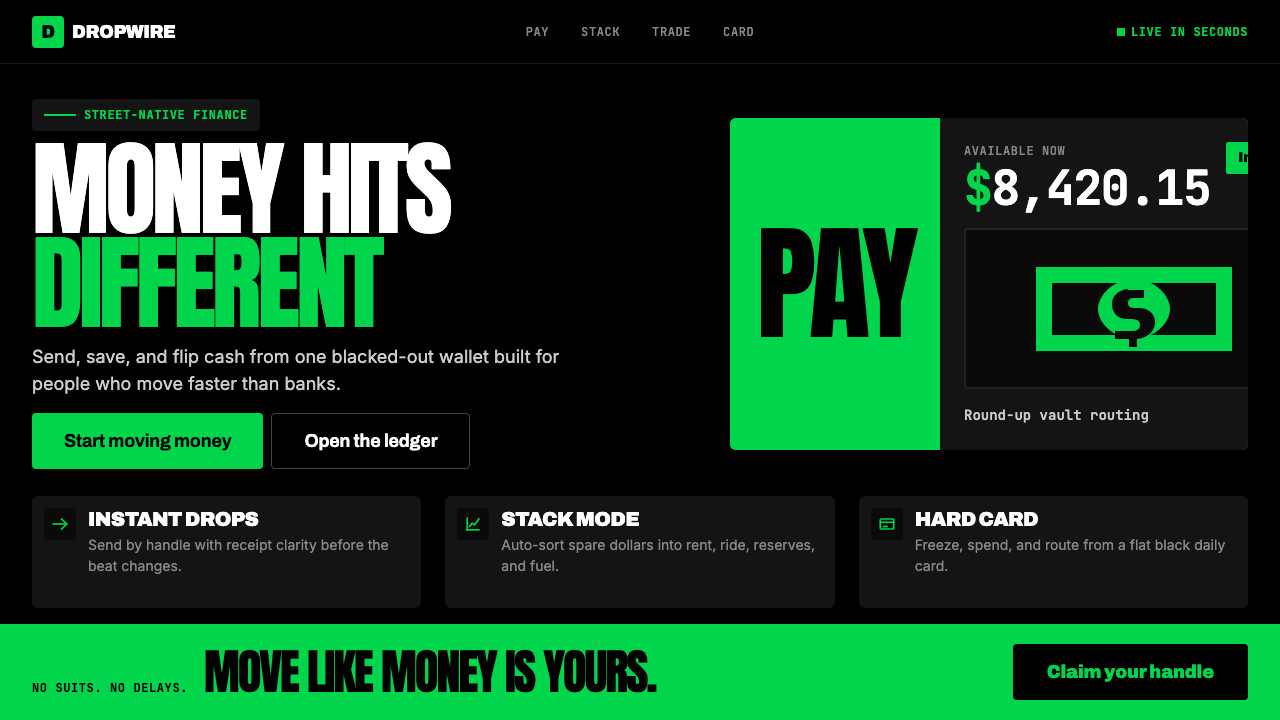 Cash App 2024Fintech that talks like a record label. Pure black, dollar-bill green, type a…
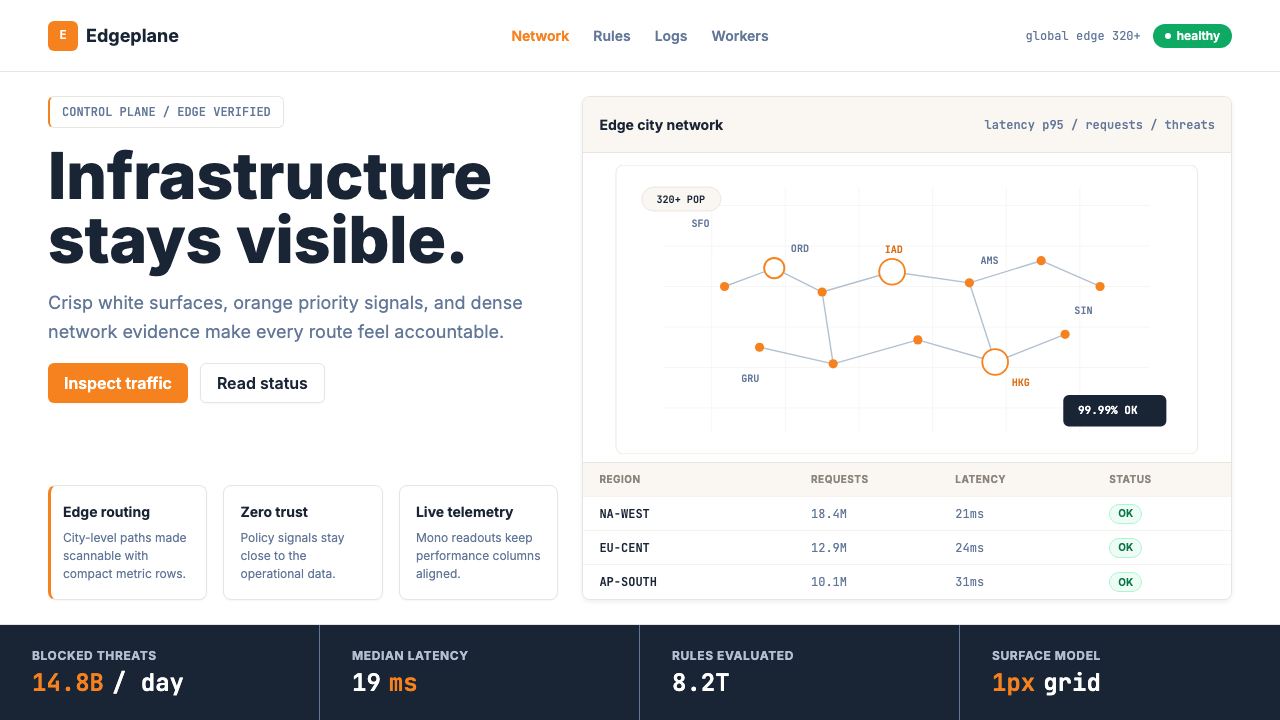 Cloudflare Orange EdgeOperational clarity wins. Orange accents, hairline grids, and mono metrics ma…
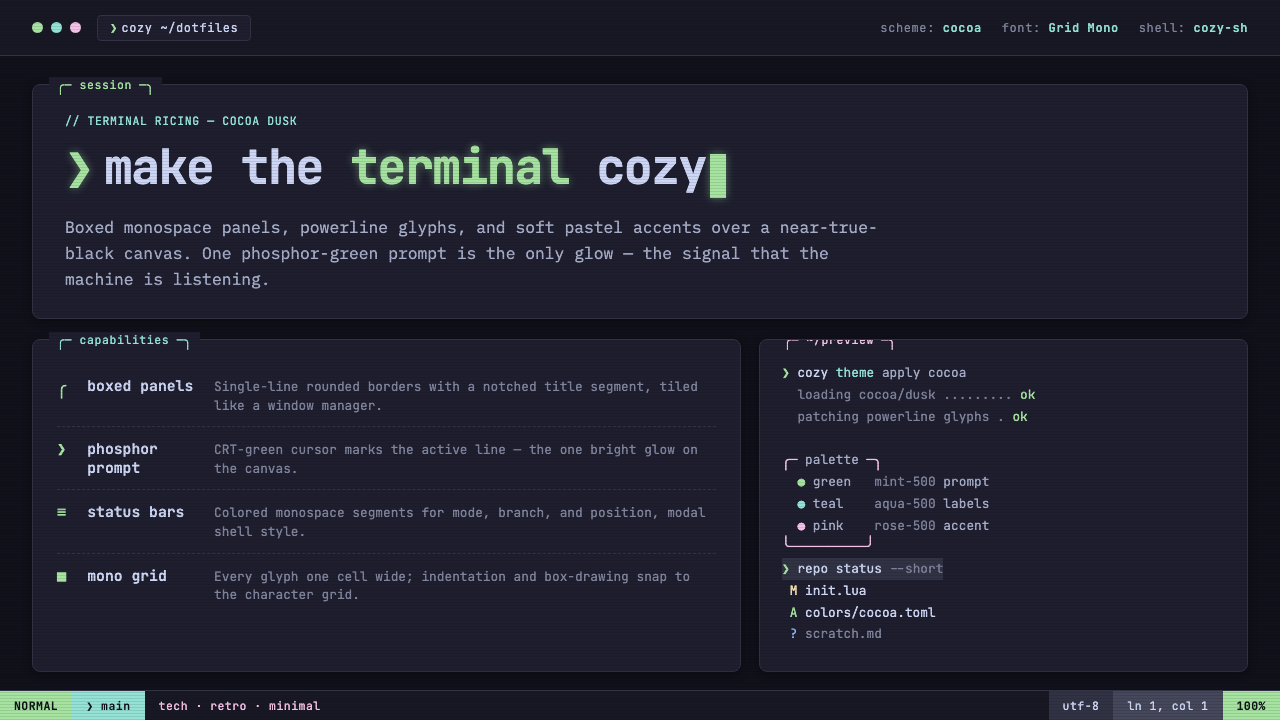 Cozy Terminal TUI RevivalMake the terminal cozy. Boxed mono panels in Catppuccin Mocha, lit by one pho…
 Deep Space ObservatoryTrust the void. Cyan telemetry and amber wavelength bars lock to a steel grid.
 Fencing PisteTurns darkness into signal. Rajdhani HUD type frames a white piste and red-gr…
 Halo (Forerunner UI)Hard light on the void. Cyan shield bars and concentric glyph rings glow on a…