What is Hills Hoist Suburbia?
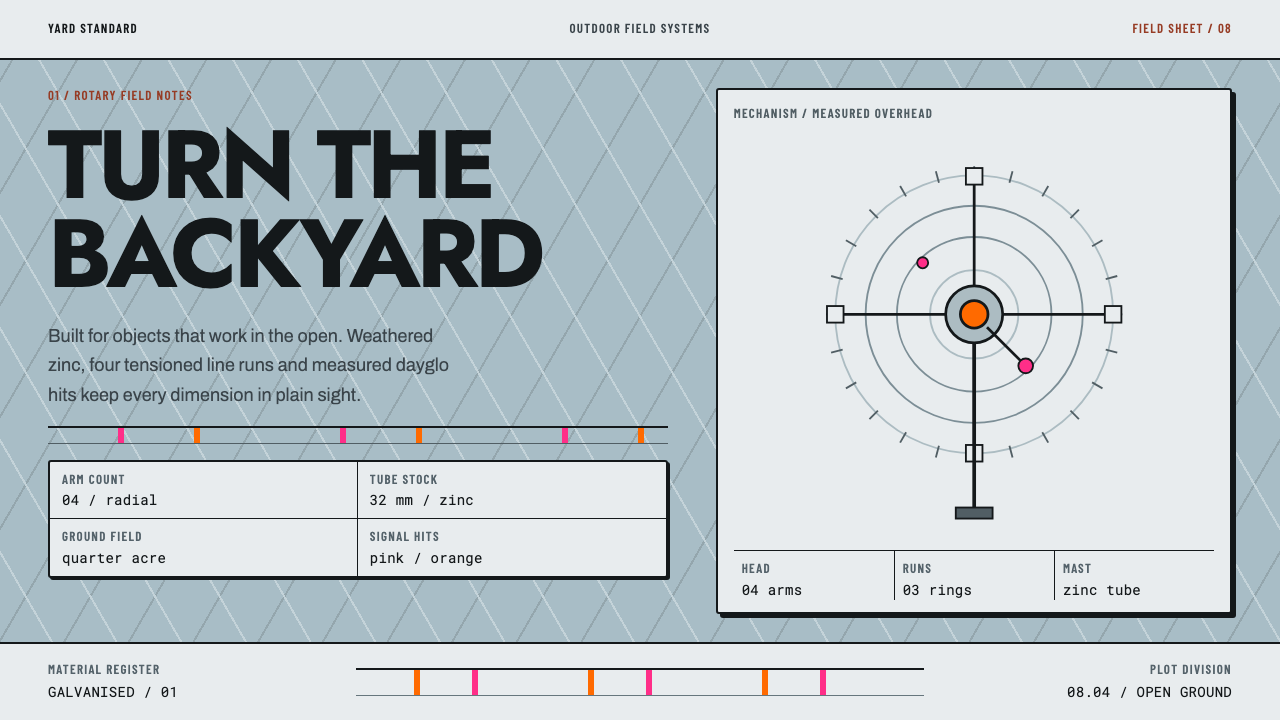
The Hills Hoist is a four-armed steel clothesline that became a national symbol, and the style built on it pairs weathered zinc grey with a few sharp hits of fluorescent colour and a great deal of empty backyard.
Hills Hoist Suburbia in brief
Hills Hoist Suburbia is a style drawn from the rotary clothes hoist, a four-armed frame of hot-dip galvanised tube that is cranked up to lift the washing high over a quarter-acre of buffalo lawn. Lance Hill welded the first one in his Adelaide backyard in 1945, and sixty-one years later the National Library named it a National Treasure. The style takes its ground from that metal and its graphics from the painter Howard Arkley, whose work turned the postwar Australian suburb into flat colour and hard outline.
Utility leads. The hoist is a working object whose shape comes from what it does: arms that radiate from a central pole, lines pulled taut between them, a mechanism that winds the whole assembly up and down. The visual system keeps that logic. Layouts turn on a central point, rows of evenly spaced lines give rhythm, and almost nothing is added that a hoist would not need. The rest of the ground is left empty, because a backyard is mostly empty.
Visually the palette is weathered zinc: a light blue-grey in which the hexagonal spangle of the galvanised coating is still faintly readable. Black outlines are hard and uniform, and shapes are flat, like the painted house fronts of Arkley's suburbs. Dayglo pink and orange arrive only as hits, small and deliberate, never as large fields of colour. Terracotta roof tiles and cream brick walls sit in the background as the suburban supporting cast.
Where does Hills Hoist Suburbia come from?
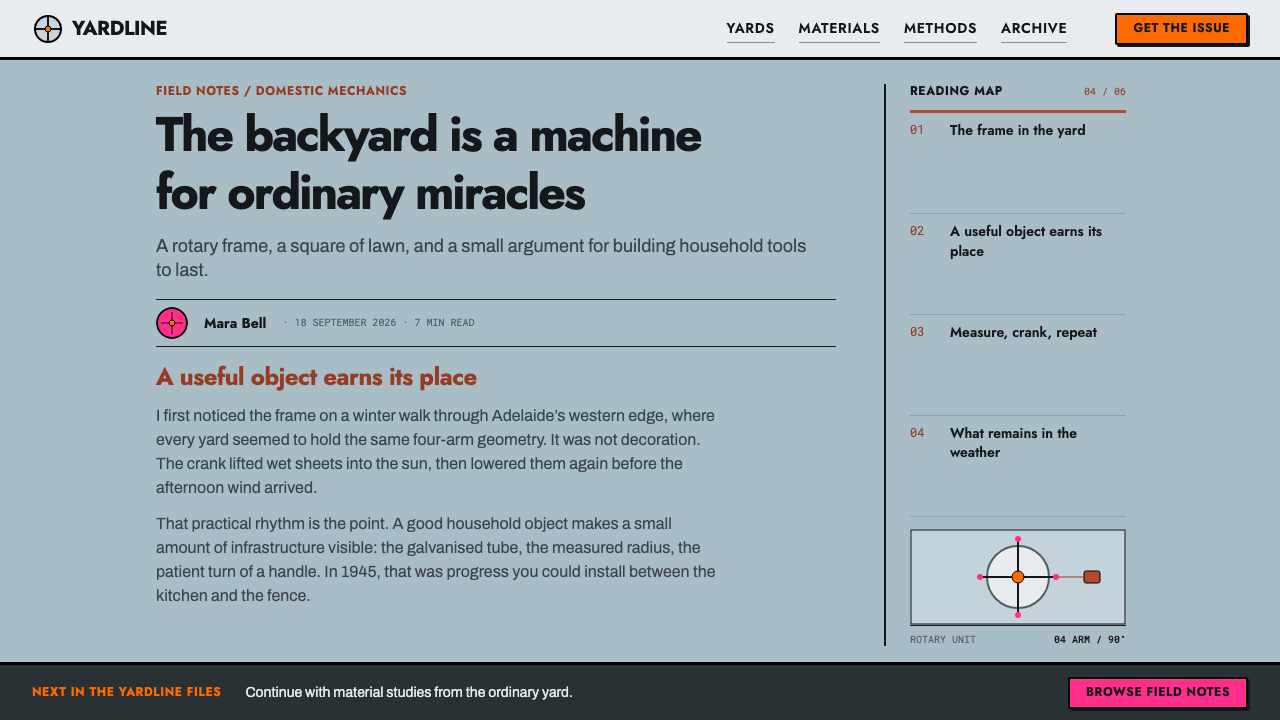
The hoist's lineage begins before Hill. The source material notes Gilbert Toyne's rotary clothesline patent of 1911, which set out the basic idea of a line frame turning around a central post, and treats it as the bloodline of the form. What Hill added in 1945 was a particular object: a rotary hoist welded from galvanised tube in a backyard in Adelaide, an arms-out frame that could be cranked up and down. The era the style covers, 1945 to 1990, begins with that welding and runs through the decades in which the object settled into the Australian suburban landscape.
Galvanising is the material fact that gives the style its colour. Hot-dip galvanised tube is steel coated in zinc, a protective skin that weathers over the years from bright metal to a soft, light blue-grey. Look closely at the coating and the hexagonal spangle, the crystalline pattern formed as the zinc cools, is still readable. This is industrial galvanising as a visual source: the colour of something built to last outdoors and left to age. The movement behind it is Australian postwar suburban design, in which practical objects were made from ordinary industrial materials and left to weather.
The suburban setting matters as much as the metal. The region the style draws on is Adelaide and the postwar suburbs of Australia, a landscape of detached houses on large blocks, each with its patch of lawn and its washing line. The quarter-acre block gave the hoist room to turn, the lawn gave the tubes a green ground, and the house front gave Arkley his subject. Without the suburb the hoist would be a tool; with it, the hoist becomes a fixture. Its recognition as a National Treasure sixty-one years after it was first welded says as much about the place as it does about the object.
The graphic language comes from Howard Arkley and the tradition of Australian pop and airbrush painting. His suburban paintings of the 1980s and 1990s reduce houses to flat fronts bounded by hard black outlines and brightened by dayglo pink and orange. This style takes that vocabulary and sets it on the hoist's ground. Metal supplies the calm, Arkley supplies the shock, and the shock stays small. The result is a system in which industrial grey and fluorescent colour sit together without cancelling each other out.
What defines the Hills Hoist Suburbia look?
Weathered Zinc Ground
The ground colour is the light blue-grey of old galvanised steel, a cool neutral that has aged outdoors rather than a bright new metal. It reads calm and slightly dusty, and it makes a good surface for black line work and small bright accents. The tone should feel like a material, not like a flat grey fill; a hint of mottling or weathering is welcome, provided it never competes with the content.
Spangle Grain
The hexagonal spangle of the coating is the style's only texture. It appears as a faint, large-grained pattern of interlocking cells in the zinc tone, visible in a few surfaces such as backgrounds and large panels. It must stay quiet. It tells the viewer that the surface is metal, and then steps aside; where text is dense or data must be read, the grain disappears entirely.
Hard Black Outlines
Every shape is bounded by a hard, even black line, in the manner of Arkley's flat house fronts. The line is uniform in weight and never tapers or softens, so forms read as cut-out and diagrammatic. Outlines do the work that shadows and gradients do in other styles: they separate, group and define. Fill colours stay flat and the black line holds everything together.
Dayglo as Hits
Dayglo pink and orange land as hits rather than fields. They mark one element on a screen: a selected item, a single figure, a key action. Used this way they carry real shock against the quiet zinc. Spread across a whole panel they would lose their force and fight the outlines, so a good test is that you can cover them with a thumb. When in doubt, use less.
Four-Arm Radial Symmetry
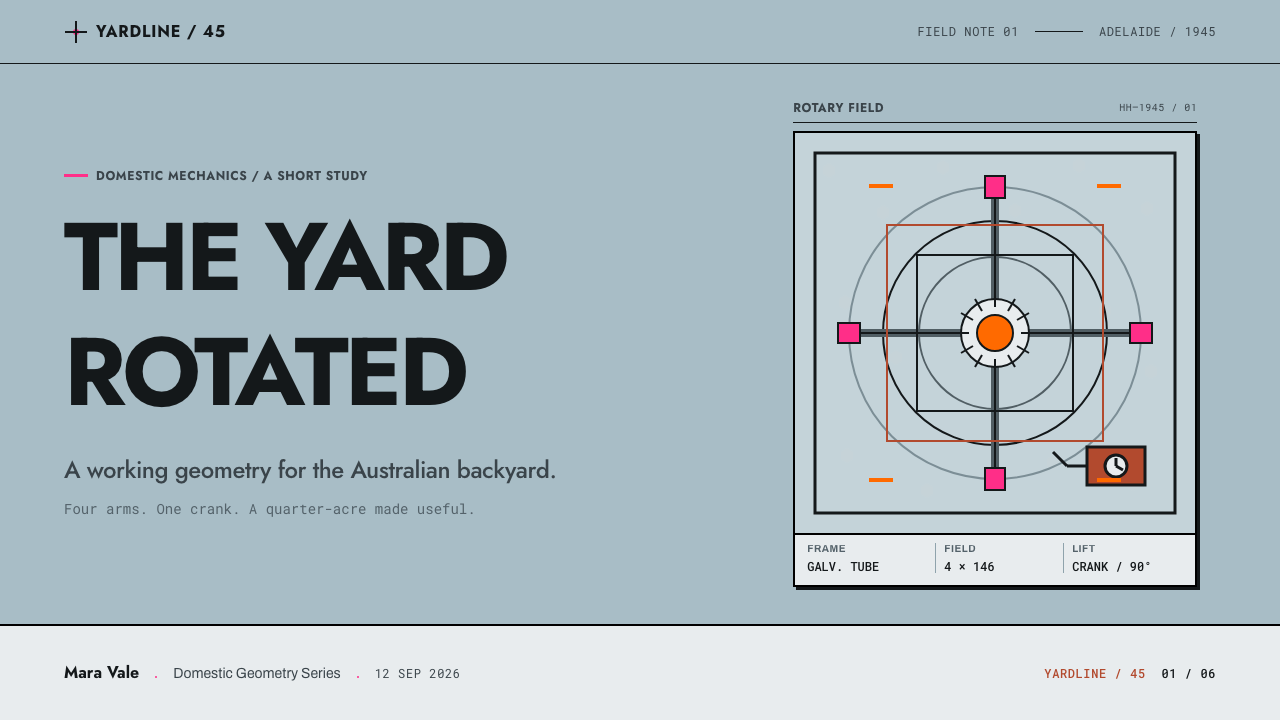
The hoist's frame gives the style a compositional figure: four arms radiating from a centre, each at a right angle to the next. Layouts echo it with cross-shaped or pinwheel arrangements, and with elements that appear to turn around a point. The rotary rhythm can be literal, as in a loader or dial, or implied, in the way blocks sit around a centre. Keeping the number of arms at four keeps the figure legible.
Taut Line Runs
Between the arms run rows of taut lines at regular spacing. In layout terms they become hairline-weight rules, repeated at an even interval, that serve as dividers, table rows, chart gridlines and the rhythm of a list. They suggest tension and order, and give an otherwise empty page a sense of structure. The spacing is the point: equal gaps, applied consistently, are the signature of the whole system.
Empty Ground and Suburban Earth Tones
A backyard is mostly lawn, and the style treats empty space as an active ingredient. Large unfilled areas are left deliberately, framed by the hoist's geometry. The supporting palette comes from the neighbourhood: the terracotta of roof tiles and the cream of brick walls, used sparingly behind the main elements. This emptiness is what makes the dayglo hits and black outlines read so clearly.
Who shaped Hills Hoist Suburbia?
Lance Hill welded the first rotary hoist in his Adelaide backyard in 1945. The National Library named the Hills Hoist a National Treasure sixty-one years later. Hill represents the maker's end of the style: an object whose form came from welding galvanised tube to solve an everyday problem, and whose lasting presence in the suburbs suggests how completely a practical design can enter a culture.
Gilbert Toyne is associated with the rotary clothesline patent of 1911, the earlier idea that the Hills Hoist descends from. The source material treats his patent as the bloodline of the design, which is a useful reminder that the hoist did not appear from nowhere. For designers Toyne stands for lineage: practical ideas are refined over decades, and the best-known object is often the latest version of an older plan.
Howard Arkley is the painter whose suburban work of the 1980s and 1990s supplies the style's graphic language: flat house fronts, hard black outlines and dayglo pink and orange. He belongs to the tradition of Australian pop and airbrush painting. His contribution is to show that the ordinary suburb can be treated with the seriousness and the colour of a pop icon, and that a few vivid hits are enough to do it.
How do you use Hills Hoist Suburbia today?
Hills Hoist Suburbia suits work that wants to feel practical, unpretentious and quietly witty. It is a good match for brands and products rooted in everyday life, where a calm industrial base and a few sharp bursts of colour express personality without fuss. The three things to keep are the zinc ground, the black outline and the discipline of the hits.
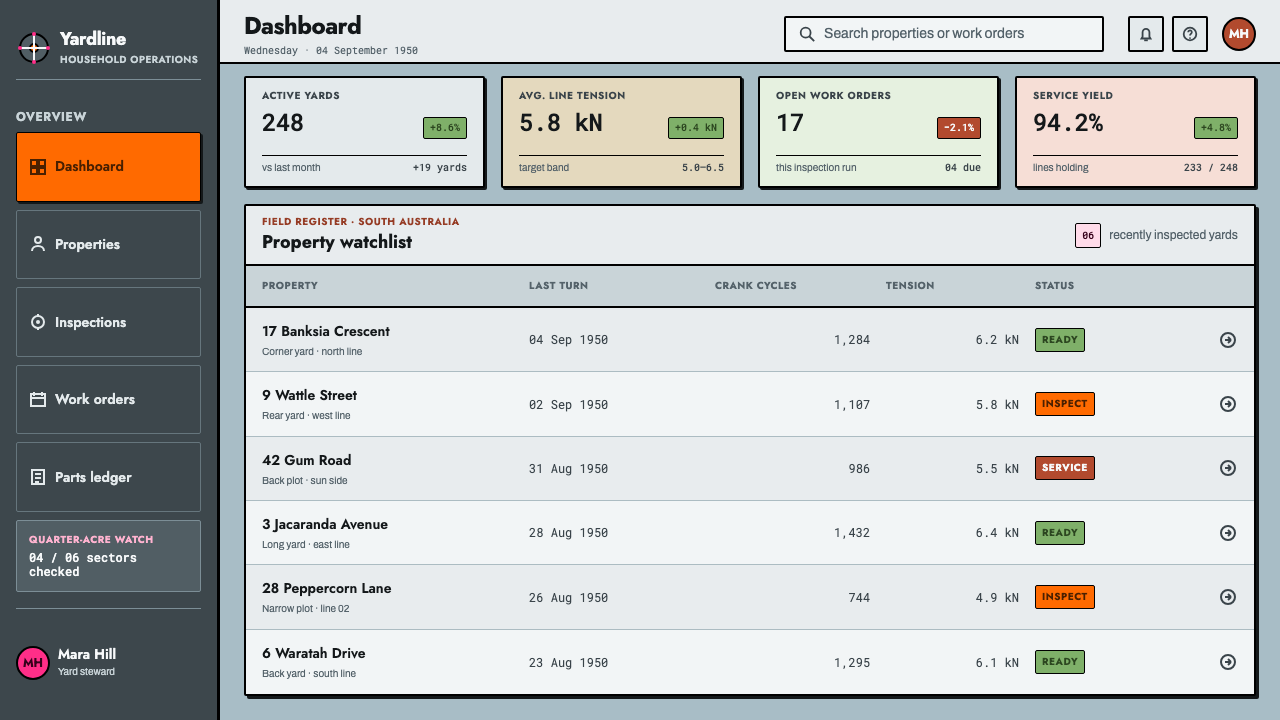
For presentation slides, give the cover a four-arm radial composition on a zinc-grey field, with the title set inside hard black outlines and one dayglo hit as the single point of attention. Content slides can use taut-line rules as dividers and keep the large empty areas that give the style its air. Data slides suit flat outlined bars and simple radial charts, with one dayglo highlight for the number that matters and everything else in grey and black.
For web interfaces, the style works well for dashboards and utility tools where calm is valuable. Surfaces are zinc grey, cards and inputs carry black outlines rather than shadows, and dayglo is reserved for the selected state, a primary action or an alert. Pricing pages can set plans as outlined panels, with a single dayglo hit marking the recommended one. A four-arm rotary loader is a natural signature element, and long lists can borrow the evenly spaced line runs as row dividers.
For editorial and marketing work, the style suits hardware and home brands, garden and household products, real-estate and suburban storytelling, design retrospectives and any identity that wants a humble, working-object charm. Illustrations should be flat, outlined and few. Let photography of real backyards sit against the grey ground, and let headlines carry the wit. The style is at its best when it looks as if it were made by someone who has actually hung out washing.
The common mistake is to treat dayglo as a fill. A page flooded with pink and orange stops being a hit and becomes a poster for something else. A second mistake is to polish the zinc into chrome, with gradients and glossy highlights that contradict the weathered, matte metal. A third is to fall into Australian cliché by adding kangaroos and flags; the object itself is the reference. A fourth is to crowd the page so that the empty ground, which carries the whole atmosphere, disappears.
Hills Hoist Suburbia — FAQ
What is a Hills Hoist?
A Hills Hoist is a rotary clothes hoist: a four-armed frame of galvanised steel tube on a central pole, strung with lines and cranked up and down to dry washing in a backyard. Lance Hill welded the first in his Adelaide backyard in 1945, building on the rotary clothesline idea in Gilbert Toyne's patent of 1911. Sixty-one years later the National Library named it a National Treasure. As a design source it offers a four-arm radial figure, weathered zinc, taut lines and a lot of open ground.
Why zinc grey instead of bright silver or chrome?
Because the hoist lives outdoors and ages. Galvanised steel starts bright and weathers to a soft, light blue-grey, with its hexagonal spangle still faintly visible. That worn colour is the honest one. Bright silver or chrome belongs to a different story of shiny new goods and invites gradients and highlights that this style avoids. Zinc grey is calm, slightly cool and matte, which is what lets the black outlines and the dayglo hits carry the energy.
How much dayglo is enough?
As a rule, one hit per view, two at most. Dayglo pink and orange are hits rather than fields: small, deliberate spots that direct attention to one thing. A practical test is whether you could cover them with a thumb. If a screen needs more emphasis than that, strengthen it with a black outline, a heavier rule or more empty space around the element, rather than adding more colour. The restraint is what keeps the colour shocking.
How do I handle the empty ground in a dense interface?
Treat emptiness as structure, not as waste. In a dense product, you can keep the working areas tight but leave deliberate quiet zones around key elements, in headers, margins, empty states and between groups. Use the evenly spaced taut-line rules to organise the dense areas so the eye can rest. The style does not require a sparse layout everywhere, only that the emptiness you do have is real and is not filled with decoration.
Can the style work on a dark background?
This theme is a light one, built on a weathered zinc ground. A dusk version is possible, with charcoal replacing the zinc grey, the black outlines becoming pale or light-grey lines, and dayglo hits glowing more strongly against the dark. The danger is that dayglo then becomes overpowering very quickly, so the discipline of hits matters even more. Keep the radial figure, the taut lines and the empty ground; they carry the style whichever way the colours are turned.
Related design styles
 Matchbox LabelPropaganda for the pocket. Flat orange-red-yellow spot inks on dark slate, co…
 Air Niugini Livery 1975A flag engineered for flight. Signal red sweeps across enamel white, underlin…
 Amtrak Arrow (1971)Civic authority at speed. Deep navy, Helvetica lockups, and red-blue arrows.
 Athos Bulcão Azulejo PanelCobalt grid, alive. Majolica white marks rotate across a broken navy tile fie…
 El Al Israel AirlinesNational blue takes command. White aircraft geometry cuts a flat jet-age post…
 Gulf Racing LiverySpeed made disciplined. Powder blue, orange stripe, black roundel, strict gri…