What is Australian Flying Doctor Radio?
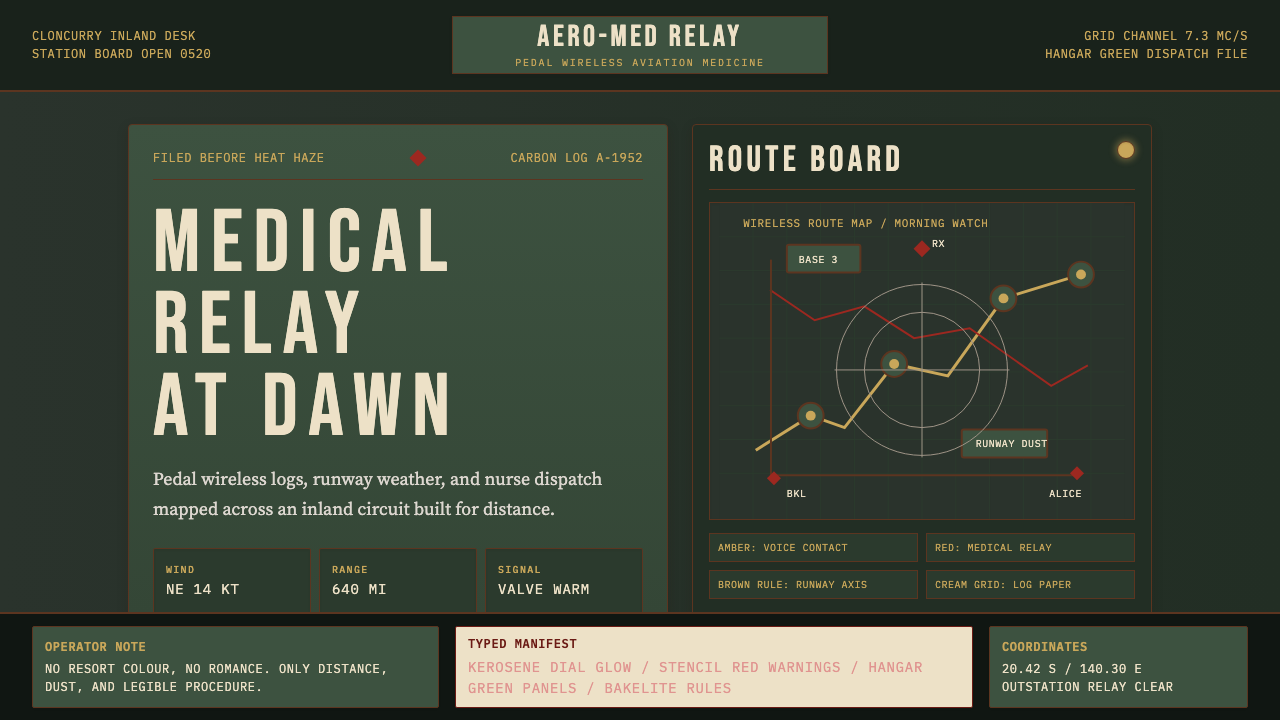
From a corrugated-iron shed in the Queensland outback, one pedal-powered wireless set and a fleet of biplanes forged a visual language as functional and uncompromising as the landscape it served.
Australian Flying Doctor Radio in brief
Australian Flying Doctor Radio is a design aesthetic rooted in the visual culture of the Royal Flying Doctor Service (RFDS) and the wider network of outback infrastructure that surrounded it from the late 1920s through the 1950s. It draws on the look of RAAF hangar buildings, pedal-powered Traeger wireless sets, typewritten dispatch logs, hand-stencilled signage, and the schematic diagrams pinned to plywood walls of remote station communication rooms.
The palette anchors itself in deep institutional greens — the painted steel of hangar walls and government-issue equipment cabinets — set against signal reds borrowed from stencilled warnings and emergency markings, with warm amber tones evoking the glow of bakelite instrument panels and kerosene lanterns. Background surfaces suggest the textured skin of aged corrugated iron, worn plywood, or yellowed paper. Everything reads as functional, slightly worn, and built for survival rather than display.
As a design system, it is deliberately dark and warm in character: high contrast for legibility across difficult reading conditions, typewriter-style letterforms for authenticity, and a compositional logic borrowed from technical schematics and operational manuals rather than from commercial print culture. It is one of the few historical aesthetics that manages to feel both institutional and deeply human.
Where does Australian Flying Doctor Radio come from?
The story begins with Reverend John Flynn, a Presbyterian minister who in 1912 began documenting the medical isolation of Australians living hundreds of kilometres from the nearest doctor. Flynn's reports to the Australian Inland Mission were stark: minor injuries became fatal infections; women gave birth without any medical support; accidents left men dying over days rather than hours simply for want of transport. His answer was the concept of a 'mantle of safety' — a network of aerial medical services that would collapse the tyranny of distance.
Flynn founded the Aerial Medical Service in 1928 at Cloncurry in western Queensland, operating a de Havilland DH.50 biplane. The service was revolutionary in concept but initially hobbled by one critical problem: there was no way for remote stations to communicate with the base. Correspondence by mail took weeks. The breakthrough came from Alfred 'Alf' Traeger, a radio engineer in Adelaide who in 1929 developed a pedal-powered wireless transceiver that could be operated without a generator or mains electricity. A person sitting at the device could pedal to generate enough current to transmit and receive morse code — and later voice — across several hundred kilometres of open country. By the mid-1930s, Traeger sets had been distributed to stations across the outback, transforming the service from a reactive ambulance into a genuine communications network. The Aerial Medical Service was renamed the Royal Flying Doctor Service in 1942.
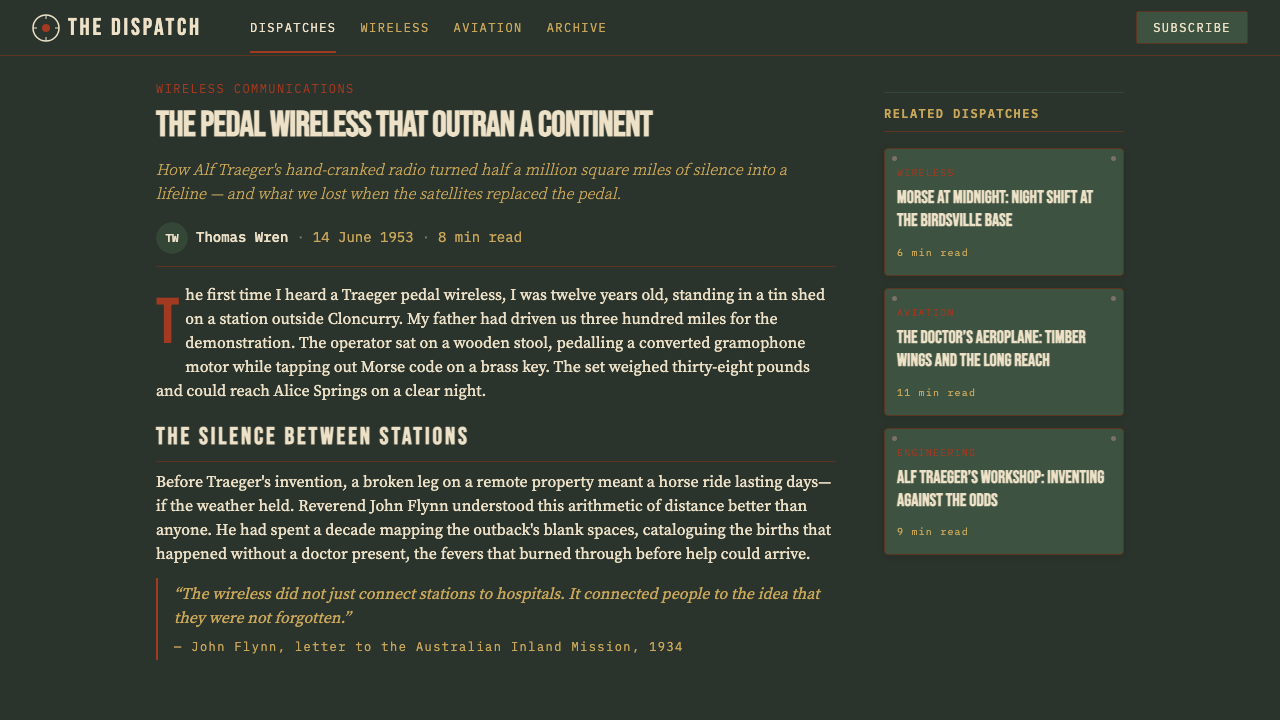
The visual culture of the RFDS and its outback setting developed organically from the materials at hand. Station buildings were corrugated iron on timber frames — cheap, portable, and brutally effective against heat. Equipment arrived in government-green painted metal cases, stencilled with part numbers and warning codes in bright red. Morse code transcripts and flight logs were typed on portable machines, the faint impressions of keys still visible on yellowed carbon copies. Maps and circuit diagrams were hand-drawn in ink or pencil and pinned directly to walls. The Traeger set itself — with its bakelite casing, amber indicator lights, and hand-stamped metal identification plates — became a totemic object, the physical embodiment of connection in an isolating landscape.
By the 1950s, the RFDS had expanded to cover nearly the entire Australian outback, with bases in every state and territory. The visual infrastructure of the service — its signage, logbooks, equipment, and architecture — had coalesced into a coherent aesthetic that was entirely unintentional: it looked the way it did because those materials, under those conditions, served those purposes. Hudson Fysh, co-founder of Qantas and a close associate of Flynn, helped establish the aviation and radio culture of the interior; Fred McKay, Flynn's successor as head of the Australian Inland Mission, sustained the pastoral and spiritual dimension of the network through decades of expansion. The aesthetic they left behind is a record of practical problem-solving in one of the world's most demanding environments.
What defines the Australian Flying Doctor Radio look?
Color Palette
The palette centers on a deep institutional green — the colour of painted hangar walls, government-issue metal cabinets, and RAAF field equipment — used as the dominant background tone. Against this ground, signal red appears with clarity and urgency, drawn from hand-stencilled warning markings and emergency indicators. Warm amber provides the third anchor, evoking bakelite instrument panels, indicator bulbs, and kerosene lanterns. Off-whites and aged cream tones reference typewritten paper and worn canvas. The overall effect is dark, warm, and purposeful — the palette of a place where light is rationed and every mark must count.
Typography
Letterforms echo the typewriter — monospaced, slightly uneven, with the characteristic ink pressure variations of mechanical key strikes. Stencil-cut letters appear for headings and signage: thick strokes, rounded terminals, and the deliberate bridges that prevent the stencil template from falling apart. All-capitals settings reinforce the operational and military register. There is no decorative lettering and no serif refinement; legibility at a glance, even in poor light or under operational stress, governs every typographic decision.
Surface and Texture
Surfaces carry the memory of material. Backgrounds suggest the corrugated profile of galvanised iron, the grain of rough-sawn plywood, or the fibrous weave of aged paper — rendered as subtle tonal variation rather than photographic replication. Equipment faces show the micro-scratches of field use. This textural layer distinguishes the aesthetic from purely diagrammatic approaches: it places every element inside a physical environment with a past, giving the whole system the feeling of something used and trusted rather than merely designed.
Schematic Logic
Information is organized along the visual grammar of technical schematics and operational charts: horizontal rule dividers, grid-aligned blocks, labelled signal lines, and annotated data fields. Charts and data presentations borrow the aesthetic of hand-drawn circuit diagrams — clean lines with deliberate angles, nodes marked with small circles or crosses, routing paths that avoid decoration and emphasize flow. This schematic logic gives the system an internal coherence that feels earned rather than imposed.
Operational Restraint
Nothing is ornamental. Every visual element — a border, a dividing line, a background tone — exists because it performs a function: separating information zones, directing the eye, signalling urgency, or establishing hierarchy. The aesthetic borrows this discipline directly from the operational environments it depicts: in a remote radio room with limited supplies and no graphic design tradition, every mark had to earn its place. Applied to contemporary design, this translates to a high signal-to-noise ratio and a strong resistance to decorative inflation.
Dark Ground Logic
The system is built for dark grounds, which is unusual among historical aesthetics. The dominant green and the warm dark background tones mean that light elements — amber glows, white type, red signals — sit as figures against a deep field. This inversion of typical print conventions suits the nighttime and low-light conditions of outback operation, and in contemporary applications it produces interfaces that feel immersive, focused, and authoritative rather than clinical or cold.
Amber Warmth
Amber is the emotional counterweight to the system's institutional severity. Where green and red carry authority and urgency, amber introduces human warmth: the lit dial of a receiver in an otherwise dark room, the glow of a lamp on a typewritten page, the readiness signal on a transmitter. In use, amber functions as a highlight colour for interactive states, focus indicators, or moments where the system needs to communicate readiness or attention without alarm. Its warmth prevents the overall palette from reading as purely cold or governmental.
Who shaped Australian Flying Doctor Radio?
Flynn founded the Aerial Medical Service in 1928 after more than a decade of documenting the medical isolation of outback Australia through his work with the Australian Inland Mission. His vision of a 'mantle of safety' — an integrated network of aerial medicine, radio communication, and pastoral care — was as much a design brief as a humanitarian mission. The systems and visual conventions of the RFDS flow directly from his insistence that the service be genuinely usable by the people it served, which meant prioritising clarity, reliability, and physical robustness over any aesthetic consideration.
Traeger was the engineer who made the RFDS communications network possible. His 1929 pedal-powered wireless transceiver — developed in close collaboration with Flynn — resolved the fundamental problem of generating electricity in locations without power infrastructure. The Traeger set's design, with its bakelite casing, hand-stamped metal plates, amber indicator lights, and robust mechanical construction, became the visual anchor of the entire aesthetic. Traeger continued refining his transceivers for decades, eventually introducing voice transmission to replace Morse code and developing simplified keyboard systems that allowed non-specialists to operate the equipment.
Fysh was the co-founder of Qantas and a key figure in establishing the aviation and radio culture of inland Australia. His work in the early days of Australian aviation — operating across the same vast distances and under the same harsh conditions as the RFDS — contributed to the shared visual and operational vocabulary of outback aviation infrastructure. The functional severity of early Qantas operations, its logbooks, hangar signage, and ground equipment, overlaps substantially with the RFDS aesthetic and reflects the broader culture of pragmatic, resource-constrained aviation that defined the Australian interior in the interwar period.
McKay succeeded John Flynn as superintendent of the Australian Inland Mission in 1951 and led the organisation through a period of significant expansion in both the radio network and the medical service. Under McKay, the School of the Air — which used RFDS radio infrastructure to deliver education to remote children — was formalised and extended, deepening the integration of radio communication into outback life. His stewardship of the network through the 1950s and 1960s consolidated the visual and operational culture of the RFDS into the form that is now recognised as characteristic.
How do you use Australian Flying Doctor Radio today?
Australian Flying Doctor Radio translates into contemporary design most naturally through dark-ground interfaces and presentation contexts where authority, clarity, and a sense of purposeful history are valued. The aesthetic carries inherent trust signals — it looks like something that has been tested against real conditions — which makes it well-suited to contexts where credibility and reliability are the primary messages.
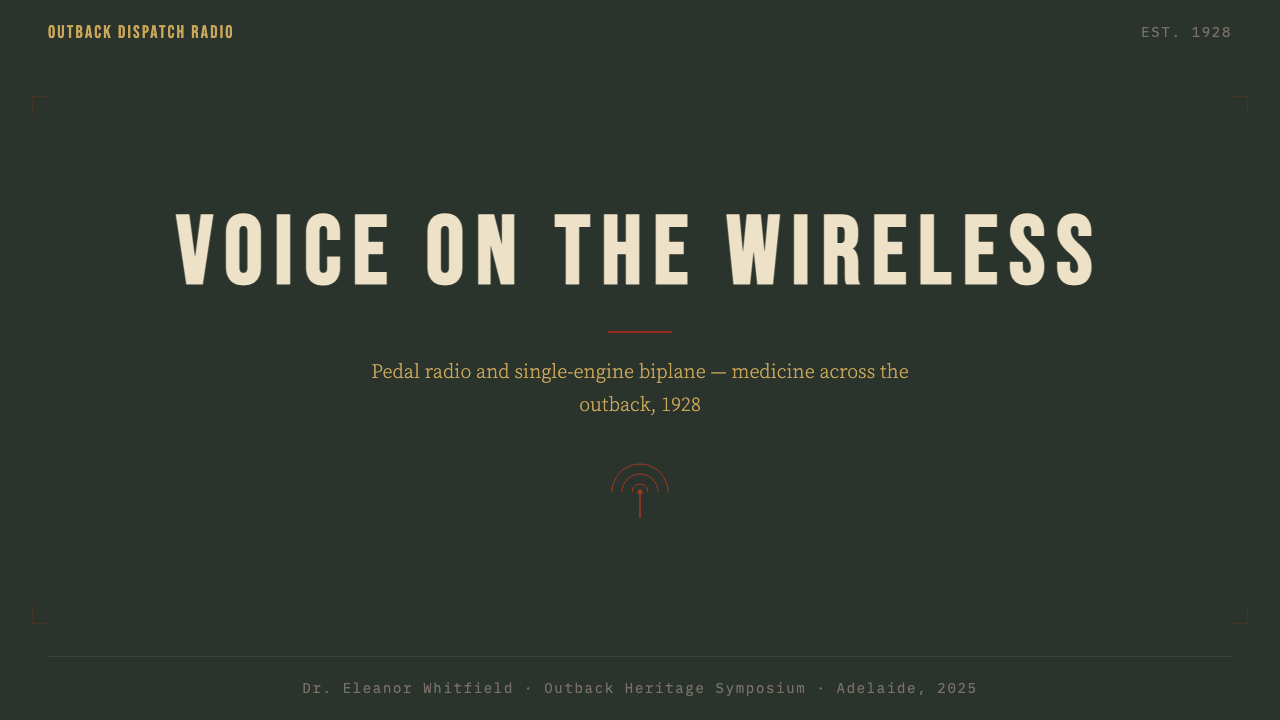
For presentation slides, the style suits cover pages with a boldly anchored composition: a large schematic-style element in amber or red positioned against the deep green or near-black background, with stencil-weight headline type in cream or white. Content slides should follow the operational logic of the dispatch log: clear horizontal zone divisions, typewriter-register body text, and data presented in simple ruled tables rather than decorative chart containers. Data visualisations work as schematic diagrams — signal lines, annotated nodes, and sparse grid overlays — rather than as softly rendered infographics.
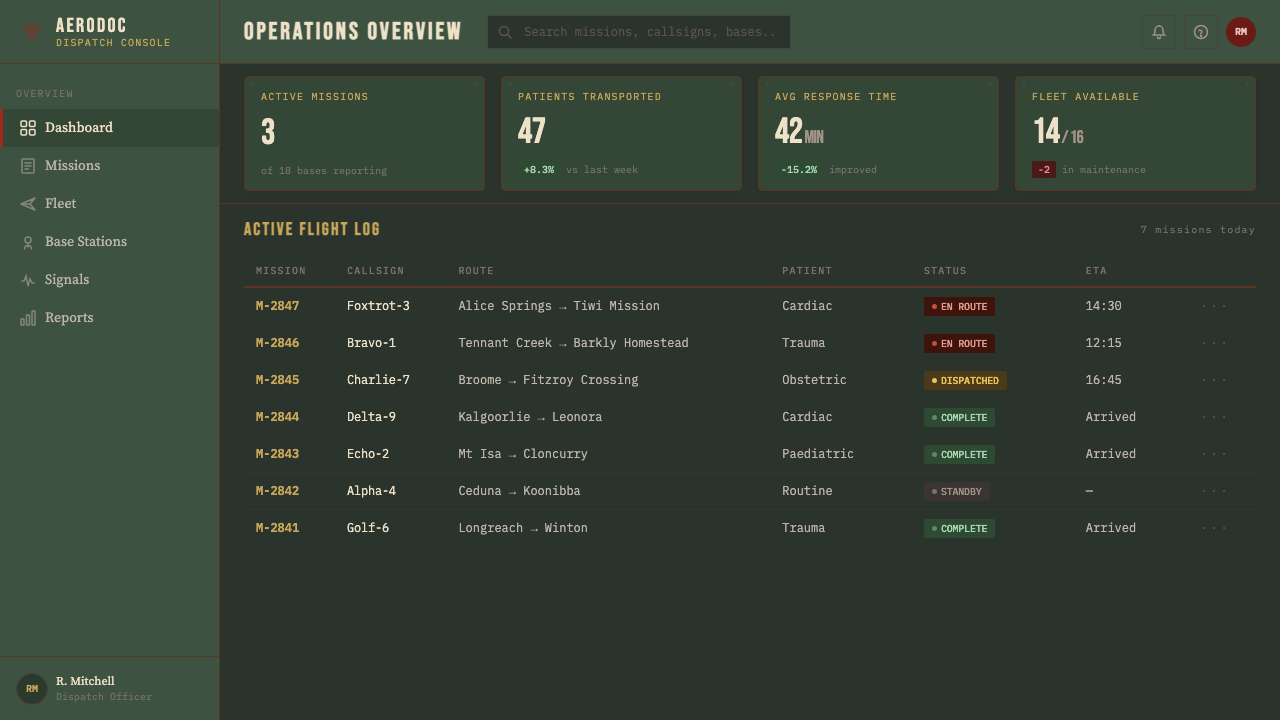
For web interfaces and dashboards, the aesthetic is most powerful when the dark ground is used consistently and the amber highlight is reserved for active states, focus rings, and primary calls to action. A navigation structure borrowed from a radio dial or frequency selector — indexed, sequential, and labelled with operational precision — creates a coherent metaphor. Sidebar panels can carry the corrugated texture as a background pattern. Tables and data grids benefit from the schematic grid logic: narrow rule lines, monospaced figures, and a clear hierarchy between header rows and data rows established purely through weight and colour rather than through decorative treatment.
For editorial and marketing work, the style's poster-like contrast — deep green fields broken by red and amber signals — translates well to full-width feature sections and documentary-tone photography treatments. Long-form text benefits from a generous measure with typewriter-style line spacing and section breaks marked by a single horizontal rule in the signal red, rather than by any decorative element. Marketing pages can use the amber glow motif — a warm circle of light against the dark ground — as a focal point for hero sections, creating a campfire-like warmth that makes the severity of the overall palette emotionally accessible.
A common mistake when applying this aesthetic is treating the textural elements as decoration rather than as structural character. Layering corrugated iron textures on top of a design that has not committed to the palette and compositional logic produces pastiche rather than coherence. The system works when the deep green, signal red, and amber are adopted as a genuine hierarchy — background, accent, and warmth — and when every element, including texture, exists because it contributes to readability or emotional register. Equally, over-saturating the signal red or amber turns urgency into noise; the power of each colour depends on its restraint elsewhere in the composition.
Australian Flying Doctor Radio — FAQ
Is this aesthetic only appropriate for dark-mode interfaces?
The style was born from a dark-ground environment — hangar interiors, instrument panels lit from behind, kerosene-lit station rooms — so it reads most naturally and most authentically in dark-ground applications. A light-ground adaptation is possible: the deep greens become muted sage or khaki, the signal red holds its role, and amber warms a cream or off-white background. This works better for print and long-form editorial contexts than for screen interfaces. The critical constraint is maintaining the high contrast between background and figure elements; reducing the contrast in the name of lightness loses the aesthetic's essential character.
How does this style differ from general military or industrial aesthetics?
The RFDS aesthetic shares DNA with military and industrial visual cultures — the institutional green, the stencil type, the schematic logic — but its emotional register is distinctly different. Military aesthetics emphasise power and threat suppression; industrial aesthetics emphasise scale and efficiency. The Flying Doctor aesthetic carries a humanitarian urgency: it is built around the idea of reaching people in crisis across impossible distances. The amber warmth and the human scale of the Traeger set — something operable by a farmer or a nurse with no technical training — give the system a warmth and approachability that purely military or industrial aesthetics lack. It is rigorous but never cold.
Can the typewriter letterform register work in digital interfaces without looking retro?
It can, but it requires careful scoping. Typewriter-register letterforms — monospaced, slightly imperfect in weight distribution — work well for data fields, log-style readouts, timestamps, and any content that is operational or informational in character. They struggle in body copy at reading length, where the monospaced rhythm creates fatigue over extended text. The practical approach is to use a typewriter-register typeface for display and data elements, and a clean sans-serif in the same weight range for body text. This preserves the aesthetic character without imposing the reading cost across the full interface.
What kinds of products or brands would this style suit most naturally?
The style suits products and organisations where reliability, reach, and a sense of earned authority are core values: emergency communications tools, remote operations platforms, logistics and field-work software, documentary and investigative journalism brands, hardware products designed for outdoor or demanding environments, and organisations with a genuine history of operating in difficult conditions. It is less suited to consumer lifestyle brands, social platforms, or any context where playfulness and approachability are primary values. The style's strength is its specificity: it says something definite about what an organisation values and how it operates, which is only an asset when those implied values align with the product's actual positioning.
How should the corrugated iron texture be used without becoming decorative noise?
The texture should function as a material signal, not a pattern. It belongs on surfaces that are structurally equivalent to walls or enclosures in the original environment: background panels, sidebar containers, modal backdrops, and card surfaces where the content sits 'inside' a space. It should not appear on interactive elements, type, or any surface where it would compete with content for visual attention. The tonal contrast between the texture and the content layer must remain clearly legible — if the texture can be mistaken for content or creates visual vibration behind text, it has overstepped its structural role and become decoration.
Related design styles
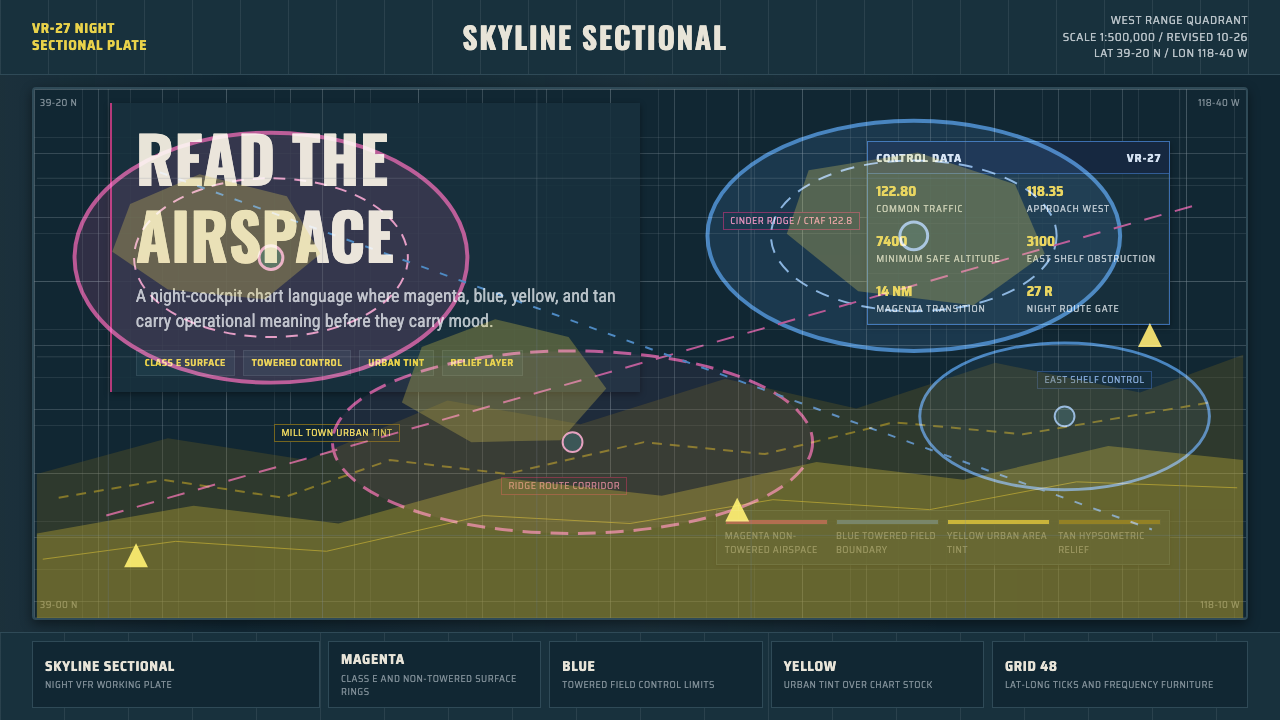 Aeronautical ChartReads like cockpit data. Magenta-blue airspace rings cut through dense dark-c…
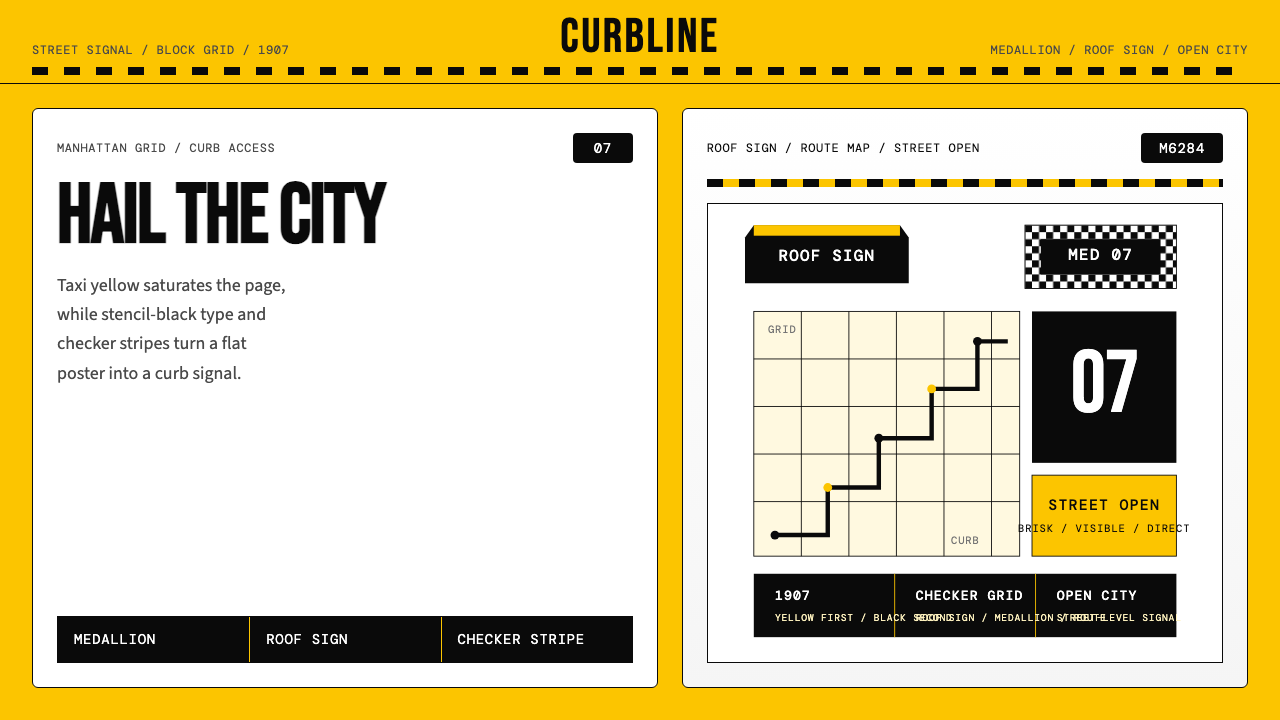 New York Yellow Cab (1907)Visibility is the brand. Taxi yellow, stencil type, checker stripes.
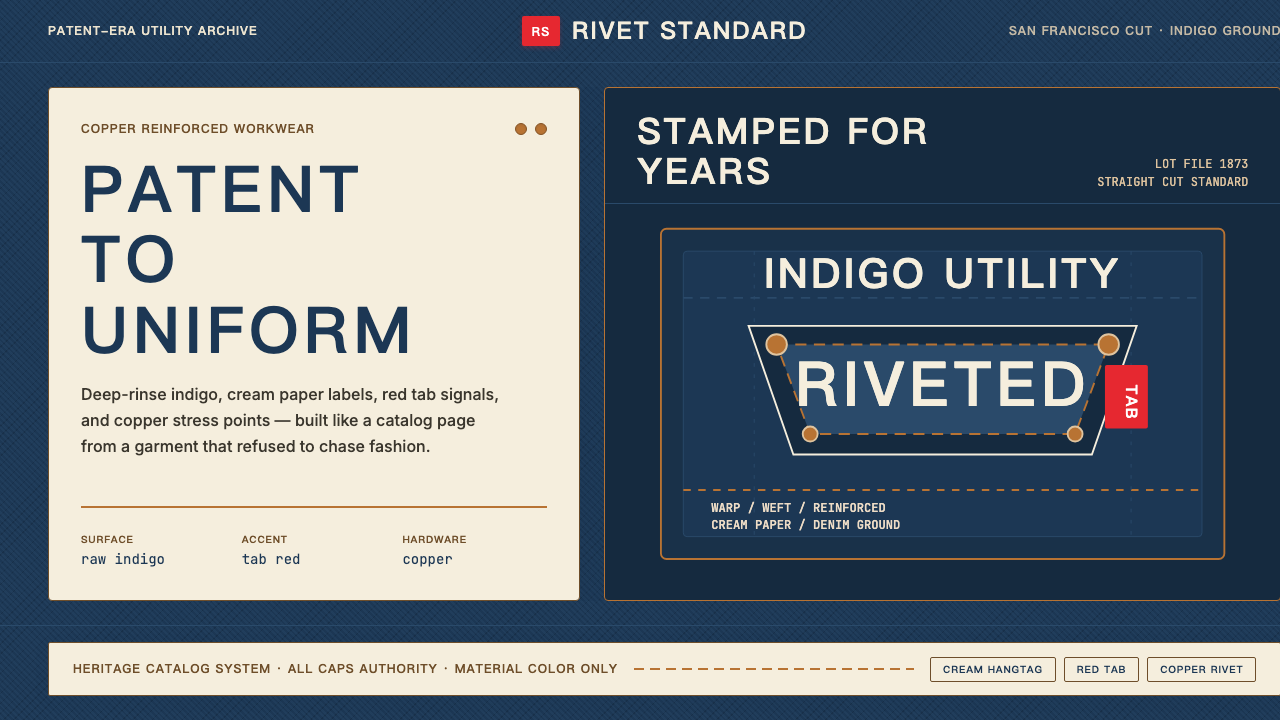 Levi's 501Utility becomes permanent. Indigo ground, cream hangtag panels, red tab and c…
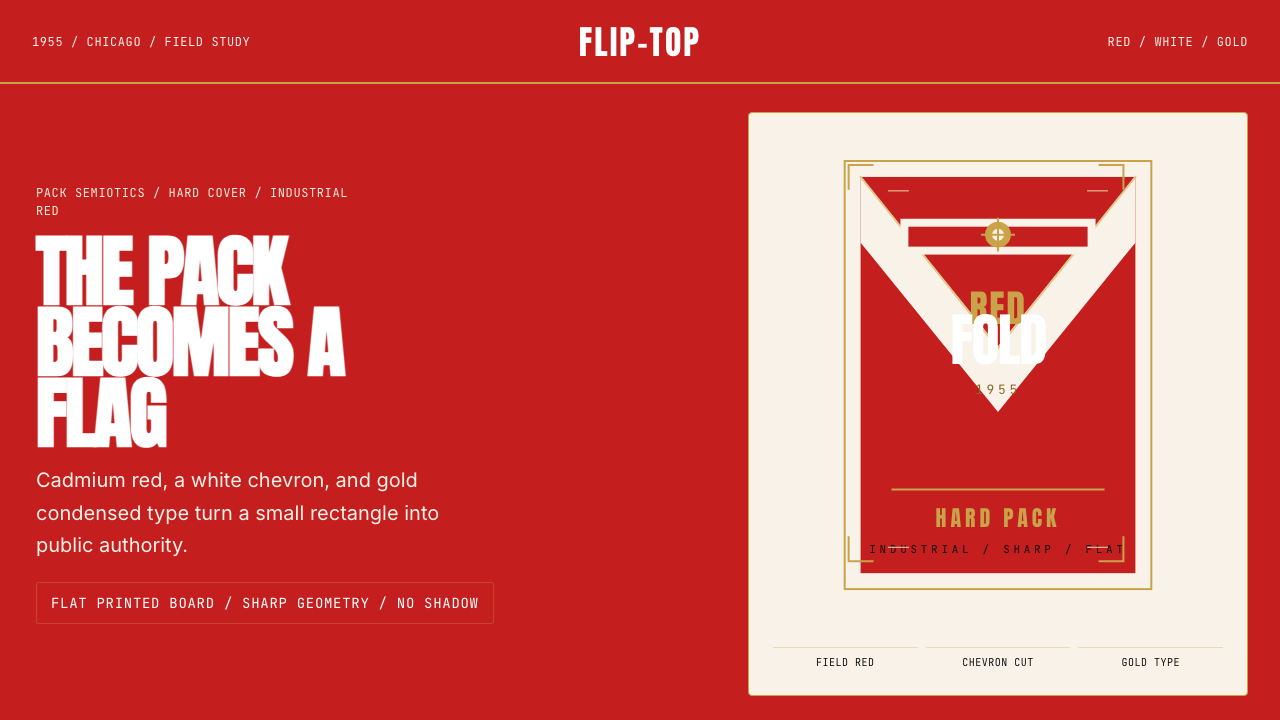 Marlboro Red Flip-Top (1955)Authority in one fold. Cadmium red, white chevron, and gold type read like a…
 Tour de France (Yellow Jersey)Yellow owns the finish. Bungee type, polka dots, and navy tickers snap to an…
 Aeroflot Soviet AirlineEngineered restraint rules. Silver ground, royal-blue cheatlines, and flat gr…