What is Apple Liquid Glass 2024?
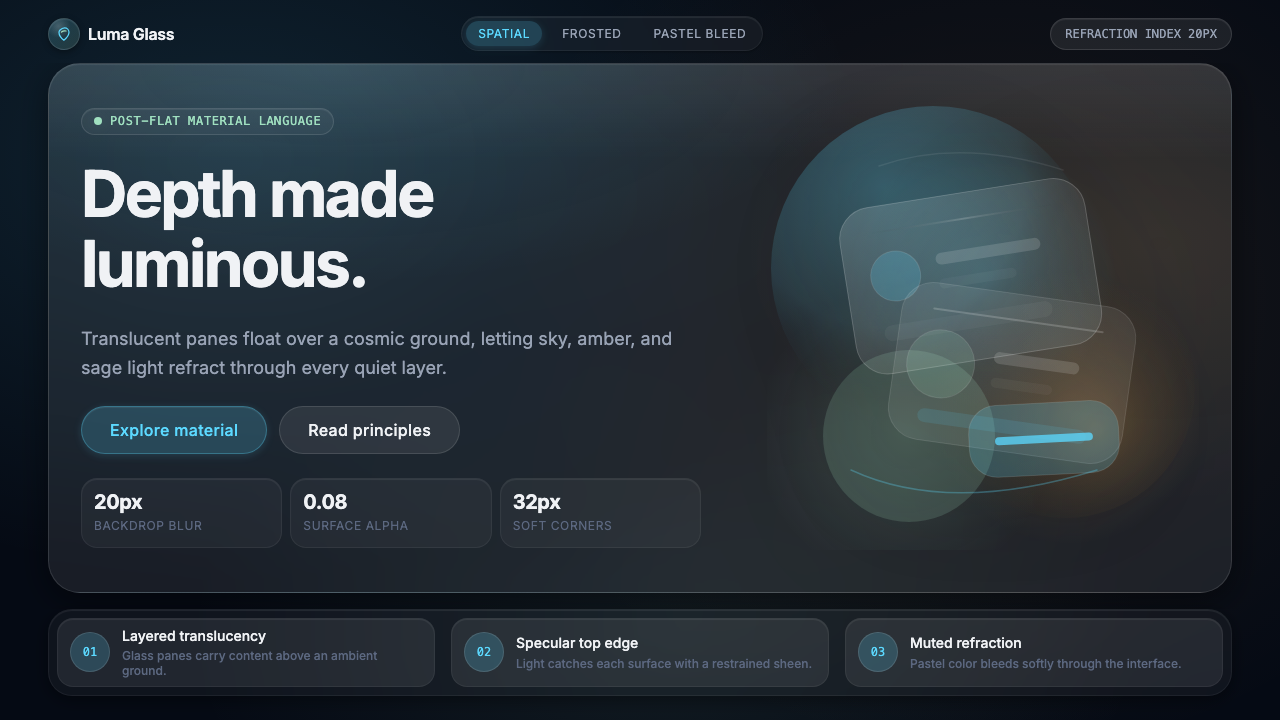
After a decade of flat design, Apple's Liquid Glass gives depth back its design rights — translucent panels that breathe, shift, and glow as if cut from living crystal.
Apple Liquid Glass 2024 in brief
Apple Liquid Glass is the visual design language Apple introduced alongside visionOS and the Apple Vision Pro, first announced in 2023 and shipping in February 2024. At its core, it is a system of translucent, layered surfaces — panels that appear to be made from frosted or polished glass, floating at distinct depths in three-dimensional space. Unlike flat design, which treats the screen as a single plane, Liquid Glass treats the screen as a volume: surfaces stack, light passes through them, and the world behind each panel shimmers and blurs in ways that communicate hierarchy without requiring hard borders or heavy drop shadows.
The aesthetic draws on several convergent influences: Apple's own heritage of translucent and material surfaces stretching back to the candy-gloss Aqua interface of Mac OS X; the glassmorphism trend that swept digital design in the early 2020s; and the visual grammar of cinematic science-fiction interfaces, where floating holographic panels suggest technology that has transcended the physical page. What distinguishes Liquid Glass from generic glassmorphism is its precision and restraint — the backdrop blur is calibrated, the specular highlights move with perspective in a physically plausible way, and the tinting draws from the surrounding environment rather than from a fixed palette.
The result is a design vocabulary where surface itself carries meaning. A panel that lets background content show through is signaling its secondary role; a panel that catches a bright specular highlight is announcing a focal point. Depth is not decoration — it is structure. This makes Liquid Glass one of the first mainstream digital design languages to treat the third dimension as a first-class organizational tool rather than a cosmetic flourish applied on top of a flat layout.

Where does Apple Liquid Glass 2024 come from?
The seeds of Liquid Glass were planted long before visionOS. The original Mac OS X Aqua interface, unveiled by Steve Jobs in 2000, introduced digital surfaces that mimicked polished candy and gel — buttons that appeared to have volume, toolbars with visible reflections, a dock that turned surfaces into mirrors. This was unapologetically skeuomorphic: the screen imitated physical materials because that imitation helped users orient themselves in a new paradigm. For over a decade, increasing craft and realism defined Apple's design language.
iOS 7 in 2013 reversed that trajectory. Under the design leadership that followed the departure of Scott Forstall, Apple stripped its interfaces back to flat, light, and typographically spare. Color became the organizing tool; depth and material simulation were treated as visual noise. For ten years, this paradigm held across iOS, macOS, and watchOS. The frosted glass effect survived in limited form — Notification Center panels, Control Center overlays, the macOS menu bar — but it was a footnote, not a philosophy.
The spatial computing project that became Apple Vision Pro changed the equation fundamentally. A headset worn in the real world cannot use opaque colored panels without occluding the user's physical environment. Surfaces need to be transparent or translucent so that the wearer can still perceive the room around them. This was not purely an aesthetic preference — it was an ergonomic and safety requirement. From that constraint, a new material logic emerged: glass became the default surface not because it looked premium, but because it was the only honest material for a device that sits between the user and the world.
The Human Interface team at Apple, led by Alan Dye, developed the Liquid Glass system through visionOS 1.0, refining the physics of how virtual surfaces catch light, how they tint based on the content behind them, and how specular highlights shift as the user's head moves. The language draws explicitly on architectural glass — the way a glass facade on a modern building reads differently at morning versus dusk, reflecting the sky while letting interior light leak through. By the time visionOS shipped publicly in February 2024, Liquid Glass had been polished into a coherent design system with its own rules for layering, tinting, blur radius, and the treatment of content that falls behind a translucent surface.
What defines the Apple Liquid Glass 2024 look?
Translucent Surface
The defining material of Liquid Glass is a surface that is neither fully opaque nor fully transparent. It reads as frosted or polished glass — content behind it is visible but softened, the way a face is readable through a pebbled shower screen. The degree of translucency is not uniform across a design; it varies by layer and by the semantic role of each panel. A primary content surface is closer to opaque; a supplemental overlay is closer to transparent. This gradient of opacity communicates hierarchy without requiring color-coded borders.
Backdrop Blur
Every Liquid Glass panel blurs the content behind it in a manner calibrated to the panel's position in the layer stack. The blur is not applied uniformly — it respects the luminance and saturation of what lies beneath, brightening slightly against dark backgrounds and tinting faintly against vivid ones. The effect is that each panel feels physically real: you instinctively understand that something is behind it and at a different depth, the way you understand there is a street behind a rain-streaked window.
Specular Highlights
The most distinctive signature of Liquid Glass is the specular highlight — a bright, narrow band of reflected light that appears along one or two edges of a panel, as if catching light from a distant source. Unlike the gradient-style inner glow of skeuomorphic design, Liquid Glass highlights are physically motivated: they shift in position and intensity as the user's viewing angle changes, using the device's motion sensors and eye-tracking to update the reflection in real time. This makes each surface feel alive and responsive rather than painted.
Environmental Tinting
Liquid Glass panels are not neutral in color — they tint subtly based on the content they sit above or the environment the device is operating in. A panel floating over a warm sunset photograph picks up a trace of amber; one sitting above a blue gradient acquires a cool undertone. This environmental tinting is gentle enough that it does not overwhelm the panel's readability, but strong enough that the interface feels organically connected to its context rather than pasted on top of it.
Depth Layering
The Liquid Glass system articulates space through explicit depth layers rather than through color contrast or border weight. Primary content panels sit closest to the viewer; contextual overlays recede; background surfaces anchor the scene. Each layer has a consistent visual treatment — degree of blur, intensity of highlight, thickness of tinting — so that viewers learn to read depth intuitively after brief exposure. This layering system replaces the two-dimensional hierarchy of flat design with a three-dimensional hierarchy that matches the intuitions we carry from the physical world.
Restrained Color
Despite the richness of its material effects, Liquid Glass uses color with considerable restraint. The glass surfaces themselves are largely achromatic — their tinting is borrowed from context rather than asserted from a fixed palette. Intentional color is reserved for interactive elements, status indicators, and brand accents, and even there it tends toward muted pastels rather than saturated primaries. The overall effect is that color feels earned and meaningful rather than decorative, because the glass material handles ambient warmth and coolness while discrete color marks deliberate intent.
Motion and Physics
Liquid Glass is inseparable from animation. Panels enter and exit with a spring-physics quality — they do not simply appear or fade, they seem to settle into place as if they have mass and momentum. When a panel is dismissed, it collapses inward with the compliance of real glass retracting rather than a flat shape scaling to zero. Transitions between states respect the direction of spatial depth: a new panel emerges from behind, a dismissed one retreats into the layer beneath. Motion is not decorative in this system — it communicates the logic of the spatial model.

Who shaped Apple Liquid Glass 2024?
Alan Dye has served as Apple's Vice President of Human Interface Design since 2014, overseeing the design evolution from iOS 7's flat language through the material refinements of subsequent years and ultimately to the Liquid Glass system for visionOS. His team's challenge with Liquid Glass was unlike any previous Apple design project: the constraints of a spatial operating system demanded that the entire visual grammar be reconceived around the properties of transparent and semi-transparent surfaces, motion-responsive highlights, and the relationship between digital panels and the physical room behind them. Dye's fingerprints are most visible in the discipline of the system — the way Liquid Glass achieves optical richness while maintaining the legibility that has always defined Apple's approach to interface design.
The Apple Human Interface Team is the design organization responsible for the visual and interaction languages of all Apple operating systems. For Liquid Glass, the team's work extended beyond visual specifications into physics simulation — defining how virtual glass surfaces should catch and reflect light, how they should respond to the user's head position via the Vision Pro's sensors, and how they should tint based on the environment. The team also solved the challenge of making Liquid Glass accessible: a surface that communicates through translucency rather than solid color required rethinking contrast and legibility standards for users with visual impairments.
Though Jony Ive left Apple in 2019, four years before the Vision Pro announcement, his design philosophy casts a long shadow over Liquid Glass. During his tenure, Ive was responsible for both the skeuomorphic peak of early iOS and the flat revolution of iOS 7 — he presided over both poles of the design pendulum that Liquid Glass now swings between. His insistence on materials that are honest to their nature and his attention to how light interacts with physical objects provide the philosophical and aesthetic DNA that Liquid Glass inherits. The way Liquid Glass panels catch light is, in a meaningful sense, a digital expression of the same sensibility that chose aluminum and glass for the iPhone's physical body.
The visionOS platform engineering team worked in close collaboration with the Human Interface designers to translate Liquid Glass from a visual concept into a technical reality. The system's most distinctive behaviors — perspective-correct specular highlights that update at display refresh rates, blur effects that adapt to the luminance of content below, panels that tint from environmental light — required novel rendering solutions. The platform team's work established the foundational APIs and rendering primitives that allow third-party developers to build applications that feel native to the Liquid Glass environment, rather than flat windows awkwardly imported into spatial space.
How do you use Apple Liquid Glass 2024 today?
Liquid Glass is most natural when applied to design work that lives in layered, depth-rich contexts — spatial interfaces, floating overlay panels, hero sections with vivid background imagery, and any situation where the viewer needs to parse multiple information layers simultaneously. The key principle is that glass surfaces earn their translucency: a panel should be transparent because the content beneath is relevant context, not as mere aesthetic texture. When every surface in a design is translucent, the depth hierarchy collapses and the visual system loses its organizing power.
For presentation slides, Liquid Glass works particularly well on cover and transition pages where a single bold image or gradient serves as the backdrop. A frosted panel carrying the title floats above the background, catching a thin specular highlight along its upper edge and letting the image show through with just enough blur to ensure legibility. Content slides should resist the urge to glass every element — instead, reserve the translucent panel treatment for callouts, data annotations, and supplemental information that genuinely sits above the primary layer. Data slides benefit from the depth system: a primary chart occupies the foreground surface while axis labels and annotations appear on a slightly recessed, lighter glass layer behind it.
For web interface design — dashboards, pricing pages, product carousels — Liquid Glass introduces a hierarchy that color alone cannot achieve. A navigation bar that blurs the page content behind it communicates its permanent, top-layer status without requiring a heavy solid background. Card components with a light frosted treatment distinguish themselves from the page surface without needing hard drop shadows. Modal dialogs and drawer panels gain their overlay meaning from translucency rather than from dimming overlays. The system works best when backgrounds are rich — vivid gradients, high-quality photography, or dense data visualizations — because the glass has something interesting to refract.
In editorial and marketing contexts, Liquid Glass is well-suited to hero sections and feature callouts where depth and dimensionality signal premium quality. A marketing page might use a full-bleed video or animated gradient as its backdrop, with product descriptions and calls to action carried on floating glass panels that shift in blur and highlight as the user scrolls. The style also translates effectively to social card design and digital out-of-home: a vibrant background paired with a luminous frosted text panel reads immediately as a contemporary, high-production aesthetic.
The most common mistake when applying Liquid Glass is treating it as a filter — simply adding blur and transparency to every surface regardless of whether depth is doing any organizational work. The result is a design that looks foggy rather than layered, where nothing reads as having a clear depth position. A related mistake is neglecting the specular highlight: without that thin bright edge catching light on one or two sides of a panel, a blurred transparent rectangle is just a tinted box with reduced contrast, not a glass surface. Liquid Glass requires committing to the full material logic — blur, tint, highlight, and physics-aware motion — or it reads as an incomplete gesture rather than a coherent design language.

Apple Liquid Glass 2024 — FAQ
Is Liquid Glass the same as glassmorphism?
They share a common vocabulary — both use translucency, backdrop blur, and light-colored strokes on panel edges — but Liquid Glass is more precisely specified and physically motivated. Glassmorphism as a trend was largely decorative: blur and transparency applied as aesthetic choices with arbitrary settings. Liquid Glass adds perspective-correct specular highlights that update with viewing angle, environmental tinting derived from real content rather than fixed palette choices, and a physics layer governing how panels enter, exit, and transition through space. Think of glassmorphism as the visual approximation and Liquid Glass as the fully engineered material system beneath it.
Can Liquid Glass work in contexts without spatial computing hardware?
Yes, and it already does. Apple began bringing Liquid Glass principles into iOS and macOS in the years following visionOS's launch, applying the translucent surface treatment to elements like the Dynamic Island, Control Center panels, and widget overlays. On a flat screen, the perspective-shifting specular highlight is approximated through static positioning rather than real-time sensor input, and the environmental tinting responds to on-screen content rather than the physical room. The system loses some of its interactivity but retains its organizational logic — depth through translucency continues to work as a hierarchy signal regardless of the display technology.
How should text be handled on a Liquid Glass surface to ensure readability?
Text on glass presents a genuine legibility challenge because the background content behind the panel is variable and sometimes high-contrast. Liquid Glass addresses this through a combination of approaches: the blur beneath the panel removes high-frequency detail that would compete with letterforms; the slight brightening or darkening of the glass surface relative to its backdrop adds a contrast buffer; and for critical text — primary labels, call-to-action copy, data values — a secondary shadow or a very slight matte treatment behind the text block is permissible. Where Liquid Glass designs fail on legibility, it is usually because the blur radius is insufficient or the panel's opacity has been reduced too aggressively in pursuit of visual transparency.
Is Liquid Glass appropriate for products that are not made by or for Apple?
The design language is not proprietary in its visual principles — translucency, depth layering, specular highlights, and environmental tinting are available to any designer working in any medium. What belongs specifically to Apple is the implementation in visionOS and the associated APIs. Designers working outside Apple's ecosystem can apply Liquid Glass principles effectively, but they should be aware that the style carries strong Apple brand associations in its most literal application. The further a design moves from the direct visual conventions — combining the glass material with different typographic choices, different motion curves, or different compositional approaches — the more the style becomes a starting point for a distinct language rather than a direct translation of Apple's.
How does Liquid Glass handle dark mode or low-light environments?
Liquid Glass adapts to dark environments by deepening the glass tint rather than inverting it. In a dark context, panels do not flip to white-on-dark in the conventional sense; instead, the glass becomes darker and more reflective, leaning into its mirror-like qualities. Specular highlights become more prominent against a dark background because the contrast ratio between the bright edge and the surrounding dark glass is higher. Environmental tinting also shifts — where a light-mode panel might pick up warm amber from a background, the dark-mode equivalent might pick up a cooler, more luminous version of the same hue. The consistency of the material logic across light and dark modes is one of the more technically demanding aspects of implementing the system correctly.
Related design styles
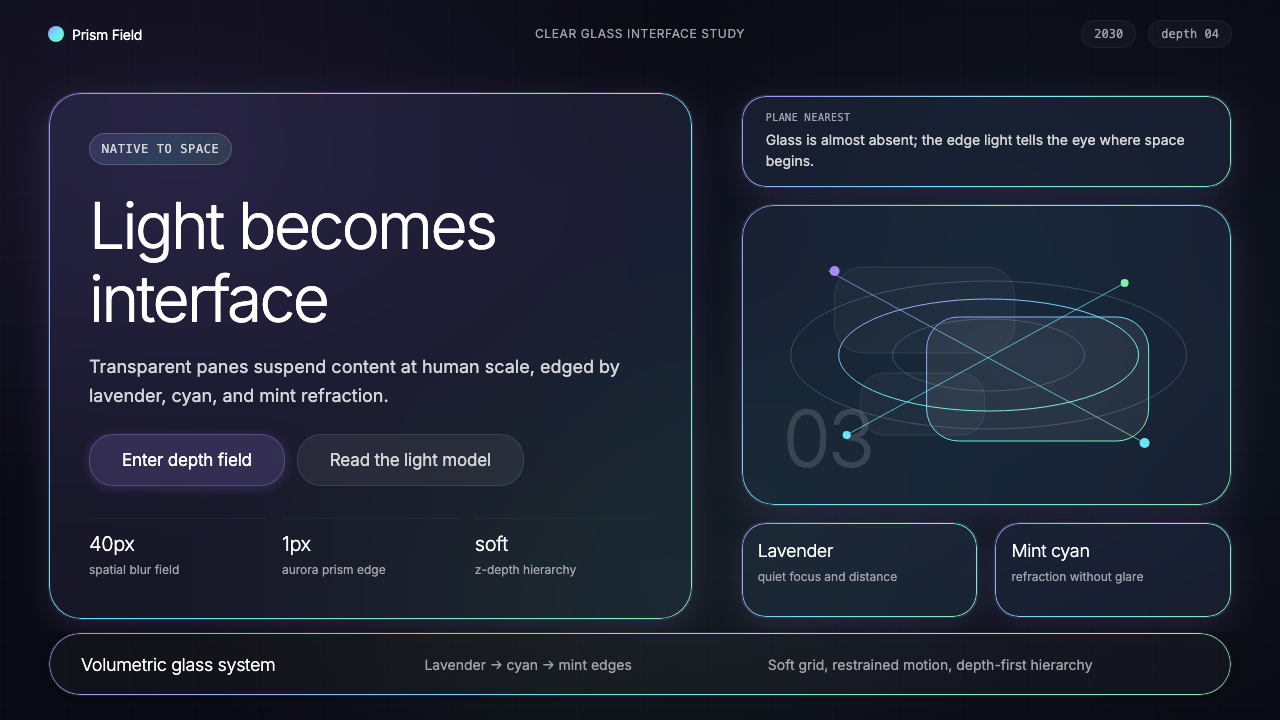 Vision Pro Spatial UI (2030)Structured light, not software. Deep navy glass panels glow with lavender-cya…
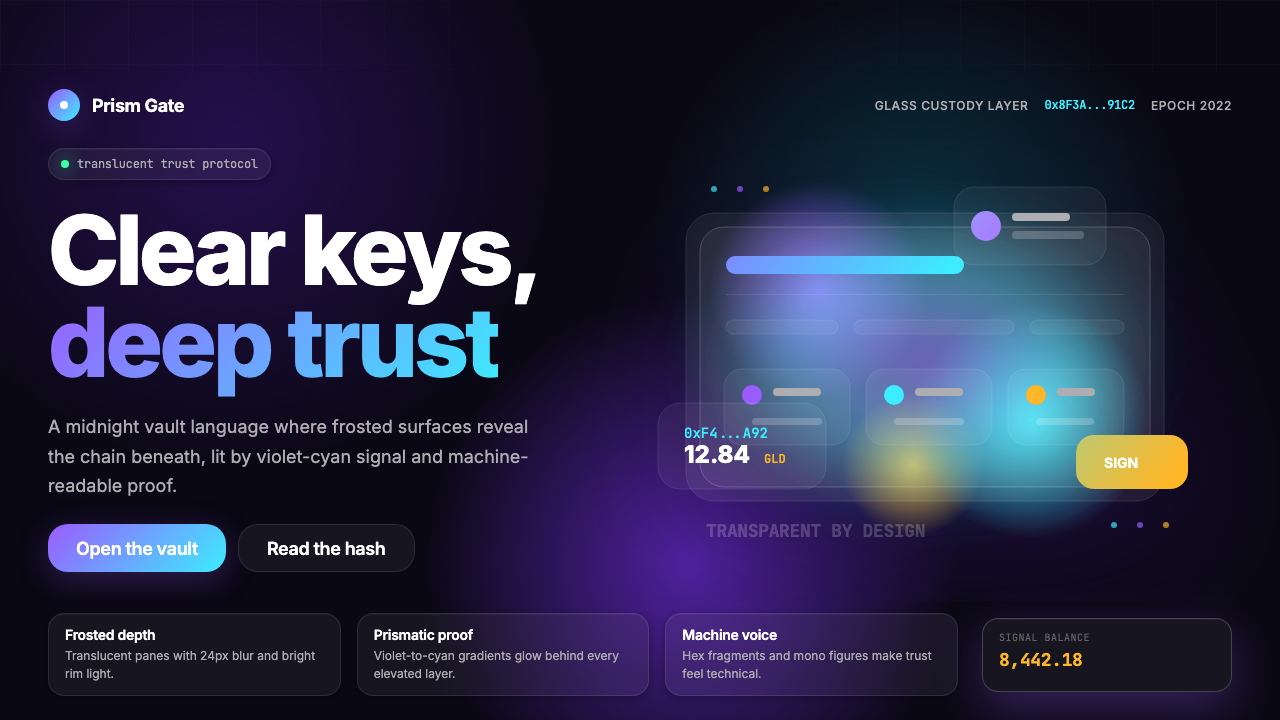 Web3 Glass Morphism (2022)Midnight trust in glass. Onyx, violet-cyan glow, and mono hashes make transpa…
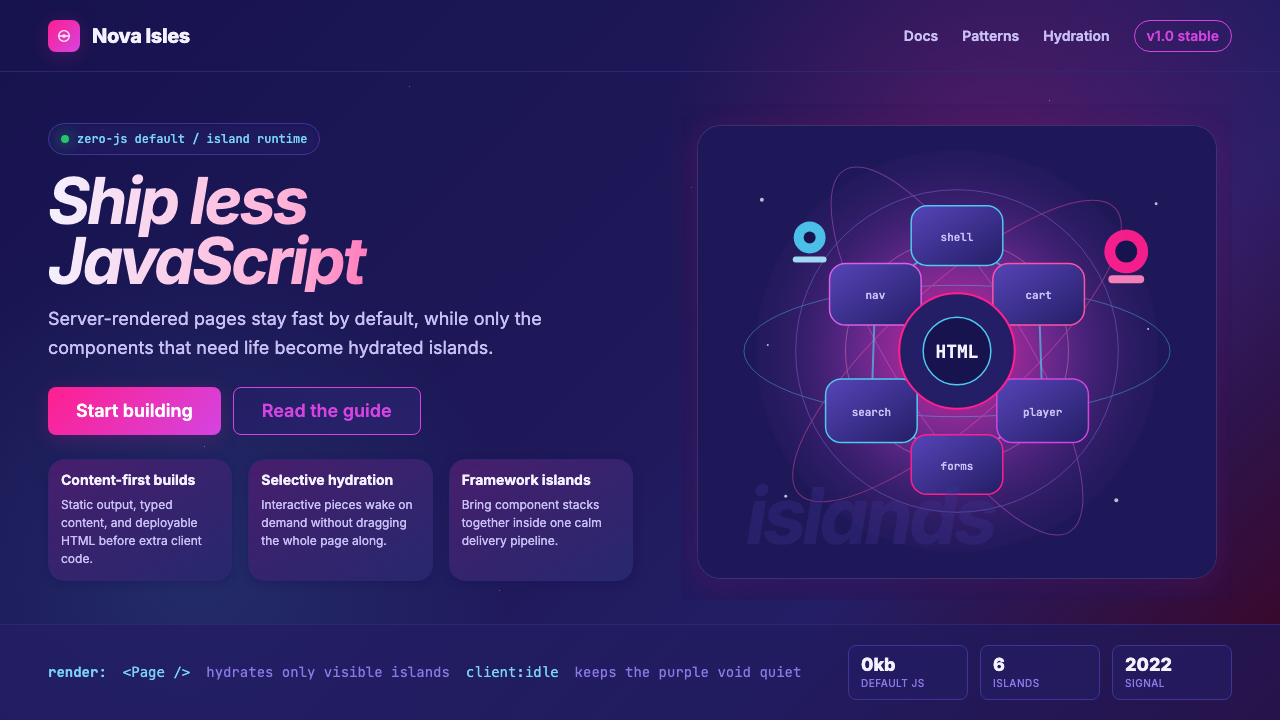 Astro Islands Architecture 2022Warm cosmic devtools. Deep violet, magenta glow, Inter clarity, and island ge…
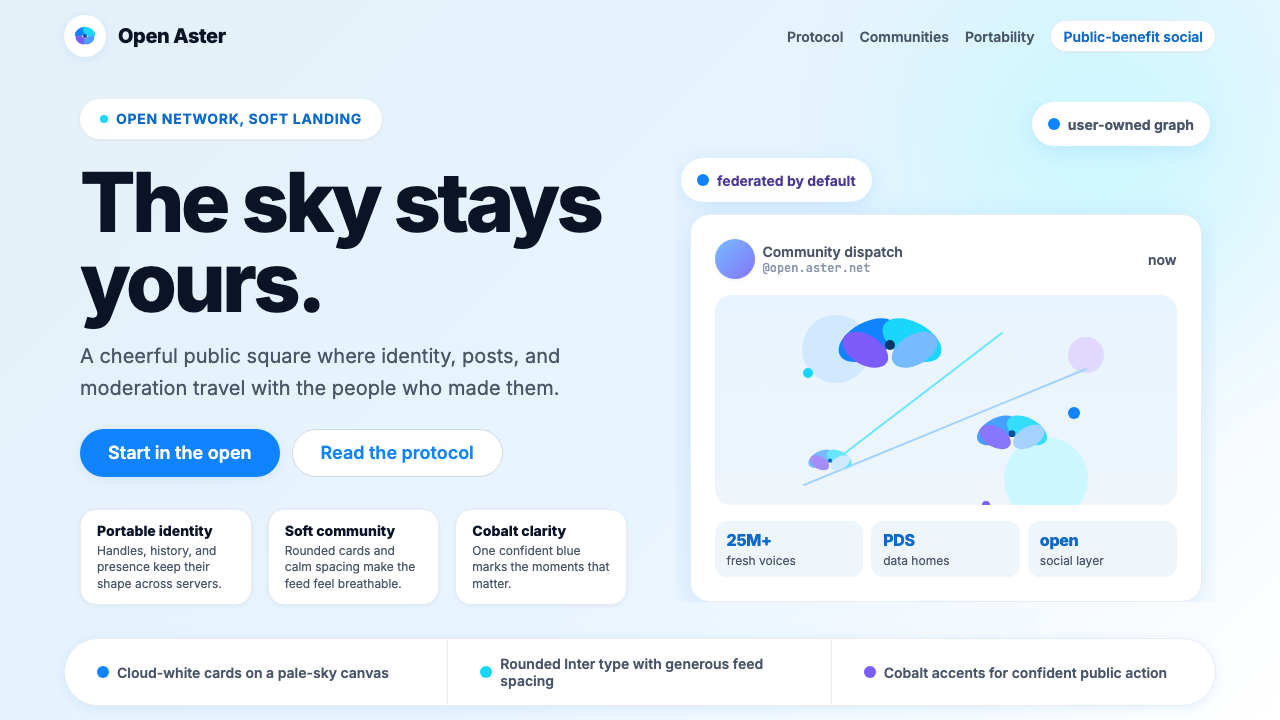 Bluesky AT Protocol 2024Open tech feels warm. Pale sky, cloud cards, Inter, and one cobalt accent car…
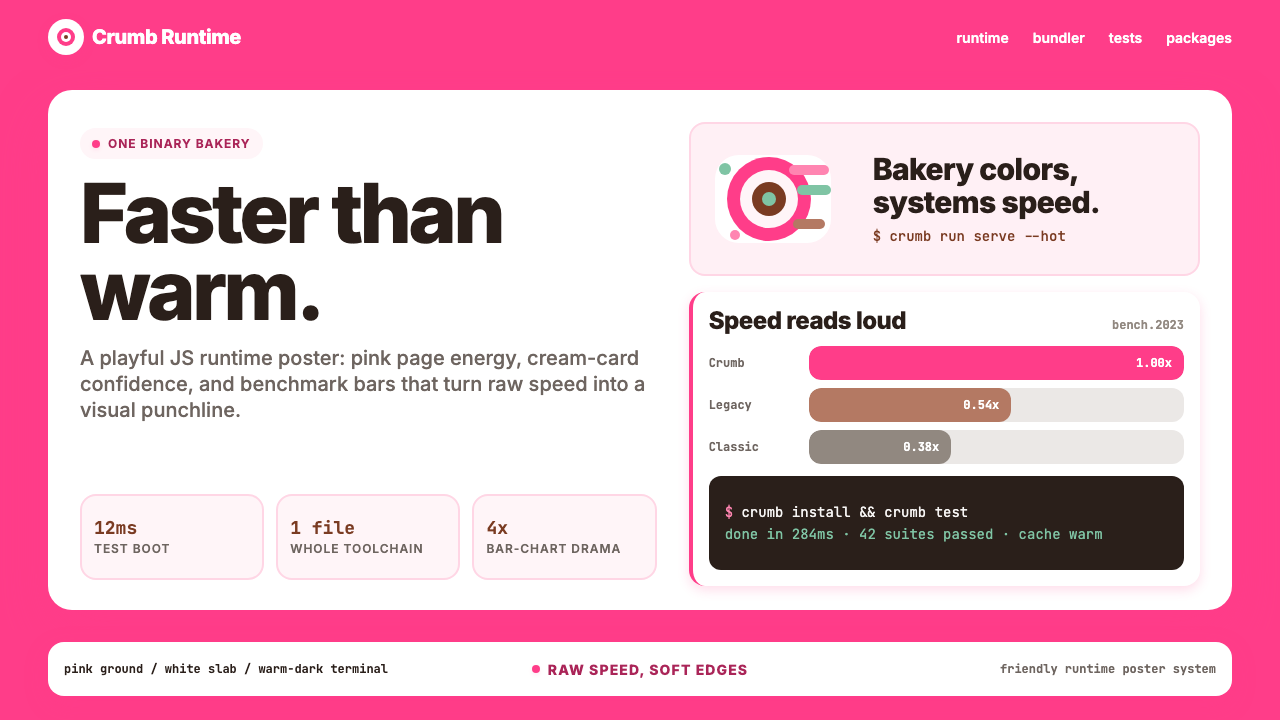 Bun JS Runtime Pink 2023Dev speed gets bakery-bright. Hot pink grounds white slabs, mono bars, and wa…
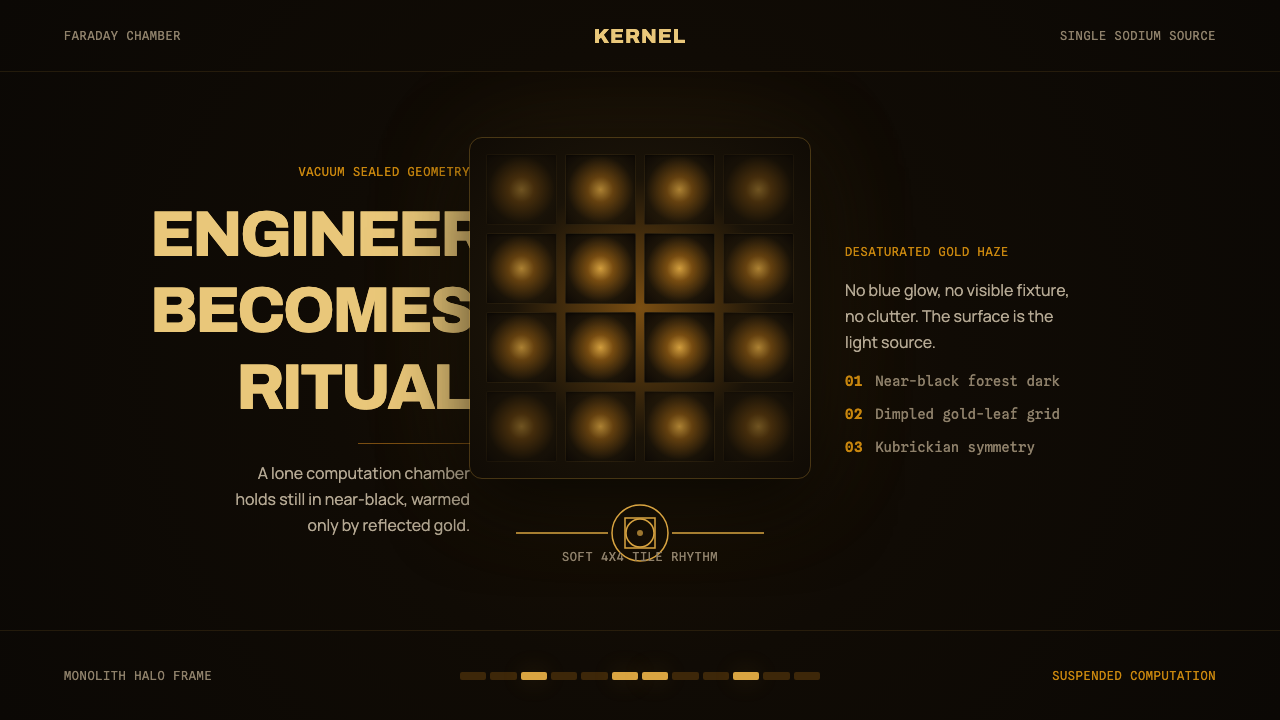 DevsEngineering turns sacred. Near-black void, sodium gold, and a centered dimple…