What is Amber Inclusion Specimen?
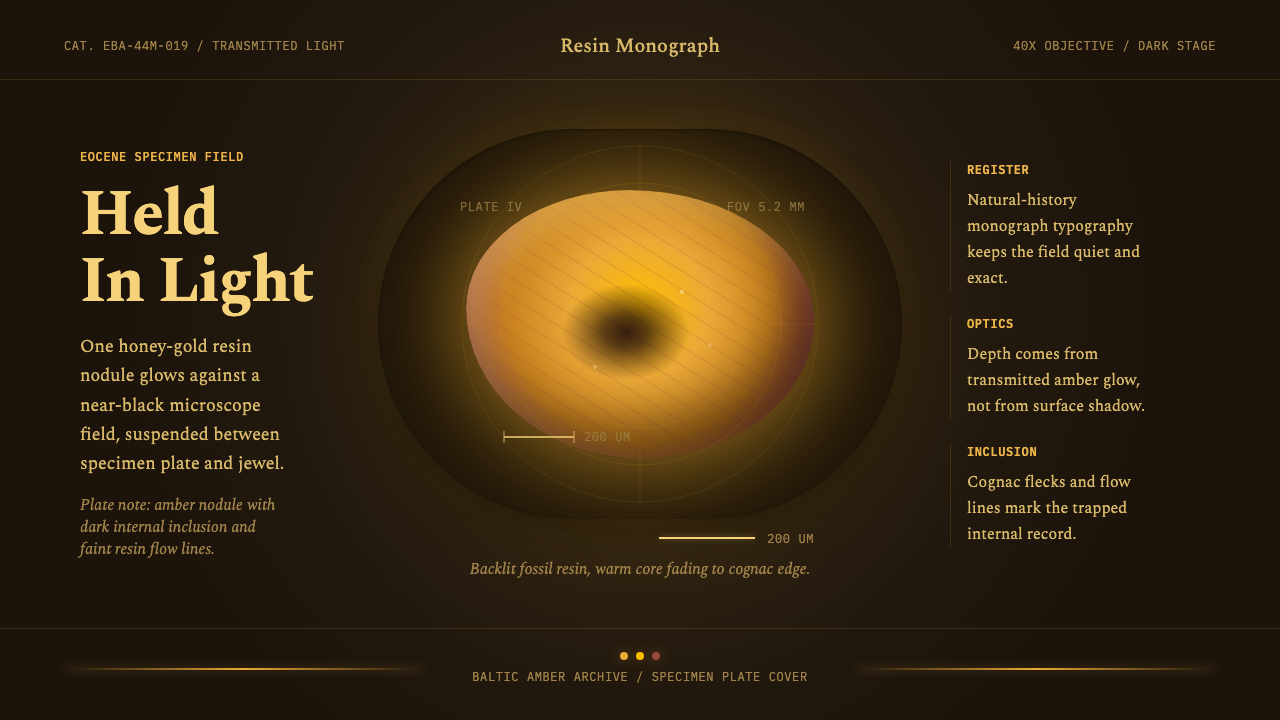
An ancient insect glows honey-gold inside a fossil resin nodule, suspended in black — half specimen plate, half jewel.
Amber Inclusion Specimen in brief
Amber Inclusion Specimen is a design system distilled from transmitted-light photomicrographs of Baltic amber — fossil tree resin, tens of millions of years old, that trapped insects and plant fragments as it hardened and has preserved them in astonishing detail ever since. Under a microscope with light passed through the specimen from behind, the resin itself glows a warm honey-gold, while the trapped inclusion and the surrounding stage recede into near-black darkness.
The style's register sits deliberately between two traditions: the clinical documentation of a natural-history specimen plate and the covetous glow of a jewel held up to light. A single warm, translucent specimen floats at the center of a dark field, its glow the only real color event in an otherwise near-monochrome composition — everything else exists to support and annotate that one radiant object.
Supporting elements are quiet and precise: a thin scale bar indicating true size, a small note of magnification, and a catalog identification number, all set in restrained monograph-style type. Nothing competes with the specimen itself for visual attention; the entire system is built to let one glowing object command a dark field.

Where does Amber Inclusion Specimen come from?
Baltic amber, the fossil resin at the heart of this style, formed roughly 44 million years ago during the Eocene epoch, when vast coniferous forests covered what is now the Baltic Sea region, encompassing present-day Kaliningrad, parts of Poland including Gdańsk, and Lithuania. As trees in these forests exuded resin — whether from injury, disease, or normal seasonal flow — insects, spiders, and fragments of plant material occasionally became trapped in the sticky substance before it hardened, and over tens of millions of years that resin fossilized into the golden, glass-hard material known as amber.
Baltic amber has been collected, traded, and prized for its beauty since prehistoric times, but its scientific value as a paleobiological record became fully appreciated only with the development of modern microscopy. Naturalists and paleoentomologists — scientists specializing in fossil insects — began systematically documenting amber inclusions in earnest during the nineteenth and twentieth centuries, recognizing that a single trapped insect could preserve details of anatomy, and even behavior, unavailable from any other fossilization process, since ordinary sedimentary fossilization rarely preserves soft tissue or fine structural detail.
The specific photographic style this design system draws from emerged from transmitted-light photomicrography during the mid-to-late twentieth century, particularly through Cold-War-era scientific documentation efforts in the Baltic amber region. Researchers working with early photomicroscopy equipment discovered that lighting a specimen from directly behind, rather than from above, produced the dramatic effect of the resin itself appearing to glow — an incidental technical choice, driven by the practical need to see through translucent material, that produced images of striking aesthetic power.
This transmitted-light technique became the standard method for documenting amber inclusions in scientific literature, museum catalogs, and paleobiology journals, establishing a visual convention — glowing amber specimen, near-black surrounding field, scale bar and catalog annotation — that has since been recognized as having an aesthetic identity distinct from its purely documentary function, one that treats scientific rigor and visual beauty as inseparable rather than competing goals.
What defines the Amber Inclusion Specimen look?
Color
The palette is built around a single warm honey-gold to amber-orange glow set against a near-black field. This is nearly monochromatic by design — the entire visual drama depends on one warm color event standing alone in darkness, not a broader palette competing for attention.
Transmitted Glow
Light should appear to emanate from behind or within the specimen itself, as if backlit, rather than falling on it from an external source. This transmitted-light quality — rather than reflected surface lighting — is what distinguishes the style's warm glow from an ordinary spotlight effect.
Typography
Type is restrained, monograph-style, and quiet — small-scale annotation type rather than bold display lettering. Labels and catalog text should feel like scientific documentation, never competing with the specimen for visual weight.
Single-Specimen Focus
Compositions center on exactly one glowing specimen at a time, positioned centrally or with deliberate asymmetric placement, never a scattered field of multiple equally-weighted objects. This singular focus is central to the jewel-like reverence the style conveys.
Scale Bar and Annotation
A thin, precise scale bar and small magnification note should accompany the specimen, signaling scientific rigor. These annotations are minimal in visual weight but essential to the specimen-plate register — without them, the image reads as pure jewel photography rather than documented specimen.
Near-Black Field
The field surrounding the specimen recedes to near-black rather than a lighter neutral, maximizing the contrast that makes the warm glow read as radiant. This darkness should feel like the absence of transmitted light rather than a flat design choice.
Precise Restraint
Every element in the composition should feel deliberate and precise — nothing casual, nothing decorative for its own sake. This precision echoes the scientific documentation tradition the style descends from, where every mark on the page serves a recording function.

Who shaped Amber Inclusion Specimen?
Scientists specializing in fossil insects who systematically documented amber specimens using transmitted-light photomicrography, establishing the visual convention of a glowing specimen against a near-black field annotated with scale and catalog information.
Researchers studying the roughly 44-million-year-old Baltic amber deposits, whose scientific documentation of trapped insects and plant material provided both the subject matter and the specimen-plate visual conventions this design style draws from.
Scientific photographers who developed the technique of backlighting translucent amber specimens for microscopy, discovering that light passed through the resin produced a striking glow effect that became central to the style's visual identity.
How do you use Amber Inclusion Specimen today?
Applying this style well starts with committing to a single glowing focal object against a near-black field — the entire visual system collapses if attention is spread across multiple competing elements rather than concentrated on one radiant specimen.
For presentation slides, the style makes a striking cover treatment with a single warm-glowing shape or icon centered against near-black, annotated with a thin scale-bar-style rule beneath the title. Content slides should keep supporting text small and restrained, treating each slide as if it were a specimen plate — one focal idea per slide, precisely labeled rather than densely packed.
For web interfaces, the style suits premium or collectible-feeling products — a single product image or key metric can be treated as the glowing specimen, centered against a dark field, with supporting labels kept small and precise. Dashboards can use this restraint for hero moments — a single highlighted number or chart glowing warmly against dark surrounding chrome — while ordinary interface elements remain quiet and understated.
For editorial and marketing contexts, the style rewards patience and restraint: a single striking image or object per section, generously surrounded by dark negative space, with captions set in small, precise, monograph-style type. This is the opposite of a busy, image-dense layout — the style depends on scarcity to make its one glowing subject feel valuable.
A common mistake is placing multiple equally-bright glowing elements in the same composition, which destroys the singular focus the style depends on. Another mistake is using bold, large display type for labels and annotations, which contradicts the quiet, scientific-documentation register that gives the style its credibility.

Amber Inclusion Specimen — FAQ
Why does the specimen glow rather than simply appear lit from the front?
The glow effect comes specifically from transmitted light — light passed through the translucent amber from behind, a technique developed by scientific photomicrographers to see through the specimen for documentation purposes. This backlit quality is what makes the resin appear to radiate its own warmth rather than simply reflecting external light, and it is essential to the style's jewel-like character.
Can this style work with a cool color palette instead of warm honey-gold?
Not without losing its core reference. The warm amber-orange glow is directly drawn from the actual mineral color of fossil resin under transmitted light, and this warmth is what creates the contrast against the near-black field that defines the style. A cool palette would evoke a different material entirely — closer to blue-tinted ice or glass specimens — and would need a different name and reference point.
Is the scale bar and catalog annotation strictly necessary, or purely decorative?
It is functionally essential to the style's identity. Without a scale bar or catalog note, the image reads as generic jewel photography rather than a documented scientific specimen. The annotation is what supplies the 'natural-history specimen plate' half of the style's dual register — remove it and only the jewel half remains.
Does this style suit densely-packed layouts with lots of content?
No. The style depends entirely on scarcity and negative space — a single glowing specimen surrounded by generous darkness. Dense, content-heavy layouts work directly against this logic and should either be redesigned to isolate a single focal element per section, or paired with a different, more information-dense style entirely.
What kind of products or contexts does this style suit best?
It suits contexts wanting to convey rarity, preciousness, or quiet scientific authority — luxury or collectible product pages, museum or archival digital experiences, premium single-product showcases, and any brand wanting to feel considered and rare rather than abundant and casual. It struggles in high-volume e-commerce or content-dense contexts where scarcity of focus is not desirable.
Related design styles
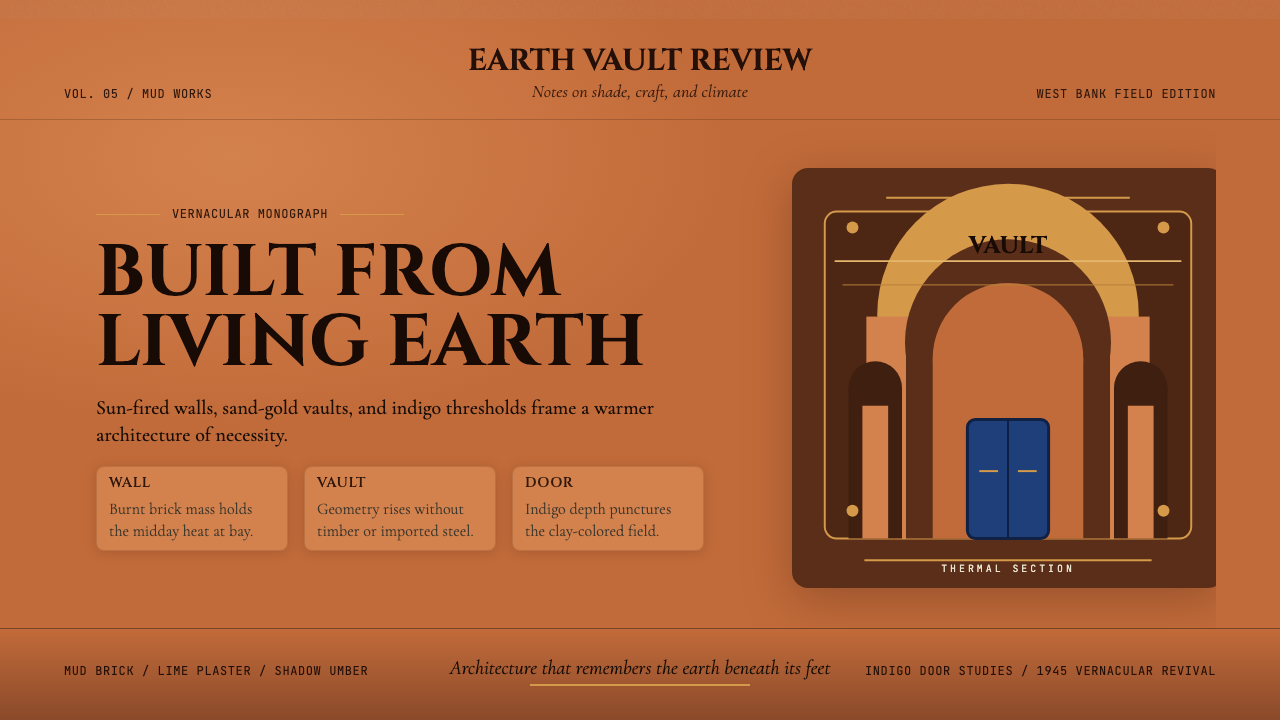 Egyptian Hassan Fathy Vernacular (1945)Earth remembers craft. Burnt brick, sand-gold vaults, and indigo doors carry…
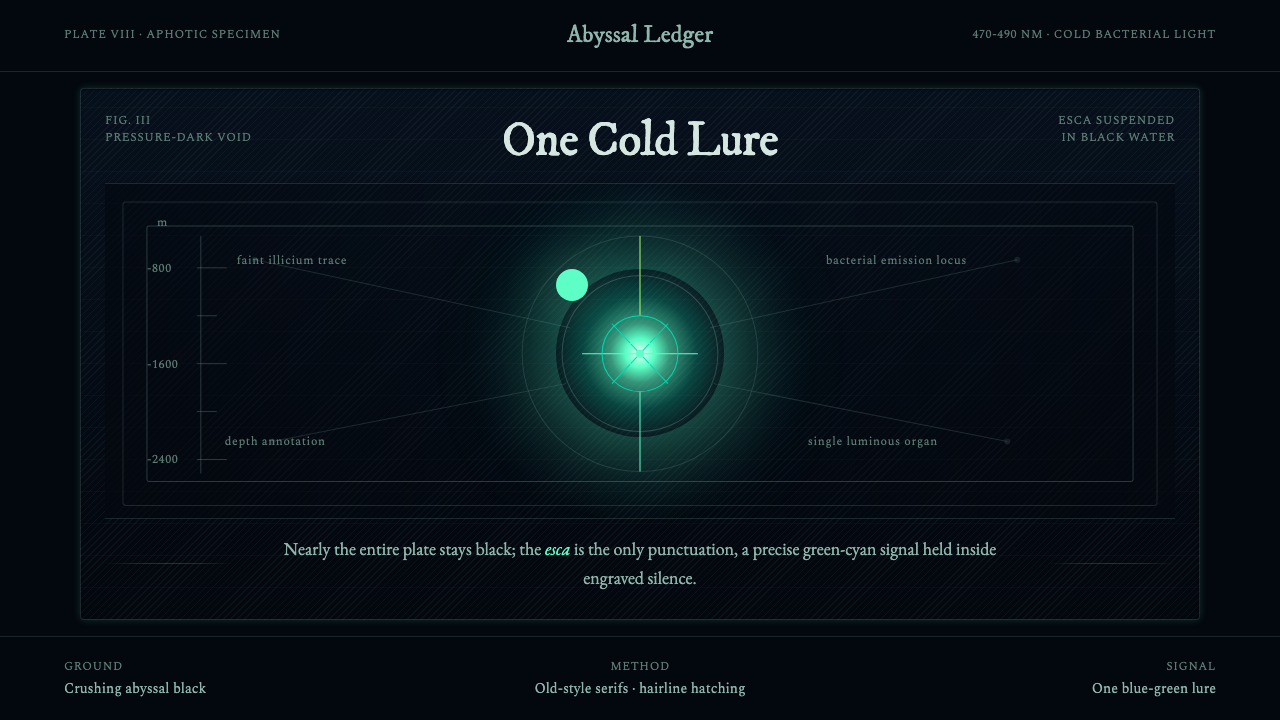 Anglerfish Lure BioluminescenceLight is scarce. Old serifs and hairline rules frame one cold green-cyan lure.
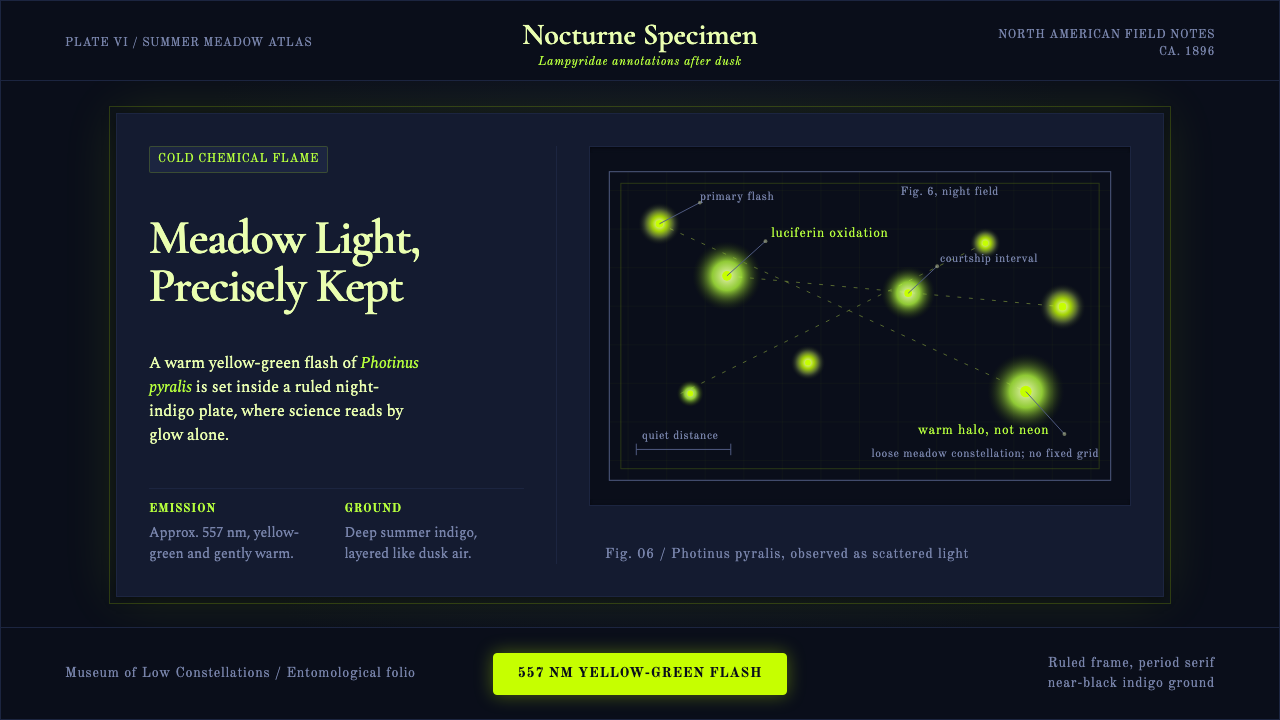 Firefly BioluminescenceQuietly luminous. Yellow-green 557 nm sparks drift through ruled indigo plate…
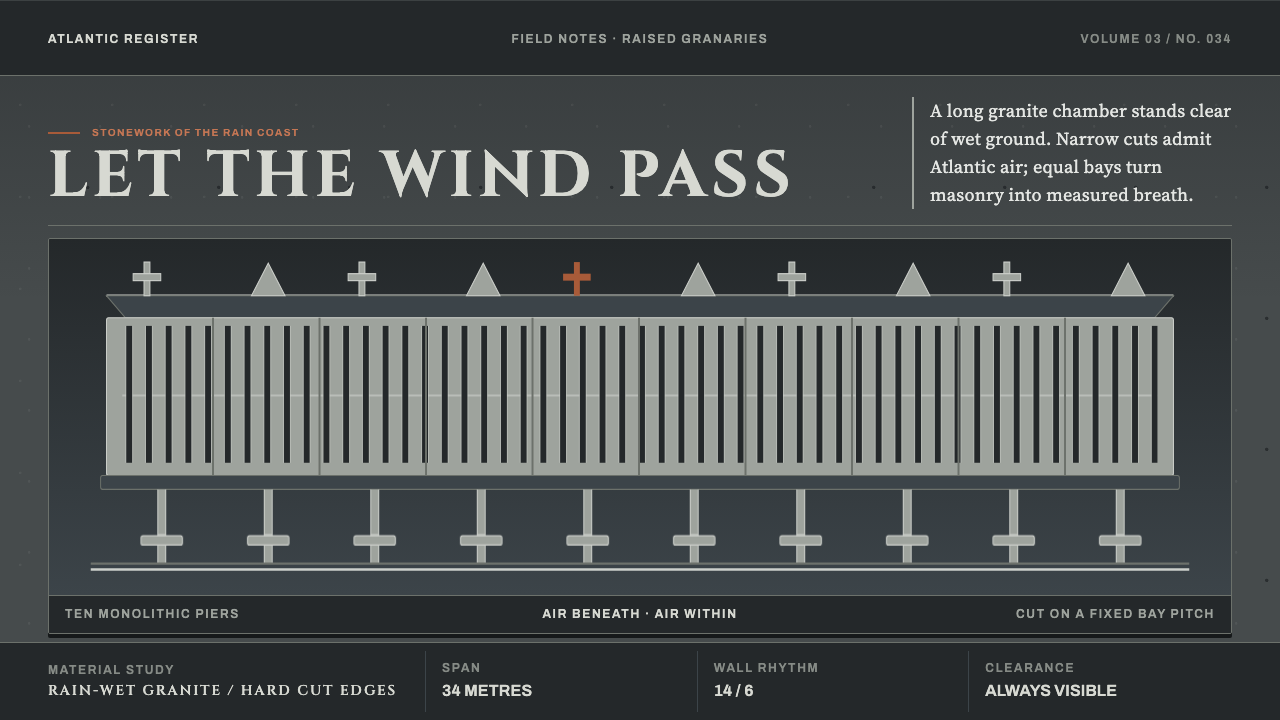 Galician HórreoStone learns to breathe. Wet granite, narrow slits and raised bays conduct At…
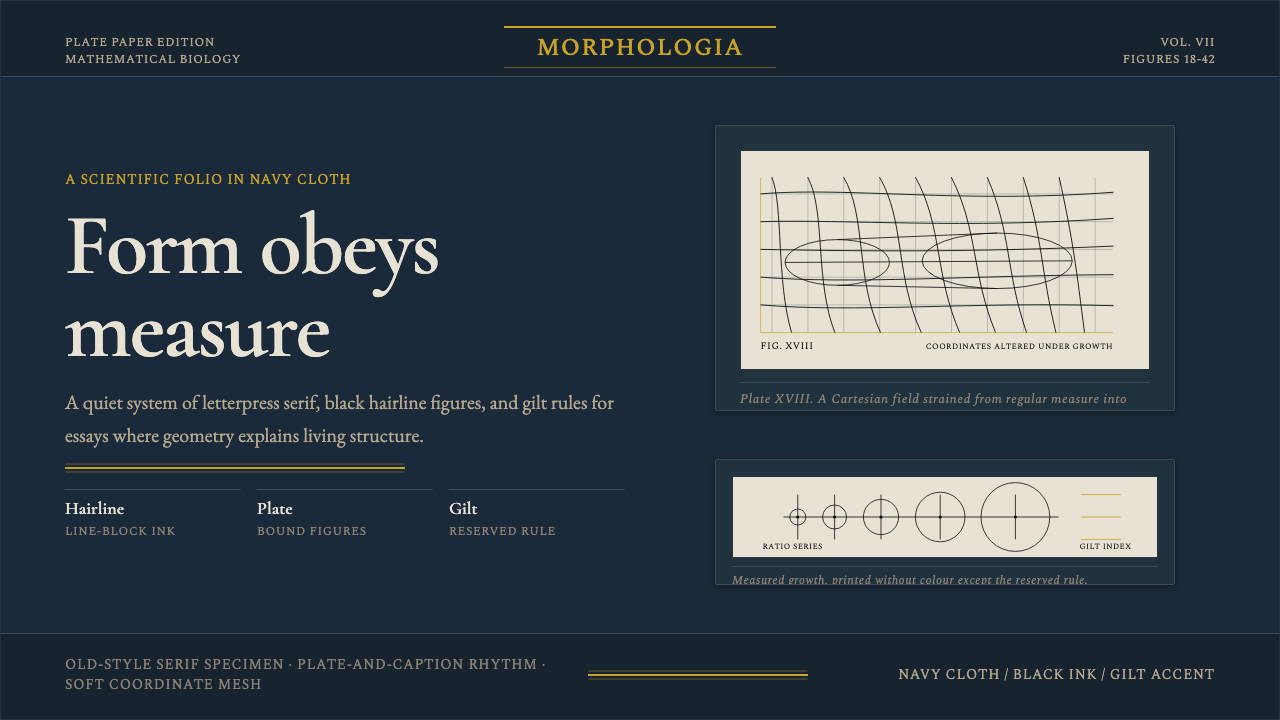 On Growth and FormMathematics in mourning cloth. Navy ground, gilt rules, Garamond type, hairli…
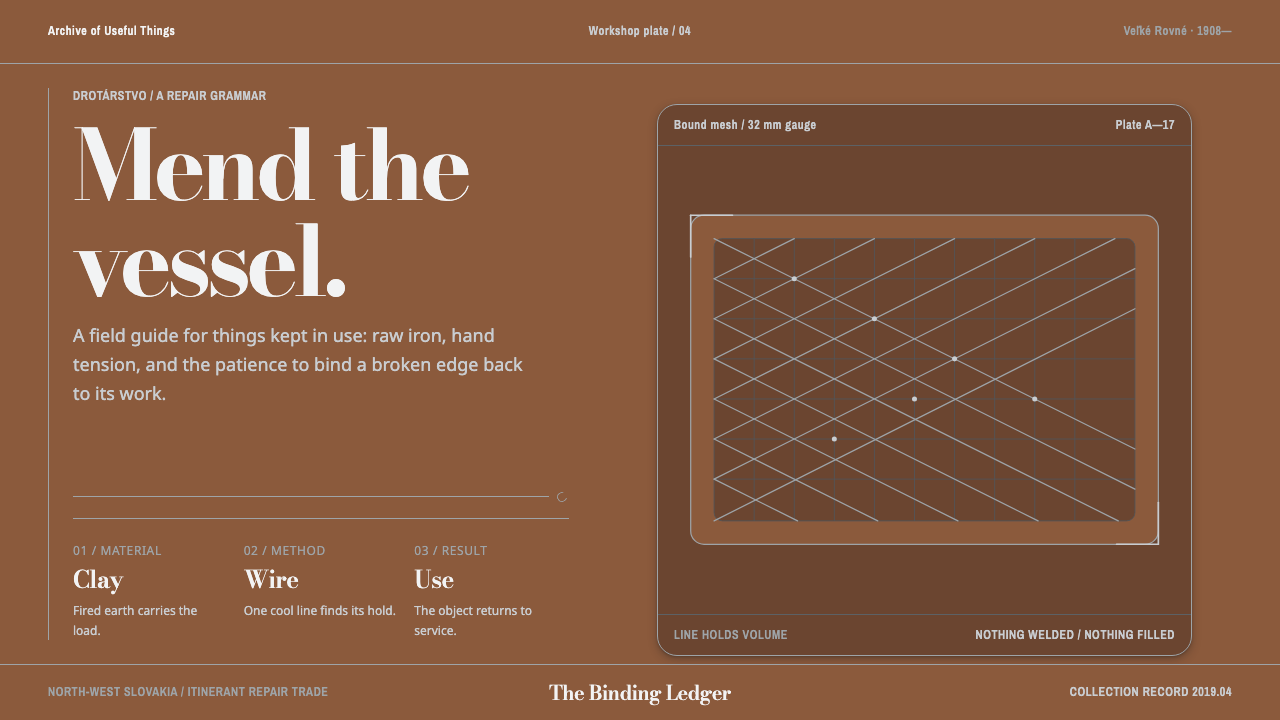 Slovak Drotár WirewareRepair becomes structure. Cold wire mesh binds warm fired clay in a measured…