What is Akha Silver Headdress?
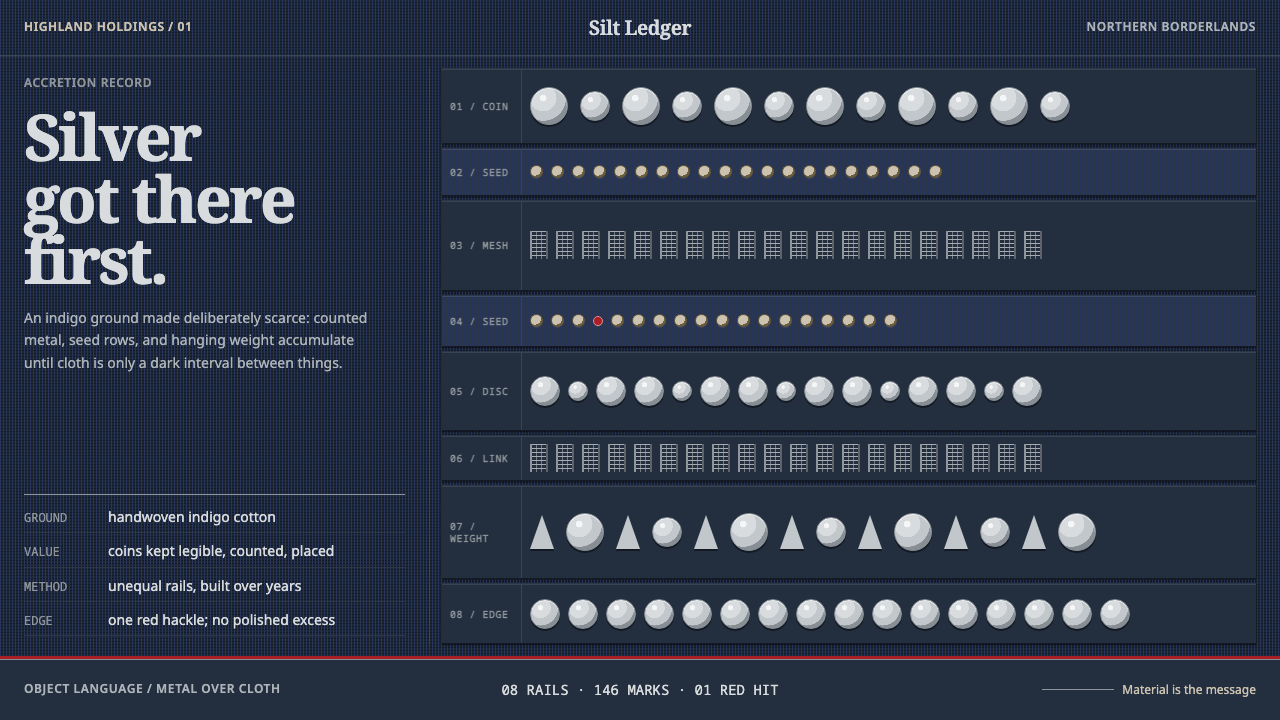
Built over years from seeds, discs, mesh and old coins, the Akha silver headdress covers its indigo ground until almost no cloth remains — and lets the metal do all the speaking.
Akha Silver Headdress in brief
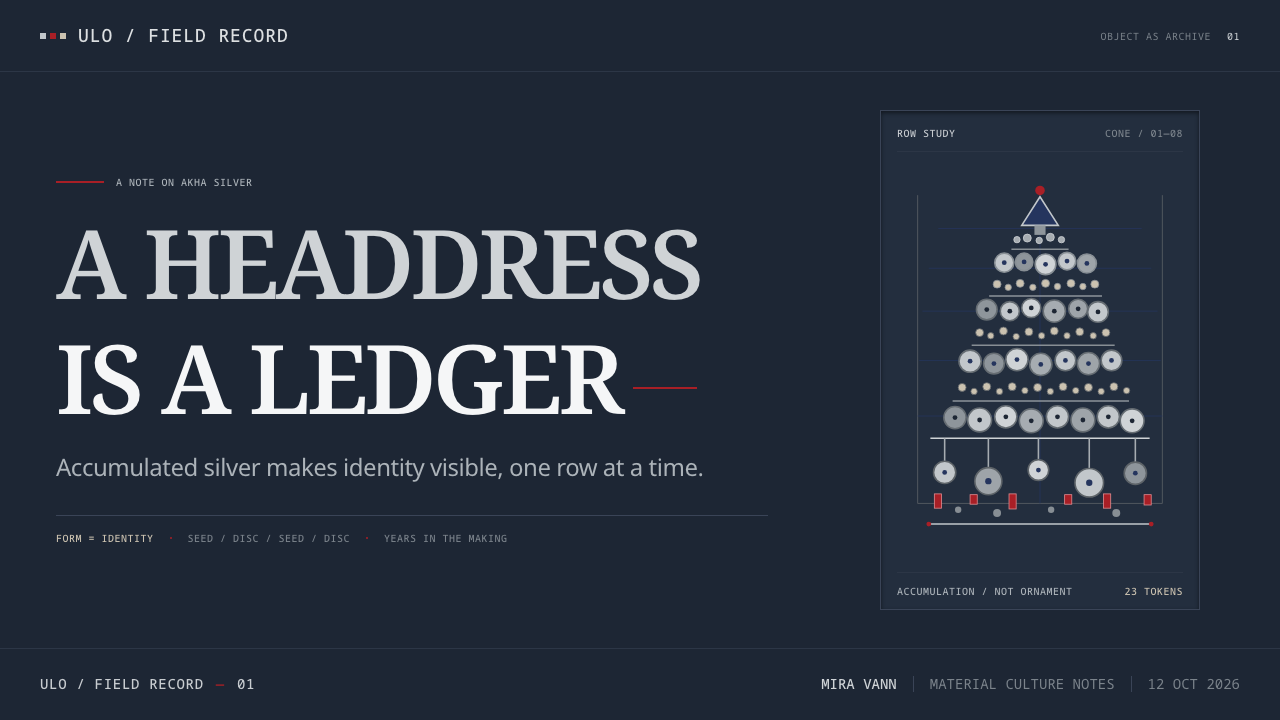
The Akha silver headdress is the visual starting point for a design language built on density, metal and a dark ground. An Ulo Akha woman's headdress is a bamboo cone sheathed in handwoven cotton, dyed blue-black with indigo and then covered, row after row, until the cloth is nearly gone: Job's tears seeds alternating with convex aluminium discs, woven silver mesh, cone finials, gibbon fur, red rooster hackles, and old coins swinging along the lower edge. It is less a decorated object than an object made of its decoration.
As a design system it translates into a clear set of rules. The ground is dark and almost never visible. Rows are horizontal and stacked, each with its own material and rhythm, and they never quite match: the spacing varies, the discs differ slightly, the edges wander. Metal speaks first, catching light against the deep indigo, while seeds, fur and feathers supply a quieter texture and a rare touch of red. There is no empty space to rest in. Ornament here is not an accent laid on a surface; it is the act of covering the surface.
Respect matters in how the style is read. The headdress is not a pattern but a personal and communal object, made by a woman over years, and its form signals which Akha subgroup she belongs to. The design language takes its structure — dark ground, stacked metal rows, accumulated irregularity — from that object without claiming to reproduce it or stand in for it. Handled carefully, it offers a rare example of richness through accumulation rather than through polish or symmetry.

Where does Akha Silver Headdress come from?
The tradition is older than 1900, and the examples that survive in collections date mostly from the nineteenth and twentieth centuries. It belongs to the Golden Triangle highlands, a region spanning northern Thailand, Shan State in Myanmar, Laos and Yunnan in China. The source groups it with Akha (Hani) dress, and the headdress is one of the clearest visible markers of identity within it.
Construction is a matter of years. A woman builds her headdress herself, starting from a bamboo frame and a cone of handwoven cotton dyed with indigo until it is blue-black. Because the silver has to be accumulated first, the work proceeds as means allow. That is why the headdress reads as a record of time: layers were added at different moments, and nothing was designed all at once. The source lists the women who assemble their own headdresses as the key figures of the tradition, and the Akha silversmiths of Shan State alongside them.
The coins add a second layer of meaning. Old coins swing along the lower edge, and they are readable: rupees on a wealthier woman, low-value baht on a woman with less. The face of the coin is a ledger, and its number and origin count. In design terms, this explains why the ornament is never arbitrary. It is evidence, and the logic of the system — dense, specific, dark-grounded — is the logic of something that has to be accounted for.
Three movements named in the source frame the style: Akha (Hani) dress, highland silver-coin ornament of Southeast Asia, and subgroup identity in headdress form. The last matters most to designers. The headdress is not a generic 'ethnic' motif. Different subgroups wear different forms, and the Ulo Akha cone is one of them. Documented examples appear in institutional collections, and the source cites the Maxwell Museum and the Science Museum of Minnesota as reference points. Anyone borrowing the system's logic should do so with the same care.
What defines the Akha Silver Headdress look?
Indigo Ground
The base is a deep blue-black, dyed into handwoven cotton. It is rarely seen directly; it shows only as a darkness between rows and behind the discs. This ground is what makes the metal speak: silver needs a dark field to read as light. The system keeps the ground dark and uninterrupted so that every metallic element has something to push against.
Stacked Horizontal Rails
The structure is a stack of horizontal rows, running around the cone like rails. Each row has its own material and its own rhythm: seeds, discs, mesh, finials. They build upward in tiers, so the whole reads as layers laid one on another rather than as a single composed picture. The horizontal emphasis gives the form its stability and its sense of weight.
Rhythm That Never Quite Matches
Because the piece is built by hand over years, no two rows line up exactly. Spacing varies, discs differ slightly in size and tilt, and edges wander. The irregularity is not a flaw to be corrected but the visible trace of a human hand working over time. A version that is too regular reads as a cheap repeating pattern; the near-miss rhythm is what gives the system its life.
Metal Speaks First
Silver mesh, convex discs and coin-like forms take the lead voice. They catch highlights and throw them back against the dark, giving the surface a cold, bright, slightly restless sparkle. Other materials support the metal rather than competing with it. The hierarchy is clear: first the shine, then the texture beneath it, then the single warm note of red.
Material Alternation
The vocabulary of materials is varied and deliberately mixed: seeds, aluminium discs, woven silver, cone finials, gibbon fur, rooster feathers. Rows alternate between hard and soft, bright and matte, smooth and fibrous. The effect is a rich surface built from contrast between neighbouring layers, not from a wide colour palette. The colour range stays narrow while the texture range stays wide.
Coins as Ledger
Old coins hang along the lower edge and swing as the wearer moves. They are readable objects: rupees on a wealthier woman, low-value baht on one with less. Each coin is a countable unit and a record of origin. In design terms, repeated disc forms can behave as units of information, so the ornament is something that can be read as well as admired.
Density Without Rest
There is no white space in this system. Ornament does not decorate an empty field; it replaces the field. The eye is given no clearing, only rows upon rows with a rare accent of red. This density is the point rather than the problem, but it means any practical use must make a separate, deliberate place for reading, since the ground itself is too busy to carry text.

Who shaped Akha Silver Headdress?
The headdress is made by the woman who wears it, over years, as silver is accumulated. She is designer, maker and owner at once, and her means are legible in the result. The rows that never quite match are the visible trace of one hand working over time. Within this system she is the author, and any use of the style should credit the tradition she carries rather than treating it as anonymous decoration.
The silver in the headdress depends on specialist metalwork, and the source names the Akha silversmiths of Shan State as part of the tradition. Their craft stands behind the worked metal elements, such as mesh and finials. The system's reverence for metal as the leading voice is, in effect, a reverence for their skill, and it is why surface and finish matter so much to how the style looks.
The Maxwell Museum is cited in the source as a reference collection for documented examples of this headdress tradition. Museum records are how the construction — bamboo cone, indigo cotton, seeds, discs and coins — is known to people outside the community. For designers, a collection like this is the right place to look at the original object rather than relying on second-hand pastiche.
The Science Museum of Minnesota is the second institution the source cites for collected examples dating from the nineteenth and twentieth centuries. Together with the Maxwell Museum, it indicates that the headdress is documented, dated and studied, and that the system's descriptions of materials and construction rest on recorded objects rather than invention.
How do you use Akha Silver Headdress today?
Akha silver is a model for designs in which richness should come from accumulation rather than gloss or symmetry. Its lesson is that a surface can be made valuable by what is laid over it, row by row, and that restraint of colour can coexist with abundance of texture. Applying it well means understanding both the density and the care behind it.
For presentation slides, a cover can be a deep indigo field almost filled by stacked horizontal rails of silvery tone and coin-like discs, with the title in a clear light face on a quiet panel set into that field. Content slides work as bands: each row is a point in an argument, and the rows build upward. Data slides can treat discs as units, so a count becomes a literal row of coins; reserve a calm panel for numbers and labels, because the ornamented ground is too busy to read over.
For web interfaces, the style fits dark-mode dashboards, collection pages and product pages for jewellery, craft and heritage goods. Pricing tiers can be presented as stacked rails, each tier a row with its own rhythm. Body text should always sit on calm, unornamented panels with strong contrast, and metallic shimmer should be used sparingly so that it never harms legibility. The ornament belongs in headers, dividers and hero areas, not under paragraphs.
For editorial and marketing work, the style is best used for stories about craft, heritage, accumulation and value. Photography of actual objects should come with captions that name the makers and the tradition, and the layout can echo the headdress with stacked bands of image and text. Campaigns about savings, collections or long-term craft can lean on the visual logic of something built slowly, and its sense that wealth is something carried and displayed.
The most common mistake is to treat the style as a generic tribal or ethnic pattern and apply it to unrelated subjects. That erases the source and misrepresents what the object means. Other errors are practical: making the rows perfectly regular, which kills the handmade logic; laying a single silver band on a white page, which gives the metal nothing to push against; overusing the red accent; and spraying metallic gradients where the original uses discrete, countable pieces. Borrow the structure, credit the tradition, and never claim its identity.
Akha Silver Headdress — FAQ
Is this a faithful reproduction of Akha dress?
No. It is a design language that takes its structure — dark ground, stacked metal rows, accumulated irregularity — from a real object. The headdress itself is a personal and communal piece, made by a woman over years, and its form signals subgroup identity. The system borrows logic, not identity, and it should not be presented as authentic Akha dress or used to stand in for the people and craft behind it.
Why must the rows never quite match?
Because the original is built by hand over years. Rows are added at different times, spacing varies and the discs differ slightly, so exact alignment would be a false claim about how the object was made. In design terms, a near-miss rhythm gives the surface life, while perfect repetition turns it into a cheap tiled pattern. The goal is the look of accumulation, not the look of a machine.
What do the coins mean, and how does that affect the design?
Old coins hang along the lower edge and are readable: rupees on a wealthier woman, low-value baht on one with less. The coin face is a ledger, so its number and origin count. That is why the ornament in this system is never arbitrary. In design terms it means repeated disc forms can act as countable units of information, and a decorative element can carry data as well as beauty.
Why is the system built on a dark ground, and can it work on a light one?
The indigo ground is what lets the metal speak: silver needs darkness to read as light. On a pale page the same rows lose their contrast and look flat and fussy. If a light layout is unavoidable, keep dark indigo panels for the ornamented areas and let the pale ground surround them, rather than spreading metallic detail directly on white.
How can the style be used respectfully?
Use the structure, not the identity. Keep the subject matter close to what the style actually expresses — accumulation, craft, value, heritage — and avoid applying it as a generic tribal motif. Name the tradition and its makers where the context allows it, point to documented examples in museum collections, and do not suggest that the design belongs to an unrelated brand's own heritage.
Related design styles
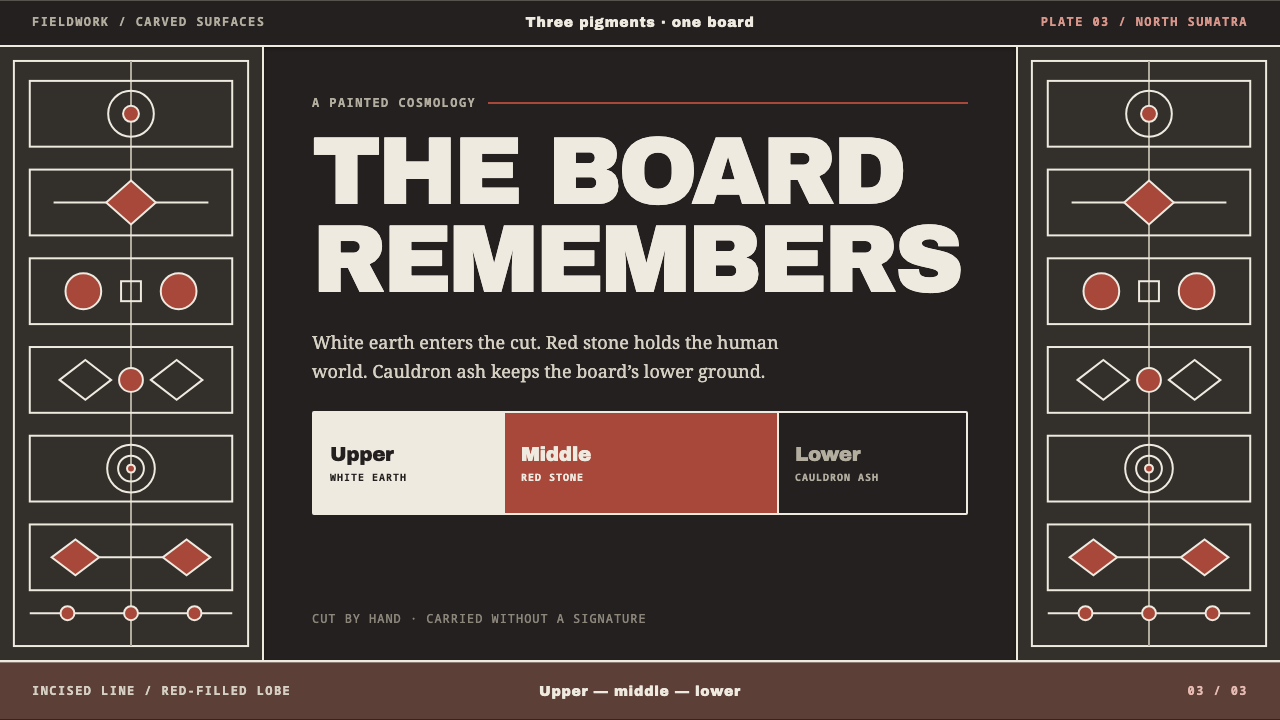 Batak GorgaCosmology cut into wood. Chalk-white lines and batu hula red hold a blackened…
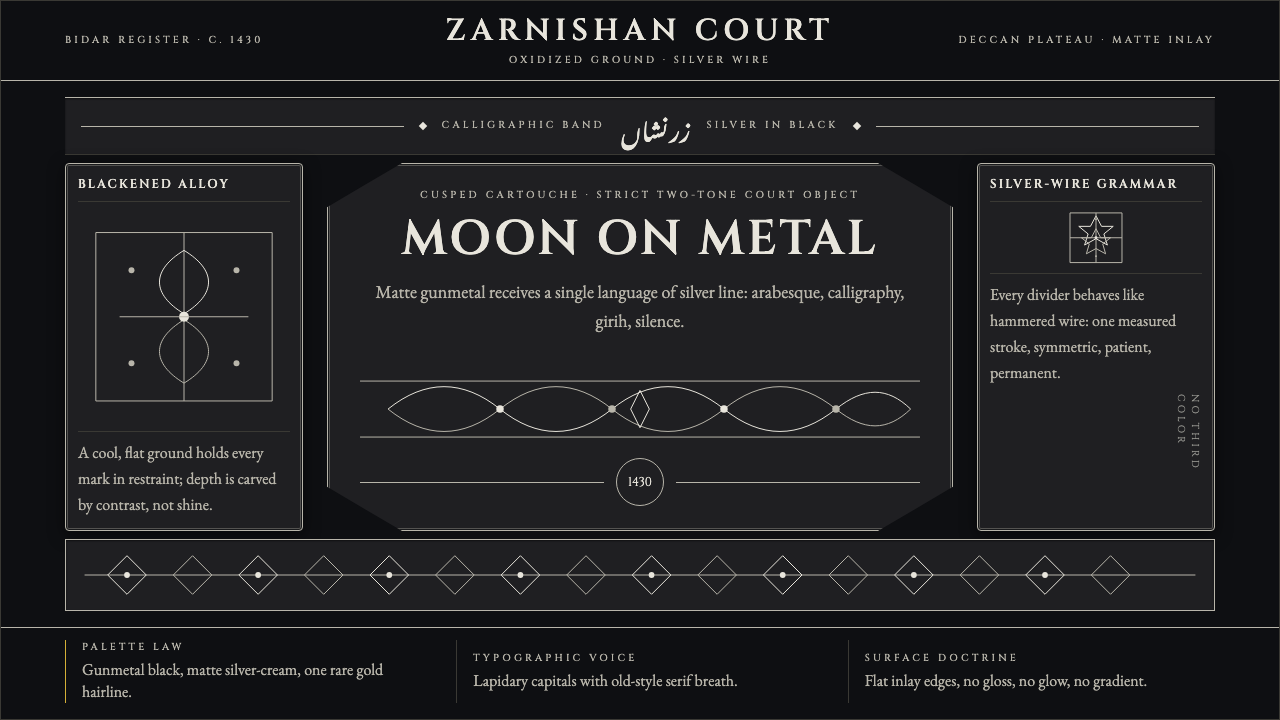 Bidri Deccan MetalworkCourtly darkness, tooled by silver. Cinzel caps and hairline arabesques cut g…
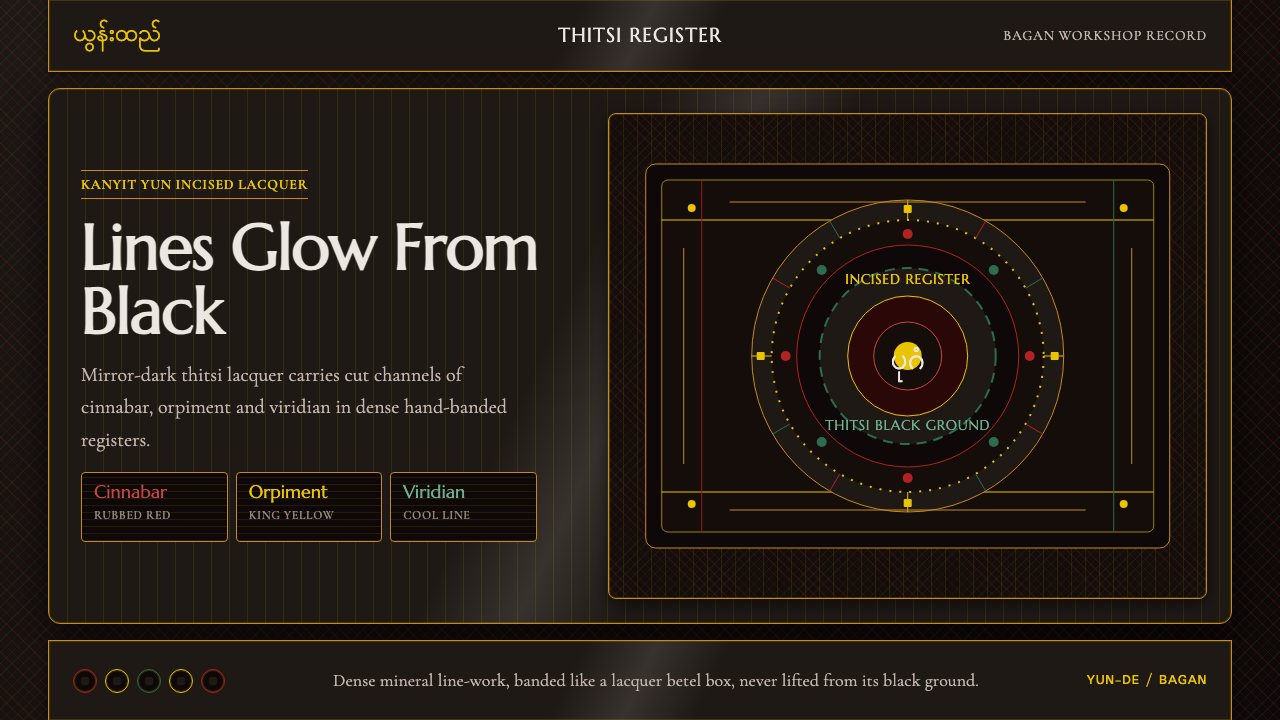 Burmese Yun LacquerwareLacquer glows in cut lines. Cinnabar, orpiment and viridian band a mirror-bla…
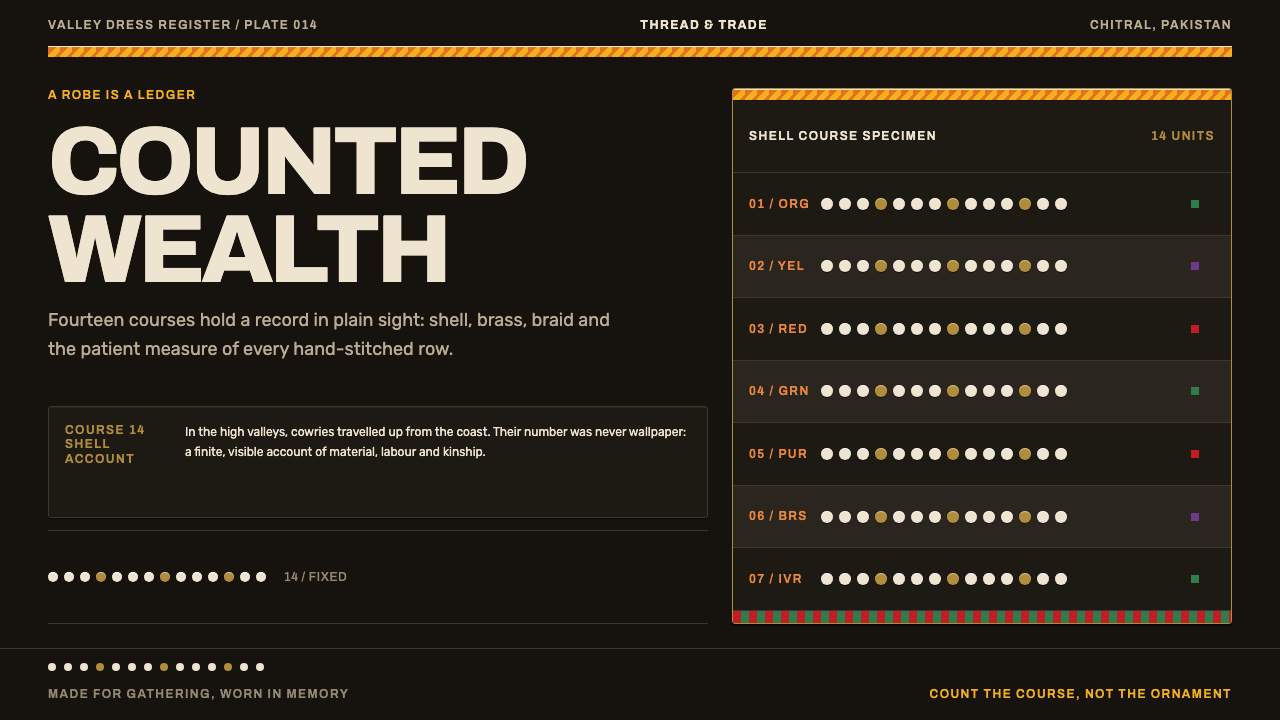 Kalash KupasDensity carries value. Ivory shell courses and orange braid are counted on wa…
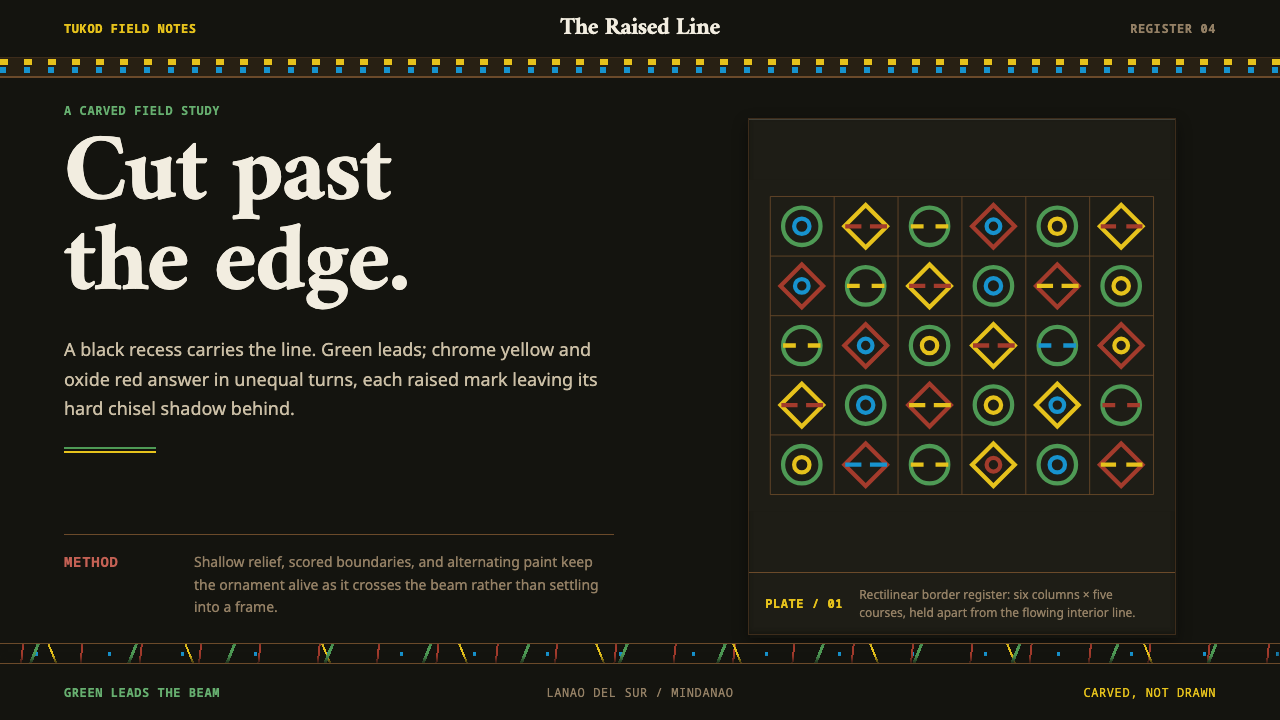 Maranao OkirCarving commands the field. Green, yellow and oxide-red lines rise from black…
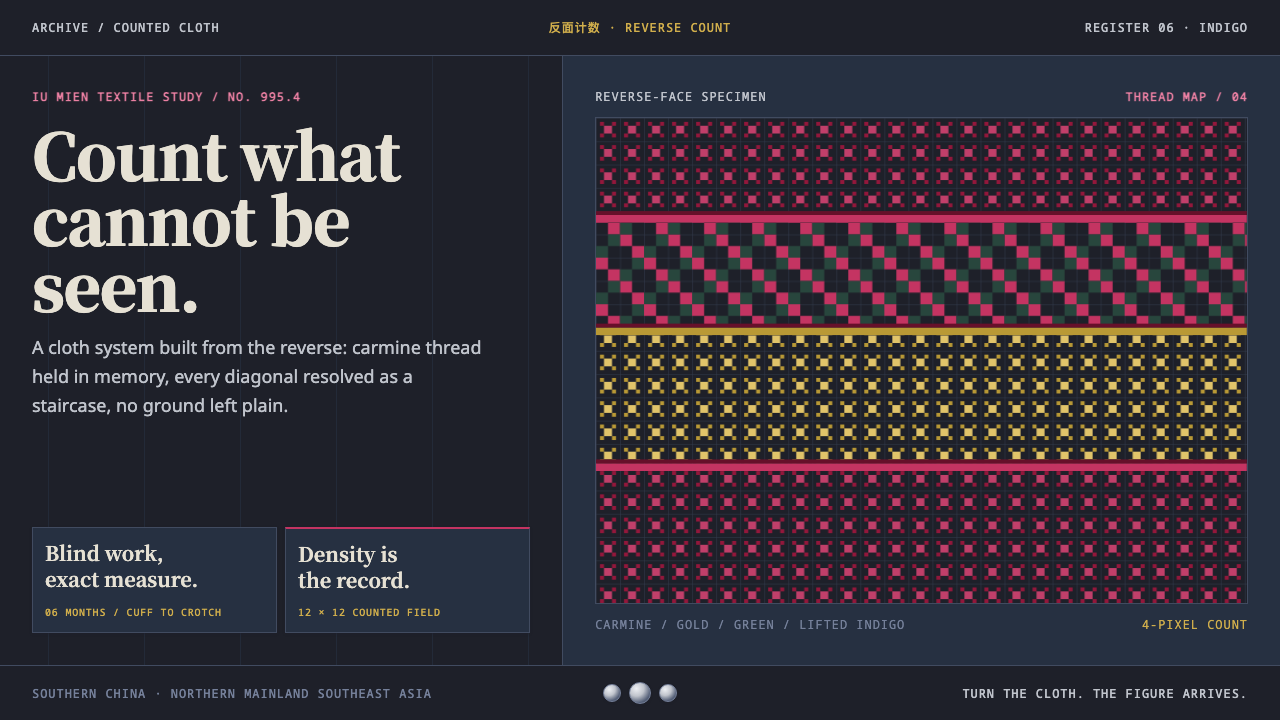 Mien Yao Cross-StitchDensity is the achievement. Carmine counted stitches saturate near-black indi…