What is Tjanpi Desert Weavers?
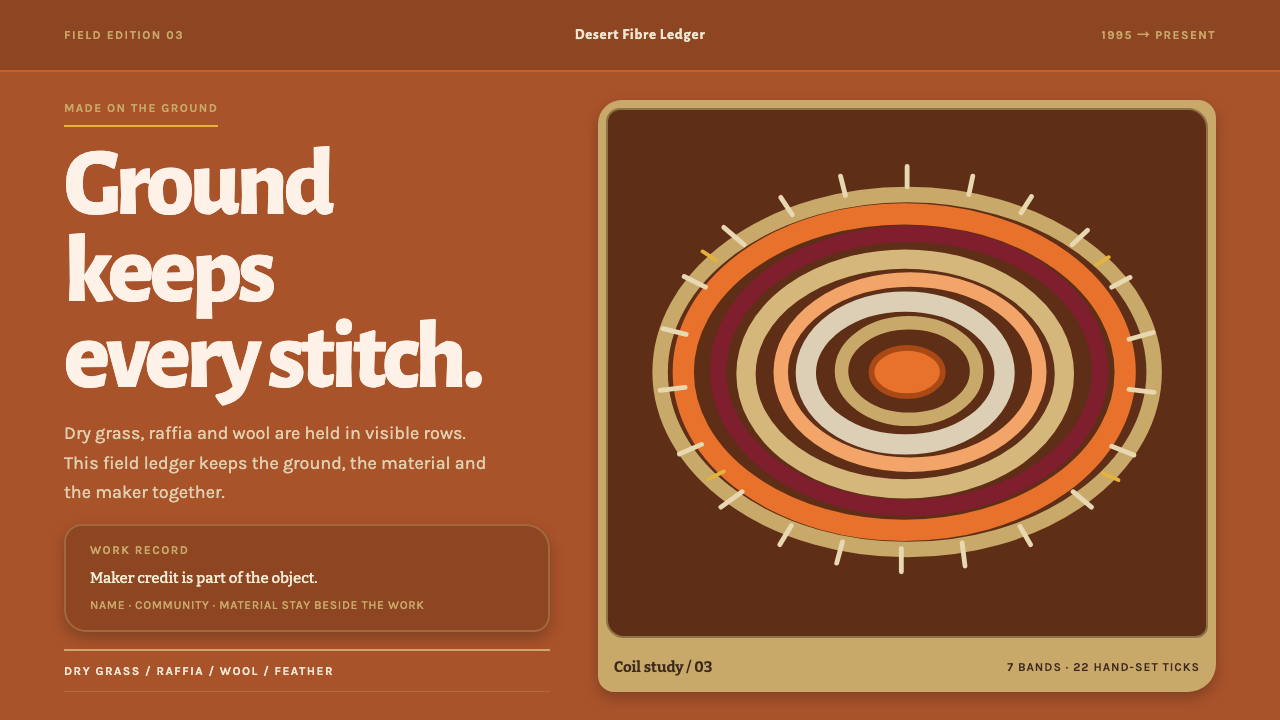
Tjanpi Desert Weavers takes dry desert grass, coils it into baskets and life-size animals, and builds a design language around the red soil, the straw-colored bands and the maker's name left beside the work.
Tjanpi Desert Weavers in brief
Tjanpi Desert Weavers is a design style drawn from the fibre art of the women of the NPY Lands, the Central and Western Desert country of Australia. 'Tjanpi' is Pitjantjatjara for dry desert grass. Since 1995 the weavers of the NPY Women's Council have gathered it on country, bound it into coiled bundles and stitched it with raffia, wool and emu feathers, first into baskets and later into full-scale grass animals and even a four-by-two-metre Toyota.
As a visual system the style is warm, tactile and deliberately unmachined. Its ground is oxidised red soil, the earth the work is made and photographed on, which gives the whole system a dark, mineral base. Color arrives in bands rather than gradients: dry straw yellow, the hot orange of dyed raffia, a deeper red. Rows are paced by hand, so no band repeats exactly, and edges are allowed to stay fibrous instead of being sanded back to a clean line.
What separates it from a generic 'earthy craft' look is its ethic. The maker's name and community sit beside the work and are never anonymised. The style treats irregularity as evidence of a person, and it asks the interface to keep that person in view.
Where does Tjanpi Desert Weavers come from?
The word tjanpi names the dry grass that grows across the desert country of central Australia. In Pitjantjatjara it means exactly that: dry grass. The material is gathered where it grows and carries the color of its place, and that fact is the root of the whole system. Tjanpi Desert Weavers does not borrow a palette from a mood board. It reads the palette directly off the landscape the work comes from: the oxidised red of the soil, the pale gold of the straw, the orange of dyed raffia.
In 1995 the weavers of the NPY Women's Council began working with tjanpi in the form that gave the enterprise its name. The setting is the NPY Lands, an expanse of Central and Western Desert country, and the model sits inside two overlapping traditions. The first is the movement of Aboriginal women's art centres and social enterprise, in which making is at once an art practice and a livelihood organised by the women themselves. The second is contemporary Australian fibre art, where grass, wool and feather are treated as serious sculptural materials. Underneath both lies the technique of coiled basketry: grass is bound into a bundle, the bundle is wound into a spiral, and every turn is stitched to the one before it with raffia or wool.
Baskets were only the beginning. The same coiling logic scaled up into full-size grass animals, and in 2005 into the Tjanpi Toyota, a vehicle four by two metres in size made by twenty weavers from Blackstone, also called Papulankutja. The work won the Telstra award at NATSIAA the same year and is now held in the National Museum of Australia. A car is about the least likely thing to be made of dry grass, and that is the point. It shows that a hand-paced, bundled and stitched structure can be stretched to any scale without ever adopting the regularity of a machine.
The design system was written from those conditions. Where an industrial interface assumes identical rows, this one assumes rows paced by a hand and lets their rhythm drift. Where a polished brand hides its authorship, this one prints the name of the maker and the community next to every piece. It is a deliberate answer to a simple question: what does it mean to design with respect for how something was actually made?
What defines the Tjanpi Desert Weavers look?
Ground
The page ground is oxidised red earth, a dark, mineral brick-red rather than a clean neutral. It is the color of the soil the weavers work and photograph on, so everything else sits on it the way a basket sits on country. Because the ground is already saturated and dark, the system never relies on pure black or pure white; contrast is built from straw tones lifting off the red.
Bands, Never Gradients
Color is laid down in discrete bands, the way a coil of dyed raffia shows a stripe and then stops. Straw yellow, hot orange and deeper red sit side by side with hard transitions between them. A gradient would imply light falling across a surface; a band implies a thread that changed color. The difference is the difference between a rendering and a made object.
Hand-Paced Rhythm
Rows are not generated by a rule. Each coil is wider or narrower according to the hand that made it, so stacked elements, list rows and stripes never repeat exactly. In an interface this means resisting the reflex to equalise everything: gaps may vary slightly, bands may differ in thickness, and the page keeps a slow, human pulse instead of a metronome.
Fibrous Edges
Edges are allowed to stay rough. Where a refined system would trim and align, this one lets the end of a strip, the border of an image or the outline of a shape look as if a few stalks still stick out. The roughness is limited and consistent, never a distressed filter laid over a clean layout; it reads as the natural end of a material, not as a special effect.
Coil and Stitch Structure
Underneath the surface the logic is structural: bundle, wind, stitch. Compositions favour rounded, spiralling or concentric arrangements and bands that follow a continuous path, with small accents standing in for the raffia, wool and emu feather that bind the coils. Accents are few and sit on the structure the way a stitch sits on a coil, never decorating the empty space around it.
Named Authorship
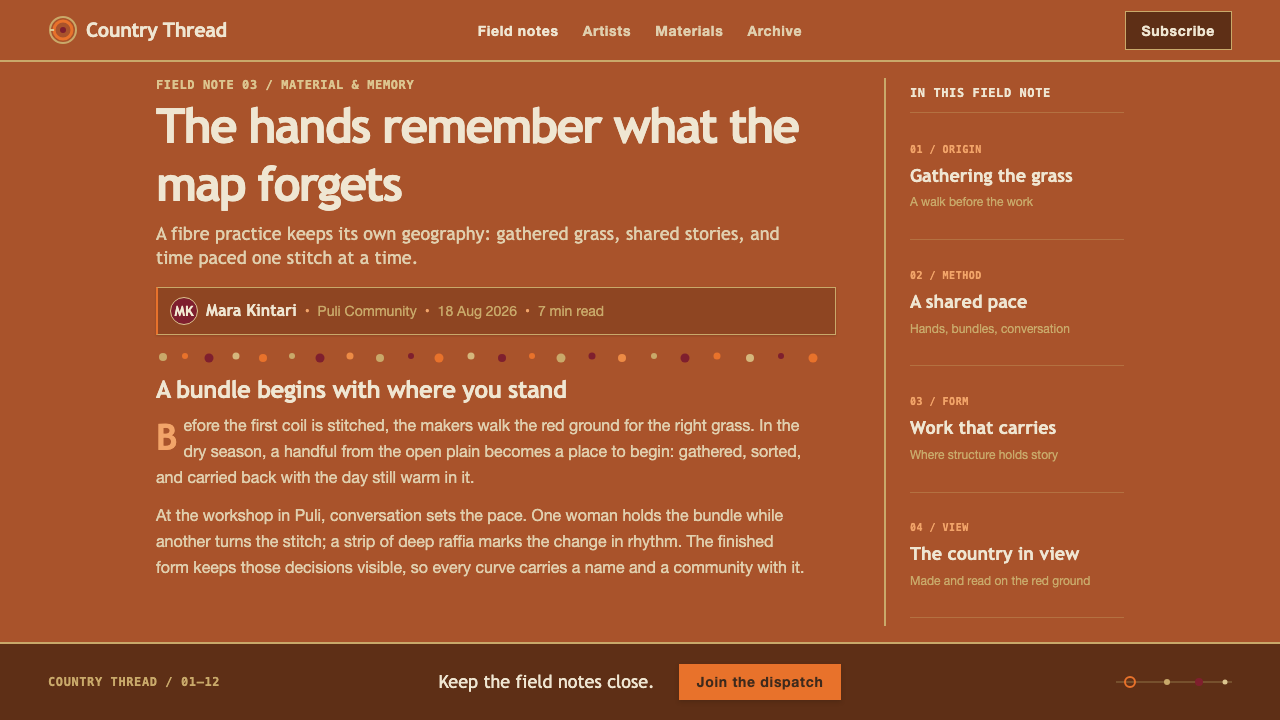
The maker's name and community stay beside the work. In interface terms, every card, image or product entry carries a credit line as a permanent part of the layout, not a hover detail or a footnote. This is the most distinctive rule in the system, and the one that most clearly separates it from imitations that borrow only the color.
Plain, Label-Like Type
Type behaves like the wall label beside a museum object: clear, unadorned and in service of the piece. Headings are modest in character and let the bands carry the visual weight. Text on the dark red ground is set in straw tones, and the credit line is treated as part of the typographic hierarchy instead of an afterthought.
Who shaped Tjanpi Desert Weavers?
The NPY Women's Council is the organisation whose weavers have gathered, bound and stitched tjanpi since 1995. It is the institutional home of the enterprise and the reason the work is organised as a collective livelihood as well as an art practice. Any use of this style implicitly points back to it as the source of the method and the ethic of credit.
Twenty weavers from Blackstone, also known as Papulankutja, made the Tjanpi Toyota in 2005, a four-by-two-metre vehicle built from coiled grass. Their collaboration proved that the tjanpi method could scale from a handheld basket to an object the size of a car while keeping every row hand-paced, which is the principle the design system builds on.
Tjanpi Desert Weavers is the name of the enterprise and its body of work, taken from the Pitjantjatjara word for dry desert grass. Its output spans baskets, full-scale grass animals and the Toyota, and it is the reference point for the visual vocabulary: coils, bands, fibrous ends and a palette read directly off the desert.
The National Museum of Australia now holds the Tjanpi Toyota, which had won the Telstra award at NATSIAA in 2005. Its place in a national collection gives the style a clear institutional context: this is fibre art treated as a major contemporary work, which is why the design language borrows the manners of museum display, with plain labels and named makers.
How do you use Tjanpi Desert Weavers today?
Tjanpi Desert Weavers is a strong choice when the content involves making, provenance or people: craft collectives, ethical supply chains, cultural institutions, community and social-enterprise brands. Its core move, putting the maker beside the work, can be carried into any interface. Applying it well means keeping the three ideas together: an earth-red ground, color in bands, and a visible credit line.
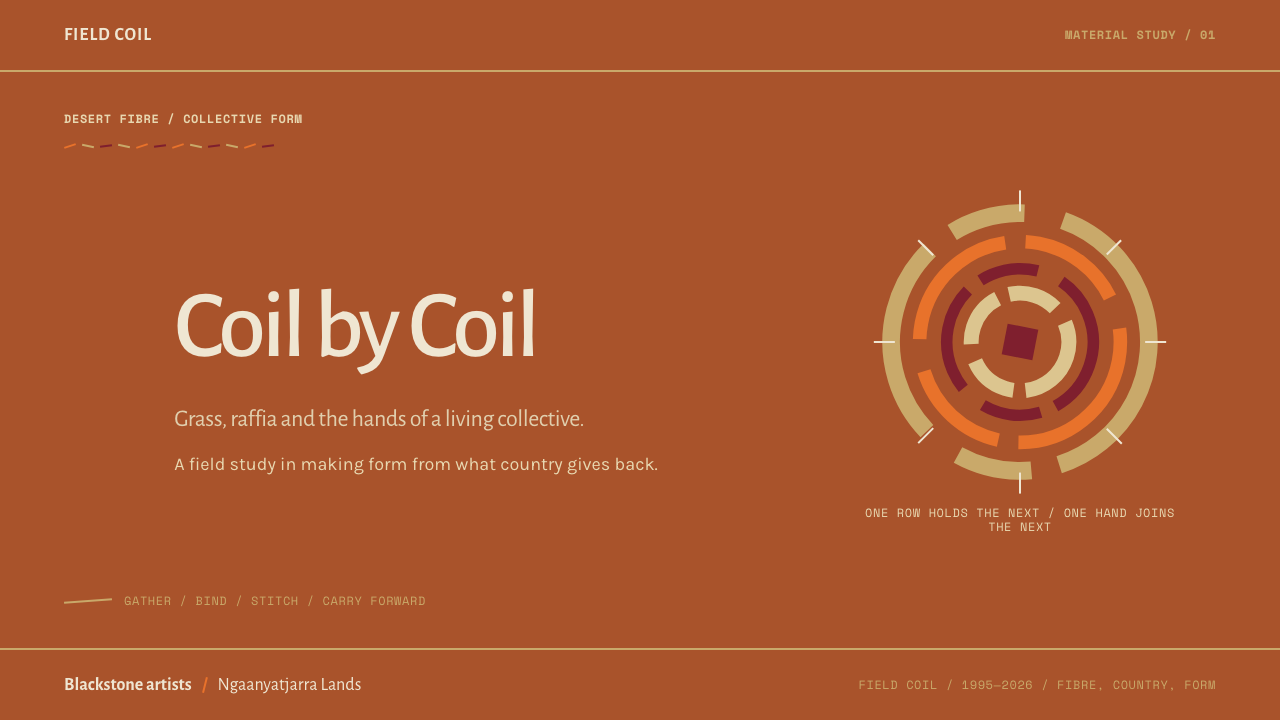
For presentation slides, a cover works best as a large field of oxidised red with a few straw and orange bands running across it, and the title set plainly in straw tones. Content slides should keep the ground and use a single band as the divider between heading and body. Data slides suit the system well, because bars are already bands: draw them as flat segments of straw, orange and deeper red with no gradient or shadow, leave their ends slightly irregular, and put the source and author line directly beneath the chart.
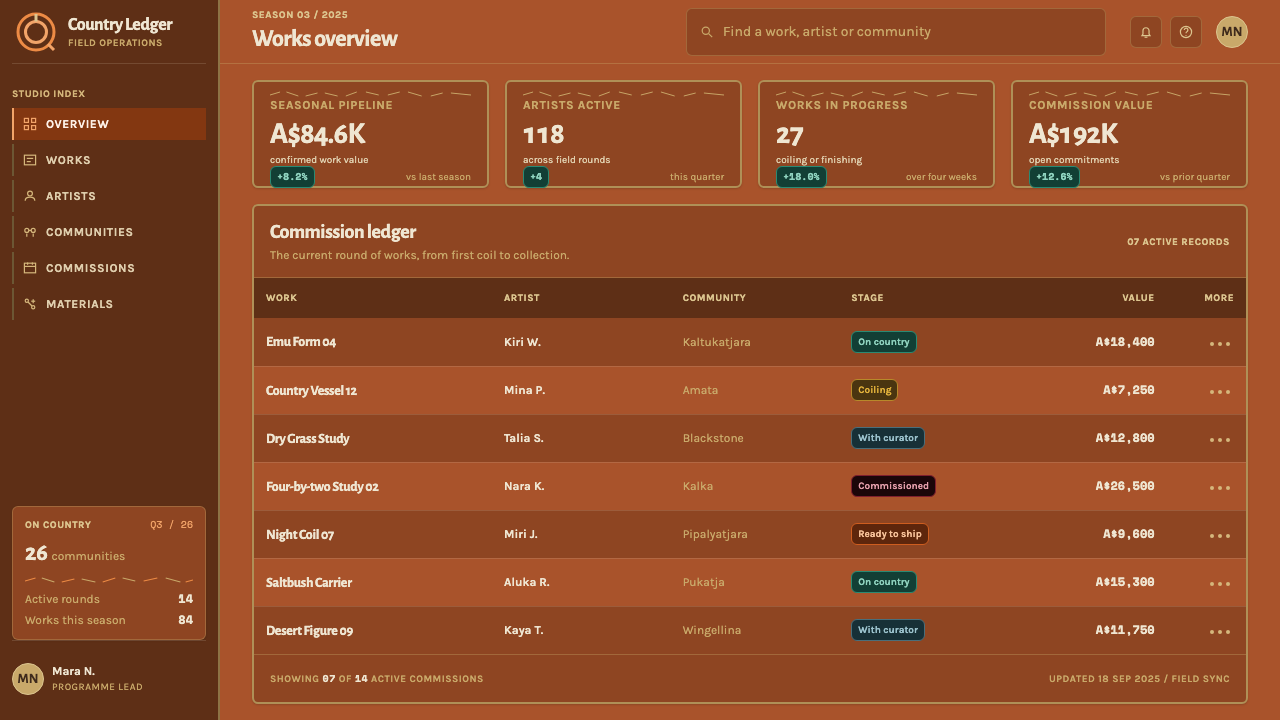
For web interfaces, the style fits portfolio, shop and about pages more naturally than dense dashboards. On a pricing or catalogue page, show each item as a block on the red ground with a clear band of color for the category, and give every entry its credit line. Buttons should be flat and unglossy; focus and hover states can be a change of band color rather than a glow. Avoid drop shadows altogether, since nothing in a coiled basket floats above its surface.
For editorial and marketing work, the system rewards long-form storytelling. A feature article can alternate wide color bands with narrow columns of text, run the maker's name as a standing element in the byline area and treat photographs as sitting directly on the red ground. Campaign pages can repeat a single band motif as a rhythm device, letting the thickness vary slightly from one repeat to the next so it stays hand-made.
The most common mistake is to keep the palette and drop the ethic. A red-and-orange page with perfectly equal stripes, a glossy gradient and no credit to any maker is a costume, not this style. A second mistake is to import imagery or patterns that belong to other cultures or to sacred story, or to imitate painting rather than fibre. The system is about coil, band, material honesty and attribution; keep to those and the result stays respectful and recognisable.
Tjanpi Desert Weavers — FAQ
What does 'tjanpi' mean?
Tjanpi is Pitjantjatjara for dry desert grass. It names the raw material the weavers gather on country and bind into coiled bundles, and it gives the enterprise, Tjanpi Desert Weavers, its name. In design terms it also names the palette: the colors come from the grass, the red soil and the dyed raffia the work is made from.
Is this the same as Aboriginal dot painting?
No. Tjanpi Desert Weavers is a fibre tradition built on coiled basketry, not a painting tradition. Its visual language comes from material and construction: bundled grass, stitched coils, bands of dyed raffia and wool, fibrous edges. A design built on it should borrow those structural ideas and the habit of crediting the makers, not imitate dotted or story-bound imagery that belongs to other practices.
Why bands instead of gradients?
Because bands describe how the object is made. A coil of dyed raffia shows one color, then another, with a clear edge where the thread changes. A gradient would import the logic of simulated light, which the system does not use. Bands also reproduce reliably across print, screen and small sizes, and they let color signal structure and category instead of mood.
Does the style work as a dark layout?
Yes, it is built as a dark system. The ground is a deep, earthy red that stands for oxidised soil, and the lighter straw and orange bands lift off it. The key is to keep the ground warm and mineral rather than turning it into neutral black, and to use the straw tones for text so that the contrast stays soft and readable.
When does Tjanpi Desert Weavers struggle?
It struggles where a product wants cold precision, anonymity or the sheen of a high-tech brand: fintech dashboards, security tools, anything that depends on a glossy, frictionless surface. It also struggles when the credit line cannot be kept, since attribution is part of the style and not a decoration. Where makers, provenance and materials are the story, it is among the most distinctive choices available.
Related design styles
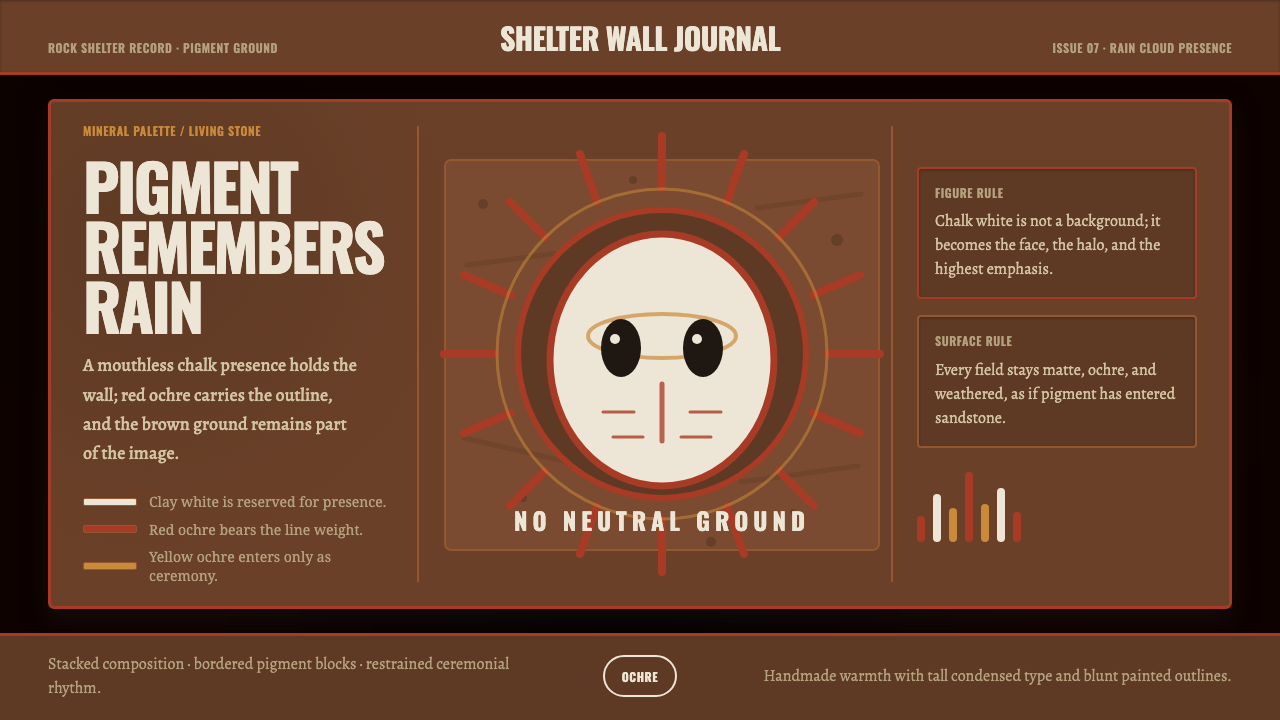 Aboriginal Wandjina KimberleyAncestral presence in stone. Chalk white haloes and red ochre outlines sit on…
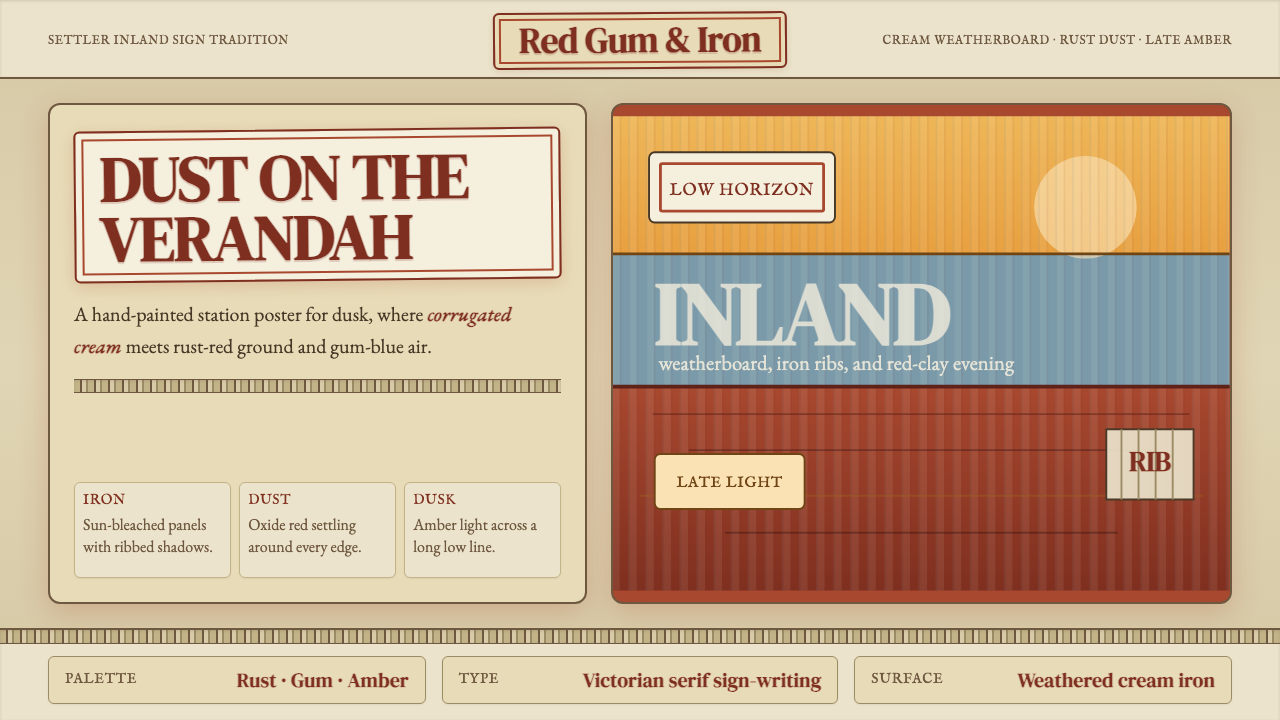 Australian Outback VernacularWeather is the voice. Rust dust, gum-blue bands, and serif sign-writing age t…
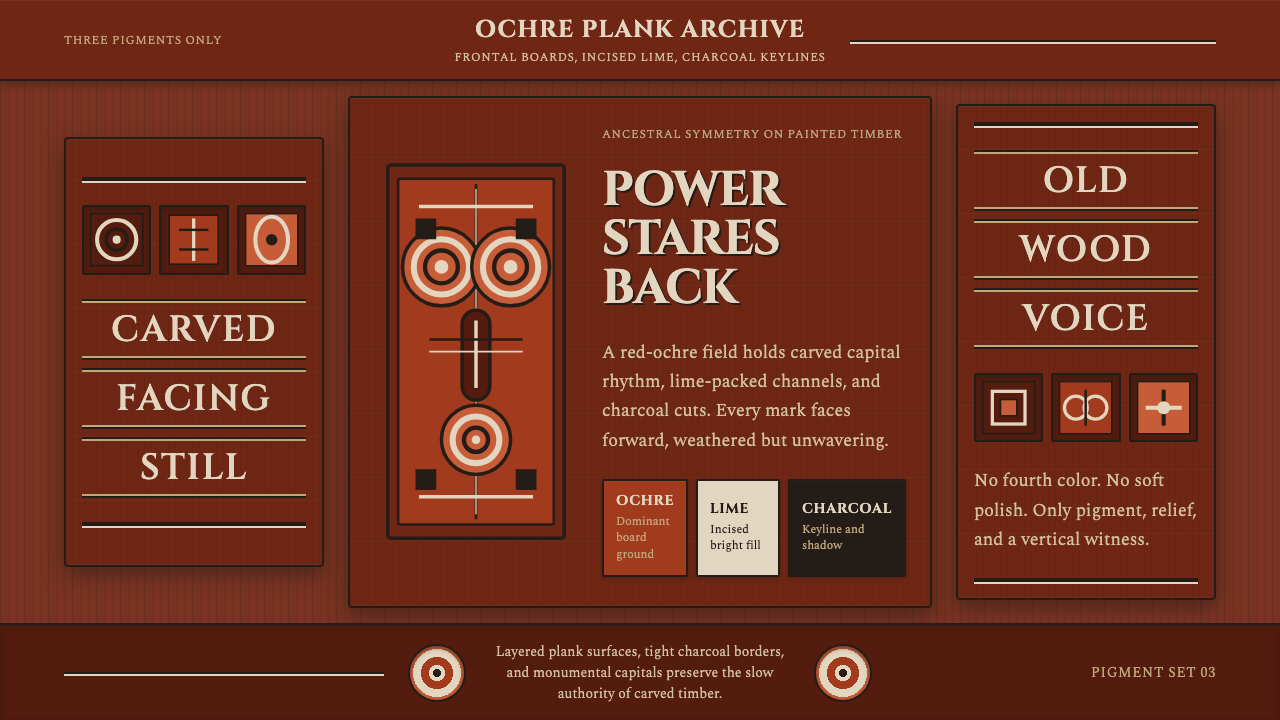 Sepik Spirit BoardThree-pigment power. Ochre, lime, and charcoal lock into frontal carved symme…
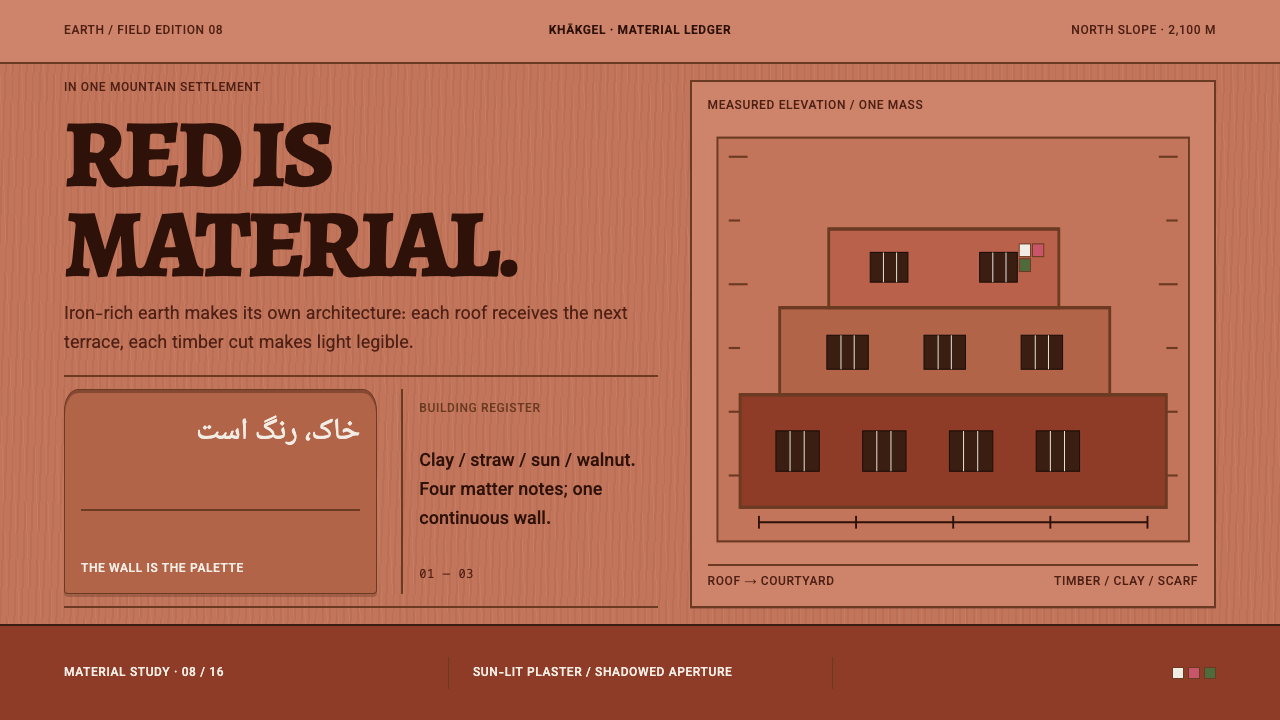 Abyaneh Red VillageRed is material, not decoration. Stepped clay bands and dark timber apertures…
 Autumn Momiji 紅葉Stillness catches fire. Momiji gradients burn against chestnut timber and wid…
 Bangladeshi Jute CraftMemory stays stitched. Jute green, indigo borders, terracotta warmth.