What is Saigon Street-Food Brand?
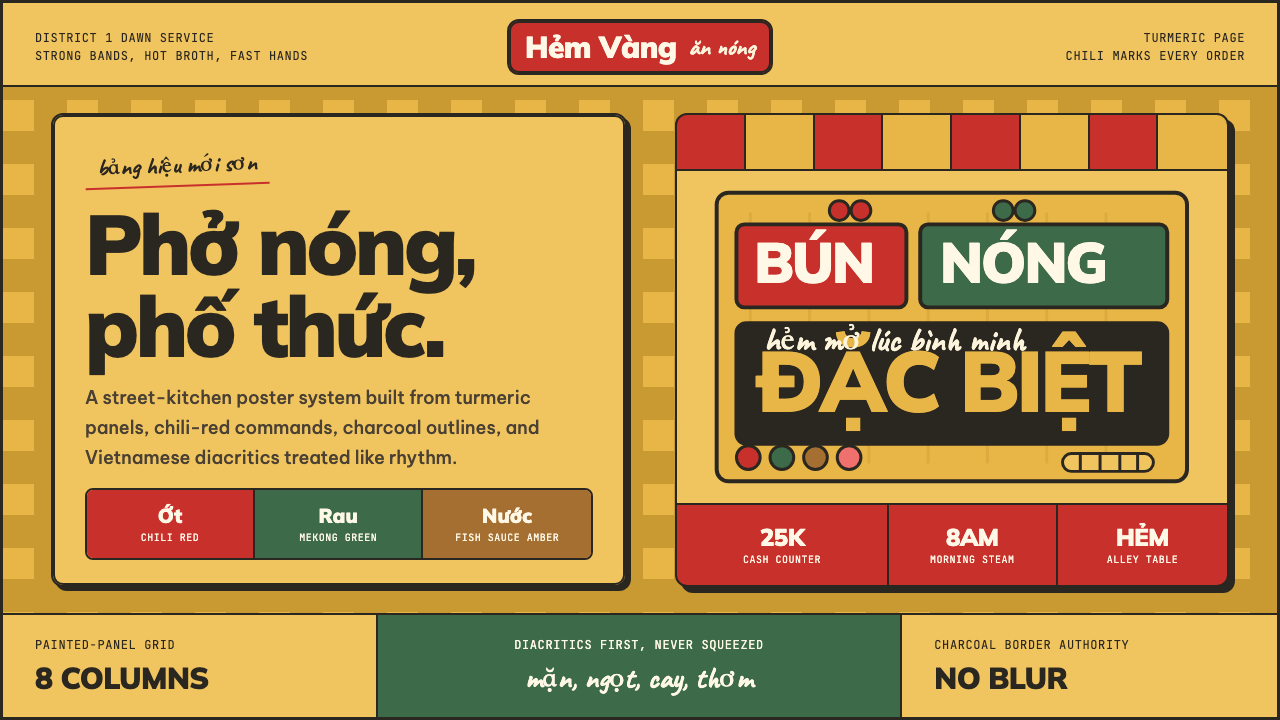
Saigon Street-Food Brand distills the sensory intensity of a District 1 dawn alley — turmeric steam, chili-red stools, and hand-painted Vietnamese diacritics — into a disciplined modern design language that is warm, bold, and unmistakably rooted in place.
Saigon Street-Food Brand in brief
Saigon Street-Food Brand is a contemporary Vietnamese design aesthetic that emerged from Ho Chi Minh City's F&B branding renaissance between roughly 2018 and 2024. It translates the raw visual energy of the city's street-level food culture — makeshift banners, hand-lettered signage, the saturated warmth of market stalls lit by morning sun — into a coherent design system suitable for modern restaurants, packaging, and digital interfaces.
The style is defined by three dominant forces acting in concert. Saturated turmeric yellow serves as the primary ground — the color of pho broth, of tamarind paste, of the particular afternoon light filtering through corrugated awnings. Against that warmth, chili red appears as a signal color: urgent, appetitive, directional. Black-pepper charcoal anchors hierarchy, giving the system its street-authority and legibility. Together these three values replicate the chromatic experience of a Saigon market stall without resorting to nostalgia or pastiche.
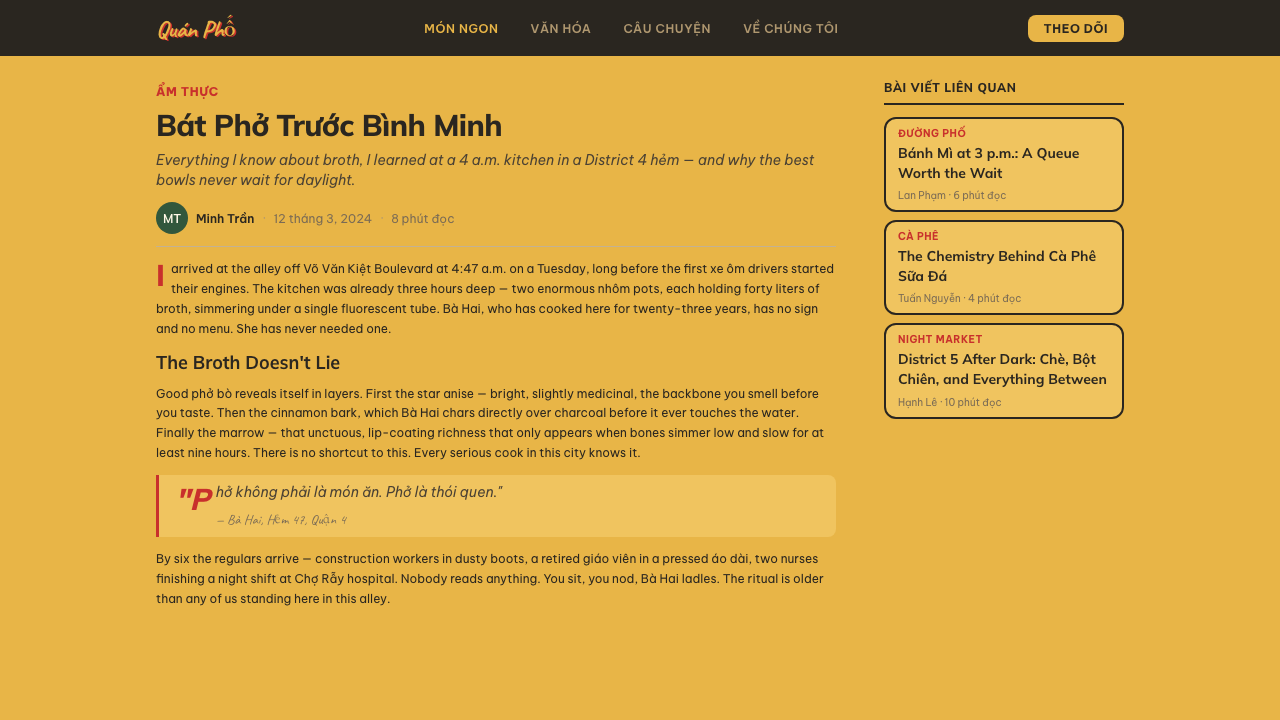
What distinguishes this aesthetic from generic 'tropical' or 'Southeast Asian' design is its specific engagement with Vietnamese typography. The Vietnamese writing system, with its elaborate system of tonal diacritics stacked above and below base vowels, creates a visual rhythm unlike any other Latin-derived script. Saigon Street-Food Brand treats these diacritics not as a technical constraint to be managed but as a primary visual asset — marks whose density and verticality give headlines a musicality and weight that plain Latin text cannot achieve.
Where does Saigon Street-Food Brand come from?
The roots of this aesthetic reach back to French colonial Saigon, where the administration built covered markets — the Bến Thành, the Bình Tây — that became permanent fixtures of the city's food culture. French colonial signage mixed Latin letterforms with Vietnamese diacritics in ways that were initially awkward but over generations produced a hybrid visual language: bold, compressed, layered with chromatic contrast. Mid-century Vietnamese propaganda poster design, which emphasized flat color fields and stark typographic hierarchy for mass legibility, further codified the chromatic authority that contemporary practitioners would later draw on.
The immediate context for the style's emergence was the rapid expansion of Ho Chi Minh City's middle class and tourism economy from the 2010s onward. As international visitors flooded the city and a generation of Vietnamese consumers with global design awareness came of age, demand surged for F&B brands that could project authenticity without looking unreconstructed. Shophouses in Bình Thạnh and District 3 became home to independent studios seeking a visual language that was distinctly Vietnamese rather than a regional variant of Scandinavian minimalism or generic Asian modernism.
The Saigon studio ecosystem was central to codifying the style. Rice Creative, founded by Joshua Breidenbach and Quinta Cohn, brought a rigorous craft sensibility to Vietnamese clients beginning in the mid-2000s, establishing standards for typography, print finish, and material weight that rippled through the broader scene. Bratus, the studio of Đinh Anh Huân, pushed a more maximalist and playfully layered version of Vietnamese graphic language, one that embraced the graphic noise of market signage rather than editing it away. Yosuke Masuko, working across Ho Chi Minh City and Tokyo, contributed a perspective that treated the city's visual density as a resource rather than a problem to solve.
By approximately 2020, enough work had accumulated — in restaurant identities, craft-beer labels, hospitality packaging, and boutique hotel graphics — that a legible house style had crystallized. The 2018–2024 window represents not the invention of Vietnamese graphic design but a specific moment when international visibility, local craft infrastructure, and a shared set of aesthetic commitments converged into something replicable and teachable. Digital platforms, particularly Instagram and Behance, accelerated the crystallization by giving studios access to a global audience and giving that audience access to a coherent body of work.
What defines the Saigon Street-Food Brand look?
Color: Turmeric, Chili, Charcoal
The palette is anchored by three values that map directly onto the sensory vocabulary of Vietnamese street food. Turmeric yellow — warm, slightly orange-shifted, intensely saturated — dominates as the primary ground and background, evoking the color of broth, spice paste, and market-stall lighting. Chili red appears as the action and accent color: vivid, appetitive, carrying the urgency of a freshly painted restaurant sign. Black-pepper charcoal — a deep, dense dark that is not quite neutral black — grounds type and structural elements. These three are used in high-contrast combinations; they are never dulled to pastels or neutralized to earth tones. The system reads as warm without being soft.
Vietnamese Diacritics as Visual Rhythm
Vietnamese orthography uses six tonal diacritics that appear above and below vowel characters, creating vertical complexity that is entirely absent from unaccented Latin text. In Saigon Street-Food Brand, this complexity is embraced as a primary design asset rather than accommodated as a constraint. Headlines set in Vietnamese have a natural density and visual musicality — the stacked marks create a rhythm across the top of a word that Latin headlines cannot replicate. Large-scale display type exploits this density deliberately, treating the mark-rich upper zone of the letterforms as a textural field.
Hand-Painted Signage Influence
The style carries a deliberate reference to the hand-painted market signs that characterize Ho Chi Minh City's commercial streetscape. This influence manifests as a controlled imprecision: letterforms that acknowledge human gesture rather than demanding geometric perfection, layouts where overlapping elements and tight spacing evoke the compressed energy of a stall banner rather than the ordered white space of a European editorial. The imprecision is never sloppiness — it is a specific visual register that communicates immediacy and authenticity, the sense that this brand exists in real physical space rather than in a design system.
Material Weight and Tactility
Saigon Street-Food Brand is intimately connected to print and physical materials. The style developed in an environment of restaurant menus, paper bags, tissue wrapping, and ceramic tableware — objects that are handled rather than merely viewed. This origin shapes the aesthetic's relationship to texture: uncoated paper stocks, slight ink spread at the edges of large type, the bleed and imperfection of flexographic printing on kraft — all read as authentic rather than as errors to be corrected. On screen, the style references this physicality through deliberate choices: no smooth gradients, no sterile white backgrounds, slight tonal warmth in what might otherwise be neutral grounds.
Bold Hierarchy Without Formalism
The typographic and compositional hierarchy in Saigon Street-Food Brand is strong — there is never ambiguity about what is the headline, what is the price, what is the supporting information. But this hierarchy is achieved through energy and contrast rather than through rigid formal systems. Section breaks are marked by dense rules, decorative devices borrowed from Vietnamese printing traditions, or chromatic shifts rather than by the mathematical grid logic of Swiss design. The composition breathes through dynamic tension rather than through generous margin. The result feels organized but not sterile — legible but alive.
Cultural Specificity as Brand Equity
A defining characteristic of the style — and the value proposition of the studios that developed it — is the conviction that cultural specificity is an asset rather than a limitation. Where global F&B design often moves toward universalism (clean sans-serifs, neutral palettes, geometry that could read as anything from Seoul to São Paulo), Saigon Street-Food Brand moves in the opposite direction, deepening its Vietnamese-ness: referencing specific regional color traditions, engaging with the particularities of the Vietnamese script, and drawing on imagery and material references that cannot be extracted from their geographic origin without losing their meaning.
Layering and Density
Rather than the generous white space and single-focal-point composition favored by much contemporary premium design, Saigon Street-Food Brand embraces a layered density that mirrors the visual environment it references. Multiple information elements coexist on the page — a background texture, a bold typographic field, a price callout, a decorative rule — without canceling each other out. The discipline lies not in reduction but in calibration: each layer is assigned a clear chromatic or tonal register that prevents the composition from collapsing into visual noise. The density reads as abundance rather than clutter.
Who shaped Saigon Street-Food Brand?
Rice Creative, founded in Ho Chi Minh City by Joshua Breidenbach and Quinta Cohn, became one of the most internationally recognized Vietnamese design studios of its generation. Their work — for clients spanning craft spirits, hospitality, and cultural institutions — established a standard for typographic rigor and material craft in Vietnamese F&B branding that the broader studio ecosystem oriented itself against. Rice's characteristic approach combined European modernist discipline with Vietnamese cultural references, producing work legible both to international design audiences and to local consumers for whom the references carried genuine weight.
Đinh Anh Huân founded Bratus as a creative studio that occupied a different pole from Rice Creative's restrained modernism. Bratus work is characteristically maximalist, layered, and energetically referential to the graphic noise of Vietnamese street culture — hand lettering, overlapping information, dense color, the compressed visual field of a market stall. Where Rice tends toward refinement, Bratus tends toward exuberance. Together the two studios defined a productive range within the Vietnamese contemporary graphic design scene, demonstrating that the aesthetic could sustain both registers.
Yosuke Masuko worked across Ho Chi Minh City and Tokyo, bringing a cross-cultural perspective that treated the visual density of Vietnamese cities as a resource to be organized rather than noise to be suppressed. His contribution to the emerging style was partly methodological: he developed visual systems that could hold the density, layering, and chromatic intensity of Vietnamese street culture within structured design frameworks capable of scaling to digital interfaces and international brand contexts. His Tokyo background gave him fluency in Asian design systems that neither Europeanize their source material nor reduce it to folkloric surface.
Beyond individual studios, the emergence of Saigon Street-Food Brand as a legible style was a collective achievement of a dense urban design ecosystem. The proliferation of independent restaurants, craft-beer bars, boutique hotels, and coffee-third-place culture in Ho Chi Minh City during the 2010s created unprecedented local demand for original brand identities rather than generic signage. This demand funded a generation of Vietnamese designers trained partly abroad and partly through the city's own expanding design education infrastructure, whose work appeared simultaneously on Instagram, on Behance, and on the walls of District 1 shophouses.
The anonymous tradition of Vietnamese colonial-era print culture — the market signmakers, the handbill printers, the shop-front calligraphers of French Indochina — functions as a collective historical figure behind the contemporary style. These practitioners developed the hybrid Latin-Vietnamese typographic register over generations, finding solutions to the problem of rendering a tonal diacritic-rich script in condensed commercial contexts. The bold, compressed, high-contrast visual language they produced was not designed as style but as practical adaptation. Contemporary practitioners consciously reference and recontextualize this inheritance rather than treating it as historical raw material to be upgraded.
How do you use Saigon Street-Food Brand today?
Saigon Street-Food Brand is one of the most directionally clear design systems for food, hospitality, and culture-forward consumer brands because its aesthetic values are not merely decorative but structurally motivated. Applying it correctly requires understanding the system's internal logic: the palette communicates warmth and intensity, the typography treats diacritics as a rhythmic asset, and the layered density signals abundance and authenticity rather than complexity for its own sake.
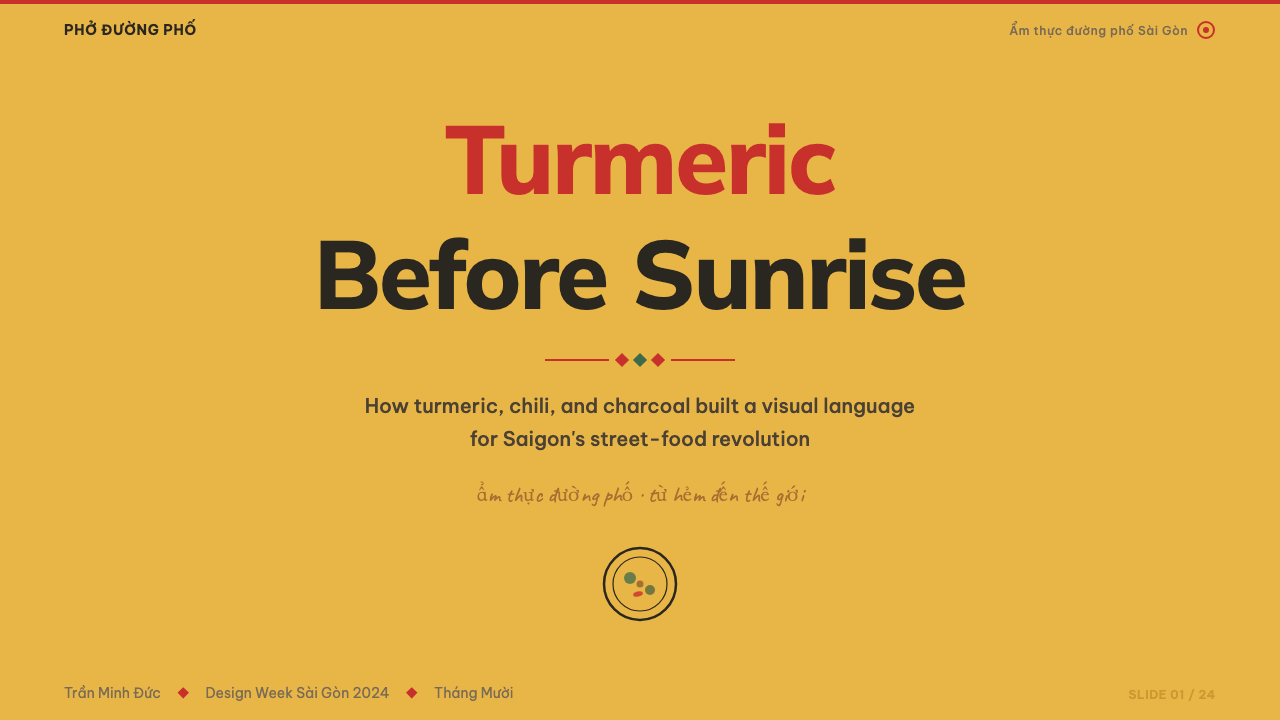
For presentation slides, the style works best when the cover commits fully to the palette: a deep turmeric ground with a bold Vietnamese or bilingual headline, the diacritics given space to read at scale. Content slides benefit from treating each slide as a restaurant menu section — strong typographic hierarchy with one organizing element per slide (a price, a percentage, a claim), and a chili-red accent reserved for the most important number or call to action. Data slides can take on the diagrammatic energy of market signage: bars and segments in turmeric and charcoal, red reserved for the outlier or the target. Resist the temptation to add photographic texture — the palette is already doing the sensory work.
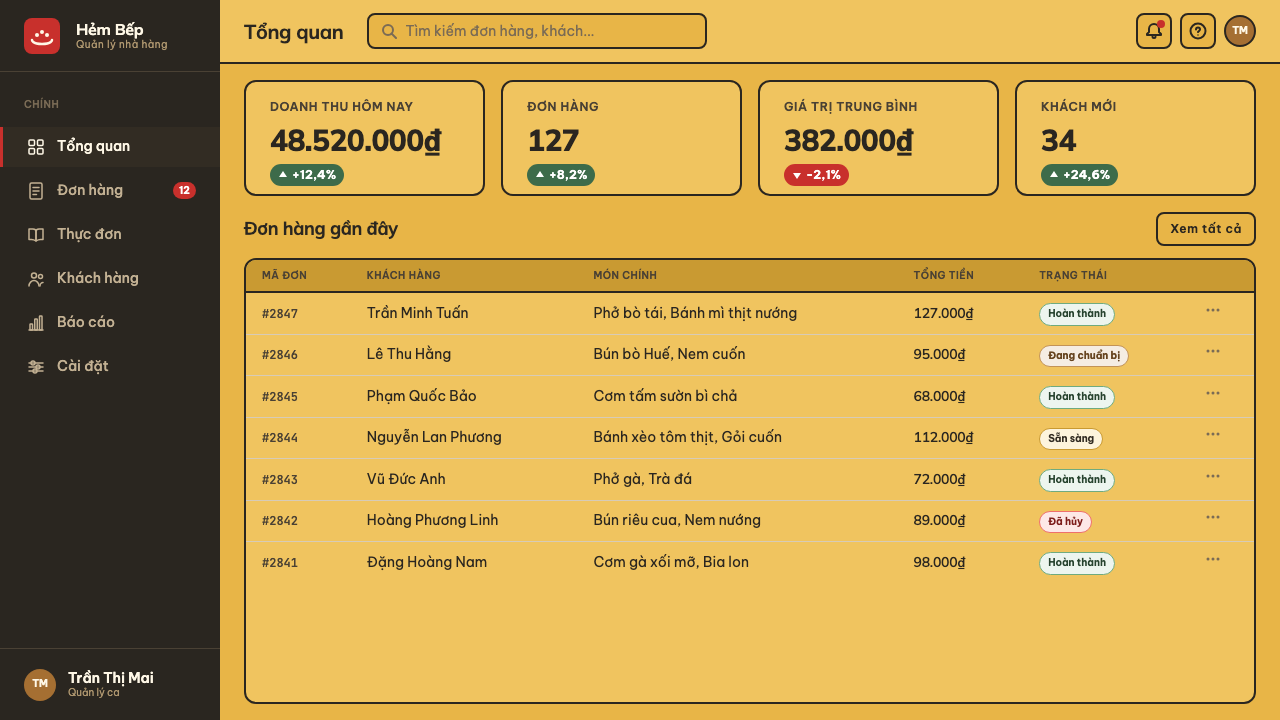
For web interfaces, Saigon Street-Food Brand translates well to restaurant booking flows, delivery platforms, and food-media editorial contexts. Dashboards benefit from the strong color-hierarchy: turmeric as the primary brand field in headers and key metric tiles, charcoal for body and navigation, red for alerts and action buttons. Pricing pages carry the style's poster-energy well, with full-width tier cards alternating between turmeric-on-charcoal and charcoal-on-cream, red reserved for the recommended tier. The style is less suited to contexts requiring neutrality — analytics platforms, enterprise software, or any interface where the warm saturated palette would create cognitive friction in extended use.
For editorial and marketing work, the style has natural affinity with food journalism, travel content, cultural coverage, and brand identity projects for restaurants and markets. Editorial layouts benefit from using the diacritic-rich headline as a primary visual element, leading the page with scale and texture before the body copy begins. Marketing pages for restaurants can use the compressed layering of the style to pack value into a small space: hours, signature dishes, a location call-out, and a reservation prompt can coexist on a single block if organized by the system's clear chromatic hierarchy.
A common mistake is applying the palette without understanding its temperature logic. Turmeric and chili red are both warm, and when used at high saturation in equal proportion they flatten into undifferentiated heat — the system loses its hierarchy. The correct approach is to treat turmeric as the ambient temperature (the background condition) and chili as the spike (the exception that reads against the field). Similarly, reproducing the visual density of the style without the underlying organizational logic produces clutter rather than abundance. Layering works when each layer has a clear register — background, mid-field, foreground — and occupies it consistently.
Saigon Street-Food Brand — FAQ
Is Saigon Street-Food Brand appropriate for non-food brands?
The style can extend beyond food contexts, but it requires careful judgment. The chromatic warmth and material density of the aesthetic work well for any brand where sensory abundance and cultural rootedness are desired values — travel, music, cultural events, artisan goods, lifestyle retail. It is less suited to categories where the palette's appetitive warmth would create tonal friction: financial services, healthcare, professional services, or enterprise software. The key question is whether the warmth and density serve the brand's communication goals or work against them. A craft-beer brand benefits from the same visual register as a pho restaurant; a legal firm or a data platform typically does not.
How do I use this style if my text is in English or another non-diacritic-heavy language?
The diacritic-rhythm quality is the most culturally specific element of the style, and it cannot be fully replicated in English. However, the other characteristics — the chromatic warmth, the layered density, the material texture, the bold hierarchy — transfer cleanly to any language. English-language work in this style should compensate for the loss of diacritic texture by leaning into scale contrast and weight: larger, bolder headlines set more tightly than convention would suggest, complemented by the strong chromatic field. The decorative elements drawn from Vietnamese printing traditions — dense rules, layered frames, typographic ornaments — provide visual rhythm independent of the script.
Does the style work on light backgrounds as well as dark?
The canonical Saigon Street-Food Brand is warm-ground: turmeric or cream as the primary background, with charcoal and chili as foreground. An inversion to a dark ground — charcoal as background, turmeric or cream as type — is possible and works well for evening contexts, premium packaging, or occasions where the brand wants to project authority rather than warmth. On a dark ground, turmeric functions almost as a light source: warm, glowing, high-contrast against the charcoal. Chili red on dark grounds should be used sparingly — it can read as aggressive at high saturation against dark. The key is that the inverted version should feel like a deliberate nighttime interpretation of the same palette, not a different visual system altogether.
How does Saigon Street-Food Brand relate to other Southeast Asian design styles?
Southeast Asian design is enormously varied, and Saigon Street-Food Brand is a specifically Vietnamese aesthetic rather than a regional generalisation. It shares with Thai, Indonesian, and Malaysian contemporary F&B design a preference for warm saturated palettes and cultural specificity, but it differs in the role of script: the Vietnamese Latin alphabet with diacritics creates fundamentally different typographic possibilities than Thai, Burmese, or Javanese scripts, which have their own visual rhythms. Designers working across Southeast Asia often note that the Vietnamese style is uniquely accessible to non-Vietnamese designers precisely because it uses a Latin-derived alphabet — the typographic mechanics are familiar even as the cultural referents are specific.
Is this style suitable for digital-first brands, or is it primarily a print and physical-packaging aesthetic?
The style originated in print and physical materials, and its relationship to tactility — uncoated stocks, ink spread, material warmth — is genuine. However, it has transferred successfully to digital contexts, particularly in restaurant apps, food-delivery platforms, and food-media editorial sites, where the warm palette and visual density create a strong sensory impression on screen. The main adaptation required for digital use is restraint in the use of literal texture: the physicality that in print comes from uncoated paper must on screen be suggested through chromatic warmth and tonal variation rather than through photographic texture overlays. The style also rewards responsive design that scales the hierarchy rather than shrinking it — at mobile sizes, the bold typographic elements remain legible and the chromatic fields remain impactful.
Related design styles
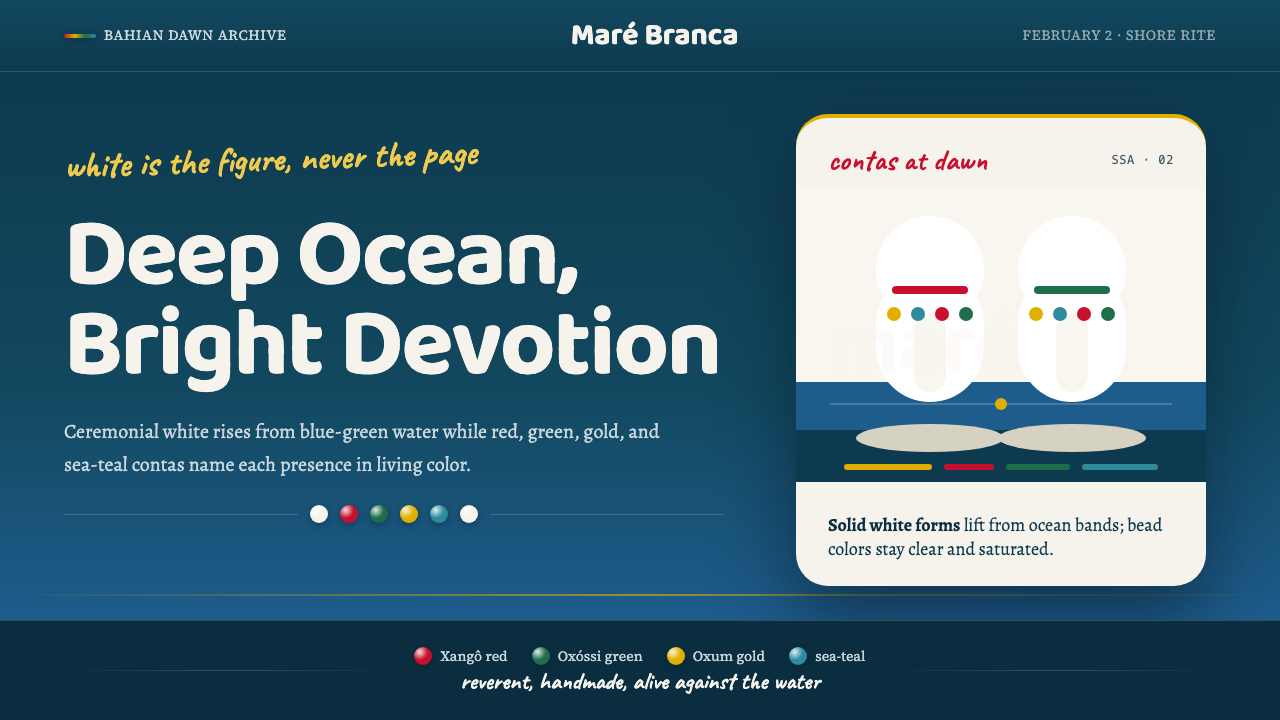 Candomblé OrixáReverent but alive. Ocean blue carries white figures and saturated bead-color…
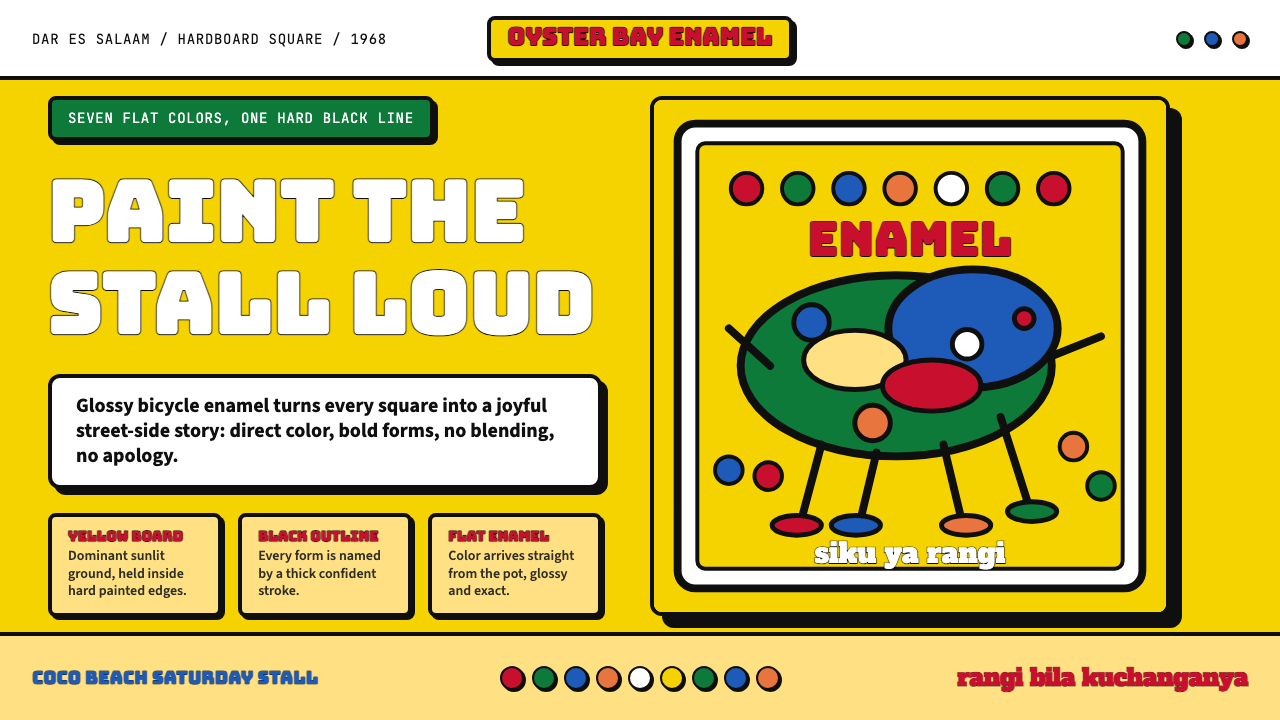 Tingatinga PaintingJoy refuses blending. Enamel yellow, Bungee strokes, and black-outlined flat…
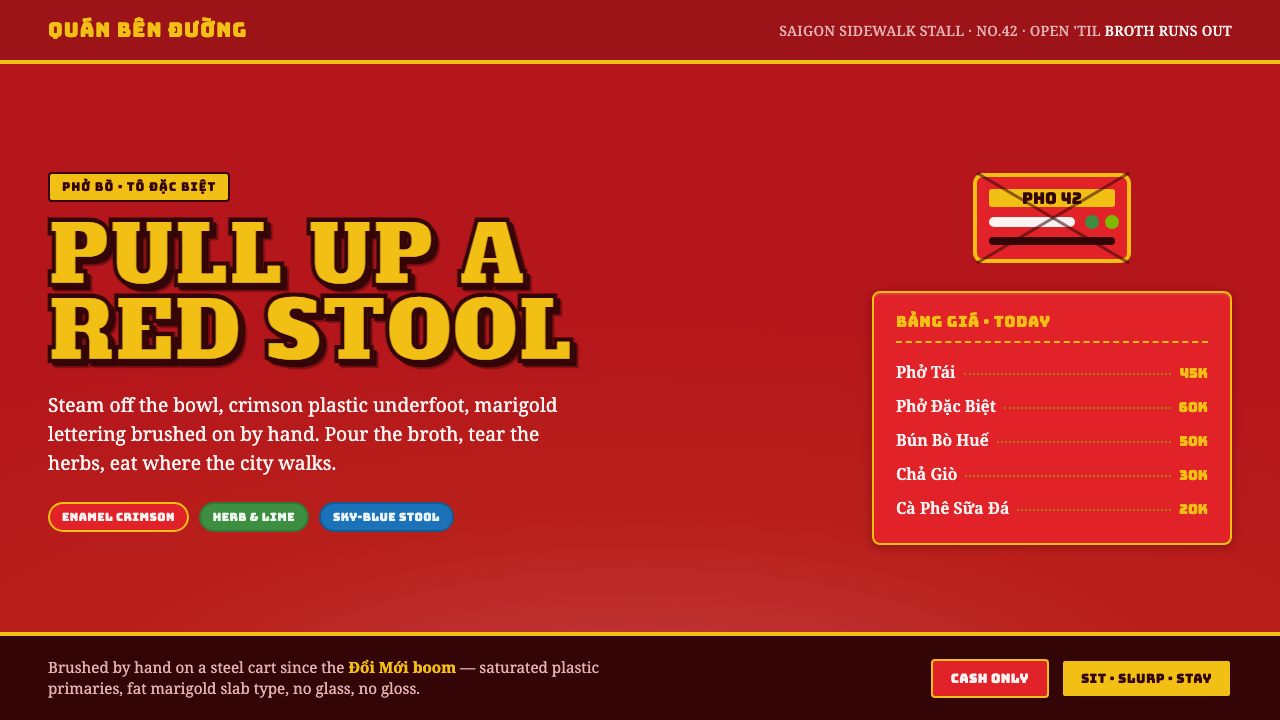 Vietnamese Pho Street CartEat where the city walks. Crimson enamel ground, fat marigold slab signage, b…
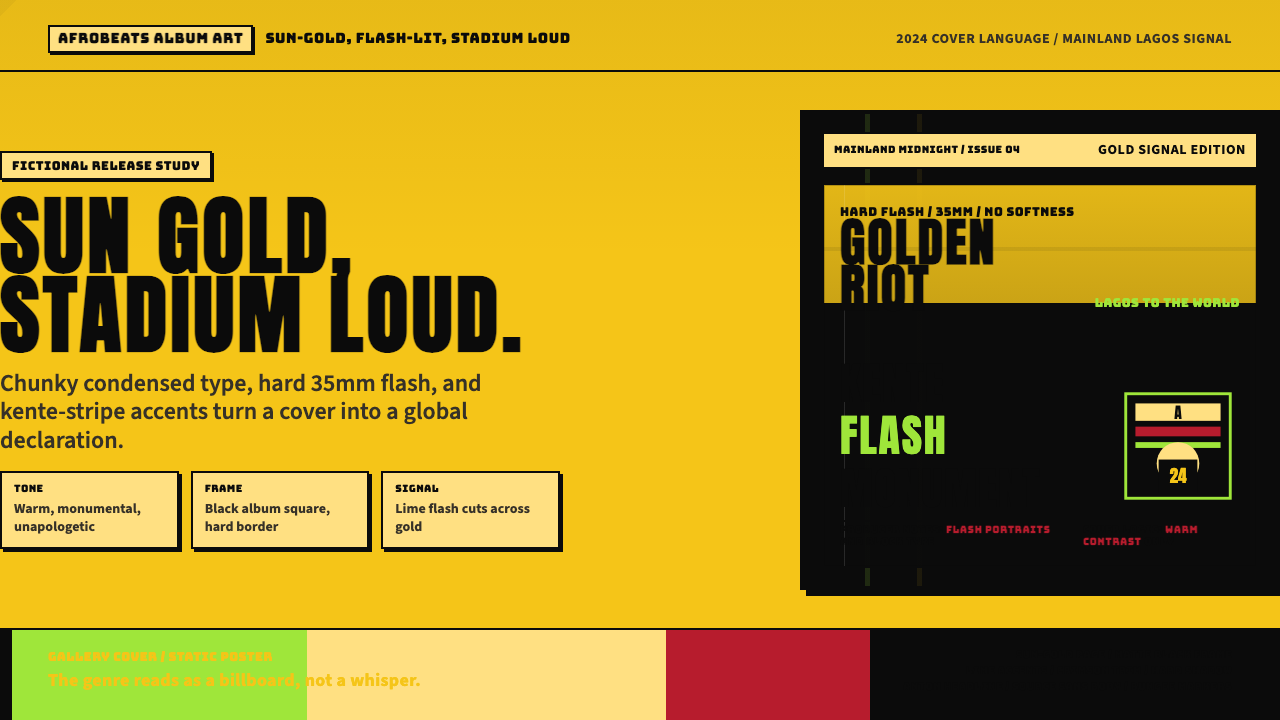 Afrobeats Album Art 2024Sun-gold and stadium loud. Anton type, kente stripes, and hard flash drive th…
 Coca-Cola ClassicHappiness goes full-bleed. Signature red, white ribbon waves, and warm rounde…
 Malagasy Lamba HoanyWords become ornament. Hot fuchsia, saturated print plates and a border that…