What is Uzbek Adras & Atlas Ikat?
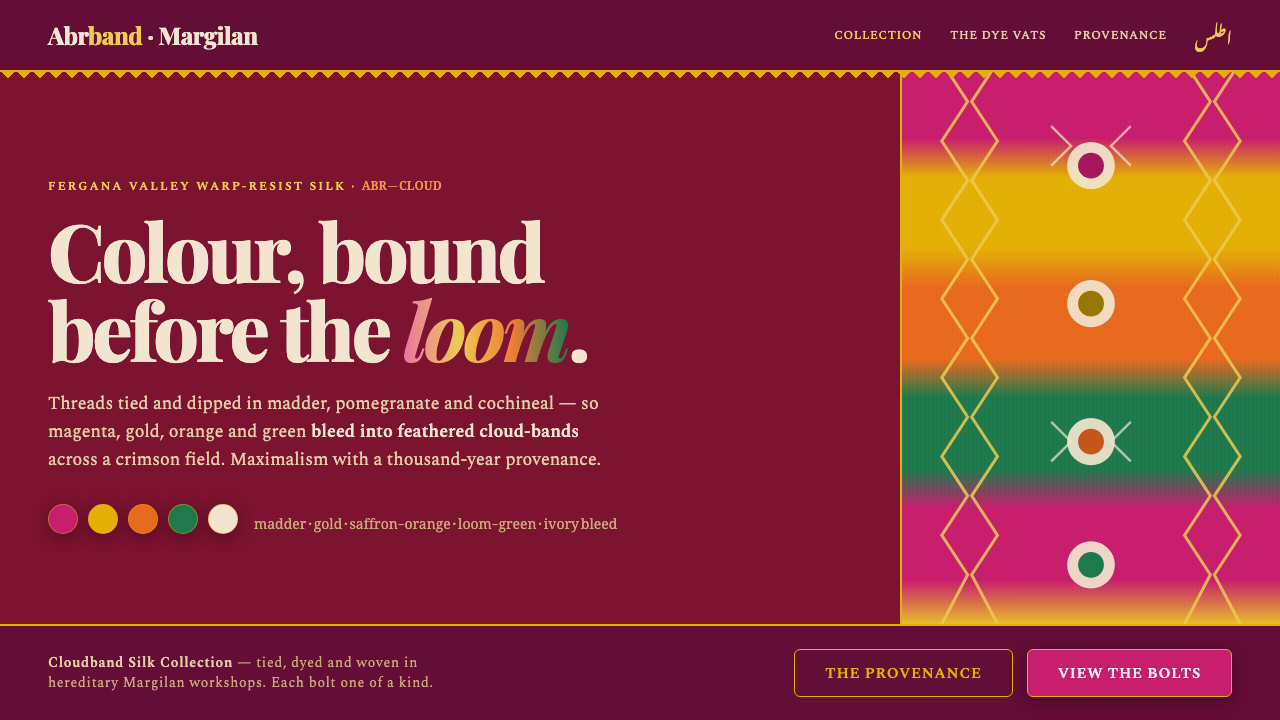
Uzbek adras and atlas ikat bring colour to the surface before weaving begins — luminous cloud-bands of magenta, gold, orange, and green igniting across a deep crimson field.
Uzbek Adras & Atlas Ikat in brief
Adras and atlas ikat are warp-resist textiles from Uzbekistan’s Fergana Valley. Adras is a half-silk, half-cotton cloth; atlas is pure silk. Their defining visual event happens before the loom: abrband masters bind bundled warp threads, dye them, and release them so colour travels beyond the tied areas. Once those threads are woven, the escaped dye becomes soft-edged abr, or cloud, bands rather than a sharply printed pattern.
The palette is emphatically polychrome. Magenta, golden yellow, orange, and green appear as charged stripes and fields against a deep crimson madder ground. Ivory interruptions emerge along the feathered boundaries where dye has escaped or been held back by the bindings. The result is neither orderly striping nor random marbling. It is a collision of colour with visible tension: bands approach, overlap, taper, and dissolve while remaining bound to the direction of the warp.
On screen, Uzbek adras and atlas ikat should be understood as a system of dyed movement rather than a decorative textile scan. Crimson establishes the field; high-chroma abr bands create the main rhythm; soft, feathered transitions preserve the logic of dye migration; ram’s-horn zigzags connect the composition to its Silk Road weaving lineage. The style is lush and conspicuous, but its boldness comes from disciplined bands of colour rather than indiscriminate visual noise.
Where does Uzbek Adras & Atlas Ikat come from?
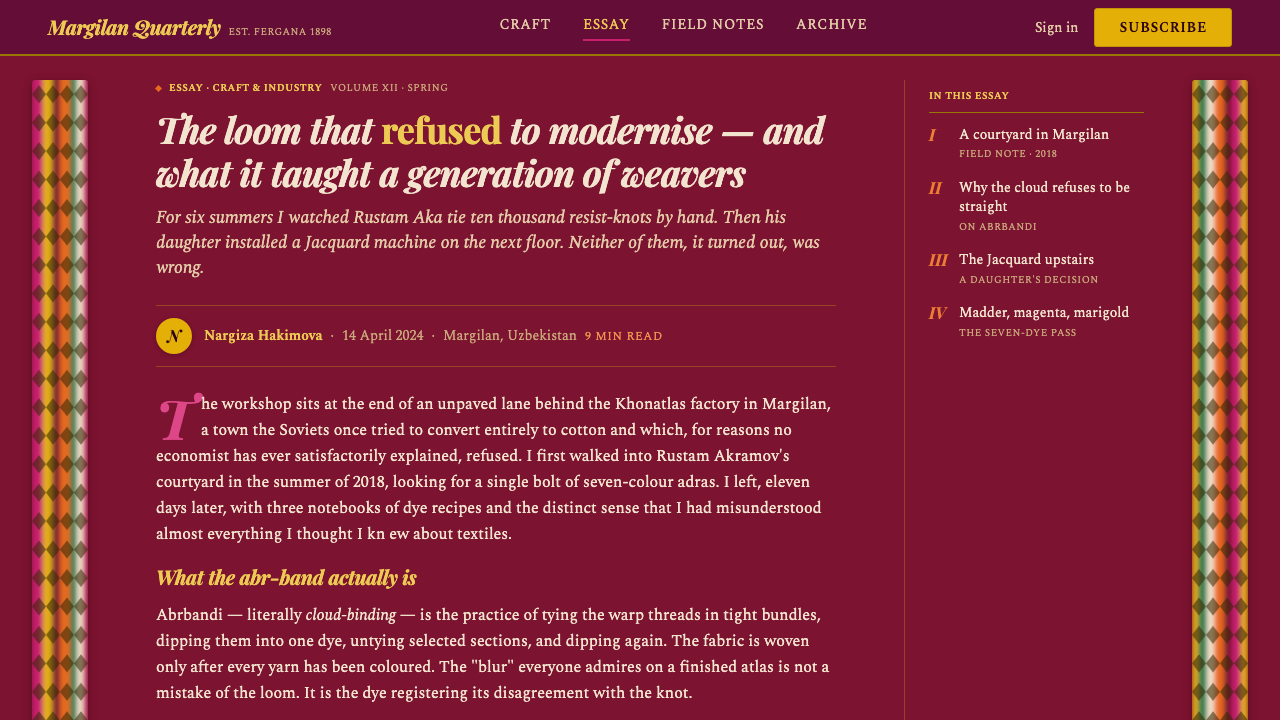
This tradition belongs to Central Asia, specifically Margilan and the Fergana Valley in Uzbekistan. Its public identity is inseparable from warp-resist dyeing: colour is bound into the warp before the textile reaches the loom. That sequence gives the finished cloth its characteristic softened edges, because the pattern is shaped by bundled threads, tied areas, dye, and weaving together rather than added afterward to an already finished surface.
The source material places adras and atlas ikat within a living craft spanning the first half of the twentieth century, with deep roots in the nineteenth century. That description matters because it resists treating the textile as a closed historical style. The visual language carries inherited practice, but it remains grounded in active making by specialist workshops and artisans rather than in a single frozen canonical object.
Margilan abrband master weavers are central to the process. Their work begins with bundled threads and controlled bindings, then moves through dyeing and weaving. The word abr, meaning cloud, is especially revealing: the blurred edge is not a defect to be corrected. It is the desired evidence of colour moving at the limits of restraint, producing bands that appear to breathe across the cloth.
Fergana hereditary dye workshops and Yodgorlik silk artisans locate the tradition within a continuing network of silk knowledge. The broader context is Central Asian ikat, Silk Road textile tradition, and Fergana Valley silk weaving. For contemporary designers, that lineage means the look should retain a sense of material consequence: radiant colour, directional bands, and feathered boundaries should feel like outcomes of tied and dyed threads, not generic digital decoration.
What defines the Uzbek Adras & Atlas Ikat look?
Crimson Ground
A deep crimson madder field gives the system its density and confidence. It is not a neutral backdrop waiting to be filled; it is an active ground against which gold, magenta, orange, and green become more luminous. Large areas of crimson should remain visible so the brighter bands feel embedded in a textile field rather than scattered across an empty interface.
Abr Cloud Bands
The central motif is the abr band: a lengthwise field of colour whose edges soften, fray, or bloom instead of ending cleanly. These bands should travel with purpose across the composition. Their irregularity is directional, not chaotic, because it derives from bundled warp threads and the migration of dye around bindings.
Feathered Dye Edges
Feathered ivory edges are essential to the look. They mark the places where dye has escaped its bindings and therefore preserve the sense of process. A transition should feel absorbent and fibrous rather than mechanically blended. The boundary is a visible negotiation between held colour and released colour.
Polychrome Collision
Magenta, golden yellow, orange, and green are strongest when treated as adjacent forces rather than isolated accents. Their intensity comes from contrast against crimson and from their encounters with one another. Use each colour as part of a band system, allowing one hue to lead while another interrupts, narrows, or emerges through a softened edge.
Lustre and Saturation
Atlas is pure silk, and the overall visual character is luminous and lustrous. Digital work should preserve this feeling through depth of colour and generous tonal bloom, not through metallic simulation or glossy ornament. The effect should suggest silk catching light through dye-rich fibres: radiant, soft at the edges, and unashamedly vivid.
Ram’s-Horn Zigzag
Ram’s-horn zigzag motifs provide a structural counterpoint to the cloudlike bands. Their angular rhythm can frame, divide, or redirect attention without interrupting the textile atmosphere. They work best as a recurring woven signal: firm enough to give the composition a lineage, restrained enough that the abr bands remain the visual protagonist.
Who shaped Uzbek Adras & Atlas Ikat?
Margilan abrband masters embody the defining knowledge of the tradition: binding and dyeing bundled warp threads before weaving. Their process produces the abr cloud bands that distinguish adras and atlas ikat from surface-applied pattern. In a design interpretation, their role should be remembered through directional colour, controlled irregularity, and edges that reveal the history of dye meeting restraint.
The hereditary dye workshops of the Fergana Valley represent continuity in colour knowledge. Within this visual system, colour is not an interchangeable palette selection; it is bound to process, fibre, and sequence. Their presence anchors the style in the practical intelligence of preparing threads so that vivid fields and pale escaped edges can coexist after weaving.
Yodgorlik silk artisans stand for the silk-making dimension of the tradition. Their inclusion keeps attention on material character: adras and atlas are not abstract patterns but luminous cloths whose colour, softness, and visual richness arise through silk and weaving. Contemporary work inspired by them should favour a sense of fibre-bound radiance over flat ornamental repetition.
How do you use Uzbek Adras & Atlas Ikat today?
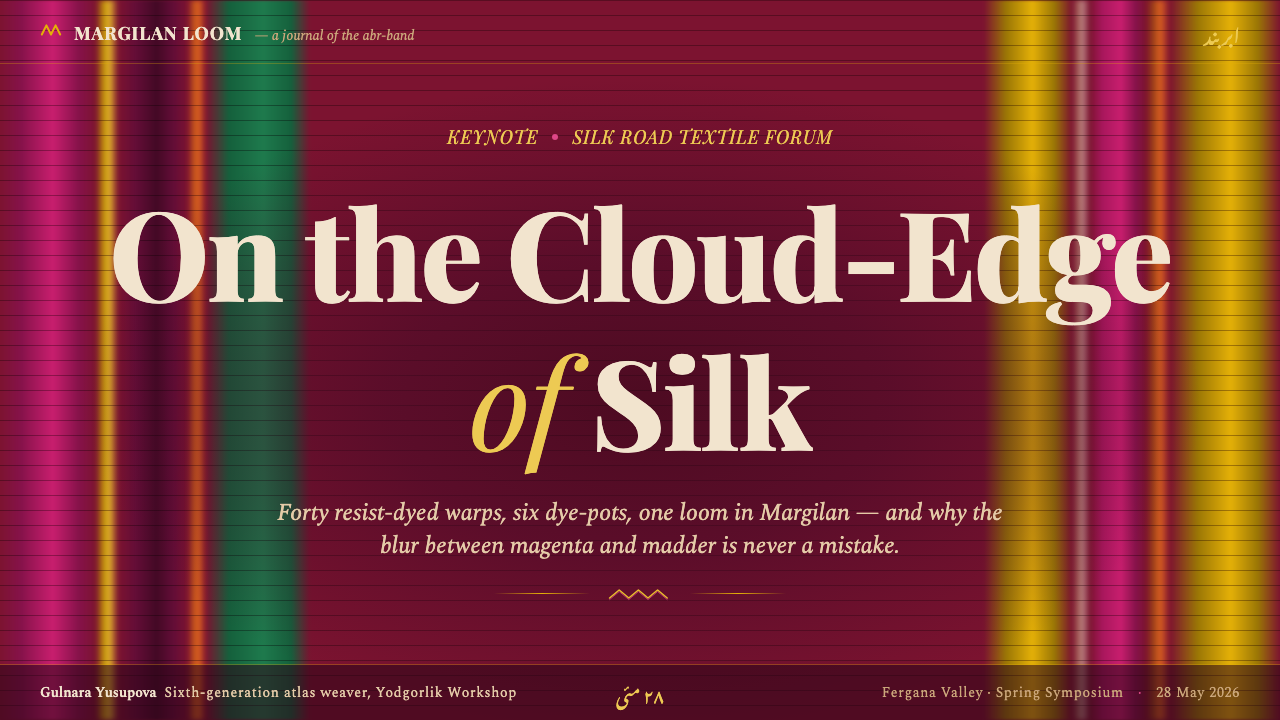
For presentation covers, begin with a broad crimson field and let one or two abr bands sweep through it as the principal image. A title should sit where the band’s movement creates contrast, not compete with every hue at once. For content slides, quiet the pattern substantially: retain crimson as an anchor, reserve cloud bands for section changes or side fields, and give text enough calm territory to remain readable. The textile logic works best when visual energy is concentrated rather than spread across every slide.
Data slides can use the style’s directional colour system without turning charts into fabric. Assign a leading hue to the main series, use related abr colours to distinguish supporting information, and keep the chart structure clear against the darker field. A feathered band can introduce a topic or separate a narrative segment, while the data itself should remain crisp enough to read as information. The goal is a diagram with textile atmosphere, not an illustration that obscures comparison.
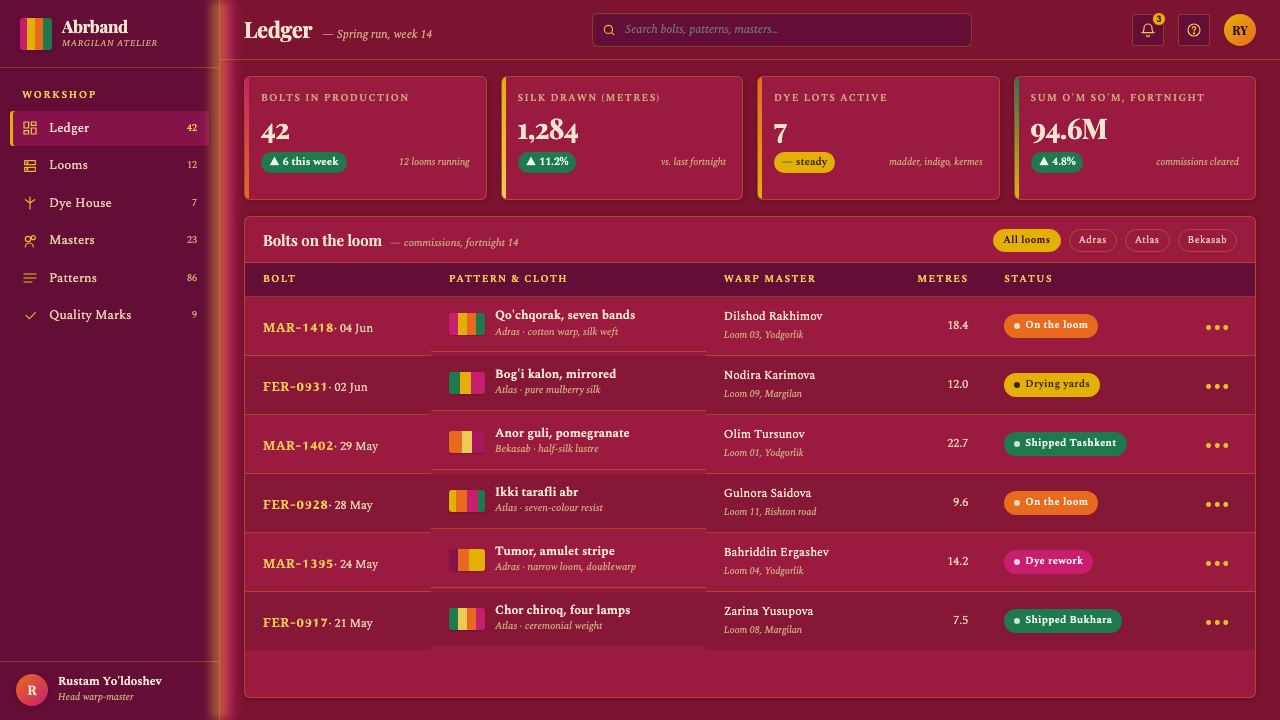
For web interfaces, this approach suits dashboards, campaign pages, and pricing pages that need confidence and memorability. A crimson shell can establish the world of the interface; vivid bands can identify active areas, major calls to action, or transitions between sections. Use ram’s-horn zigzags as occasional navigational or sectional markers. Dense screens need restraint: the interface should borrow the textile’s colour hierarchy and directional movement without making every control look patterned.
Editorial and marketing layouts benefit from using abr bands as narrative events. A feature opening can carry an expansive cloud-band composition, while article sections can return to quieter crimson grounds with a single stripe or zigzag cue. Marketing blocks can alternate between richly patterned moments and calmer reading surfaces, creating the sensation of moving through lengths of cloth. This rhythm is especially useful when a page needs to feel celebratory, crafted, and visually abundant without losing its hierarchy.
The common mistake is to reduce Uzbek ikat to generic colourful zigzags or a repeated wallpaper motif. That removes the essential relationship between dye and warp. Avoid perfectly hard-edged stripes, uniform geometric repetition, and equal visual weight for every colour. Let crimson provide depth, let the abr bands travel directionally, preserve pale feathered edges, and use the ram’s-horn motif as a structural echo rather than the whole story.
Uzbek Adras & Atlas Ikat — FAQ
What is the difference between adras and atlas?
The source material distinguishes them by fibre composition. Adras is half silk and half cotton, while atlas is pure silk. Both belong to the luminous warp-resist textile language associated with Uzbekistan’s Fergana Valley, and both can express the cloud-banded colour effects created through abrband dyeing before weaving.
Why are the edges of the colour bands soft rather than crisp?
The softness comes from the warp-resist process. Bundled threads are tied and dyed before they are woven, and dye can move beyond the bindings. The resulting feathered edge records that movement. It is why the abr bands resemble clouds: the visual boundary is shaped by dye escaping restraint, not by a hard printed outline.
Can this style work on a dark digital background?
Yes. The pre-approved system explicitly translates the textile into crimson grounds with high-chroma abr stripes and feathered edges, so a dark and saturated field is integral rather than incidental. The important constraint is legibility: treat the brightest bands as concentrated moments of emphasis, and preserve quieter areas for text, controls, and information.
How should ram’s-horn zigzags be used without overpowering the design?
Use them as a structural motif rather than a continuous texture. A zigzag can signal a section boundary, direct attention, or frame a focal area. Because the abr cloud bands carry the strongest evidence of the dyeing tradition, ram’s-horn forms should support their movement and establish lineage, not replace them with a uniform geometric surface.
Related design styles
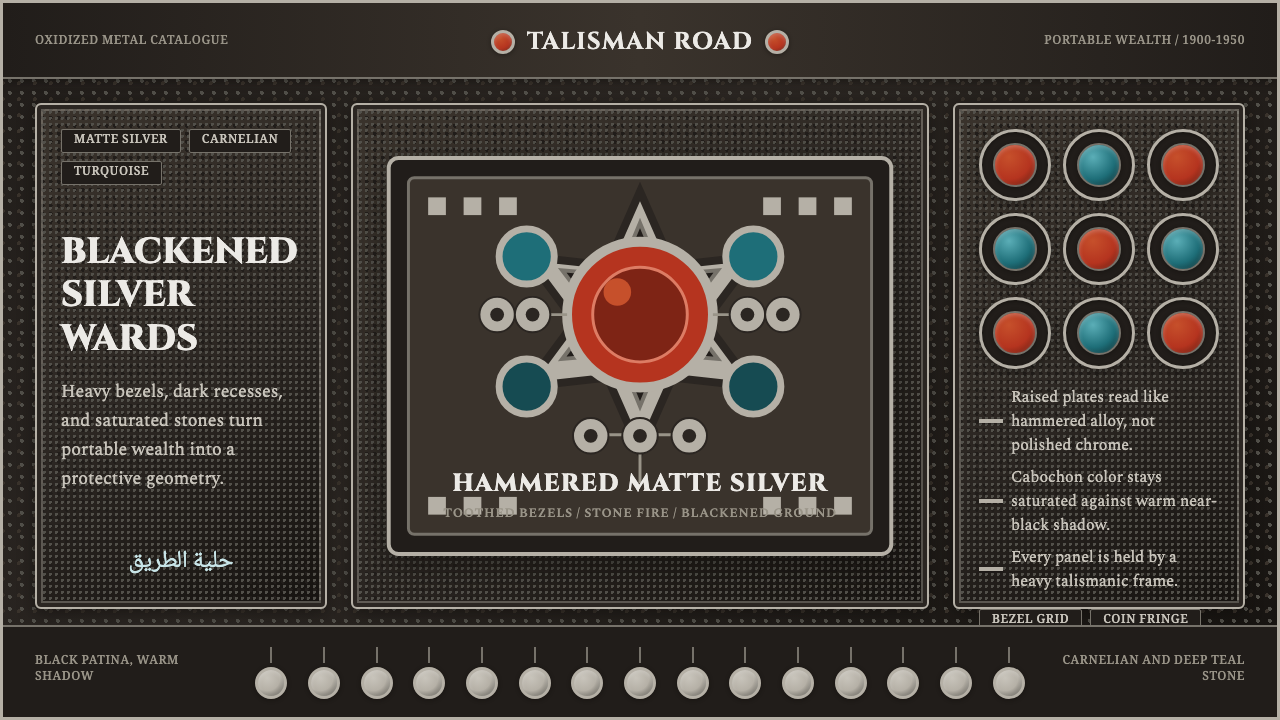 Kuchi Nomad Silver JewelryWeight becomes protection. Matte silver frames carnelian and teal stones on b…
 Christmas ClassicTradition glows warmly. Evergreen panels, berry-red notes and burnished-gold…
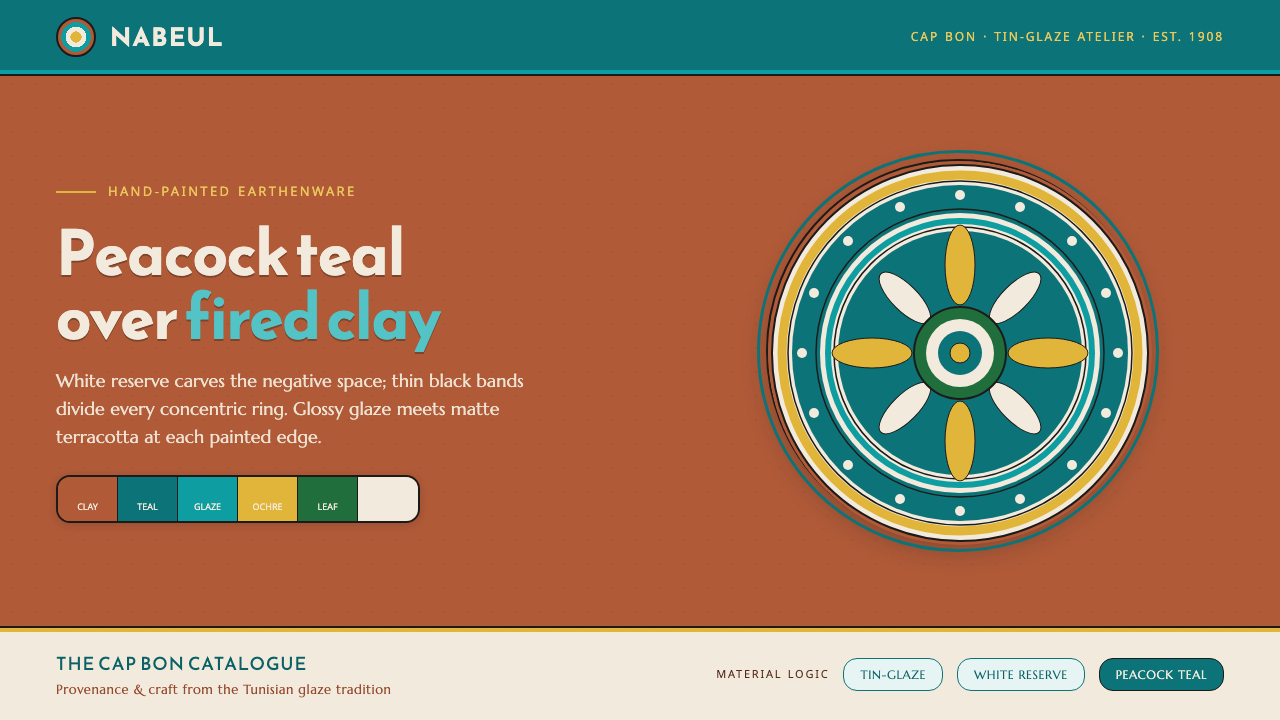 Nabeul Ceramic TealGlaze over fired clay. Peacock teal and white reserve banded in black on terr…
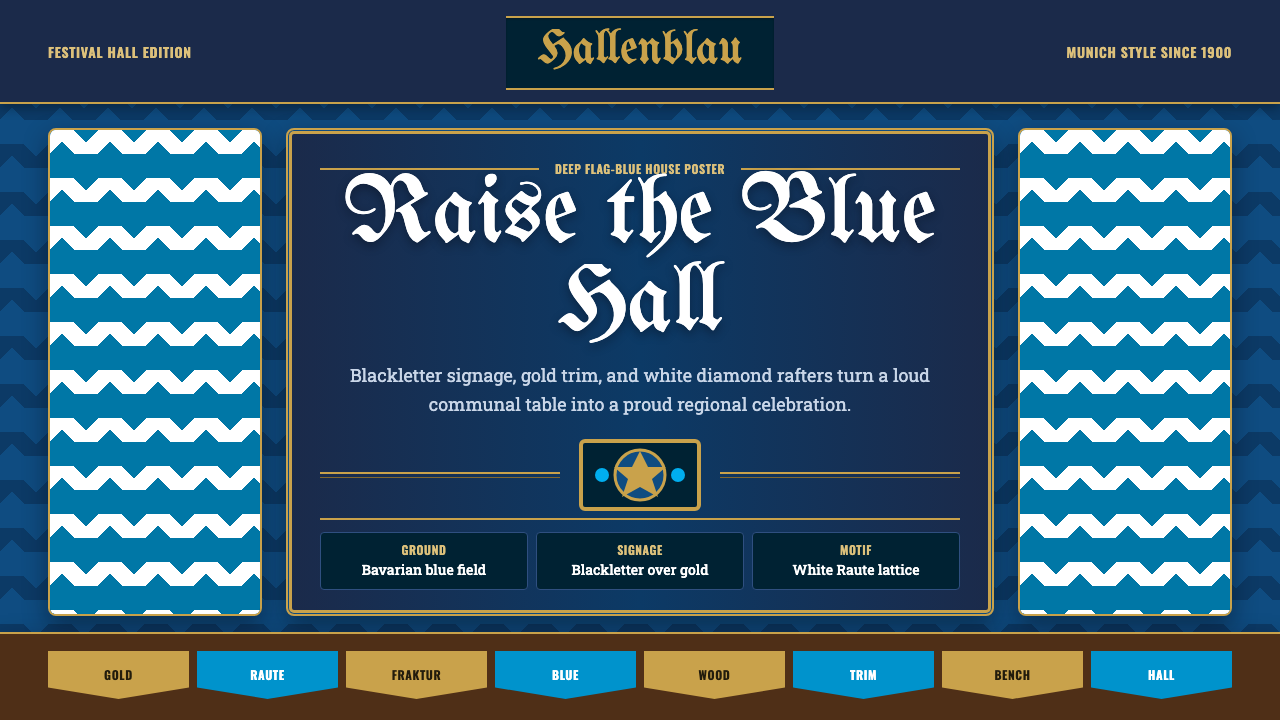 Bavarian Beer HallHearty regional ceremony. Deep flag-blue, Fraktur signage, gold trim, and whi…
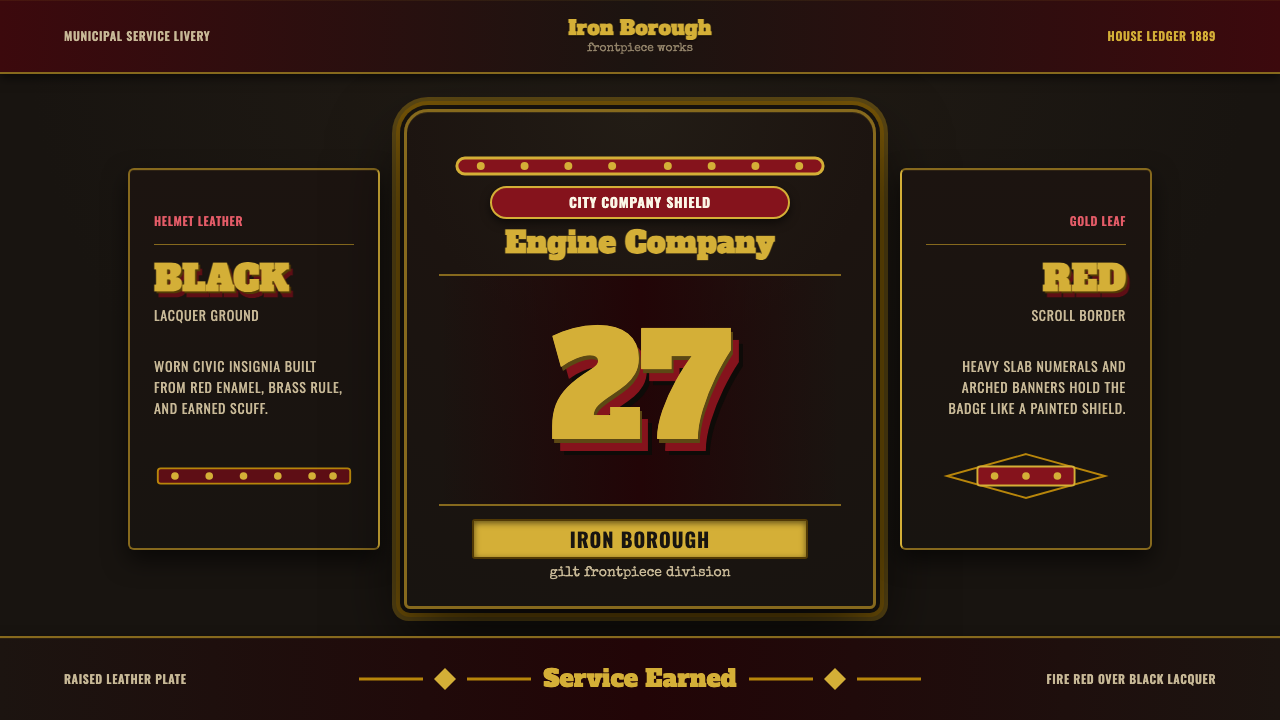 Fire Brigade ShieldEarned civic armor. Gold leaf numerals, fire-red borders, black leather symme…
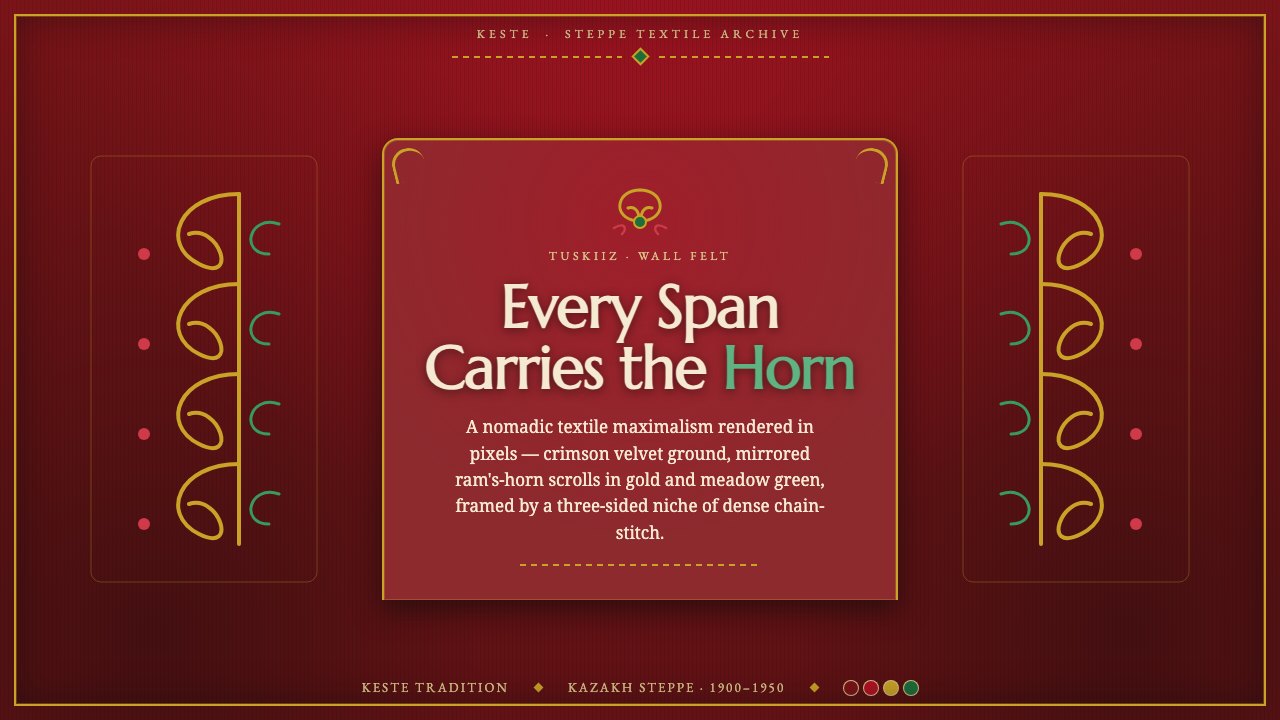 Kazakh Tuskiiz Wall HangingNothing flat, nothing empty. Crimson velvet, gold-green ram's-horn scrolls, a…