What is Dubai Museum of the Future?
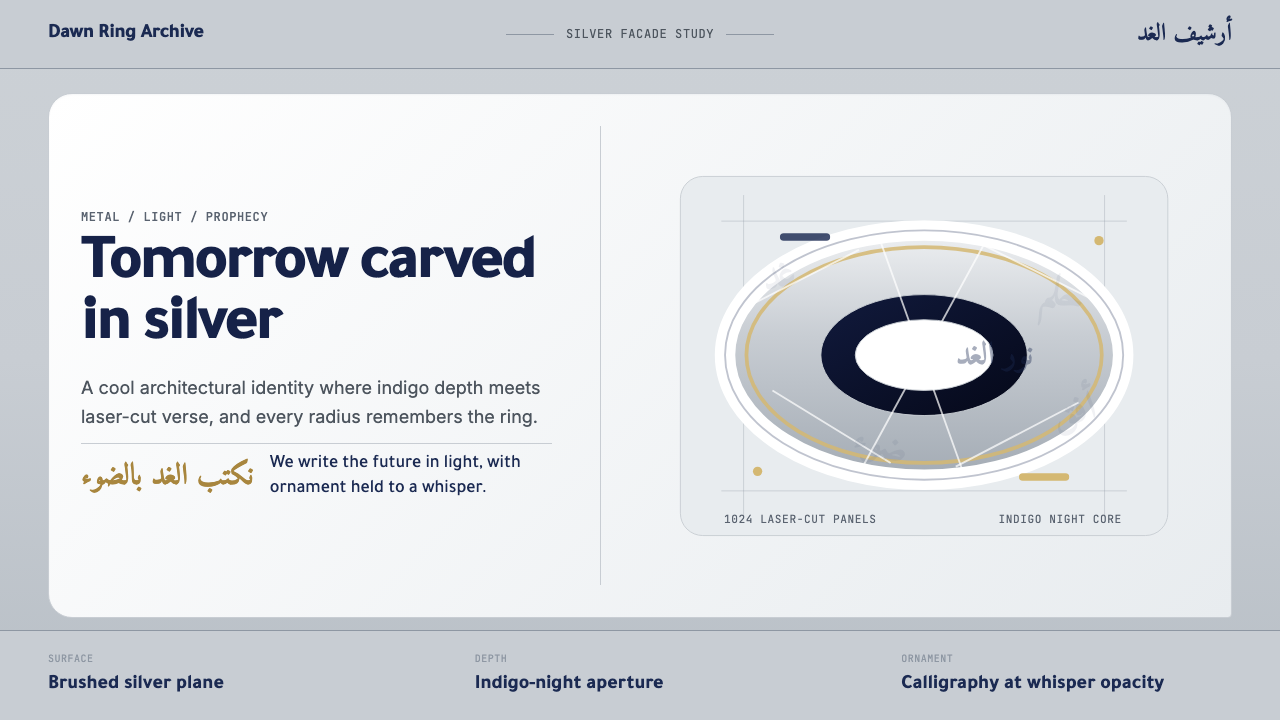
The Museum of the Future turns a building into a manifesto — its silver torus wrapped in laser-cut Arabic poetry rewrites what a public institution can look like at the edge of tomorrow.
Dubai Museum of the Future in brief
The Museum of the Future design system is a visual language derived from one of the twenty-first century's most ambitious architectural gestures. Opened on February 22, 2022, the museum occupies a luminous torus — a donut-shaped structure clad in over a thousand stainless-steel facade panels, each incised with verses from Arabic poetry authored by Sheikh Mohammed bin Rashid Al Maktoum, Dubai's ruler. The building has no solid façade in the conventional sense; it reads instead as a calligraphic skin stretched over engineered steel and glass, simultaneously monumental and weightless.
Translated into digital form, this language yields a system of cool, polished surfaces layered with ornamental depth. Brushed silver tones carry the building's metallic luminosity into interface backgrounds and structural containers. A rich, dark indigo — recalling the Gulf sky at night before city lights fully claimed it — provides the depth register against which silver and white components float. Calligraphic forms appear not as headline typography but as decorative overlays at low opacity, referencing the building's engraved poetry without claiming typographic authority.
What distinguishes this aesthetic from generic luxury tech or Arabic modernism is its fundamental tension: it is simultaneously futurist and deeply rooted. The building's curves are the product of parametric computational engineering, yet every curve also traces the path a written Arabic letter might take. The design system inherits this duality — it does not pretend the future is culturally neutral, and it does not use heritage as nostalgic decoration. Instead, it places both registers in the same composition and asks them to coexist.
Where does Dubai Museum of the Future come from?
The museum's origins lie in a 2017 commission by the Dubai Future Foundation, the government entity established to position Dubai as a global hub for innovation and forward-thinking governance. The commission went to Killa Design, led by British-Lebanese architect Shaun Killa, who had already shaped Dubai's skyline through a series of landmark towers. Killa's proposal for the museum was unconventional from the outset: rather than a rectilinear cultural institution, he proposed a torus — a form that has no beginning and no end, a loop that evokes both continuity and transformation.
The structural challenge of realizing the torus was substantial. The building has no internal columns supporting its elliptical ring; the entire structure is self-supporting through a sophisticated steel exoskeleton. The facade panels — 1,024 in total, each unique and laser-cut from stainless steel — were designed in close collaboration between the architects and structural engineers, with the panel geometry precisely calculated to carry structural load while holding the calligraphic text. The poetry, written by Sheikh Mohammed, was selected partly for semantic resonance and partly for its graphic potential: Arabic calligraphy in the Naskh and Thuluth traditions has intrinsic geometric qualities that make it naturally compatible with parametric surface engineering.
Shaun Killa worked alongside exhibition designer Atelier Brückner, a Stuttgart-based studio whose immersive interior experiences have shaped science museums and world expositions worldwide. Atelier Brückner was responsible for the museum's internal journey — five floors organized around speculative futures in space, health, ecology, urban life, and wellbeing. The interior aesthetic extends the exterior vocabulary inward: curved corridors lined with luminous screens, surfaces that shift between metallic and organic registers, and light systems designed to evoke both deep space and Gulf sunlight. The interior is as much scenography as it is architecture.
The building sits at a precise location on Sheikh Zayed Road in the Emirates Towers district, deliberately positioned so that it is framed by the two Emirates Towers when viewed from certain angles — a composition that sets historic prestige against twenty-first century ambition. When UAE leadership selected the February 22 opening date, the date itself was part of the statement: 22.02.2022, a palindrome, reinforcing the building's own formal logic of symmetry and the circular. From its first day of operation, the museum became not only a cultural institution but a photographic landmark, its torus recognizable across social media worldwide as an icon of the Gulf's aspirational self-image.
What defines the Dubai Museum of the Future look?
Surface and Luminosity
The dominant material register is brushed metal — cool, directional, and precision-engineered. Unlike polished chrome, which reflects its environment chaotically, a brushed surface has a controlled directionality to its sheen. In the digital translation of this aesthetic, surfaces are rendered with a subtle grain that catches implied light from a consistent angle. This controlled luminosity reads as technological confidence rather than flashy showmanship: it signals that something has been machined to tight tolerances, not decorated.
Calligraphic Depth
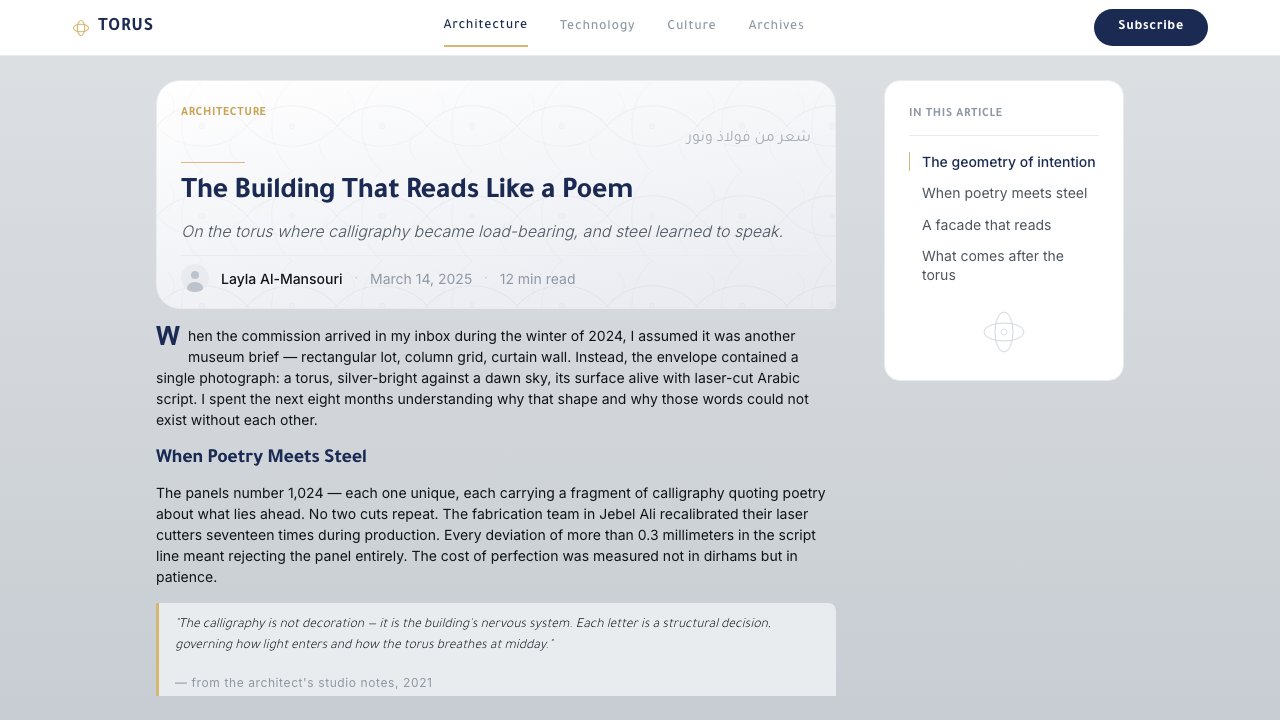
Arabic calligraphy appears as a structural layer within the visual system, not as typographic text. At low opacity, calligraphic forms create a dimensional middle ground between solid surfaces and empty space — like the ghost of writing preserved inside the material itself. This technique mirrors the building's actual construction, where verses are literally cut through the metal skin to let light pass. In digital application, calligraphic overlays add ornamental richness without competing with functional typography or compromising legibility.
Indigo Depth Register
The deep indigo that grounds the system carries multiple resonances simultaneously. It evokes the Gulf night sky at its deepest, before sunrise or after sunset fully completes. It carries the historical weight of lapis lazuli and indigo trade routes through the Arab world. And it functions structurally as a near-black that reads as more contemplative and spatial than black itself — a void that has atmosphere rather than one that simply absorbs. Against this indigo ground, silver and white components take on a quality of floating emergence.
Curved and Pill-Shaped Components
The building's defining form is its torus — a closed curve with no corners, no termination, and no hierarchy of directions. This formal logic flows into the digital component vocabulary as rounded, pill-shaped buttons, cards with generous corner radii, and containers whose edges suggest continuation rather than termination. Sharp rectangular components would read as architecturally dishonest to this system; every boundary has a curve that speaks to the building's fundamental geometry.
Restrained Color Accent
The system is not colorful in the conventional sense. The dominant tones are achromatic — silver, near-white, and the deep blue-black of indigo — with color appearing only as a precise accent at high-value moments: an active state, a critical alert, a call-to-action. When color does appear, it tends toward warm gold or cool luminous white rather than saturated primaries. This restraint gives the rare moments of color significant weight: when a warm gold accent emerges from a sea of cool silver and indigo, it reads as genuinely exceptional rather than merely decorative.
Poetry as Structure
In the building, poetry is not applied to the surface as decoration — it is the surface. The calligraphic text constitutes the structural skin of the facade; remove the words and the building loses its outer form. This principle of language as load-bearing material translates into the digital system as a high investment in copy and naming. Labels, headers, and microcopy are crafted with the care given to visual elements because in this system, the text is part of the architecture. Placeholder language or filler copy is antithetical to the spirit of the system.
Futurism Grounded in Place
Unlike generic futurist aesthetics that borrow from science fiction or Silicon Valley visual culture, this system is geographically anchored. Its materials, proportions, and ornamental vocabulary derive from a specific building in a specific city, reflecting both the architectural traditions of the Gulf region and the particular ambitions of Dubai in the early 2020s. The system reads as future-facing without being placeless — it carries the heat and light and ambition of its origin, and any application of it will feel slightly different from other futurist systems precisely because of this rootedness.
Who shaped Dubai Museum of the Future?
The British-Lebanese principal of Killa Design led the architectural concept and design of the museum from the 2017 commission through its 2022 opening. Killa's decision to propose a torus — structurally demanding and formally unconventional — rather than a safer rectilinear landmark was the defining creative choice of the project. His background working across London, the Gulf, and East Asia gave him fluency in both the commercial ambitions of Dubai's development culture and the expressive possibilities of contemporary facade engineering. He has become one of the key figures associated with the Gulf's distinctive approach to landmark architecture as national brand statement.
Dubai's ruler and the UAE's Prime Minister authored the Arabic poetry inscribed on the building's facade, making him a direct creative contributor to the museum's most distinctive visual element. His verse — 'The future belongs to those who can imagine it, design it, and execute it. It isn't something you await, but something you create' — is visible on the building's outer skin and encapsulates the institutional ambition the museum was designed to express. His involvement signals that this is not a project where political patronage simply funds artistic vision; here the patron's own words became the building's surface.
The Stuttgart-based experience design studio was responsible for the museum's interior journey — the five thematic floors exploring speculative futures in space, health, ecology, cities, and wellbeing. Atelier Brückner's practice spans world expositions, science museums, and branded environments across Europe and the Middle East, and they brought to the project a rigorous approach to immersive spatial narrative. The interior they created is as compositionally deliberate as any designed surface: light, material, and movement are orchestrated to guide visitors through a sequence of atmospheric registers, from the vast darkness of an simulated cosmos to the organic warmth of imagined future ecosystems.
The Chairman of the Dubai Future Foundation, the government entity that commissioned and oversees the museum, Bin Lahej was central to establishing the institutional framework within which the building could be realized. The Dubai Future Foundation was itself a novel kind of governmental organization — one explicitly tasked with prototyping futures and exploring emerging technologies at a national scale. His leadership defined the brief: not a traditional museum that conserves the past, but one that actively models possible futures, an orientation that shaped every aspect of the architectural and spatial program.
The realization of the museum's torus required close collaboration between multiple engineering disciplines — structural, facade, and environmental — working in tandem with the architects. The exoskeleton that supports the ring without internal columns, the precision laser-cutting of 1,024 unique facade panels, and the integration of calligraphic text into load-bearing surfaces were all engineering challenges that had never been solved at this scale. The project is as much an achievement of applied engineering as it is of architecture, and the design system it produced reflects this: it is a system where material capability and ornamental ambition are not in tension but are the same gesture.
How do you use Dubai Museum of the Future today?
The Museum of the Future design system rewards thoughtful application and resists superficial use. Its visual language is derived from a specific architectural and cultural context — Gulf futurism, Arabic calligraphic tradition, parametric engineering — and that context gives it its authority. Applying it well means understanding what the system is actually communicating: that precision and poetry can coexist, that technological ambition and cultural heritage are not opposites, and that material restraint can produce emotional impact. Without that understanding, the visual elements become mere decoration.
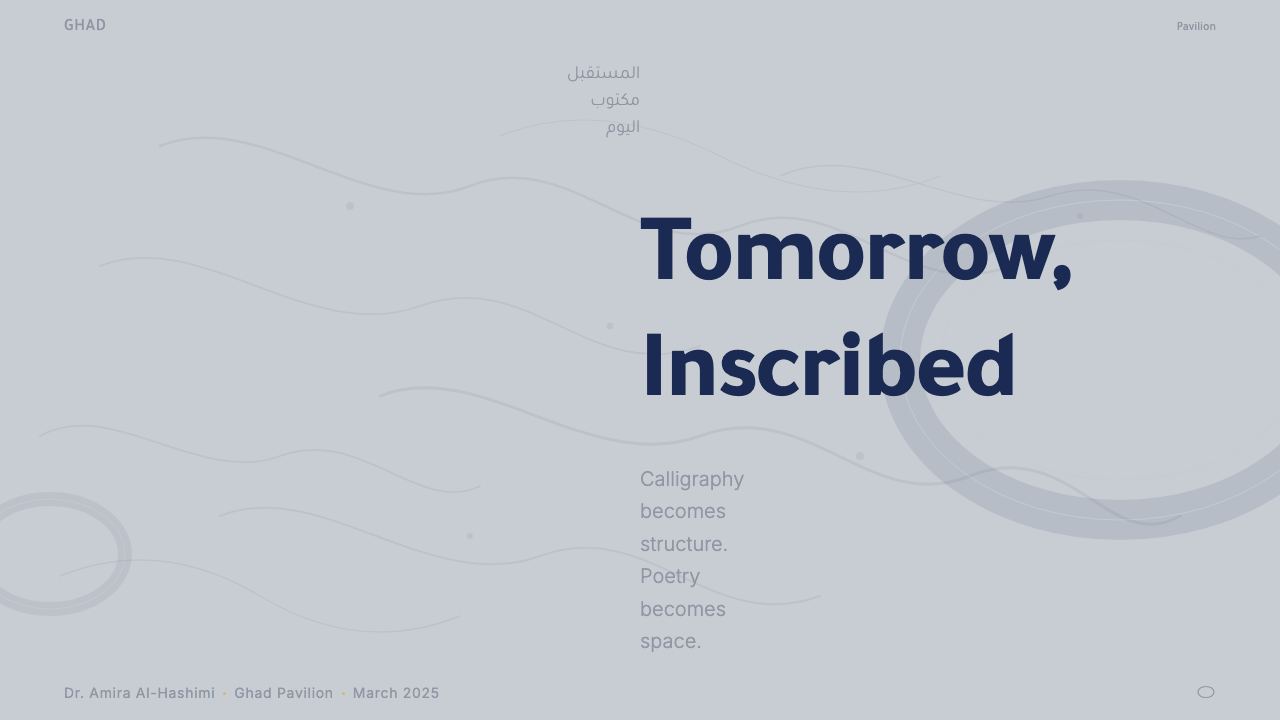
For presentation slides, this system works best for forward-looking content: annual reports, strategic visions, technology roadmaps, or any context where the audience should feel they are glimpsing something not yet fully arrived. A cover designed within this system typically centers a dominant architectural or abstract form on an indigo or deep background, with a title rendered in a clean, generous typeface that holds space rather than demanding it. Content slides should use the cool silver register for backgrounds, with text in near-white or white, and reserve any warm accent tones for the single most important data point or conclusion on each slide. Calligraphic motifs, if used, should appear in the corner or background at very low opacity — present but not competing.
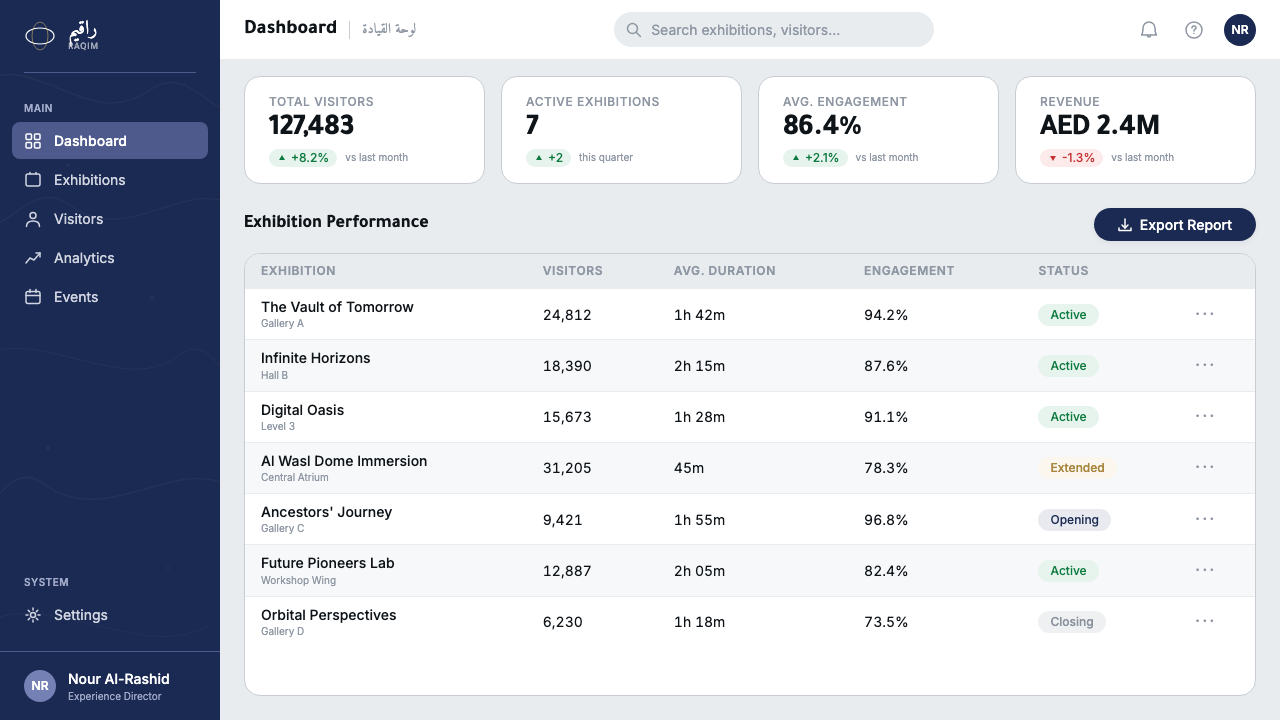
For web interfaces and dashboards, the system is well suited to environments where authority and technical capability are core values: enterprise SaaS platforms, financial dashboards, government digital services, museum or institutional websites, and any product positioning itself as operating at the frontier of its field. The approach emphasizes a dark or cool-neutral foundation, generous negative space, and a component vocabulary dominated by rounded forms. Navigation should be typographic and restrained; interactive states announce themselves through luminosity changes rather than color shifts. Data visualization within this system takes on a cool diagrammatic quality — charts rendered in silver and white tones against dark grounds, with a single accent for the most critical metric.
For editorial and marketing work, this system carries weight appropriate to announcements, launches, and moments that claim significance. A marketing page in this register uses full-width photographic or rendered imagery of the museum or its architectural vocabulary as a visual anchor, with headline copy that reaches for the poetic — short, declarative, and spaced to breathe. Feature blocks should alternate between deep indigo grounds and near-white or silver grounds, maintaining the visual temperature contrast that the building itself creates between its interior and exterior. Call-to-action elements should be rare and restrained, not stacked or repeated, because the system's authority depends on knowing when to speak and when to hold silence.
A common mistake when working with this system is to oversaturate the calligraphic overlay or to use it as a headline element, which immediately flattens it into generic Islamic pattern decoration. The calligraphy gains its power precisely from being withheld — seen through, not read directly. Similarly, mistaking the system's aspirational tone for permission to use bombastic language or aggressive visual hierarchy undermines what makes it distinctive. This is a system of confidence, not aggression; of measured revelation, not spectacle for its own sake. Its quieter moments carry more authority than its loudest ones.
Dubai Museum of the Future — FAQ
Is this style only appropriate for technology or innovation-themed projects?
The museum itself is a cultural and civic institution, not a technology company, and its design language reflects that breadth. The system is appropriate for any context where the tension between heritage and futurity is a live theme — cultural institutions, arts organizations, national or regional brand identity, high-end hospitality, and urban development projects can all find genuine alignment with it. The system struggles in contexts that require warmth and approachability above all else, such as consumer products aimed at families or wellness applications where softness is a primary signal. Its authority can also feel too heavy for playful or experimental products that need to feel lightweight and provisional.
How does this design system relate to other contemporary Gulf or Middle Eastern aesthetics?
The Gulf region has produced multiple distinct contemporary design languages in the past two decades. Saudi Vision 2030 materials tend toward a more austere geometric modernism. Qatari cultural institution design, as seen in institutions designed by Jean Nouvel and I.M. Pei, often works with abstracted desert geometry and a warmer material palette. This system is distinctive in its combination of explicit calligraphic layering with precision-industrial metallic surfaces — it is the most explicitly material and literary of the major Gulf design languages. It shares with the broader tradition a rejection of the European classical canon as a reference point and a commitment to using Arabic script as a primary visual element rather than a secondary cultural marker.
Can the system be adapted for light-background interfaces?
Yes, and a light variant is arguably closer to the building's daytime exterior — the steel panels appear silver-white in direct Gulf sunlight, and the calligraphic cutouts cast sharp dark shadows on interior surfaces. A light version would use near-white or warm silver grounds, with the indigo appearing as an accent or primary text color rather than a background. The calligraphic overlay works equally well at low opacity on light grounds, reading as a warm gray or cool shadow. What must be preserved in the light variant is the cool metallic directionality — warm beige or cream grounds would shift the system toward a heritage aesthetic rather than the technological-poetic register that defines it.
How should calligraphic elements be sourced or generated for this style?
The building's calligraphy is in the Thuluth and Naskh traditions — classical forms with centuries of established conventions for proportion, stroke weight, and letter connection. Using authentic calligraphic forms matters for this system; generic display Arabic fonts or algorithmically generated letterforms will not carry the same visual authority. Existing calligraphic artwork by recognized Arabic calligraphers, adapted with permission, offers the most direct route to authenticity. Failing that, commissioning a contemporary Arabic calligrapher to produce custom letterforms for the system is the appropriate approach. What should be avoided is treating any Arabic text in a standard digital typeface as a calligraphic element — legibility and calligraphic expressiveness serve different purposes, and confusing them produces neither.
How does the system handle motion and animation?
Motion in this system should mirror the building's own temporal quality: slow, deliberate, and weighted. The torus moves differently at different times of day as Gulf light rakes across its surface — it does not flash or pulse, but shifts register gradually. Interface animations within this system favor long easing curves, slow fades, and transitions that feel like the surface of a material changing temperature rather than a digital state flipping. Calligraphic overlays, if animated, should drift at very low speed — suggesting the ghost of movement rather than active animation. What should be avoided is rapid, bouncy, or staccato motion, which would introduce a levity incompatible with the system's fundamental gravity.
Related design styles
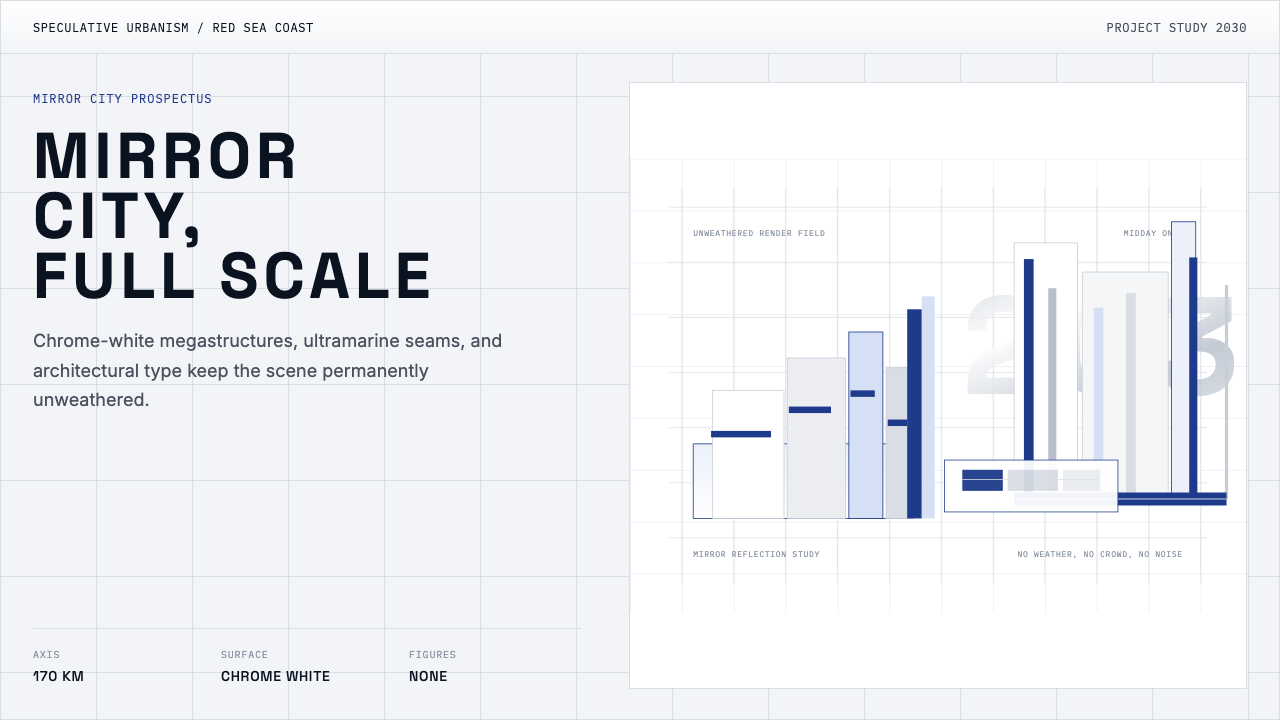 NEOM Mirror FuturismPermanently unweathered. Chrome-white grids and ultramarine seams stage a CGI…
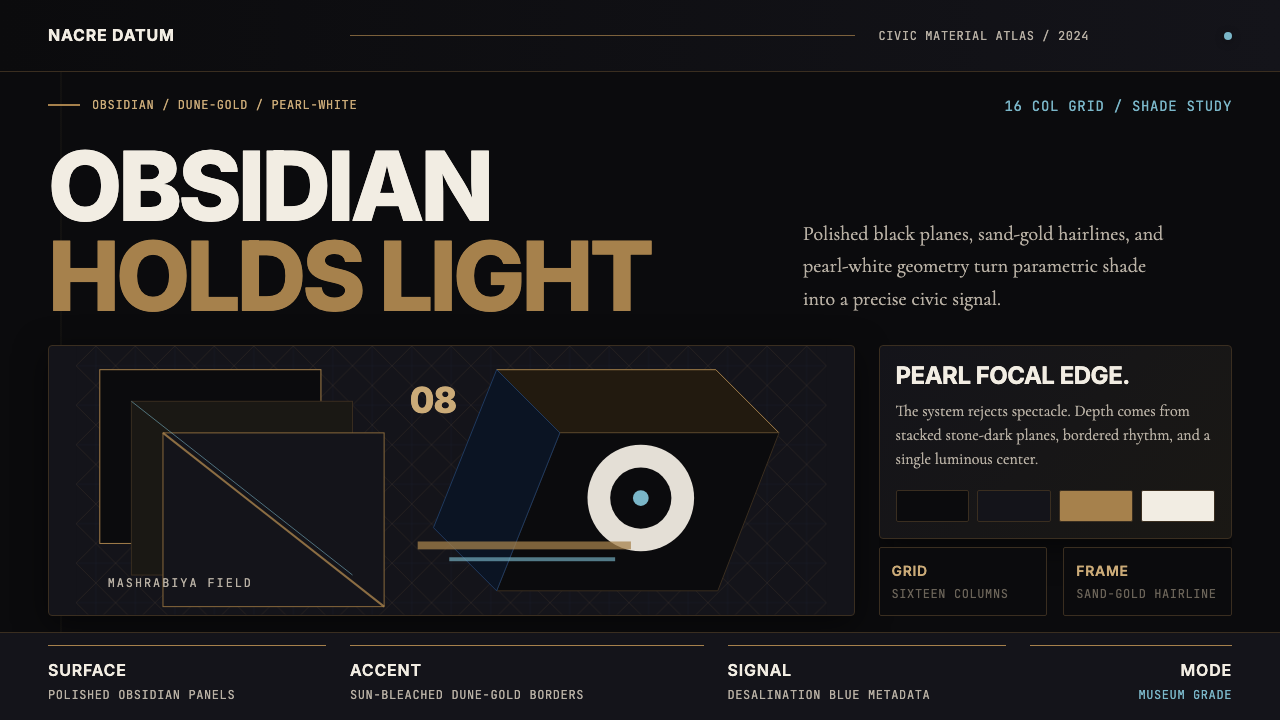 Qatari Pearl Modern Architecture 2024Monumental restraint. Obsidian panels, sand-gold gridlines, pearl-white geome…
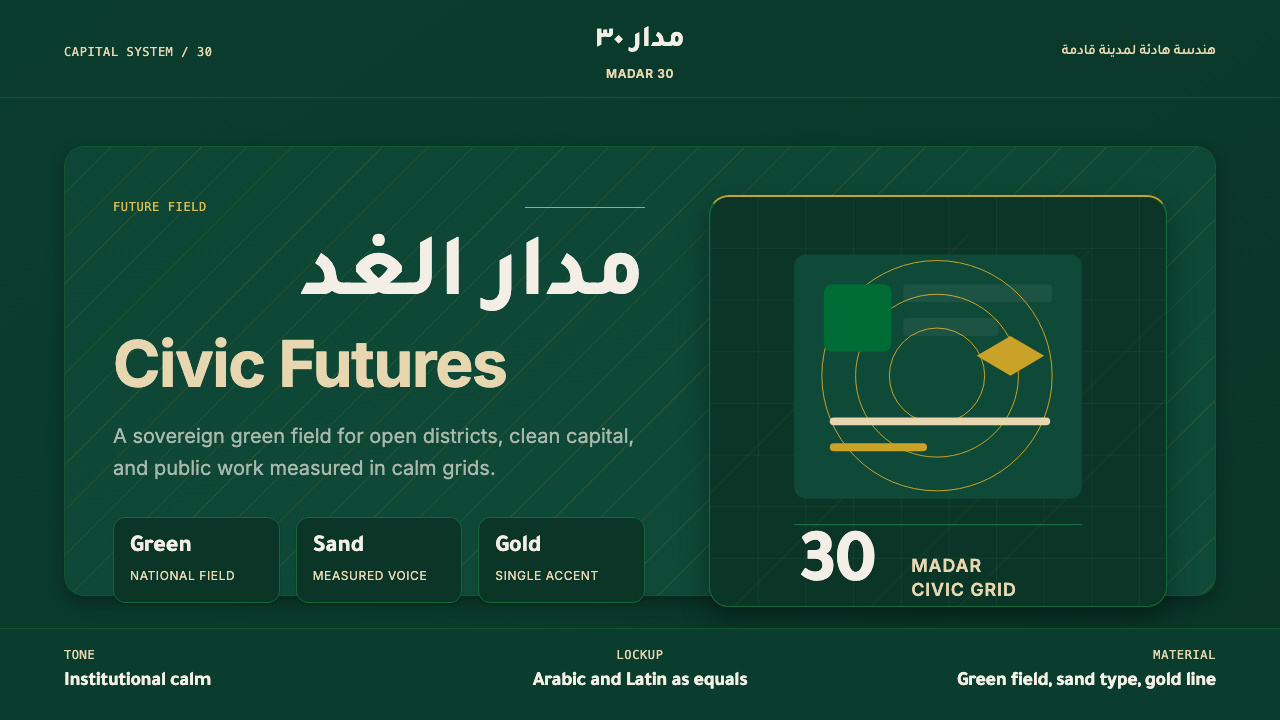 Riyadh Vision 2030Sovereign futurism. National green, sand type, and gold hairlines hold a calm…
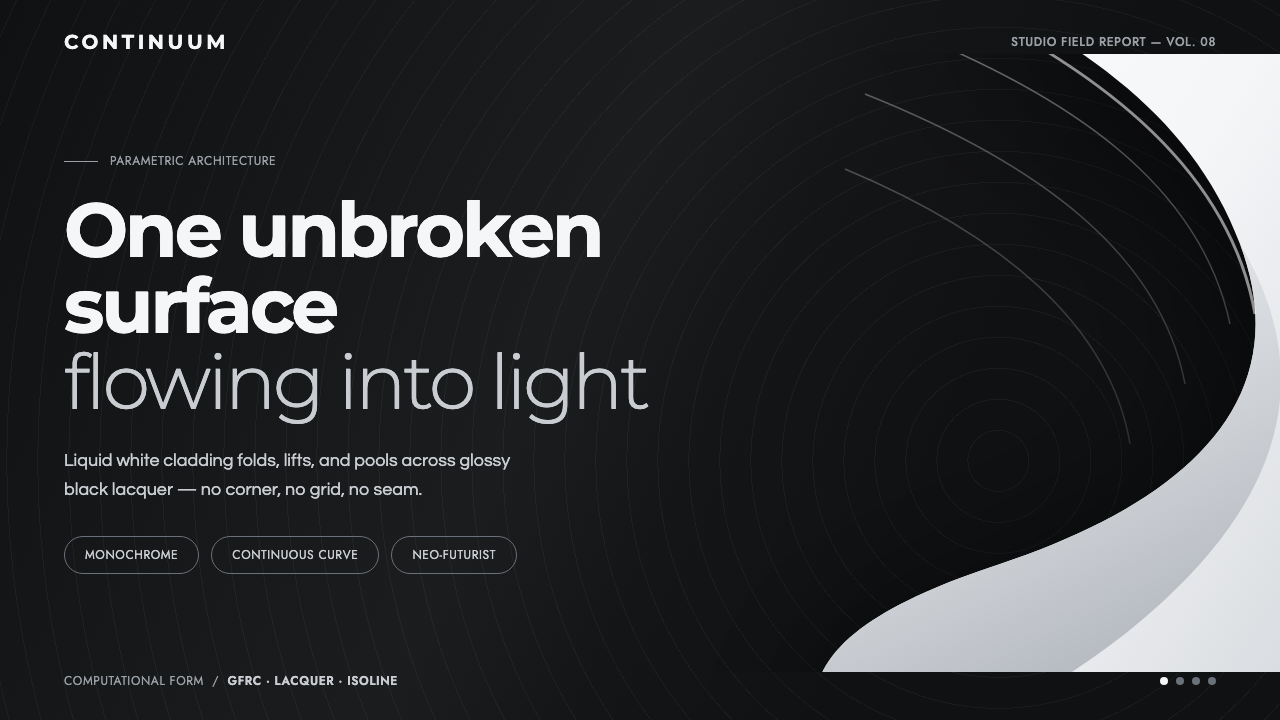 Parametricism (Zaha Hadid)Architecture as one unbroken surface. A liquid-white swoop floats on glossy b…
 Parviz Tanavoli HeechNothing, made monumental. A looping bronze word glows gold over near-black un…
 SANAA White LightnessArchitecture made of light. White planes float on cool silver-grey, edged in…