What is NEOM Mirror Futurism?
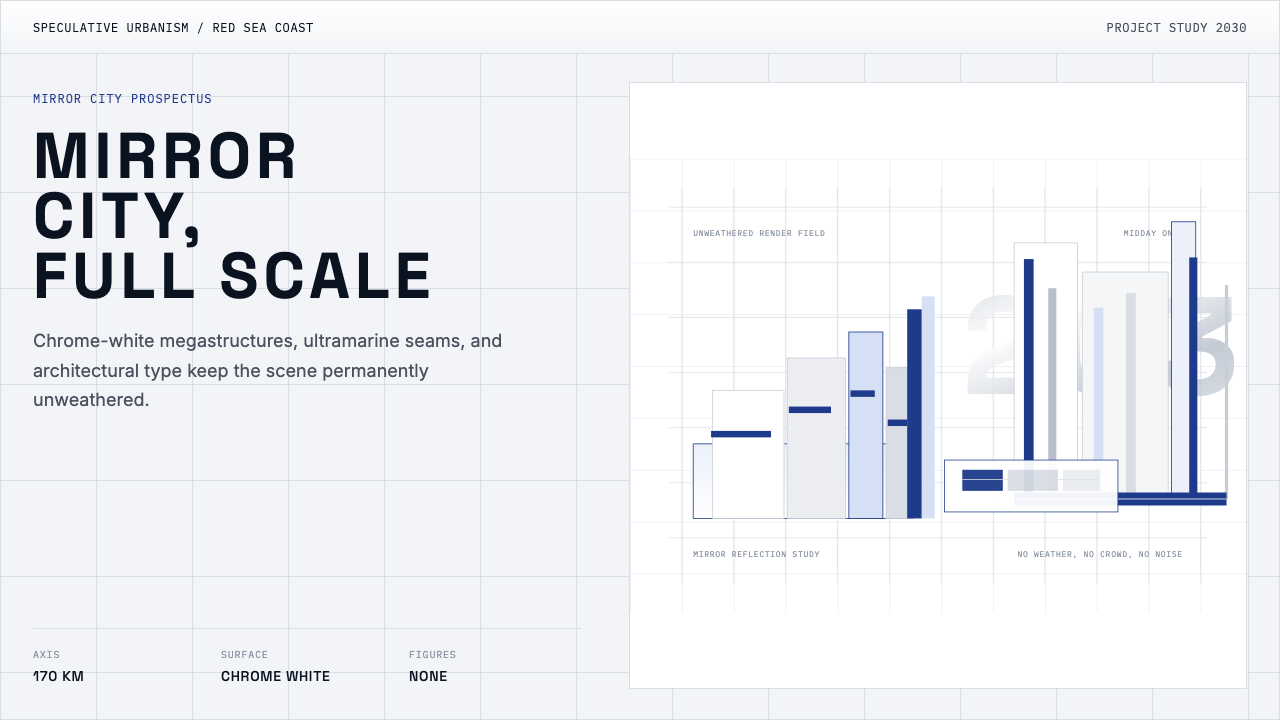
NEOM Mirror Futurism is the visual language of a megacity that exists only in CGI — chrome-white grids, ultramarine seams, and architectural scale so vast that it erases human presence entirely.
NEOM Mirror Futurism in brief
NEOM Mirror Futurism is the design aesthetic developed for and around the NEOM megacity project — a five-hundred-billion-dollar Saudi Arabian development announced in 2017 and projected to be partially complete by 2030. The style is defined by its origin: every image, every rendering, every brand touchpoint was created before a single permanent structure existed. This is a visual language conjured entirely from future-tense aspiration, and it looks like it.
The aesthetic vocabulary is drawn from architectural visualization pushed to its outermost extreme: mirror-clad surfaces reflecting empty desert sky, ultramarine accent lines scoring the boundaries between structure and void, type scaled to the dimensions of building facades. Color is restricted to a narrow and deliberately inhuman register — whites that are too white, blues that carry no warmth whatsoever, reflective surfaces that return the environment without absorbing it. The effect is of a place that has not yet been touched by anyone.
What makes NEOM Mirror Futurism a coherent design language, rather than simply a collection of flashy architectural renders, is its internal consistency. The same spatial logic — extreme emptiness, mirror-plane reflections, a horizon line treated as an absolute edge — runs through brand materials, motion graphics, model photography, and the project's visual communications at every scale. It is a total aesthetic environment designed to make the impossible feel authoritative.
Where does NEOM Mirror Futurism come from?
The NEOM project was announced by Crown Prince Mohammed bin Salman in October 2017 as a cornerstone of Saudi Vision 2030 — the kingdom's program to diversify its economy away from petroleum dependency. The site chosen was the Tabuk Province in northwest Saudi Arabia, along the Red Sea coast near the Gulf of Aqaba: a region of extraordinary topographic drama, with granite mountains descending directly to crystalline water. From the start, the project's identity was visual before it was physical. An entire brand language had to be invented for a city that would not exist for years.
The visual aesthetic that emerged was shaped by the project's two dominant ambitions: to signal radical discontinuity from existing urban precedents, and to communicate directly to an international audience of sovereign wealth funds, technology companies, and global media. Traditional Gulf architectural ornament — the geometric tile patterns, the arabesque, the mashrabiya screen — was entirely excluded. In its place came a vocabulary drawn from high-end architectural visualization software: clean environmental reflections, spectral light effects, and a color palette that reads as technological rather than regional.
The style's most distinctive element — the mirror-clad surface — was crystallized in The Line, NEOM's most publicized component: a linear city one hundred and seventy kilometers long, whose two facing facades would be clad in mirrored glass from ground to apex. When renderings of The Line were released in 2022, the imagery was immediately absorbed into global visual culture as shorthand for a particular strain of utopian speculation: authoritarian in scale, pristine in surface, and conspicuously devoid of the evidence of ordinary life.
Key design contributors included starchitect firms such as Thom Mayne's Morphosis and Zaha Hadid Architects, alongside the project's in-house visual communications teams. The visualization work drew on AI-augmented rendering pipelines that were then at the cutting edge of architectural presentation, producing images at resolutions and with surface fidelity previously impossible outside of feature-film visual effects. This production context left its mark on the aesthetic: the images look the way they do partly because of the tools that made them, and those tools were optimized for visual spectacle at the expense of quotidian legibility.
What defines the NEOM Mirror Futurism look?
Mirror Surfaces and Reflective Logic
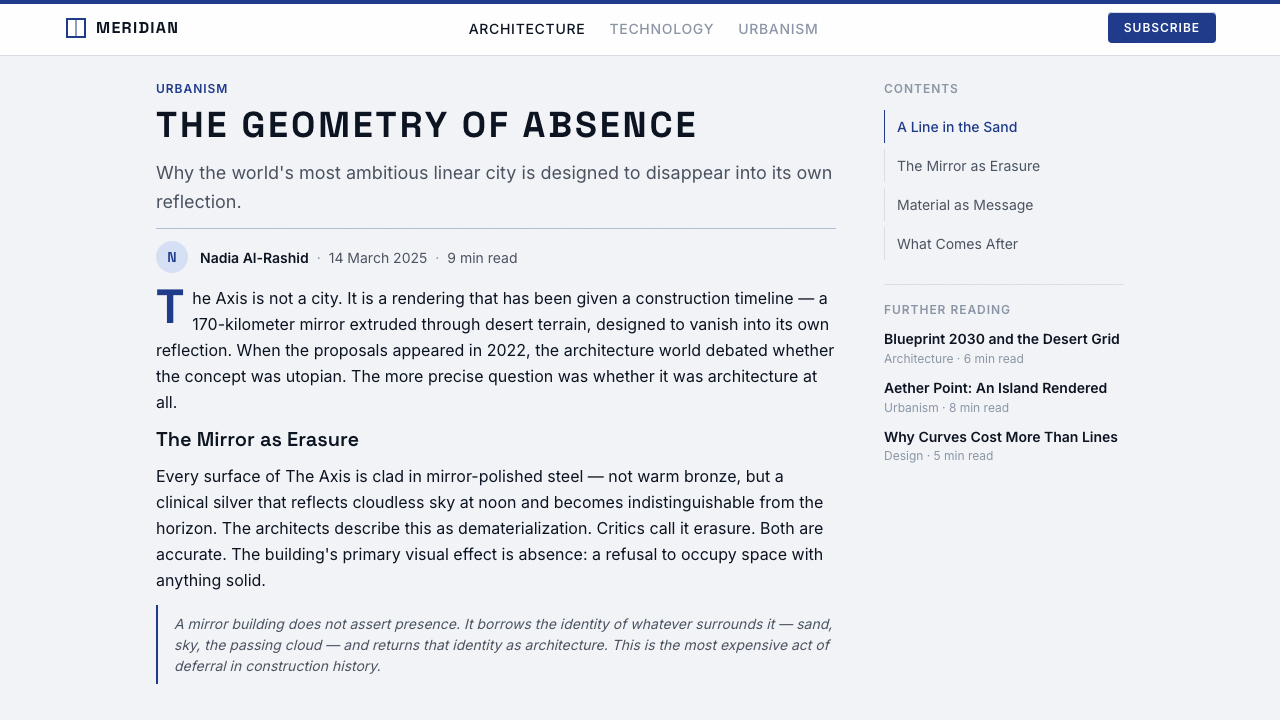
The defining material of NEOM Mirror Futurism is not a material at all — it is the act of reflection. Every major surface in the visual system is conceived as a mirror: it shows the sky, the desert, the adjacent void, but offers no texture or grain of its own. This creates a paradoxical visual effect in which the most prominent element in any composition is simultaneously present and transparent, massive and weightless. The mirror surface makes no claim to warmth or habitation; it asserts pure presence.
Ultramarine as Structural Accent
Against the dominant white-and-mirror ground, a single deep blue — carrying the cool, spectral intensity of ultramarine — functions as the system's primary accent. It appears at junctions: where surfaces meet, where the built form meets the landscape, where one zone transitions to another. Unlike accent colors in conventional brand systems, this blue does not signal interactivity or call-to-action; it signals seam, boundary, and precision. It is the color of an engineered edge.
Architectural-Scale Typography
Text in NEOM Mirror Futurism is not sized for reading — it is sized for viewing. Logotypes, project names, and marketing statements are set at a scale that implies they would need to be seen from a significant distance to be legible. This creates an unusual effect in print and screen contexts: the letterforms feel monumental even at standard display sizes, as though the viewer is always positioned far below the information. The type style tends toward geometric sans-serif forms with extraordinarily wide tracking, amplifying the sense of vast, unpopulated space.
Void as Composition
The most consistent compositional choice in the NEOM visual system is the deliberate preservation of vast empty zones — not as negative space in the classical sense, but as active subject matter. Sky occupies two-thirds of a frame; horizon line is placed very high or very low; foreground surfaces extend to the edge of the image with no figures, vehicles, or vegetation to provide scale. This emptiness is the point: it communicates a space not yet scaled to human beings, a landscape that is fundamentally pre-inhabited.
CGI Light and the Absence of Weathering
All surfaces in NEOM Mirror Futurism exist in a state of permanent newness. There is no patina, no erosion, no stain from use. The light source behaves like a rendering engine's default — high and directional, producing clean shadows without diffusion. This refusal of weathering is not incidental but deliberate: it signals that the project described exists outside of ordinary time, in a perpetual moment of completion. The photorealistic fidelity of the images makes this uncanny quality more, not less, pronounced.
Scale Without Human Reference
A consistent and striking aspect of NEOM visual materials is the near-total absence of human figures. When people appear at all, they are silhouetted at extreme distance, functioning as scale indicators rather than as individuals with legible presence. The effect of their near-absence is to make the built environment the protagonist of every image: the architecture speaks for itself, at a volume that no human presence could compete with. The viewer understands the scale abstractly, without ever being invited to inhabit it.
Chromatic Restraint and Technological Coolness
Beyond the ultramarine accent, the palette is almost entirely achromatic: the dominant tones are variants of white, silver, and the grey-blue cast of clear desert sky. Warmth is systematically excluded. Where earth tones from the actual landscape — the red-orange of the Tabuk granite, the ochre of sand — appear in context, they are treated as a foil to be contrasted against rather than harmonized with. The effect reads as technological rather than climatic, cosmopolitan rather than regional.
Who shaped NEOM Mirror Futurism?
As Crown Prince and the primary architect of Saudi Vision 2030, Mohammed bin Salman is the initiating force behind NEOM and the direct client for the aesthetic system it spawned. His decision to position NEOM as a global cultural and technological statement — rather than as a conventional real-estate development — determined that the project would need a visual identity capable of competing on a world stage. The grandiosity of the visual language reflects the grandiosity of the political ambition it was designed to embody.
As NEOM's chief executive, Al-Nasr has been responsible for translating the Crown Prince's vision into an operational organization with a coherent brand identity. Under his leadership, NEOM developed the visual communications infrastructure — the style guidelines, the rendering pipelines, the multi-project brand architecture — that gives the NEOM aesthetic its internal consistency across The Line, Sindalah, Aqaba, and the project's other components. He has been the public face of the brand's ambitious claims about what the city will eventually be.
The Pritzker Prize-winning architect and founder of Morphosis brought to NEOM a design sensibility already disposed toward extreme formal ambition and deconstructivist surface complexity. Mayne's participation lent the project a degree of international architectural credibility and contributed to the visual language of fractured, angled surfaces that give the NEOM aesthetic its sense of tectonic dynamism — the idea that the forms are in motion, or have been arrested mid-movement.
The London-based practice, continuing its work after the death of its founder in 2016, contributed architectural designs to several NEOM components. The firm's signature approach — fluid, continuously curved forms that reject orthogonal geometry — introduced a counterpoint to the mirror-plane rigidity of The Line's visual identity. ZHA's work within the NEOM system demonstrates how the project's visual language accommodates both the hard-edged mirror logic and the parametric fluid forms that characterized early twenty-first century prestige architecture.
Unlike most historical design movements, the NEOM aesthetic was produced not by a single named designer or studio but by large internal and external visualization teams working with AI-augmented rendering pipelines. These teams — drawing on software capable of generating photorealistic environmental reflections, spectral lighting, and atmospheric haze at scales impossible through conventional rendering — are the primary authors of the NEOM visual language in its most widely circulated form. The namelessness of this authorship is itself characteristic of the style: production infrastructure, not individual creative signature.
How do you use NEOM Mirror Futurism today?
NEOM Mirror Futurism is one of the most visually striking contemporary aesthetics available for design work, but it is also one of the most context-dependent. Its power derives from a specific emotional register — vast aspiration, technological authority, deliberate inhuman scale — and that register will be productive in some contexts and actively counterproductive in others. The first question to ask before applying this style is not how, but whether: does the project genuinely benefit from appearing monumental, pristine, and uninhabited?
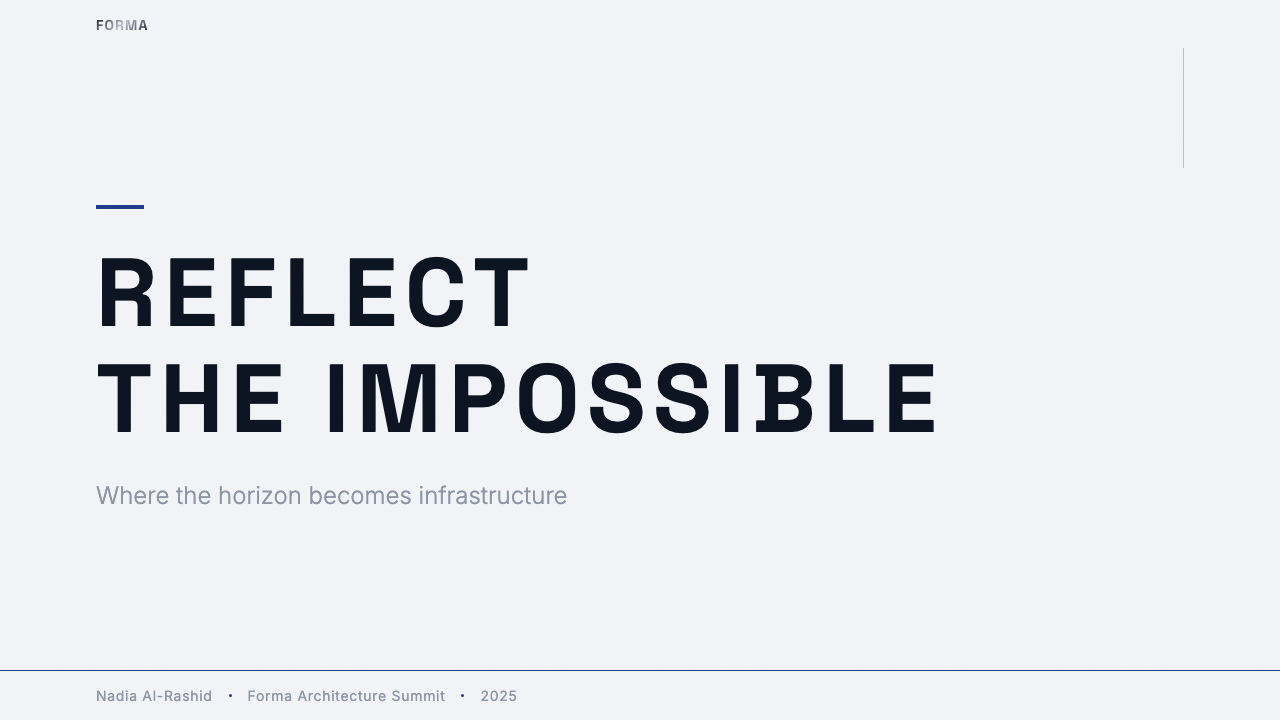
For presentation slides, the style works best when the presenter wishes to communicate institutional ambition or strategic vision rather than operational detail. A cover slide using this aesthetic should feature an expansive, near-empty composition — ideally with a strong horizontal line (representing horizon or division) against which a single block of wide-tracked type is placed. Content slides should maintain generous empty zones; resist the urge to fill every region. Data visualizations should be treated as architectural objects: large, geometric, with ultramarine-toned accent lines marking key thresholds. The most common mistake is overcrowding — the style collapses when human-scale density is introduced.
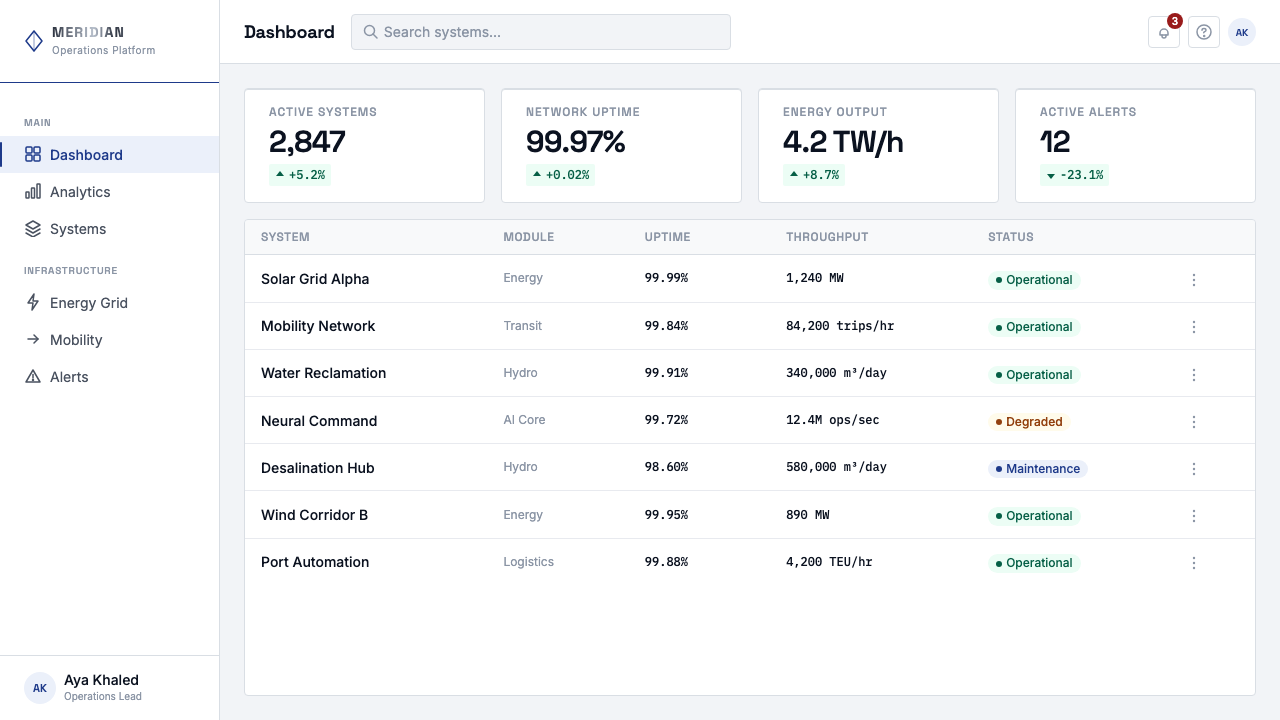
For web interfaces, this aesthetic is appropriate for hero sections and landing pages of projects that position themselves as paradigm-shifting: infrastructure, platforms, frontier technology, institutional investment. Dashboard and utility interfaces are poorly served by it — the style's emptiness reads as absence of information rather than elegant restraint when the user's primary task is data monitoring. If applied to a pricing or tier page, use the reflective surface logic to create sharp visual distinction between tiers rather than gradual differentiation; each option should feel like a distinct architectural zone.
For editorial and marketing contexts, NEOM Mirror Futurism works well for long-form feature coverage, brand manifesto documents, and annual reports targeting sophisticated institutional audiences. The visual language projects authority and forward-orientation. A spread layout might use a nearly full-bleed image with a high horizon line, type reversed out in white against the deep tones of the sky zone, and an ultramarine rule marking the transition between image and text. Avoid applying the style to content about warmth, community, or everyday human experience — the gap between form and subject will be dissonant.
A critical mistake when working with this aesthetic is introducing organic or warm elements in an attempt to make it more approachable. Earth tones, rounded forms, photographic imagery of people in close-up, or soft-shadow components all work against the style's fundamental logic. If the goal is approachability, a different aesthetic is the right choice. Applied with full commitment, however — and in contexts that genuinely call for its particular blend of spectacle and authority — NEOM Mirror Futurism produces visual communication of considerable power.
NEOM Mirror Futurism — FAQ
Is NEOM Mirror Futurism a legitimate design movement or just marketing imagery for a single project?
It is both, and the tension between those two descriptions is part of what makes it interesting. As a brand identity, it was commissioned to serve a specific project. But the visual language it developed — the mirror-surface logic, the ultramarine seam, the vast uninhabited compositions — has been absorbed into broader conversations about futurist urbanism, Gulf-state aesthetics, and AI-augmented visualization. It has influenced how other large-scale infrastructure projects present themselves visually, and it has entered the vocabulary of speculative design and world-building imagery. Whether it achieves the status of a named historical movement will depend partly on whether NEOM itself is eventually realized, but as a coherent aesthetic system it warrants serious study.
How does this style differ from earlier futurist movements like Italian Futurism or Googie?
Italian Futurism was animated by speed, violence, and the body in motion — it was fundamentally human-centric, celebrating the merger of human will with machine force. Googie architecture, emerging from postwar American car culture, was exuberant, vernacular, and designed to be comprehended at sixty miles per hour. NEOM Mirror Futurism shares neither the human-centrism of the former nor the popular accessibility of the latter. Its relationship to speed is abstract — the project is about long-term static presence, not movement. Its audience is institutional rather than popular. Where Googie wanted to delight a driver, NEOM wants to impress a sovereign wealth fund.
Can this style work for smaller-scale or consumer-facing projects?
With significant adaptation, yes — but the adaptation required is so substantial that the result should probably not be described as NEOM Mirror Futurism. The core difficulty is scale: the style's emotional logic depends on the viewer feeling small relative to what they are looking at. At product or application scale, the vast empty zones become awkward voids, and the absence of human warmth reads as unfriendly rather than authoritative. What can be borrowed productively are individual elements: the ultramarine accent logic, the mirror-surface treatment for hero images, or the extreme type tracking. These can be incorporated into a broader visual system without committing to the full aesthetic.
What is the relationship between this aesthetic and the actual architecture being built?
The relationship is, by necessity, speculative — NEOM is still largely unbuilt, and the gap between the rendered image and the realized structure is substantial by any historical measure. The visual language was developed before there was physical architecture to photograph, which means it reflects aspirations rather than actualities. As construction progresses, the inevitable introduction of weather, scale inconsistency, material variation, and human occupation will produce a built environment that diverges from the rendering aesthetic. How the brand adapts its visual language to that gap — or whether it acknowledges the gap at all — will be one of the more interesting design questions of the coming decade.
Is this style politically neutral to use, or does applying it carry connotations?
It is not politically neutral, and designers using it should be aware of its connotations. The aesthetic was created to communicate the ambitions of an authoritarian state using the visual register of technological progressivism — a juxtaposition that critics have noted. The conspicuous absence of human figures has been read as a form of visual erasure of the communities and labor that would be displaced or employed by the project. Using this aesthetic in unrelated contexts does not automatically import those specific critiques, but the style does carry associations with megaproject ambition, institutional power, and the aestheticization of scale that designers should consciously engage with rather than ignore.
Related design styles
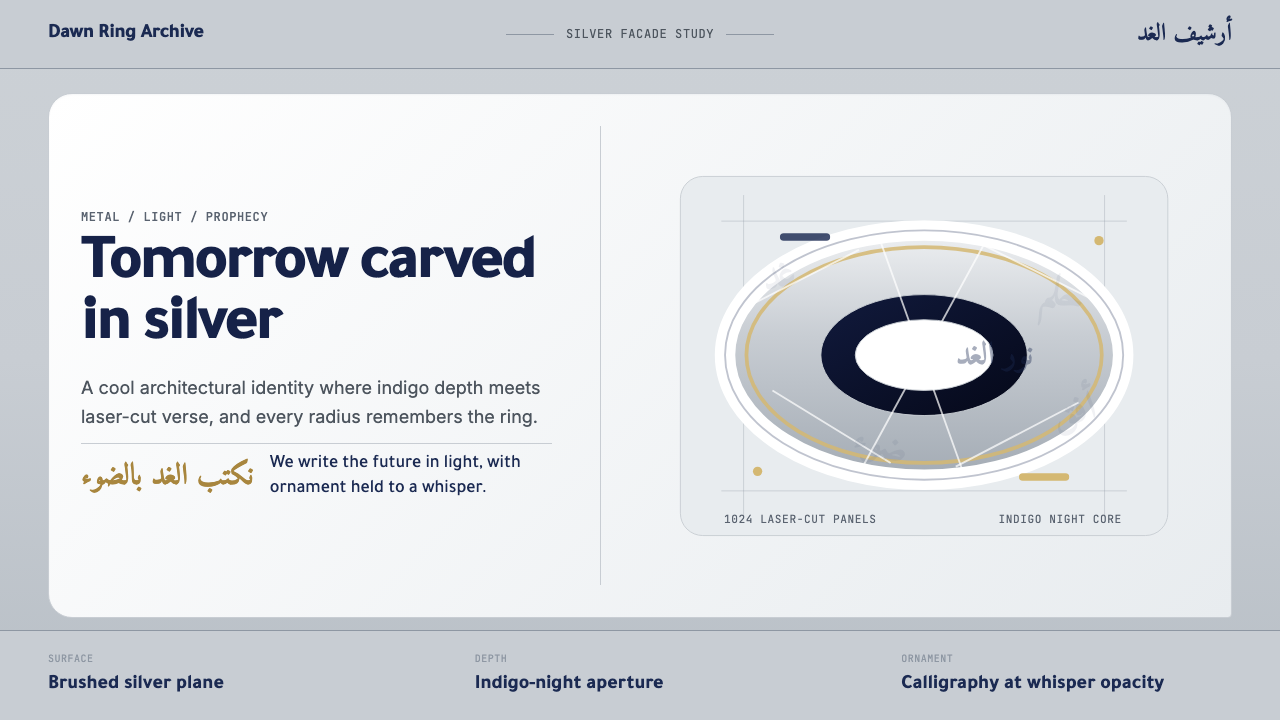 Dubai Museum of the FutureTechnological luxury feels poetic. Silver metal, indigo depth, and Amiri call…
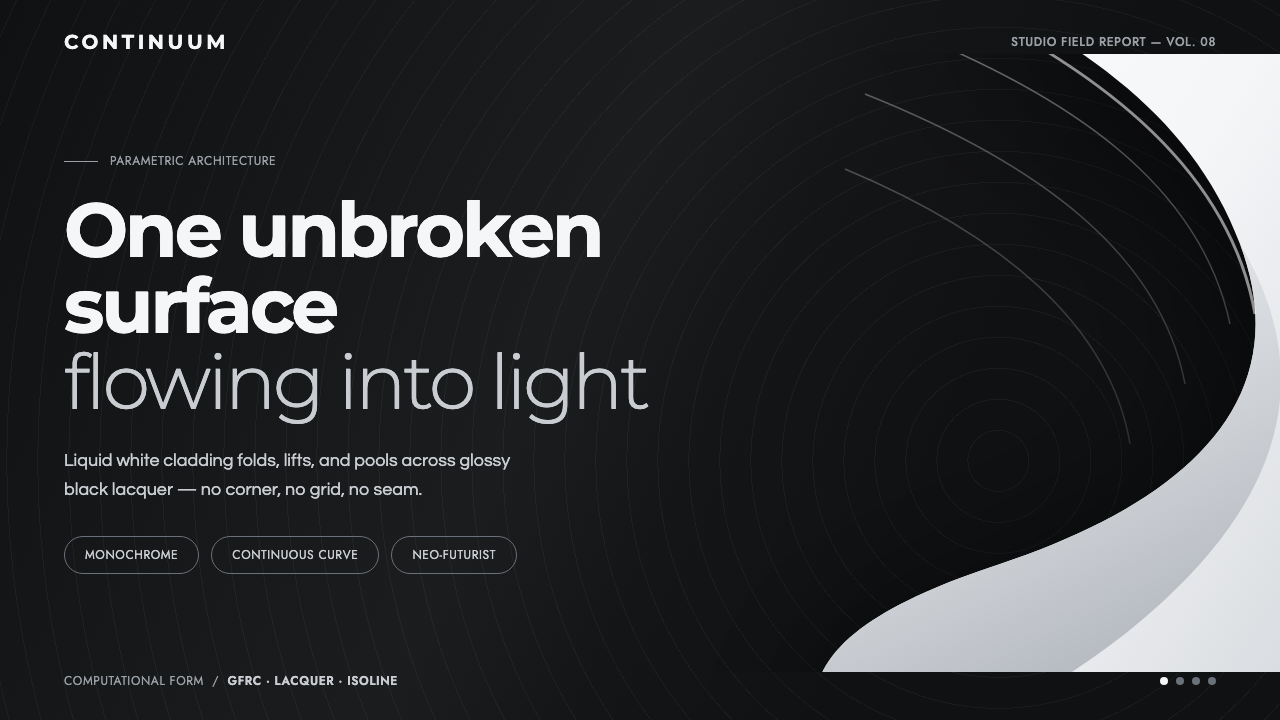 Parametricism (Zaha Hadid)Architecture as one unbroken surface. A liquid-white swoop floats on glossy b…
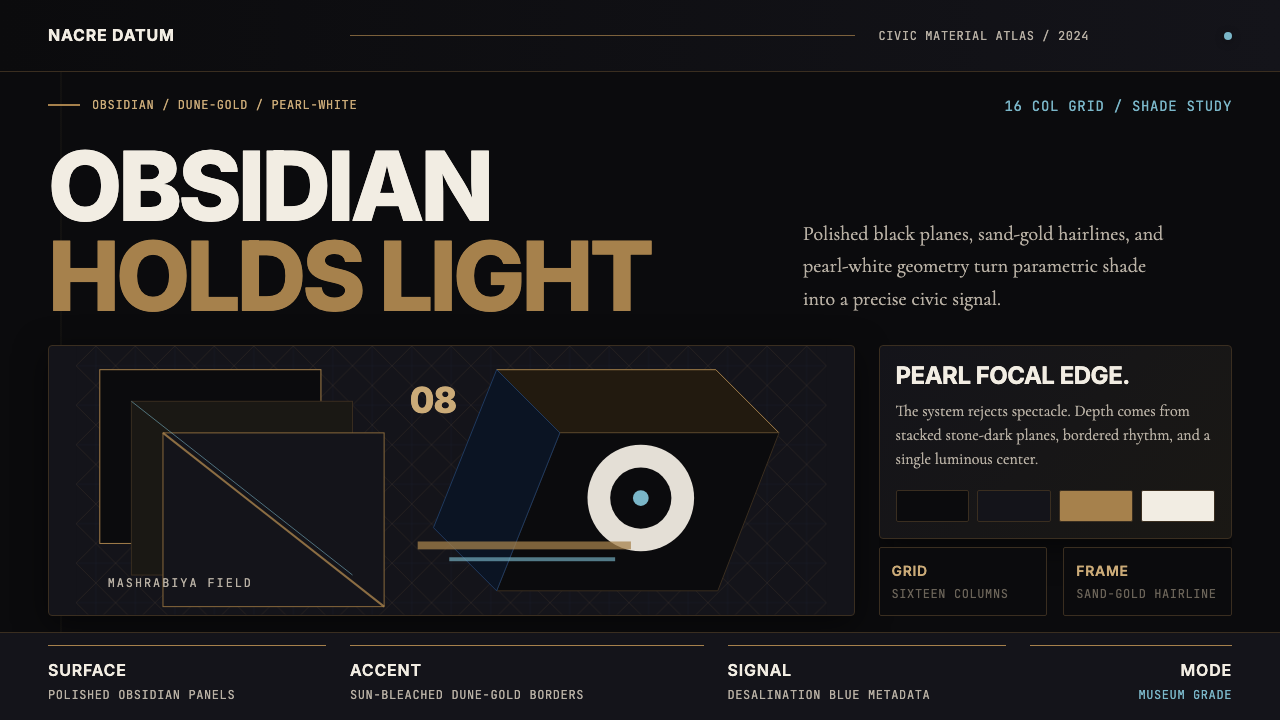 Qatari Pearl Modern Architecture 2024Monumental restraint. Obsidian panels, sand-gold gridlines, pearl-white geome…
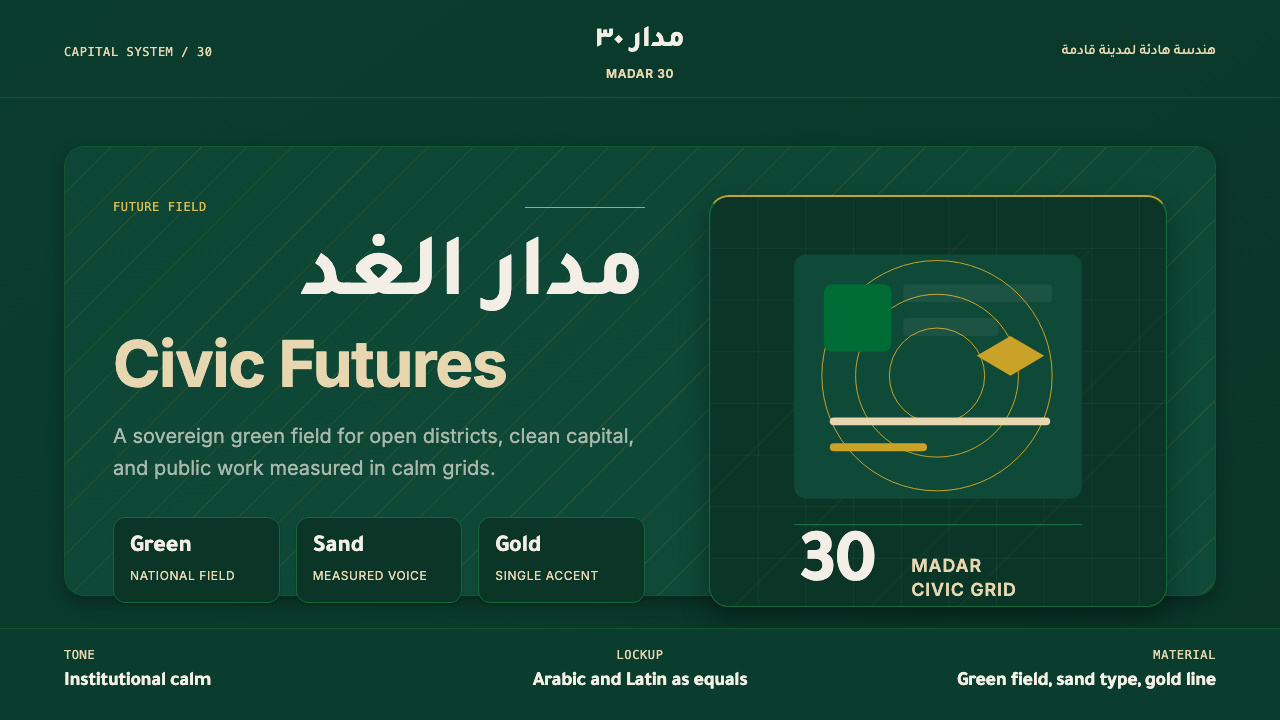 Riyadh Vision 2030Sovereign futurism. National green, sand type, and gold hairlines hold a calm…
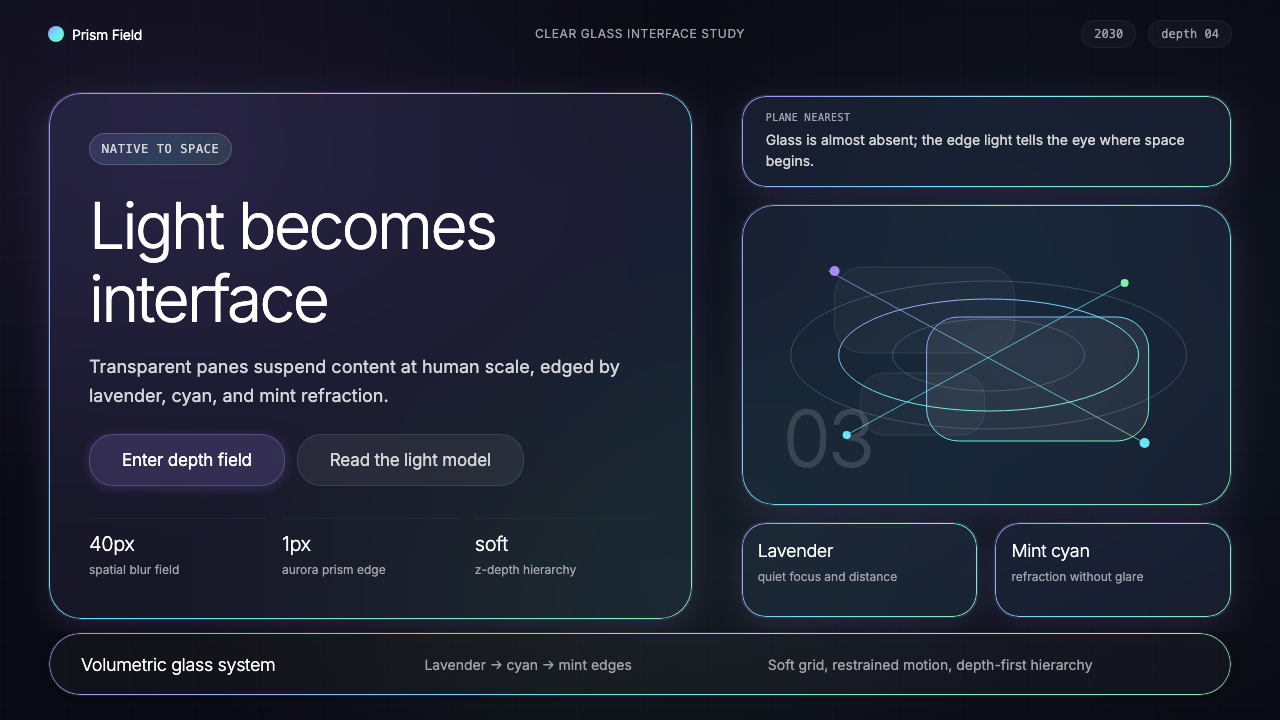 Vision Pro Spatial UI (2030)Structured light, not software. Deep navy glass panels glow with lavender-cya…
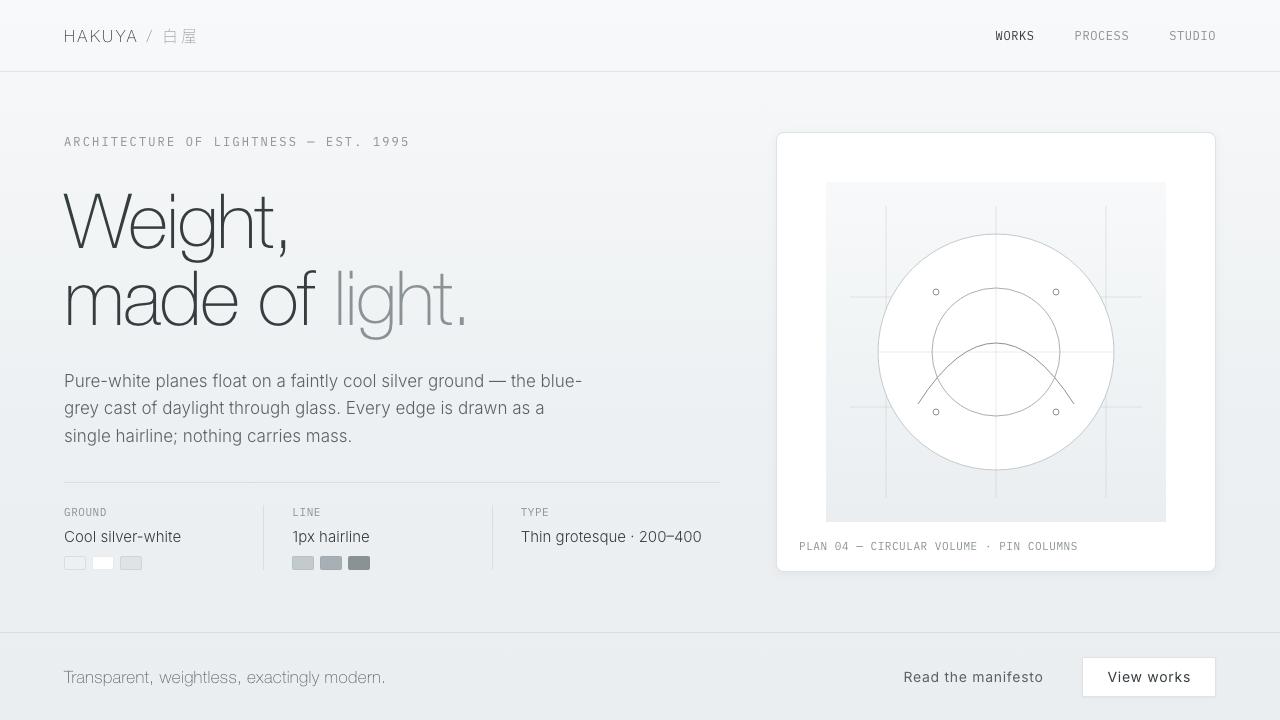 SANAA White LightnessArchitecture made of light. White planes float on cool silver-grey, edged in…