What is Torres Strait Dhari Headdress?
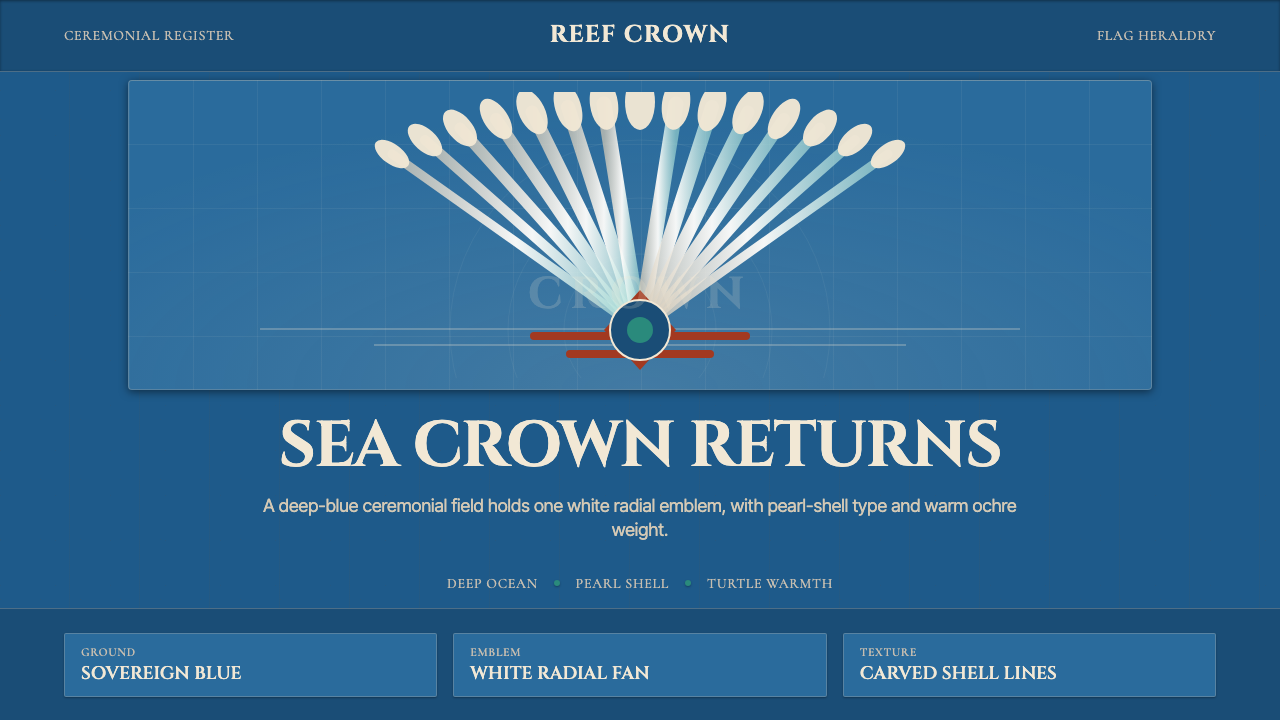
A single sacred headdress became the heraldic heart of an entire people — and its visual logic of centered radiance, ocean depth, and shell-bright white still carries that sovereign weight.
Torres Strait Dhari Headdress in brief
Torres Strait Dhari Headdress is a design language rooted in the ceremonial object that stands at the center of the Torres Strait Islander flag: the dhari, a fan-shaped headdress of white egret feathers mounted on a woven rattan frame. The style translates the visual logic of that singular emblem — bilateral symmetry, radial expansion from a strong center, a palette of deep ocean blue offset by luminous white and the warm amber of turtle shell and pearl — into a complete design system.
Where most heritage-inspired aesthetics borrow surface textures or regional motifs, the dhari system works differently. Its organizing principle is heraldic: every composition is structured as though it were a flag. The dominant element sits at the center, flanked by symmetrical fields. Negative space is as deliberate as any mark. The result is a visual language that feels ceremonial without being archaic — authoritative and still.
The palette operates in strong contrasts. A deep, near-indigo blue — the color of open ocean between Cape York and Papua New Guinea — anchors every surface. Against it, white reads with the optical intensity of polished pearl shell. A warm honey-amber drawn from turtle shell provides the only departure from this cool polarity, used sparingly as a bridge between the two. The overall effect is not decoration but declaration.
Where does Torres Strait Dhari Headdress come from?
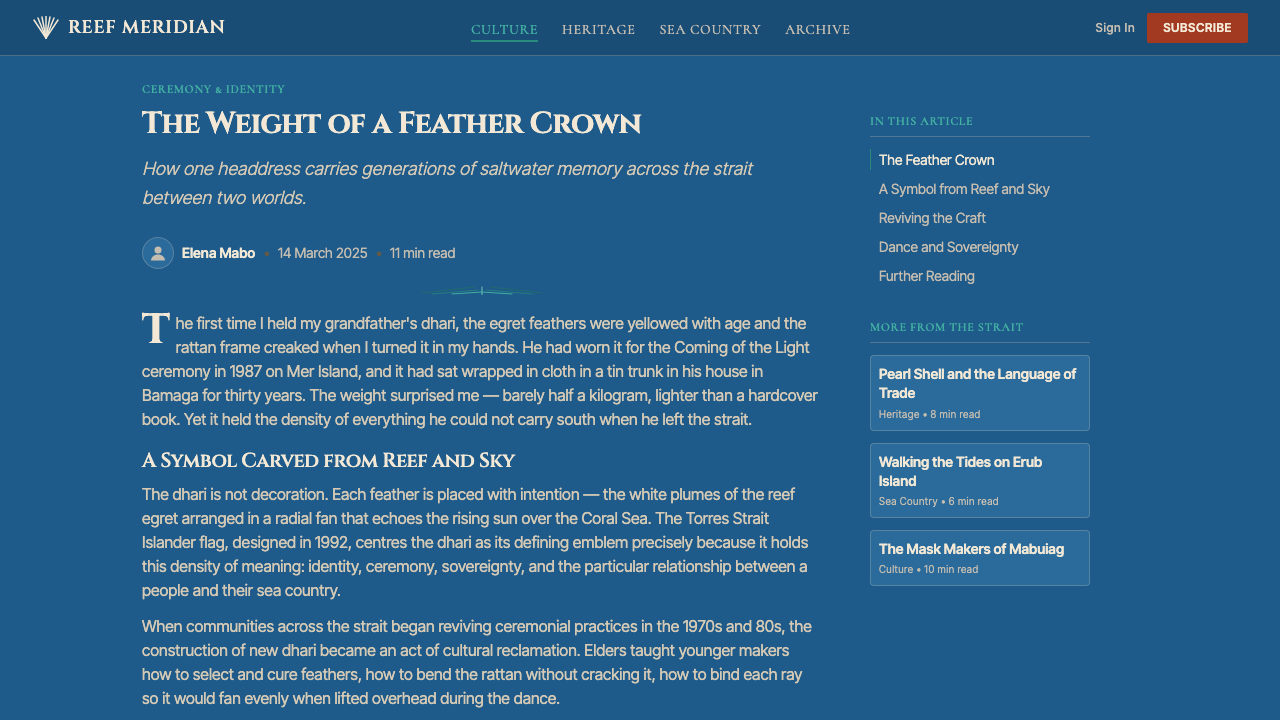
The Torres Strait Islands form a scattered archipelago of more than two hundred islands between the northernmost tip of Queensland, Australia, and the southern coast of Papua New Guinea. The islands were inhabited for at least three thousand years before European contact, with distinct languages, trade networks, and ceremony traditions binding communities across the water. The dhari headdress was central to the most important ceremonial dances — not a costume detail but the defining marker of ritual status, worn only in contexts of communal significance.
The featherwork construction of the dhari reflects both ecological knowledge and skilled craft. White egret feathers were selected for their particular luminosity, their capacity to catch and radiate light in the way that pearl shell and polished bone do. The rattan framework — shaped into the characteristic spreading fan — was itself a demonstration of structural ingenuity, supporting the mass of feathers in a shape that remained legible and upright through the movement of dance. The bilateral symmetry of the form was not aesthetic convention but a requirement of the object's ceremonial function: the dancer's body, and by extension the community the dancer represented, appeared balanced and complete.
In 1992, the Torres Strait Regional Authority held a competition to design a flag for the Torres Strait Islander people. The winning design, created by Bernard Namok of Thursday Island, placed the dhari at the center of a triband field — black for the people, blue for the sea, and green for the land. A white five-pointed star appeared below the dhari, representing the five island groups. The flag transformed a sacred dance object into a political emblem of sovereignty and identity, and in doing so gave the dhari a second life as a heraldic form legible far beyond its ceremonial context.
The broader cultural renaissance that surrounded and followed the 1992 flag design was tied to the Mabo land rights movement. Eddie Mabo, a Torres Strait Islander from Mer Island (Murray Island), had launched a legal challenge to the doctrine of terra nullius — the colonial legal fiction that Australia had been unoccupied before European arrival. The High Court's 1992 Mabo decision overturned that doctrine, recognizing native title for the first time in Australian law. The decision arrived in the same year as the flag. Together, they marked a turning point in the assertion of Torres Strait Islander identity and sovereignty, and the dhari — both on the flag and in contemporary visual culture — became one of the central symbols of that turning.
What defines the Torres Strait Dhari Headdress look?
Color: Ocean Depth and Radiant White
The dominant ground is a deep, saturated blue that reads as open ocean — not the bright turquoise of tropical shallows but the near-indigo of deep water under full sun. Against this field, white carries maximum luminosity, drawn from the specific quality of egret feather and pearl shell: a brightness that seems to generate its own light rather than simply reflecting it. A warm amber — the color of polished turtle shell — appears as a third note, bridging the cold polarity of blue and white with organic warmth. The palette is used at high contrast; there are no muted midtones or dusty neutrals.
Bilateral Symmetry and Centered Composition
The dhari's fan form is perfectly bilateral — a mirror axis runs through the center of every composition. This is not the casual symmetry of decorative borders but the formal symmetry of heraldry and ceremony: both halves are load-bearing. The central element commands the field; flanking elements are subordinate but not incidental. This principle applies across scales, from a full-page layout to a small icon. The effect is authority — the composition does not invite wandering attention but fixes the gaze at the center.
Radial Structure
Compositional energy flows outward from the center, following the logic of the headdress's spreading feathers. Lines, shapes, and typographic hierarchies radiate rather than cascade vertically or march horizontally. Data visualizations take on a sunburst or mandala quality; navigational elements orbit a core. This radial logic distinguishes the style sharply from grid-dominant Western design traditions, where information flows top-to-bottom or left-to-right. Here, everything originates at a point and expands — the visual equivalent of a declaration.
Pearl-Shell Luminosity
Pearl shell — trochus and pearl oyster — was the most valued trade material in the Torres Strait for centuries, and its optical qualities inform the style's treatment of light. Where other aesthetics might achieve highlight through gradients or glows, this system achieves it through high-contrast edge articulation: a brilliant white element placed directly against deep blue reads as luminous rather than simply light. The iridescent quality of shell is suggested not by gradient fills but by the sharpness of the color boundary — the way a polished shell seems to contain its own interior light.
Ceremonial Weight and Stillness
The dhari is not a casual object; it is worn in moments of maximum communal gravity. This context of use shapes the visual register of the entire style. Compositions are still — elements do not chase the eye but hold their positions with confidence. Motion, where it exists, is expansive and slow, like the spread of feathers rather than the flutter of leaves. Decorative busyness is structurally excluded. The white space surrounding a central element is not emptiness to be filled but a field of attention, the visual equivalent of the cleared ground before a ceremony.
Turtle Shell Warmth as Accent
Turtle shell appears in the flag as a thin border strip and, in the broader material culture of the Torres Strait, as a medium for carving masks and ceremonial objects. In the design system, its warm amber tone functions as the sole deviation from the blue-white axis — a carefully rationed accent that prevents the palette from reading as purely cold or corporate. It is used at small proportion: a single line, a label background, a highlighted data point. Used at large proportion, it would overwhelm the ocean authority of the primary palette.
Flat Geometry, No Simulation
The dhari as a visual object is flat when rendered in two dimensions — a silhouette, a flag element, a carved form. The design system follows this same flatness: shapes are filled with solid color, borders are hard, and depth is created through layering and contrast rather than shadow gradients or three-dimensional illusions. This is consistent with the ceremonial function of the original object, which must be legible at a distance, in motion, and across varying light conditions. Flat geometric clarity is not a stylistic choice so much as a functional inheritance.

Who shaped Torres Strait Dhari Headdress?
A Thursday Island artist and the designer of the Torres Strait Islander flag (1992), Namok placed the dhari at the center of the triband composition and in doing so performed the decisive act of visual translation: transforming a ceremonial object into a heraldic device legible far beyond its original context. His design has become one of the most recognizable Indigenous flags in the world. The compositional decisions he made — the bilateral framing, the star below the dhari, the strict triband field — established the visual grammar that the dhari design system extends.
A linguist, cultural educator, and central figure in the documentation and transmission of Torres Strait Islander languages and ceremonial traditions in the latter half of the twentieth century. Bani worked to preserve and explain the dhari and the dances associated with it, placing the headdress within its proper cultural context at a time when that context was under pressure from assimilationist policies. His work is part of the broader cultural foundation that made the 1992 flag and the dhari's entry into visual culture meaningful rather than merely decorative.
A Badu Island artist working in printmaking, sculpture, and performance, Tipoti is among the leading contemporary figures connecting the visual traditions of the Torres Strait to international contemporary art contexts. His linocuts and etchings draw on the formal vocabulary of traditional Torres Strait design — the dhari, the ceremonial mask, the turtle — and submit them to the demands of the fine art print medium. His work demonstrates how the visual logic of the dhari can be extended and elaborated without departing from its ceremonial seriousness.
Though primarily known as a land rights activist and plaintiff rather than a visual artist, Eddie Mabo's historical significance is inseparable from the cultural context of the dhari as a heraldic form. The 1992 High Court decision bearing his name arrived in the same year as the Torres Strait Islander flag, and together these two events marked a turning point in the legal and cultural assertion of Torres Strait Islander sovereignty. The dhari's elevation to a political symbol of identity cannot be understood apart from the Mabo decision's overturning of terra nullius and the assertion of continuous connection to country that the decision recognized.
The committee that organized and judged the 1992 flag competition was itself a collective act of cultural self-determination, bringing together community representatives from across the island groups to define a visual identity that could represent the diversity of Torres Strait Islander peoples under a single emblem. The decision to center the dhari rather than any other ceremonial object or geographic marker was a choice about which aspect of shared culture could carry the most sovereign weight — and the choice has proved durable. The flag, and the dhari at its center, have become reference points for Torres Strait Islander visual culture in all its contemporary forms.
How do you use Torres Strait Dhari Headdress today?
The dhari design system is among the most compositionally distinctive heritage-derived styles available to contemporary practitioners, because its heraldic logic is structural rather than decorative. Applying it correctly requires understanding what the system is actually doing: fixing attention at a center, radiating energy outward, holding the eye within a bilaterally balanced field. Simply applying the blue-and-white palette to an unrelated layout will produce pastiche; the composition must also obey the system's ceremonial gravity.
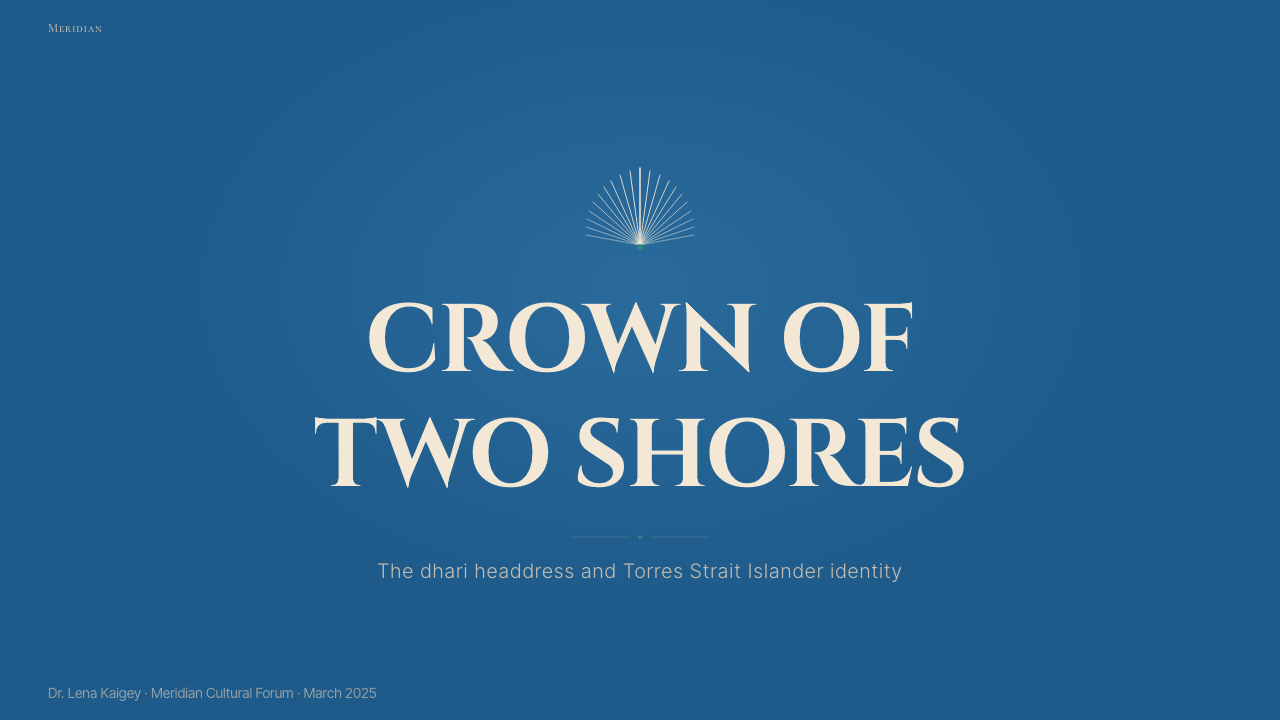
For presentation slides, the system excels at cover pages where authority and identity need to be established in a single visual. A centered composition on a deep blue ground — a radial device at the center, the title in luminous white type below it, minimal flanking detail — carries immediate gravitas. Content slides should preserve the bilateral principle: information organized around a vertical center axis, with left and right columns treated as mirror-weighted rather than left-to-right reading sequences. Data slides work well when chart elements radiate from a core rather than stacking in bars; circular or sunburst formats align naturally with the system's compositional DNA.
For web interfaces, the style is particularly well-suited to dashboard headers, flagship feature blocks, and pricing page hero sections — contexts where the product is making a claim about its own significance. The approach: commit to a deep blue primary surface, use white for all primary text and interactive elements, and introduce amber only at the level of highlights, active states, or pricing tier indicators. Navigation should be centered rather than left-aligned; card components should be bordered in white on blue rather than cast in soft shadow. The bilateral symmetry principle applies to page-level layout as well — two-column arrangements should feel balanced, not skewed toward a primary reading column.
For editorial and marketing work, the system supports bold single-image compositions with strong typographic integration. A magazine cover or social media image in this style places one dominant centered element — a radial motif, a portrait with dhari-echo framing, a product shot isolated against the ocean blue — with the headline type integrated into the radial structure rather than placed independently at the top or bottom. Marketing pages benefit from the style's poster-like authority: alternating full-width sections in deep blue and white, with the amber accent used consistently for call-to-action elements. The style translates well to print, outdoor, and large-format digital because its high contrast and flat geometry hold at any scale.
A common mistake when applying this system is using the palette without committing to the compositional logic. Blue and white at high contrast without bilateral centering will read as a generic nautical or corporate theme — visually competent but without the system's distinctive authority. A related error is distributing the three colors at roughly equal proportion across a layout; the dhari palette is hierarchical, with blue dominating, white as the primary figure, and amber as a scarce accent. Overusing amber breaks the oceanic coolness that gives the white its particular luminosity. Finally, avoid asymmetric layouts that would be natural in grid-dominant Western design traditions — the centered, bilaterally balanced structure is not a style detail but the system's fundamental organizing principle.
Torres Strait Dhari Headdress — FAQ
Is using the dhari design system culturally appropriate for non-Indigenous designers and brands?
This is a question that deserves honest engagement rather than a formulaic answer. The dhari headdress is a living ceremonial object tied to a specific community's sovereignty and spiritual practice, not a historical artifact available for general appropriation. A design system inspired by its visual logic — the radial structure, the ocean palette, the heraldic centering — can be applied with respect and attribution, but using the dhari itself as a brand mark, or presenting the design as representative of Torres Strait Islander identity without community involvement, crosses into appropriation. The appropriate approach involves genuine consultation with Torres Strait Islander communities, transparent attribution, and an honest assessment of whether the use serves the community's interests or merely extracts their visual culture for commercial benefit.
How does the dhari system differ from other Pacific Island or Oceanic design aesthetics?
The Torres Strait Islands sit geographically between Australia and Papua New Guinea, and the visual culture of the region draws from both directions. However, the dhari system's most distinctive characteristic — the heraldic, bilaterally centered composition — sets it apart from most Pacific Island aesthetics, which tend toward all-over pattern, interlocking geometric tessellation, or asymmetric figurative imagery. Polynesian and Melanesian design traditions (tapa, tā moko, Māori kōwhaiwhai) work with continuous surface coverage; the dhari system works with a single dominant centered emblem and open surrounding field. The closest parallel in Western design is indeed heraldry — which is why the 1992 flag reads with such immediate clarity as a sovereign statement.
Can the dhari system work for dark-mode interfaces, or is the deep blue always the background?
The deep blue ground is the canonical orientation of the system — it reflects the ocean, which is the environmental context from which the palette is drawn. However, the system can invert: white as the dominant ground with the blue used for structural elements and type, and amber reserved for accents. This inversion is used in the flag itself, where the green and black bands bracket a central blue field — the visual structure includes both light and dark registers. For interface purposes, a white-ground variant reads as formal and documentary, close to the quality of official correspondence; the blue-ground variant reads as immersive and authoritative. What the system resists is mid-value grounds — medium grays or muted backgrounds that rob the palette of its characteristic polarity.
How should the amber accent be used, and what happens when it is overused?
The amber accent functions as a third voice in a composition that is otherwise conducted between two — blue and white. Its role is to mark the specific: a selected state, a tier label, a highlighted figure in a data set, a call-to-action button. When used at this proportion, it reads as the warm center of the dhari itself — the point from which the feathers spread, the shell at the core of the composition. When overused — applied to multiple elements, used as a fill color for large content areas, or mixed freely with the primary white — it competes with rather than accents the white, and the palette's oceanic character dissolves into something generic. The discipline is proportion: amber at small scale intensifies the blue-and-white polarity; at large scale it destabilizes it.
Does the ceremonial origin of the style mean it should only be used for serious or formal contexts?
Not necessarily, but the style does carry a formal register that should be understood and either embraced or consciously subverted. The dhari's visual gravity comes from its ceremonial function: it was worn to mark events of maximum communal significance, and that context of use has shaped the visual system's character. In contemporary application, this manifests as a tendency toward authority and stillness — the style is less at home in playful, chaotic, or sensory-rich environments than in those calling for presence and dignity. This does not limit it to government institutions or cultural organizations; a technology product, a premium consumer brand, or an editorial publication can all carry this register appropriately. The risk is forcing the style into contexts where its gravity works against the user's emotional goals — a children's app, a casual social platform, or an entertainment brand where warmth and spontaneity are the target feeling.
Related design styles
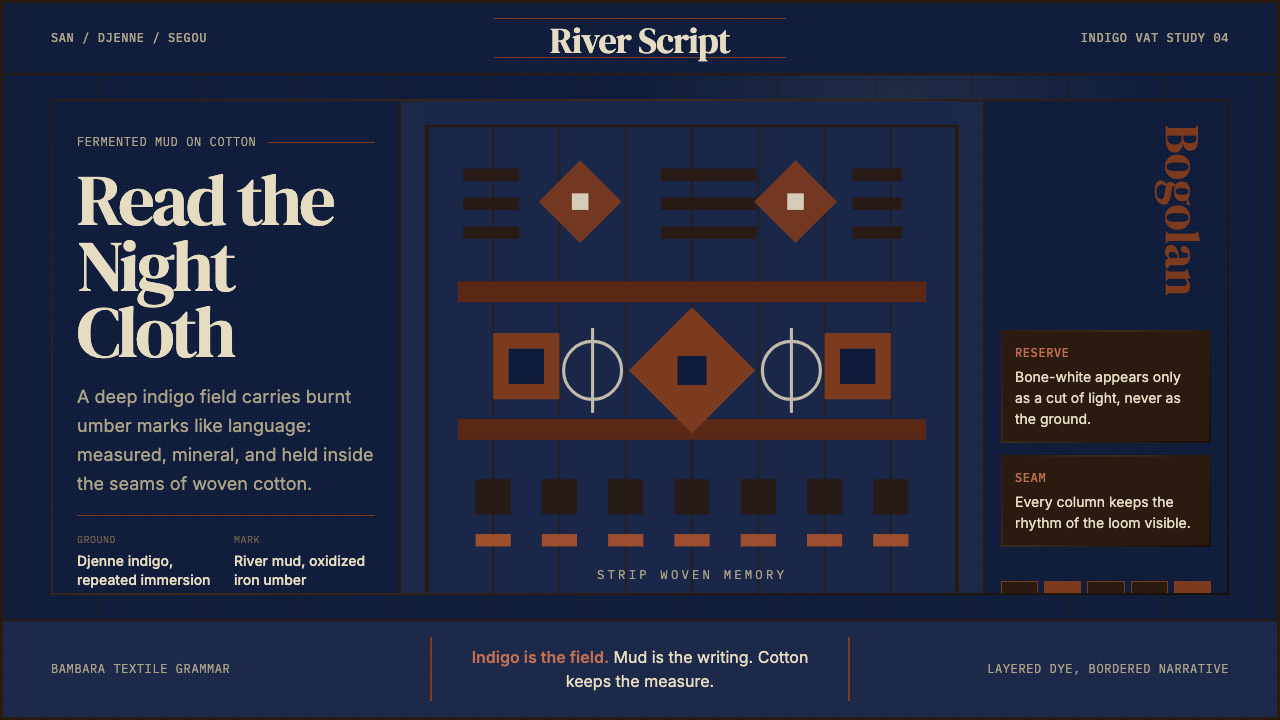 Malian Bogolan over Djenné IndigoCloth reads at night. Djenne indigo, burnt-umber mud marks, and strip seams.
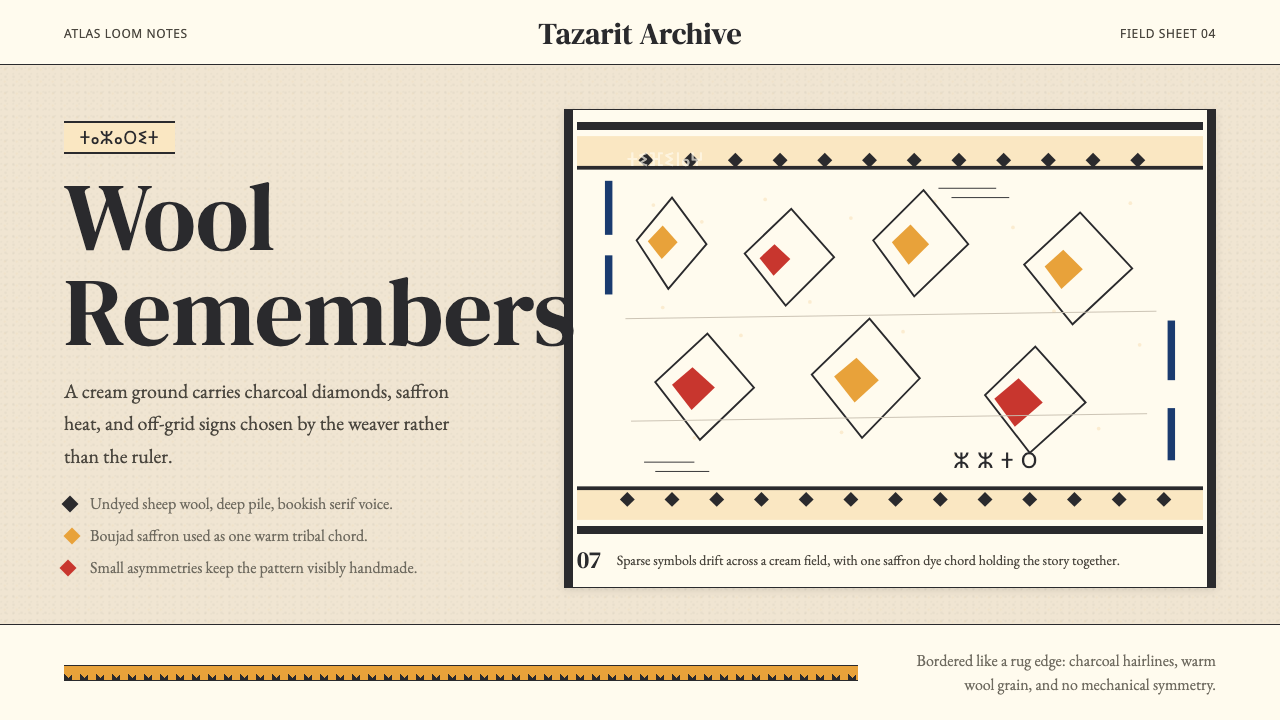 Moroccan Amazigh Berber RugAutobiography in wool. Cream ground, charcoal diamonds, saffron bands drift o…
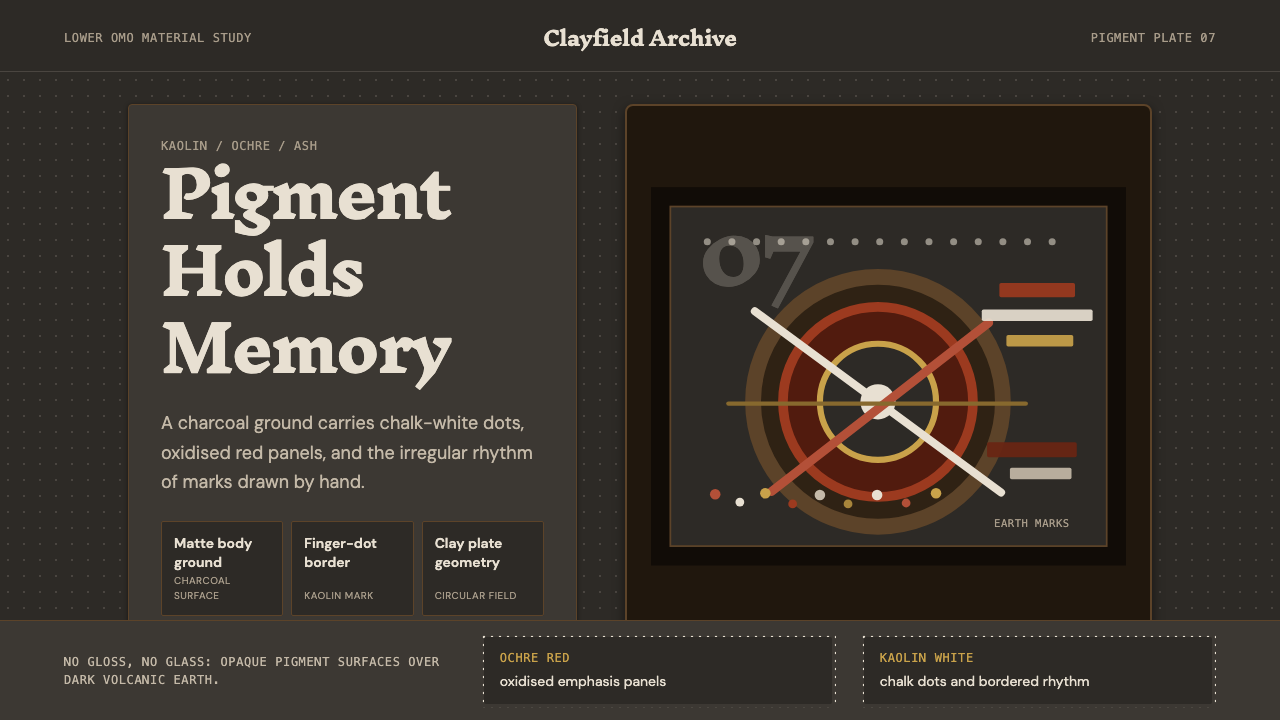 Mursi Omo Valley Lip Plate PaintRaw dignity, matte and proud. Kaolin dots and ochre rings sit on charcoal gro…
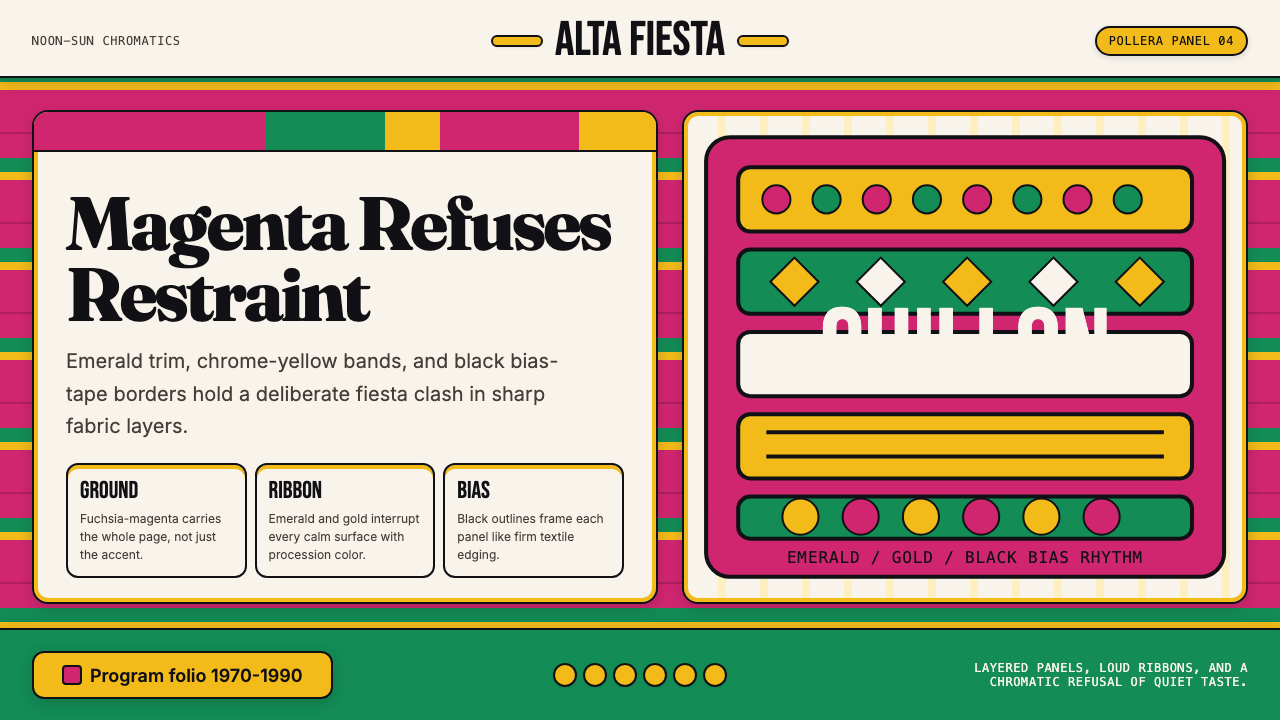 Bolivian Pollera Fiesta MagentaChromatic defiance. Magenta ground, emerald bands and black outlines clash li…
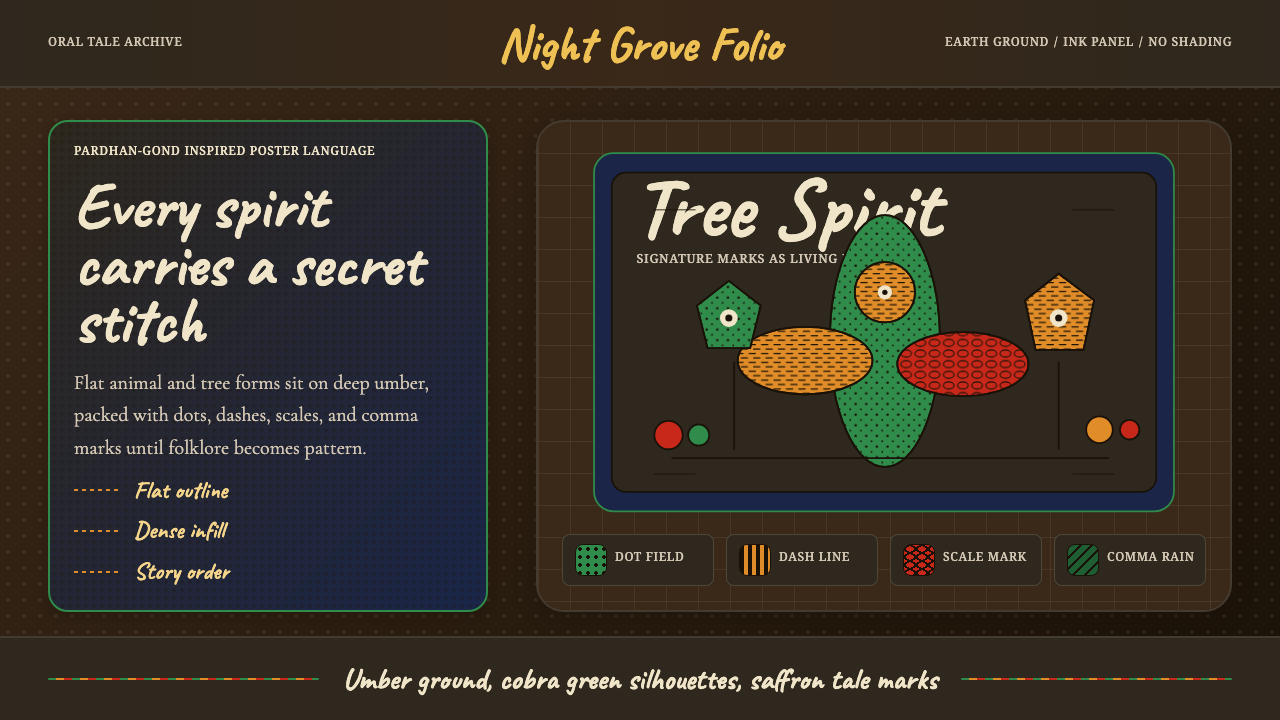 Gond Pardhan (Tree Spirit Painting)Story breathes in pattern. Cobra green forms on umber ground, filled with dot…
 Gond Tribal Art (Madhya Pradesh)The wall becomes a forest. Earth-cream, charcoal, and stippled red make it ce…