What is Tokyo Shibuya Scramble Neon?
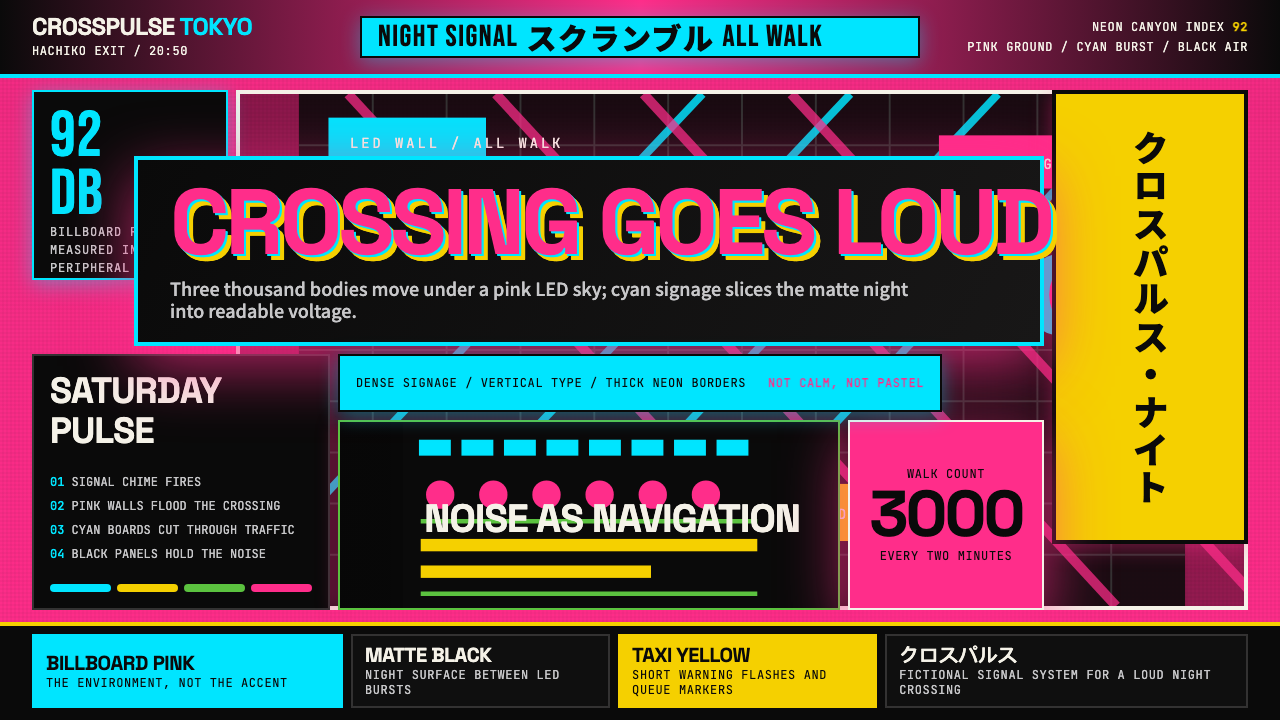
Shibuya Scramble Neon is the design language of Tokyo's most photographed crossroads — maximalist, disciplined, and unapologetically loud.
Tokyo Shibuya Scramble Neon in brief
Tokyo Shibuya Scramble Neon is a visual system rooted in the real sensory environment of Shibuya Crossing — the world's busiest pedestrian intersection, where roughly three thousand people cross simultaneously every two minutes beneath a canyon of enormous LED billboards, backlit signage walls, and layered vertical type. It is not a generic cyberpunk fantasy; it is a precise extraction of the pink-cyan-black palette and typographic density that characterize the Q-FRONT tower, the Shibuya 109 fashion building, and the labyrinthine Don Quijote discount store with its signature all-caps katakana stacked from pavement to roofline.
The style is defined by contrast at every scale: warm neon pink as a dominant ground fights against electric cyan borders and accents, while matte black panels provide breathing space and structural anchoring between bursts of color. Vertical type — a natural feature of Japanese signage culture — gives compositions a columnar, stacked quality that reads differently from left-to-right Western layouts. The overall effect is maximalist but not chaotic; the competing elements follow an implicit hierarchy of luminosity and scale that emerges from the physical logic of outdoor advertising.
What distinguishes this system from other neon-inflected aesthetics is its specificity of place and its restraint within excess. The palette is tight: a warm pink ground, a cold cyan edge, near-black surfaces, and occasional white highlights. There is no attempt to include every neon hue; the system captures the actual color temperature of a specific Tokyo neighborhood at a specific hour of the evening. Layering is permitted — even required — but each layer belongs to a clear plane: background, midground type, foreground graphic, overlay glow.
Where does Tokyo Shibuya Scramble Neon come from?
The physical and cultural roots of this design system stretch back to 1979, when Tokyu Corporation opened Shibuya 109 — a cylindrical fashion complex that anchored the east side of Shibuya Crossing and became a magnet for the gyaru and kogal street-style subcultures of the 1980s and 1990s. Those subcultures were defined by conspicuous decoration, high-contrast color, and an aggressive reclamation of femininity through visual excess — values that filtered directly into the area's signage culture. By the time Q-FRONT, the tower housing the giant video screens, opened in 1999, the crossing had already established its visual grammar of layered, competing, high-luminosity surfaces.
The aesthetic cannot be separated from the post-bubble period of Japanese culture. After the economic bubble burst in 1991, the 1990s saw a flowering of youth street style that used visual maximalism as a form of cultural defiance. The gyaru aesthetic — platform shoes, bleached hair, dramatically contrasted cosmetics, dense layering of accessories — translated directly into the visual language of the brands and stores that served that community. Shibuya's crossing became an outdoor advertisement for the community itself, each storefront an argument for a particular version of loudness.
Daido Moriyama, the Japanese photographer whose grainy, high-contrast street photography documented Tokyo from the 1960s onward, captured the pre-LED neon era of the crossing in ways that shaped how subsequent artists and designers understood its visual language. His images emphasize blur, grain, and the halation of bright lights against dark wet pavement — qualities that survive in contemporary interpretations of the scramble aesthetic even when the technical rendering is crisp and digital. Sofia Coppola's 2003 film Lost in Translation, though set partly at the Park Hyatt in Shinjuku rather than Shibuya, crystallized the international image of Tokyo-at-night as a place of beautiful, illegible luminosity — and that image drew heavily on the visual reality of Shibuya Crossing.
The post-2020 era brought significant physical redevelopment to Shibuya, with new tower complexes rising around the station and the scramble crossing gaining new architectural backdrops. This redevelopment introduced a tension the design system explicitly encodes: the collision between the maximalist, organically accumulated neon layer of older Shibuya and the cleaner, more architecturally deliberate surfaces of new development. The pink-cyan-black palette represents the older neon stratum, while the matte black panels and geometric structure in the system's vocabulary acknowledge the newer context pressing in around it.
What defines the Tokyo Shibuya Scramble Neon look?
Color Temperature
The palette is built around a specific opposition: a warm, saturated pink that reads as artificial and inviting in equal measure, set against a cold, electric cyan that suggests neon tube light or LED edge-lighting. These two hues do not harmonize in the traditional sense — they vibrate against each other, creating the visual tension that characterizes the scramble crossing at night. Near-black and matte-dark surfaces absorb the excess, preventing the composition from becoming illegible. White appears only as highlight or glow, never as a neutral field.
Layered Depth
Unlike flat design systems that enforce a single visual plane, Shibuya Scramble Neon explicitly operates in depth. Elements are stacked across a foreground, midground, and background — a graphic motif sits above a color field, which sits above a darker architectural plane, which sits above a near-black void. Glow and halation — the soft spreading of light around a bright source — are used to transition between planes rather than hard edges. This gives the system its characteristic sense of luminous depth without recourse to realistic rendering.
Vertical Typography
Vertical text orientation — drawn directly from the tradition of Japanese signage and print culture — is a defining structural device in this system. Columns of type read top-to-bottom and are stacked side by side, creating a grid of vertical rhythm that differs fundamentally from horizontal Western layouts. Even when Latin characters appear (as they frequently do on Shibuya storefronts, in brand names and English taglines), they may be rotated or arranged vertically, subordinating Western typographic convention to the columnar logic of the environment.
Controlled Density
The system is maximalist in the sense that it accommodates a high information load — multiple type scales, multiple color zones, graphic motifs and text coexisting in the same composition — but it is not random. The density is controlled by a consistent hierarchy of luminosity: the brightest, most saturated elements attract attention first; mid-luminance elements form the readable layer; dark elements recede into structure. This mirrors the actual perceptual experience of the crossing, where the brain automatically sequences the visual input by brightness before processing content.
Signage Logic
The design language is fundamentally derived from outdoor advertising — from surfaces designed to be read at distance, in motion, in competition with dozens of other surfaces. This origin imposes certain rules: type must be bold enough to read against complex backgrounds; color must hold its identity even when adjacent to competing hues; spatial hierarchy must be legible in a peripheral glance as much as in focused reading. When applied to screen or print contexts, these outdoor-advertising constraints produce designs with unusual visual resilience — they work at small sizes, at low resolution, and in difficult lighting conditions.
Matte Black Anchoring
Against the luminous energy of the pink-cyan palette, matte black panels serve a crucial structural role: they stop the eye, mark spatial boundaries, and give the composition a sense of architectural solidity. These dark zones are not voids or absences — they read as surfaces, as physical panels mounted on a facade or interior wall. The black is matte, not glossy, which prevents it from competing with the neon reflection and halation that surround it. This is the design equivalent of the dark spaces between the buildings that make the crossing's light-canyon effect possible.
Glow as Transition
Rather than using hard edges or soft drop shadows to separate elements, this system uses luminous glow — the spreading of light from a bright element into its surrounding field — as the primary transition device between layers. Glow belongs to the vocabulary of neon and LED lighting: it is not a graphic trick but a faithful reproduction of how high-luminance sources behave in low-luminance environments. The glow is color-accurate — pink sources produce pink halation, cyan sources produce cyan spreading — which maintains palette discipline even in the transition zones.
Who shaped Tokyo Shibuya Scramble Neon?
The private railway company that developed and continues to anchor much of Shibuya's commercial infrastructure, including Shibuya 109 (opened 1979) and the Shibuya Hikarie tower (opened 2012). Tokyu's long-term investment in Shibuya as a fashion and entertainment destination — and its management of the dense retail environment around the crossing — is directly responsible for the visual density and layered commercial signage culture that defines the scramble area. The visual language of Shibuya Scramble Neon is, in a material sense, the visual language that Tokyu's tenant mix produced.
The Japanese photographer (born 1938) whose decades of street photography in Tokyo established the visual grammar through which Shibuya's neon environment is understood internationally. His high-contrast, grain-heavy, motion-blurred images of Tokyo streets — shot from the 1960s onward — treated the city's signage, light pollution, and spatial compression as photographic material in their own right. Later photographers and designers working with Shibuya neon imagery return repeatedly to the halation, grain, and tonal compression of Moriyama's vocabulary, even when working digitally.
The American filmmaker whose 2003 film Lost in Translation crystallized the international aesthetic image of Tokyo-at-night as a place of beautiful, disorienting luminosity. Though the film is set primarily in Shinjuku rather than Shibuya, its cinematography — wide-angle views through hotel windows at night, the compression of neon-dense streetscapes, the foreignness and beauty of illegible signs — became the reference point against which many subsequent visual interpretations of Tokyo neon are measured. Coppola's contribution was essentially curatorial: she selected and framed images of a real visual environment and amplified their emotional resonance for an international audience.
The collective of female-led Tokyo street-style subcultures — gyaru, kogal, and related movements — that flourished in and around Shibuya from the 1980s through the 2000s. These communities used visual excess as a statement of identity and autonomy, combining bleached hair, platform footwear, and dense layering of color and accessories in ways that directly influenced the commercial visual language of the brands and stores that served them. The extreme contrast, high saturation, and layered decoration of the scramble area's signage culture is in large part a commercial expression of the aesthetic values these communities developed.
The Japanese discount retailer whose Shibuya flagship — and dozens of other urban locations — represents perhaps the most extreme commercial expression of the layered, dense, vertically stacked signage aesthetic. Don Quijote stores are intentionally designed to maximize signage density, with hand-lettered and printed signs covering virtually every surface from floor to ceiling, competing in color and scale. The brand's visual approach has been described as a 'compressed market' aesthetic, and it is one of the clearest living examples of the maximal commercial layering that the Shibuya Scramble Neon system codifies.
How do you use Tokyo Shibuya Scramble Neon today?
Shibuya Scramble Neon is a high-commitment style: its visual intensity requires deliberate application and a clear understanding of what contexts it serves well. Used correctly, it communicates energy, cultural specificity, and an urban immediacy that few other design systems can match. Used incorrectly, it reads as noisy, illegible, or culturally appropriative without substance. The baseline question is always whether the content's values — loudness, layering, urban density — align with the system's vocabulary before applying it.
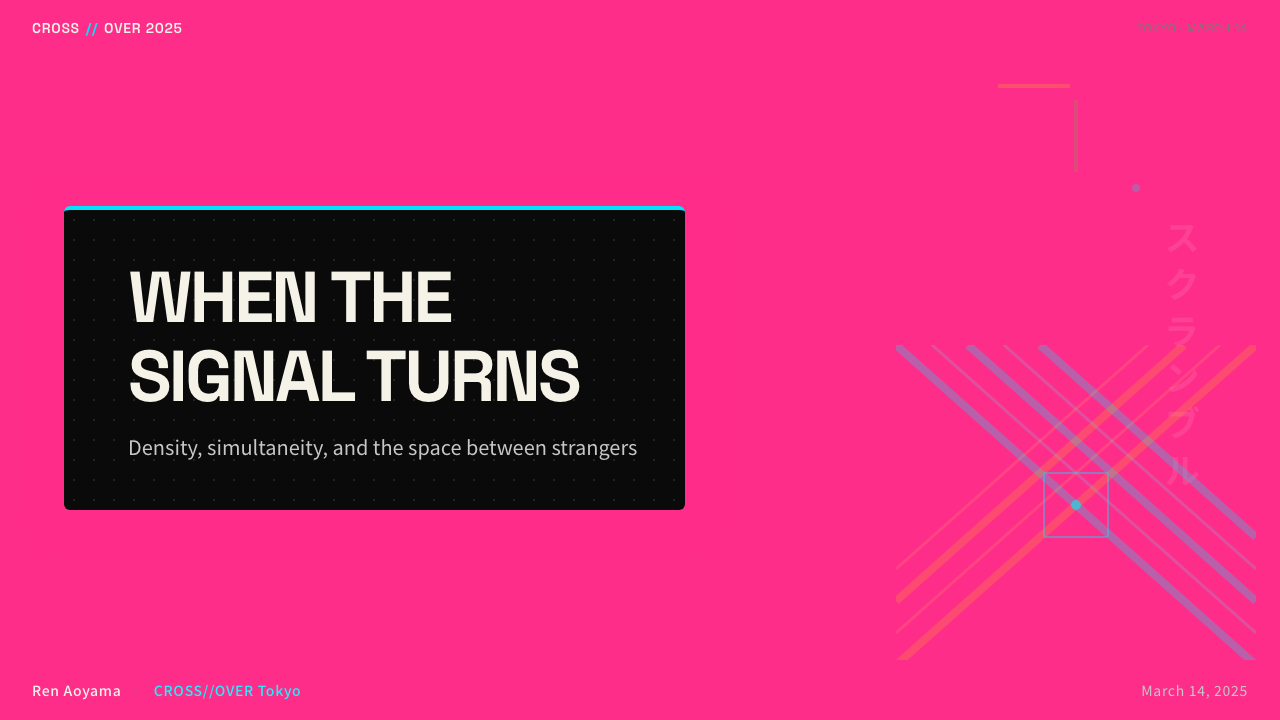
For presentation slides and covers, the system works best when the content itself is bold and experiential rather than analytical or technical. A cover slide benefits from a full bleed of the warm pink ground with a single high-contrast title in white or near-white, vertical accent type along one edge, and a geometric black panel anchoring a corner. Content slides should resist the temptation to pack in every element — choose one background plane, one accent color, and maintain generous matte dark zones to let the color breathe. The common mistake is applying the maximalist vocabulary to every slide equally; the system works by contrast, so some slides should carry most of the visual weight while others breathe.
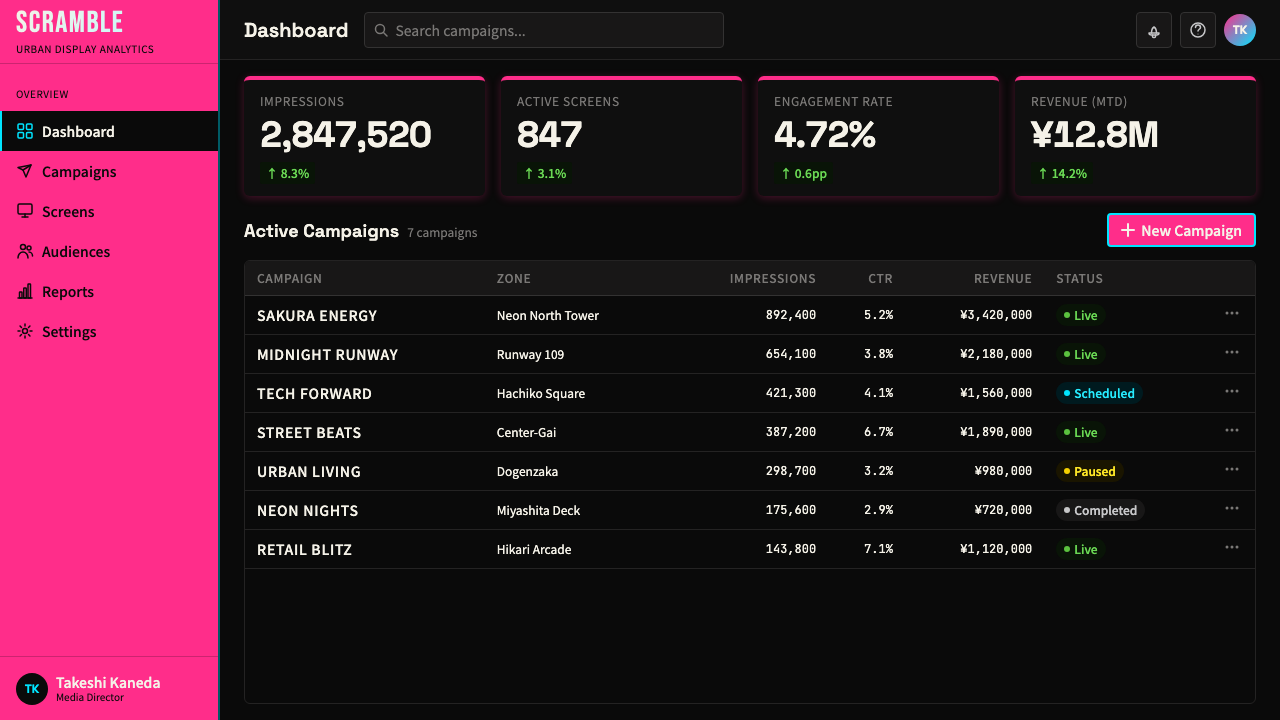
For web interfaces, Shibuya Scramble Neon is most appropriate for entertainment, nightlife, fashion, or cultural platforms where the audience expects sensory stimulation and where brand distinctiveness is valued over universal legibility. A dashboard or functional tool would be poorly served by this palette's intensity. For fitting contexts, the approach is to designate clear dark zones for navigation and controls — using the matte black vocabulary — and reserve the saturated pink-cyan contrast for hero sections, feature highlights, and interactive calls to action. Glow effects on interactive elements reinforce the neon-tube language without requiring complex animation.
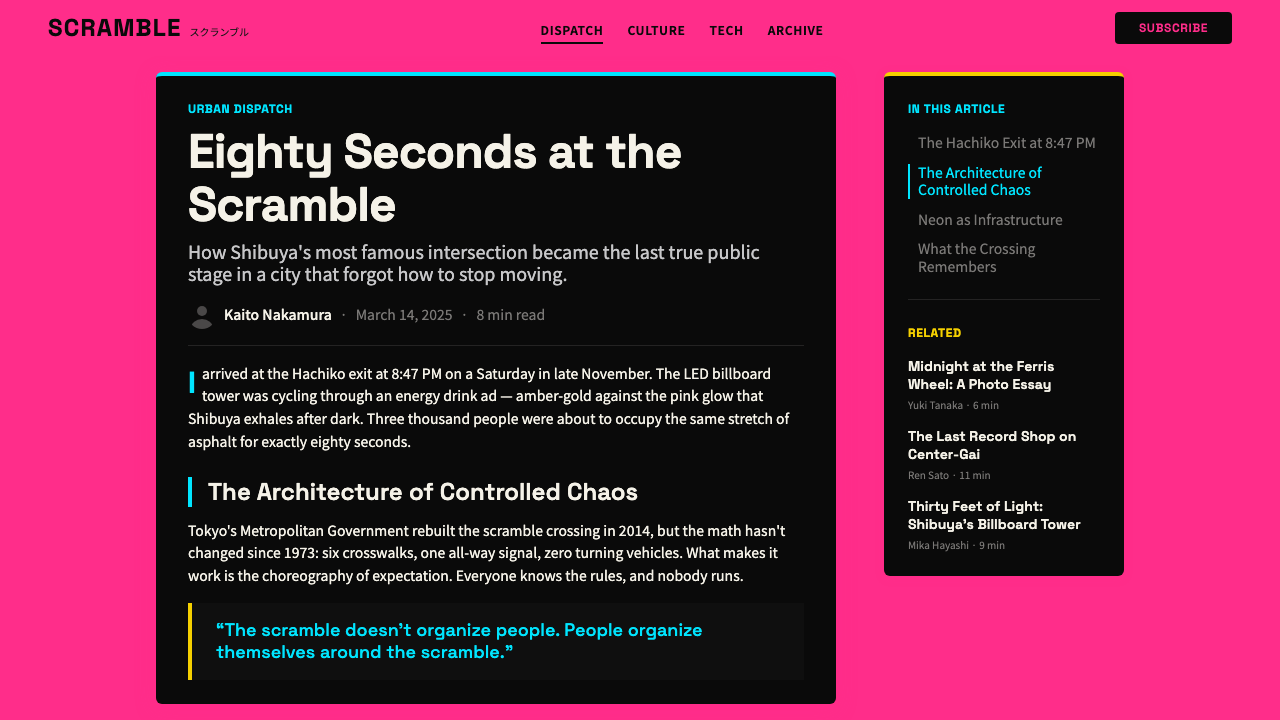
For editorial and marketing applications, the style produces strong results in contexts with cultural adjacency to Tokyo, Japanese street fashion, or urban nightlife. Event posters, album packaging, and brand campaigns that want to signal contemporary urban energy in a recognizably Japanese register benefit from the system's layered density and vertical type tradition. In these applications, full-bleed photography treated with high-contrast processing and overlaid with the pink-cyan color palette — rather than photography used naturalistically — maintains the system's graphic integrity. Text should be treated as a graphic element, not just a label: size and weight variations should be dramatic, and the vertical orientation should be considered wherever the language and layout permit.
A common and significant mistake is applying this style without committing to the matte black anchor. Designers attracted to the pink-cyan energy sometimes attempt to run the palette on white or light backgrounds, which destroys the contrast logic that makes the system work. The dark background is structural, not optional: it is what makes the neon colors read as luminous rather than pastel. Similarly, attempting to soften the palette — reducing saturation to make it more 'palatable' — produces an incoherent result that has neither the energy of the original system nor the cleanliness of a minimalist alternative. If the full intensity feels too strong for a given context, the solution is to use it at reduced scope — in a single section or hero element — rather than diluting it across the whole design.
Tokyo Shibuya Scramble Neon — FAQ
Is Shibuya Scramble Neon the same as cyberpunk?
They share some surface features — neon, dark backgrounds, urban density — but differ fundamentally in origin and intent. Cyberpunk is a Western science-fiction aesthetic built around dystopian futures, technological anxiety, and imagined Asian megacities. Shibuya Scramble Neon is rooted in a specific, real neighborhood and a specific cultural history: the gyaru and kogal street styles of the 1980s and 1990s, the commercial architecture of Tokyu Corporation, and the accumulated signage of real retailers. It is descriptive rather than speculative, documentary rather than imaginative. Applying Shibuya Scramble Neon without awareness of this distinction risks producing work that borrows visual trappings from a specific culture while discarding the actual values and history that produced them.
Can this style work for a brand that has no connection to Japan?
It depends on the level of application and the honesty of the intent. Using the color system — warm pink, electric cyan, matte black — as a palette without claiming cultural authority is a legitimate design choice, in the same way that using Memphis-era geometric patterns does not require an Italian heritage. However, incorporating specifically Japanese typographic traditions — vertical kana text, kanji as compositional elements — without cultural context or native-language speakers involved in the process is more fraught. The most defensible approach is to use the visual energy and color vocabulary of the system while being transparent about the reference and avoiding elements that function as cultural signifiers when used out of context.
How does this style handle readability at high density?
Readability in this system is managed through the luminosity hierarchy described in the characteristics: the brightest elements read first, mid-luminance elements form the primary content layer, and dark elements structure without demanding attention. The key discipline is never letting pink and cyan compete at equal luminance and scale for the same reading task — one must always be dominant and the other subordinate. Type on the pink ground should be white or very light; type on dark ground can be pink or cyan. Overprinting light type on the cyan accent color creates illegibility and should be avoided. When density is unavoidable, increasing the size of matte black zones — not reducing color saturation — is the correct correction.
Does the vertical type tradition require Japanese text, or can Latin script be vertical too?
Latin script can and does appear vertically in Shibuya signage culture — brand names, English taglines, and loan words often run vertically on the actual storefronts that inspired this system. In design applications, rotating Latin text ninety degrees is a legitimate device borrowed directly from the source environment. However, Latin letters were not designed for vertical reading in the way Japanese kana and kanji were, so the legibility threshold is lower — vertical Latin works best at large sizes, short strings, and high contrast. Long body text should remain horizontal even in a Shibuya Scramble Neon composition.
What does the ongoing Shibuya redevelopment mean for the authenticity of this aesthetic going forward?
Shibuya has been under significant architectural redevelopment since the early 2010s, with several major tower complexes — Shibuya Scramble Square, Shibuya Stream, Shibuya Fukuras — transforming the skyline around the crossing. The new architecture is cleaner, more minimal, and architecturally intentional in ways that the older, organically accumulated signage layer is not. This creates a visible tension at the actual crossing: the legacy neon-and-layered-signage culture coexists with glossier, more restrained surfaces. The design system documented here captures the older stratum — the pink-cyan-black of the Q-FRONT era — which is increasingly a record of a specific moment as much as a living standard. Using the system honestly means acknowledging that it describes a Shibuya that is actively being transformed, not a permanent or unchanging reality.
Related design styles
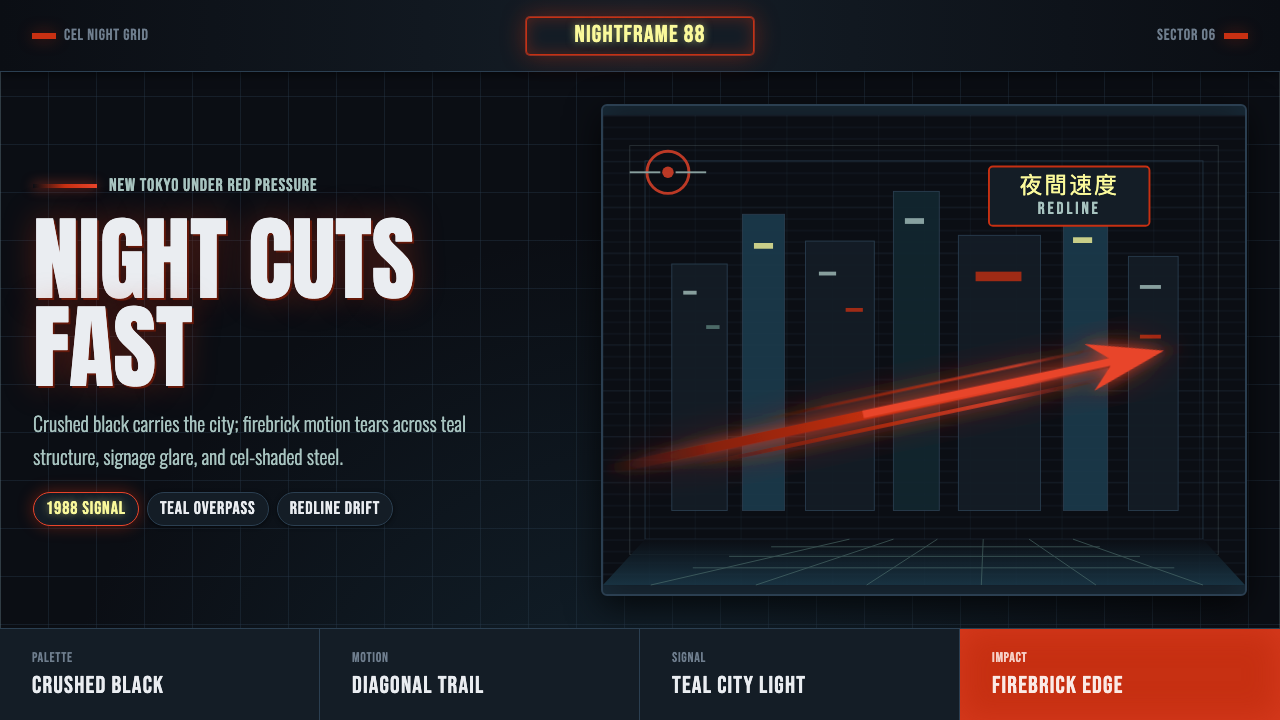 Akira Neo-TokyoNight moves fast. Firebrick trails cut crushed black, teal grids, and condens…
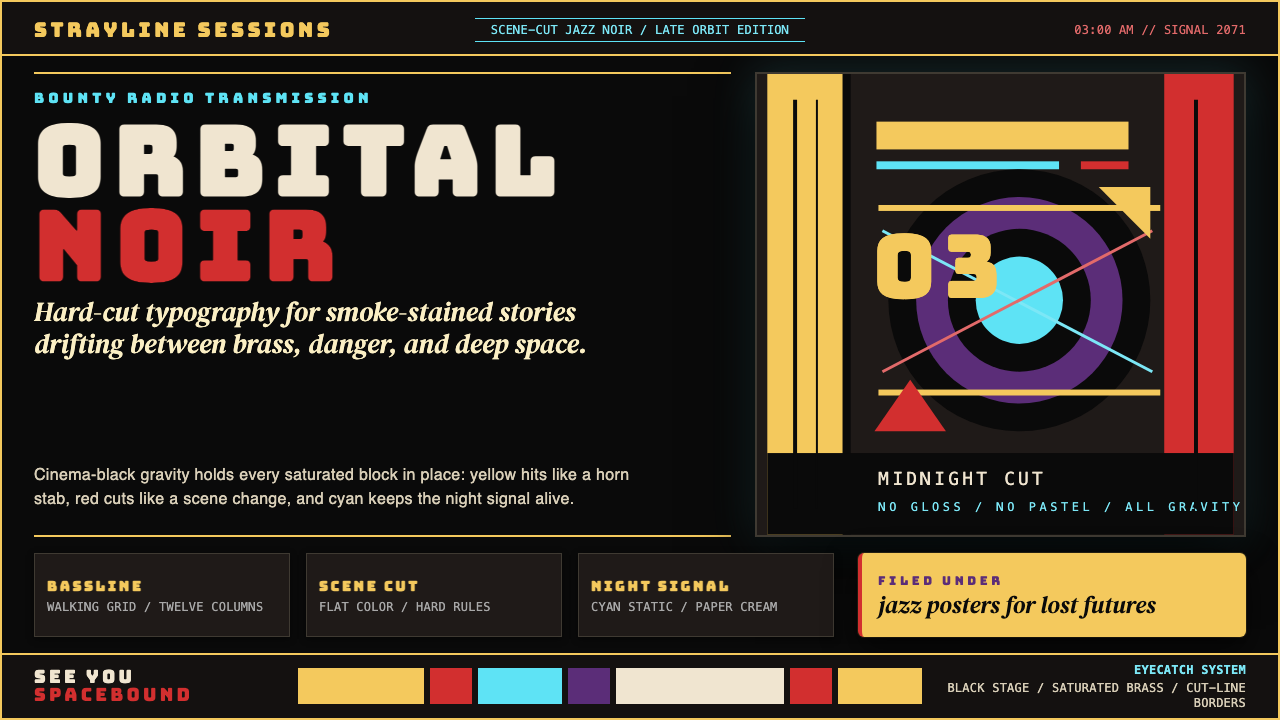 Cowboy Bebop Jazz-NoirCool at 3 AM. Bungee type, jazz yellow, red cuts, and cyan rules hit deep bla…
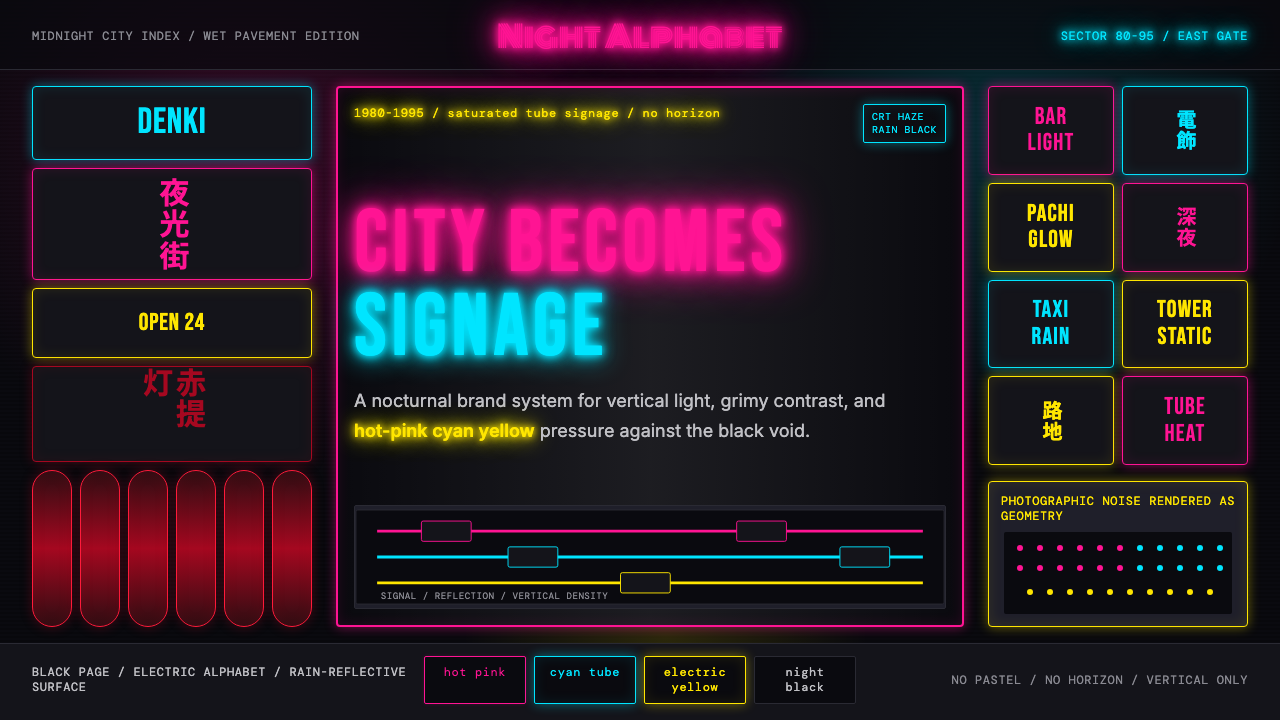 Tokyo Shinjuku Neon (1980)Night turns into alphabet. Hot pink, cyan, and yellow stack as glowing vertic…
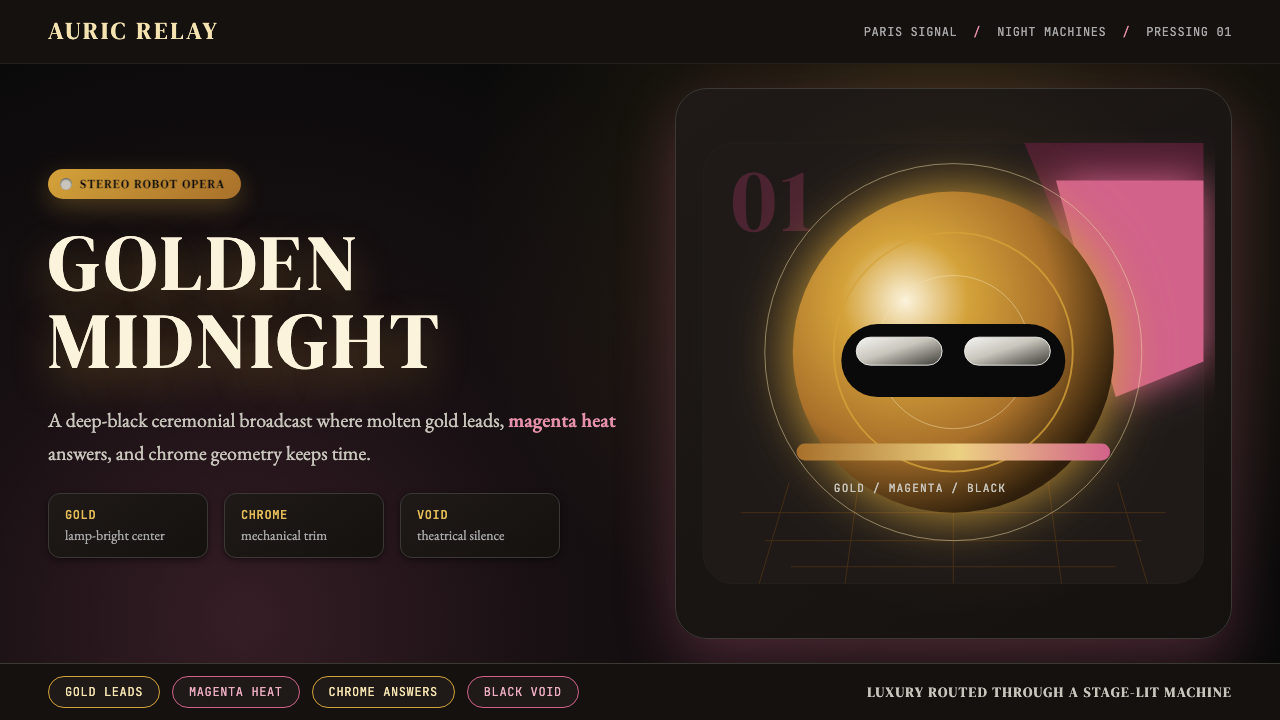 Daft Punk Discovery (Gold-Helmet)Warm sci-fi disco. Gold serif caps orbit a magenta void with chrome-disc geom…
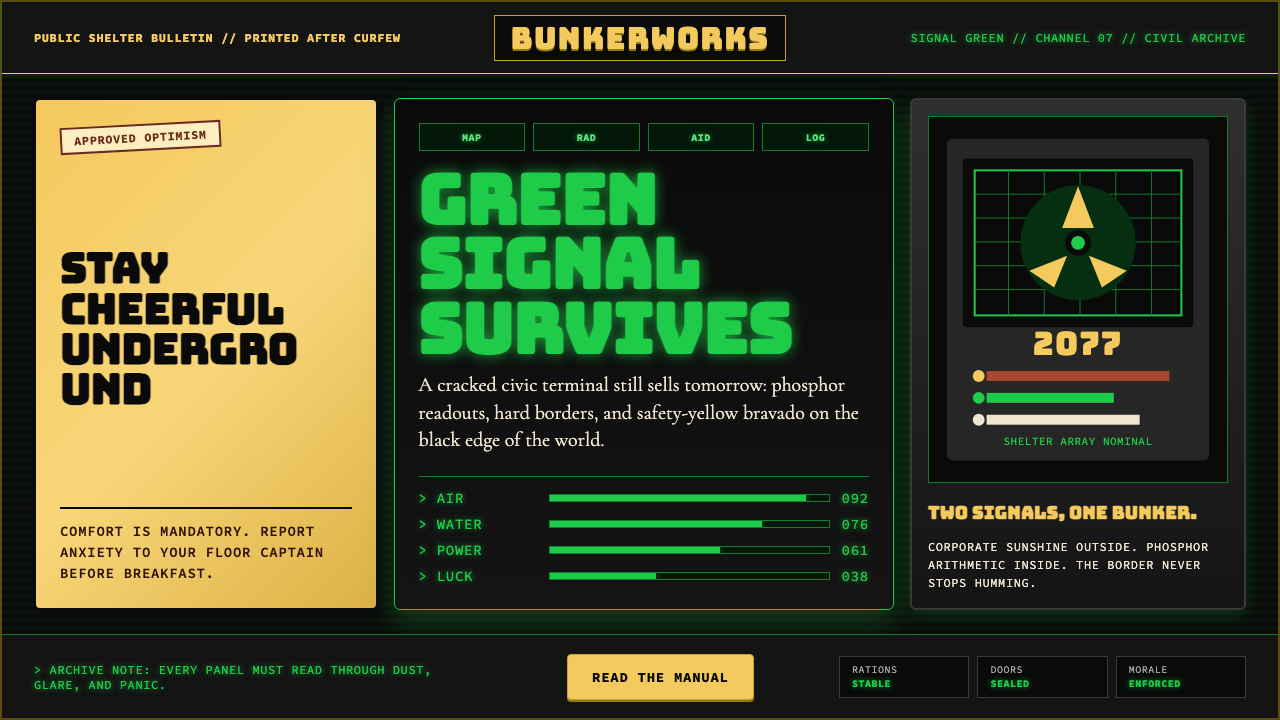 Fallout Vault-Tec Pip-BoyIrradiated optimism. Vault yellow and CRT green lock into a bordered bunker g…
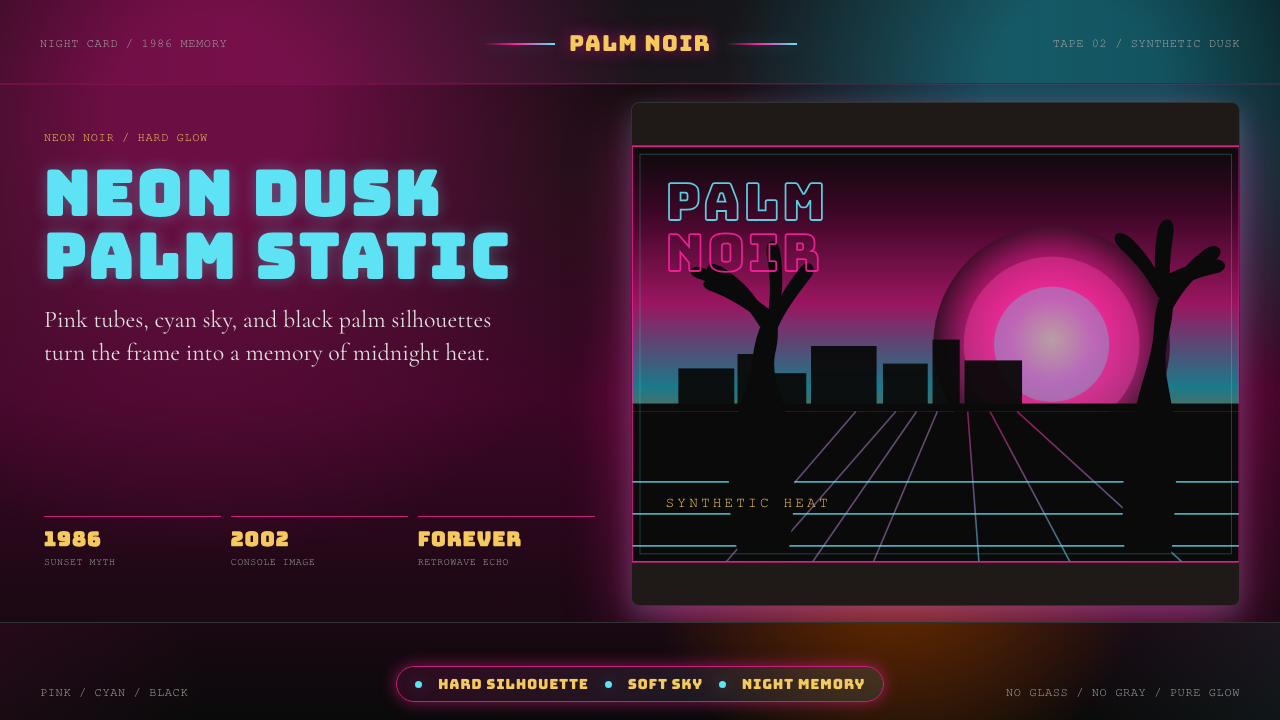 GTA Vice City (2002)Neon-noir nostalgia. Pink-cyan dusk, chunky type, and palm silhouettes.