What is Sudanese Nubian Meroë Pyramid?
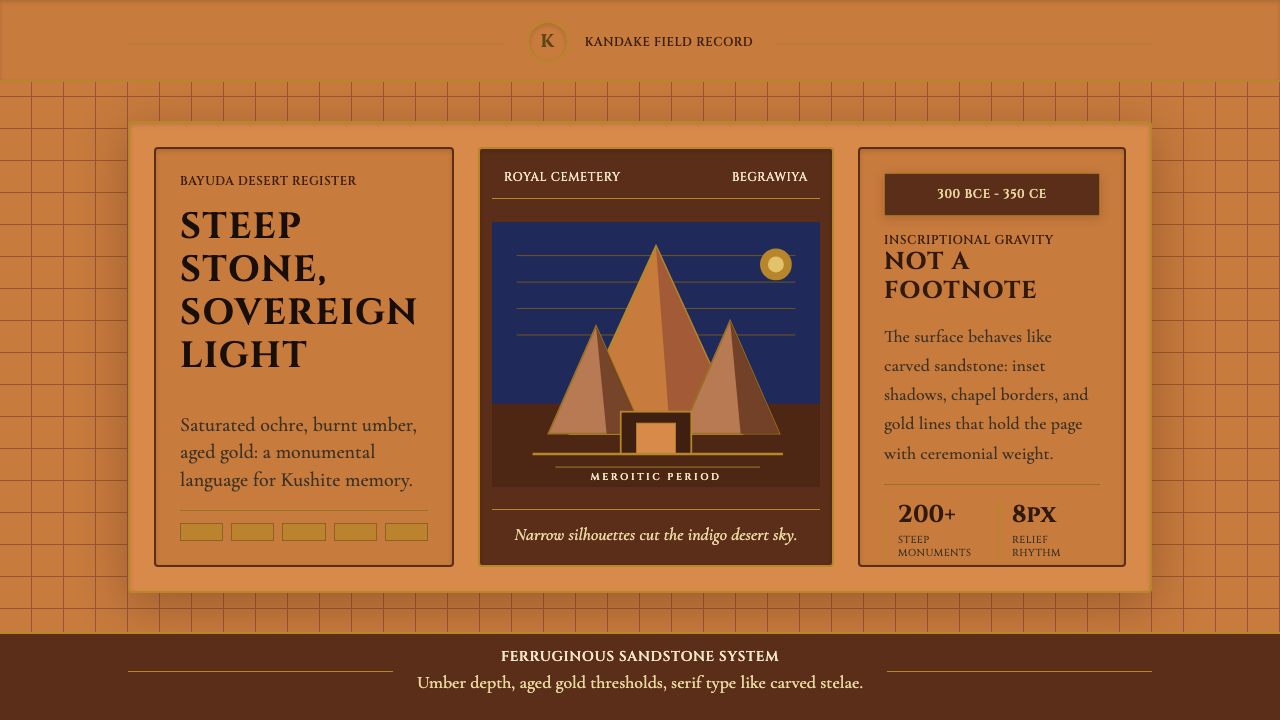
The Kushite kingdom built more pyramids than Egypt — steep, narrow sandstone spires rising over the Bayuda desert at Meroë — and their monumental gravity now shapes a design language built on saturated ochre, burnt umber depth, and the weight of carved stone.
Sudanese Nubian Meroë Pyramid in brief
The Sudanese Nubian Meroë Pyramid style is a design system rooted in the visual and material world of the ancient Kingdom of Kush, the civilization that flourished along the middle Nile from roughly 300 BCE to 350 CE. Its visual language draws on the ferruginous sandstone of the Meroë pyramids, the gold borders of royal stelae, the earthy warmth of fired brick, and the ceremonial gravity of Kandake queen reliefs. The result is a palette and compositional approach that feels ancient without being archaic — monumental without being cold.
Where many ancient-world design references default to Egyptian blue or Greek marble white, this system insists on the specific ochres, umbers, and aged golds of sub-Saharan African antiquity. Every surface recalls stone at golden hour. Cards are composed like offering chapels framing sacred content; headings sit in panels that read as bas-relief inscriptions. The aesthetic refuses the pale desert pastels of orientalist cliché — Kush was a major empire and trading civilization, and its visual identity carries equivalent authority.
The style is neither purely decorative nor archaeologically reconstructive. It translates Meroitic visual sensibilities — their preference for bold silhouette, saturated warm color, repetitive architectural rhythm, and ceremonial framing — into a contemporary interface vocabulary. It suits contexts that demand gravitas: cultural institutions, heritage brands, luxury goods, editorial publishing, and any product that wants to invoke history as a source of strength rather than nostalgia.
Where does Sudanese Nubian Meroë Pyramid come from?
The Kingdom of Kush — also known as the Nubian civilization — was not a satellite of Egypt but its rival and, for nearly a century, its ruler. The Twenty-Fifth Dynasty of Egypt (circa 747–656 BCE) was Kushite: Nubian pharaohs ruled from Memphis and commissioned temples at Karnak. When Egypt eventually expelled the Kushites under Assyrian military pressure, the kingdom retreated south and established a new capital at Meroë, on a bend of the Nile between the fifth and sixth cataracts, where it flourished for another seven centuries.
Meroë became one of the ancient world's great ironworking and trading centers, positioned on routes connecting sub-Saharan Africa, the Red Sea, and the Mediterranean. The city's wealth funded an unprecedented building program. Over two hundred pyramids were constructed at three Meroitic necropolises — Meroë North, Meroë South, and Begerawiyah — for rulers and queens of the Kushite state. Unlike Egyptian pyramids, Meroitic ones are steeply angled, with bases narrow relative to their height, creating the distinctive silhouette of a sharp triangle against the desert sky. Each pyramid was accompanied by a small offering chapel on its eastern face, decorated with bas-relief carvings of the deceased in royal regalia.
The Kandake tradition — from the Meroitic word for queen mother or ruling queen — produced some of antiquity's most formidable rulers. Queen Amanirenas (reigned approximately 40–10 BCE) famously resisted Roman expansion under Augustus, led military campaigns, and negotiated a peace treaty with Rome that was favorable to Kush. Her story, preserved partly in the writings of the Roman geographer Strabo, exemplifies the independent political and military agency that characterized Meroitic queens. These rulers were depicted on stelae and pyramid chapel walls as powerful, heavily adorned figures — broad-shouldered, robed in elaborate garments, flanked by captive enemies — an iconography that is visually distinct from Egyptian royal portraiture in its frontality and density of pattern.
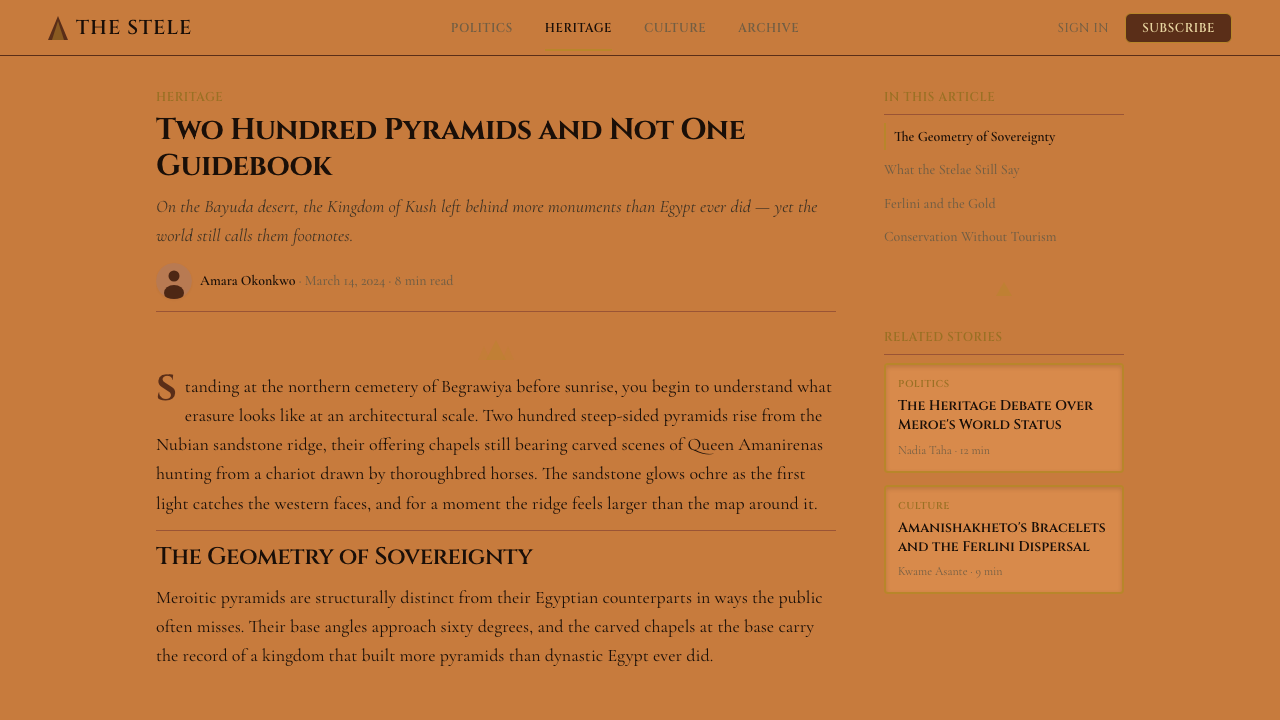
The Meroitic script, developed around the third century BCE, remains only partially deciphered. It is one of the world's oldest alphabetic writing systems and one of the least understood — an irony that underscores the broader neglect of Nubian history in Western scholarship until the late twentieth century. The visual character of Meroitic inscription — its angular, rhythmic letterforms carved into sandstone — provides the typographic reference point for the serif weight and stelae-like gravitas of the design system's heading treatment. The twentieth-century rediscovery of Meroë's significance is associated with American archaeologist George A. Reisner, who excavated the royal cemeteries beginning in 1920, and with later Sudanese and international scholarly efforts to document and preserve what remained of the site.
What defines the Sudanese Nubian Meroë Pyramid look?
Color Palette
The palette is built on three dominant tones derived from the physical materials of Meroitic architecture: a saturated ochre that reads as sun-baked sandstone, a deep burnt umber that anchors shadow and depth, and an aged gold used sparingly as accent and border. These warm earth tones reject both the cool neutrals of minimalist design and the pale sandy beiges of romanticized desert imagery. Supporting tones — a dense near-black that reads as shadow on stone, and a warm off-white that recalls bleached plaster — provide contrast without breaking the palette's thermal warmth.
Typography
Headings are set in high-contrast serif typefaces that carry the weight and formality of carved stone inscription — their thick strokes suggest chisel marks, their thin strokes the fine detail of engraved stelae. Body text shifts to a more neutral serif or a legible humanist form, maintaining historical gravitas without sacrificing readability at length. Type scale is generous: the hierarchy from display to body is dramatic, echoing the relationship between the large cartouche inscription on a pyramid chapel wall and the smaller descriptive text in the surrounding registers.
Structural Framing
Content is organized within frames that recall the architectural language of offering chapels and ceremonial niches. Cards and content blocks are defined by borders that read as architectural moldings rather than hairline rules — substantial, weighted, sometimes doubled. These frames are not decorative additions to content but structural containers that lend the content inside them ceremonial significance. The metaphor is explicit: if the pyramid chapel framed the sacred offering, the card frames the content as something worth attention.
Pattern and Ornament
Unlike the Bauhaus principle of zero ornament, Meroitic aesthetics embrace controlled decorative patterning as a carrier of meaning and authority. Borders use repeating geometric registers — chevrons, stepped motifs, lotus bud sequences — drawn from the actual carved decoration of Meroitic pyramid chapels and stelae. These patterns are used at the edges of compositions, as section dividers, or as background textures at very low opacity. The discipline is selectivity: pattern appears only at structural boundaries, never as fill for empty space.
Silhouette and Triangular Form
The steep triangular silhouette of the Meroitic pyramid — far narrower than its Egyptian counterpart — is the defining geometric signature of this style. Compositional elements favor tall, narrow proportions over wide, horizontal ones. Triangular shapes appear as directional markers, decorative flourishes in border registers, or as compositional framing devices that echo the pyramidal skyline. This verticality is reinforced by the typography: headings and display text lean tall rather than wide, column measures are relatively narrow, and layouts use generous vertical rhythm.
Textural Warmth
The style departs from the flat, screenlike surfaces of most contemporary design systems by allowing subtle textural suggestion. Backgrounds may carry a very faint grain that recalls weathered sandstone; gold accents have an oxidized, matte quality rather than a high-shine metallic finish. This is not skeuomorphism — no attempt is made to convincingly simulate physical materials — but a low-frequency textural signal that keeps surfaces from reading as purely digital. The effect is warmth and age without pastiche.
Ceremonial Scale
Meroitic monumental architecture works at a scale intended to communicate permanence and authority to viewers standing at its base. This sense of scale translates into the design system as an unusual willingness to let hero sections, display type, and primary imagery occupy space aggressively. White space is not minimalist breathing room but ceremonial clearing — the empty forecourt in front of the chapel. Proportions are bold: a hero image might occupy the full upper viewport, a single heading might dominate an entire section.
Who shaped Sudanese Nubian Meroë Pyramid?
Amanirenas, Kandake of Kush from approximately 40 to 10 BCE, is the most historically documented of the Meroitic ruling queens. When the Roman prefect of Egypt Gaius Petronius seized Meroitic border towns following Augustus's annexation of Egypt in 30 BCE, Amanirenas led a counter-campaign, sacking the Roman garrison at Syene (modern Aswan) and reportedly carrying off a bronze head of Augustus as a trophy. She is said to have been blind in one eye — a detail that may be referenced in her depictions on pyramid chapel walls, where she appears as a formidable, robed figure overseeing bound captives. The peace treaty she eventually negotiated with Rome, confirmed by Strabo and other Roman sources, granted Kush favorable terms and removed the tribute obligation Rome had initially demanded. She stands as one of antiquity's most effective military diplomats.
Arakamani, who ruled in the third century BCE, is credited in ancient tradition with relocating the Kushite royal burial site from Napata — the earlier Kushite capital — to Meroë, establishing the city as the kingdom's spiritual and administrative center. This act of intentional capital-building transformed Meroë into the site of the great pyramid clusters that now define the style. Whether or not the tradition is historically precise, Arakamani's reign marks a pivotal moment in the consolidation of Meroitic visual identity: the move south represented a deliberate assertion of Kushite independence from Egyptian cultural norms, including the adoption and adaptation of Egyptian pyramid forms into the distinctive steeper Meroitic variant.
Amanishakheto, who ruled around 10 BCE to 1 CE, is renowned as one of the wealthiest Meroitic rulers whose material legacy survives. Her pyramid at Meroë North contained an extraordinary cache of gold jewelry — armbands, shield rings, finger rings, and necklaces decorated with imagery from both Meroitic and Egyptian religious traditions — discovered (and largely removed) by the Italian adventurer Giuseppe Ferlini in 1834. This jewelry, now divided between the Egyptian Museum in Munich and the Egyptian Museum in Berlin, is among the most vivid surviving evidence of the sophisticated goldworking tradition at Meroë and of the visual language of royal adornment that the design system's gold accent and ceremonial border treatment references.
George Andrew Reisner, the American Egyptologist and archaeologist, conducted the first systematic excavations of the Meroitic royal cemeteries between 1920 and 1923. Working under the Harvard University–Museum of Fine Arts Boston expedition, he mapped, numbered, and documented the pyramids at Meroë North, Meroë South, and Begerawiyah — establishing the basic chronological sequence that scholars still use. His work brought Meroë to wider international attention and produced the first rigorous stratigraphic record of the site. His legacy is complicated: he also held views common to his era that minimized the indigenous African origins of Nubian civilization, attributing its development partly to Egyptian or Mediterranean influence — a position that subsequent Africanist scholarship has substantially revised. His documentation, however, remains foundational to Meroitic studies.
The Meroitic script — an alphabetic writing system developed around the third century BCE, adapted from Egyptian hieroglyphics but phonetically distinct — represents one of antiquity's most consequential and least understood intellectual achievements. It appears on pyramid chapel walls, royal stelae, offering tables, and administrative documents, in both a hieroglyphic and a cursive form. While scholars have been able to read Meroitic phonetically since the early twentieth century (it was deciphered by Francis Llewellyn Griffith in 1911), the language itself remains largely untranslatable because no bilingual key has been found. The script's visual character — angular, rhythmically spaced, densely carved into stone — informs the typographic sensibility of this design system: letterforms that carry weight and history, arranged with the measured cadence of inscription rather than the fluidity of handwriting.
How do you use Sudanese Nubian Meroë Pyramid today?
The Meroë Pyramid style is most naturally suited to contexts where authority, cultural depth, and a sense of permanence are desired — and where warmth is as important as gravitas. Its palette and structure work against generic minimalism and in favor of content that wants to feel like it has been curated or consecrated. This makes it an excellent fit for cultural institutions and heritage brands, luxury goods and hospitality, editorial publishing with a strong visual identity, and any digital product that positions itself as rare or considered rather than fast or disposable.
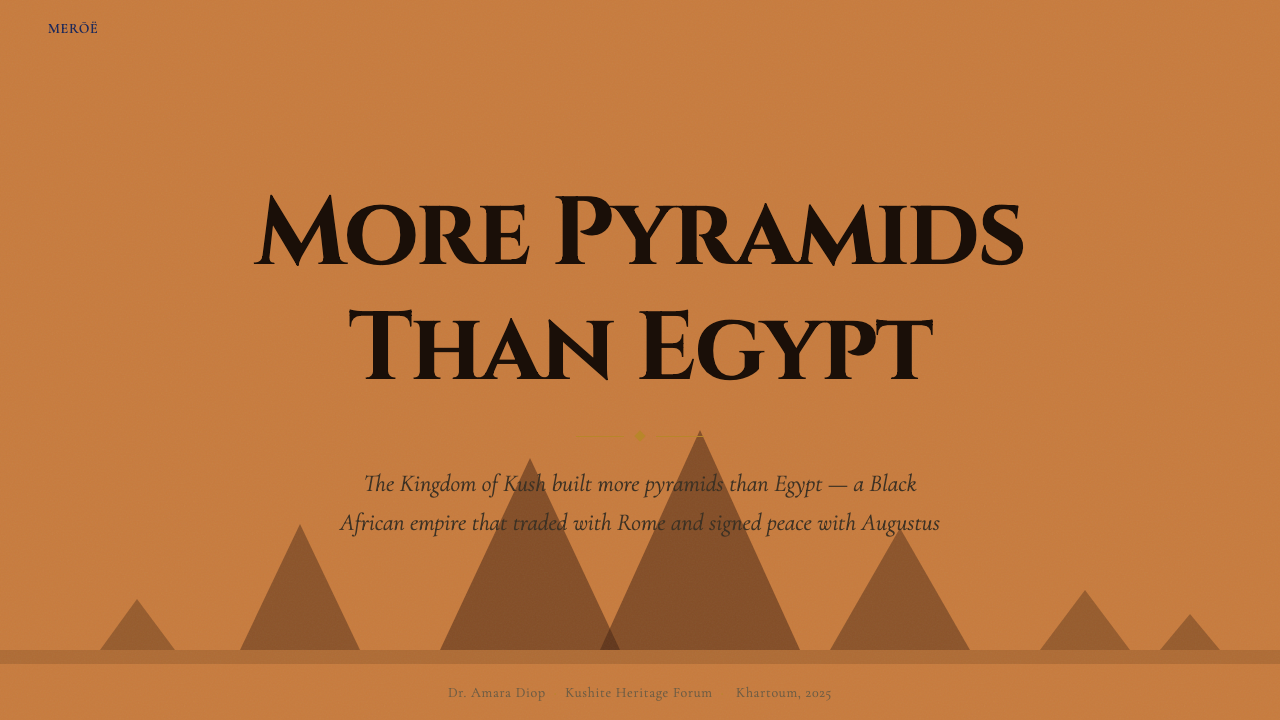
For presentation slides, the style rewards commitment. A cover slide built in this system should function like a title page in an illuminated manuscript: a central heading in weighty serif type, an ochre or umber field, gold rule borders framing the content, and nothing else. Content slides work best when the grid is treated as a register system — the same horizontal banding logic used in carved wall decoration — with headings establishing the top register and body content filling the lower one. Data visualizations carry the style effectively when chart elements are drawn in the warm earth palette: bars in umber, accent lines in aged gold, backgrounds in deep ochre.
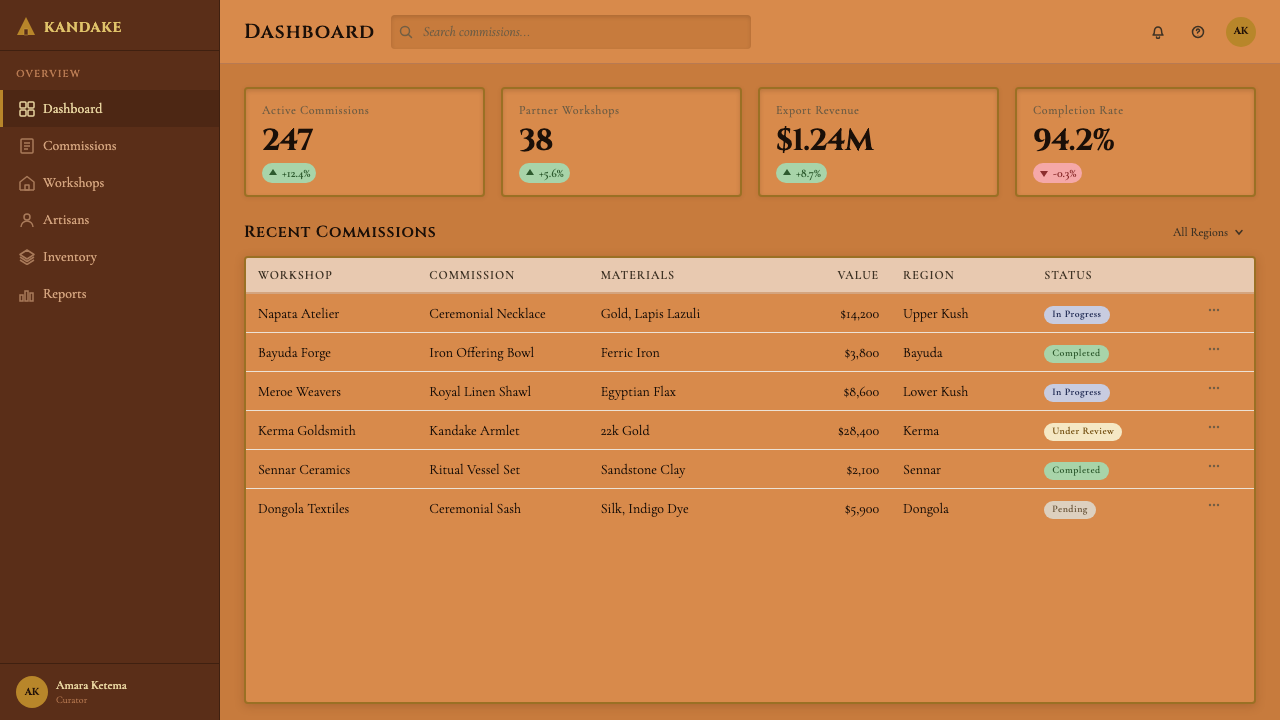
For web user interfaces, the style is particularly well-suited to landing pages, editorial long-form content, and product pages for premium or heritage products. Dashboard and data-dense applications are harder to pull off — the rich palette and ceremonial framing can create visual noise when multiplied across many interactive elements. The approach that works: designate one dominant color (typically the ochre) as the background system, reserve the umber for depth and hierarchy, deploy gold only at key structural moments (borders, active states, key calls to action), and keep interactive controls visually simple so the page's ceremonial weight rests on content rather than chrome.
For editorial and marketing work, the style's greatest strength is its poster quality. Full-bleed imagery can be treated with a warm color wash to bring it into the palette; headlines set in high-contrast serif type over ochre or near-black fields read as authoritative from a distance. Marketing pages benefit from the rhythmic quality of Meroitic architectural decoration: section breaks marked with a gold geometric border register, alternating full-width sections in ochre and deep umber, and generous spacing that gives each section its own forecourt before the content begins.
A common mistake when applying this style is confusing richness with busyness. The Meroitic pyramids are visually arresting not because they are decorated from base to apex, but because the decorated zones — the chapel entrance, the stele, the relief bands — appear against large areas of plain sandstone. The same logic applies in digital contexts: pattern and gold accent should appear at structural boundaries and key moments, not as fill. A layout that applies decorative borders to every card, every section, and every heading will quickly read as overwhelming. Reserve the ceremony for what deserves it.
Sudanese Nubian Meroë Pyramid — FAQ
How is this style different from a generic Egyptian aesthetic?
The distinction matters both historically and visually. Egyptian visual culture — as popularly understood — tends toward blue and gold, wide horizontal proportions (think the Great Pyramid's broad base), hieroglyphic profile figures, and the cool blues and greens of faience and lapis lazuli. The Meroitic system is warmer and more vertical: the pyramids are steeply angled, the palette is built on ochre and umber rather than blue and turquoise, and the figure style is frontal and densely patterned rather than the canonical Egyptian side profile. Using the Meroitic system is an explicit acknowledgment that Nubian civilization had its own distinct visual identity — one that absorbed and adapted Egyptian influence rather than simply copying it. Applying the style as though it were a variant of generic Egypt misses this distinction entirely.
Can the Meroë style work on dark backgrounds?
Yes, and the style has natural dark-mode possibilities rooted in the actual appearance of the pyramids at night or in low light, when the ochre stone deepens toward umber and the gold borders read more luminously. A dark variant should pivot from the burnt umber as the dominant background — not pure black, which loses the warmth — with ochre used for mid-tone surfaces, aged gold for all structural accents and borders, and a warm cream for heading type. The key is maintaining thermal warmth in the deep tones: a cool dark grey will break the palette and read as a completely different style. The decorative pattern elements — geometric border registers, triangular motifs — actually read more crisply on deep backgrounds, which is a structural advantage.
Does the ceremonial heaviness of the style make it unsuitable for everyday digital products?
Not necessarily, but it requires restraint in how the system is applied. The full ceremonial treatment — gold borders, patterned registers, umber backgrounds, heavy serif headings — is appropriate for hero moments, landing pages, and feature presentations. For everyday operational contexts within the same product (account settings, data tables, transactional flows), the palette's warmth can be preserved while the decorative layer is stripped back: ochre as a light background, umber for typographic hierarchy, and gold only for active states or primary calls to action. The ceremonial weight becomes an accent rather than the ambient register. The risk is inconsistency — if the landing page is fully realized in the style and the product interior is not, users experience a false promise. Better to commit fully or adapt thoughtfully throughout.
How does this style handle photography and illustration?
Photography works best when it is treated as part of the palette rather than as a window onto a different visual world. Warm-toned photography — architectural, landscape, material — integrates naturally. Cooler or more contemporary photography can be color-graded toward the ochre-umber range, or treated with a warm overlay at low opacity that brings it into the system without eliminating photographic detail. High-contrast duotone treatment — one tone in umber, highlights in aged gold or warm cream — is another effective option. Illustration, if used, should echo the frontality and geometric density of Meroitic relief carving: figures should be composed, not naturalistic; patterns should be structural rather than decorative; and line weight should be bold enough to read as inscription rather than sketch.
Is the Meroë style culturally appropriate to use outside African or heritage contexts?
The question deserves a direct answer. Design systems are not the exclusive property of the cultures they reference, and historical aesthetic traditions have always traveled and been adapted across contexts. The more relevant considerations are intent, accuracy, and acknowledgment. Using this style because its monumental authority and warm palette genuinely serve a product's communication needs — and doing so with some knowledge of what the visual system actually references — is defensible. Using it as a generic exotic or ancient-world signifier, without any care for the specific Nubian civilization being referenced, is the kind of careless appropriation that reduces a rich tradition to wallpaper. The style's documentation — including its historical context and key figures — is part of what distinguishes thoughtful adoption from surface borrowing. Approach with specificity, not vagueness.
Related design styles
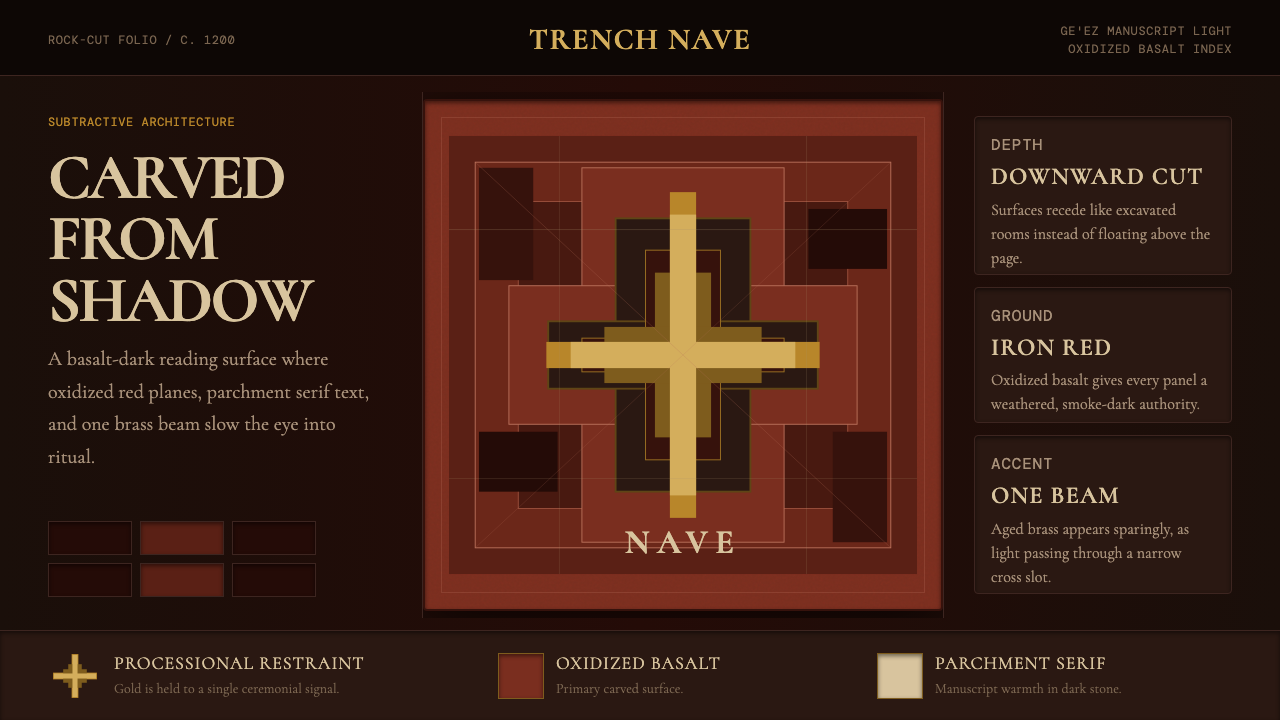 Ethiopian Lalibela Rock-Hewn Church (c.1200)Sacred weight in shadow. Oxidized basalt, parchment serif, and one aged-gold…
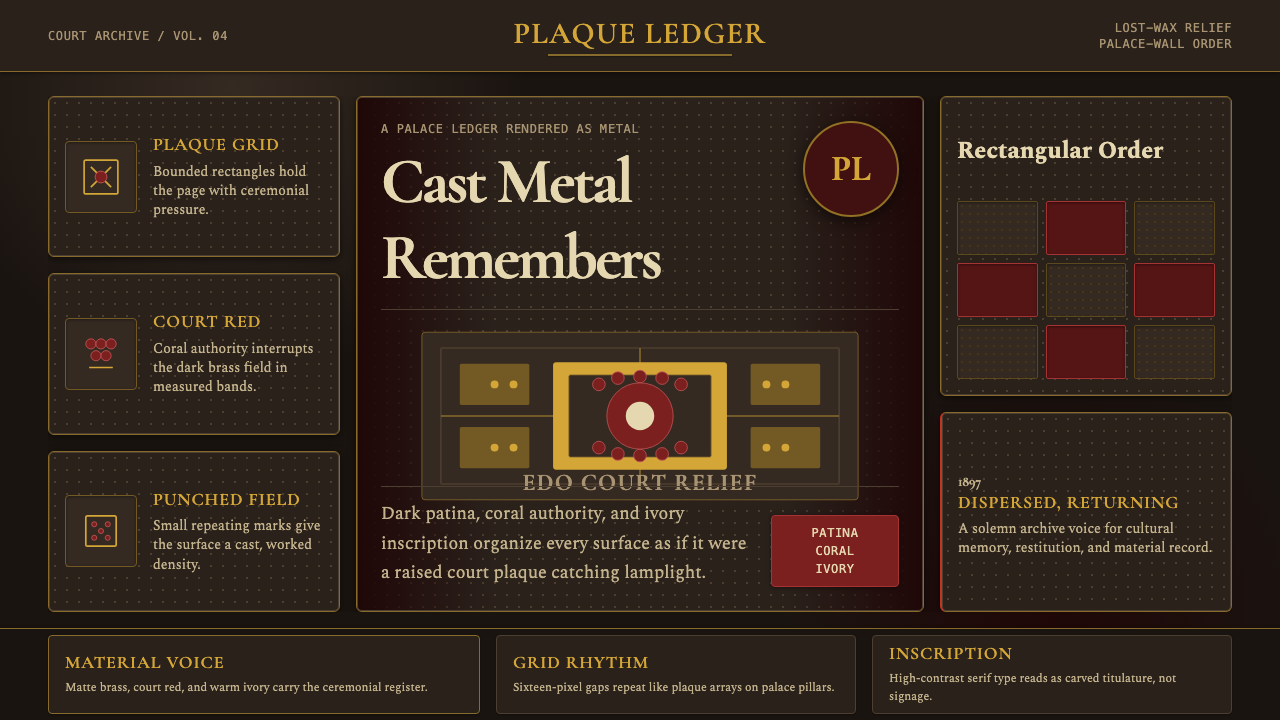 Benin Bronze Oba CourtCourt gravity in cast metal. Patinated brass grid, coral red panels, ivory se…
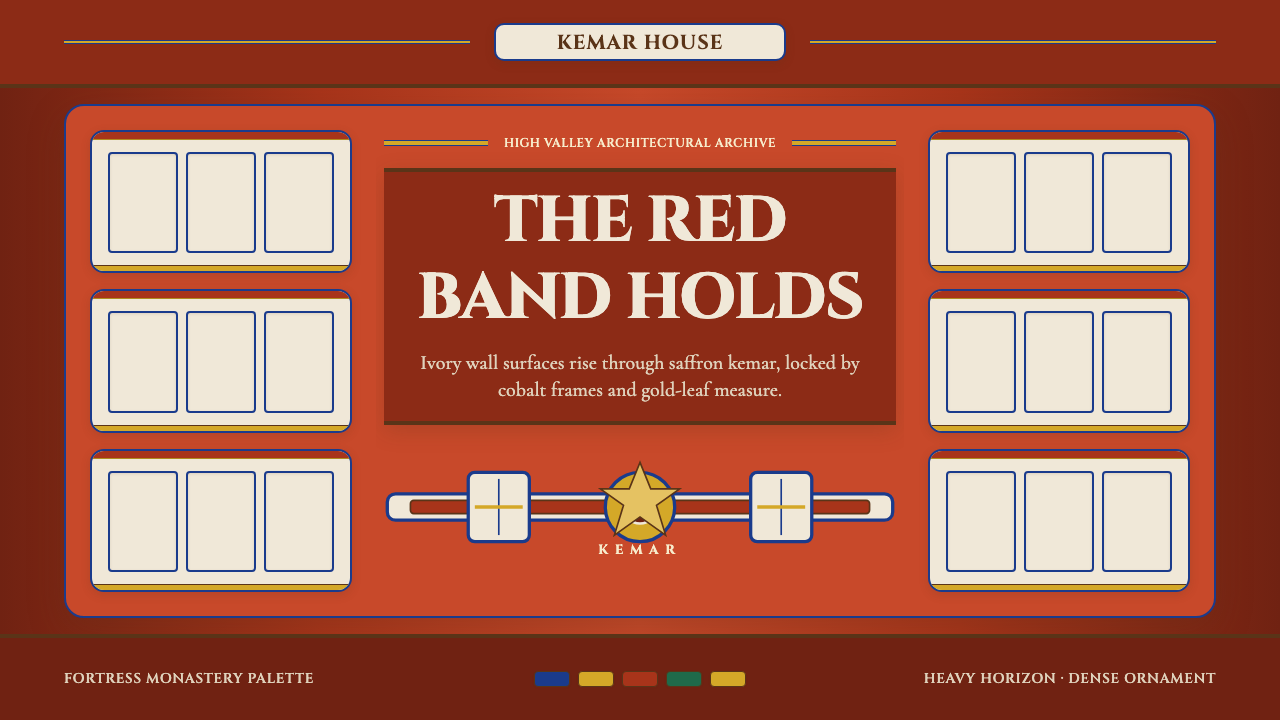 Bhutanese Dzong (Fortress Red)Monumental red holds the page. Cobalt frames and gold bands lock the fortress…
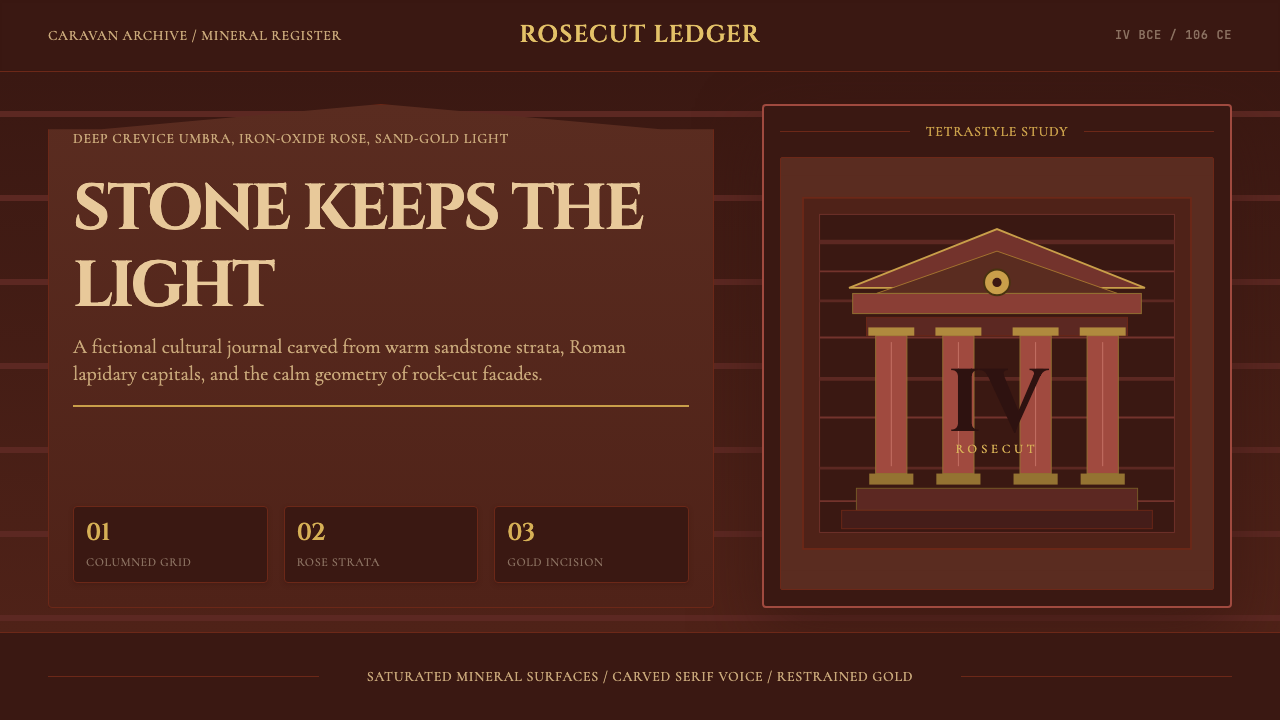 Jordanian Petra Rose NabataeanGeology feels monumental. Crevice umbra, rose strata, and Cinzel capitals car…
 Lao Naga Temple StencilDevotional gilt, not chrome. Flat gold-leaf naga and flame stencils glow on o…
 Mughal Miniature (Akbar era)Opulence refuses emptiness. Saffron paper, ruby panels, cobalt lattice, gold…