What is Spotify Wrapped 2023?
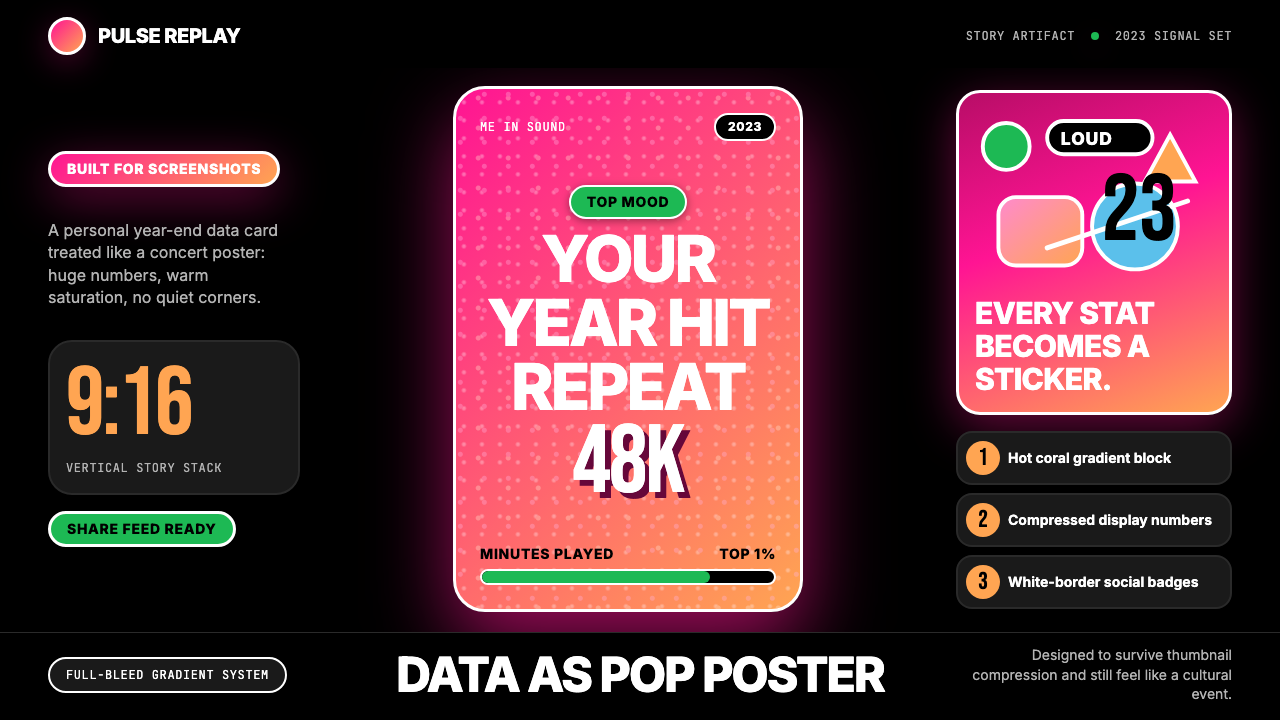
Spotify Wrapped 2023 proved that personal data could become a cultural spectacle — by designing every stat card to feel like a concert poster made just for you.
Spotify Wrapped 2023 in brief
Spotify Wrapped 2023 is the visual language behind Spotify's annual year-in-review campaign, reaching its most fully realized form in the "Sound Town" and "Me in 2023" edition released in late 2023. The design system turns listening statistics into shareable social artifacts: saturated pink-coral-orange gradients stretch across full-bleed mobile canvases, enormous display numerals announce listening totals, and sticker-style character illustrations add a playful, personalized dimension to what could otherwise be dry data.
The system is built entirely around the 9:16 vertical story format. Every composition is engineered to survive the ruthless compression of a social media feed — high contrast, bold shapes, and intense color saturation ensure that even a tiny thumbnail on a crowded screen reads as distinct and energetic. The design has no interest in subtlety; its purpose is to be seen, shared, and immediately recognizable as the same visual family across hundreds of millions of individual user cards.
What distinguishes Wrapped 2023 from earlier editions is the degree to which the visual language became a cultural phenomenon in its own right. The gradient palette, the sticker characters, and the oversized stat typography were copied and parodied across creative industries far beyond music streaming. For several weeks each December, the Wrapped aesthetic becomes a shared visual vocabulary — and the 2023 edition is widely regarded as the high-water mark of that achievement.
Where does Spotify Wrapped 2023 come from?
Wrapped began in 2016 as a relatively modest end-of-year feature called "Year in Music," giving users a simple breakdown of their most-listened artists and songs. The visual presentation was functional but unremarkable. Over the following years, Spotify's design team — led from the Stockholm headquarters and anchored in New York — incrementally transformed the feature from a static report into a dynamic, card-based story experience optimized for social sharing. The shift from desktop-first to mobile-first was decisive, moving the design center of gravity from information display to social spectacle.
Rasmus Wängelin, a designer closely associated with the Wrapped creative direction, and collaborators including Marisa Gallagher, helped establish the bold visual vocabulary that the campaign became known for. Their approach drew on the language of concert poster design, zine culture, and the maximalist energy of early-2000s music graphics, filtered through the technical constraints and sharing conventions of Instagram Stories and TikTok. The result was a design system that felt simultaneously nostalgic and forward-looking — warm and tactile in its gradient richness, yet optimized for a purely digital, highly compressed delivery format.
The 2023 edition arrived at a moment when the Wrapped format was already a cultural institution. The design team escalated the visual intensity deliberately: the pink-coral-orange gradient palette became warmer and more saturated than in previous years, sticker-style character illustrations replaced the more abstract graphic elements of earlier editions, and the typography grew bolder and more display-oriented. The "Sound Town" feature — which assigned users to a real-world city based on their listening patterns — added a conceptual layer that gave the visuals a geographic identity to animate.
The broader cultural context matters too. By 2023, the year-in-review format had proliferated across virtually every major platform: Apple Music had its Replay, Netflix had its year-end recaps, BeReal had its own version. Spotify had to distinguish itself not only from competing music services but from the entire ecosystem of data-storytelling that it had helped to pioneer. The answer was to lean further into emotional warmth, visual maximalism, and the irreducible sense of personal identity that the Wrapped aesthetic communicated — the feeling that this data belonged to you and nobody else.
What defines the Spotify Wrapped 2023 look?
Gradient Color as Identity
The defining visual signature of Wrapped 2023 is its gradient palette: a warm arc running from electric pink through coral into vivid orange. Unlike the subtle, atmospheric gradients common in contemporary UI design, Wrapped gradients are saturated to the point of intensity — they read as neon in darkness, as heat in light. The gradient is not an accent; it is the background, the atmosphere, the emotional register of the entire system. When deployed across a card, it creates an immediate sense of energy and warmth that transforms a row of statistics into something that feels personal and celebratory.
Oversized Display Typography
Numbers and short text fragments are set at scales that would be considered recklessly large in conventional information design. A listening total might occupy the majority of a card's vertical space; an artist name might bleed off the edge of the frame. This typographic maximalism serves two purposes: first, it ensures legibility at thumbnail size on any social feed; second, it transforms the data point itself into a graphic element. The numerals are not merely informative — they are compositional anchors, and their sheer scale conveys importance and pride.
Sticker-Style Character Illustration
The 2023 edition introduced a family of character illustrations rendered in a style that deliberately evokes physical stickers: bold outlines, flat fills, a slightly raised or dimensional quality that suggests the illustration could be peeled off the screen and applied elsewhere. These characters range from abstract mascot figures to representations of musical genres personified. They bring a tactile, collectible quality to the digital cards — an analog warmth in a purely digital context — and give the system a playful personality that pure data visualization could never achieve.
Full-Bleed Mobile Canvas
Every design decision in Wrapped 2023 flows from the choice to treat the mobile story frame — a tall, narrow rectangle viewed in portrait orientation — as the primary and only canvas. There are no margins, no white space at the edges, no breathing room between the design and the frame boundary. The gradient fills the entire screen. The typography runs to the edges. This full-bleed approach, which would feel cramped in other contexts, reads as immersive and enveloping in the story format — the user is inside the card, not looking at it.
Social-Feed Legibility Engineering
Wrapped cards are designed to survive radical compression. When a card is shared to a social story or appears as a small preview in a feed, it must still communicate identity and energy. This requirement drives the high-contrast color choices, the avoidance of fine detail, and the bold typographic scale. Nothing in the system depends on fine typography, subtle gradient transitions, or detailed illustration that would disappear at small size. Every element is tested against its smallest probable viewing context, which is the conceptual reverse of how most design systems are built.
Personalization at Scale
One of the most technically and conceptually ambitious aspects of Wrapped is that the design system must feel personal while being generated at scale for hundreds of millions of users. The solution is a template architecture in which the structural grammar — gradient background, oversized numeral, character illustration, short text label — remains constant, while the specific data inputs (the number, the artist names, the assigned Sound Town) create genuine individuality within that framework. The result is a paradox: the most widely distributed graphic design campaign of its season, and yet something that feels uniquely yours.
Maximalism as Brand Trust
Wrapped 2023 operates in deliberate opposition to the restrained, neutral aesthetic that has dominated consumer tech design for over a decade. Where most platforms favor quiet backgrounds, systematic spacing, and controlled color, Wrapped asserts that the moments worth celebrating deserve a visual register to match — loud, warm, unapologetically saturated. This maximalism is not a lapse of discipline; it is itself a design decision with clear cultural stakes. It signals that Spotify understands the emotional significance of music in its users' lives, and that the data is not merely informational but experiential.
Who shaped Spotify Wrapped 2023?
A designer centrally associated with Spotify's Wrapped creative direction, Wängelin helped establish and evolve the bold visual vocabulary that the campaign became known for. His work on Wrapped reflects a sustained commitment to treating data visualization as emotional design — not merely representing information accurately, but ensuring that the act of seeing your own numbers generates a genuine feeling of recognition and celebration.
A designer and creative collaborator involved in the Wrapped visual system, Gallagher contributed to the campaign's evolution into the social-media-optimized story format that millions of users share each December. Her work reflects the broader Spotify design team's discipline of testing every visual element at the thumbnail scale that social feeds impose — a constraint that shaped the entire visual grammar of the campaign.
The Wrapped visual system is the product of a distributed in-house design organization, headquartered in Stockholm and anchored in New York, that has iterated on the campaign's visual language since 2016. The team's collective achievement is a design system that scales to hundreds of millions of individually generated cards while maintaining the sensation of personal authorship — a technically and conceptually sophisticated problem that the 2023 edition solved with particular clarity.
While not a person, the Instagram Stories format — introduced in 2016 — functions as a decisive shaping force on the Wrapped aesthetic. The 9:16 aspect ratio, the full-screen immersive canvas, and the tap-to-advance interaction model all created the technical constraints within which Wrapped's visual language evolved. Understanding Wrapped requires understanding that the story format is not a container into which a design is placed, but the generative condition from which the entire visual grammar is derived.
How do you use Spotify Wrapped 2023 today?
Applying the Wrapped 2023 aesthetic to a new context requires clarity about what the system is actually doing: it uses emotional warmth, saturated color, and bold typographic scale to make data feel personal and celebratory. These principles transfer most cleanly to contexts where you have genuine data that belongs to a specific person or group — usage summaries, achievement milestones, progress reports, event recaps — and where the goal is not just to inform but to generate a feeling of recognition and pride.
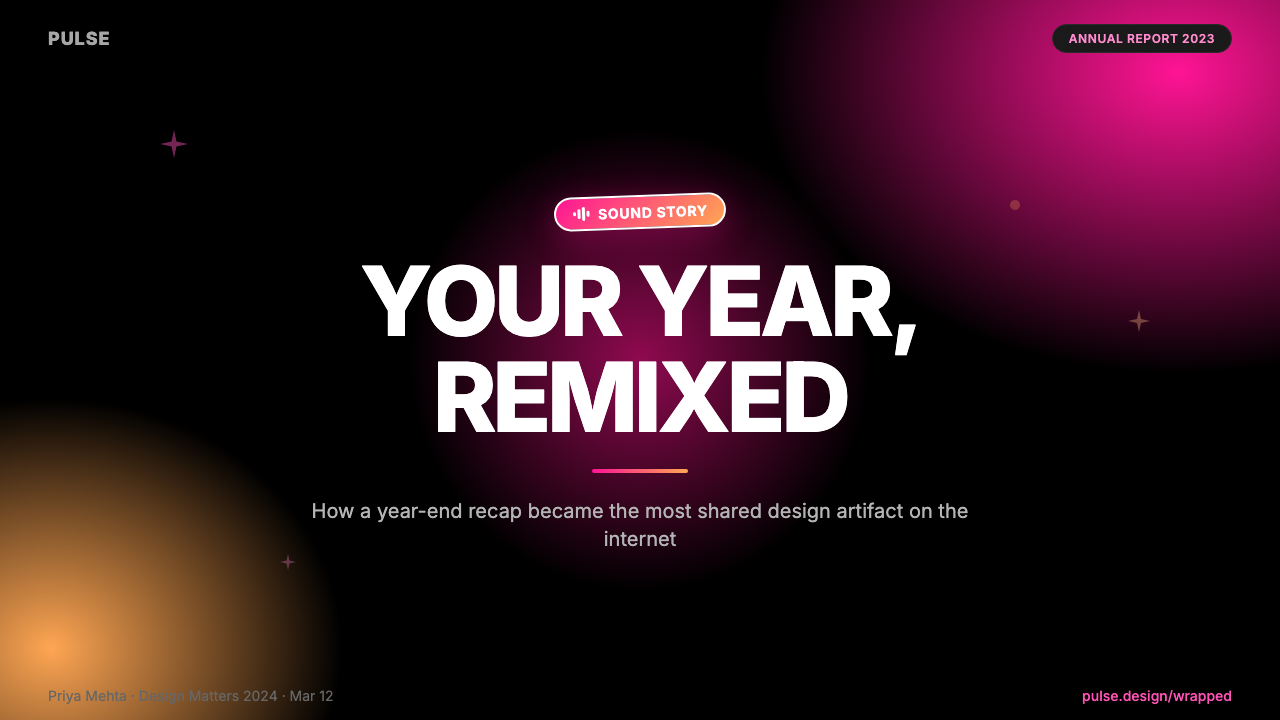
For presentation slides, the style works best when used for a single dramatic reveal moment rather than sustained throughout an entire deck. A Wrapped-derived cover slide pairs a full-bleed warm gradient with one dominant number or short phrase at oversized scale; the sticker illustration element can be replaced with a bold icon or logotype treated at similar scale. Content slides should pull back to a simpler palette — using one accent color from the gradient family against a near-white or black ground — to avoid gradient fatigue. Data slides within this system work well when key numbers are set very large and explanatory text is kept to a minimum.
For web interfaces, the aesthetic is best suited to celebratory or milestone-focused contexts: onboarding completion screens, achievement unlocked states, annual report microsites, or campaign landing pages. Sustained use across a full dashboard or navigation system tends to exhaust users — the intensity that makes a single card memorable becomes oppressive when it appears on every screen. A practical approach is to use the full gradient and typographic scale for hero states and key moments, then transition to a restrained version — a single tonal color, standard type sizes — for surrounding content.
For editorial and marketing contexts, the style has strong applications in social-first content where the final destination is a story or feed post rather than a long-form page. Sponsored content, event announcements, and campaign summary graphics all benefit from the bold compositional logic: one dominant visual element (a number, a name, a short phrase), a saturated background that establishes energy, and minimal supporting text. The sticker character approach translates naturally to mascot-forward brand identities or campaign-specific character assets. Print applications are possible but require care — the gradient intensity that reads as vibrant on a backlit screen can appear overwhelming in print without adjustment.
A common mistake when applying this style is using the gradient as decoration rather than as atmosphere. In the Wrapped system, the gradient is the entire ground — it is not applied on top of white space or used as a banner element within a larger layout. A gradient used as a partial element or a card accent tends to look like a Wrapped reference rather than a coherent application of the aesthetic. Either commit fully — full-bleed, full-saturation — or step back to a solid color derived from the same warm family. The other common error is overloading the card with information; the Wrapped format is built around one primary message per card, and adding a second or third message of equal scale undermines the system's entire visual logic.
Spotify Wrapped 2023 — FAQ
Is the Wrapped gradient a fixed set of colors, or does it vary year to year?
The palette evolves each year as part of Spotify's creative refresh, but certain qualities remain consistent: the gradients are warm-toned, running from pink or magenta toward orange or coral, and they are always pushed to a high saturation level that reads as vivid rather than pastel. The 2023 edition is particularly associated with a pink-to-orange arc that veers more toward coral warmth than earlier editions, which leaned more toward magenta and purple. Adapting the aesthetic to your own work does not require replicating the exact tones — the principle is warmth, intensity, and a gradient that spans enough of the spectrum to feel energetic.
How does Wrapped differ from other social-media data visualization aesthetics, like Apple Music Replay?
Apple Music Replay and similar data-storytelling campaigns tend toward a restrained, premium aesthetic — dark backgrounds, controlled typography, a sense of quiet exclusivity. Wrapped takes the opposite stance: it maximizes warmth, saturation, and visual noise in deliberate contrast to the understated norm. The sticker illustrations, the oversized numerals, the full-bleed gradients are all legible signs of a design that wants to be shared, celebrated, and recognized across a noisy social feed. Where Replay feels like a private acknowledgment, Wrapped is designed to function as public celebration.
Can this aesthetic work for a non-music brand, or is it too closely associated with Spotify?
The Wrapped aesthetic is currently strongly associated with Spotify — using its exact gradient palette and typographic style in a new context will likely read as a Wrapped reference rather than an independent design system. The more productive approach is to extract the underlying principles — emotional warmth through saturated gradients, the primacy of a single large data point, the sticker illustration sensibility — and reinterpret them with your own color palette and illustration language. The core idea of treating data as celebration rather than as information is fully transferable. The specific visual execution is not, at least until the association with Spotify fades.
Does the Wrapped style work in dark mode and light mode equally well?
The Wrapped system is essentially gradient-mode — neither conventionally dark nor light, because the gradient background eliminates the neutral-ground question entirely. This makes it unusual among design systems in that there is no simple dark-mode or light-mode variant to manage; the gradient is the mode. When adapting the aesthetic to interfaces that need to toggle between dark and light states, the practical approach is to treat the gradient as a reserved state (used for hero moments, celebration screens) and use a dark or light solid background for the surrounding interface. The gradient can shift slightly — warmer and lighter for a light context, deeper and more vivid for a dark context — but maintaining saturation in both directions is essential.
What are the biggest risks of applying this style badly?
The two most common failure modes are inconsistency and overextension. Inconsistency happens when elements from the Wrapped vocabulary — the gradient, the oversized type, the sticker illustrations — are used in isolation without the structural commitment that makes them coherent: a card with a warm gradient but small, conservative typography looks like an accident rather than a design choice. Overextension happens when the style is applied to contexts that require sustained reading or complex navigation — a dense documentation site, a multi-step form, a data table — where the visual intensity works against comprehension. The Wrapped aesthetic is calibrated for a specific emotional beat: a single moment of recognition. Outside of that beat, it tends to exhaust rather than energize.
Related design styles
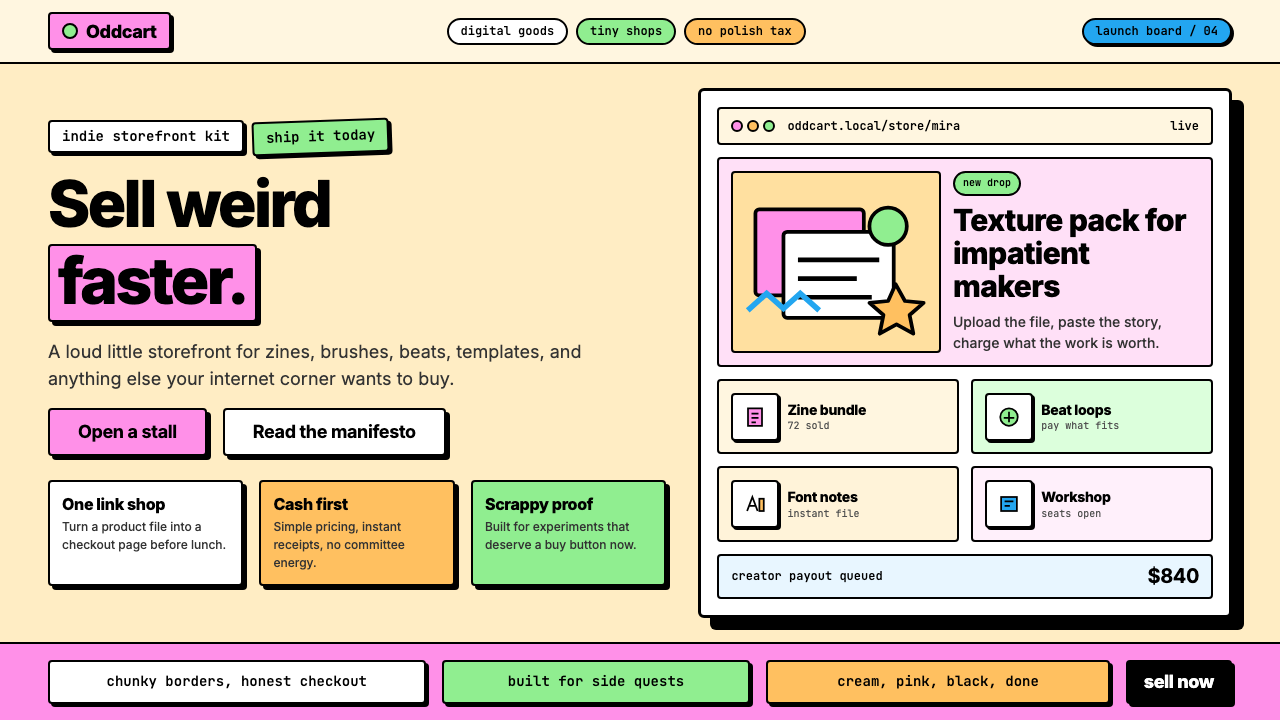 Gumroad CreatorGeoCities by way of Memphis. Hot pink, chunky black borders, hard offset shad…
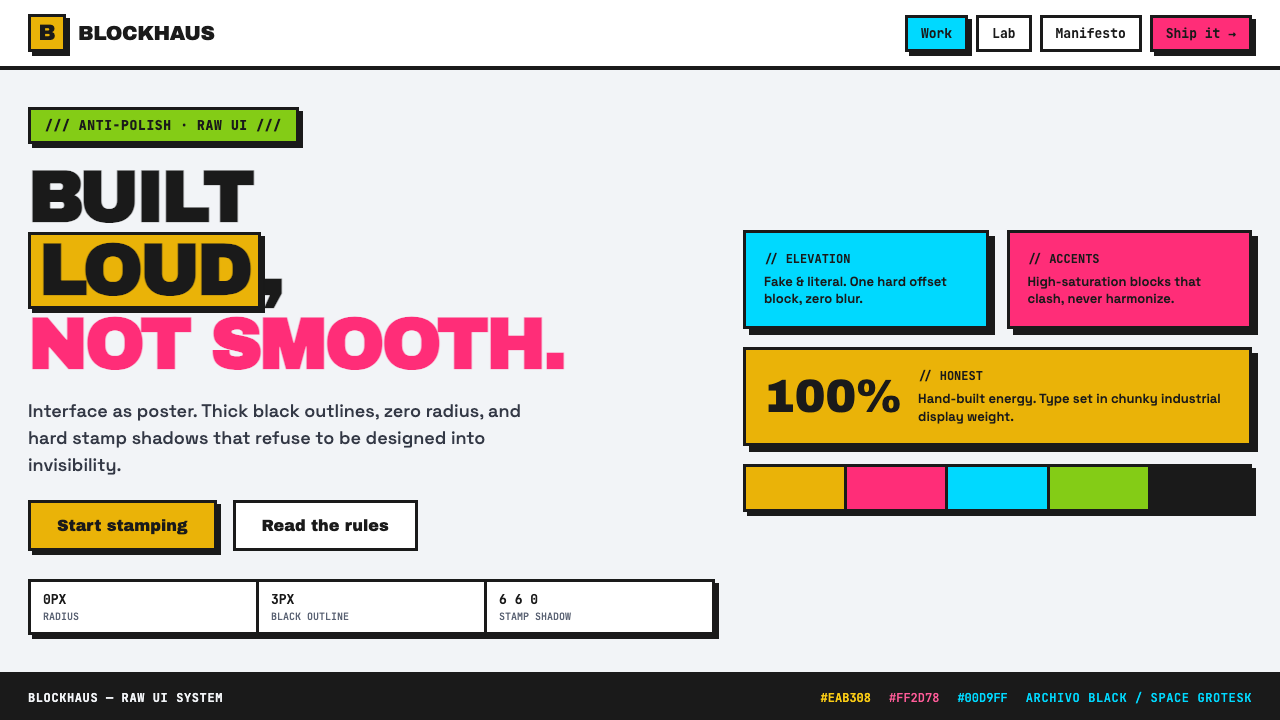 Neubrutalist Web DesignAnti-polish, on purpose. Black outlines, zero radius, hard stamp shadows, cla…
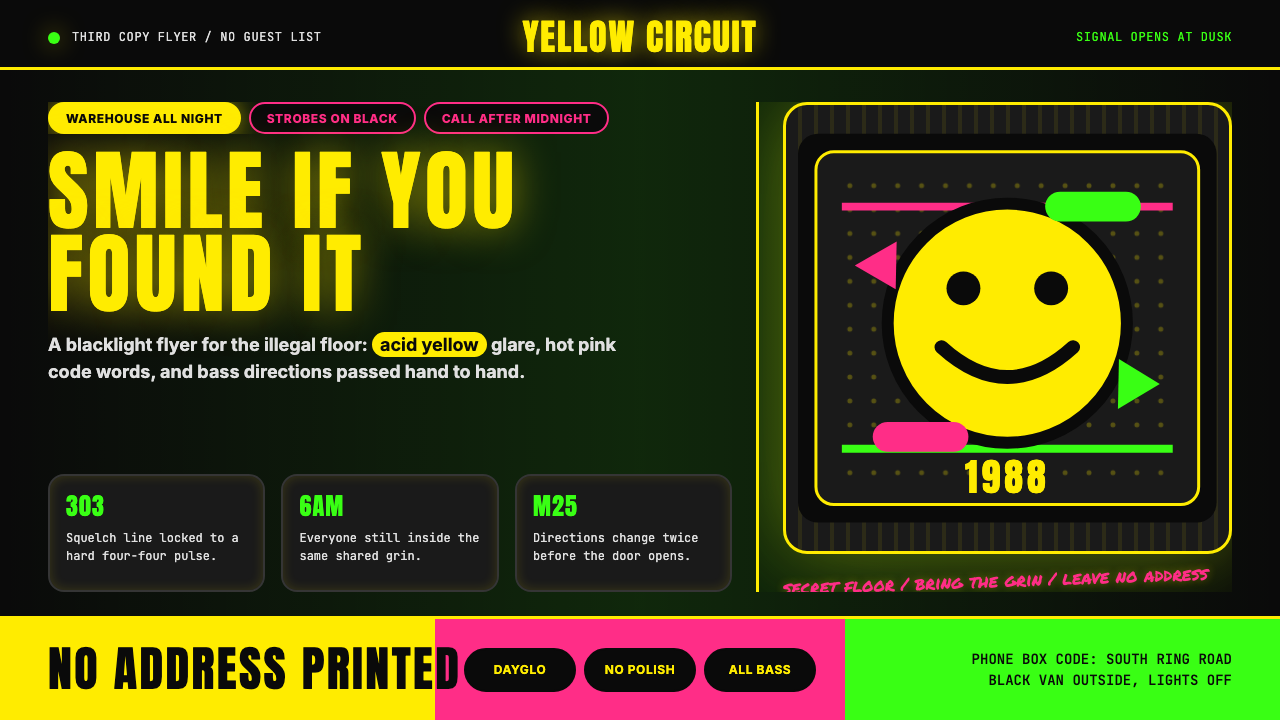 Acid House Smiley (1988)Rave energy hits first. Acid yellow on black, Anton caps, smiley glow.
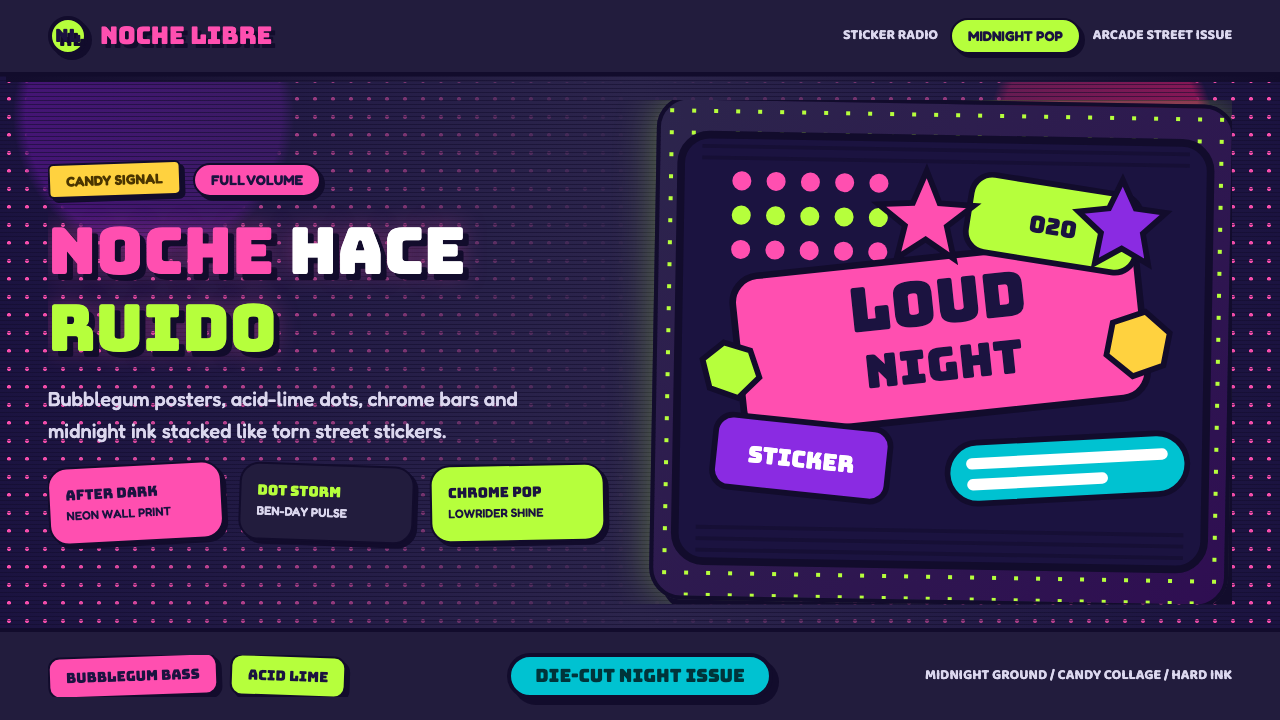 Bad Bunny YHLQMDLGMaximal night-pop collides. Bubblegum pink and acid lime stickers glow on mid…
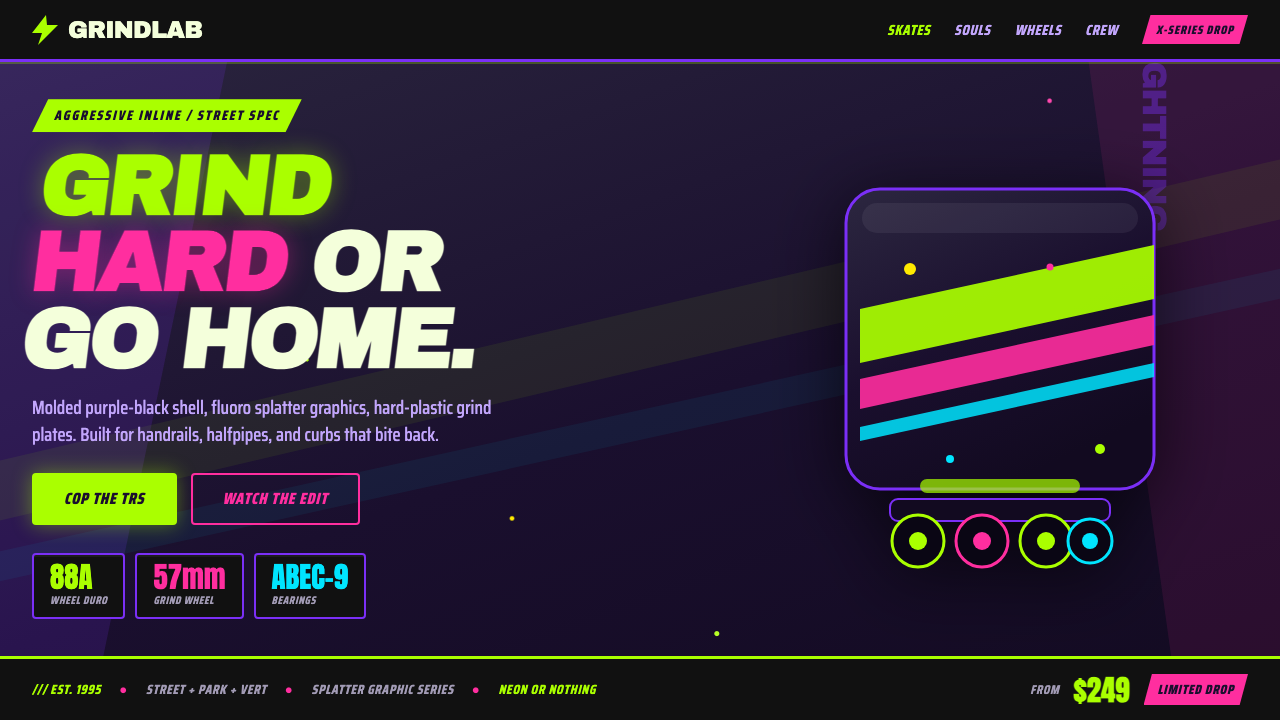 90s Aggressive Inline SkateX-Games attitude in plastic and paint. Fluoro lime and magenta slash across m…
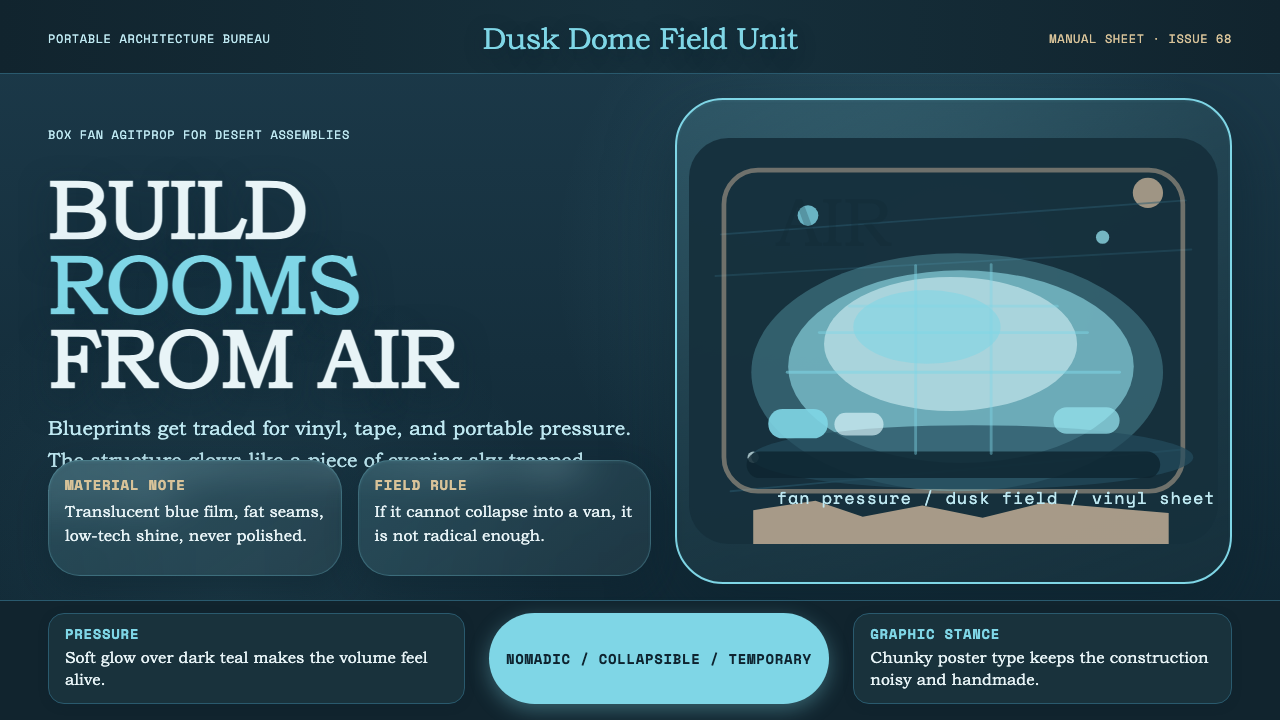 Ant Farm InflatablesTemporary architecture glows. Vinyl-blue domes swell over dark desert teal.