What is Sky App Private Cloud (2024)?
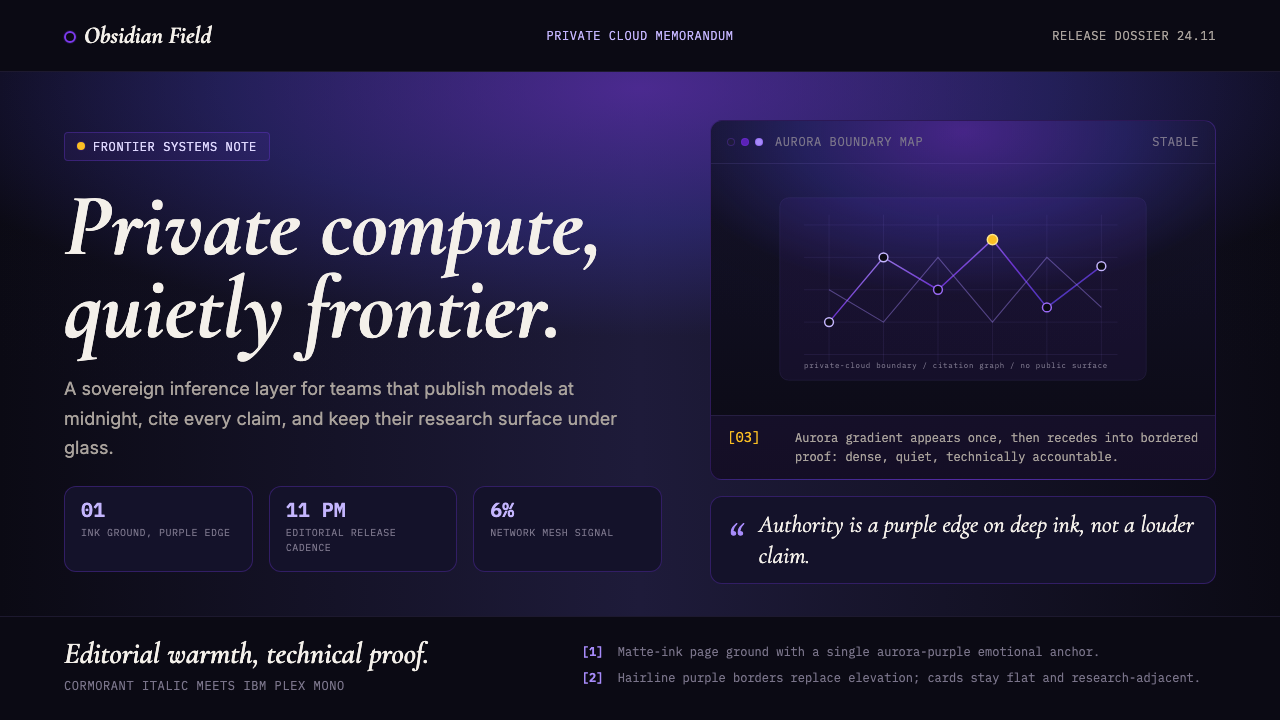
Sky App Private Cloud is the design language that frontier AI labs converged on in 2024 — deep matte-ink pages, a single aurora-purple gradient as the sole emotional moment, and editorial italic type paired with monospace technical authority.
Sky App Private Cloud (2024) in brief
Sky App Private Cloud (2024) is a contemporary design system that crystallized across frontier artificial intelligence laboratories during 2024, synthesizing the visual conventions that major AI labs — operating from San Francisco, Paris, Toronto, and London — had independently arrived at for their model-release landing pages, research communications, and developer documentation. It is the aesthetic of a midnight announcement: matte-black or near-black background, one dramatic gradient moment in aurora purple or indigo, dense typographic hierarchies, and a discipline that treats every visual decision as a form of intellectual credibility.
The system is organized around a fundamental tension that defines much of frontier-lab communication: the collision between humanist warmth and machine precision. On one side, editorial italic serif type — drawn from the tradition of literary magazines and academic journals — signals that the work being described has been considered by human minds and carries intellectual weight. On the other side, monospace technical type signals that the claims being made are grounded in verifiable, reproducible computation. Neither typeface alone would carry the system; together they create a voice that is simultaneously authoritative and approachable.
What distinguishes Sky App Private Cloud from generic dark-mode UI design is its restraint in the use of color and gradient. Where ordinary dark interfaces pile up gradients, glow effects, and particle animations, this system allows itself exactly one gradient — the aurora sweep across a hero section or a primary call-to-action — and holds the rest of the composition in strict achromatic discipline. That singular gradient becomes the system's emotional center of gravity, more powerful for its rarity.
Where does Sky App Private Cloud (2024) come from?
The origins of the Sky App Private Cloud aesthetic lie in a convergence that happened largely without coordination. Between 2022 and 2024, as large language model development accelerated and frontier AI labs began releasing products to the public, their design teams — working independently at organizations like Anthropic, Mistral, Cohere, and several others — arrived at strikingly similar visual conclusions. The shared substrate was a set of conditions: audiences of technically sophisticated developers and researchers, a need to signal both intellectual seriousness and approachability, and the constraint that a design language had to work under the scrutiny of communities that distrust visual excess.
The deep-ink background emerged as a practical and symbolic choice. Practically, dark backgrounds reduce eye strain during long reading sessions on backlit screens — a genuine consideration for developer documentation consumed at night or in code editors set to dark mode. Symbolically, darkness signals focus and concentration: it is the background of a terminal window, a research paper rendered in night-mode, a model training run visualized in a monitoring dashboard. The matte quality — avoiding reflective or glassy surfaces — further reinforced the sense of substance over spectacle.
The aurora-purple gradient had its own genealogy. Purple had long been associated with technical creativity and intellectual exploration — a thread running from early computing culture through to the distinctive brand palettes of developer tools. By 2024, purple-to-indigo gradients had become a shorthand for AI capability and frontier ambition, partly because they occupied a unique position in the visible spectrum: unlike red or blue, purple carries no strong pre-existing cultural association outside of technology, making it available as a fresh signal. The gradient form — rather than a flat color — was chosen because it implied movement, possibility, and the continuous improvement that defines a product in active development.
The typographic system reflected a deliberate attempt to solve a communication problem specific to frontier AI labs: how to speak to both engineers and executives in the same document. Italic serif type borrowed from the visual register of long-form editorial journalism — the kind associated with serious intellectual publications — to signal that the ideas presented deserved sustained attention. Monospace type, by contrast, borrowed from the culture of terminal interfaces and code editors, confirming that behind the editorial voice lay an infrastructure of verifiable technical fact. Key figures in this visual consolidation included Aaron Levy and Will McAuliffe from Anthropic's design team, Mike Abbink who brought editorial typographic sensibility to technical communication, and Adam Wathan whose work in the post-Vercel marketing-engineering tradition helped normalize the dark-mode premium aesthetic across the developer community more broadly.
What defines the Sky App Private Cloud (2024) look?
Matte-Ink Background
The defining ground of the system is a very deep, non-reflective background — neither pure black nor a named neutral, but a dark tone with enough warmth or coolness to absorb the gradient that rests on top of it. The matte quality is essential: any shine, gloss, or reflective surface effect would shift the register from focused to flashy, undermining the intellectual seriousness the system projects. This background is not the absence of design; it is a deliberate choice that makes every subsequent element — type, gradient, structural lines — read with exceptional clarity against the dark field.
Singular Aurora Gradient
The aurora-purple-to-indigo gradient is the system's only concession to spectacle, and its singular use is what gives it power. Applied once — typically across a hero section, a primary headline, or a central call-to-action element — it functions as the emotional apex of the entire composition. Every other element in the layout holds to achromatic or near-achromatic values, which means the gradient reads as a genuine moment of revelation rather than ambient decoration. The transition from one cool, deep hue to another carries connotations of depth, intelligence, and the invisible computational processes that underpin frontier AI systems.
Editorial Italic Serif
Italic serif type, drawn from the tradition of literary and academic publishing, serves as the humanist voice of the system. It appears on headlines, pull quotes, and primary statements of value — the sentences that synthesize what a model or product can do at the highest level of abstraction. The italic angle implies movement and considered thought, while the serif construction implies historical depth and permanence. Against the dark background, italic serif type in a warm, near-white tone creates a contrast that feels like a handwritten annotation on a dark notebook page: intimate, considered, and slightly urgent.
Monospace Technical Authority
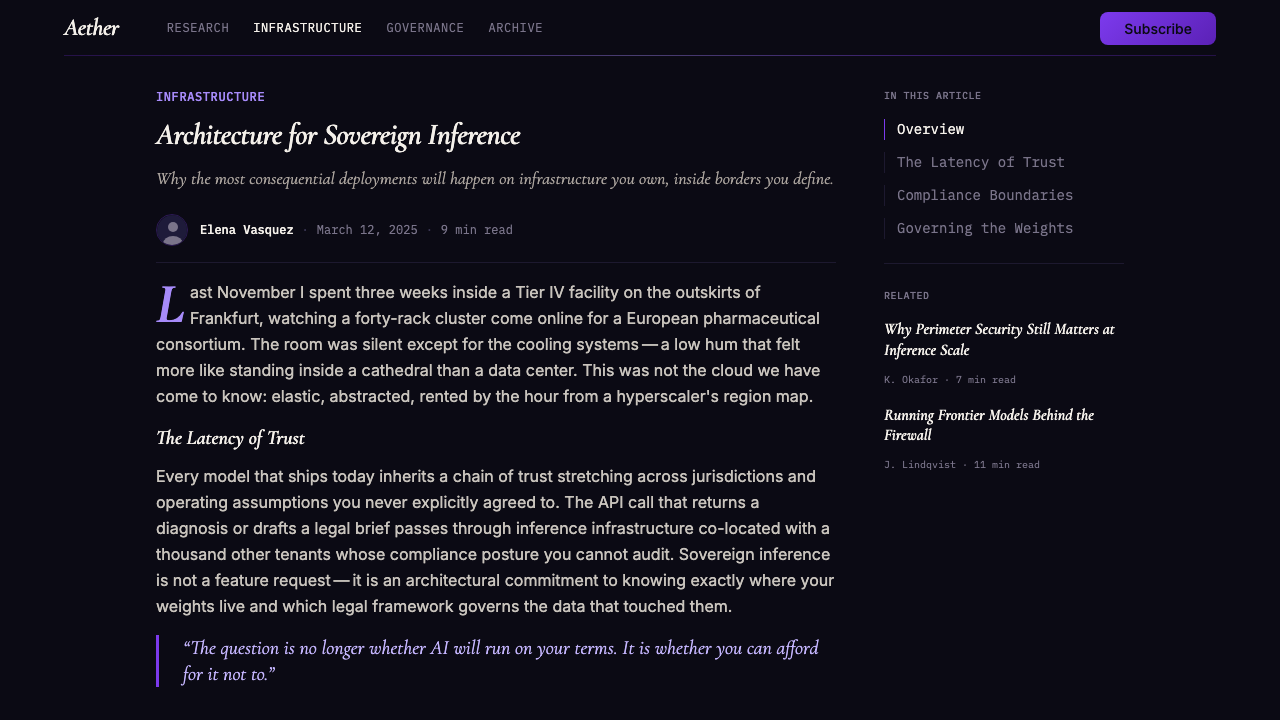
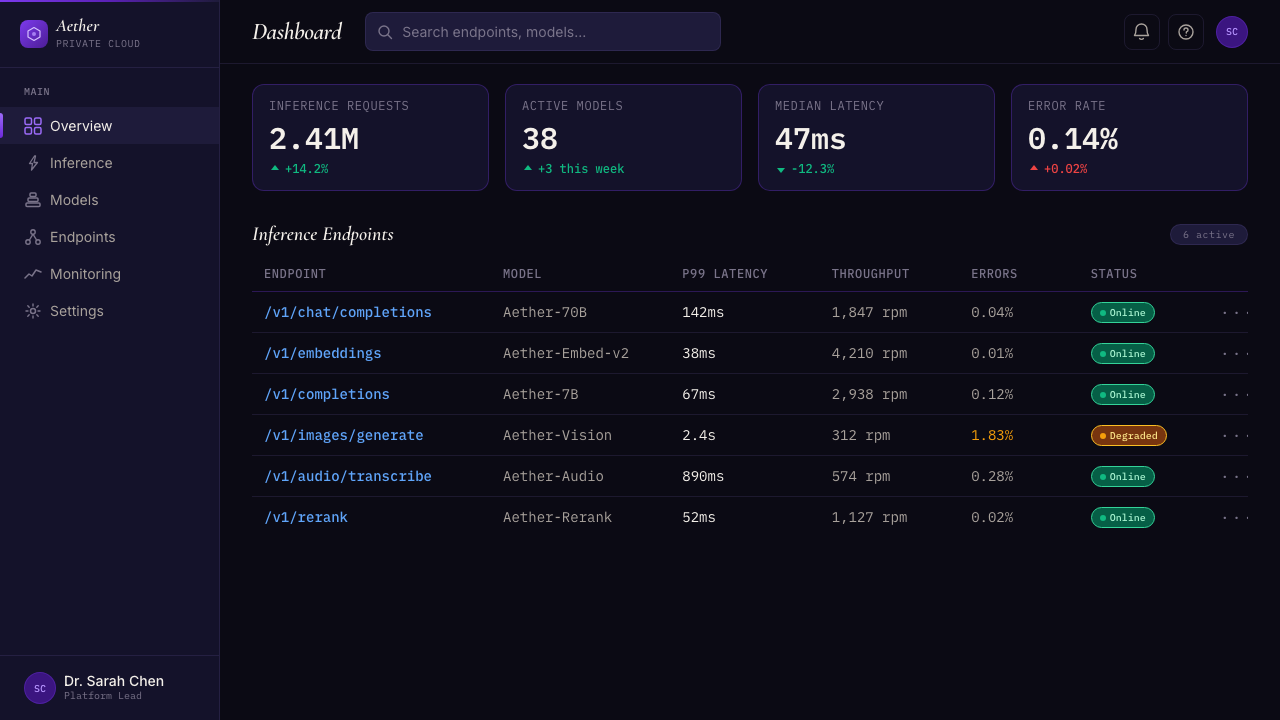
Monospace type — the letterform of code editors and terminals — appears alongside the editorial italic to anchor claims in technical reality. It is used for code samples, model names, benchmark citations, API references, and any content that the reader should understand as precisely rendered rather than paraphrased. The monospace register signals that the numbers cited are exact, the interfaces described are real, and the product can withstand the scrutiny of a technically sophisticated audience. In the overall typographic hierarchy, monospace body text and labels occupy the middle stratum — denser and cooler than the italic headlines above them, more detailed and specific than the structural navigation around them.
Achromatic Structural Discipline
Outside of the singular gradient, the system operates in a strict achromatic register: the background, body type, dividers, secondary labels, and interface chrome are all drawn from a range of near-whites, warm grays, and cool grays set against the deep ink ground. This discipline is not minimalism for its own sake but a structural decision that ensures the gradient retains its visual weight. Any additional accent color — even a subtle one — would compete with the aurora moment and dilute the system's most powerful communication device. The achromatic field also creates the conditions for high-density information display: benchmark tables, technical comparisons, and capability charts can be presented without any element dominating another.
Citation-Dense Information Architecture
Sky App Private Cloud layouts carry a characteristic informational weight: they are dense with citations, footnotes, benchmark references, and technical annotations in a way that signals the claims on the page are substantiated. This is not clutter — the grid and typographic hierarchy organize the density into clearly differentiated strata — but it is a deliberate counter to the convention of sparse landing pages. The implicit argument is that a product confident in its capabilities does not need to hide behind empty space; it can afford to show its working. Headers introduce sections, pull statistics stand as large typographic objects, and fine technical detail occupies a clearly subordinate but always-present layer below.
Structural Edge, No Glow
One of the defining refusals of the system is the suppression of glow effects and diffuse light halos — visual devices common in entertainment-oriented dark interfaces. Where borders appear — around code blocks, data cards, or modal containers — they are rendered as precise, low-contrast lines rather than glowing outlines. Where depth is indicated, it is through stacking and z-order rather than ambient illumination. This decision preserves the seriousness of the visual register: glow implies magic and spectacle; a clean edge implies precision and confidence. The system communicates that it does not need theatrical lighting to make its case.
Who shaped Sky App Private Cloud (2024)?
Aaron Levy was part of the Anthropic design team during the period when the Sky App Private Cloud aesthetic consolidated. Working on product and brand communication for one of the most closely watched AI laboratories, Levy and his collaborators faced the specific challenge of building a visual language that could carry both the philosophical weight of Anthropic's safety-focused mission and the technical credibility required to be taken seriously by a developer audience. The design choices made during this period — the deep-ink backgrounds, the editorial typographic pairing, the disciplined single-gradient system — reflected those dual demands.
Will McAuliffe contributed to the visual identity work at Anthropic during the same formative period, helping to articulate the principles that would come to define frontier-lab aesthetics more broadly. His work helped establish the expectation that a serious AI product's visual language should be as rigorous and considered as its technical outputs — that the design of a model-release announcement or a safety paper's landing page is a form of intellectual communication, not merely marketing presentation.
Mike Abbink brought a background in editorial typography and type design to the frontier-AI design conversation. The distinctive use of italic serif type — drawing on the long tradition of print publishing's authority register — as a counterpoint to technical monospace owes much to typographers like Abbink who understood how letterform choices carry cultural associations and what it means to deploy editorial type in a digital-native context. His work represents the broader influence of print-journalism typographic thinking on a generation of digital product designers.
Adam Wathan, founder of Tailwind CSS and the design-engineering firm behind it, played a central role in normalizing the premium dark-mode marketing aesthetic across the developer community. Through Tailwind's own marketing site — and through the influence of Tailwind UI's component library — Wathan's post-Vercel marketing-engineering approach demonstrated that technical products could be simultaneously beautiful and credible. His work established many of the conventions that the Sky App Private Cloud system later refined: the full-bleed dark hero, the high-contrast typographic hierarchy, and the idea that a developer tool's marketing site could be a piece of craft design.
The Paris-based Mistral AI team contributed a distinct European inflection to what was emerging as a shared frontier-lab aesthetic. Operating in a design culture with deeper roots in editorial and luxury publishing, Mistral's visual choices helped confirm that the deep-ink, editorial-italic, aurora-gradient system was not merely a Silicon Valley convention but a genuinely cross-regional convergence. The fact that similar visual decisions emerged independently in San Francisco, Paris, Toronto, and London validated the aesthetic as a response to shared communication conditions rather than imitation of a single originator.
How do you use Sky App Private Cloud (2024) today?
Sky App Private Cloud is most naturally suited to contexts where technical authority and intellectual credibility are primary communication goals: model-release announcements, research-paper landing pages, developer documentation hubs, API marketing sites, and any product positioning itself at the frontier of a technical category. The system performs well when the audience brings skepticism and will reward — rather than resent — visual density. It is not a warm or inviting aesthetic; it is an impressive and rigorous one, and the distinction matters for product fit.
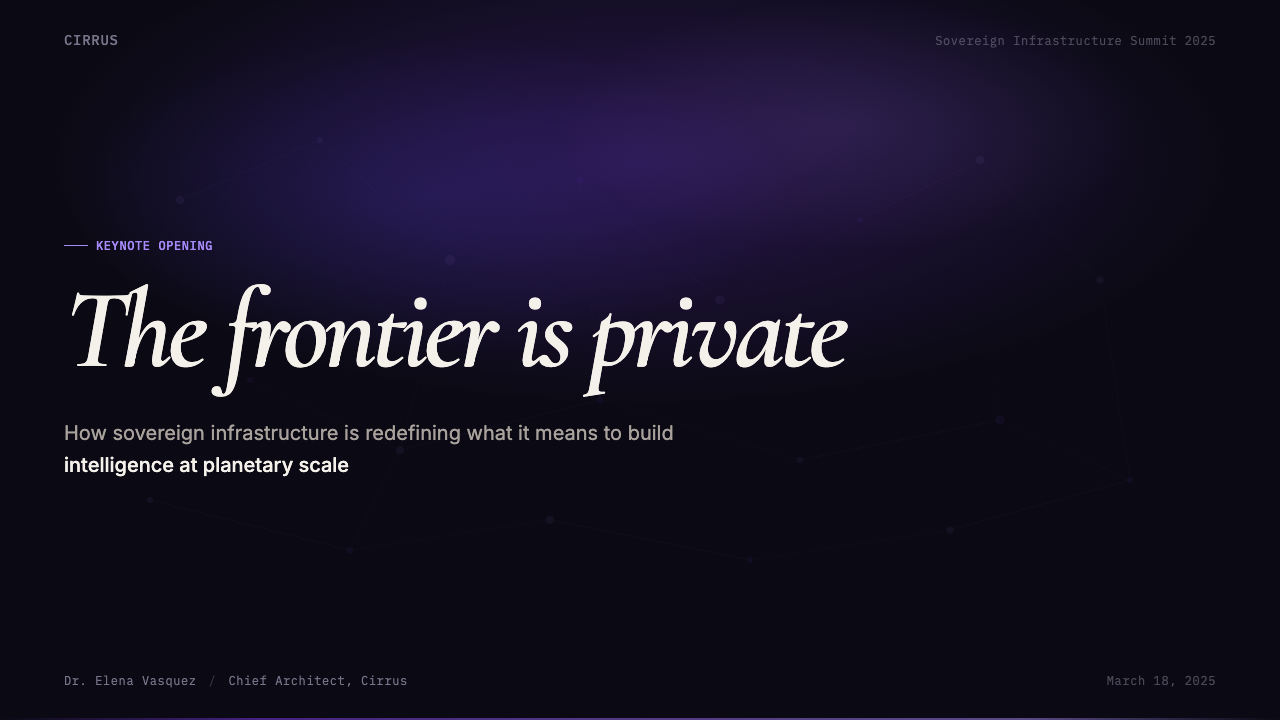
For presentation slides, the system translates well when applied with discipline. Cover slides benefit from the full-bleed dark background with the aurora gradient placed as the sole hero element behind a bold typographic statement — one short sentence in editorial italic, a supporting detail line in monospace. Avoid filling the cover with multiple graphic elements; the system's power comes from restraint. Content slides should use a strict grid with generous margins, present data in tables rather than decorated charts, and reserve the gradient exclusively for slides marking major transitions or conclusions. A common error is applying the aurora gradient as a background texture on multiple slides — this immediately collapses the singular emotional weight that makes the gradient effective.
For web interfaces, the system is best applied to documentation portals, pricing pages with technical tiers, and dashboard landing pages where density and credibility matter more than conversion-optimized friendliness. The approach: set the darkest background tone for the full page, introduce structure through subtle variations in surface depth rather than heavy borders, use the gradient only in the primary hero area, and allow white-text body copy at appropriate scale to carry the information load. Navigation should be typographic, with no icon decoration beyond functional indicators. Data-heavy sections — benchmark tables, capability comparisons — should be presented in monospace or structured tabular form, with column headers in a clearly subordinate type size.
For editorial and marketing work — pitch decks, research reports, investor presentations, or long-form product announcements — the system provides a strong structural vocabulary. Section breaks can be marked with a fine horizontal rule and a large numeral or section label in the editorial italic. Pull quotes or key statistics should be set at dramatically larger scale than surrounding body text, using the editorial italic to create typographic anchors that guide a reader through a long document. Marketing pages work well with alternating full-width sections: a dark section carrying the primary value proposition, followed by a lighter section at the near-white end of the gray range for detailed specifications or social proof.
A persistent mistake when applying Sky App Private Cloud is treating the aurora gradient as a repeatable element — using it on buttons, card borders, section backgrounds, and decorative dividers simultaneously. This flattens what should be a singular moment of visual intensity into ambient wallpaper. The gradient must be earned: every other element in the layout should hold in achromatic discipline so that when the aurora appears, it commands full attention. A second common error is using the editorial italic for body text rather than for headlines and high-level statements — the italic weight and angle that makes it powerful at display scale becomes tiring and illegible at reading scale.
Sky App Private Cloud (2024) — FAQ
Is Sky App Private Cloud only suited to AI products?
Not exclusively, though that is its strongest natural context. The system's core values — technical credibility, intellectual seriousness, information density — translate well to any technical product where the audience is sophisticated and skeptical: developer tools, infrastructure platforms, security products, research publication sites, and high-stakes B2B software. It performs less well for consumer products where the audience is non-technical, for products in categories where warmth and approachability are primary values, and for brands that need to communicate joy, playfulness, or sensory richness. The key question is whether the product's values align with the aesthetic's register: if the product is trying to impress a critical, technically literate audience, Sky App Private Cloud is a strong choice; if it is trying to delight a broad consumer audience, it will likely feel alienating.
How does this system differ from generic dark mode design?
Generic dark mode design uses a dark background primarily to reduce eye strain or to follow a platform convention, and typically adds color through multiple accent hues, gradient backgrounds, glow effects, and icon-heavy navigation. Sky App Private Cloud uses darkness as a deliberate communication choice — it signals focus and technical seriousness — and then imposes strict discipline on everything else. The singular gradient, the editorial-italic headline treatment, the suppression of glow and ambient light effects, and the citation-dense information architecture are all choices that go beyond 'dark mode' into something more specific. The simplest diagnostic: if a dark interface has multiple accent colors, glowing borders, or icon-driven navigation, it is generic dark mode. If it has one gradient and everything else is achromatic, it is something closer to this system.
Can this aesthetic work for a company that is not a frontier AI lab?
Yes, but the alignment between the aesthetic and the company's actual positioning needs to be genuine. The system signals a specific set of values — frontier ambition, technical depth, intellectual seriousness — and audiences will evaluate whether the product behind the design lives up to them. For a developer infrastructure company, a cybersecurity firm, or a research-adjacent B2B product, the system can be applied authentically and effectively. For a company that does not operate at the frontier of a technical category, or whose primary audience is not technically sophisticated, using the system can feel aspirational in a way that undermines trust: the design promises more than the product delivers. The most successful applications of this aesthetic are those where the visual seriousness matches the actual technical depth of the offering.
What is the right way to handle the aurora gradient across different screen sizes?
The aurora gradient should be treated as a full-width or full-bleed element at every screen size, never cropped or contained within a bordered card or module. On larger screens, the gradient hero section can be given significant vertical height, allowing the full sweep from purple to indigo to resolve at an unhurried pace. On smaller screens, that vertical height must be compressed, which means the gradient needs to be applied at a steeper angle or a shorter sweep to maintain the sense of a complete tonal journey within the constrained space. The critical thing to preserve at all sizes is the singularity: the gradient should appear once and once only, with the rest of the layout — regardless of screen size — holding in the achromatic register around it.
How should this system handle imagery and photography?
Photography and representational imagery sit uneasily in Sky App Private Cloud, for the same reason they sit uneasily in most high-discipline dark-mode systems: naturalistic imagery imports warmth, texture, and visual noise that competes with the achromatic rigor of the rest of the layout. Where imagery must appear — team photographs, product screenshots, data visualizations — it should be presented with a dark overlay or treatment that integrates it into the overall dark register, never as a full-color, full-contrast window into a different visual world. Diagram illustrations and abstract technical visualizations are far more compatible with the system than photography: they can be drawn from the same achromatic palette with the gradient used as a selective accent, maintaining visual coherence with the surrounding typographic layout.
Related design styles
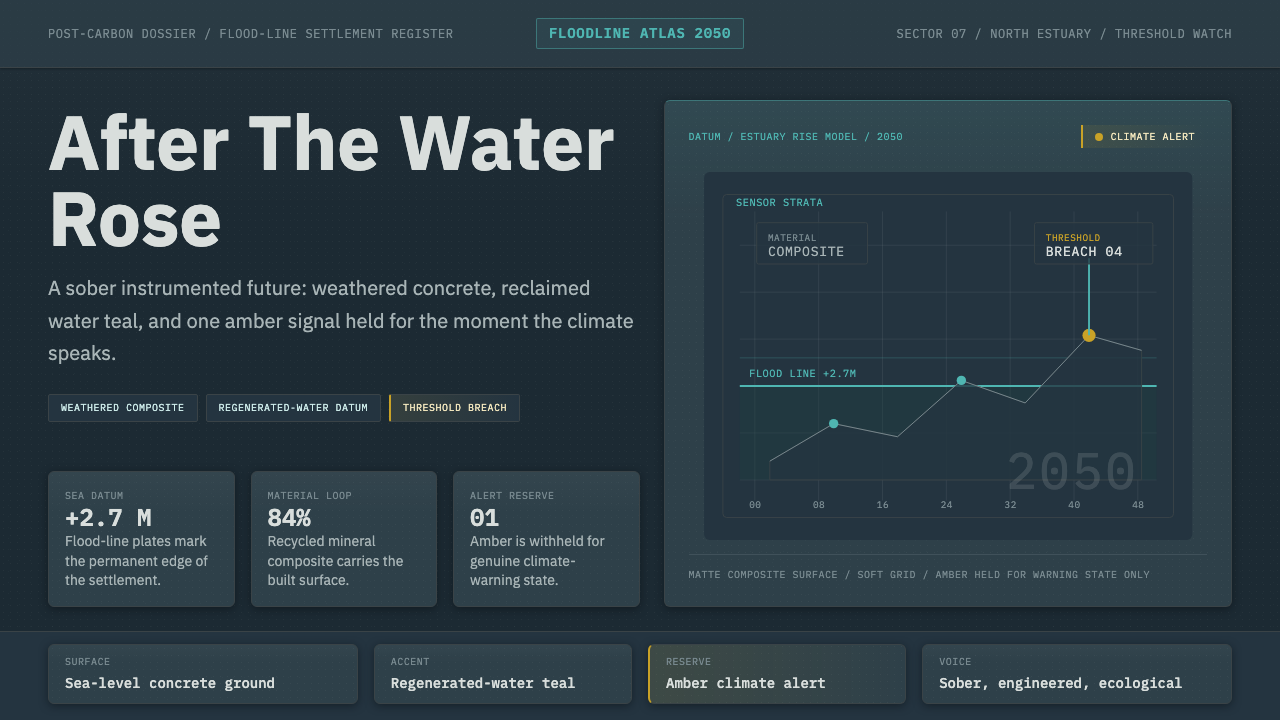 Cli-Fi 2050Pragmatic after the flood. Concrete blue-gray, muted teal, and one amber aler…
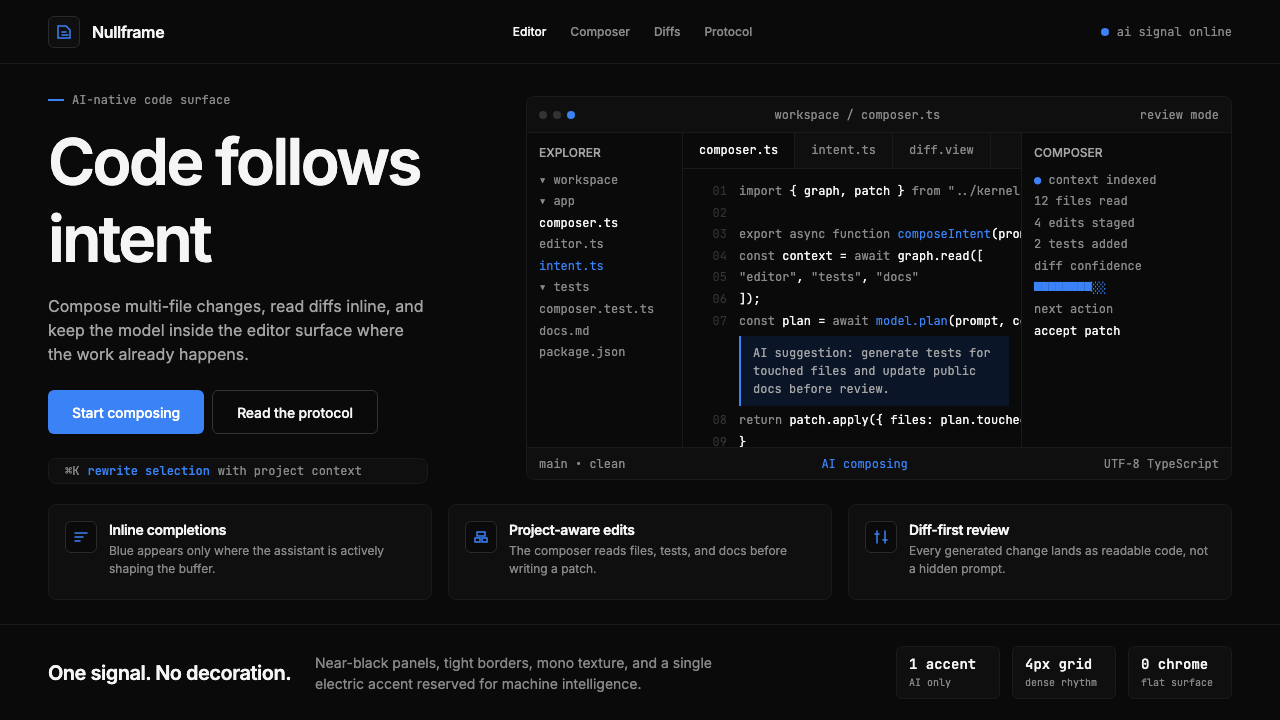 Cursor IDEAI-first code editor. Pure dark surfaces, off-white text, electric blue reser…
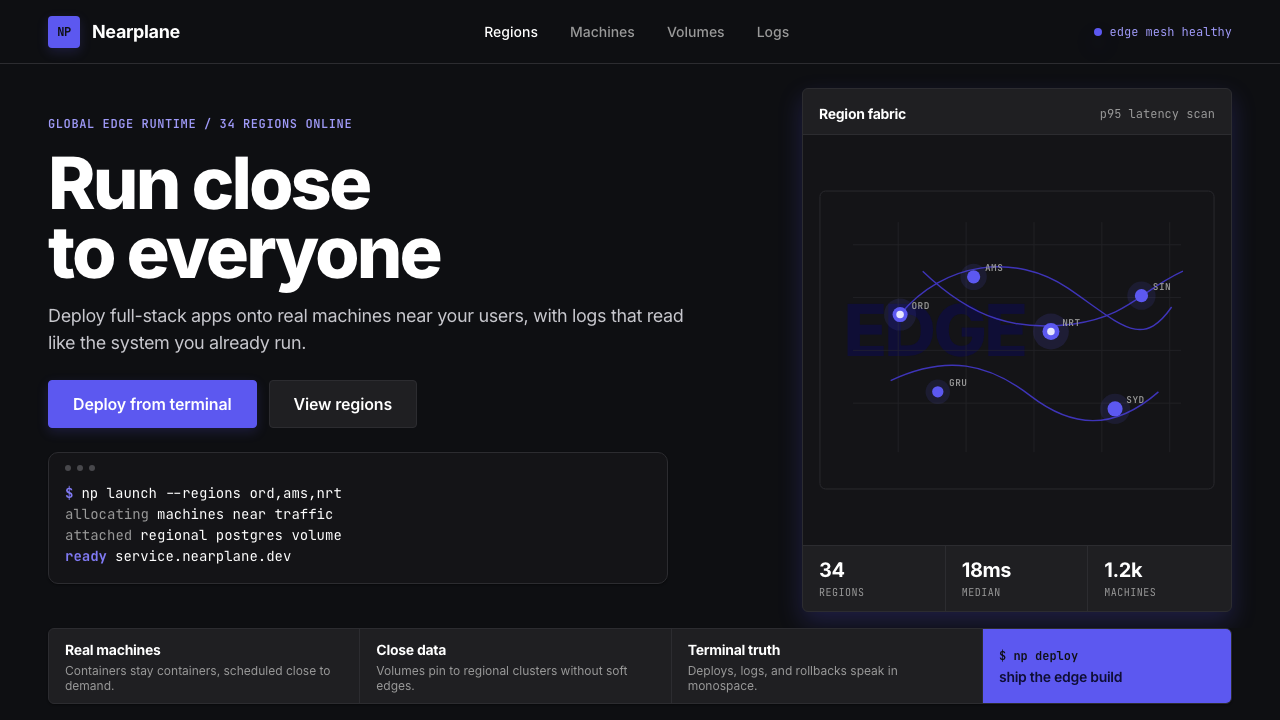 Fly.io Edge-Compute PurpleEdge-cloud with discipline. Electric purple nodes, Inter type, and terminal b…
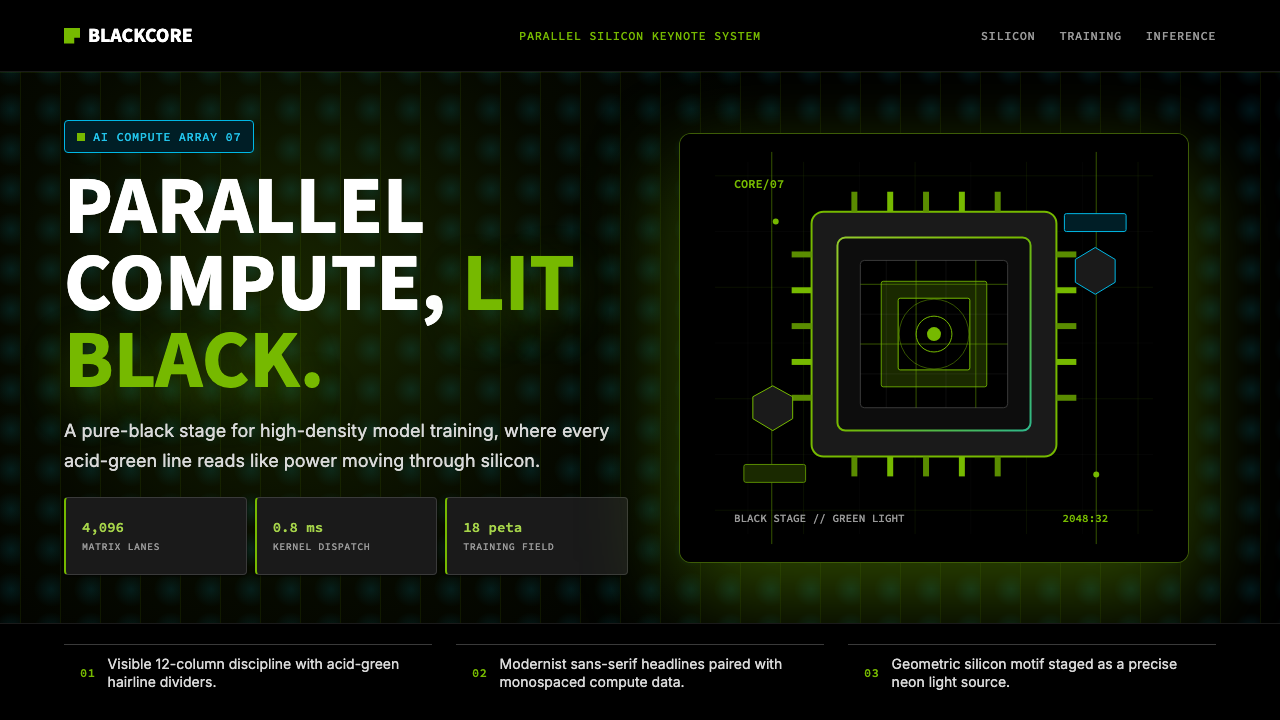 NVIDIA GPU Green-BlackPure black turns compute theatrical. Acid green hairlines and chip geometry s…
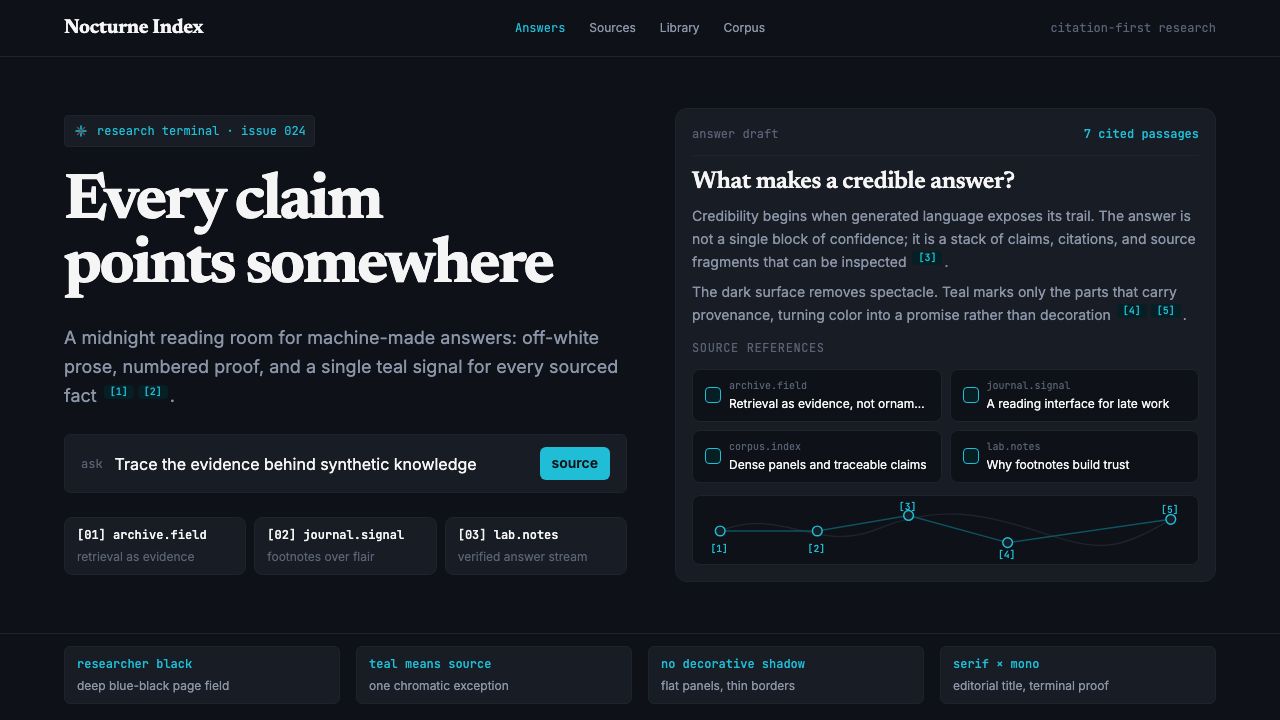 Perplexity AISerious search after midnight. Teal citations cut through black panels and de…
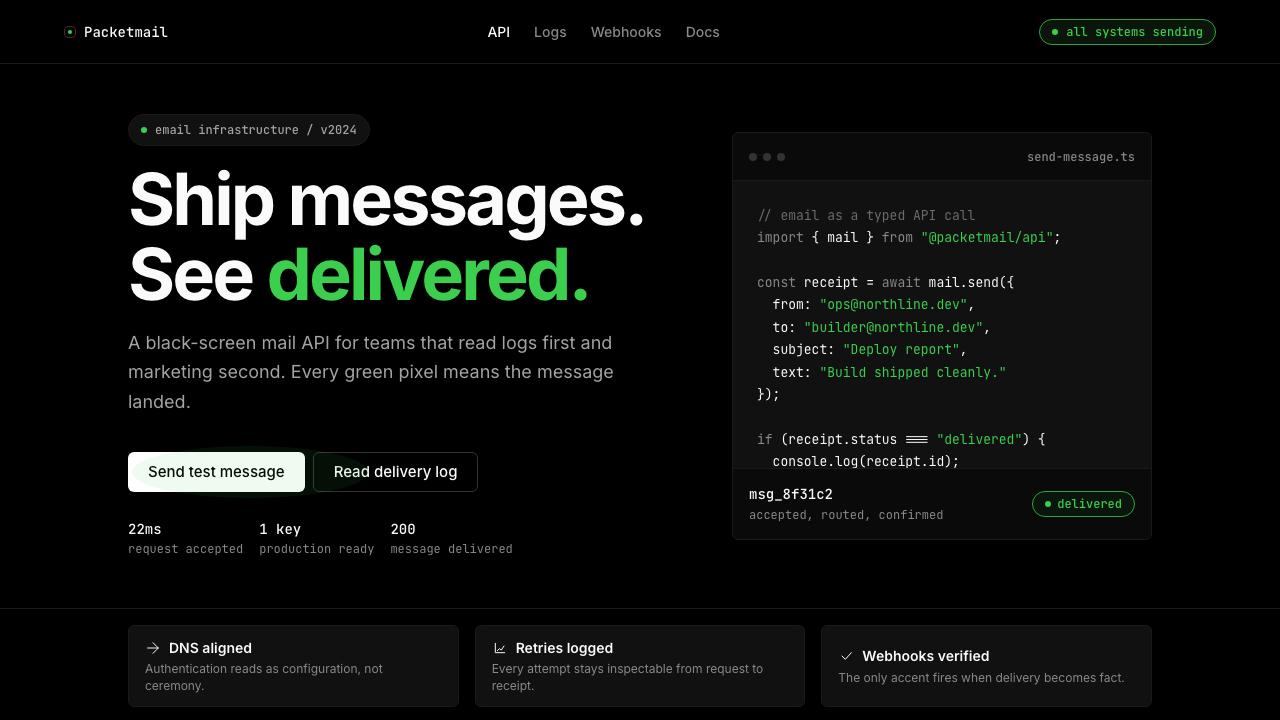 Resend 2024Clean code becomes brand. Pure black, JetBrains Mono, and one green delivered…